




Abstract
Pianists experience high rates of Playing-Related Musculoskeletal Disorders (PRMDs). Biomechanical factors have been investigated by both researchers and music teachers as potentially significant in PRMD development. Knowledge exchange between the fields of music and science about PRMDs may be beneficial, but differences in language use can make interdisciplinary communication challenging. One potential solution is to translate pedagogical ideas into language that is consistent with biomechanical science. Doing so could improve interdisciplinary communication and allow for scientific examination of pedagogical ideas. However, no methods for doing so have been published. To fill this gap, we developed a methodological framework with two stages for translating ideas about piano technique into scientific language: Stage 1 uses Qualitative Content Analysis to summarize pedagogical content; then, Stage 2 includes an “Analysis of Biomechanical Language,” in which researchers translate the ideas described in Stage 1. Both stages are collaborative and rely on expert consultation to produce an appropriate translation. This article outlines the framework and explains how it was used in an initial study on the Taubman Approach. Further methodological guidance to assist researchers in future studies is given based on some of the challenges encountered in the initial study. The framework and guidance here will allow researchers to carry out more studies of this kind. Because the framework is newly developed, it will likely need to be adapted further as more studies are done.
Keywords
Introduction
Over the past several decades, a large body of research has documented the problems of pain and injury in performing musicians. These injuries, sometimes called Playing-Related Musculoskeletal Disorders (PRMDs) (Zaza & Farewell, 1997), have been found to be relatively common among pianists (Wood, 2014). Still, data on risk factors is largely correlational, and a great deal remains unknown about their potential causes (Baadjou et al., 2016). Practitioners and researchers have increasingly focused on biomechanics and instrumental technique to better understand PRMD development, prevention, and treatment (Kaufman-Cohen & Ratzon, 2011; Winspur, 2003). Biomechanical studies have been conducted to examine how certain ways of playing might impact the musculoskeletal system (e.g., Oikawa et al., 2011). One benefit of these studies is that they can measure quantitative data for variables that are often difficult for the performer to perceive. However, a number of methodological constraints can limit the generalizability of their findings. For example, pianistic tasks in research studies are often limited (Arthur et al., 2013) and sample sizes are small (Blanco-Piñeiro et al., 2017). Further, studies are often observational, meaning that researchers cannot study the impact of particular ways of playing over long periods of time (Wu, 2007). Due to these methodological challenges, it is difficult to make technical recommendations for preventing PRMDs in pianists based solely on scientific evidence.
In addition to scientific research, music teachers may have a significant role in PRMD prevention (Guptill & Zaza, 2010; McKechnie & Jacobs, 2011). As the “first line of defense” (Dawson, 2015) against playing-related injuries, teachers can apply the practical recommendations given in the scientific literature. Where there are research gaps, teacher experience may also be an important contribution to injury prevention programs. Teachers are able to try different practical approaches with many students over longer periods of time (Lehmann et al., 2007). While they cannot easily measure and control variables, teachers with extensive practical experience may provide important insights that scientists would not otherwise encounter. That being said, different schools of piano technique sometimes give conflicting directions about the best approach (Wheatley-Brown et al., 2014). Some approaches may also be focused on achieving musical goals (e.g., expressivity), which do not necessarily require considering biomechanical efficiency or injury prevention. Due to the respective advantages and limitations that scientists and teachers have in approaching the problem of PRMD’s, it may be mutually benefical to increase knowledge exchange between them. For that reason, the need for more interdisciplinary discussion has been identified by medical professionals (Branfonbrener & Kjelland, 2002), researchers (Russell, 2006), and teachers (Palac, 2015).
One essential aspect of knowledge exchange between the fields of science (e.g., biomechanics, motor control, health, performance science, etc.) and piano pedagogy is appropriate use of language (Pecen et al., 2016). However, language differences between these fields can limit their ability to communicate effectively. Musicians have their own professional language, and music teachers often use subjective or metaphorical language to help students achieve a desired result (Milanovic, 2012; Woody, 2004). Such language can be practically useful when teaching, but is often biomechanically imprecise. Scientific language, on the other hand, is typically designed to give certain specific meanings to words (Reeves, 2005), and these may or may not correspond to those given by teachers. A study by Wheatley-Brown et al. (2014) that examined scientific language in several pedagogical approaches to piano technique suggests that the situation is even more complicated in several ways. They found that some teachers do use scientific language, but often inconsistently. Additionally, different teachers sometimes use the same scientific terms to represent different concepts, and some use terms in ways that are different from their scientific meaning. In short, it is very difficult to determine where teachers actually agree or disagree if they are using language in different ways. Another related problem is that teachers and scientists may have difficulty communicating with each other if they do not use a consistent set of terminology with shared meanings. There has been increased interest in scientifically evaluating pedagogical ideas in recent years (Comeau, 2009), but language problems can make this challenging. Scientists will struggle to test these ideas without first understanding what teachers’ language is meant to convey. If discrepancies are found between teachers’ statements and scientific findings, it will be impossible to know if these are real, substantive differences, or simply due to different use of language. One possible solution to these problems is to translate pedagogical ideas into language that is consistent with that of modern biomechanical science (Russell, 2019). This would include not only using appropriate scientific terms, but also doing so in a way that is clearly defined and consistent with their use in scientific fields. Such a translation could allow for knowledge exchange to occur more easily.
A Framework for Translating Pedagogical Language and Initial Study
Despite the potential usefulness of translating piano pedagogy into scientific language, it has not yet been attempted in the academic literature. Therefore, no specific methodology has been established for doing so. This article will outline a methodological framework that we developed for a study translating two concepts from the Taubman Approach (TA). The TA was developed by the American piano teacher, Dorothy Taubman (1917–2013), who was widely recognized for her work with injured pianists (Schweitzer, 2013). She rejected the widespread reliance on traditional authority in piano pedagogy, and instead believed scientific knowledge should inform teaching practice (Taubman, 1984). While Taubman received some criticism from both the musical and medical fields, many pianists have claimed to be cured of physical and technical problems after working with a Taubman teacher (Urvater, 1986). The anecdotal success and increased popularity of the TA over recent years (The Golandsky Institute, 2011) suggest that a better understanding of its conceptual basis and practical recommendations could contribute to broader discussions on PRMD prevention. It may also help to improve communication between teachers and practitioners. However, the TA has been rarely mentioned in the scientific literature (e.g., Pereira et al., 1997), which may be in part due to her use of language. In addition to some of the more common problems with pedagogical language identified above (Wheatley-Brown et al., 2014), a great deal of time has passed since Taubman began formulating her approach, and she relied on certain scientific sources that are now outdated (e.g., Ortmann, 1929). This, combined with her practical experience teaching students, has produced a lexicon with varying degrees of correspondence to current scientific language. Therefore, it would be beneficial to translate Taubman’s ideas before they are evaluated or included in scientific discussions. Our study did so for two concepts identified in the TA as likely to lead to technical and physical problems: “curling” and “keybedding”.
Two research questions were investigated in our study: 1) What are the underlying biomechanical components of “curling” and “keybedding”? 2) How can these components be expressed in language that is consistent with modern biomechanical science? These questions were investigated using the following framework, which has two stages (Figure 1). The first uses Qualitative Content Analysis (QCA) (Schreier, 2012) to develop a descriptive summary of relevant pedagogical ideas (“Pedagogical Summary”); the second, the “Analysis of Biomechanical Language”, is an iterative process that allows researchers to translate pedagogical ideas in scientific language. We decided to make the two stages distinct in order to accurately summarize pedagogical ideas before translating them. The following sections will outline both stages of the framework and describe how it was applied in our study. Visual representation of the methodological framework presented here.
Stage 1: Pedagogical Summary using Qualitative Content Analysis (QCA)
The aim of Stage 1 is to create a descriptive summary of pedagogical ideas so they may be translated appropriately. Qualitative Content Analysis (QCA) is a systematic method for describing the meaning of qualitative material (Schreier, 2012). In QCA, researchers reduce content and analyze it in context in order to “identify themes and extract meaningful interpretations of the data” (Roller & Lavrakas, 2015). This is done by categorizing data for the purpose of summarizing and highlighting important content (Drisko & Maschi, 2015). While a number of different approaches to QCA exist, we adopted the one developed by Schreier (2012) because it has several characteristics. First, Schreier’s QCA is systematic, meaning that it includes a fixed set of steps. This process aims to emphasize reliability, which generally refers to the extent to which a coding frame “yields data that is free of error” (Schreier, 2012, p. 167). This is essential for our purposes because an appropriate translation cannot be done without first obtaining an accurate description of the original pedagogical material. Second, Schreier’s QCA is reductive, which allows researchers to extract relevant ideas from a large amount of data and organize them in a descriptive coding frame. Schreier (2012, p. 3) notes that it does not allow for describing the “full meaning” of the material; rather, it permits researchers to describe aspects of the material that they consider important. In our method, this means highlighting pedagogical ideas that are relevant to a particular aspect of piano technique being studied. Third, Schreier’s QCA is flexible, so it can be applied to a wide range of materials and disciplines, and it takes the context of language into account to better interpret its meaning. This means it will allow researchers to analyze pedagogical ideas that are presented in a number of modalities (e.g., verbal, written text, video, etc.) and settings (e.g., lecture, instructional book, academic writing, etc.). In sum, these characteristics make Schreier’s QCA suitable for the aims of our framework.
Diagram of a QCA coding frame. Each concept is divided into main categories, which are then divided into subcategories. During the pilot phase, excerpts are segmented into units of coding. Each unit is then coded into one of the subcategories. Miscellaneous categories are created at both the main category and subcategory levels.
Within each main category, subcategories were largely developed inductively, based on preliminary examination of the TA source materials. These data-driven subcategories were developed using the technique of “subsumption” (Schreier, 2012, p. 88). This was done by initially creating a subcategory based on a first excerpt; then, each following excerpt was either considered relevant to that first subcategory, or a new subcategory was developed. Miscellaneous categories were added at each level (main and sub) to include material that did not fit into the established categories. This process was continued until all relevant data had been categorized.
Once all categories and subcategories were created, a coding frame was then developed, in which the name of each subcategory was listed, followed by its description. Examples of which data should be included or excluded were provided, as well as “decision rules” (Schreier, 2012, p. 102) to help determine whether ambiguous data belonged in that subcategory (Figure 3). One subcategory from the coding frame on “curling”.
Example of a coded excerpt (Taubman, 1984, pp. 145-146) from the analysis on “curling”. Each highlighted section corresponds to a unit of coding.
Stage 2: Analysis of Biomechanical Language for Translation
After Stage 1 is complete, the aim of stage 2 is to present the underlying biomechanics of pedagogical ideas using language that is consistent with contemporary science. This process of translation can occur by viewing both pedagogical and scientific language as “functional tools” used in particular social contexts to achieve certain aims (Herdenstam et al., 2009; Tylén et al., 2010). Using this view, an essential part of translating pedagogical language must be determining how it is being used in a particular context to produce a certain result. If this is not done, then it is virtually impossible to determine what that language is meant to convey. For this reason, Stage 2 is an iterative process of consulting the QCA findings and scientific sources over an extended period of time. Doing so allows researchers to view a statement both in its own context and relative to the rest of the data gathered. A translation of a particular idea may be further informed and updated as more data is analyzed.
A functional view of language also suggests that the aim of translation should not be to produce an “objective” or “authoritative” expression of certain ideas about piano technique; rather, it should be to produce one that is useful for scientific study or discussion. This means that the language produced in Stage 2 should have certain characteristics. First, it should be biomechanically precise and use terminology with clear scientific definitions. Scientific language is not immune to the sort of problems attributed to pedagogical language, like imprecise terminology, disagreement about the meaning of terms, or a diverse set of terms used for the same concept (Reeves, 2005). Therefore, researchers should keep their potential audience in mind (researchers, clinicians, etc.) when choosing terminology for translation. They should also define terms explicitly when needed to limit possible confusion. The results of Stage 2 should also produce an explanation of pedagogical ideas that is scientifically coherent according to current knowledge at the time of study. That being said, the aim of this framework is to translate pedagogical ideas, not to scientifically evaluate them. Because there may not always be scientific consensus on a certain idea, researchers may choose a translation they deem to be biomechanically plausible, even if it has not yet been tested. Results of the translation may in fact lead to such studies being done.
When translating from one discipline to another, some information from the pedagogical approach will likely be “lost in translation”. This is endemic to the process of translating language given for one purpose (pedagogy) into that of another (scientific understanding). For instance, statements describing the pianist’s experience of playing may be reduced to some extent when they are translated into pure biomechanics. These more experiential aspects of pedagogical advice should not be ignored when translating; in fact, they may be very useful in informing researchers' understanding of what is meant to be occurring biomechanically. However, they will ultimately be left out of the resulting translation because they do not serve the purpose for which the translation is being carried out. Instead, researchers may note the experiential language used in the source materials and explain how it contributes to their interpretation of the biomechanics involved.
Example of a summary table included at the end of a main category. All subcategories were included in the same table, but only one subcategory is included here as an example.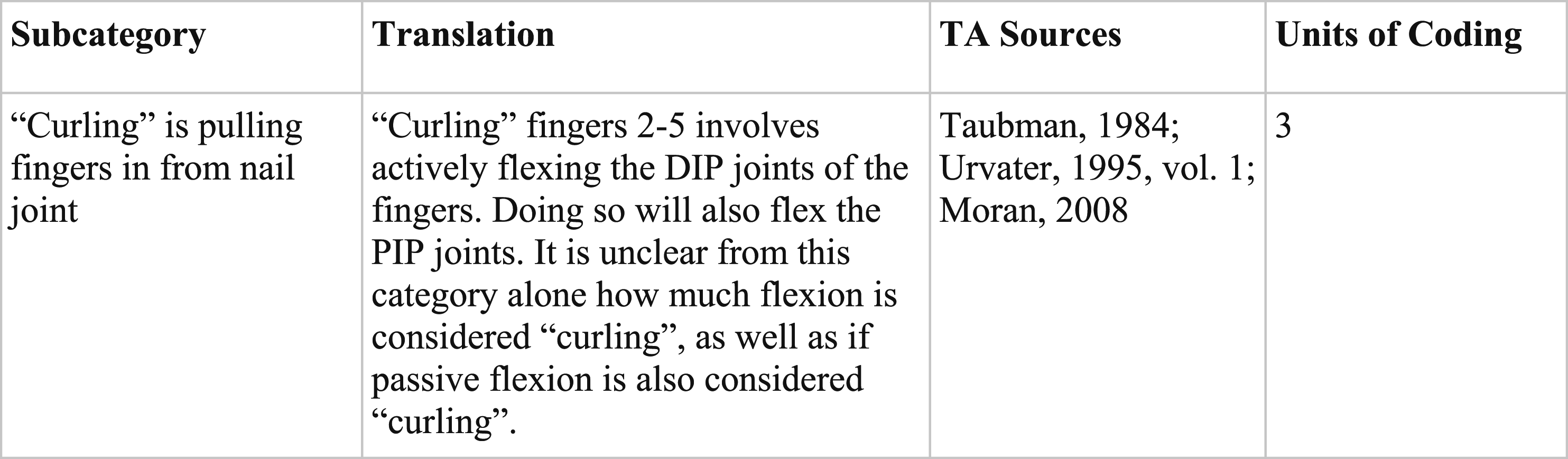
Methodologically Significant Findings and Guidance for Future Studies
The results of our initial study suggest that the framework outlined here can produce a successful translation of pedagogical ideas into scientific language. Because this framework is newly developed, it will likely need to be further developed as more studies are done. Several considerations emerged during the initial study that may be useful to future studies of this kind. Some of them will be discussed below as a reference for other researchers.
Other considerations that emerged in Stage 1 were relevant to the validity of the coding frames produced. As stated above, the main topics chosen for analysis were concept-driven, so it was important to ensure the coding frame captured them in a way that accurately represented their meaning in the TA (“content validity”) (Schreier, 2012). In our study, content validity was mainly assessed through expert consultation, which involved discussions between the main researcher and a certified Taubman teacher (Author Dvorkin). The coding frame for each concept was developed based on the pedagogical source data, meaning that it was important to consider how well the frames encapsulated that data (“face validity”) (Schreier, 2012). Schreier (2012) states that one marker of face validity is the coding frequency for “miscellaneous” categories. Generally, the miscellaneous categories in our study contained relatively few coded excerpts. However, we sometimes found that a miscellaneous category could have a high number of coded excerpts if it pertained to an aspect of piano playing that had some elements related to our topic of study and others that did not. For example, Taubman’s recommended hand position has several biomechanical elements to it. Some of these make it distinct from “curling”, but others are unrelated to “curling” altogether. The latter were coded in the miscellaneous subcategory, which ended up containing a high number of excerpts. This brings up a significant issue for executing Stage 1 of the framework: the biomechanics of piano playing are complicated enough that researchers may have to decide what is and is not relevant to their topic of inquiry, and then decide to leave other aspects of the pedagogical approach to be examined at another time. When that occurs, future studies will likely be needed to more thoroughly describe the remaining topics that could not be fully covered in a single study.
Another important consideration emerged relevant to our desire to present pedagogical ideas using the original language as much as possible. While doing so is an important aspect of “accurately” summarizing source materials, we found that this task can be complicated if there is a high amount of linguistic diversity in the source materials. Broadly speaking, the TA sources were found to be largely consistent in their use of many of their most commonly used terms. This finding reflects the fact that the TA has been deliberately crafted with its own lexicon (Milanovic, 2012). Some inconsistencies in terminology may be explained by a few factors that were important to consider in translation. First, the sources examined were diverse in both scope and intended audience (e.g., instructional DVD, method book, scholarly writing). Additionally, language in the TA continues to be used in the present day in practical contexts (The Golandsky Institute, n.d.); while the main core lexicon has been established and standardized, different teachers may have idiosyncratic ways of instructing students. Therefore, some level of terminological variety is inevitable as the approach is used more widely. These factors are likely relevant to pedagogical language more generally, and therefore should be taken into consideration when conducting research of this kind. The way in which researchers categorize diverse terms will inevitably impact the structure of the coding frame, so they will need to make decisions which will have implications for their findings.
Terminology used to name aspects of human anatomy or piano mechanics. These terms used were sometimes distinct from those found in the scientific literature. Some could be directly substituted with a corresponding scientific term, while others required certain considerations to be made before an appropriate scientific term could be determined. For example, the specific muscles that Taubman labelled the “long flexor” and “short flexors” (Taubman, 1984) needed to be identified among more than one possible choice. The most likely choices were made by examining Taubman’s description of the muscles’ location and function, as well as biomechanical considerations relative to their potential involvement in piano playing. Throughout the analyses, descriptions were added as necessary for anatomical parts that were not specifically mentioned in the TA sources (e.g., thumb muscles). This was done only in places where it was deemed necessary for understanding the underlying biomechanics of a particular pedagogical concept. Terminology with a precise definition, but without an equivalent scientific term. Teachers sometimes use concepts that are practical for piano pedagogy, but do not correspond to any specific terms in the scientific literature. One example is Taubman’s use of the terms “white key area” and “black key area” (Urvater, 1995, vol. 3), which refer to specific parts of the keyboard in the plane between the edge of the keys and the fallboard (Figure 6). For these terms, a verbal description was used in the analysis. Biomechanical language describing an empirical phenomenon (e.g., a joint position or movement). Sometimes, the TA sources contained terms that were consistent with the scientific sources (e.g., “flexion” and “extension”). In other situations, more colloquial language was used. In the latter case, it was not always evident whether descriptions were intended as literal or relative (e.g., statements that a joint should be “straight”). In these situations, other sources (pictures, videos, verbal excerpts) were used to determine the most likely intended meaning. Subjective language describing a biomechanical phenomenon. Teachers often use language that is meant to evoke an “embodied experience” for the pianist (Milanovic, 2012). This can make translation challenging because there is no standard point of reference for a movement or position. For example, “pulling” the fingers “in” can mean moving them towards the palm (Taubman, 1984), while “pulling” the fingers “out” can mean moving them away from the piano (Urvater, 1995, vol. 3). In this case, seemingly opposing descriptions (“pulling [the fingers] in” and “pulling [the fingers] out”) can actually refer to the same biomechanical phenomenon (finger flexion) by using different points of reference: a part of the body or the piano. The context of these statements provided insight into their meaning beyond the words themselves. Another challenge of subjective language is that a single experience may be caused by the interaction of many distinct, but interrelated, biomechanical factors. This occurred when analyzing the idea that “curling” the fingers will make the fingers and hand feel “very restricted” (Urvater, 1995, vol. 1), which is an experience that may be the result of a number of factors. In order to take multiple potentially significant factors into account, certain biomechanical concepts were discussed that were not explicitly mentioned in the TA sources, but were likely contributors to the resulting experience they describe (e.g., the relationship between force and velocity) (Knudson, 2007). Metaphor used to describe complex biomechanical phenomena. Because there are many biomechanical factors that may contribute to the subjective feeling of the upper limb when playing, metaphors are used in the TA sources to connect the pianist’s experience of playing to another familiar experience (e.g., standing or walking) (Urvater, 1995, vol. 1). Metaphors do not clearly represent what is occurring biomechanically, so the analysis required us to examine these statements relative to other terms used in context. For example, the pianist is told that when they are keeping a key depressed, they should not feel as though they are “pushing”, “hovering”, or “relaxing”, but rather that they are “standing” on the key (Urvater, 1995, vol. 1). “Standing” could have many biomechanical implications, but its comparison with other terms allowed us to extrapolate certain biomechanical aspects of it. For example, the recommendation that the pianist should feel like they are “standing” without “pushing” or “hovering” was interpreted to mean that a certain range of fingertip force is associated with “standing”. According to Taubman, this amount should be enough to keep the key fully depressed (one aspect of not “hovering”) (Urvater, 1995, vol. 1), but not be excessively high (i.e., “pushing”). In the end, she states it should be similar to the amount needed to “rest” the hands on the keys before playing. Based on the facts of typical piano design, it could be extrapolated that the amount is higher than the approximately 20g required to keep the key down (i.e., the upweight), and likely at or below about 50g, which is the amount required to depress the key (i.e., the downweight) (Reblitz, 2019). Scientific terms used differently from their scientific definition. This sometimes occurred for words that have both a scientific and a subjective meaning. For example, the word “force” can be used as a noun in mechanics, but also as a verb in a colloquial context (e.g., “forcing” the keys down). In the TA sources, it is used in both ways in different contexts, which required consideration during analysis. Different terms used to describe similar phenomena For example, the concept of “keybedding” is often referred to by several other names (e.g., “pushing”, “pressing”, etc.) in various sources. In some situations, diverse word choices were considered to be deliberate, so certain nuanced differences were discussed as if they had varying biomechanical implications. In other situations, the number of related terms used was too large to be distinguished from one another during the course of this study. Taubman uses the term “white key area” to refer to the space between the front edge of the white keys and the front edge of the black keys. She uses the term “black key area” to refer to the space between the front edge of the black keys and the fallboard. The latter includes the space on the white keys that is between the black keys.

Based on the findings of the initial study, one general consideration for researchers when translating pedagogical ideas is the need for extrapolation beyond the most literal meaning of the original text. Researchers will have to make certain judgements about when and how to do so based on the specific statements being translated. Some statements, such as those discussing anatomy, may be easier to directly translate into scientific language. Others, such as those using metaphor or describing an experience, will likely require more extrapolation to determine their underlying biomechanics. Various tactics were used in the initial study to translate such statements, such as looking at the statement in context, looking at multiple source materials that explain related phenomena, and the personal experience of the authors. This list is by no means exhaustive, and future research may illuminate other useful strategies.
As discussed above in the description of Stage 2, the translation produced should express ideas that are considered scientifically coherent at the time of study. This posed some challenges in the initial study, particularly in situations where the most obvious or literal translation of pedagogical ideas would not be consistent with current scientific understanding. This occurred when dealing with scientific terms used in ways that were inconsistent with their scientific meaning. It also occurred when the pedagogue’s description of physiology was not entirely consistent with current scientific understanding. In such cases, the most literal interpretation of the statement was adapted to fit current scientific knowledge, and this was explicitly noted in the results. In future studies, any decisions to do this will be left to the researchers’ discretion; however, it is essential that researchers are transparent about these decisions. This is another area in which consulting experts can be useful: the input of both scientific and pedagogical experts may help researchers reconcile a pedagogical idea with current scientific understanding in such a way that does not significantly distort its intended meaning.
Conclusions
The framework outlined here was developed to extract ideas about piano technique from pedagogical approaches and translate them into language that is consistent with biomechanical science. Doing so can help bridge gaps in knowledge in both the scientific and pedagogical fields around the subjects of piano technique and PRMD’s. Interdisciplinary language differences exist that can make knowledge exchange very challenging; translating pedagogical ideas may facilitate that process. It can also allow for scientific evaluation of pedagogical ideas. Since no published method for doing so currently exists, the framework outlined here will allow researchers to carry out more studies of this kind in the future.
Strengths and Limitations
The framework developed here has several strengths and limitations for the purpose of translating pedagogical materials. One strength is that it incorporates QCA (Schreier, 2012), which is a pre-established method with several attributes that make it suitable for summarizing pedagogical materials (see above). One of these is its emphasis on both reliability and validity (Schreier, 2012), which may help researchers summarize pedagogical ideas more effectively before they are translated. Because our study was a first attempt at this type of inquiry, future studies may choose to try other qualitative methods during Stage 1.
Another strength of the framework as a whole is its emphasis on collaboration in both stages. Collaborative approaches can generally be useful in qualitative research (Cornish et al., 2014). We feel the interdisciplinary nature of this type of inquiry is best served by incorporating diverse perspectives into the final results. Even so, the ability to produce successful results in both stages of this framework will inevitably rely on researchers’ collective knowledge of both the pedagogical approach and the relevant scientific fields. Therefore, a potential limitation of the framework is that the results will suffer in quality if members of the research team are not sufficiently familiar with either domain. To improve the quality of the results, researchers should be explicit about how certain choices were made during translation including possible alternative ways to understand the source materials (Patton, 2015). This will provide greater transparency to readers, and also allow pedagogues to better understand how their language may be interpreted. Still, there are many possible interpretations of pedagogical language, so the degree to which a study can accurately summarize and then translate the ideas of a pedagogical approach will always be somewhat limited. However, the potential benefits of attempting to do so make it worthwhile in spite of those limitations. We considered our study on the TA to be a first attempt, which could be used to generate more discussion and further research. One limitation of our study was that it involved consultation with only one Taubman teacher. Including more teachers and researchers in future studies will likely bring greater levels of nuance in meaning to the interpretation of Taubman’s ideas.
Another limitation of this framework is that it is intended solely for translating pedagogical ideas, but not scientifically evaluating them. The results of studies using the framework may stimulate future research to evaluate the ideas produced by the translation. As mentioned above, doing so can be quite difficult before a translation is done, so this framework can be an important preliminary step to scientifically evaluating pedagogical ideas. Because the framework described here is still emergent, future research may investigate its usefulness for other pedagogical approaches, including those for other instruments. Such studies may improve understanding of what linguistic challenges are relevant to certain approaches in particular, and what challenges apply to music pedagogy more widely. In addition to stimulating new research, this framework may also be used in practical contexts to facilitate interdisciplinary discussion about piano technique. For example, translation may be used to generate a glossary of terms that may be helpful in a variety of settings. These may include clinical or educational settings in which individuals with scientific training (e.g., researchers, doctors, therapists) and musicians need would like to communicate more effectively. Future studies could investigate the use of the above framework for those purposes as well.
Footnotes
Declaration of Conflicting Interests
The author(s) declared no potential conflicts of interest with respect to the research, authorship, and/or publication of this article.
Funding
The author(s) received no financial support for the research, authorship, and/or publication of this article.
