




Abstract
Qualitative longitudinal research is a useful method for studying adolescent development, not least because the dimension of temporality in the analysis of longitudinal studies can help researchers understand the complexity of transitions during this unique and dynamic life stage. The Gender and Adolescence: Global Evidence programme is a multi-year cross-country longitudinal study of adolescents in low- and middle-income countries. This article presents the methodological opportunities and challenges involved in analyzing such datasets, and seeks to offer insights for researchers undertaking qualitative longitudinal research. To ensure that both breadth and depth of such data are accurately represented in the analysis, a range of analytical approaches can be used. In this article, we provide key examples of how this data has been analyzed across a cohort of adolescent participants, exploring changes both pre- and post-Covid-19 including interactions with critical health and education services, and within individual life histories, exploring individual adolescent trajectories over multiple time points. Furthermore, we highlight how including caregivers’ and key informants’ perspectives can enhance triangulation of results. We show the importance of using a range of different approaches when analyzing a qualitative longitudinal dataset.
Keywords
Introduction
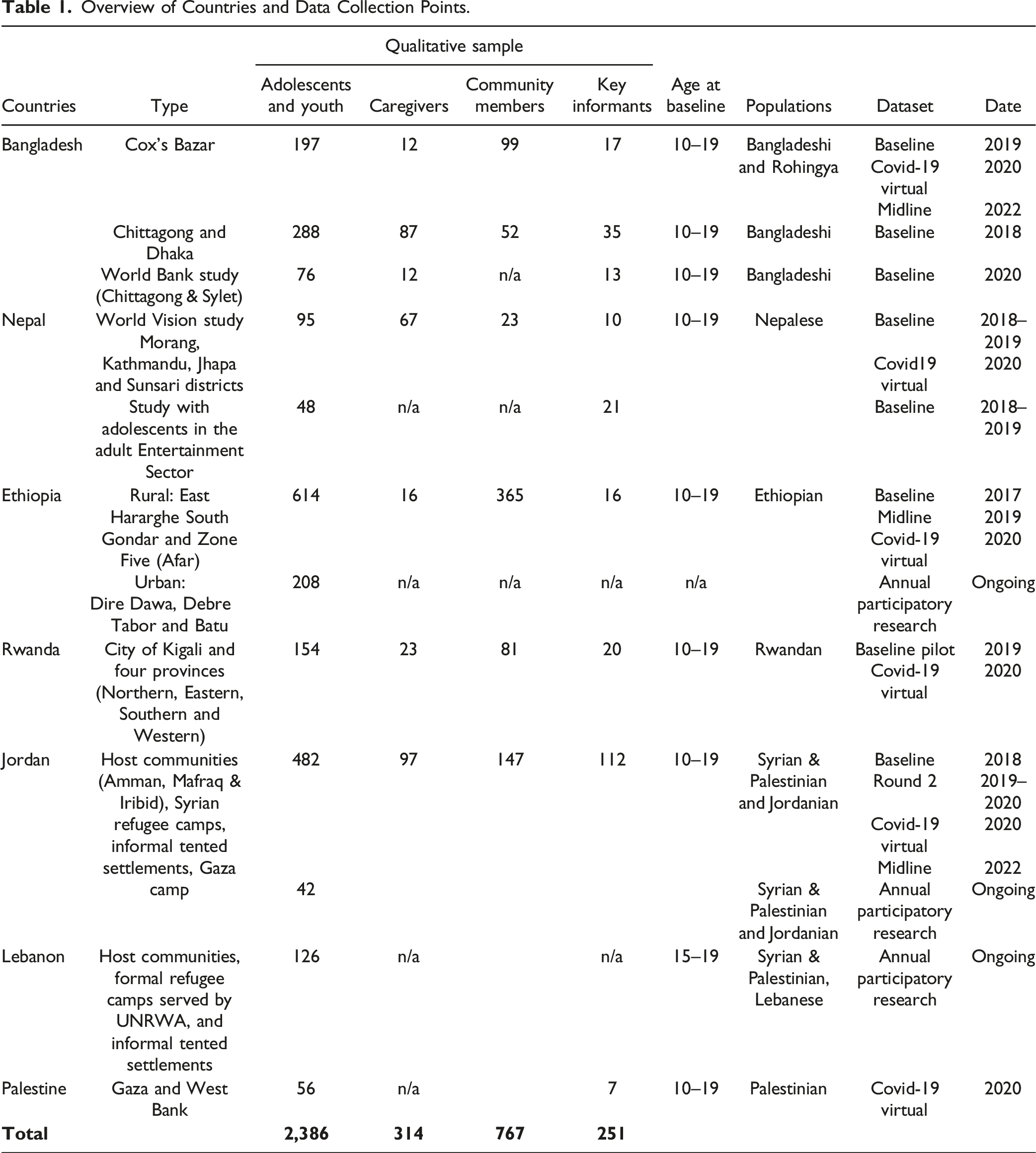
Qualitative longitudinal research (QLR) allows for the analysis of specific life transitions both through comparing different moments in time and/or by understanding the process in which these transitions take place (Bidart, 2013). Adolescence is a particularly unique juncture in an individual’s life, when a young person begins to have some level of autonomy but is not yet perceived as a fully independent adult (Devonald et al., 2021). This life stage plays a key role in shaping people’s futures. It is a time when key decisions are made about school and work, and when social and gender norms begin to become more entrenched (Baird et al., 2021; Harper et al., 2018). Qualitative longitudinal analysis can be key for capturing the intricacies of this dynamic life stage, but it also requires methodological innovation. The Gender and Adolescence: Global Evidence (GAGE) programme is a multi-year longitudinal study of adolescent development in low- and middle-income countries (LMICs). It spans seven countries and includes a large qualitative sample size of around 3718 participants (2386 adolescents, 314 caregivers, 767 community members and 251 key informants).
This paper describes some methodological examples of analysing longitudinal qualitative data on adolescent development. It is structured as follows. First, it provides an overview of qualitative longitudinal research methodologies and why these are particularly useful for studying adolescent development. It then provides an overview of the GAGE programme’s methodology and conceptual framing. Next, it outlines some of the analytical strategies used by the GAGE study. To illustrate this, it presents three examples of how this data can be analysed to fully capture both breadth and depth. Finally, it discusses what lessons can be learned for researchers planning to undertake QLR.
The paper aims to answer the following research question: - What analytical approaches can be deployed to maximize the richness of large, cross-country QLR on adolescents and youth in LMICs?
Literature Review
Conceptualizing Change and Time in Qualitative Methodologies
First, it is important to outline what constitutes a QLR study. While QLR methodologies are continually evolving, there are some key requirements. QLR consists of studies which ensure that “temporality is designed into the research process” (Thomson et al., 2003, p. 185) to “understand how and why the social world unfolds in varied ways” (Neale, 2020, p. 10). In short, it is concerned with exploring “change over time” (Thomson, 2007, p. 573). While time is a clear requirement for QLR, the literature has not reached a consensus about the length of time or the frequency of visits needed to constitute a longitudinal study (Saldaña, 2003). Kelly and McGrath (1988) state that longitudinal design must have “multiple waves of observation; over ‘a substantial calendar time – months or years’” (p. 135). As well as inclusion of time in the data collection process, the exploration of change must be included in the analysis. QLR therefore focuses on processes instead of just outcomes (Thomson, 2007). Saldaña (2003) describes how both the length of time of QLR studies and the definition of change are context dependent. Thus, individual studies will have their own independent interpretations of what changes are examined and how long is needed to explore this.
Longitudinal Methods to Study Adolescent Development
Longitudinal methods are particularly pertinent for studying adolescence because they help to unpack the driving forces that shape life-course transitions (Bidart, 2013). They can be useful for identifying complex realities and processes, and comparing different moments in time (Bidart, 2013). Adolescence brings significant social, physical and psychological changes, and it is a life stage when individuals gain the skills they need to build the foundations for good health and well-being in later life (Patton, Olsson, et al., 2018; Patton, Sawyer, et al., 2018). The processes of adolescent development are complex, often following non-linear patterns and varying trajectories (Morrow, 2013). As such, QLR can be instrumental in capturing this complexity (Bidart, 2013). Furthermore, it can be used to compare and contrast differences in what young people say and what they do, and provide a more nuanced picture of how adolescents live their lives (Thomson, 2007).
The life course is constructed by key moments (such as dropping out of school, illness in the family, or getting married) that can change life trajectories and have long-term implications for an individual (Bidart, 2013). Longitudinal research can be useful in identifying these key moments and how they shape adolescents’ lives, during adolescence and throughout adulthood.
Adolescence is also described as a “window of opportunity” – when certain types of interventions are most effective, due either to adolescents’ heightened susceptibility to negative stressors on the one hand (Balvin & Banati, 2017), and to positive social reinforcement on the other (Ross et al., 2020). Accordingly, QLR allows researchers to identify key patterns and points in time that can be used to inform policies and interventions (Fadyl et al., 2017). It can also be used to explore the long-term consequences of specific policies on adolescents’ lives as they transition to adulthood (Thomson, 2007).
Overview of QLR Studies
Historically, researchers and policy makers alike have tended to favour quantitative approaches to studying the life course, with qualitative approaches taking a backseat or supportive role (Locke & Lloyd-Sherlock, 2011; Neale, 2020). Often, this is due to a lack of either funding or time (Holland et al., 2006). However, more recently, there has been increasing value placed on QLR and, as a result, the QLR literature is growing (Corden & Millar, 2007). Yet, many of these studies tend to focus on higher-income contexts. A number of these studies focus on transitions through the life course. Thomson and Holland’s (2003) nine-year longitudinal study of 100 young people in the United Kingdom (UK) used both a narrative analysis of individual cases over time and analysis across the sample. The Timescapes Men as Fathers study follows 46 men over 9 years in the UK (Coltart & Henwood, 2012; Shirani & Henwood, 2011). There are also numerous studies that focus on experiences of illness or disability over time, such as traumatic brain injury recovery in New Zealand (Fadyl et al., 2017), Lewy body dementia in the UK (Bentley et al., 2021) or experiences of cancer patients and their carers (Calman et al., 2013). QLR in LMIC contexts is more emergent. Young Lives is a longitudinal study of the dynamics of poverty and inequality as they affect young people in Ethiopia, India, Peru and Vietnam, and since 2007 it has incorporated a qualitative research component. As well as limited QLR in LMICs, there are also relatively few cross-country longitudinal studies. Sanip’s (2020) qualitative longitudinal study of medical students across two different continents (in Malaysia and the UK), Young Lives, and GAGE some examples of cross-country comparative qualitative longitudinal studies found in this literature review. Although there has been increasing exploration of the ethical and data collection processes, there is a lack of literature on analytical processes in QLR (Kneck & Audulv, 2019). Furthermore, while other papers reflect on methodological practice and issues in QLR, none have sample sizes as large as the GAGE programme.
Approaches to qualitative analysis can differ. QLR analysis is often synchronic (occurring simultaneously with data collection) when time constraints allow, as initial and ongoing analysis is required to inform future rounds of data collection (Tuthill et al., 2020). Analysis can be conducted with a diachronic approach (after all data has been collected) or a combination of both diachronic and synchronic approaches (Tuthill et al., 2020).
Thomson and Holland (2003) proposed using two different methods. First, an across participant (horizontal) approach, which could help understand how “lives unfold collectively” (Neale, 2020, p. 7). This allows comparison across the sample on the basis of a range of factors such as age, gender, nationality, disability, marital status, and educational achievement (Thomson & Holland, 2003). They also suggest using a within-participant (vertical) approach to maintain the integrity of individual narratives. This allows for a more in-depth trajectory approach for this subset of participants, to understand the specific process that took place at the individual level and “how” something has happened over time (Thomson, 2007). A combination of these types of analysis is needed to maintain a nuanced understanding of the complexity of the data in a longitudinal qualitative study (Fadyl et al., 2017).
GAGE Qualitative Longitudinal Methods
Overview of the GAGE Programme
Overview of Countries and Data Collection Points.
Conceptual Framing
The GAGE programme’s conceptual framework is a holistic approach based on the idea of the interconnectedness of three ‘Cs’ – capabilities, change strategies, and context – in supporting adolescent development and empowerment (see Figure 1) (Baird et al., 2021). It draws on Pawson and Tilley’s (1997) approach to evaluation, and Amartya Sen’s (1984, 2004) capabilities approach. Capabilities outcomes provide a framework for the type of “assets” adolescents need to live meaningful lives. This focuses on an individual’s freedom to achieve these valued ways of “doing and being” rather than focusing on the external assets they have. The GAGE programme focuses on a set of six capability domains: education and learning; bodily integrity and freedom from violence; health, nutrition, and sexual and reproductive health; psychosocial well-being; voice and agency; and economic empowerment. The capabilities approach has been criticized for being too individualistic and thus the notion of “collective capabilities” has been developed to recognize that individual capabilities are reliant on social, community, political and global networks (Ibrahim, 2006; 2020). The GAGE conceptual framework highlights the instrumental role of these “contexts” in adolescents’ lives. Finally, adolescents’ realities can be shaped by a number of “change strategies” or programmatic and policy interventions that can improve adolescents’ capability outcomes. (For more information on the GAGE conceptual framework, see GAGE consortium, 2019.) GAGE Conceptual Framework.
Data Collection and Sample
The GAGE programme has a total quantitative sample of 20,000 adolescents and a qualitative sub-sample of 3718 participants. Participants are purposively sampled to include the most marginalized and “left behind” adolescents who are often excluded from research. These include married adolescents, adolescent mothers, adolescents with disabilities, those that have been forcefully displaced, and out-of-school adolescents. GAGE uses a range of qualitative research tools, including individual in-depth interviews, focus group discussions and participatory exercises that are tailored to age and country context. (For more information on these tools, see Jones et al., 2018; Jones, Presler-Marshall, Małachowska, Jones, Sajdi, Banioweda, Yadete, Gezahegne et al., 2019; Jones, Presler-Marshall, Małachowska, Jones, Sajdi, Banioweda, Yadete, Emirie et al., 2019; Małachowska et al., 2020; Presler-Marshall et al., 2022). The range of innovative participatory and qualitative tools aim to engage the most marginalized adolescents in the research process through challenging structures, norms and power dynamics, aiming to promote a diversity of voices (Pincock & Jones, 2020). Ethical approval was secured from the Overseas Development Institute (ODI) Research Ethics Committee and from regional ethics boards. We obtained informed consent from adult participants aged 18 and above, and informed assent from respondents under the age of 18, as well as informed consent from their caregivers.
In this paper, we use three illustrative examples – using data from GAGE research in Ethiopia and Jordan – to highlight different methods of analysis and the benefits of using QLR methodologies for studying the lives of marginalized adolescents in LMICs.
Findings: Methods to Capture Breadth and Depth of Data in Analysis
The benefits of having a large longitudinal dataset mean that we can highlight similarities as well as differences over time across the whole cohort of adolescents and across subsets of adolescents (such as girls compared to boys or adolescents from urban areas compared to those from rural or pastoralist communities). We can also include detailed explorations of the lived experiences of any given individual over time. However, when working with large amounts of qualitative data, it can be challenging to ensure that the breadth and depth of that data is accurately represented. To achieve this, we adopted a number of analysis strategies, as we now discuss.
Sub-Analysis
In line with the study by Fadyl et al. (2017), we use sub-analysis to ensure that the complexity of the data is accurately captured. Our initial analysis took a cross-capability approach aiming to understand key findings across our entire dataset, with special attention to differences by age, gender, location, disability, refugee or marital status. However, in subsequent sub-analyses, we were able to hone down on areas of the data that showed potential for important insights, allowing us to focus on a certain sub-group or capability sub-domain to get a more detailed examination of the data. For example, in Baird et al. (2022), we focused on a sub-sample of married adolescent refugee girls in Jordan and Bangladesh to explore life after marriage both pre- and post-Covid-19. In our initial, analysis on the impact of Covid-19 on adolescents living in Jordan, we found that married adolescent girls experienced significant challenges due to the Covid-19 pandemic. In further sub-analysis, we were able to explore this in more detail and highlight how factors such as increased social isolation and care and domestic burdens add to the stress of married girls post-Covid-19. It also allows us to bring together sub-groups of the sample from different countries to compare across different contexts.
Across Participant Approach: Pre- and Post-Pandemic
In line with the approach suggested by Thomson and Holland (2003), we use both an across-participant and within-participant approach. In this first example, we show how we use across-participant analysis to understand key differences based on age, gender, location, etc. across our entire cohort. Longitudinal data can be particularly useful for looking at changes due to the impact of a crisis. In Ethiopia, we use GAGE data from before and during the Covid-19 pandemic to compare adolescents’ experiences of education at the height of the pandemic and after they had returned to school post-lockdown. 1 While still longitudinal in nature, this analysis looks at a shorter period, compared with the full study. Using this approach, we were able to look across the sample from pre-Covid-19 data and post-Covid-19 onset data for similarities and differences based on different demographic groups.
Looking across the data, we are able to pull out key challenges facing adolescents in accessing and returning to education based on factors such as disability status, gender and rural location. These findings are outlined in Jones et al. (2021). In Figures 2 and 3, we provide a selection of quotes from adolescent boys and girls who have dropped out of school since Covid. While some of the reasons why they dropped out were similar for boys and girls alike (such as paid work responsibilities and financial pressures). There were some gender specific challenges. Adolescent girls had the added pressure of gendered social norms that render them responsible for unpaid household work, which was another driver of school dropout in some cases. A 14-year-old girl explained: “I dropped out of school because of corona[virus]; then my parents told me to help with childcare. They said the school is not yet open in the village.” Selection of quotes on drop out due to Covid-19 for female participants. Selection of quotes on drop out due to Covid-19 for male participants.

Comparing this with our pre-Covid data, we found that although the reasons for dropout in the Covid-19 data were similar, the pandemic has exacerbated these challenges, leading to dropout. It will be important for future rounds of data collection to explore how these disruptions impact longer-term trajectories. For example, some of the adolescents whose quotes are used in Figure 2 were not back in school but had plans to return, and so it will be interesting to explore, in future data collection rounds, whether they have been able to do so.
Although looking across participants can highlight individual reasons for dropout, it can also be useful for understanding community wide perspectives and norms. While none of the adolescent participants in this study described leaving school for marriage after Covid-19, many adolescents described that their peers have left school due to marriage and key informants described that child marriage was a key theme and driver for dropout for adolescent girls (see Figure 4). We can also see how this evolves from speculative descriptions of the impact of child marriage on education in round one and two to actual examples of drop out due to child marriage in round three. Selection of quotes from Afar region of Ethiopia on drop out due to child marriage during Covid-19.
This highlights another key theme that is driving dropout post Covid-19. The addition of the key informant perspective can help further contextualise these findings and explain the wider reasons why the pandemic related closures increase child marriages. The Head of the Bureau of Women and Children Affairs explained: “Adolescent girls in rural areas use education not only as a method for change but also for an instrument to escape from child or arranged marriage. If girls are out of school parents think that they have no other option other than marriage. Therefore, adolescent girls are worried about the school closures as unless the school is opened in the near future, parents will force them to get married.”
While secondary stories are not as reliable as adolescents’ own experiences, looking across the data at overall perspectives of the entire sample can help validate these findings.
Key informants can also provide an overview of the policy and programming responses and some of the challenges brought by Covid-19. Educational professional can play a key role in supporting adolescents to return to school and protecting against child marriage, however they also face increase challenges in reaching adolescents due to Covid-19. An Exam Administrator explained:
“There were many marriages during the school closures. For us, it was really difficult to follow the female students but we were working with police to cancel these marriages. There was also a taskforce in each Woreda [district] and Kebele [community] which aimed to convince parents [to bring their children back to school]. However, when we reached their home, we found that many students had left their home and were living in other places. We are still working to return students to school.”
Exploring Individuals’ Trajectories
As noted by Calman et al. (2013), analyzing longitudinal data must move beyond analyzing snapshot experiences at multiple points in time to explore “processes and change” over time. Due to the volume of data, it was not possible to do this with the entire dataset. Instead, we have selected a smaller number of adolescents from our study sample so that we can follow them and their families more closely over the next few years.
Overview of quotes by Bifani using the within participant analysis approach.

This case study must be viewed in the context of major regional, national and global events that occurred during this time. First, there is the ongoing Oromo–Somali conflict that displaced an estimated 150,000 people in 2017 (International Organization for Migration [IOM], 2019), including Bifani and her family, who lost their house, business and possessions and had to move in with family friends in Dire Dawa. They then faced clashes between Amhara and Oromo groups in Dire Dawa city, which meant they had to stay away from certain areas of the city. In 2020, the Covid-19 lockdowns coincided with the death of Hachalu Hundessa (a prominent Oromo activist) which intensified unrest across Ethiopia, including in Dire Dawa. The impact of these overlapping crises has resulted in Bifani’s trajectory changing rapidly over the course of the 3 years she was interviewed over (2017–2020, post-onset of Covid-19).
At baseline, in 2017, Bifani had strong aspirations to become a lawyer, which appeared to be an achievable goal due to her strong debating skills and high school grades. However, displacement dramatically disrupted her education, resulting in her moving from a high-performing private school to a low-performing government school. The lack of support from this new school, missed schooling due to displacement, and financial challenges experienced by her family all resulted in challenges to keeping Bifani in school. Two years later, the impacts of this were clear: she had failed her grade 8 national exams and was out of school. At this point, although she still aspired to be a lawyer, this path seemed out of reach, and she was planning to enrol in a private college to study accountancy. While her family’s economic situation had improved slightly due to their water-selling business, they were still struggling financially. Bifani described the changes in her life due to her family’s displacement:
“If I were living in Jijiga, I would have passed [the exams] because my dad had a job. He gave us everything we wanted. We do not have much here. I am not going to school. I am staying at home because of that. The life we had before is totally different from the one we have now here. I am happy being here in Dire Dawa but there are things I have lost and that makes me sad.”
During the first interview with Bifani since the onset of Covid, her educational situation seemed to have improved slightly and she had enrolled in college to study pharmacy (although at that time the college was closed due to the pandemic). However, only 3 months later, the financial implications of the pandemic for her family were much more apparent, which meant that Bifani was now unable to pay the college fees so had to again drop out. At this stage, Bifani appeared unable to achieve her goal of becoming a lawyer, as she was now pursuing any job available to her.
The impacts of displacement and the Covid-19 pandemic have significantly shifted Bifani’s trajectory, from being an adolescent with high aspirations to become a lawyer to being out of school and unable to get a job. QLR is important in capturing the complexity of this transition and the interlinking factors that led to her dropping out of school over the course of the 3 years.
Triangulation: Caregivers’ Perspectives
The GAGE study sample also includes caregivers whose perspectives can help triangulate the findings from the interviews with adolescents. This provides an alternative view on dynamics within the family and household, and together, both perspectives give a fuller view of the data (Sands & Roer-Strier, 2006).
To highlight this, we present another case study, of Farah, 3 a Palestinian girl (with Jordanian citizenship) living in Amman with her mother. At baseline, Farah was 12 years old. She has hepatomegaly (an enlarged liver often due to intrinsic liver disease), which has resulted in her being of very small stature, at risk of osteoporosis and other health challenges. Despite this, she has strong aspirations to reach higher education, become an artist and move abroad to the United States (US). During the interviews, particularly at baseline, Farah’s health problems did not take centre stage and were only mentioned briefly, giving limited insights into the challenges she faces. While an initial analysis may suggest that Farah faces relatively few challenges due to her health problems, the interviews with her mother provide an alternative perspective. Her mother explained that Farah does not like to complain about her health problems and is likely to downplay her symptoms, commenting that: “She resists, she is a fighter, I swear I see her as a warrior. She could be so tired, but she does not tell you that she is tired.”
When reviewing Farah’s interview again, we can also see many strong statements on self-efficacy and resilience, which does indeed suggest that she would likely downplay any challenges she faces. When asked whether she receives any support from the people around her, she answered: “Sometimes there are girls in the classroom and they offer to carry my bag. I say no. I do not like anyone to carry my bag. It has 14 books in it.” When further probed on the support she receives from others, she reiterated her independence: “No one helps me get dressed. Haha… You think I am a baby.”
This highlights the importance of including caregiver interviews to add more context to adolescents’ interviews, particularly for adolescents with disabilities and health problems. As in Farah’s case, young people may choose not to focus on their disability and health concerns either because they want to focus on their capabilities and assert their independence, or because their health problems are the only reality they know and are therefore a normal part of their daily life.
In Farah’s interview, we found that she often had limited detailed information about her treatment. She described: “I will undergo another surgery, but I don’t know why, a liver transplantation. They said it’ll be in 2020.” However, through the interview with her mother we got a clearer picture of Farah’s treatment, the history of her diagnosis and the challenges she faced in getting surgery, both due to Covid-19 and the family’s financial constraints. This caregiver interview therefore provided essential contextual information. As her mother explained: “She still needs to get a liver transplant from me. I waited, but corona[virus] has postponed it. All doctors say that she is all right, that her condition is good, so they prioritize the people in the worst situations. If I had $100,000, I would get her surgery done in Turkey.”
The interview also underscored the extent to which her mother is devoted to caring for Farah. The interviews with Farah’s mother provide an intergenerational perspective and also some insights into where her commitment to her daughter stems from. Throughout the interview, it is clear that Farah’s mother has a close relationship with her children and does not want her daughter’s illness to stand in the way of her achieving things in life. She stated: “I do not prevent her from anything, and let her live a normal life, she lives a normal life.” Her mother’s attitude perhaps plays a role in Farah’s limited awareness of her condition and her self-efficacy and resilience. Life history interviews conducted with Farah’s mother also helped explain this parenting style. She described her traumatic upbringing and limited autonomy over her own life decisions: “My grandparents, they were very strict and violent. They did not let me go to school. I begged my father to let me go to school, and he listened to whatever his parents’ said. Quitting the school destroyed me. I almost committed suicide three times.” She went on to explain how this influenced her own parenting style with her children: “I make sure that I do not do my family’s mistakes with my children.” This is a good example of how including caregiver interviews can help explore both the wider context and intergenerational experiences that shape adolescent–parent interactions.
Challenges and Limitations of Qualitative Longitudinal Research
The benefits of QLR outlined in this paper notwithstanding, it is also important to recognise some of the challenges and limitations when conducting QLR. While we have shown that studying individual trajectories through QLR can bring to light some of the complexities within specific adolescents’ education and health trajectories, it is also important to complement these findings with cohort level analysis, to explore overall trends.
During QLR, attrition is a key challenge due to conducting research over a multi-year time frame, especially in contexts where adolescents’ lives are affected by rapid changes and shocks, including high levels of distress migration. In these cases, the importance of establishing and investing in strong relationships between researchers and participants is key, including through participatory research approaches so that research participants have a greater sense of agency and ownership of the research process. This can help to mitigate against research fatigue, especially in environments where there is little evidence of positive immediate changes as a result of the research.
The complexity and volume of QLR of data is also a key challenge and requires labour-intensive processes during analysis as well as robust data management systems. In order to accurately analyse QLR it is important to maintain reflexivity and flexibility throughout the research analysis process. We explore the technical challenges of conducting analysis and managing data on large QLR samples in a complementary forthcoming paper.
Discussion
Data analysis is frequently highlighted as the most complex and time-consuming component of QLR (Thomson & Holland, 2003; Tuthill et al., 2020). However, there is limited research that explores methodologies for QLR analysis. In this paper, we have described how we ensured that we accurately captured both the breadth and depth of that data by using a combination of analytical approaches.
QLR can be an important methodology for understanding the impact of multiple and overlapping forms of crisis on adolescents’ development trajectories, especially when looking at education and health outcomes. In order to address the question we posed at the outset of the paper about the potential contribution of QLR to the exploration of education trajectories, we used an across-participant (horizontal) approach to show how we analysed the breadth of data pertaining to a cohort of 3,718 participants. We found this approach useful to get a clear picture of some of the factors that drive educational dropouts in the context of Covid-19 across the whole dataset. We show insights from data collection rounds pre-pandemic, in the period of the immediate onset of the pandemic and related lockdowns and again 8 months to a year later after the pandemic had become more protracted, and based on different demographic characteristics such as sex. Combining data from adolescents’ own experiences of dropout with the wider perspectives of key informants and community members further helped contextualise the findings and provide an understanding of broader patterns and underlying policy and programming shifts as well.
Yet, as mentioned, this cohort-wide approach misses some of the complexities of individual adolescent trajectories. In the next example (the life story of Bifani), we showed how within-participant (vertical) approaches can be used to complement the findings from the across-participant analysis through capturing the complexity and non-linearity of the processes that lead to dropout. There was not one single event that led to Bifani’s school trajectory changing course. Instead, it was caused by the compounding impacts of displacement, economic vulnerability and Covid-19-related closures. This case study also showed the relationship between overall household economic status and individual adolescent trajectories. This aligns with the study by Hunt (2008), which describes school dropout as a process made up of multiple causes rather than a one-off event. These compounding causes are not as accurately captured using only an across-participant approach, and so including trajectory (within-participant) analysis prevents us from showing just “a series of individual snapshots” (Morrow & Crivello, 2015, p. 276). This methodology can also help pinpoint the key moments when interventions could be instrumental in supporting adolescents to embark on positive life trajectories and achieve their aspirations (Fadyl et al., 2017). In our case study with Bifani, given the financial challenges her family faced social assistance could have played a key role in supporting Bifani to stay in education during the financial downturn she experienced in the context of the Covid-19 pandemic. Such longitudinal analyses can be useful to pinpoint key moments where policy and programming during times of crisis can support adolescents to stay in education.
We also outlined the benefits of including caregivers’ perspectives and using these to triangulate the data from adolescents’ interviews as they can corroborate the adolescent’s story, provide a different interpretation of that same story, provide missing information that was instrumental in understanding the adolescent’s story or provide entirely new information to fully contextualize the adolescent’s story (Sands & Roer-Strier, 2006). In our second example (the life story of Farah) which we use to illuminate the value of QLR in advancing understanding about adolescent health trajectories, we found that adding the caregiver interview data provided a new perspective that helped explain the adolescent’s perception of the health challenges she faced, and added missing information that built a clearer overall picture of those health challenges. However, when using this approach, it is important not to give more weight to the caregiver’s perceptions than the adolescent’s own experiences. Instead, each interview should complement the other to produce a clearer composite view of the data.
Finally, we also found that at baseline, adolescents were less willing to discuss any health problems they had, but were more likely to discuss these in more detail in subsequent interviews, suggesting that they became more comfortable talking about sensitive personal issues, including their health status with the interviewer over time. This highlights the importance of building relationships of trust with adolescents and their caregivers over the course of the longitudinal study.
Limitations
This paper follows adolescent case studies focusing on interactions with critical health and education services particularly in time of crisis, and the impact of this on adolescent development. We recognise there are other core capability domains that impact adolescent development (such as bodily integrity, including protection from gender-based violence, and psychosocial wellbeing, that are often highly sensitive due to entrenched gender norms and may require complementary analytical approaches to unpack related complexities). In future studies we aim to explore these other domains, building on but also modifying the approach described in this paper.
Conclusion
QLR is a particularly important methodology for studying adolescents’ development and interactions with public services. We have shown the benefits of this approach for exploring the complex and dynamic factors that shape displacement among adolescents and their families, adolescents’ educational trajectories and their experiences of health problems. Our discussion highlights the importance of using a range of methods when analyzing a large qualitative longitudinal dataset, including both across and within participant approaches, as well as sub-analysis of specific groups. This approach offers an effective way to capture the breadth and depth of such datasets.
Footnotes
Acknowledgments
The authors wish to thank Kathryn O’Neill for her copy-editing work and the GAGE qualitative research team for their data collection efforts.
Declaration of Conflicting Interests
The author(s) declared no potential conflicts of interest with respect to the research, authorship, and/or publication of this article.
Funding
The author(s) disclosed receipt of the following financial support for the research, authorship, and/or publication of this article: GAGE is a longitudinal research programme funded by Foreign, Commonwealth & Development Office (FCDO) as part of UK aid.
Ethical Approval
Ethical approval was secured from the ODI Research Ethics Committee and from regional ethics boards.
Correction (April 2025):
The article has been updated with a figure.
