




Abstract
Despite its importance, participatory analysis has traditionally been an unexplored field. In particular, children have been marginalized in the analysis process due to their perceived inexperience and lack of capabilities. Even though there have been efforts to provide children with training, known as capacity-building, in this approach, the pre-existing dominant narrative about who has valuable knowledges and who the experts has been repeated over time. Drawing on the understanding of participatory analysis as an ongoing process and children’s ways of knowing, this study illuminates how a group of migrant children in South Korea engage in analytic work in participatory research. In this study, the migrant children showed their engagement in analytic work while crossing the boundaries of the stages of formal analysis. Particularly, the children’s engagement in analytic work occurred based on various methods of reflection which generated a fruitful explanation about the complexities surrounding their belonging. This study should make us rethink what is regarded as children’s analysis in participatory research. Based on the results, this study suggests children’s participatory analysis needs to be radically reimagined beyond simplifying the practices of adult researchers.
Keywords
Introduction
Participatory research with children has flourished in recent years. As the new sociology of childhood reconceptualized children as active social agents (James & Prout, 1990), and the UNCRC (1989) proclaimed children’s right to participate in decisions affecting them, participatory research has come to be regarded as an ethical-political impetus in research involving children (Fernandez, 2007). In participatory research involving children, children participate in the decision-making processes around the research and contribute to the research design (e.g., designing and validating research methods in Horgan & Martin, 2021), as well as generate data (Groundwater-Smith et al., 2014; Horgan & Kennan, 2021). Children’s unique perspectives in participatory research have produced fruitful suggestions for the children themselves and their communities (e.g., Kirshner & Pozzoboni, 2011).
Participatory analysis is at the core of participatory research. By participating in the analysis process, children can reflect on what findings mean to them and produce more accurate knowledge explaining their world (Grover, 2004; Thomas & O’kane, 1998). Given that the individuals making decisions profoundly influence the findings in qualitative research (Denzin & Lincoln, 1998), such engagement by children can make the research process more rigorous. Participatory analysis can also make the research more ethical in that it not only recognizes children as having rich resources for research, but also positions them in a situation where they can advocate for relevant resources and policy changes for themselves (Liebenberg et al., 2020).
Despite its importance, participatory analysis has traditionally been an unexplored field (Holland et al., 2008; Liebenberg et al., 2020; Rix et al., 2022). In particular, children have been marginalized in the analysis process due to their perceived inexperience and lack of capabilities (Nind, 2011). As Kellett et al. (2004) have discussed several barriers perceived in child-led research, incorporating children in data analysis is no easy task. Against this backdrop, there have been efforts to provide children with training, known as capacity-building, and to teach them skills and abilities for data analysis (Kellett, 2005; Kellett et al., 2004; Nind et al., 2015). Based on the assumption that children’s absence from participatory analysis is more or less related to their low capability for involvement in analysis, in this approach, equipping children with proper skills and capacities for data analysis is regarded as the key for them to engage in participatory analysis (Kellett, 2005).
However, researchers training children for data analysis have reported several challenges. For example, the traditional power relations between researchers and participants persist. The majority of academic researchers learn and refine their research skills in formal educational institutions over a long period, an experience which many participants do not have (Strnadova et al., 2014). Therefore, the training to develop participants’ analysis capacities is likely to become a process where researchers impart knowledges and skills to the participants, reproducing traditional understandings of who has valuable knowledges and who the experts are (Nind et al., 2015).
Against this backdrop, a group of participatory researchers has experimented in negotiating the boundaries of data analysis beyond traditional paradigms. For example, Seale et al. (2015), who propose “possibility thinking” in participatory research, emphasize asking positively framed “what if” questions instead of posing common questions focused on disabled people’s difficulties (e.g., “What if people with learning disabilities could participate in data analysis?”). Arguing that various boundaries surrounding participatory research could be crossed despite tensions and complexities, Seale et al. (2015) highlight that a creative response rather than a perfect process is needed to provide an appropriate analysis process for participants.
Researchers also demonstrate alternative forms of doing data analysis, pointing out how taken-for-granted analysis practices have changed when faced with children’s hesitancy toward “schoolwork.” For example, Holland et al. (2008), who find that children tire quickly of reading large blocks of text for analysis, draw on alternatives, such as using audio recordings to review conversations. Based on these findings, Holland et al. (2008) suggest going beyond imposing an adult researcher’s “own forms of ‘doing research’” (p. 20). Similarly, Liebenberg et al. (2020), avoiding sedentary school activities, look for complementary approaches to thematic data analysis. The thematic analysis activities they have designed center fun group work and interactive activities such as body and community mapping or card games. They also utilize Facebook pages for youth to post their thoughts and questions and comment on each other’s posts, which energizes the analysis process.
The common emphasis from the group of researchers is, on the one hand, participatory analysis needs to go back to the question of “what it means to do data analysis” (Nind, 2011, p. 357). As diverse approaches are mobilized for data analysis in qualitative methodologies, in participatory research, it is recommended to open up the notion of data analysis and to work with what is possible in data analysis (Nind, 2011). On the other hand, scholars highlight the emergent nature of analytic work (Holland et al., 2008; Rix et al., 2022). While analysis is often conceptualized as a separate stage of the research process, in participatory analysis, participants’ “ongoing verification of data” is emergent throughout the research (Rix et al., 2022, p. 5). From this perspective, researchers’ sensitivity to participants’ ability to make sense of data, which has traditionally not been regarded as “analysis,” is important.
Building on the international body of research on participatory analysis across the fields, this study aims to expand the discussion by valuing children’s ways of knowing in participatory analysis. How children engage in analysis in their own ways has been unexplored, leaving our understanding of “what participatory analysis could be” largely within the conventional analysis practice. The present study illuminates how a group of migrant Joseonjok children in South Korea navigate analytic work, with focus on their everyday forms of engaging with data. Drawing on children’s ways of knowing and on the understanding of participatory analysis as an ongoing process, I document not only how the children are involved in analysis in the data workshops but also how they engage with data throughout the research in their own ways. The results of the study provide a suggestion for how to conceptualize participatory analysis.
Theoretical Framings
Participatory Analysis as an Ongoing Process
Though data analysis has been traditionally regarded as a stage of research, participatory researchers have highlighted data analysis instead as an ongoing process (Holland et al., 2008; Nind, 2011; Rix et al., 2021, 2022). As analysis in qualitative research occurs from the moment the research question is developed and continues throughout the project, participants’ analytic work is also not confined to the stage set for analysis (Holland et al., 2008), but occurs throughout the research process.
The traditional approach, presuming analysis as a discrete stage of research, often involves training and capacity-building to help participants engage in the analytic activity. In contrast, the approach emphasizing the ongoing nature of participatory analysis weights participants’ insider perspectives (Rix et al., 2022; Seale et al., 2015), paying more attention to how participants engage in analytic thinking. For example, Richardson (2002) illuminates how people with learning disabilities discuss the stories emerging from data. Keyes and Brandon (2012), who understand analysis as a continual process, emphasize interactive feedback, underlining knowledge construction through collaboration between the researcher and participants. Holland et al. (2008) also contend that ongoing discussions and returning to themes deepen the analysis conducted with children. Holland et al. (2008) add that in this process, children’s informal interaction is advantageous for analytic work as a cultural form of their communication. In that vein, in the approach understanding participatory analysis as an ongoing process, increasing attention has been paid to how the participants’ sense-making occurs through informal interaction.
Incorporating Children’s Ways of Knowing in Participatory Analysis
Scholars who explore children’s participation in inquiries have emphasized that researchers need to pay attention to children’s ways of knowing (Campano et al., 2016; Huber, 2020; Lester, 2013; Pahl, 2019). That is, if we really position children as co-researchers and continue to negotiate inquiries with children, incorporating “children’s perceived landscapes and shapes[,] thereby opening potential” becomes important (Huber, 2020, p. 46). In other words, in participatory research, we should be attentive to how children engage in generating knowledges rather than whether they legitimize the ways of participating in research already familiar to researchers.
One remarkable site is children’s play. Play is a valuable way for children to take control in a world where adults dominate (Lester, 2013). By playing, children can produce changes in the borders constructed by adults and bring about subversion. Children’s play also helps children imagine future possibilities for themselves (Campano et al., 2016). However, Campano et al. (2016) have documented that children’s critical play is at first seen as just “unruly” even by researchers, so observing children’s participatory practices requires us to keep relocating our ways of seeing and listening.
Scholars have also accentuated children’s multimodal ways of knowing the world (Binder & Kind, 2017; Kind & Lee, 2017; Shimomura, 2018). For children, particularly those who do not depend on written language as adults do, multimodality is an important mode of being and knowing (Clark & Moss, 2011). For example, drawing may be a primary language to understand young children’s way of knowing the world (Binder & Kind, 2017; Shimomura, 2018). Drawing is not simply valuable for children to represent objects, but it could be an event where the “agencies of children, materials, literature, and so forth co-exist and entangle in a space allowing each other’s idea and theory” (Shimomura, 2018, p. 8). That is, through multimodal works, multiple meanings and new possibilities can be generated.
However, as we cannot generalize what children’s lives are like, we can neither take a universal approach to children’s ways of knowing nor can we confine them to a certain form. Instead, considering children’s way of knowing may involve inscribing a “what if” quality into our inquiries: what if children’s ways of knowing are not as same as adults’, and what if children’s analysis is differently conceptualized, and how would it change our understanding? (Pahl, 2019). This “what if” approach also implies that grounding participatory analysis in children’s ways of knowing uses researcher immaturity as a methodological attitude. Immaturity as a methodological attitude “privileges open-ended process over predefined technique” (Gallacher & Gallagher, 2008, p. 513). Therefore, considering children’s ways of knowing in participatory analysis allows us to experiment in how we understand children’s meaning-making.
Drawing on the understanding of participatory analysis as an ongoing process that captures children’s ways of knowing, in this study I focused on the children’s everyday forms of analytic work, crossing the border of conventional “data analysis.” My decision was informed by Pahl (2019), who navigates the language describing children’s civic engagement in informal settings and highlights everyday forms of participation. In the present study, I attended to the quotidian world of analysis, observing what the children did and talked about as far as the data was concerned, in order to understand how they generated their own explanations and meanings. I was attentive to these details in the data workshops that I had set forth for this purpose, but also throughout the research.
Five Girls Project
This study originated from my fieldwork for my doctoral dissertation, which investigates a group of migrant Joseonjok children’s critical inquiries about the politics of belonging in South Korea. As an ethnic-Korean diasporic group, in recent years there has been continual migration of Joseonjok to South Korea from northeast China based on the geographical closeness, a sense of ethnic bonds, and linguistic and cultural similarity. However, the more the Joseonjok have taken root in South Korea, the more they have become a target of xenophobia and social exclusion (Kim, 2016; Lee, 2014; Song, 2017). Dangerous criminals are often portrayed as Joseonjok in recent thriller films, and crimes by migrant Joseonjok are framed as “Joseonjok crime” in news broadcasts, contributing to the multiple social practices of othering that construct “dangerous” narratives about Joseonjok (Kim, 2016; Kim, 2018; Shin, 2016). Moreover, the low socio-economic status of Joseonjok has been hybervisibilized and locates the diasporic group at the bottom of the socio-cultural hierarchy as migrant workers (Kim, 2016). In this situation, it appears that Joseonjok belonging in Korea goes beyond these individuals’ personal feelings and is rather strongly influenced by social practices that position them as “dangerous and poor others” who cannot be legitimate members of society. Against this backdrop, my dissertation study was designed to listen to migrant Joseonjok children’s voices on issues of migrant belonging in Korea.
Informed by transnational feminists’ understanding of epistemic privilege (Campano, 2007; Mohanty, 1993, 2018; Moya, 2002) and critical inquiries from a critical literacy perspective (Ghiso et al., 2019; Jones, 2006; Martínez-Álvarez & Ghiso, 2017), I invited migrant Joseonjok sixth graders to inquiry sessions and facilitated critical inquiries about migrant belonging. Through the project, I focused on how migrant Joseonjok children read the politics of belonging from their own and their communities’ experiences and explored how the children navigated critical inquiries based on participatory approaches. The guiding questions of the project were: 1. What issues, problems, and questions do a group of migrant children bring to the surface? 2. How do the children investigate those issues, problems, and questions? 3. What role does the researcher play in the child-led critical inquiry process?
The project was carried out for 7 months from 2019 to 2020 as an afterschool inquiry program in an elementary school located in a small Chinatown in Gyeonggi province, South Korea. Since I worked in the school as a teacher, I had relatively easy accessibility and was able to run the afterschool sessions. The sessions were held once per week, each meeting lasting an hour to an hour and a half. From June 2019 to August 2019, 10 sessions were held as a pilot study. Then, from July 2020 to December 2020, the participating children and I met 23 times. As a result, there were 33 sessions in total. Though the meetings started in-person in 2019, because of the COVID-19 school shutdowns, the inquiry group moved to a virtual space. We used Zoom as the main platform to hold meetings and to discuss, leveraging various online boards and platforms including Padlet, Jamboard, Google Presentation, Miro, and Youtube to develop discussions and document our work. However, in this process, some children had difficulty in participating in virtual meetings due to the lack of personal space at home, particularly considering that the sessions required their honest reflections on their experiences and thoughts. To mitigate this limitation, the inquiry group changed into a collaborative project with a teacher, Mr Sun, who had an interest in critical inquiries with children, and was willing to let our group use his classroom and support them in the critical inquiries even in such an unprecedented environment.
For participant recruitment, drawing on purposeful sampling, I recruited eight Joseonjok fifth graders, one, a boy, and the other seven, girls, in the pilot study in 2019. The selection started with teacher recommendations and then counted on the children’s individual decisions to participate in the sessions. During and after the pilot study, of the eight children, the boy and one of the girls quit, and another two girls dropped out because their families moved. To overcome the limitation of the teachers’ roles as gatekeepers in participant selection, wherein they would tend to choose “good representative[s]” (Horgan, 2017; Spyrou, 2011), I shared the participant selection criteria with the children who had decided to keep participating in the research and recruited one more girl through their recommendation, using snowball sampling. Even though there was a fluctuation in the group membership, five migrant Joseonjok girls—Jay, Sunny, Haelin, Xia, and Euna, who were fifth graders in 2019 and became sixth-graders in 2020—were the fixed and primary members of the sessions, and they named the project “Five Girls” after themselves. They were acquainted with each other even before participating in the critical inquiries, and some of them (e.g., Sunny and Haelin, Sunny and Xia) were friends. All of the girls were ethnic Koreans with Chinese nationalities and identified themselves as both Chinese and Joseonjok. They had been living in Korea for two to 7 years, and their families were working class.
I did not consider gender for the participant selection. But all the participants were inadvertently girls, which might have influenced the findings of this study given the gendered experiences girls face during migration (e.g., Ní Laoire, 2011). However, since this group of girls did not bring up gender in their discussion or show interest in the researcher’s questions about their gendered experiences, this project did not focus on gendered experiences, leaving the question open for follow-up research on migrant children’s gendered positioning and experiences.
Even though their school provided multicultural education, the children said they never experienced support from the school for engaging in critical reflection on their experiences as migrants. In the beginning of the critical inquiries, the children said that racism was wrong. But at the same time, they did not explicitly say they experienced racism while talking about unfair practices against themselves. It would appear they had not had enough space to critically reflect on their experiences as migrants. In that vein, doing critical inquiries was an experiment where the children had their first opportunity to critically reflect on and unpack their experiences as migrants in a school space.
In the critical inquiries, the children were invited to participate in data analysis as well as data generation. For the data analysis, I prepared two data workshops. The first was based on thematic data analysis. Informed by Liebenberg et al. (2020), who conducted thematic analysis in a YPAR project, I encouraged the children to code and systematize TikTok videos they had created about their sense of belonging. In pairs, they categorized stills from their own TikTok videos and wrote down key words that explained the categories. Looking through the codes they generated, the children found one to three themes each, which they documented as the results of their analysis.
The second analysis put more emphasis on generating counter-stories informed by Cahill (2007). Cahill (2007) argues that a participatory data analysis needs to commit to producing stories counter to the hegemonic narrative. To that end, I distributed sets of multimodal works back to the children and facilitated discussion about how dominant narratives about Joseonjok identity could be reconstructed from the children’s perspectives. Drawing on Rose’s (2016) visual analysis, I provided a set of questions the children could utilize for their analysis: • What things appear often in these images? • What things stand out in these images even though they don’t appear as often? • What do the things you point out mean as far as Joseonjok children’s identities? • How might Koreans who only live in Korea think about Joseonjok children’s identities? • How do you think these images can counter common misconceptions about Joseonjok children?
In addition to the data workshops, I prepared a space for the group to discuss and comment on the researcher’s analysis, which went through substantial changes. A prominent approach to participatory analysis has been for researchers to analyze the data first and then let young participants give feedback (Gavin, 2021; Holland et al., 2008; Nind, 2011). However, when I attempted this method, the result was quite embarrassing because the children’s responses to my analysis were simple comments like, “Wow, cool!” or, “Sounds good,” instead of critical comments or new ideas. Therefore, tweaking the idea, I provided the children some salient concepts from my perspective, such as microaggressions or othering. I asked them to reflect on and share their own experiences with the concepts. I made this methodological decision to avoid tokenistic participation and, simultaneously, to give the children more vocabulary to understand their own experiences. Since in Korea, “discrimination” is almost the only well-known concept that explains racism and xenophobia, the children’s language to explain their experiences was limited, despite their anger. Providing new concepts from the researcher’s analysis helped the children produce more nuanced explanations about how their belonging was constrained.
This study also used participatory dissemination. Prioritizing the benefits to the participants (Mangual Figueroa, 2016), we regularly discussed what the children wanted throughout the research. One idea the group proposed was publishing a book to teach migrant children’s belonging to the teachers and other students at their school, as their individual efforts to stand up to bullies often failed. Therefore, publishing a book became a major way for the group to disseminate the results of their inquiries, and the last seven of the 33 sessions were used to work on the book.
Children’s Engagement in Analysis
In this study, the children engaged in reflection on the data and developed their explanations of the data both in the data workshops and throughout the rest of the research. In the present section, I will illuminate four moments inside and outside the data workshops to understand how the children engaged in analysis.
Discussion Beyond Common Themes
Analysis is often regarded as winnowing down the data by extracting repetitive patterns and figuring out common themes (Merriam & Tisdell, 2016). While participatory analysis with children has also been built up on the practice of finding common themes, the analysis by the children in this group was deepened when their analysis went beyond “finding common themes.” This was an ongoing process of shedding light beneath and beyond the symbols on the surface, wherein conversation plays a key role.
Jay’s analysis in the second workshop was one example. In the second data workshop, Jay took a set of diagrams the children had made to illustrate their attachments in Korea and China and at first looked for points in common among the diagrams. While she was able to identify important points in the data such as “everyone in Five Girls had some important things in both countries,” she felt quite lukewarm about finding or discussing more “common theme,” and that made the conversation rather superficial. Interestingly, the conversation about her own work brought forth some narratives somewhat at odds with the patterns she had found—that she had a particularly strong attachment to China rather than having a belonging that traversed the two countries. [Yeonghwi and Jay talking about the expressions “China 99” and “Korea 5” in Jay’s diagram, Jay insisting that the number would not change even in the very far future. The numbers are meant to represent percentage-wise her attachment to each country.] Yeonghwi: Okay, I understand you love China very much. [laughs] Why do you think you love China so much, Jay? Jay: Um, I lived there since I was very young. And the second house there, I just like that house. And I am more interested in Mandarin. So, I love China more than Korea. I think that’s the reason. Yeonghwi: I see. Then your time in Korea is not that happy for you. Jay: No, I’m not happy here. […] School is not happy for me. My friends at school. And my mom makes me unhappy at home here. Yeonghwi: What kinds of issues do you have with your friends at school…? Jay: I feel like they ignore me. Yeonghwi: Because of what? Language? Jay: Yes. Yeonghwi: What about your mom at home? Jay: She scolds me a lot. Yeonghwi: Didn’t she scold you before? Jay: No, she didn’t. And she didn’t bother me about stuff, either. […] I think she just takes it [her exhaustion] out on me. I’m 99 percent or 100 percent sure. She’s stressed and takes it out on me. […] I just wrote “1%” [5% in the picture] because if I honestly wrote “0%,” that would look really bad. Yeonghwi: You mean, actually, you want to give 0 points to Korea, right? Jay: Yes.
The diagram Jay produced included contradictions, such as images that appeared to equally distribute attachment to each country labeled with imbalanced numbers—99 for China and 1 for Korea (she corrected the 5% in the picture, saying it should be 1%—see Figure 1). While we hadn’t addressed this issue much before, in the conversation about Jay’s own work, we focused on these contradictions, and it brought Jay’s limited sense of belonging in Korea to the fore. She felt dissatisfaction with living in Korea. Her friends’ disregard for her as a migrant Joseonjok was a part of this dissatisfaction in addition to the emotional burden she had to endure from the stress of being part of a working-class migrant family. Jay’s limited sense of belonging in Korea helped explain her quite halfhearted attitude in figuring out common themes across the data, where we had focused on distributed attachments to both countries. Moreover, Jay’s explanation that giving some points to Korea was to avoid “looking bad” showed her cautious and strategic response to avoid being accused of being “unruly.” For Jay, whose sense of belonging contradicted that of the other girls, talking about the stories behind her own work made her data analysis more engaging and deeper. Jay’s diagram about her sense of belonging.
The experience with Jay shows that even though finding commonalities and patterns from the data could be a primary step for children’s data analysis, their explanations of the data could go deeper by addressing the discordances and contradictions as well as the commonalities. Since in participatory research, children are involved in generating the data, they have an advantage in contributing directly to the production of visual data. Talking about the stories behind the data could enrich and deepen the data analysis.
Working Along With a Researcher: Mobilizing Researcher Questions to Navigate Analysis
In this study, the children engaged with the data along with the researcher rather than by themselves. The researcher participated in this process mainly by posing questions to push the children further in explaining migrant belonging based on the data. While the questions provided by the researcher helped guide the children’s analytic work, the children also took up and mobilized the researcher’s questions to elaborate their own thoughts and set forth their arguments.
The child participants in this study had neither expected to be co-researchers nor participated in an analysis process before. Lack of research experience among child participants has been pointed out as a challenge participatory research needs to address (Strnadova et al., 2014; Nind et al., 2015). However, in this study, I understood that not only children but many adults had not experienced engaging in a research process, and inexperience should not be spoken of in a derogatory way. At the same time, I thought it would be naïve just to expect that children would engage in an analysis process on their own without any guidance (Kim, 2016), given the social and historical construction and embodiment of childhood (Mallan et al., 2010), particularly in research practice. Therefore, in this study, I put particular effort into creating an analysis space that facilitated the children’s analytic work. To that end, I provided some analytic activities through two data workshops and a set of written questions the group could refer to unpack the data, and I also facilitated analytic conversation by posing questions directly to the children.
For example, while Sunny and Haelin were analyzing their TikTok videos about their sense of belonging (see Figure 2), I jumped in their conversation and posed a new question about how the repetitive images of “scenery” could be related to belonging. Although the two girls had been articulate about how their national identities, diasporic experiences, and friendship were implicated in their sense of belonging, they had hardly touched on the repetitive theme of scenery. To my question, after a short pause, Haelin carefully said that because they carried smartphones, taking pictures of scenery was a habitual practice they could do anywhere—in Korea or China, or even between the two countries in the airplane. Her explanation of their photography complicated the concept of belonging, adding another layer wherein migrant children traverse countries through daily practices. Sunny and Haelin’s categorization of TikTok video images.
However, asking questions without imposing my own view was a constant issue I had to deal with. With the inherent power asymmetry between an adult researcher and child participants, the children in our group were likely to just tell me what they thought I wanted to hear from them (e.g., the interaction of national identities and belonging in this study) (Komulainen, 2007; Spyrou, 2011). Further exacerbating this power asymmetry was the fact that I took a teacher-researcher role in this study; teachers are imagined as authority figures and, in fact, tend to find themselves enacting that role even if they don’t intend to. A strategy I took to address this was honestly sharing the experiences that shaped my own knowledge, particularly as a migrant student in another context, and simultaneously admitting my ignorance about the children’s experiences. While in typical contexts students are the ones whose understanding is checked and evaluated, and teachers take the role of judging and awarding points based on that understanding, the bilateral flow of information in our research helped to partially disrupt this normalized power difference. In addition, I took the position of a curious and supportive adult who wanted to learn from the students (Ryu, 2022), sharing my sincere curiosity about their views on issues of migrant belonging. Through my effort to be humble and transparent, I learned unexpected things from our group.
But despite my positioning, I noticed some signs that the children were still conscious of me when they responded to my questions (e.g., targeting me as a main audience), and so I acknowledge that there are no absolute ways to overcome the power imbalances between children and adult researchers (Spyrou, 2011).
In the data workshops, the questions I posed led the children’s discussion, but at the same time they also mobilized these questions as a frame for their explanation and navigation of their new undertaking, “analysis.” For instance, in the second data workshop, Xia and Euna utilized a set of questions I had shared as a step-by-step guide to analyze a set of drawings (see Figure 3) and, going further, expanded their analysis to interpretation. Xia and Euna’s presentation demonstrated how the children utilized the questions: Xia: The answer to the first question [“What things appear often in these images?”] was “Korea and China.” Korea and China are in both the drawings. And we thought the meaning of the pictures was that we think of Korea and China as equals. Yeonghwi: You mean, you don’t discriminate against either country, and you don’t think one country is ugly…? Xia: Yes. Yeonghwi: I see. That’s cool. Xia: And our answer to the second question [“What things stand out in these images even though they don’t appear as often?”] was how someone thinks about Korea and how someone thinks about China could be totally different. That stuck out in the pictures, even though it wasn’t the same in all of them. Yeonghwi: Um, what do you mean? Could you tell me more? Xia: We thought that everyone thought of China and Korea [in certain ways]. Even though I see them equally, other people might think in different ways. [That’s what] we think. Yeonghwi: Um, you mean some people don’t like China or other people don’t like Korea, something like that? Xia: Yeah…. and our numbers are different, too. Yeonghwi: I see. Drawings analyzed by Xia and Euna.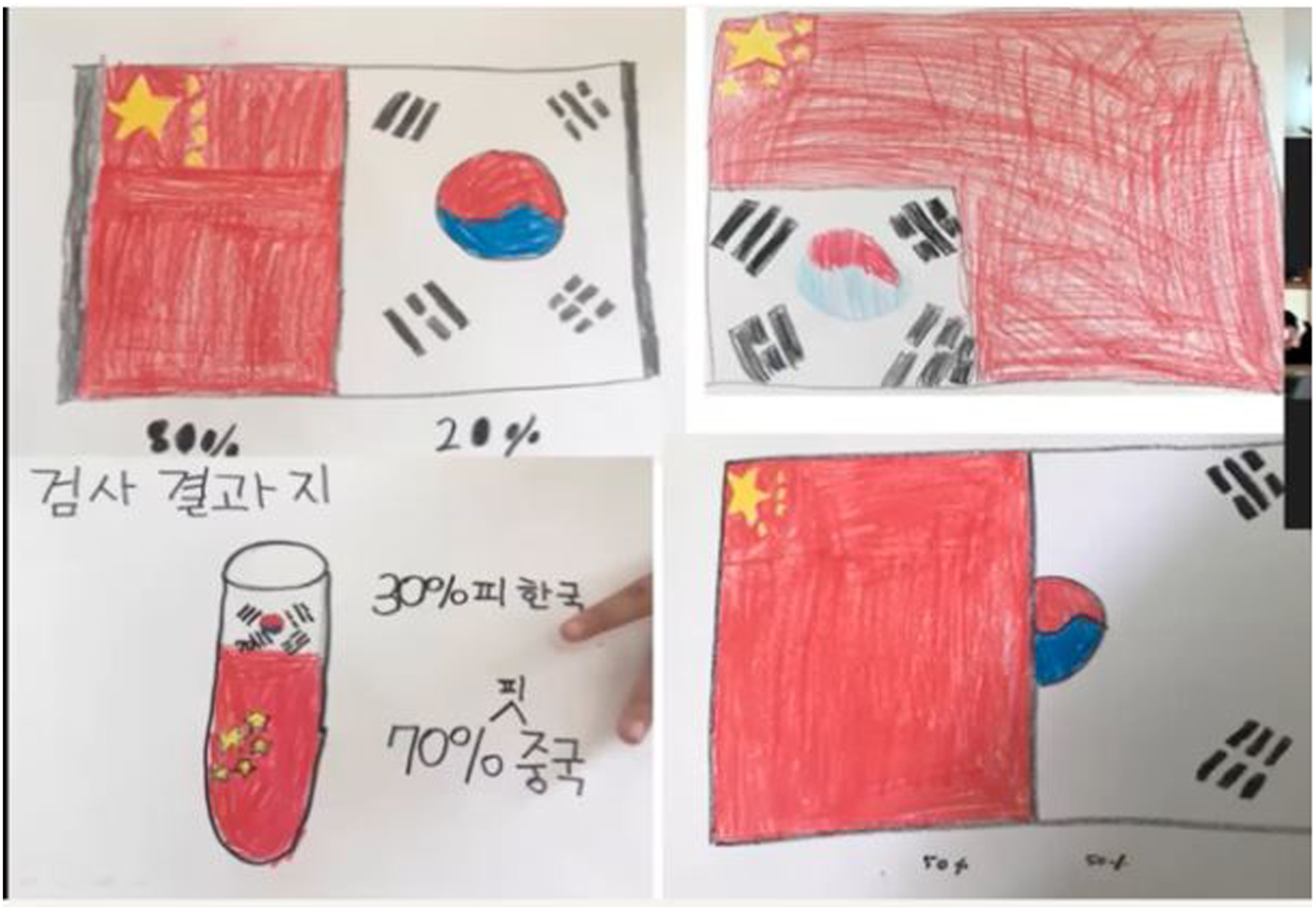
By putting the questions at the beginning of each analytic point, the children used them to launch their investigation of the data. While Xia and Euna directly answered “Korea and China” to the question that asked about the frequently appearing images in the data, the two girls soon added their own understanding of this repetitive image by elaborating that they “think of Korea and China as equals.” Their statements about their own meanings demonstrated that they followed the questions given but that the questions were flexible and could be expanded upon.
The children’s use of the second question demonstrated how they imbued meaning to the selected data through the questions. To answer the second question, Xia and Haelin looked at the numbers for Korea and China, which were different in each drawing. By suggesting the differences in numbers as evidence, they foregrounded the hypothesis that everyone might have different ideas about the relationship between the two countries, and that this could lead to discordance between the general public and Joseonjok children as far as their thoughts on parity and equality between China and Korea. As the example of the second question and the ensuing discussion shows, the girls began their reflection by answering the questions concretely. However, this reflection soon extended to their concerns about their everyday lives, bringing rich meaning to the data. For the children, the questions were useful to start the conversation, and their analytic work went beyond the questions, incorporating their own concerns.
Given that our group had scant previous experience analyzing data, the questions allowed them to navigate the work of analysis. Although our power asymmetries could not be wholly erased through these questions, the children’s analytic work showed that they leveraged the questions to elucidate their own meanings from the data.
Online Comments as a Collective Space for Empathic and Critical Analysis
The children’s analytic work was not confined to the data workshops. Rather, it occurred organically in other phases of research as well, such as when the girls made online comments on their friends’ work.
As we moved our inquiries to online spaces because of the pandemic, we could not continue some of our established routines and projects (e.g., snack and chat time, taking walks in the school and through the community). The children, however, demonstrated the potential of online spaces as collective spaces for analysis. Particularly, their online comments were an unexpected but valuable practice where they engaged in collective analysis. Their comments on Jay’s poem were one example (see Figure 4). Jay was quiet and somewhat reluctant to share her work. While everyone engaged in their own writing, she sent me a KakaoTalk message and asked whether she could choose not to share her work. …. What was interesting was when someone would anonymously comment on a poem or give a “like,” more of the children would participate in the comments. This was not what I intended. … She [Jay] messaged me, saying “Teacher, I’m okay with uploading mine.” ... Once she had uploaded her work, the other children reacted very thoughtfully. Although they knew that the new poem was Jay’s, they kept her anonymous, leaving comments on her work just referring to her as “you” instead of calling her by name, being considerate of her hesitancy to share her stories. The group commented with very empathetic words, sharing similar experiences. They also criticized xenophobic statements that Jay had heard and suggested responses. No one spoke aloud on Zoom. But I could feel that the online space was full of certain feelings—I would say affect present in the children’s acts of commenting. I could feel that this was a very important moment when the children were connected to each other. (Researcher’s field note: 10/29/2020) Jay’s poem and groupmate comments.
This emotional event demonstrated how the children created their own analytic moment. The session was intended to document their poems about their own experiences. However, as they reacted to their friends by giving “likes” or commenting, the online board became a collective space where they could listen to each other (by reading the poems), articulate their own understandings of what the experiences meant (“Even when you came to Korea, you had a hard time. I see.”) and share those understandings.
The collective analytic work was not just rational but also affective. The children connected Jay’s hardship to their own (“When I first came to Korea, […] I felt that my [Korean] was wrong”) and consoled her (“If I were you, I might also have had a hard time”). Moreover, by sharply criticizing the xenophobic statements on account of the hurt they cause migrant children (“‘Go back to China’ is hurtful to Chinese kids”) and, going further, suggesting a counter-action (“Just listen to the people who respect you”), the group demonstrated that their analysis was critical work involving their own identities and experiences.
As the participants in this study were all migrant Joseonjok children, their collective identities played a powerful role. In response to Sunny’s poem about the Mandarin ban in her classroom, the children generalized her experience to apply to all of them (see Figure 5). In expressions such as such as “we did not swear,” they showed that they recognized Sunny’s experiences not only as her own but rather as part of their collective experience. Furthermore, the way they referred to Mandarin as “our” language and asked the trenchant question, “why is it not allowed?” showed that collective identities could become a springboard for critical conversation about the data beyond its surface. Sunny’s poem and group comments.
In this study, the children’s online commenting was an excellent outlet for them to collectively engage in analytic work. Through conversation, they came to know that their individual experiences were not just their own but were the shared experiences of migrant Joseonjok children, and they elaborated on how social power impacted their lives, bringing to mind Freire (1970)’s collective dialogue as the key for refining the knowledges of the reality they live in (Vaccarino-Ruiz et al., 2022). This unexpected but notable space was open and flourished based on the group’s collective identities as migrant Joseonjok, leading to empathetic and critical analysis. For the children, the collective analysis was an affective work, going beyond the prevalent assumption that analysis is seeking objective and disinterested knowledges, and countering an outsider approach (Mallan et al., 2010).
Blurring Boundaries in the Research Process
Contrary to my assumption that dissemination would be the last phase of research where the findings would be organized and presented, the children’s analytic work continued in the dissemination phase as well. The dissemination process also included improvising new data, which reminded me of the circular nature of participatory research.
In this study, a major way of disseminating the findings was publishing a book about migrant Joseonjok children for other students in the school based on our group’s desire to correct misunderstandings about themselves. Accordingly, of the 33 sessions, the last seven were set aside to produce the book, and this lengthy process illuminated how the practice of dissemination cannot be strictly separated from the practice of analysis and data generation.
The cover page design for Haelin’s chapter was one example (see Figure 6). For the chapter where the children’s findings about their sense of belonging were introduced, the children decided to produce individual art pieces to demonstrate their belonging and made a final cover page by combining all of their pieces. Haelin began her piece by quickly searching for stock photos online and improvised a color-coded collage featuring karaoke, dancing, and bowling. After this quick data generation and analysis, she added the conclusion that engaging in these activities made her feel better during her exhausting daily routine, and it was in these activities that she felt her sense of belonging.
Interestingly, this was not just a presentation of Haelin’s previous analysis. In the first workshop, Haelin’s analysis stressed her national identity as Chinese and added to it her friendships and her photography hobby, which were intrinsic in her transnational life. This new analysis was focused more on how she was navigating a new society as an adolescent and was creating her sense of belonging, thus adding a layer to her earlier explanation of her belonging as a migrant. Although the chapter cover page design was meant to present the children’s findings to the audience, for Haelin, it was another space to expand upon her thoughts. Haelin’s chapter cover page.
The other children who presented similar stories to their previous analysis in their cover pages also tended to draw on new sets of data and analyze them. For example, in making her cover page, Jay highlighted how her sense of belonging was inclined toward China and how friendship was a key part of that belonging, juxtaposing symbols of her Chinese friends and a picture of her school in China (see Figure 7). This new story was in alignment with her previous findings stressing her limited sense of belonging in Korea and the issue of friendship, but it also involved another round of gathering data, arranging it, and articulating what it meant, just as Haelin had done. This indicates that regardless of the similarity in the stories in each phase of research—particularly in analysis and dissemination—, the children tended to repeat a set of research practices—data generation, analysis, and dissemination—in each phase rather than just summarize their previous work. They approached the boundaries of each phase in a very flexible way. Jay’s chapter cover page.
As Haelin and Jay’s chapter cover pages demonstrate, in our participatory research, the children’s dissemination was not simply presenting the results from the data analysis workshops. Rather, they reflected on their experiences, improvised data, and drew out new findings. In other words, for the children, the distinction between data generation, analysis, and dissemination was porous rather than rigid. In addition, the research process was not linear for them; instead, they would visit and revisit their own experiences and generate data that better explained their lives.
Data Analysis with Children: Beyond Simplifying Adult Tasks
By illuminating the moments migrant Joseonjok children engaged in data analysis inside and outside of data workshops about migrant belonging, this study demonstrated that their analysis occurred in a collective and conversational way. Through conversation, they went beyond figuring out common patterns and brought forth previously invisible but important stories implicated in the data. The analytic work they did through commenting on each other’s work showed how collective analysis was empathic and critical rather than disinterested and detached. In the children’s analysis, collaboration with the researcher was important. They demonstrated how they could mobilize the researcher’s questions to navigate the analytic work, although the researcher still had to take power differences into account. Finally, the children’s way of participating in analytic work showed that for them, the boundaries in the research process were porous rather than rigid and need to be understood as occurring throughout the research process.
The findings of this study could provide an answer for key questions in the field: what does it mean to do data analysis, and what are the possibilities in participatory analysis (Liebenberg et al., 2020; Nind, 2011; Rix et al., 2022)? These questions are deeply connected to the inherent dilemmas in participatory analysis wherein researcher practices in conventional analysis may not work well in participatory analysis. Children’s reluctance to do boring, school-like work is one example (Holland et al., 2008; Liebenberg et al., 2020). An alternative has been tweaking tasks in ways more appropriate for young participants. For instance, researchers may adapt to young people’s ways of conversing and encourage informal conversation about their research transcripts (e.g., Holland et al., 2010), or provide interactive activities, such as body and community mapping or card games (e.g., Liebenberg et al., 2020). Providing more appropriate activities for children is critical given that it can open various ways for children to communicate their unique insights (Clark & Moss, 2011).
However, participatory analysis also cannot be reduced to creating child-friendly tasks. Particularly, given the implicit but persistent deficit perspective on children’s competency in participatory analysis, thinking about participatory analysis beyond accessibility is necessary. Even though participatory research foregrounds children’s voices and their active role as social agents, there has been anxiety on the part of academics over whether children’s participation increases the quality of research (Dyson & Meagher, 2001; Kim, 2016). This is partly caused by the lack of clarity as to the goals of participatory research (Holland et al., 2008), but, more fundamentally, it is connected to doubts about children’s competency. For example, Kim (2016) points that in the field, academics have contested children’s competency to conduct research. That is, there has been a continuous concern that children have difficulty meeting quality standards of research, and even when the quality of their research is regarded as excellent, it is unclear whether this is only because of the low expectations set for children.
When we think about the premise of participatory research, what children can contribute by participating in analysis are their own unique resources of knowledge based on their social position and experiences. Children who are in a particular social position have a distinctive vantage point where they can better understand and explain issues related to themselves and the world at large (Kim, 2016), quite apart from the perspectives of adults (Mallan et al., 2010). This epistemological claim undergirding participatory research moves the question from whether children can produce better research output to how to support children in generating explanations of themselves and the world.
To this new question, the present study suggests considering “otherwise possibilities” in participatory analysis (Green, 2020). According to Crawley (2016), an “otherwise possibility” indicates “infinite alternatives to what is” (p. 2). Green (2020), who posits that conventional research paradigms are likely to maintain the status quo, stereotyping marginalized people’s ways of knowing as inferior or making them invisible, suggests that educational researchers need to move toward otherwise ways of conducting inquiries in order to create more inclusive and creative spaces.
The children’s ways of engaging in analysis in this study do not perfectly fit into the formal, individual, and written-language-centered nature of conventional analysis practices. Changing these practices to easier ones—i.e., ones more accessible for children—can alleviate the embarrassment researchers and children may face, but it may still legitimize “too rigid and narrow ways of knowing and perceiving the world” to incorporate children’s collective, conversational, and affective ways of doing analysis (Green, 2020, p. 115). With that in mind, children’s analysis needs to be radically reimagined beyond simplifying the practices of adult researchers.
Then how can we radically reimagine participatory analysis with children? As imagination is the capacity for “infinite alternatives” (Crawley, 2016), we cannot predict what a radically reimagined participatory analysis would look like. Rather, this study provides a starting point for the imagination by showing how to take children’s quotidian forms of communication seriously. Analysis is, ultimately, “establishing […] what is most important or most true to [oneself] in the research” (Liebenberg et al., 2020, p. 2). When we prioritize establishing better explanations of participants’ lives over conventional practices of analysis, we are able to look at various forms of children’s expressions in order to understand them. Our group’s tiny scribbles on paper, online comments, and emotional responses to each other during the inquiries—all of these could be entry points to listen to children’s understanding of the data and their lived world. Support for children to engage in analysis needs to be an ongoing experiment in pushing the boundaries of our rigid and narrow ways of knowing.
Conclusion
Participatory research has opened a space where children’s experiences and voices are valued as resources in describing their lives. By engaging in participatory research, children have produced knowledges that benefit themselves and their communities, such as imagining how a more inclusive learning environment could be built (e.g., Nutbrown & Clough, 2009), or developing methods to reframe social issues like xenophobic racism or stigmatized narratives against marginalized neighborhoods (e.g., Cahill, 2010; Lomax, 2018). Participatory research has shown that it is children who can provide the most accurate understandings of their world.
While data analaysis with children has remained relatively unexplored in the burgeoning field of participatory research, the present study illuminates how to open spaces for children to engage in analysis. Incorporating children in analysis is more than just providing child-friendly tasks or utilizing simplified versions of what adult researchers have been doing. That is, even though accessibility to children is important, their participatory analysis needs to be thought about beyond accessibility, particularly given the implicit but persistent deficit perspectives on children as co-researchers. The key is acknowledging their epistemological vantage point and incorporating their ways of knowing in analysis. In this study, migrant Joseonjok children’s ways of engaging in analysis were quite far from the formal, individual, and written-language-centered nature of conventional analysis practices. These children instead generated knowledge in a collective and conversational way, and their collective work was empathic and critical rather than disinterested and detached. Moreover, for the children, the boundaries between conventional research steps were permeable rather than rigidly compartmentalized.
We should keep in mind that the present study is a specific participatory analysis case of a group of children in South Korea who have a collective identity as migrant Joseonjok, and the ways in which children engage in analysis and generate knowledges could vary among research contexts based on several issues, including the children’s identities or how they relate to the research topics, among other things. We are still far from knowing in depth children’s ways of being, knowing, and generating knowledges. This is why we conduct research with children, while also learning from them.
Footnotes
Declaration of Conflicting Interests
The author(s) declared no potential conflicts of interest with respect to the research, authorship, and/or publication of this article.
Funding
The author(s) disclosed receipt of the following financial support for the research, authorship, and/or publication of this article: This work was supported by the Teachers College (Dean’s Grant for Student Research, Research Dissertation Fellowships, Vice President’s Grant for Student Research).
Ethical Approval
This article is my creative work and is ethically conducted following the ethical regulation of Teachers College, Columbia University (TC IRB #20-391).
