




Abstract
Design is a key part of the healthcare intervention development process, yet it is often viewed as unclear, unstructured, and challenging. INDIGO (“INtervention DesIGn with stakehOlders”) is a new mixed method that brings structure and creativity to the healthcare intervention design process and facilitates a holistic perspective of complex interventions. INDIGO combines and adapts timelining and storyboarding and enables users to create a visual representation of a complex intervention. It comprises card storyboard tokens representing intervention elements that can be moved around on a timeline chart. We discuss the background and development of INDIGO, including existing mixed methods approaches to intervention design. We then provide examples of the use of INDIGO in two empirical studies that informed the development of a brief mindfulness-based intervention, illustrating how INDIGO supported the generation of new insights. We go on to discuss the practicalities, benefits and challenges of INDIGO, including feedback from study participants. This article contributes to the field of mixed methods research by extending the scope and utility of timelining and storyboarding, and by clearly describing INDIGO so the method can be used by other researchers or intervention developers.
Keywords
Introduction
Complex interventions are employed across many areas of society. The term intervention has been defined as “any program, service, policy, or product that is intended to ultimately influence or change people’s social, environmental, and organizational conditions as well as their choices, attitudes, beliefs, and behaviors.” (Bowen et al., 2009, p.1). Within healthcare, examples of interventions include mobile phone applications to support self-management of conditions such as diabetes, group courses or therapy to improve mental health, and booklets to support dietary changes.
Intervention design refers to “a point in the development process where developers make decisions about the intervention content, format and delivery” (O’Cathain et al., 2019, p.3). Although design has been identified as one of the seven key domains of intervention development (O’Cathain et al., 2019) it is often an unclear and unstructured process, and has been referred to as the “fuzzy front end” of development (Koen et al., 2001, p. 46; Rousseau et al., 2019). One reason why intervention design might be considered unclear and unstructured is a lack of adequate methods to support the process. Approaches to design vary substantially, and a number of challenges have been identified such as enabling creativity and stabilising chaotic or messy periods in the process (Rousseau et al., 2019). Furthermore, poor intervention design could result in ineffective interventions and waste public funds (Wight et al., 2015). This is of particular concern in the field of healthcare.
In this paper we describe a new inherently mixed method that addresses these challenges to intervention design: INtervention DesIGn with stakehOlders (INDIGO). INDIGO combines and adapts the techniques of timelining and storyboarding to enable users to create a visual representation of a complex intervention. We begin by discussing the background and development of INDIGO, including existing mixed methods approaches to intervention design within and beyond the field of healthcare. We then discuss two different applications of INDIGO in empirical studies, to provide examples of its use: 1) a qualitatively driven mixed methods study using INDIGO with individual participants; 2) a qualitative study using INDIGO with focus groups. These studies informed the development of a brief mindfulness-based intervention and we discuss the added value that INDIGO brought to these studies. These accounts are intended to provide examples of how INDIGO has been used to date, rather than to describe the methods and findings of the empirical studies in full, which are reported in more detail elsewhere (Birtwell, 2021). We go on to discuss the practicalities, benefits and challenges of INDIGO, potential future directions, and the contribution of INDIGO to the field of mixed methods research and intervention design.
Methods for Designing Interventions
Complex interventions involve multiple 'elements’ or ‘component parts’ that can be combined in different ways. For example, a typical mindfulness course will involve several components such as different types of mindfulness meditation practices, group discussion, and psychoeducation, which could feature at different points within a course session and at different points across the whole course. The way these elements combine as a whole and work together will have a bearing on the success of the intervention. For our intervention we were interested not just in which component parts should be included, but in how the components might be combined to create a complete intervention. Our approach was influenced by the principle of holism from Gestalt psychology, which asserts that sufficient knowledge of a whole system or phenomena cannot be obtained from studying the individual parts (Schulz, 2013). Our methodological aim was therefore to identify or create a method that would facilitate a whole-intervention perspective of complex interventions and bring clarity, structure, and creativity to the intervention design process. By ‘whole-intervention perspective’ we mean supporting people to consider how the component parts of an intervention fit and work together as a whole, rather than focusing on the parts as disconnected individual elements that have no bearing on one another. Although our approach is influenced by Gestalt, we consider the term ‘whole-intervention perspective’ as applicable to any type of intervention, not just psychological interventions.
Representing an intervention visually has been found to help with the challenge of stabilisation during the intervention development process (Rousseau et al., 2019). For example, intervention developers and stakeholders have described how conceptualising interventions visually helped them to create a shared understanding of an intervention and allowed them to see how parts of an intervention related to other parts (Rousseau et al., 2019). We were therefore keen to use visual methods as part of our approach. In addition, visual materials can support sense-making (Radley, 2011), help participants to generate new insights (King et al., 2019), and enable researchers to “gather a holistic picture of the topics under investigation” (Bagnoli, 2009, p. 549). Mason (2006) has suggested that creatively mixing methods can facilitate innovative thinking and explorations of multi-dimensional experiences. We therefore explored the mixed methods literature to find a suitable approach that either included visual methods or could be adapted to include visual methods. By mixed methods we refer to any type of mixed methods research design (e.g. exploratory sequential, convergent; Cresswell & Cresswell, 2018) that integrates quantitative and qualitative approaches.
The methods employed by mixed methods intervention developers include qualitative interviews, case studies, document analysis, observations, surveys and questionnaires. For example, Nastasi et al. (2007) discussed the application of mixed methods research designs to develop a culturally specific mental health promotion intervention. Formative research informed the intervention design and methods included group and individual interviews, observations and document analysis. Panda et al. (2015) employed mixed methods to identify intervention considerations for a communication and outreach-based intervention strategy. The methods utilised were group and individual interviews, and quantitative questionnaires. Kong et al. (2018) included visual methods as part of their case study to inform the development of a 3-D textbook. The case study included interviews and observations and prior to being interviewed, selected interviewees were asked to draw two pictures relevant to the interview topic. The interview transcripts and field notes from observations were analysed, however the drawings were not (Kong et al., 2018).
While the above methods are undoubtedly useful as part of a mixed methods approach to intervention development, we felt they did not adequately enable consideration of a complex intervention from a holistic, whole-intervention perspective because they did not have an explicit focus on how particular elements fit together to form a coherent whole. The methods that appeared most relevant to our needs were timelining and storyboarding. We were drawn to timelining because it enables course content to be mapped out across time (e.g. within or across course sessions), and storyboarding because it enables the course content to be displayed visually. Timelines are “a visual representation of experiences laid out in a linear and chronological order” (King et al., 2019, p.167). They can be retrospective or projective (Bagnoli, 2009; Kolar et al., 2015) and are typically used to elicit interview data (King et al., 2019). Timelines typically focus on the timeline of an individual and can also incorporate world events, connecting the individual with the wider social context (Adriansen, 2012). We felt timelines could also be used to show the timeline of a multi-session course such as a mindfulness course – which content element should feature when, mapping out the whole of the course content within the bounds of time. This would allow intervention developers to determine how many elements and how much of an element could fit within the specific timeframe of an intervention or course. Timelining has been used effectively as a research method for life history research, research with young people, and with marginalised groups (Adriansen, 2012; Bagnoli, 2009; Bremner, 2020; Kolar et al., 2015). However, timelining is yet to be used for the purposes of intervention design. Timelining typically involves drawing a line on a page and writing significant events at certain points along the line (Adriansen, 2012; Bagnoli, 2009; Kolar et al., 2015) and so usually relies on text rather than images to communicate events, unlike storyboarding.
Storyboarding is a technique used in film and television production to give a sense of what the end product should look like (Bordwell & Thompson, 1993). A storyboard is “a series of comic-strip-like sketches of the shots in each scene” that can also include notes about production aspects such as lighting and camera work (Bordwell & Thompson, 1993, p.13). As a research method storyboarding can take several forms, for example with images drawn by participants (as in Walker et al., 2010), or using images cut from newspapers and magazines (as in Cross & Warwick-Booth, 2016). Storyboarding has typically been used within participatory research to support engagement and empower participants. It has been used successfully with vulnerable adults, young people and children, and in research about sensitive issues (Cross & Warwick-Booth, 2016; Redman-MacLaren et al., 2014; Walker et al., 2010). Storyboarding has also been used in the fields of human-computer interaction and digital health for designing digital and computer-based systems (Lupton & Leahy, 2019; Orji et al, 2019; Truong et al., 2006). However, it is yet to be used for the design of complex interventions that are not computer-based, or to support a holistic, whole-intervention perspective. We felt storyboarding could be of use for our project as it would allow the course content to be displayed with visual images rather than being confined to language-based descriptions, and would thus support participants to develop new insights, as discussed above.
The Development of INDIGO
While timelining and storyboarding were both relevant, individually they were limited in their capacity to support individuals to consider complex interventions from a holistic perspective. Therefore, I (the first author) combined and adapted the approaches to create a novel method: INDIGO. I am a counsellor, mindfulness teacher, and chartered psychologist with knowledge and experience of qualitative, quantitative, and mixed methods research. In addition, I have a background in film and television studies, and together with my knowledge of Gestalt psychology, this influenced the development of INDIGO.
INDIGO is unique in that it is a creative method for considering complex interventions from a holistic, whole-intervention perspective as part of the intervention design process. I designed INDIGO to have a simple format that I hoped would be appealing and engaging for the study participants. INDIGO comprises a timeline chart pre-marked with specific timestamps, and through an adaptation of storyboarding, tokens that are marked with images or letters to represent specific intervention elements. The size of the storyboard tokens represents specific durations that fit along the timeline. The storyboard tokens are placed onto the timeline to create a visual representation of a complex intervention. Explanatory notes can be added to the chart or to an accompanying worksheet by the user and a ‘key’ explains the meaning of each token.
INDIGO contains intrinsic qualities (e.g. the meaning of the storyboard tokens and the possible combinations) and quantities (e.g. the number of tokens used, the duration of tokens/elements, course sessions and the course as a whole), and can therefore be described as a merged or inherently mixed method (Bazeley, 2018). INDIGO provides a structure for the design process, literally giving intervention developers the blocks (i.e. the storyboard tokens) with which to build an intervention. By specifically applying timelining and storyboarding to intervention design we have significantly extended the scope and utility of these methods. Timelining in particular has previously been considered to have “relatively undeveloped” mixed methods potential (Bazeley, 2016, p.191).
Using INDIGO to Develop a Brief Mindfulness-Based Intervention
To provide worked examples of the use of INDIGO we now discuss two different applications of INDIGO in two empirical studies. We situate the studies in the context of the wider programme of research of which they are a part; we discuss the added value of using INDIGO including how the findings build on a previously published survey study (Birtwell et al., 2021); and we discuss some of the practicalities and challenges of using INDIGO.
The studies discussed in this article are part of a wider programme of research that aimed to develop a brief mindfulness-based intervention to improve wellbeing using a theory, evidence, and Person-Based Approach to intervention development (Birtwell, 2021; Yardley et al., 2015). The Person-Based Approach involves the use of qualitative and mixed methods, emphasises stakeholder involvement, and has proved effective in developing numerous health-related interventions (Yardley et al., 2015). The stakeholders in the current research were mindfulness teachers, past mindfulness course attendees, and mindfulness researchers.
Mindfulness practice, derived from Buddhist meditation, involves paying attention to present-moment experience in a non-judgemental way (Kabat-Zinn, 2004). Mindfulness-based interventions typically involve a mix of mindfulness practices, group discussion, psychoeducation, and home practice (mindfulness practice outside the group sessions). Examples include the 8-week courses Mindfulness-Based Stress Reduction (Kabat-Zinn, 2004) and Mindfulness-Based Cognitive Therapy (Segal et al., 2013), designed to reduce stress and prevent relapse of depression respectively. Mindfulness-based interventions can be classed as “complex” interventions because they consist of multiple interacting components that require the performance of new behaviours leading to a range of outcomes (Craig et al., 2008; Demarzo et al., 2015). There is robust evidence that mindfulness-based interventions can improve psychological outcomes such as depression, quality of life and stress (Khoury et al., 2015; Strauss et al., 2014).
Participation in 8-week mindfulness courses can, however, be challenging. Participants may struggle to engage in some practices which may lead to feelings of failure; there may be problems with logistics, prior expectations, motivation, or with the time and energy required (Allen, et al., 2009; Birtwell et al., 2019; Moore & Martin, 2015; Petersen & la Cour, 2016). Brief mindfulness-based interventions that are shorter and less intensive than the standardised 8-week interventions may mitigate some of these difficulties. There has been growing interest in brief mindfulness-based interventions and findings from preliminary research suggests they show promise (Harnett et al., 2010; Howarth et al., 2019; Jimenez et al., 2020; Luberto et al., 2017). However, the rigour of some brief mindfulness-based intervention studies has been questioned, and there can be a lack of transparency with regard to the choice of intervention content, and methods of intervention development employed (Birtwell, 2021). The two studies described herein contribute to our endeavour to develop a brief mindfulness-based intervention using a rigorous and transparent approach.
The first steps in our approach to intervention development had been to conduct a literature review and an online survey. The aim of the survey was to explore the perspectives of mindfulness teachers and mindfulness course attendees regarding the potential content and duration of a new brief mindfulness-based intervention. The survey comprised open, closed, and Likert scale questions. The findings of the survey are reported in Birtwell et al. (2021) and although they were undoubtedly useful, they were limited by the format of the survey which could not support participants to consider an intervention from a holistic perspective, i.e. how the different elements (in this case particular mindfulness practices, group discussion and other activities) could fit together within the session and course durations suggested by participants. INDIGO was therefore conceived to build on the findings of the survey and to support participants to explore the design of a brief mindfulness-based intervention from a whole-intervention perspective. Both INDIGO studies were reviewed and approved by the University of Manchester Research Ethics Committee (Ref: 2018-3878-5778) and all participants provided written informed consent.
Study 1: A Qualitatively Driven Mixed Methods Study Using INDIGO with Individual Participants
The aim of this study was to explore what participants with experience of, or knowledge of mindfulness, thought a brief mindfulness-based intervention should comprise. As we wanted to include mindfulness course attendees, teachers and researchers, we recruited participants from two mindfulness conferences. Twenty-one people took part in this study and each completed an INDIGO chart using the tokens provided. Participants gave the completed INDIGO charts to the researcher either during the conference or at a later date. Charts returned after the conference were either posted, or participants emailed photographs of their completed charts to the researcher.
The INDIGO chart comprised a blank timetable grid printed on both sides of an A4 card. The timeline was split into seven sections, representing seven intervention sessions. The card tokens (approximately 2 × 2 cm square) represented elements that feature in a range of mindfulness-based interventions (e.g. specific mindfulness meditation practices, group discussion and activities), as well as a “wild card” so participants could add elements that were not already included in the pre-set tokens, for example icebreaker activities. The tokens could be used in any combination to create a visual representation of a brief mindfulness course. The timetable grid on the chart was marked at 10-min intervals to help facilitate planning of the mindfulness course. Each course session could go up to 110 min in duration, and the course would be up to seven sessions long overall, so that the resulting mindfulness course would be shorter than a standard 8-week mindfulness course which includes sessions of 120–150 min. Tokens were cut to size to represent a 10-min or 5-min block, however the key for tokens explained how to shorten or elongate the elements, for example by combining more than one of the same token. An example INDIGO chart can be seen in Figure 1. Example INDIGO chart.
The INDIGO charts, comments written on the charts and comments written on accompanying worksheets were analysed. Participants were not interviewed about their charts or their perspectives on brief mindfulness-based interventions. Data were analysed descriptively and then interpretively. The descriptive analysis stage included quantitative analysis where we calculated the number of tokens (intervention elements) used, and the duration of the elements, the course sessions, and the complete courses. We also employed qualitative content analysis (Elo & Kynga, 2008; Sandelowski, 2000) to analyse the textual data (written comments). In the interpretive stage we employed polytextual thematic analysis (Gleeson, 2011). Polytextual Thematic Analysis is based on a form of thematic analysis and was developed by Gleeson (2011) as a method for analysing visual texts. Although it has an emphasis on visual data, it allows for analysis of multiple types of related data. For this study, the textual data were analysed alongside the visual INDIGO charts. Polytextual Thematic Analysis allows for intertextuality and intervisuality, in that “We cannot interpret a text or image through that text or image alone, we draw on the meanings carried by other texts and images.” (Gleeson, 2011, p. 318). The INDIGO charts were therefore analysed in relation to each other and to the wider literature, employing an abductive approach to analysis (Graneheim et al., 2017).
Here we present selected extracts from the findings in order to illustrate the added value of INDIGO and how it helped to generate findings that went beyond those of the initial online survey study (Birtwell et al., 2021). First, INDIGO enabled participants to make visible some of the unseen elements of mindfulness-based interventions. This included methods of supporting the group process – helping a group of course attendees to bond or form as a group, and supporting them through the course journey. These aspects were made much more explicit through the use of INDIGO, with study participants factoring in time during their course sessions for relevant activities. For example, participant LC06 used the wild card token to represent an ice-breaker activity at the start of their course. Figure 2 shows session one which has “IB” (indicating ice-breaker) written on the first token, which is a wild card. Figure 3 from participant LC05 shows the sixth session of their course where the wild card token is annotated with “endings” to indicate time for course attendees to discuss and process the ending of the mindfulness course. LC06 – session one. LC05 – session six.

Second, INDIGO enabled study participants to foreground person-centred and trauma-sensitive approaches to mindfulness practice (Britton, 2019; Lindahl et al., 2019; Treleaven, 2018). With INDIGO participants could add text descriptions to the tokens or chart and thus adapt or customise the mindfulness course elements and indicate how they should be implemented, rather being restrained by existing mindfulness course approaches and conventions. For example, choice and flexibility are key to person-centred and trauma-sensitive approaches and some participants made this explicit by adding notes to indicate relevant adaptations, as in the case of participant LC07 (see Figure 4 below). Figure 4 shows the third session of the course from participant LC07, which includes two focused attention practices (the tokens marked “FA”). A focused attention practice is a type of mindfulness meditation practice that involves focusing on one object during the practice, e.g. the breath or sounds. The participant has added the note “choose” to indicate course attendees should choose for themselves which object they wish to focus on rather than having this prescribed by the course teacher. Some participants also added notes that the risks associated with particular mindfulness practices should be explained to course attendees, e.g. that some people experience difficulties when focusing on the breath. LC07 – session three.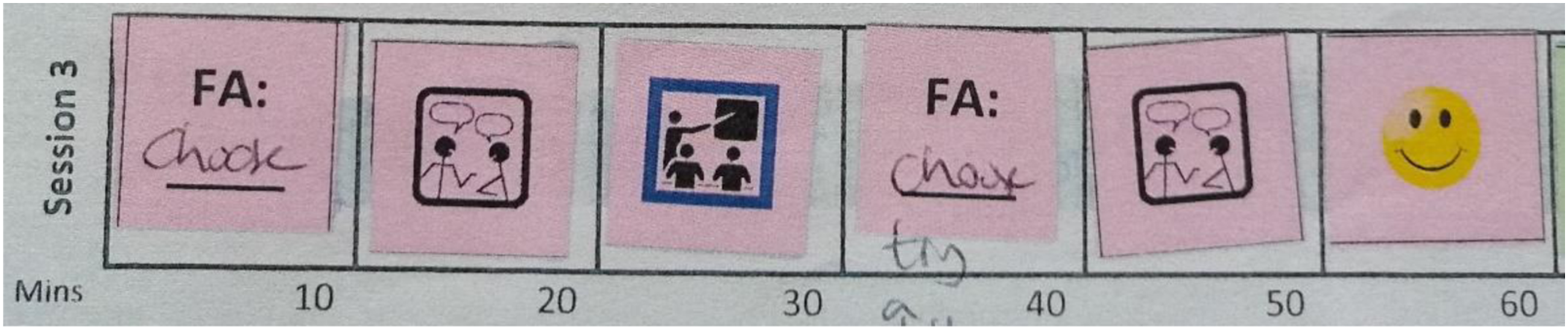
Finally, having the study participants present their ideas visually in the form of a whole course design made the influence of and similarities with existing approaches much more evident. For example, some of the mindfulness courses created appeared to follow the format of the Mindfulness-Based Stress Reduction and Mindfulness-Based Cognitive Therapy courses, and included similar elements. This can be seen in the fourth session of the course created by participant IN07 (Figure 5). This session begins in the same way as Mindfulness-Based Stress Reduction and Mindfulness-Based Cognitive Therapy: with a mindfulness practice followed by a group discussion (“check in”). It goes on to include mindfulness meditation practices that are standard features of these existing courses: the focused attention practice and open monitoring practice (“FA” and “OM” respectively in Figure 5). Having a clear awareness of these influences is important because it could affect the implementation of a new brief mindfulness-based intervention. The ‘buy-in’ of department managers and staff delivering mindfulness courses as well as course attendees is essential and attachment to existing approaches may suggest resistance to alternatives. IN07 – session four.
Study 2: A Qualitative Study Using INDIGO with Focus Groups
In the second study 12 people were recruited using snowball and convenience sampling methods to focus group discussions (one group of 7, one group of 5) about the prototype plan for the brief mindfulness-based intervention. The intervention plan was displayed on a flip-chart size version of INDIGO (approximately 80 × 58 cm), using the same intervention element tokens as with the previous INDIGO study, in order to provide participants with a visual representation of the intervention plan. Participants were provided with post-it notes so they could add comments to the INDIGO chart. A version with movable tokens (fixed to the chart with Velcro) was then provided so that participants could make physical changes to the prototype plan to aid discussions. The discussions were audio-recorded and the transcripts were analysed but the INDIGO charts were not analysed.
INDIGO proved to be a useful aid to the discussions as it enabled participants to clearly see all of the mindfulness course elements, how they related to one another and how they combined into specific sessions and the course as a whole. Participant responses to INDIGO were positive overall: “This is a great idea, having it all out like this. It works so well. It's very visual, it makes a lot of sense” (female mindfulness teacher) and “It's a terrific way of organising it… I think it's really good” (male mindfulness teacher). In the first focus group one participant fed back that it would have been useful to have the information about the course elements and their meaning prior to the focus group meeting: “I need time to digest and I haven't, so that’s causing a bit of, not anxiety, but I'm not completely comfortable with this” (female mindfulness course attendee). A written summary of the course plan had been shared in advance but it would have been helpful to also share the symbols used on the INDIGO tokens and their definitions in advance. This information was provided in advance to members of the second focus group as a result of this feedback.
Participants said they enjoyed the interactive aspect of INDIGO and moving the Velcro tokens around allowed them to try out several possible changes to the prototype plan. Being able to move physical objects around (in this case the card tokens) serves to ‘extend’ the mind, and enables thinking with the brain, eyes and hands (Paul, 2021; Vallée-Tourangeau & Vallée-Tourangeau, 2016). In fact, use of such objects does not just support thinking, it is thinking: “thinking is an embodied activity embedded in a physical environment” (Vallée-Tourangeau & Vallée-Tourangeau, 2016). While our previous online survey study (Birtwell et al., 2021) asked participants to consider which elements a brief mindfulness course should include, thus representing the course mentally, INDIGO enabled participants to create a physical representation of a mindfulness course. Representing problems or concepts physically and physically manipulating elements can reduce the cognitive demands of holding an idea in the mind (Vallée-Tourangeau et al., 2016). Physical interactivity can also lead to new insights: “The genesis of insight can be understood as an enacted phenomenon produced through the interactivity that couples an agent to the material world.” (p. 202, Vallée-Tourangeau et al., 2016) or more simply, “Insight becomes outsight.” (p. 824, Vallée-Tourangeau & March, 2020). The physicality of INDIGO therefore supported embodied cognition, insight generation, and was well-received by participants.
Discussion
In this article, we have demonstrated how the novel INDIGO method can be used to enable stakeholders to contribute to intervention design. The use of INDIGO supported participants to consider a brief mindfulness-based intervention from a whole-intervention perspective, revealing important insights about how mindfulness course elements and brief mindfulness-based interventions are perceived, and the different ways of constructing a brief course. The physical interactivity of INDIGO supported the generation of these insights.
INDIGO emphasises the location of the data, in this case the mindfulness course content, as situated within time and space, thus cementing INDIGO as an inherently mixed method containing intertwined qualities and quantities. This article contributes to the field of mixed methods research in three main ways: by extending the scope and utility of timelining and storyboarding to produce INDIGO, a new inherently mixed method for involving stakeholders in the design of interventions; by using an inherently mixed method to bring structure and creativity to the intervention design process; and by providing a clear description of the components and use of INDIGO so the method can be used by other researchers or intervention developers.
By adding pre-set time markings and storyboarding (through the use of the tokens) to timelining, we have enhanced the visual aspects and maximised the creative potential and wider applicability of timelining. These developments have also significantly extended the mixed methods potential of timelining, which was previously considered to be undeveloped (Bazeley, 2016). Within the scope of intervention design these developments allow for a more holistic understanding of complex interventions. INDIGO supports participants to consider not just what elements to include, but how much, and in what combination. This provides researchers with opportunities to look at the balance and flow of elements across an intervention and to consider the style of intervention approach including any similarities with existing interventions or approaches. Through INDIGO our study has applied inherently mixed methods to intervention design, an area often overlooked in the literature (Rousseau et al., 2019). Importantly, INDIGO brings structure and creativity to the design process, thereby addressing the challenges of intervention design (Rousseau et al., 2019).
In the empirical studies INDIGO was used successfully by participants to 1) construct a brief mindfulness-based intervention and 2) discuss a subsequent prototype intervention plan and propose changes. Participants reported that using INDIGO was interesting and enjoyable, although it could be time consuming. Preparation of INDIGO may also be time consuming for researchers/intervention developers, and this is discussed further below. The time required for completion by participants will depend on the type of intervention being designed. Some participants may prefer to have more time to look through the key for tokens to understand the meaning of each element. Taking the INDIGO chart away and completing the task in their own time may provide participants with more time for reflection, and as suggested by Bremner (2020), could therefore enhance the quality of the data. Additionally, depending on the type of intervention being designed, participants may or may not need to have prior knowledge and experience of similar interventions. This should be determined by the research team or intervention developers.
INDIGO is a flexible method that can be adapted according to the needs and expertise of the research team. It can be used to design new interventions or to make adaptations to existing interventions. The INDIGO chart can be used to prompt discussion with individuals or with groups as part of interviews; it can be used as part of a consensus methodology; and it can be used with patient and public involvement (PPI) or “User” groups.
Within the first study INDIGO was stakeholder-led, whereby the stakeholders designed their own intervention individually. However, in the second study INDIGO was researcher-led: INDIGO was used to display our prototype brief mindfulness-based intervention so focus group participants could discuss it, provide feedback, and make suggestions for changes. The INDIGO charts can be analysed as data in their own right, or alongside additional textual data from worksheets or interview transcripts. The INDIGO charts can also be used as prompts for interviews, either with individuals or groups. INDIGO is versatile and lends itself to different methods of data analysis depending on the needs of the project. For example, the first study employed both qualitative content analysis (Elo & Kyngäs, 2008; Sandelowski, 2000) and polytextual thematic analysis (Gleeson, 2011). In addition, the timestamps on the timeline may be changed or even removed if specific timings are not required, e.g. if designing a booklet the timestamps could be removed or the timings changed to text length. Thus, the balance between the qualitative and quantitative aspects can be adjusted according to the requirements of the task. Importantly, INDIGO is an accessible method that can be used across a broad range of fields, for example physical health, education, international development, work and management.
With regard to the practicalities of preparing and using INDIGO, cutting out the card tokens was time consuming. A similar effect could be achieved by printing the element icons on sticky labels. The tokens need to be intervention specific so thought needs to be given as to what icons or images would be most meaningful for each specific project, and an accompanying key for the tokens needs to be created. Researchers also need to ensure that participants have sufficient time to complete the task, and appropriate means of returning the INDIGO chart if the task is completed without the researcher being present.
INDIGO was created and used for our work developing a brief mindfulness-based intervention. This work was framed by a theory, evidence, and Person-Based Approach to intervention development (Yardley et al., 2015). However, INDIGO could be utilised and indeed may fit well within the paradigm of participatory approaches, which aim to empower and fully involve participants in the whole of the research process (Kara, 2015; Mannay, 2016). As INDIGO can be stakeholder-led (as described in the first study above) it aligns well with the participatory research ethos of ‘giving voice’ to participants (Kara, 2015; Mannay, 2016).
Conclusion
This article describes the development of INDIGO and its use within two empirical studies. INDIGO is a new method that can be used for a variety of research projects with different and combined stakeholder groups (including patient and public involvement groups) and in different intervention contexts. One of the strengths of INDIGO is that it is a flexible method that can be adapted to the needs of the research or project team. We have put forth the case that INDIGO can support the involvement of stakeholders in the intervention design process and can be of use to researchers and intervention developers in different fields. As INDIGO is a new method it is yet to undergo formal evaluation. Future work could therefore include a formal evaluation of INDIGO nested within an intervention development project. Further research could involve the use of INDIGO as a prompt to elicit individual interview data, as a way of adapting or abbreviating interventions, or as part of a consensus methodology during intervention development.
Footnotes
Acknowledgements
Kelly Birtwell would like to thank the participants of the empirical studies, the individuals and organisations that assisted with recruitment, and Dr Jessica Drinkwater for providing feedback on a draft of the manuscript.
Declaration of Conflicting Interests
The author(s) declared no potential conflicts of interest with respect to the research, authorship, and/or publication of this article.
Funding
The authors disclosed receipt of the following financial support for the research, authorship, and publication of this article: This research was funded by the National Institute for Health Research (NIHR) School for Primary Care Research [Capacity Building Award 8]. C.J. Armitage is supported by the NIHR Manchester Biomedical Research Centre, and C.J. Armitage and R. Morris are supported by the NIHR Greater Manchester Patient Safety Translational Research Centre. The funders had no role in the design of this study and did not have any role during its execution, analyses, interpretation, and storage of the data or decision to submit results. The views expressed in this publication are those of the authors and not necessarily those of the NIHR or the Department of Health and Social Care.
