




Abstract
Realist evaluation is a method increasingly adopted to provide an understanding of how and why a program works, for whom, and under what circumstances. Initial program theories (IPT) are the crucial starting point of any realist evaluation, however descriptions about how they are developed in practice remain under-reported in the published literature. This article argues for the value of genuine research-group conversations using David Bohm’s concept of dialogue in realist research. We label it the realist dialogic approach. We draw out the relational qualities as well as the contextual circumstances of dialogue through our development of IPT and interview guides for a research study on the implementation and scaling of a large-system value-based program to transform complex health services. We selected the relevant middle-range theories, conducted a literature review, and drew on informal discussions with key stakeholders, to develop IPT through research-group conversations. The benefits of this approach were: 1) development of rigorous, novel, deep and well-tailored IPT, 2) detailed understanding of the complex intervention under investigation and development of rapport and networks with participants, 3) empirically grounded Context-Mechanism-Outcome (CMO) configurations, predicated on suitable abstract and contextually-contingent middle-range theories, and 4) productive research team interactions which supported the entire research process. The challenges of this approach include: 1) establishing and retaining a sense of humility across the research team, 2) contextual circumstances can hinder dialogic relationship, and 3) time and resource heavy. This paper uses middle-range theory and ethnographic insights to advance the existing practice of realist evaluations and offer transferable lessons to other scholars considering similar approaches. Moreover, we content that the use of middle-range theory to extend the methodological literature is a novel contribution to realist work.
Keywords
Introduction
Glossary of Realist Methodology Terms.

We argue for the value of a genuine research-group conversations using David Bohm’s (2013) concept of dialogue in realist research. We label it the realist dialogic approach. This article extends the existing knowledge base by focusing on our dialogic approach to surface and develop IPT and interview guides. First, we introduce the existing literature on IPT development. Second, we discuss the approach we employed to develop IPT for our realist evaluation on the implementation and scaling of a large-system value-based program to transform a complex health system within a state-wide program in New South Wales (NSW), Australia: Leading Better Value Care (LBVC) (Sarkies et al., 2020a; Sarkies et al., 2022). Finally, we provide a critical discussion of the benefits and challenges of the realist dialogic approach coined and adopted by our research team to create IPT and interview guides to underpin a realist evaluation.
Existing Methodological IPT Guidance
Developing IPT is an essential step in a realist evaluation, yet they are under reported, wide-ranging and can be difficult to develop. An IPT can be built using multiple sources (Shearn et al., 2017) – including systematic literature reviews, stakeholder interviews (Mukumbang et al., 2016), assessing program documentation, and realist synthesis (Flynn et al., 2020) – offering researchers flexibility in their approach. Scholars (Fick & Muhajarine, 2019; Flynn et al., 2020; Shearn et al., 2017) have recently begun to detail their methods for building IPT in realist evaluation and synthesis for the purpose of encouraging consistency of realist principles, and transparency and debate of realist practice.
While Realist and Metanarrative Evidence Synthesis: Evolving Standards (RAMESES II) established quality standards for realist evaluation (Greenhalgh et al., 2017a; Wong et al., 2017) including a short guide on developing realist program theories (Greenhalgh et al., 2017c), they do not offer detailed methodological guidance and discussion which is helpful in developing realist method. For instance, while the RAMESES II standards recommend that program theory is in realist terms (Greenhalgh et al., 2017a, p.4), it is not clear how a researcher might go about creating realist CMOs from stakeholder discussions.
Shearn et al. (2017) argues for early adoption of grand or middle-range theories to aid building IPT in large, messy and complex interventions. Shearn et al. (2017) outlines four approaches for building IPT which can be used singly or in combination; 1) using middle-range theories to inform current or comparable programs, 2) using concepts from middle-range theory that are selected purposely for realist evaluation by the research team but have not been referenced in the program, 3) systematic literature search and extract potential initial program theories from similar interventions and 4) potential initial program theories using informal stakeholder interviews or discussions, documentation of current programs, or using professional knowledge within the research team. Past authors (Flynn et al., 2020; Shearn et al., 2017) have contributed to this methodological conversation further by discussing some of the challenges in using data-driven approaches to develop IPT such as a) identifying what is already well established in the existing literature, b) generating an overabundance of candidate theories, and c) developing theory that may be unstructured.
Realist Dialogic Approach
Realist research is commonly performed by groups (either within research teams and/or with external stakeholders), and at various points of the methodological timeline realist research requires dialogue (for instance, developing and refining IPT). The international realist community places value on the importance of in-depth conversation of realist research, evaluation and methods through various avenues such as the JSCMAIL via RAMESES email group (https://www.jiscmail.ac.uk/cgi-bin/webadmin?A0=RAMESES) and, international conferences (e.g., https://realist2020.org/). Multiple authors (Flynn et al., 2020; Greenhalgh et al., 2017c) discuss the information collected in team meetings, using these forums to build IPT. This indicates the importance and recurring utility of IPT conversation in research teams.
Scholars (Frank, 2005; Metcalfe, 2013) argue that methodological problems arise from a subjective social relation between researcher and participant and point to the ethical and practical imperatives of dialogic social relations in research contexts. Yet little attention has been paid to dialogic relationships within teams of researchers. Moreover, to the best of our knowledge, the concept of dialogue has not been explored in the realist evaluation literature. Etymologically, dialogue is made up of dia meaning ‘through’ and logos meaning ‘the word’. David Bohm (Bohm, 2013, p. xix) describes dialogue as ‘a new kind of mind’ which carries and is carried by participants. Bohm’s concept of dialogue is not simply an exchange, a defence of previous ideas or a summative discussion. Rather, dialogic social relations allow participants to have thoughts and ideas that they could not have had on their own while recognising them as an extension of their own thinking.
This article argues for the value of genuine dialogue in realist work. Here, we demonstrate that a group dialogue is an advantageous step in building realist-orientated, theory-informed, evidence-based IPT. We provide a critical discussion of the benefits and challenges of the realist dialogic approach adopted by our research team to create IPT and interview guides to underpin a realist evaluation. We elaborate on the process of, and the social dynamics involved in, developing IPT within research team meetings, including the types of questions asked, the interpersonal dynamic, the environment established, and the resources used. Middle-range theory which is typically used to develop program theories in realist work, is used here in conjunction with our ethnographic insights of our approach to offer an advancement on realist evaluation methods, and transferable lessons to other scholars considering the same approach.
A Case Exemplar
Summary of the multi-level implementation package for the LBVC program (Sarkies et al., 2020a).
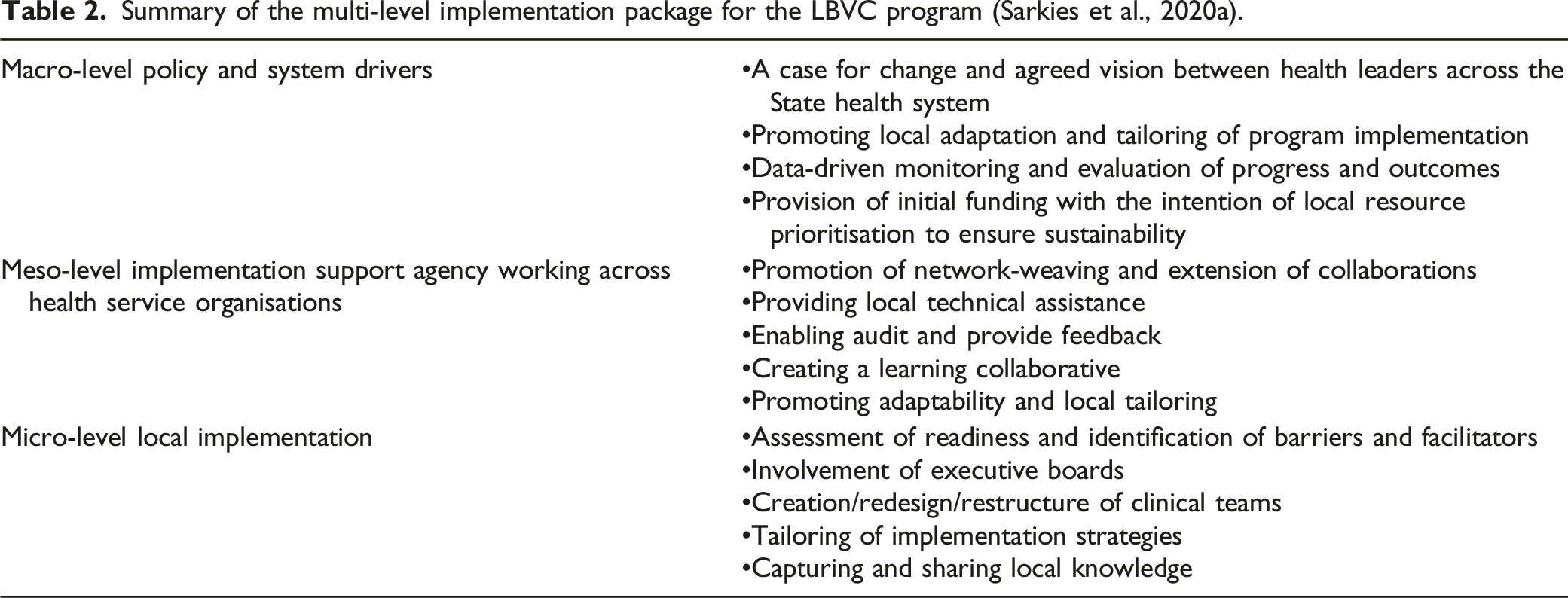
Our realist evaluation examines seven of the eight tranche one LBVC initiatives which have the potential to reduce unwarranted variation in clinical practice. Three initiatives address the inpatient setting (chronic obstructive pulmonary disease, osteoporosis refracture prevention, inpatient management of diabetes), two initiatives focus on ambulatory outpatient care (diabetes high-risk foot service, osteoarthritis chronic care programme) and two initiatives are care coordination (renal supportive care, chronic heart failure) (See (NSW Health) for further details regarding the aims of each initiative). Underpinning the package, rigorous clinical evidence supports the models and standards of care being implemented however as is well known, even effective interventions will not become routine practice passively (Sarkies et al., 2021; Sarkies et al., 2020b). The evidence-based implementation program including strategies such as audit and feedback, have a general evidence-base, however the causal mechanisms driving these implementation strategies, and processes to scale interventions, as well as the variations in context that link these causal mechanisms with outcomes remain less understood. This presents unique challenges for the implementation of this system-wide programme at scale. Our realist evaluation will provide information guiding the scale up and replication of interventions in other local context in similar large-system projects.
Realist Dialogic Approach for IPT Development
We engaged in four main phases to develop IPT including: 1) gaining an understanding of relevant theories, 2) literature review, 3) informal discussions with key stakeholders and 4) dialogical group conversations (Figure 1). While we have presented our IPT development as discrete phases, in practice there was some degree of overlap between them. This iterative and cyclical approach is commonplace in realist evaluations, allowing researchers to return to previous literature as research understanding deepened (Wong, 2015). The four phases for IPT Development.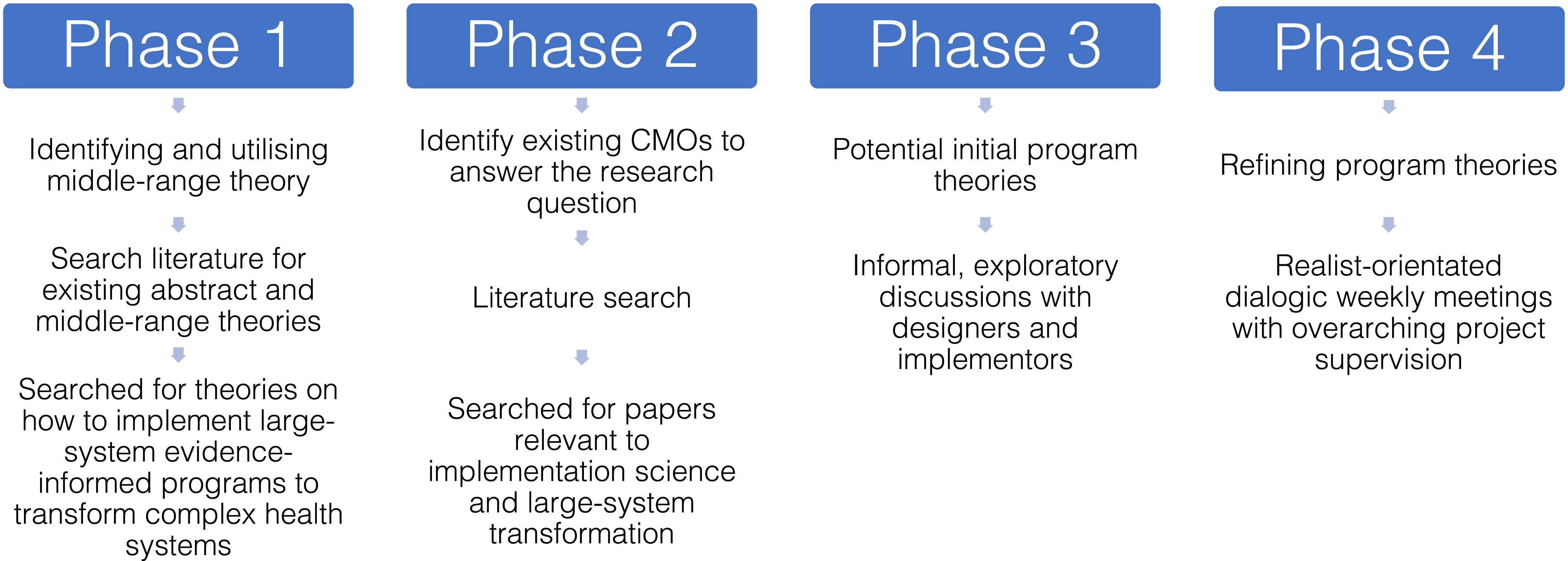
Development of Initial Context-Mechanism-Outcome Propositions
Phase 1. Identifying and utilising middle-range theory
This phase began by a purposive search for relevant abstract and middle-range theories to support and further our understanding of the implementation and scaling of large-system value-based programs to transform complex health systems. We followed an adapted version of Shearn et al. (2017) approach to selecting middle-range theories. Like both Westhrop (2012, 2013) and Shearn et al. (2017), the conceptual framework needed to consider social structure and multiple layers of overlapping context (individual, interpersonal, institutional, infrastructural, and cultural).
Drawing on our experience of similar programs, the publicly available documents about the LBVC programs, the research team’s existing theoretical knowledge, and a literature search, we identified 23 potentially relevant explanatory theories from the implementation science, psychological, sociological, health organisation and management, health services research, health policy and health systems literature. The research team (EFA, MS, JL, CP, H-MN, RH) was made up of experienced health services researchers with diverse academic backgrounds, one sociology (EFA), two with clinical (MS, JL), one psychology (CP), and a research assistant (H-MN). An experienced realist researcher (RH) actively mentored the core team and validated work.
These theories were then appraised according to two criteria: 1. Ecological level within the social system that they offered explanatory power (e.g., micro individual, meso organisational, and macro system). 2. The extent of theoretical explanatory power for the current research project. Specifically, theories that would be relevant to explain particular implementation strategies given the concepts and putative mechanisms we had identified. Frameworks to categorise, organise, and process models that outline steps considered important for successful implementation were excluded (Shearn et al., 2017, p.6)
Three middle-range theories were selected through team discussion and mobilising expertise that best fit the pre-specified criteria. These were: the Capability, Opportunity, Motivation model of Behaviour change (COM-B) (Michie et al., 2011) at the micro individual level; organisational readiness for change theory (Armenakis et al., 1993) at the meso organisational level; and complexity theory at the macro systems level (Braithwaite et al., 2018, 2019; Byrne, 1998; Plsek & Greenhalgh, 2001).
Context-Mechanism-Outcome configuration- Leadership as a worked example*.

* Note: This table contains only initial program theory and does not represent the final theory for the influence of leadership on program implementation.
Phase 2. Literature review
Following the selection of existing abstract and middle-range theories from the literature, we undertook a review of the peer-reviewed literature to identify existing CMOs for large-system evidence-informed programs to transform complex health systems. Large-system implementation literature was identified from PubMed and Google Scholar electronic databases combining search terms relevant to implementation science and large-system transformation. Reference lists of relevant articles were scanned to identify further articles. We identified 34 key papers relevant to our project. We found, as others have (Flynn et al., 2020), that the literature only offered incomplete CMOs. All 34 papers did not contribute fragments to every CMO, and some were more useful than others as certain papers were closely aligned to our study. For example, Best et al.’s (2012) discussion on designated and distributed leadership informed multiple CMOs within leadership (see Table 3 for example).
Phase 3. Informal, exploratory discussions with designers and implementors
The core research team conducted eight informal, exploratory discussions with 14 purposively selected research partners or delegates, for the purpose of extracting potential initial program theories from people involved in the program (implementation support staff) or experts in the content area (clinical network managers) from the NSW Ministry of Health (macro-level) and Agency for Clinical Innovation (meso-level). We selected informants based on their position, and after the discussion asked them to recommend other knowledgeable individuals (snowballing).
Researchers sought to understand how the implementation of the initiatives worked or not. Researchers did not audio-record the discussions, with only notes being taken, as verbatim quotes are not necessary for the generation of CMO configurations. Informants agreed for their information to use to build IPT which would then be presented to participants. Each substantive comment made by informants was captured by CP in written form, with the notes amassed more than 8000 words in total across the 14 informants. EFA and/or MS checked the notes to ensure they were a credible record of the session.
In the data collection phase, all 14 informants provided verbal audio-recorded informed consent for a semi-structured interview where they had the opportunity to confirm, refute or refine the IPT (Macquarie University Human Research Ethics Committee Project ID 23816). These discussions also allowed us to build rapport with informants, who later participated in semi-structured interviews. We did this by purposefully structuring the conversation in a way that would build rapport. For example, multiple stakeholders and researchers took part in single discussions rather than a one-on-one environment, which facilitated a synchronous two-way (researcher/stakeholder) group conversation. This synchronous exchange allowed the researchers to build upon responses, disclosures, and discussion in a way conducive to a depth of explorations that would otherwise be harder to achieve through asynchronous information exchange characterised by program documentation review. In addition, collective conversations facilitated recollection, sharing of experience and examples and ‘sparking off each other’, whereby stakeholders built or contradicted the views of others; all very supportive IPT building activity. Researchers dedicated substantial time to rapport building conversation, and only progressed to open questions once adequate conversation flow had been established.
Phase 4. Dialogic discussion
Phases 1-3 (theoretical search, literature reviews and informal stakeholder interviews) produced useful information on which we could base our group dialogue. The core team (EFA, MS, CP) – each from a different disciplinary background (sociology, physiotherapy/implementation science, psychology respectively) – under supervision from JL and RH – met twice weekly (60 minutes per meeting) and also reflected on newly formulated CMOs individually prior to the weekly meetings. The senior research supervision was particularly important during this phase of IPT development. The supervisors stewarded the group through the process by providing ‘hands-on’ support to keep the research team ‘on-track’ where required and ‘hands-off’ guidance that allowed the time for expansive thought.
The program theories were built through a group dialogue between the core team in our weekly meetings where we brought together the information collected in Phases 1-3. Our conversations also drew on abduction; that is, researcher-informed guesswork and hunches that led to novel ideas for generating theories and testing possible mechanisms (Jagosh, 2020). We began the process by having one member of the team present their potential IPT in a tabulated word document in advance of the meeting. Table 3 outlines an example structure for some of these IPT about the influence of leadership on the implementation of the program.
The remaining team members read through the potential IPT and documented their feedback individually, presenting their feedback to the core team at the weekly meetings. During our meetings, the core team would flesh out and unpack the potential IPT through group dialogue which gave us an opportunity to clarify the literature, draw out the implications of key concepts and strategies, explore the empirical scope of issues and create, test and refine the logic of our CMOs.
There was some variation in how well supported the CMOs were and instances where sources contradicted one another. We discussed and resolved the latter by relying on the source that was best placed to comment on the CMO (i.e., informal discussions with key stakeholders). We did not capture this variation in our audit trail nor did we quantitively keep track of instances when sources contradicted one another as that level of documentation would have been too onerous for the early stages of IPT development.
Doing Dialogue
We posed questions regarding both the content and the configuration of the CMOs to one another to gain a greater understanding, resolve misunderstandings or disagreements (e.g., ‘What do you mean by influence? Let’s flesh that term out’ ‘Where does influence come from? What would Bourdieu say?'). We engaged in an open dialogue and though the process was not formalised, there were times when we were acutely aware of the need for turn taking so that everyone was included.
We edited the CMOs in a tabulated document in Microsoft Word on a central screen in our meeting room in real time during our collective brainstorming sessions (see Table 3 and Figure 2). As the language and logic of IPT is critical, we found it beneficial to have CMOs in a visually prominent position so we could read them out loud and unpack particular words, clarify our meaning and firm up Cs and Ms and Os and the logic between them. Writing, thinking and conversing about the IPT was aided by having the table, our questions and conversations centred around the draft CMOs projected on the wall in front of us and editing them in real time, stimulated deeper thought and conversation about the underlying assumptions of our program theory. The large visual presence of the CMO table also signalled to the team that this was the focus of our conversation, and largely prevented minds wandering from what often felt like a daunting task. The ideal environment for IPT development would include having a private quiet space, free from distractions and interruptions, to engage in and maintain a dialogue though transient interruptions are unavoidable. CMOing in action.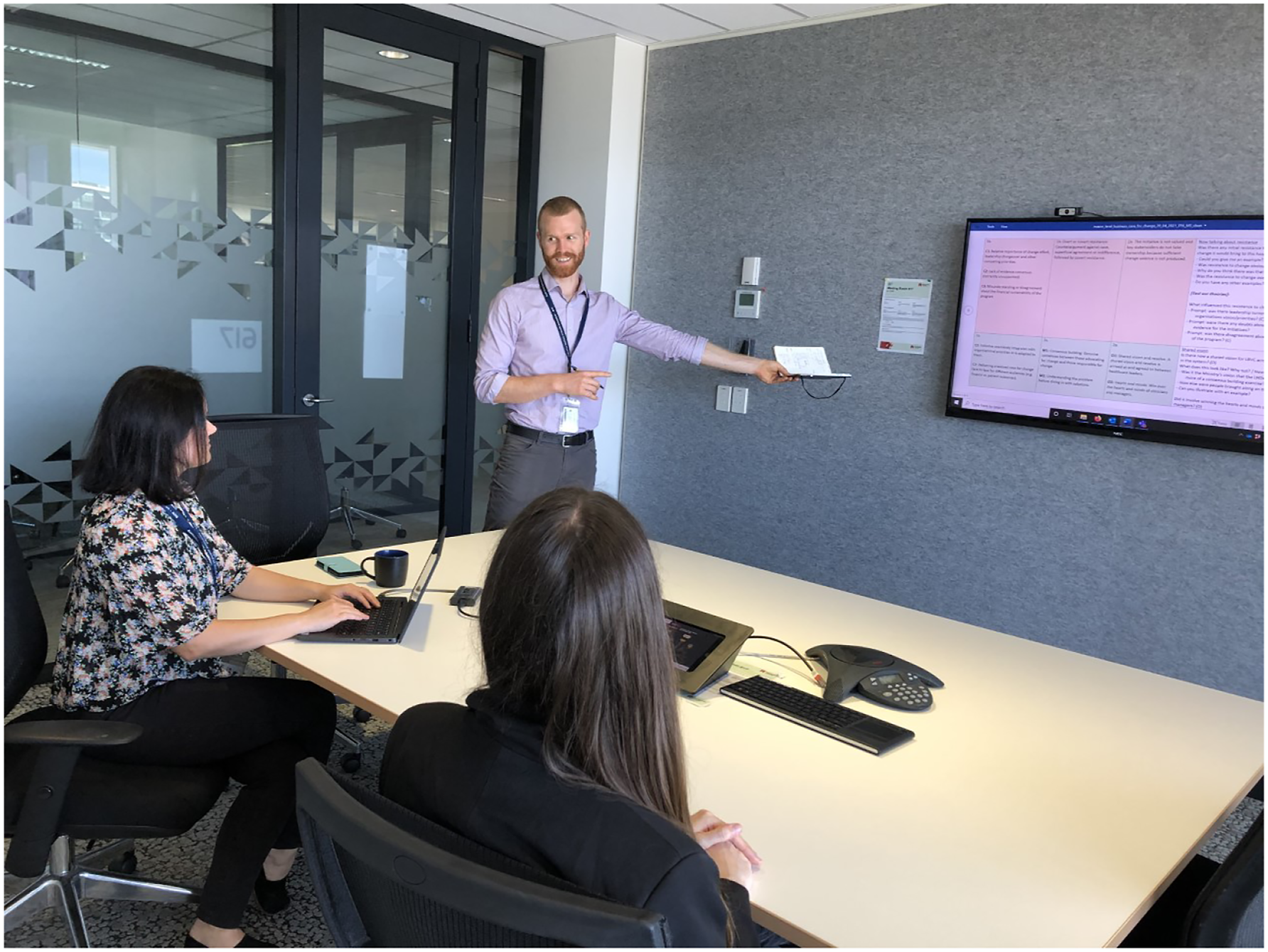
Over time we also developed a routine that involved meeting weekly; the same spatial environment, aids (e.g., table), participants and structure provided us with a sense of continuity, familiarity and momentum to establish and maintain group dialogue.
Cultivating a respectful, genuine and open core team dynamic was essential to the productivity of our dialogic conversations. The social logic of the group dynamic changed over the course of our meetings from a self-conscious and individualistic approach to a fluid, collaborative and open dynamic. For instance, in the first meeting and having never created a CMO before, the member who prepared our tabulated CMOs expressed concern about ‘not getting the CMOs right’ at the outset. In response the remaining team members acknowledged the difficulty of the task and that their own attempt would not be superior. At the following meeting, the same member jokingly invited the others to ‘tear me to shreds’. Our approach to CMO formation started out with one member sharing underdeveloped but necessary initial ideas, in an individualistic, self-conscious and self-protective way. Importantly, for the purposes of developing a dialogic relationship, the remaining members met that understandable fear of critique and judgment with support and reassurance. We had not worked together before, but the three team members, who held similar academic ranks, developed trust organically over time through increasingly candid conversations of common professional topics/issues.
After establishing trust amongst the members and a routine, we observed that our approach to CMO formation had shifted; we used the prepared program theory as a talking point, puzzling out loud, asking each other how and why questions, listening to each other’s thoughts/ideas/sentences and developing them further or sitting comfortably thinking in silence, mulling over possibilities and connections between a C and an M or an M and an O. The dialogic relation allows for ideas to be proposed without fear of reprisal, so members regularly proposed alternate theories. We also discussed our CMOs with JL and RH who were both external to the core group.
Context-Mechanism-Outcome configuration and interview guide - Leadership as a worked example.

After creating questions, we spent time discussing whether the questions would make sense to macro, meso and micro-level participants, if the language was appropriate, and if the question was too complex. We refined our draft interview guide with our supervisors (JL and RH) through conversation. We also role-played the interview guides together rotating the role of interviewer, interviewee and observer which gave us an opportunity to test it and practice asking scripted as well as spontaneous realist questions.
Discussion
This paper argues for the value of a realist dialogic approach which involves genuine research-group conversations using David Bohm’s (2013) concept of dialogue in realist research. We suggest that a dialogical research team dynamic established at the outset of the project (e.g., developing IPT) will be useful throughout a realist research process. We found that a realist dialogic approach to developing IPT presents four benefits and three challenges which we will discuss below.
What Worked Well and Why
We found that the four-phase approach to developing IPT was comprehensive for four reasons. First, it allowed us to develop rigorous, novel, deep and realist orientated IPT under circumstances of minimal access to program documentation. This was achieved by canvassing the current literature, allowing us to identify existing CMOs from similar programs providing a comprehensive grounding of the CMO configurations and offered reassurance and alignment with the field. To develop our IPT further, and avoid the pitfall of rediscovering what is already well-established in the literature (Flynn et al., 2020; Shearn et al., 2017), discussions with stakeholders allowed us to add new CMO configurations which were specific to the program and localised context under investigation. This phase also allowed us to complete any partial CMOs, thus mitigating the problems encountered by focussing solely on the literature (Flynn et al., 2020; Shearn et al., 2017). Second, from a methodological point of view, we gained a greater understanding of the structures and processes of the program under investigation, and we were able to develop rapport and networks with stakeholders which aided us in our subsequent formal data collection process. Third, research team conversations based on the literature, informal stakeholder discussion and middle-range theory allowed us to create complete CMOs which were empirically grounded, predicated on suitable abstract and middle-range theories, and contextually-contingent.
Fourth, the open, collaborative group dynamic formed between the core research team in the early stages of the study, was utilised and beneficial throughout the duration of the study, particularly during data analysis. Group talk of professional topics allowed us to identify common ground and form as a group. Holding similar academic ranks and starting from the same level with realist work and establishing trust meant that it was easier to engage in a dialogical relationship with each other because there was understanding and acceptance of our collective vulnerability. This context and relationship was important in developing what Winnicott (1991) refers to as a holding environment; a stable sense of support that allowed us to be responsive to one another’s thoughts and questions about CMOs in a way that kept us open to the reflexive dialogue. Our ethnographic observations reflect the shift in social logics that Bohm (2013) refers to; the first initially based on self-consciousness where individuals feel they need to hold onto or defend their own ideas which results in a summative approach of adding perspectives. The second approach was based on our ability to hear the differences offered by other team members without feeling disrespected or focusing on who said it. A realist dialogic approach enabled us to stay present to emerging, back and forth dialogue and allowing our ideas around CMO connections to re-form around new beginning points. This point in conversation is reached because of a sense of a common purpose, that no one person can have all the answers, and a shared understanding of the intrinsic and inherent value of dialogue for generating new knowledge.
Establishing a dialogue in the IPT development reduced the potential risk of one or few perspectives dominating the lines of inquiry allowing a genuine dialogue between whole people and disciplines (sociology (EFA), psychology (CP), and applied clinical practice and implementation science (MS)). The core team learnt and taught each other about realist work and middle-range theory which created a camaraderie within the core team. Victor Turner’s (Turner, 1969, 1974) concept of communitas is particularly relevant here, Turner identified communitas as a community based on egalitarianism and comradeship amongst all new members as they jointly undergo a rite of passage. Communitas engenders an “unmediated relationship between person and person, a relationship which nevertheless does not submerge one in the other but safeguards their uniqueness in the very act of realising their commonness” (Turner, 1974: 274). The intense feeling of togetherness and belonging, as well as the lack of norms and expectations enables initiates to explore new ideas and connections. Part of the sacredness of this period is the transient humility it engenders. The dialogic dynamic and a Turneresque communitas was fundamental to the creation of IPT allowing us to think together and think differently at the same time. It also established the foundations for an ongoing dialogic team, which was integral for data collection, analysis and dissemination activities.
Realist interviews are theory-driven and based on the teacher-learner cycle (Pawson & Tilley, 1997). The role of teacher and learner are fluid within realist interviews: the interview starts with the interviewer teaching the program theory to the interviewee and then the interviewee adopts the teacher role by explaining to the interviewer (now in the role of learner) how the program works (or not) in real life (Pawson & Tilley, 1997). Manzano (2016) astutely points out that applying the same or similar interview questions to every participant is not in keeping with realist thinking which posits that the questions will change as the interviewers’ knowledge develops. We found that realist interviewing required a considerable amount of ‘thinking on your feet’ and practicing interviews together within a dialogical relationship allowed us to set aside our prepared questions and focus on crafting new realist ones that emerged from the call and response of interview (Metcalfe, 2013). More broadly, our dialogical relationship established at the outset of the project, has been integral to each step in the realist study, including IPT development, design of study aids, data collection, analysis and dissemination activities.
Challenges of a Realist Dialogic Approach
Reflecting on a realist dialogic approach, we outline three main challenges we encountered: 1) dialogic conversation was dependant on humility amongst team members, 2) contextual circumstances can hinder dialogic relationship, 3) the process was time and resource intensive.
First, the dialogic conversation was dependant on humility amongst all members of the research team. Our self-conscious and individualistic approach to IPT development initially is reminiscent of Erving Goffman’s (1959, 1967) performance-based logic of social interactions. These ethnographic insights demonstrate that researchers may employ avoidant and corrective face-saving processes when they fear evaluation, expectation, or judgement (Goffman, 1959; 1967). Trust within the group was established through common academic rank and experience, however we do not wish to imply that those with different academic rankings are unable to engage in dialogic relationships, rather we wish to emphasise that the mechanism of the dialogical process is humility of all participants. Humility could be easily misinterpreted as a lack of professional competence, but humility allows new connections to emerge from group dialogue. While dialogical meeting calls for a humility and openness, professional identity can demand a display of imperturbable control, as if the researcher already knows what to say before any particular situation has arisen. Indeed, effective dialogue occurs in respectful relations; that is, when those in senior positions are mindful to not impose themselves or their agendas, on others and those in junior positions are confident enough to voice their ideas. We believe dialogue is possible in solitary desk-based realist research too. Metcalfe and Game (2008) argue that solitary workers can develop the mature capacity for reflexive dialogue by finding inspirations through their own otherness, and in their openness to the back and forth of their own feedback.
Second, the contextual circumstances can hinder dialogic relationships. We began IPT development in face-to-face meetings but then transitioned to online meetings as the COVID-19 pandemic unfolded. We noticed that it was harder to establish and maintain dialogical relation with the team slipping into identity-based logic more easily. We struggled to read each other’s non-verbal cues while meeting online; for example, silences were often misinterpreted, and gestures were hidden from view.
Third, our IPT development took 6 months and required three research staff members, realist specific training and twice weekly meetings. The time and space required for dialogical talk was more resource intensive than we had anticipated, and it required significant planning and coordination to participate collectively as a group in developing IPT. This challenge is consistent with other approaches to IPT development, including Flynn et al. (2020) who developed IPT through realist synthesis over a 15 month period using a research librarian, three research staff, realist training, and weekly core research team meetings.
While it is possible that the significant time and resources demands are the result of a dialogical approach, it may well be that any form of comprehensive and novel IPT development is inherently resource intensive. The implication being that this may not be a limitation of our approach. Realist theories should, at some level, be portable and thus well-articulated realist theories - for example in leadership in large scale transformations - could be the starting point for other realist research teams, thereby potentially shortcutting the development time.
At the heart of our study are researchers fostering and maintaining trusting and respectful relationships within the research team. Specifically, we point to the importance of engaging in dialogical conversations where researchers variously unpack, extend, question, and reconsider IPT. We suggest routines and practical measures or aids will help facilitate this process such as securing an appropriate space, crafting and/or utilising appropriate aids, establishing a regular routine, as well as fostering trust and enduring relationships with your participating team members.
Conclusions
In this article, we labelled and presented our realist dialogic approach which we used to develop IPT and interview guides for a realist evaluation on the implementation and scaling of a large-system value-based program to transform a complex health system. We also point to the utility of using middle-range theory to inform methodological insights, improving the transparency and future guidance of IPT development. Developing IPT through a dialogical approach meant that we built defensible, novel, deep and well-tailored IPT, developed a detailed understanding of the complex intervention under investigation and rapport and networks with participants, empirically grounded CMO configurations, predicated on contextually-contingent, abstract and middle-range theories. A productive group dynamic supported the research process. A realist dialogic approach requires humility amongst team members, supportive contextual circumstances and an appropriate allocation of time and resources. Where it suits the design and purpose, we recommend realist researchers engage in genuine dialogic team conversations within conducive environments to facilitate the process.
Footnotes
Authors’ Note
EFA was responsible for conceptualising the overall paper and completing the first draft. MS, CP, and JCL provided the initial edits to the draft. EFA was responsible for re-drafting in response to initial edits. EFA, MS, JCL, CP, RH, and JB were then responsible for writing the final versions of the manuscript. All authors read and approved the final manuscript.
Research team members involved in this research include Natalie Roberts, Andrew Partington, Johanna Westbrook, Richard Day, Jean-Frédéric Levesque, Rebecca Mitchell, Frances Rapport, Henry Cutler, Yvonne Tran, Robyn Clay-Williams, Diane E Watson, Gaston Arnolda, Peter Hibbert, Reidar Lystad, Virginia Mumford, George Leipnik, Gary Disher, and Kim Sutherland. We appreciate their expertise and involvement in various aspects of our larger realist project. We also sincerely thank the reviewers for their feedback and direction in revising the paper.
Declaration of Conflicting Interests
The author(s) declared no potential conflicts of interest with respect to the research, authorship, and/or publication of this article.
Funding
The author(s) disclosed receipt of the following financial support for the research, authorship, and/or publication of this article: This work was supported by the Medical Research Future Fund (MRFF) (GNT1178554, CI Braithwaite). The funding arrangement ensured the funder has not and will not have any role in study design, collection, management, analysis, and interpretation of data, drafting of manuscripts, and decision to submit for publication.
