




Abstract
This study focuses on the development of a reliable coding scheme (CP-CODER) for studying interaction dynamics during the co-production of a public service involving priority communities. CP-CODER addresses the need to involve priority populations in the development of public services, an approach that has been recognized as difficult because of the high possibility of their experiencing negative health, social, and economic outcomes. The coding scheme was designed to capture group dynamics and forms of public engagement by adopting and integrating existing theoretical frameworks in the public service management and qualitative method literature. Coding was conducted on the transcripts of four co-production workshops, which included 26 family caregivers, three local health and social care service provider representatives, and five researchers involved in the co-production of new community-based services. One category was added to the two theoretical frameworks. The kappa ranged from 0.70–1.00 for the eight variables and the 26 individual items. The overall kappa was 0.91, while the overall percentage of agreement was 91.16%. The results of the pilot test showed the importance of integrating and managing three dimensions in co-producing with a priority population: the turn-taking, the content, and the level of abstraction of the discussion. The findings of this study have enhanced and supported both practitioners and researchers in co-producing services, ensuring the equal contribution of all participants, even those whose voices are rarely heard.
In the 1970s, participatory research was first introduced to encourage populations to create change and act (Bergold & Stefan, 2012; Macaulay, 2017). The value of this principle is so undeniable that ‘no one is against it’ (Arnstein, 1969). This acknowledgment of the need for public participation has resulted in several research approaches, such as participatory action research and participatory appraisal (Baum et al., 2006; Kemmis & McTaggart, 2005; Pain & Francis, 2003). Despite their relevance, benefits, and participatory approaches may reconfirm unbalanced roles, inequalities, and exclusions of priority populations (Heselton et al., 2021; Rosen, 2021). Participatory approaches are also limited because they can fail to produce social change, which may generate negative consequences among some groups of actors (Bussu et al., 2020; Newitt & Thomas, 2020). Therefore, identifying and managing interaction dynamics during citizens’ involvement practices and settings have become priorities (Olesen, 2018).
Among the several approaches used in participatory research, co-production has become one of the most frequently discussed in the social science literature (Loeffler, 2020). Interaction dynamics that occur during co-production differ from other forms of public engagement because they entail equal collaboration between citizens and providers (or other relevant stakeholders) (Batalden et al., 2016; Bovaird & Loeffler, 2013). Because it allows citizens to provide substantial and active contributions in decision-making processes, co-production promotes and encourages the principles of ethics and democracy (Thomson & Berriman, 2021). In other forms of engagement, citizens express their views (i.e., consultation) and, through dialogue and argument, participate in decision-making regarding the design and delivery of services. However, final decisions are left to providers (Loeffler & Bovaird, 2017). To explore the adoption of co-production, several studies in the social science literature have focused on analyzing interactions at the micro level, such as those among patients and clinicians in the co-production of patient therapies and treatments (Mortari & Silva, 2018; Palumbo, 2016). However, in terms of interaction dynamics, analysis at the meso level, such as citizens, service provider representatives, and other relevant stakeholders in the co-production of public services, is more challenging than analysis at the micro level, where interactions are dyadic (Petrescu, 2019). During the co-production of public services, several participants are involved concurrently in workshops or other forms of public participation, which increases the complexity and unpredictability of their interaction dynamics (Osborne, 2021).
Recent studies have focused on methods, approaches, and tools for generating service ideas during co-production workshops, even with remote collaboration (Archibald et al., 2021; Benson et al., 2021; Hall et al., 2021; Phillipset al., 2021). Other previous studies have offered practical advice to support facilitators in moving from low levels of public engagement to co-production, ensuring equal, active participation during workshops (Gheduzzi et al., 2020; Liabo et al., 2020). However, few studies have analyzed interaction dynamics and models of communication at the interface (Osborne, 2021). Moreover, they have focused only on collecting data on perceptions or encouraging a particular behavior in priority populations (e.g., (Fenge et al., 2011; Moen et al., 2010; Turner et al., 2021; Wilkinson, 1998)). Analyzing interaction dynamics is of paramount importance when priority populations are involved. The implementation of co-production with priority participants has been widely debated and considered urgent (Mulvale et al., 2019; Pacheco-Vega & Parizeau, 2018; Phillips et al., 2021; Rosen, 2021). Participants in co-production workshops are usually citizens with good education, health, and capabilities for communicating and learning in a group (Alonso et al., 2019; Ballantyne & Varey, 2006). Involving priority and marginalized populations in such activities is complex and time-consuming because of differences in power dynamics, competences, skills, and resources (Amann & Sleigh, 2021; Filipe et al., 2017; Mulvale & Robert, 2021). However, the lack of involvement of such populations leads to the risk of generating unbalanced results, thus undermining the democratic principle of co-production (Bussu et al., 2020; Clark, 2018; Fung, 2006; Weaver, 2019). Allowing marginalized populations to have a voice in the service delivery process is a way of creating inclusive and equal public service systems (Beresford et al., 2021; Radonic et al., 2021). A systematic analysis of interactions during co-production workshops for co-producing services would provide empirical evidence of what happens in terms of micro-dynamics and content during interactions involving priority populations, service providers, and other relevant stakeholders.
To contribute to the constructive enhancement of participatory approaches, this study investigated group interaction dynamics during the co-production of services involving a priority population: family caregivers of elderly people living in rural and remote areas. The aim of this study was achieved by developing and applying a reliable coding scheme, CP-CODER. This coding scheme was designed to enable a common understanding of the key factors that influence interaction dynamics at the interface among priority citizens, service providers, and other relevant stakeholders. The following sections describe the design and application of the coding scheme. The theoretical background of the coding scheme is discussed, followed by a case study on the co-production of public services in which CP-CODER was tested and analyzed.
Material and Methods
Conceptualization: Mixing Two Lenses of Analysis
This work adopted a mixed lens of analysis to develop the conceptual coding scheme, which examines the individual interactions in the co-production of public services with a priority population. It borrows (a) the concept of co-production from the forms of public engagement classification (Loeffler & Martin, 2015) that is suggested in the public service management literature, and (b) the analysis of individual interactions from the co-production of interaction approach (Morgan & Hoffman, 2018) that is suggested in the qualitative data analysis literature (Figure 1). This twofold perspective integrates in one context two units of analysis developed in two different streams of literature. Process followed for developing the mixed lens of analysis.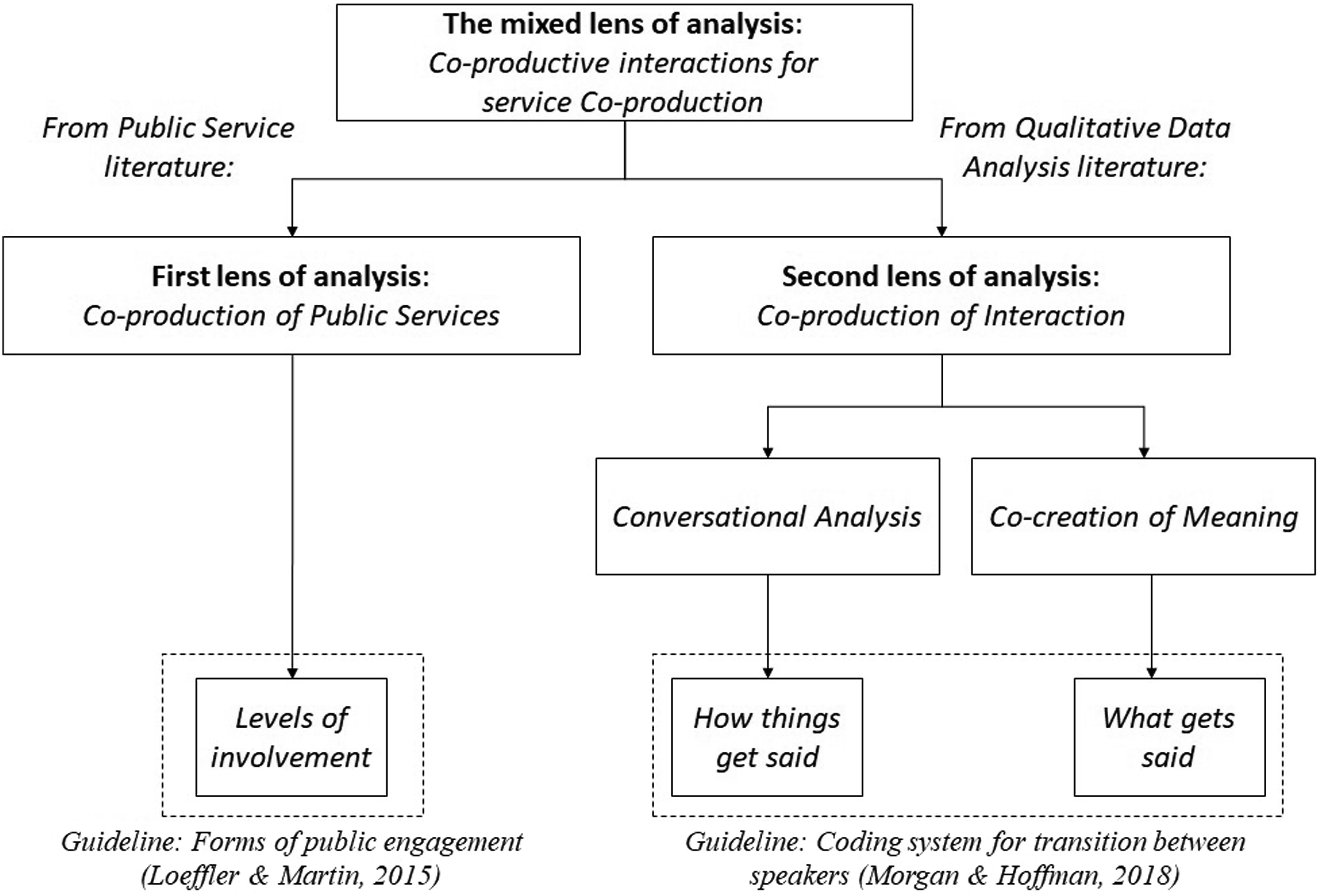
To investigate the co-production of public services, the focus of the analysis has been broadened to the four forms of public engagement of Loeffler and Martin (2015) (Loeffler & Martin, 2015). Since several forms of public engagement may coexist during co-production workshop, a mere study of the interactions in co-production would not consent to gather a complete overview of the dynamics among participants (Gheduzzi et al., 2020). Therefore, the interactions in each form of engagement were analyzed, making the results comparable and complete. Loeffler and Martin’s (2015) framework was considered suitable for analyzing the forms of public engagement given its conciseness, maturity, and international acknowledgement.
To study the interaction dynamics during focus group discussions, Morgan and Hoffman’s (2018) coding system for transition between speakers was chosen. This system is peculiar because it analyzes how things are said and what is said. Due to the novelty and originality of analyzing both the content and the micro-dynamics of group discussions, this system was deemed appropriate for analyzing interaction dynamics using different perspectives (Morgan & Hoffman, 2018).
Loeffler and Martin (2015) and Morgan and Hoffman’s (2018) Frameworks.

On the basis of the above analysis, Loeffler and Martin’s (2015) framework and Morgan and Hoffman’s (2018) coding scheme were selected to form the basis for developing the coding scheme CP-CODER. Four researchers with previous experience in qualitative research agreed on using these two frameworks as guidelines for generating the initial codes on the forms of public engagement and interaction dynamics during group discussions, respectively. By referring to the literature, the researchers established coding rules for distinguishing categories and developing subcategories. For internal clarity, this phase was called conceptualization phase, as the researchers organized theoretical concepts in a usable coding scheme (Figure 2). Process Followed for Developing the new Coding Scheme.
Empirical Test: Revising and Enriching Conceptual Coding Scheme
An empirical case was used to test, revise, and enrich the conceptual coding scheme theoretically derived from Martin and Loeffler’s and Morgan and Hoffman’s frameworks. A longitudinal community-based project called Place4Carers was selected, which was intended to co-produce an innovative service for family caregivers of elderly citizens in Vallecamonica, a remote rural area in the north of Italy. The new service aims to support family caregivers in caring for elders and improve their condition (and thus the conditions of their elders). The project was developed by two Italian universities, a local social care service provider, and an institute of neurological diseases, and it was funded by Fondazione Cariplo (Graffigna et al., 2020). This project was considered suitable for this research for at least three reasons. First, it included co-production workshops involving a priority population defined as people with high probability of experiencing negative health, social and economic outcomes for being exposure to an external strain, such as burden and hours of caregiving, over time (Alwang et al., 2001; Bartolomucci et al., 2005; Munari et al., 2021). Second, the workshops involved the priority population, local service providers’ representatives, and researchers, making the interaction dynamics and models of communication interesting and thought-provoking. Third, the direct involvement of researchers in the workshops’ design, implementation, and assessment ensured access to data and transcript interpretation (Haverland & Blatter, 2012).
The coding scheme was applied to four co-production workshops of the Place4Carers project to integrate the abovementioned frameworks and clarify the forms of engagement and interaction dynamics occurring in the workshops. Overall, 26 family caregivers, three local service provider’s representatives, and five researchers were involved. The family caregivers were mostly female (n = 79%), had medium–low levels of education (with high school degree = 41%), had medium–high levels of burden (time dependence burden = 80%; developmental burden = 60%), and had large numbers of hours dedicated to caring activities weekly (caring hours = 78 h/week) (Graffigna et al., 2021). Since this sample of family caregivers had experienced these psychological and social strains for more than 3 months, they were facing high probability of failing into negative health, social and economic outcomes and, thus, they were considered a priority population (Gheduzzi, 2022). During each workshop, one researcher with at least 2 years of experience in qualitative research acted as facilitator. The workshops were held over a period of 4 months. No incentives were provided to the participants.
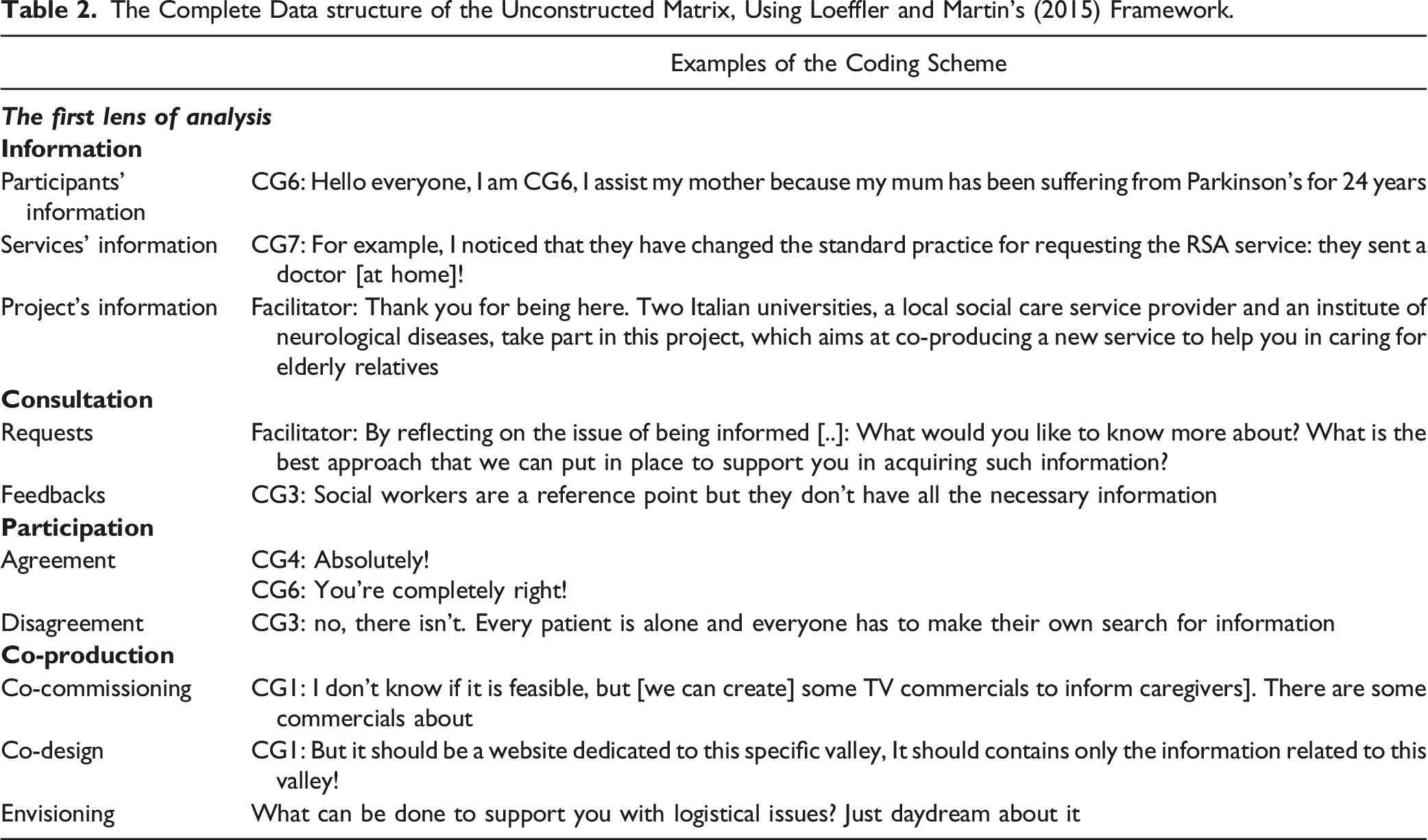
The qualitative content analysis explained by Elo et al. (2008, 2014) was conducted for coding the four workshops, following an accountable procedure composed by five phases (Figure 2) (Elo et al., 2014; Elo & Kyngäs, 2008). In the preparation phase, the four co-production workshops used for the analysis were transcribed verbatim, and the transcript was transferred to NVivo, the software used for the analysis. Then, the four researchers read the transcripts several times focusing on two units of analysis: forms of public engagement and types of interactions. In the development phase, the four workshops were coded using two unconstructed matrixes that resulted from the conceptualization phase; thus, each transcript was coded twice. The coding process of each categorization matrix followed an accountable process: the codes were grouped on the basis of their similarities and differences into predefined categories suggested by the two theoretical frameworks, the categories were compared to avoid overlapping, and the categories were divided into subcategories while maintaining the same level of abstraction of the reference frameworks (Elo et al., 2014). During the coding process, the latent content was analyzed by including pauses, laughter, and sighs in the analysis (Assarroudi et al., 2018).
The Complete Data structure of the Unconstructed Matrix, Using Loeffler and Martin’s (2015) Framework.
The Complete Data Structure of the Unconstructed Matrix, Using Morgan and Hoffman’s (2018) Framework.

In the refinement phase, the results of the coding process were discussed by the four researchers to ensure that the categorization matrixes captured how the forms of engagement differed in terms of interactions (Elo et al., 2014).
In the finalization phase, the coding results of the four workshops were compared with each other, and their correspondence with the research question was tested to confirm the validity and accuracy of the analysis. This approach, grounded on the theoretical frameworks, allowed the researchers to support and extend the existing theory while exploring and including new findings.
Ethical Approval
The participants provided written consent before joining the research and the co-production workshops. The ethical committee of the Università Cattolica del Sacro Cuore and the Politecnico di Milano approved the protocol for caregiver involvement.
Inter-Coder Reliability
Cohen’s kappa with a 95% confidence interval was adopted to test the intercoder reliability of the CP-CODER coding scheme. Given the wide use of Cohen’s kappa in assessing interrater reliability, this measure was used to evaluate the agreement among the coders on the coding of the four workshops with the application of CP-CODER (McHugh, 2012). To assess the intercoder reliability, two out of the four trained researchers rated 10% of the workshops’ transcripts independently, checking the agreement on (a) the level of public engagement and on (b) the group interaction dynamics. After evaluating the intercoder reliability, the two coders discussed and resolved disagreements. Then, intercoder reliability was assessed for each category and overall.
Validity
Validity determines “the degree to which researchers claim about knowledge correspond to the reality (or research participants’ constructions of reality) being studied” (Eisner & Peshkin, 1990). Among the different methods of assessing validity in qualitative research, a guiding theory was used to verify findings. Hence, CP-CODER was developed starting from two recognized frameworks in the academic literature for analyzing interaction dynamics during group discussions and distinguishing forms of public engagement (i.e., (Loeffler & Martin, 2015; Morgan & Hoffman, 2018)). The development of CP-CODER followed an accountable procedure that included subcategories, codes, and any integration of the initial coding scheme from the literature of public service management and qualitative data analysis literature (Grayson-Sneed & Smith, 2018). Once the categories and subcategories were established, a structured codebook was created for sorting the data in the coding scheme and started the coding analysis to enhance construct validity (Thyer, 2010).
Results
The following paragraphs report the new conceptual coding framework (CP-CODER) and the results of interrater reliability.
CP-CODER: New Conceptual Coding Framework
This section presents CP-CODER, a new framework developed over 18 months for investigating the forms of public engagement and the interaction dynamics.
The Data Structure of the Integrated Category: Shared Social Objects.

The version of CP-CODER that was developed theoretically using two theoretical frameworks was then revised and tested empirically using the four co-production workshops.
The first lens of analysis was used to investigate the adoption of co-production by distinguishing it from the other forms of public engagement. In what follows, the resulting categories and subcategories of the first unconstrained matrix developed from Loeffler and Martin (2015) framework are presented.
Information
It is one-way communication, as defined by Loeffler and Martin (2015) (Loeffler & Martin, 2015). It includes contextual information that clarifies the frame of the discussion, but does not support providers in co-producing public service solutions. The main topics in this dimension are caregivers’ personal life experiences, healthcare services, and project activities. This category is divided into three subcategories: • • •
Consultation
It is two-way communication established by providers to investigate citizens’ opinions (Loeffler & Martin, 2015). It includes feedbacks, preferences, and suggestions of participants about a specific issue or question highlighted by the facilitators or providers. This category is divided into two subcategories: • •
Participation
It is two-way communication in which providers involve citizens in decision-making processes. It includes open debates among participants in which participants exchange opinions (Loeffler & Martin, 2015). Since this category is characterized by a sequence of different participants’ opinions that agree or disagree with those previously expressed, it is divided into two subcategories: • •
Co-production
It includes interventions that make substantial contributions to the definition of a new service (Loeffler & Martin, 2015). From the case under investigation, it emerged that co-production involves two main steps: (a) generation of new service ideas for supporting caregivers and (b) development of such ideas, where participants challenge and enrich the emerging ideas by sharing personal opinions on how to develop them practically. This dimension includes also the intervention of facilitators (or providers in some cases) who attempted to rein in the discussion by asking participants to concentrate on co-designing possible service solutions (Gheduzzi et al., 2020). On the basis of these findings, the co-production category is divided into three subcategories: • • •
The second lens of analysis was used to analyze how thing were said and what was said during the workshops. In what follows, the resulting categories and subcategories of the second unconstrained matrix developed from Morgan and Hoffman (2018) tool are presented.
Questions and answers
It includes all the requests and responses among participants. This category is organized in the following subcategories: • • •
Change in topic
It means any shift in the discussion subject that may change during turn-taking. Morgan and Hoffman’s tool divides this category into three subcategories: introduction of a new topic, expansion, and differentiation. Each subcategory can be explicit or implicit, depending on how the discourse of a previous participant is continued by the following participants. An explicit change in topic means that the participants continue the discourse by joining the discussion and using specific grammatical connections that refer to what has just been said. Several possible statements that the participants used to link their speech with the previous ones, such as “The same situation happened,” “I’ve faced this problem as well,” and “I completely agree with this point”, were coded. By contrast, an implicit continuation of the topic means that the participants do not explicitly refer to previous contents. • • •
Interpersonal connections
It includes statements that agree or disagree with other parties’ contributions explicitly. As suggested by Morgan and Hoffman’s tool, this category is divided into three subcategories. • • •
Shared social objects
It includes sentences that abstract and discover the main issues and possible service solutions from the personal experiences of each participant. This category is divided into two subcategories, namely, conceptualization and co-planning, which can be either implicit or explicit. • •
Figure 3 displays the new coding scheme, i.e. CP-CODER, by highlighting how the two lenses of analysis were explicated in categories and how these categories were explicated in subcategories. The new coding scheme: CP-CODER.
Intercoder Reliability Check
The Results of the new Coding Scheme, i.e. CP-CODER, Variables and Items.

Discussion and Conclusion
Discussion
A reliable coding scheme (CP-CODER) was developed to analyze interaction dynamics during co-production involving a priority population: family caregivers of elderly citizens living in rural and remote areas. CP-CODER was developed based on two well-known frameworks of Loeffler and Martin (2015) and Morgan and Hoffman (2018) for analyzing forms of public engagement and interaction dynamics. Then, the coding scheme was integrated with existing theoretical findings, finalized, and applied to four co-production workshops involving family caregivers of elderly people living in remote rural areas. Finally, Cohen’s kappa was adopted to assess the intercoder reliability of the final version of CP-CODER.
This coding scheme addresses the need to analyze interactions at the interface among priority citizens and service providers during co-production workshops. Despite the specific context of its application in the present study, CP-CODER is intended to be applicable not only to family caregivers but also to other priority populations that experience external strain over time and risk negative health, social, and economic outcomes.
Previous studies in the literature have focused on studying interactions during patient–clinician dialogues concerning the co-production of patients’ therapies (e.g., (Realpe et al., 2015; Roter & Larson, 2002; Van Dam et al., 2003)). While these studies have clarified interaction dynamics in shared decision-making at the micro level (i.e., patient–clinician relationships), they have not elucidated interactions at the meso level, at which priority populations and service providers co-produce services during workshop discussions. CP-CODER contributes to filling these gaps in the literature by analyzing interaction dynamics during workshop discussions about service co-production involving priority populations.
The application of this novel coding scheme yielded relevant findings. First, it showed that the co-production of public services in a priority population may require lower forms of public engagement (i.e., information, consultation, and participation). The integration of the technical knowledge of service providers and the experiential knowledge of priority populations requires preliminary phases in which participants become familiar with each other and establish a climate of trust. Equal partnerships between providers and priority citizens, which characterizes co-production, are not achieved immediately because time is required to overcome differences in power dynamics. In planning co-production workshops, both researchers and service providers should include a preliminary phase in which a trusting environment and a common understanding among participants are achieved.
Furthermore, the CP-CODER revealed that interaction dynamics during co-production changed not only in terms of micro-dynamics and subjects, as suggested by Morgan and Hoffman (2018), but also in terms of the level of abstraction of the content. Regarding the focus groups, the co-production workshops required a phase during which participants identified common and recurrent issues that arose during the discussion (Wilkinson, 1998), thus raising the level of abstraction of the content. In focus groups, this phase is the final phase of the collaboration process. Instead, in co-production workshops, it was a necessary step for discussing ideas about possible service solutions. In managing co-production workshops, researchers, and service providers should guide the discussion, encouraging participants to organize and conceptualize the issues, using physical and digital tools when they are deemed effective (Stickdorn & Schneider, 2012).
The findings of this research showed that the micro-dynamics and subjects characterizing co-production are similar to those of the other forms of public engagement (i.e., information, consultation, and participation). However, the level of abstraction of the content was identified as the factor that distinguished co-production from lower forms of public engagement. For this reason, researchers and service providers should support priority populations with ad hoc communication strategies and tools for creating and discussing abstract content. Because of the precarious condition of participants, they are exposed to external strain over time. Thus, they might need support in focusing on discussions, identifying recurrent topics, and transforming the content of such topics from the experiential and personal to the abstract and general.
The development of this new coding scheme offers at least three theoretical and practical contributions. First, as the first coding scheme for analyzing interpersonal interactions during co-production, it enriches the literature on this topic. Co-production has usually been investigated by examining its antecedents or effects, but its mechanism has remained a “black-box” (Gheduzzi et al., 2021; Park, 2020). Despite the high unpredictability of interaction dynamics, the in-depth analysis of the mechanism of co-production is not only pioneering but also fundamental in identifying the real source of value (Osborne, 2021). Indeed, the interactions and exchanges among citizens and service providers are the main sources of value in the co-production process (Osborne et al., 2021). Therefore, an in-depth analysis of the interaction dynamics during co-production is not only pioneering but also fundamental for the successful development of co-production (Dudau et al., 2019).
Second, this study distinguishes co-production from other forms of public engagement in terms of interaction dynamics. This distinction could enable providers and researchers to prevent tokenism or the unbalanced involvement of priority populations in decision-making processes. In some cases, the involvement of priority populations was only feigned because of limited opportunities for their participation or little respect for their comments (Crompton, 2019). Hence, the clarification of interactions during the co-production process encourages the fair involvement of the priority populations (Gheduzzi et al., 2020).
Third, the findings of this research encourage the involvement of priority populations, whose voices are often forgotten despite their willingness to contribute (McColl-Kennedy et al., 2017). The literature on this topic includes a debate on the possibility of involving fragile and marginalized citizens in co-production processes despite their limited motivations and uncertain and stressful conditions (Alonso et al., 2019; Brandsen, 2021). This study contributes to this debate by providing guidelines for interacting with and involving priority populations in their successful inclusion in co-production processes
Conclusion
This study presents a reliable coding scheme that is representative of the interaction dynamics occurring among priority citizens and service providers during co-production workshops. It is recommended as an initial criterion standard for supporting researchers and service providers in conducting co-production with priority populations.
Although the CP-CODER has the potential to be a relevant tool for researchers and practitioners hoping to enhance the involvement of usually excluded citizens and, thus, the creation of more democratic public services, some limitations should to be considered. First, CP-CODER was developed and finalized on a small sample (a single-site project). Second, the validity did not include cross-sectional data or triangulation strategies (Rourke & Anderson, 2004; Thyer, 2010). Third, the analysis was at the meso level (citizens and service providers co-producing a service). However, group dynamics can also occur at the macro level (policy-makers and citizens or voluntary organizations co-producing a new policy or regulation) (Petrescu, 2019). Hence, future research should integrate and test CP-CODER in different contexts and at various levels of co-production to improve its validity and reliability.
CP-CODER will assist providers and researchers in involving priority populations in co-producing new or existing services in a way that ensures equal contribution of all participants and better reflexive practice by researchers. Although CP-CODER was developed on the basis of a specific target group, it can be easily adopted and modified to consider other types of priority populations with high probability of experiencing negative health, social and economic outcomes for being exposure to an external strain over time.
Footnotes
Acknowledgments
The authors are grateful to the carers involved for their time and contributions. We are also grateful to the other research members of the project, including the local home care service provider (Azienda Territoriale per i Servizi alla Persona) and the four nursing homes (Fondazione Angelo Maj, Fondazione Villa Zani, Fondazione Rizzieri, Fondazione Ninj Beccagutti).
Declaration of Conflicting Interests
The author(s) declared no potential conflicts of interest with respect to the research, authorship, and/or publication of this article.
Funding
The author(s) disclosed receipt of the following financial support for the research, authorship, and/or publication of this article: This work was supported by the Fondazione Cariplo, under Grant call ‘Ricerca sociale - 2017', rif. 2017–0955.
Ethical Approval
The participants provided written consent before joining the research and the co-production workshops. The ethical committee of the Politecnico di Milano and the Università Cattolica del Sacro Cuore approved the protocol for caregiver involvement.
