




Abstract
This paper seeks to facilitate the use of grounded theory (GT) methodology by novice researchers and PhD students of public policy discipline. The GT is widely used in social sciences research. This methodology has different variations, while Strauss and Corbin’s systematic approach is more pragmatic than others due to the introduction of a staged process known as axial coding. Regarding the fact that applying this method is largely dependent on the context of the research area, the main question is, what would be the elements of a systematic approach specifically customized for the public policy research domain? This paper is an analytical review of the research literature in 3 areas: variants of grounded theory approaches, soft systems models in social science, and public policy subsystem elements. This research suggests the use of 6 categories of context and discourse, content and ideas, participants, structure, policy process, and outputs and effects as a substitute for the three categories of Strauss and Corbin’s axial coding paradigm of GT.
Introduction
Charmaz (2014) defines Grounded Theory (GT) as a method that begins with qualitative data and follows with iterative steps of going forward and backward between data and analysis to construct theories. In this research methodology, there is a systematic relationship between findings and data (Glaser & Strauss, 1977). According to Glaser and Strauss (1967), the introduction of GT was an attempt to bridge the gap between empirical research and theory. Gouldner (1973) believes that GT provides a balance between imagination, creativity, and science.
Differences between various disciplines and the contexts of researches, result in the development of different generations and variations of GT. Each of these GT variations is defined by philosophical, theoretical, and disciplinary backgrounds and the subject issues of research (Bryant, 2019; Bryant & Charmaz, 2007). In other words, the application of GT is highly dependent upon the given substantive area to the extent that Glaser and Strauss (1977) defined GT as discovering substantive theory that is relevant to a given substantive area (Benoliel, 1984). Actually, many GT theorists produce their own variation of GT for doing research on specific issues (Bryant & Charmaz, 2007; Ong, 2012). GT has been widely used in various disciplines in the literature, including management (R. Jones & Noble, 2007), accounting (Gurd, 2008), psychology (Fassinger, 2005), economics (Finch, 2002), and political sciences (Becker, 2012). Also, GT has been frequently used by researchers in the field of public policy and administration (Anderson et al., 2016; Richards & Farrokhnia, 2016; Tummers & Karsten, 2012). Public policy and policy research domains as independent research areas seriously impact the content and the use and production of variations of GT methodology.
Despite the importance of knowing and leveraging the differences between these variations of GT, it is often difficult for novice researchers to decide which variation they should use to analyze their data and what would be the difference between the GT analysis in these variations (Heath & Cowley, 2004). The three most popular research designs incorporating GT, which distinguish themselves from other research designs, are emergent (Glaser, 1992), systematic (Strauss & Corbin, 1998), and constructivist (Charmaz, 2006).
Among different variations of GT, the coding paradigm of Strauss and Corbin specifically introduces and discusses the systematic aspect of GT by enacting abstraction aspect through the use of a systematic matrix for coding, known as the axial coding paradigm, on the one hand, and deduction aspect by using research data on the other hand through iterative movements between empirical data and theory (Bryant, 2019; Clarke, 2007). In other words, they used axial coding to explain the inter-relationships of categories and present a systematic view of what is really going on (Bryant & Charmaz, 2007). Strauss and Corbin considered elements of a theory as the elements of a system, although they have never labeled this explicitly. This systematic manner facilitates building up hypotheses from the outputs of the qualitative research. In fact, systematic GT approaches are much easier to understand and deploy for researchers with previous backgrounds and different capabilities (Bryant, 2019). To this end, Strauss and Corbin (1998) introduced three main categories of conditions, action/interaction, and outcome to guide the coding process in GT. Because of this systematic view, this approach is far more widely used by researchers to conceptualize empirical data in the form of theoretical propositions (Bryant, 2019).
A critical criterion in using GT is that the significance of a research method is defined by the fact that to how extent it facilitates the development of new insights (Bryant, 2019). So, the main issue is that the three systematic main categories introduced in the axial coding paradigm do not facilitate the development of new insights in all research domains. We need a customized GT systematic approach for the policy research domain. The question here is that what categories should be focused on in axial coding when applying a pragmatic approach (i.e., focusing on the actual usefulness of the methodology) in the policymaking research domain?
To better understand the systematic approach and apply it, it is necessary to refer to its root definition in the management discipline. Soft systems literature provides a suitable framework to apply the systematic approach to our study. In fact, public policymaking as a social system is better understood using the soft systems thinking approach, because of its human interaction nature. Using such models in the study of policy systems is of utmost importance. We can use systematic modeling techniques to better understand the main aspects of the policy system and the relationships between them (Bergvall-Kåreborn et al., 2004), which otherwise would be frequently complex, implicit, and unquestioned (Wilson, 2001). Incorporating a systematic thinking approach with the systems approach to policymaking conduces to a new GT approach specially customized for the study of public policy discipline. Designing such a customized GT approach will facilitate the application of GT systematic approach for the study of public policy and public administration domain, especially for the PhD students and novice researchers.
This paper is organized into 4 sections. The first section explores different variations and generations of GT as a research methodology and Strauss and Corbin’s approach as a systematic approach to GT. In order to examine the meaning of the “systematic approach” in more detail, it is necessary to refer to the definition of systems in the management literature. So, the second section (i.e., Soft Systems Approach to Study of Human Systems Elements) reviews the background and principles of applying systematic methods and models to study human systems like public policymaking. The third section (i.e., Public Policy System Frameworks) investigates the main elements of public policy as a social system in public policy literature. And finally, the last section (i.e., Proposed Framework) suggests a systematic framework incorporating the main elements of a policy system to help researchers in the course of the coding stage of GT, as part of Strauss and Corbin’s approach for the study of public policymaking discipline.
Review of Different GT Approaches
Glaser and Strauss (1967), in their work, The Discovery of Grounded Theory, introduced the GT as a revolutionary and innovative qualitative research methodology to facilitate the discovery of theory from data through comparative analysis (Dunne, 2011). Unlike most sociological research methodologies that mainly focus on verifying current theories, GT primarily focuses on generating theories, and verification becomes secondary (Glaser & Strauss, 1977).
As a qualitative research method, GT makes the researcher a part of the research process (Strauss & Corbin, 2015). The main features of GT which distinguish this methodology from rivals are constant comparative analysis, theoretical sampling, and dynamic iterations of data collection and analysis (Dunne, 2011). The elements of theory as the output of GT are conceptual categories and their attributes which are indicated by the data, and hypotheses or generalized relations among the categories and their concepts (Glaser & Strauss, 1977).
Over the years, the development and expansion of GT led to the development of a constellation of GT variations as a sign of healthy growth of the methodology (Bryant, 2019; Charmaz, 2014). There are five major variations of GT in the literature, which could be interpreted as various phases of development of GT or just its different generations resulting from different philosophical backgrounds (Bryant, 2019): 1. Emergent GT was introduced by Glaser and Strauss and Glaser’s subsequent works, which maintains the researcher passive in the process of research (Glaser & Strauss, 1967). Emergent GT insisted on the emergence of codes and categories directly from the data, not previous insights or frameworks. For more details on this GT variant, refer to Artinian et al. (2009) as an example. 2. Classic GT, introduced by Strauss in the 1980s, is based on the pragmatism approach. He has embedded the American pragmatism philosophy as a central component to the developed action, structure, and process. Refer to Bryant and Charmaz (2011) for more details. 3. Systematic GT was introduced by Strauss and Corbin and provided a procedure for qualitative data coding in the analysis of content (Strauss & Corbin, 1990). They discussed that current and previous theoretical knowledge flows into the data. For more details on this GT variant, refer to Rahimi-Feyzabad et al. (2021) as an example. 4. Constructivist GT introduced by Charmaz and Bryant focuses on searching for patterns and explanations in the process of making comparisons and interpretations out of communications (Bryant, 2002; Bryant & Charmaz, 2007; Charmaz, 2014). For more details on this GT variant, refer to Torelli and Puddephatt (2021) as an example. 5. Postmodern situational GT introduced by Clarke widens the span of GT research from actors and their perspectives to artifacts, practices, and discourses. In this approach, the situation itself becomes the unit of analysis, and the researcher maps the situation to analyze it (Clarke, 2005; 2007; Clarke & Keller, 2014). Refer to Miller and French (2016) as an example for more details on this GT variant.
As it can be seen, the first three variations of GT have been offered by its cofounders. It is because of the split and divergence between the two cofounders of GT since the 1990s (Dunne, 2011; Heath & Cowley, 2004). Glaser criticized Strauss and Corbin’s approach for forcing the outcome of GT research with their proposed coding paradigm, but other scholars believe that Glaser’s coding families are incoherent and bewildering (Bryant, 2019). The main difference between these two variations is that Glaser stressed only the inductive (i.e., reasoning and proceeding from particular facts to a general conclusion) nature of the GT. While at the same time, Strauss and Corbin introduced an abductive analysis approach, including both inductive and deductive (i.e., involving inferences from general principles) to GT (Heath & Cowley, 2004). Also, Strauss and Corbin put more emphasis on the verification in the process of theory generation (Ong, 2012).
Although, despite these differences between Glaser’s and Strauss and Corbin’s approaches, they both agreed that most of the researches using GT often failed to accomplish more than levels of coding, not moving to the stage of theoretical coding and generating theoretical statements. They both remedy these failures by providing coding families by Glaser and the coding paradigm by Strauss and Corbin (Bryant, 2019). Strauss and Corbin introduced their systematic approach in the 1990s to remedy the repeated failures of researchers in articulating integrative conceptualizations out of substantive coding data. Axial coding in this approach proposes a strategy to bring back data together again as a coherent whole (Charmaz, 2014). The axial coding is the main contribution of Strauss and Corbin to the GT methodology coding procedure as the process of data analysis looking for context (Bryant, 2019; Strauss & Corbin, 2015). It can be viewed as a texture of relationships around the axis of an axial category (Strauss, 1987). The purpose of the axial coding phase is to sort, synthesize, and organize data and build relationships around a major category (Charmaz, 2014; Creswell, 1998).
Data analysis comparison between Glaser’s approach and Strauss and Corbin’s approaches to GT (Heath & Cowley, 2004).

This research is based on Strauss and Corbin’s approach to GT. Because among different variations of GT, the coding paradigm specifically introduces and discusses the abductive aspect of GT methodology by enacting abstraction aspect by using axial coding paradigm on one hand and inductive aspect by using research data on the other hand through iterative movements between empirical data and theory (Bryant, 2019; Clarke, 2007). Because of that feature, this approach is far more widely used in researches by helping researchers to conceptualize empirical data in the form of theoretical propositions (Bryant, 2019).
Strauss and Corbin proposed this coding paradigm to facilitate making the links between categories visible. The elements of the coding paradigm or organizing scheme of Strauss and Corbin includes (Strauss & Corbin, 1990, 2015): • Conditions forming the structure of phenomena: perceived reasons for what happens and explanations for responses of participants through actions/interactions; • Actions/Interactions including responses of participants to issues, events, or problems; • Consequences and outcomes of actions/interactions, whether anticipated or actual.
Each of these theoretical terms provides answers to specific questions in the research. Conditions answer the why, where, how, and when questions; actions/interactions answer the how and by whom questions; and consequences answer what happens because of actions/interactions (Charmaz, 2014). By connecting the actions/interactions to conditions and outcomes to action/interaction and conditions, we can generate theories to explain and control the outcomes. In this way, the coding paradigm helps researchers sort out concepts and categories and link them properly (Strauss & Corbin, 2015).
The main question here is how we can develop the axial coding categories of Strauss and Corbin’s systematic approach to best fit the public policy research context? In order to answer this question, it is necessary to refer to the definition of systems in the management literature.
Soft Systems Approach to Study of Human Systems Elements
The classical approach to analyzing systems, known as “systems engineering” or “hard systems thinking,” was introduced in the 1930s and showed great potential during World War II. So, it became the dominant approach to systems analysis and study. After World War II, this approach applied to civilian systems. But, research led by Peter Checkland in the 1980s found that some situations in human systems are very different and just opposite the presumptions of the systems engineering approach (Huaxia, 2010). Checkland (1981) introduced this new approach in its “soft systems methodology” or SSM as a way to deal with problematic situations involving human beings (Basden & Wood-Harper, 2006). His new approach was based on four central ideas (Huaxia, 2010): 1. Defining social systems isn’t done by describing them but using hermeneutics to interpret them. 2. Unclear or multiple objectives: Social systems don’t have a clear consentaneous objective because of different worldviews, feelings, and interpretations of participants of any system. 3. There is no optimal solution to the problems in social systems. 4. Social systems have two main analysis dimensions: Logic-based and Social-Cultural.
The public policy system as a human system is better understood using the soft systems thinking approach because of its human interaction nature. So, we can use modeling techniques used in SSM to define and study the public policy system and its subsystems. Multiple frameworks have been introduced in the literature to define social systems in different aspects clearly. This research reviews the three most used frameworks that have a systematic approach to modeling social systems as soft systems: CATWOE, CCP, and CPO frameworks.
Framework 1 for the Study of Soft Systems: CATWOE
CATWOE is one of the most known and used modeling frameworks in SSM introduced by Checkland and Scholes (1999), which has remained unchanged since its introduction (Bergvall-Kåreborn et al., 2004). CATWOE is an abbreviation representing the six aspects of social systems: 1. Customer: user of the system, whether victim and purchaser of goods or services or beneficiary and people who carry out the process of production (Bergvall-Kåreborn et al., 2004) who are affected by the system’s activities (Basden & Wood-Harper, 2006). 2. Actor: Those who carry out the transformation and main activities of the system or cause it to occur (Wilson, 2001). 3. Transformation represents the purposeful activity to transform input to output, to link current and imagined future situations (Basden & Wood-Harper, 2006; Checkland & Scholes, 1999). 4. Worldview or Weltanschauung: The worldview makes transformation meaningful because it reflects the perspectives, assumptions, and beliefs of human participants (Bergvall-Kåreborn et al., 2004). 5. Owner: Those who have the ultimate power and authority to decide to stop the transformation and cease the system to exist (Bergvall-Kåreborn et al., 2004; Checkland & Scholes, 1999). 6. Environment: Environmental constraints are those factors outside the system which has to be taken as given (Checkland & Scholes, 1999).
Framework 2 for the Study of Soft Systems: CCP
Pettigrew (1985) introduced an organizational change framework known as the “Pettigrew Triangle,” which emphasizes the importance of contextualism in the study of social systems (Sminia & de Rond, 2012). This framework uses three main aspects to study organizations as social systems (Pandey, 2015). This framework has been used in various systematic studies of social systems in different disciplines. The three aspects in the CCP approach are (Sminia & de Rond, 2012): 1. Context: Pressures on the system from the environment, which is then divided into two levels: a. Inner context: the structure and culture of the system and its political context. b. Outer context: the social, political, and economic environments. 2. Content: Inputs to the transformation process of the system. 3. Process: Actions, reactions, and interactions of the system participants to move from present to future state.
Framework 3 for the Study of Soft Systems: CPO
The other major framework used in defining different aspects of human systems is the framework known as CPO (Fridrich et al., 2015). The three main aspects of soft systems in this framework are: 1. Context: There are two types of contextual conditions (Johns, 2006): a. Omnibus context conditions are hard or impossible to manipulate but important to monitor and record. b. Discrete context conditions are easier to change than omnibus context conditions because they are closer to the system’s transformation process and have a stronger influence on the system. 2. Process: Jenny and Bauer (2013) define the process aspect as a set of actions that lead to outcomes alterations. These processes are divided into two types (Fridrich et al., 2015): a. Implementation processes, including intervening steps to affect the outcomes of the system. b. Change processes, including dynamics triggered by the implementation process, leading to changes and alterations in the system, its members, or even its environment. 3. Outcome: The results and effects of the intervention process, which are measurable and meaningful for stakeholders. The CPO framework distinguishes between three types of outcomes (Fridrich et al., 2015): a. The proximate outcomes, also known as immediate, initial, or short-term outcomes, are first-level results that have been achieved by the implementation or change processes. b. The intermediate outcomes, also known as medium-term outcomes, are results achieved at the social level. c. The Distal outcomes, often known as the system’s overall objective, are higher-level results of the system’s processes.
Main aspects of social systems in different frameworks for the study of soft systems.
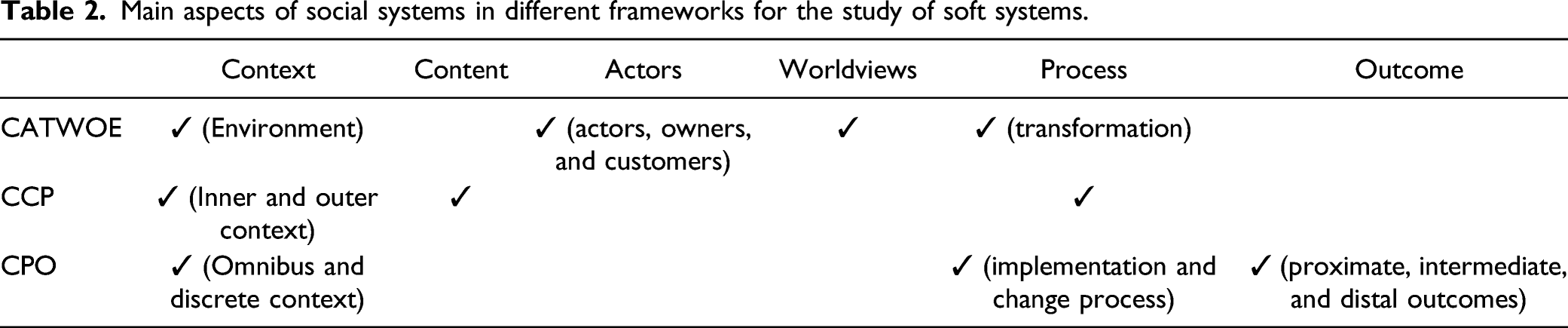
The literature review mentioned above provides a general understanding of soft systems elements. Each system can also have its own set of customized elements as a unique system with distinctive attributes. In the following section, the literature regarding the elements of public policymaking as a system will be discussed.
Public Policy System Frameworks
There are various definitions of policymaking, each emphasizing different aspects of the concept. Howlett et al. (2009) define it as a set of actors attempting to match policy goals with policy means in a process known as applied problem-solving. In another definition, Dye (1972) defined policymaking as anything a government chooses to do or not to do. However, All these different definitions attempt to capture the idea that the policymaking process has a techno-political nature and aims to match goals and means by the constrained social actors (Howlett et al., 2009). In the technical aspect of the policymaking process, actors seek to identify the best matching combination of goals and tools to address particular problems. On the other hand, in the political aspect, resolution of disagreements of different actors on the nature and definition of the problem and potential solutions are being addressed (Howlett et al., 2009; Majone, 1975; Meltsner, 1972).
Policymaking studies are divided into two main streams based on the key object of study. First, policy analysis studies consider the policy itself as the key object of study. These studies try to identify different elements of public policy and the links between them and propose some new connections. Second, policy process studies consider the policy process as the key object of study. These studies enable us to understand better the policymaking process dynamics and the factors playing a role in its development.
Regardless of choosing any of the approaches mentioned above to study policymaking, we must understand public policy subsystems to better study the nature of policymaking. Studying public policy subsystems enables us to understand how policy issues get on the agenda, policy choices selected, decisions taken, efforts to implement policies managed, and assessment of the outputs and outcomes done and fed back into the cycle (Howlett et al., 2009). In addition, how changes in policy subsystems will ultimately lead to changes in policy outcomes (Howlett & Ramesh, 1998), and applying policy subsystems approach results in the convergence of policymaking issues and debates (Howlett et al., 2009).
Public policy scholars use different labels to define policy subsystems. The most known labels of policy subsystems are whirlpools, sub-governments, policy communities, iron triangles, and policy networks (Weible, 2008), which appear to be synonyms or equivalent at some level (Jordan, 1990a). Although there are some differences between these various labels, for example: • Policy subsystems versus sub-governments: The main difference between policy subsystems and sub-governments is the span of actors involved. Policy sub-government is defined as a group of members of the parliament, their staff, bureaucrats, and representatives of groups and organizations interested in the policy area that make most of the routine decisions in a given policy area (Jordan, 1990b). In this definition, the actors involved in the sub-government are limited to societal and state actors (deHaven-Smith & Horn, 1984; Howlett et al., 2009). While policy subsystem also encompasses actors outside these formal authorities, including a variety of public and private actors at all levels of government who share a set of basic beliefs (Howlett et al., 2009). • Policy communities versus policy networks: The main difference between policy communities and policy networks lies in the motives guiding the actions of those involved. Policy communities’ primary motivation is a specific knowledge or expertise, while the primary motive for the policy networks is the pursuit of their actors’ interests (Howlett & Ramesh, 1998; Torgerson, 1986).
These various labels represent a spectrum of policy subsystems with the iron triangle at one end and issue networks at the other end based on the size, stability, turnover of the participants, and institutionalization level (Howlett et al., 2009). However, the main characteristics of policy subsystems are (Jones & Jenkins-Smith, 2009; Nohrstedt & Weible, 2010; Sabatier, 1998): 1. Policy subsystems are nested: Various subnational subsystems are embedded within a national subsystem. 2. Policy subsystems are overlapping: A subsystem’s decisions affect other subsystems, especially when issues overlap. 3. Policy subsystems are semi-autonomous and independent in authority to some degree.
There are different classifications of policy subsystem elements in the literature based on the structure of relationships among their participants (Atkinson & Coleman, 1989; Howlett et al., 2009; McCool, 1989). Also, the complexity and vagueness of the dynamic relationships in policy subsystems are rising because of the rising number of interest groups in policymaking, widening the scope and increasing the specialization of public policies (Jordan, 1990b). Some of the most important categorizations of policy subsystem elements are: • Walker (2000): Policymaking process; system domain for policies; external factors; outcomes of interest. • Weible (2008): Culture; institutions and rules; social, economic and environmental conditions; actors’ relationships; social constructions; power and authority. • Milward and Wamsley (1985): Interest groups; legislative committees; executive branch agencies. • Freeman (1955): Bureaucracy; congressional committees; interested segments of the public. • Almaguer-Kalixto et al. (2014): Policy actions; actors; discourses.
Scholars like Sabatier (1998) believe that coalitions framing the public choice are the main elements of the policy subsystem. Although, some other scholars have other opinions about the elements of the policy subsystem. Howlett et al. (2009) provided one of the most famous categorizations of the elements of the policy subsystem. They believed that there are three analytical dimensions for the policymaking universe: • Actors: Several actors are involved in the policymaking process stages, and the combinations of policy actors in each stage are different (Howlett et al., 2009). In fact, formulation and implementation of policies are products of the interactions between these actors (Jordan, 1990a; Walt & Gilson, 1994). Changes in the membership of subsystems may lead to change in the policy outcomes (Howlett & Ramesh, 1998). • Institutions: Bureaucracies, legislatures, and courts, shape and regulate the relationships between actors through formal rules, compliance procedures, and standard operating practices (Hall, 1990; Howlett et al., 2009). The main role of institutions is to influence the actions of policy actors by shaping their interpretations of the problem and possible solutions and constraining the way solutions are chosen and implemented (Howlett et al., 2009; Timmermans & Bleiklie, 1999). • Ideas: The most critical inputs to the process of policymaking are the ideas and information (Weible, 2008) which shape the established beliefs, values, and attitudes behind the way actors understand policy problems and propose solutions (Edelman & Lasley, 1988; Hall, 1990; Howlett et al., 2009; Schneider, 1985).
To simplify the explanation of interrelations between policy subsystem elements, most analysts take the macro, meso, and micro levels as subsystems within the overall policy system (Almaguer-Kalixto et al., 2014). Different combinations of the relationships between the three elements of actors, institutions, and ideas make distinctive ways of policymaking, which are known as policy styles, modes, or regimes (Howlett et al., 2009). For example, Weible (2008) differentiates between three ideal types of policy subsystems: unitary subsystems, collaborative subsystems, and adversarial subsystems.
Finally, Howlett and Rayner (1995) classified eight different policy subsystems based on the two criteria of the number and types of participants of the subsystem and whether the relationships between the participants are state-directed or society-dominated. The eight types of policy subsystems are bureaucratic, clientelistic, triadic, pluralistic, participatory, captured, corporatist, and issue networks.
The elements of public policy subsystem in different recognized frameworks.

Proposed Framework
This section presents a new systematic GT approach customized for the public policymaking domain, based on the three sections of review of different GT approaches, soft systems approach to the study of social systems elements, and public policy system frameworks. The elements of the policy subsystem in our proposed framework as derived from synthesizing different classifications in the literature are: 1. Context & Discourse: Including value system, economic system, cultural factors, social construction, constitution and rules, and public policymaking schools or paradigms. 2. Content & Ideas: Including public problems, public interest, the content of policies, expertise, and knowledge & information. 3. Policy participants: Including official actors, social actors, lobbyist and pressure groups, and other interest groups. 4. Structure: Including relation among actors, coalitions, and type of policy subsystems (sub-government, community, coalition, network, etc.). 5. Policy process (snapshots of activity): Including agenda setting, policy formulation, policy implementation, and policy evaluation. 6. Policy outputs and effects: Including outputs, outcomes, impacts, and policy change.
Proposed framework’s main elements overlap with GT axial coding dimensions.
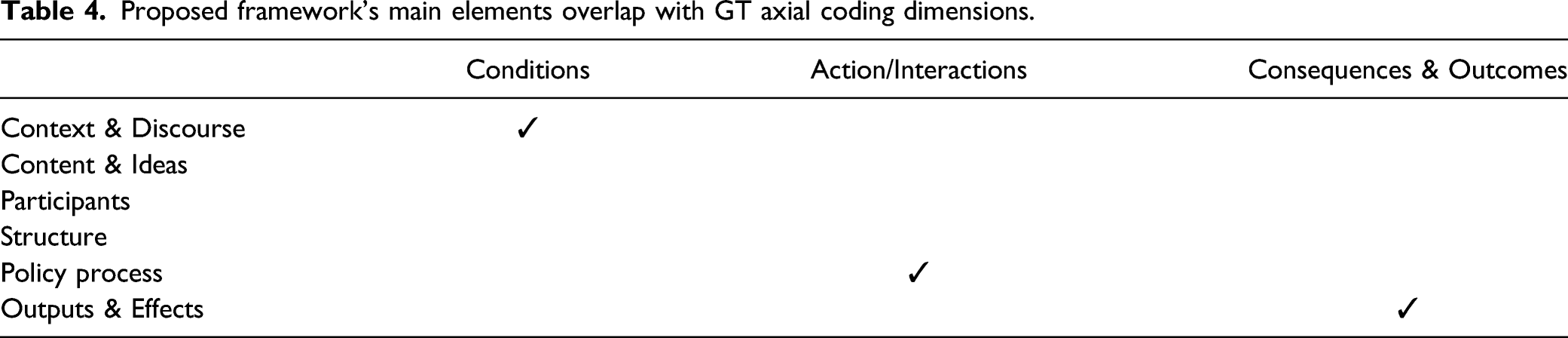
The 2nd to 4th lines in Table 4 represent the policy subsystem elements that couldn’t necessarily be connected directly to one of the three dimensions of the axial coding paradigm of Strauss and Corbin. Also, the connection and overlap of other elements in the horizontal and vertical axes represent a close conceptual connection between them. Although, it does not necessarily mean that they are objectively and accurately the same.
Proposed framework’s main elements overlap with soft systems elements.
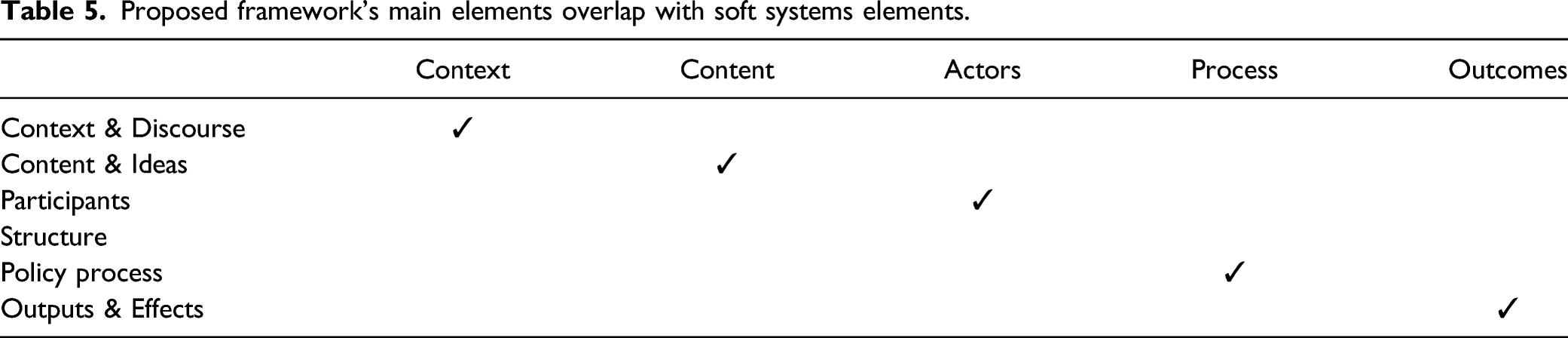
Similarly, the 4th line in Table 5 represents the element of the policy subsystem, which couldn’t necessarily be connected directly to one of the main elements of soft systems.
Conclusion
As mentioned before, Strauss and Corbin’s GT approach is based on the pragmatism philosophy. They emphasized the actual usefulness of the methodology for researchers to develop new insights into the research field. So, the main criteria in developing and refining their approach to fit the public policy discipline’s different domains were to keep that pragmatic view to facilitate the use of GT as qualitative research in the public policy domain, especially by novice researchers. To this end, this research suggests the use of six categories of context and discourse, content and ideas, participants, structure, policy process, and outputs and effects, instead of three categories of Strauss and Corbin (conditions, action/interactions, and consequences and outcomes) in the axial coding phase of GT in the researches regarding the public policymaking domain. The main advantages of using these six categories instead of the original three would be: 1. It is derived from the literature and theoretical foundations of the public policy discipline, especially the issues raised in the public policy subsystem literature. This feature covers the main concern of the authors of GT, which is the adaptability of this methodology based on different contexts and research areas. 2. It provides a more comprehensive framework for the axial coding phase of Strauss and Corbin’s GT. Specifically, three categories are introduced (the 2nd to 4th lines in Table 4) that do not exist in Strauss and Corbin’s axial coding paradigm. 3. It provides a more comprehensive framework to study public policymaking as a social system than the elements of social systems in previous studies. Specifically, the element of structure is added to the elements of the soft systems approach.
Footnotes
Declaration of Conflicting Interests
The authors declared no potential conflicts of interest with respect to the research, authorship, and/or publication of this article.
Funding
The authors received no financial support for the research, authorship, and/or publication of this article.
