




Abstract
Grounded theory (GT) has become an influential methodology for research inquiry which involves the texts of human communication and language use as its primary empirical focus of data collection and analysis. However, influential models of GT have been most typically applied to the process of interpreting nonformal and especially “unstructured” texts such as conversations, interviews, and online communications. By contrast, policy researchers have the rather different challenge of interpreting the innate contradictions, diverse imperatives, and often conflicting perspectives which inform the meanings of policy positions as well as documents across different contexts. Building upon the interdisciplinary implications of recent constructivist models of the methodology, this article investigates how an optimizing “knowledge-building” approach represents an exemplary model for using GT for policy document research purposes. It does so in relation to the case study of a project focused on emergent as well as contextual dilemmas of analyzing World Trade Organization e-commerce policies.
Introduction
With its “systematic inductive methods” for conducting research for theory development, “grounded theory” (GT) has become an influential framework of qualitative and human-centered research (e.g., Thornberg & Charmaz, 2012). A key reason for this is its facility to allow researchers who focus on human communications to go beyond descriptive, objective, and literal levels of meaning to interpret in a systematic way and for inquiry purposes real-world contexts of both performance and social process (Charmaz, 2006). New and more sophisticated approaches to policy research linked to complex problems, issues, and challenges have conversely advocated the need for approaches and methods of inquiry which allow deep-level interpretations beyond the surface-level reception of policy positions and statements (Ritchie & Spencer, 2002; Sadovnik, 2006). As Wagenaar (2003) has suggested, the robust analytical logic of GT should lend itself to policy research aimed at the empirical rather than normative data represented by a collection of documents and statements constituting some kind of policy position or strategy.
However, to better harness the use of GT research methodology for policy research, a more focused as well as structured approach is perhaps needed in relation to how the interpretive domain of human knowledge involves “data” directly made up of the interplay of key concepts and words (and also actions or behavior). This idea supports the proposal of critics like Charmaz that a more structured approach can better “optimize” the use of GT for research inquiry purposes going beyond classical GT’s exemplary focus on data from interviews. In this way, we have found it useful to use a knowledge-building approach we have developed elsewhere (Richards, 2012a) as a bridge between more focused and structured uses of GT approaches and methods on one hand, and on the other optimal policy building for authentic and complex problem solving (Richards, 2012b). Thus, in relation to the case study example of World Trade Organization (WTO) e-commerce policies (i.e., policies related to commerce making use of electronic networks), this article will explore a knowledge-building approach to using GT for policy-building purposes.
Toward this end, the discussion of the article and the supporting diagrams which inform this will be outlined and developed in three parts or stages. The first part builds further on earlier constructivist efforts to apply in more focused, structured, and effective ways the crucial insight of GT that the links between key words and key concepts (also language and knowledge) are an integral part of the research process as well as an important qualitative focus of systemic research analysis. A knowledge-building application of GT outlined in this section is thus similar to how the concept of “structured overviews” can be used to build upon “concept maps” to bridge advanced models of both reading and writing. On the basis of this foundational section, the second part details how the case study example of WTO e-commerce policies might be therefore analyzed in terms of an emergent and comprehensive framework of data building and analysis which moves from descriptive to more interpretive levels in a focused or “optimal” way. This is in order to engage with how advanced applications of GT replicate a “double-loop learning” mode of engaging with the underlying rhetoric of any spoken or written text (Gynnild, 2011, p. 47) also strongly associated with WTO e-commerce policies. With this especially relevant to the growing importance of policy research, the third section of the article outlines the particular application of an optimal application of GT for policy analysis in related terms of the important related insights of both Agyris (1976) and his collaborator Schon when initially developing the double-loop learning model (cf. also Schon & Rein, 1994). This is that any research process involving especially complex and intractable policy problems or challenges may further involve a negative self-fulfilling or circular process (single loop). This can be analyzed and transformed in relation to rather a potentially more positive cycle (double loop).
A Knowledge-Building Approach to Using GT in Policy Research?
The key to using GT for formal policy research lies in the related challenge of trying to reconcile an “open-ended” emergent approach to knowledge building. This should involve the “inherent” purposes of texts or data sets on one hand, and on the other of relevant problem solving and focused inquiry. Various models of GT have tended to focus on conversational-type (rather than formal) texts and data sets approached as social processes (e.g., Simmons, 2011). The increasing importance of policy studies emphasizes the need to further develop and refine GT methodology. In this way, some of the aspects of the generic process represented by GT may be better recognized as constituting an exemplary foundation of not only the domains of qualitative research but perhaps all research. This section discusses how the kind of knowledge-building approach outlined below provides an integrated framework for an emergent and optimal rather than merely imposed or catch-all interpretations of meaning.
Beyond Description: The Limitations of Classic GT (CGT) for Policy Studies
CGT is epitomized by the kind of systematic qualitative data analysis outlined by Glaser and Strauss (1967). This does not just apply to the analysis of verbal texts (in classical GT, interviews are an exemplary focus of analysis) but also to interpretive frameworks applied by researchers. In addition to the original model, related derivations have been criticized over the years for what some see as characteristic “weaknesses.” We rather prefer to refer to the “limitations” of the CGT model which later models (including those additionally offered by both Glaser and Strauss) have attempted to go beyond or build upon in terms of the transition between description and interpretation. In this way, the dialogic and hermeneutic strengths of the general model of GT might be both better appreciated and also defended. What might also be recognized is how the great and enduring importance of GT for all researchers in any community of practice is the “grounded” interplay of key words and key concepts in any theorizing or knowledge construction as inevitably grounded in processes of language use and communication.
Thus, Rennie (2002) has observed that there is typically a tendency for vagueness or lack of specificity in much application of CGT. Likewise, Allen (2010) complains that CGT is often weak in practical applications. According to Dey (2007), the reason for this is that CGT suffers from a general lack of explicit procedural guidelines. In other words, as Giske and Artinian (2007) put it in terms of how a networking approach does not always redeem the limitations of a linear and hierarchical framework of coding, CGT is often a “chaotic process” which needs to be improved, refined, or theorized to lead to more effective results or applications. Versions of CGT have thus been accused of demonstrating “extreme inductivism” and “adhockery” (Goldthorpe, 2000, p. 77/89). Indeed the descriptive approach to data collection and analysis in various versions of CGT has led to accusations of tendencies for superficial theorizing, associated weaknesses in transferability, and for a plethora of “incoherent descriptions” making the whole process “insurmountable” as well as “unexpectedly awkward and time consuming” (Gasson, 2004; Kelle, 2005).
Yet, as epitomized by the exemplary focus of CGT on oral texts, the main strengths but also weaknesses of CGT would seem to lie in how the general model recognizes that human conceptualization—the basis for all theory building as well as thinking—is based as much on the associative as well as logical (i.e., conceptual) aspects of how humans use the key words of natural languages. At the center of the retrospective “split” and associated debate between Glaser and Strauss (along with Corbin) in the 1990s is the dilemma of whether to or what extent a systemic approach to using CGT for general research purposes (and not just data analysis) might involve a more structured and indeed also focused version of the data analysis of performative and social texts of human communication in context. As indicated, some critics suggest that the CGT approach to posing research questions or purposes tends to be vague and inadequate to generate effective and sufficient data collection (Dey, 2007; Goldkuhl & Cronholm, 2010). This is perhaps epitomized by how the original model encourages the researcher to answer the question of “what is happening here?” (Glaser, 1978). As Charmaz (2006) points out, there are many external as well as internal factors which can influence researchers’ assumptions as well as interpretations. This can and often has led to CGT research criticized for being a “fluid” and open-ended method “open to all possible theoretical directions” which can be directed to irrelevant or trivial areas outside of the “immediate field of study” (Goldkuhl & Cronholm, 2010).
Strauss and Corbin’s (1990) innovative new concept of axial coding provided a basis for introducing an associated concept of “paradigm models” to anticipate, recognize, and explore how the texts of social processes and conversations often also (like formal texts but less obviously) involve organizing schemes or thematic structures of meaning. This version of CGT thus encouraged a more systematic approach to the links between and general meanings of seemingly unrelated concepts and categories (Kendall, 1999, p. 745). Strauss’s former collaborator Glaser (2002) worried that the integrity of the original methodology of describing emergent social patterns could be tainted and compromised by imposed agendas and structures or what he referred to as imposed as “forced” not emergent theoretical sensitivity in the form of unacknowledged preconceptions or prejudices. Yet the Strauss and Corbin model made an important innovation which went at least some way to addressing the central dilemma of how qualitative research coding and theorizing are linked interpretive processes always framed by (although not necessarily bound by) the preconceptions of researchers and their particular knowledge communities. It recognized that some form of conceptual intervention across different social contexts is inevitable in the analysis of any text or data set and that, on this basis, a convergent approach is needed for the most effective construction of knowledge. In short, the key insights of CGT have an enduring relevance beyond the initial and subsequent models of qualitative research.
Toward a More Focused as well as Structured Approach to Applying GT to Policy (and Other Domains of Qualitative) Research
As the Strauss and Corbin innovation exemplified, many critics have felt the need for a more systematic, rigorous, and perhaps structured framework for applying GT as a research methodology. Although this was perhaps not generally recognized or explicitly addressed as such, at the core of the well-known Glaser–Strauss/Corbin debate or controversy (e.g., Kelle, 2005) was the implicit challenge or dilemma of how to “bridge” the CGT methods of concept identification, coding, and analysis with the interpretively constructive purposes of the most effective qualitative research as a mode of inquiry, problem solving, and/or active knowledge building. As Charmaz (2006, pp. 131–132) puts it, CGT tended to view the researcher as ultimately “a conduit for the research rather than a creator of it.” As the proponent of rather a new “constructive” version of GT (ConGT), Charmez advocated a strategy and approach which would better link GT as a framing methodology to its application as “problem-solving practices” (p. 7). This supports how other “constructivist” views of the theory-building process see the GT methodology as a set of guidelines adaptable to different kinds of study and context and able to provide complementary support for a range of other qualitative approaches (Hardy & Bryman, 2004, p. 625).
As Charmaz (2006) further suggests, a ConGT approach to research inquiry may be applied in terms of “the most significant code” of analysis being one which derives from the research design (and researcher “agency”) rather than the organizing scheme of a particular data set. In this way, an adapted version might provide a bridge for knowledge-building purposes between the knowledge implications of often diverse data sets and contexts or systems of meaning on one hand, and on the other the knowledge purposes of a particular focus and design of research inquiry or problem solving. For this reason, we are advocating in this article the idea of linking optimal applications of GT for policy research to a knowledge-building framework which engages with and frames but still leaves open policy research data collection and analysis as an emergent process. As Goldkuhl and Cronhom (2010) put it, an interplay between modes of “induction” and “deduction” can be achieved to reach “a well-structured outcome” in terms of “the centrality of a storyline around which analyses can coalesce.”
The adaptation below outlines a knowledge-building approach to more effectively focusing and structuring research using basic GT methods and CGT’s central concept of emergent inquiry procedure. Building on the ConGT model, it thus takes up the related Charmez suggestion to better connect, converge, and optimize the link between particular research designs and interpreted texts and data sets. An accumulation model of knowledge building not only is a slow and unfocused process but tends to conceal latent preconceptions. In contrast, clear, relevant, and focused research inquiry designs provide a basis for optimizing the knowledge-building process in terms of meaningfully “deep probes” which transform specific preconceptions into explicit, general, and transferable implications. Because of its basic strategy to focus on concepts as much as categories and themes, ConGT is arguably a framework more readily adaptable to applied policy research than discourse, genre and related rhetorical methodologies of textual or social analysis—even if including the latter as supporting methodologies or as associated procedures.
A Knowledge-Building Pyramid Model of “Structured” GT Research
As Figure 1 indicates, the concept of a “pyramid” model of the knowledge-building process represents a framework for optimizing various kinds of problem-solving research inquiry. As well as way of prioritizing research questions and corresponding outcomes or objectives of inquiry, the model represents a focused as well as structured model for framing the emergent process of transforming mere data description and information “accumulation” into more refined and useful concepts, codes, theories, and relevant knowledge. Most importantly, it thus links a gradually emergent view of the data-building process with a more optimal notion of effective research design based on concepts of inquiry (and not just description) referenced by relevant problems transformed into meaningful sets of research and also “data-gathering” questions. The convergent right-hand model indicates how a focused set of prioritized research questions can usefully optimize the sequence and scope of an associated set of data-building questions.

An “optimal” framework for the knowledge-building process. Adapted from Richards (2011).
The initial foundations of optimal knowledge building
The initial foundations of any inquiry framed as an optimal knowledge-building process thus lie in the posing of a relevant central research question which can provide a “thread of inquiry” to link all the related aspects and subsequent stages of the process. As a means of also linking words and ideas in an act of predication—as well as the knowledge-building modes of description and interpretation—an effective central research question should basically link some particular problem or issue emphasis to a general concept, theme, or topic area. To the extent that a central research question should presuppose an inquiry design in relation to some exemplary problem or issue it should also thus frame a set of related key concepts which might seek to effectively connect the macro-level inquiry purposes and the micro-level data-building aspects. In this way, such a model serves to facilitate what Charmaz refers to as “points of departure” in a constructive model of the GT research process. It further serves to initially frame what Strauss and Corbin (1990) call a “partial framework of local concepts” which might enhance the subsequent coding process of concept development.
The pyramid on the left of Figure 1 indicates a typically descriptive approach to accumulating or assembling data and related information which often ignores or fails to acknowledge underlying interpretive frames in use. This is also the case with more classical applications of GT. Also corresponding to the distinction between surface and deep learning models of knowledge construction (e.g., Biggs & Tan, 2011), the inverted pyramid in the middle acknowledges how theoretical or “community of practice” assumptions are often implicit in the translation of data or information into knowledge and interpretations. It also emphasizes how an explicit focusing and structuring of this as an inquiry design (as distinct from top-down hypothesis or rationalization) may also productively optimize the process of knowledge building. The interpenetrating pyramids on the right hand outline a systemic model of this we have developed elsewhere (e.g., Richards, 2014) also as a practical model productively used in the education and support of doctoral students to encourage this.
Words, concept, and the emerging process of knowledge building
In effective ConGT, a researcher should not only develop more refined and specific codes out of data sets (as a process of theory building) but also at the same time achieve a deeper understanding of the related issues within a particular context of related communications about this. Although the Glaser version of CGT also embraced observations of actions and behaviors as “texts,” diverse forms of concepts represented as key words present the basic stuff of the GT coding methodology and its refinement as a process of emergence. Mention has been made of how Strauss and Corbin’s (1990) version of CGT aims to “convert texts into concepts.” The selection and combination of both words and concepts represent alternate processes of communication and interpretation. Figure 2 thus frames the key connection between an interplay of concrete and abstract conceptualization of ideas (i.e., key concepts) on one hand, and on the other key words likewise linked to the horizontal–vertical interplay of both logical categories and social versus experiential associations or resemblances.

Focus questions to analyze policy documents: Building on grounded theory’s important recognition of the crucial interplay of language and knowledge in the research process.
In other words, in the overall coding process, researchers need to navigate the tensions as well as connections between both (imposed vs. emergent) linear and hierarchical categorization and networks of relations or connections. The knowledge-building process aims to optimize these connections and links in terms of particular inquiry purposes. As the notion of a “semantic map” epitomizes, key words (the main words in a text which link together to organize the content) are constructed out of both the human capacity for logical relations or structures, on one hand, and on the other, rhetorical dimensions of verbal and visual associations.
As Figure 2 also outlines as an interplay of key words and key concepts, the kind of convergent model of emergence which might be applied to the analysis of policy documents can and should purposively harness with focus and structure the alternate cognitive and textual tendencies of linear/hierarchical structures of organization and networks of significance. It applies the optimal knowledge-building approach outlined in Figure 1 to the analysis of policy documents in terms of the key GT dynamics of key words linked to key concepts as part of a dialogic linking of the processes of description and interpretation. Just as key words represent the micro-level or content focus of any language-use or textual construction, so key concepts relate to a corresponding macro-level of ideas and rhetorical strategies of communication. This further corresponds in the policy domain to the related distinction between micro-level details and macro-level “large-scale” or overview perspectives.
In both the Glaser and Strauss–Corbin versions of CGT, the emergent coding and theorizing process can and should involve ongoing interventions including additional questions, conceptualization, and issues from an initial engagement with particular data sets and related contexts and texts of communication. This model also represents an ongoing constructive engagement or “dialogue” with the data in relation to a particular inquiry design, process, and purpose. An effective way to optimize the process lies in translating into a related set of data-building questions, a coherent set of research questions directed at a specific problem and/or outcome. Whereas the framing of an integrated research design and set of related research questions should work back as a response to a targeted problem or outcome, much emergent refinement will be needed in terms of the selection, combination, and progressive sequence of additional issues and questions to be addressed.
With policy documents in particular (but also especially with interviews and surveys), this process should be developed and refined first before the main process. Pilot studies are useful way to do this. But in principle this process should always be flexible, adaptable, and open ended in terms of how initial feedback can require changes and improvements in the methodological framework or strategy of addressing a particular research question. As Charmaz (2006, pp. 63–67) recommends, an inquiry structure should not be limited by existing theories and ideas nor preconceptions and biases which might limit the initial framing of this. Rather researchers should prepare the ground for embracing the new concepts relevant to the research problem as “unforeseen areas” (Charmaz, 2006, p. 46). As Charmaz further puts it, an applied framework should at least involve directions which “extend the analytic power of the emerging ideas” (p. 61).
Applying the model to policy research
Policy documents and the basic methods of ConGT both proceed from formal concepts to rhetorical aspects of discourse and context. On this basis, we have taken up Charmaz’s suggestion that a constructive model of GT might allow a more systematic but also purposeful (i.e., structured and focused) mode of emergent qualitative research when it comes to policy analysis in particular. Such an adapted model might still involve in a supporting role the kinds of discourse, genre and also schematic (e.g., concept-mapping) analysis typically applied to media, cultural, and less formal (i.e., “subjective” or “ideological”) texts, on one hand, and on the expository, report, and other texts focused on describing or presenting “objective” information (e.g., Gee, 1999). This is important since policy research often needs to consider secondary and less formal texts (e.g., media statements and dinner speeches by leaders as well as interviews and surveys) to clarify and contextualize formal policy documents or positions.
There is a support for this idea from cognitive schema theory and related models. In comparison to how reading theory recommends the use of visual mind maps or verbal concept maps to interpret either an often subjective understanding of a text or rather descriptive analysis of its content, advanced writing models refer to the structured overviews which make explicit the cognitive schemas directly or indirectly used to plan the organization of a writing purpose (Grabe & Kaplan, 1996). This is not only in terms of a set of linked or progressive set of ideas and concepts but also related language-use details. In related fashion, the move from classical GT to constructive models (and what we are call an “optimal knowledge-building” model) represents a move to go beyond a reader response largely determined by descriptive or even subjective meanings to apply the kind of higher order framework of interpretation required to analyze more sophisticated written documents. This is especially so when it comes to interpreting policy texts within relevant communicational contexts also in terms of their underlying rationales or purposes whether theoretical, rhetorical, or even political. In other words, an interpretive “writing” analysis is generally needed to go beyond a merely descriptive reading of key words and also key concepts. This is similar to how, as the independent as well as collaborative work of both Agyris and Schon suggests, the surface-level analysis of “single-loop learning” is inadequate for much decision making and planning especially where complex problems and policy issues are concerned. That is, a second loop or “deep” learning and rhetorical engagement is also needed with those underlying rationales or purposes.
A Knowledge-Building Approach to Analyzing WTO E-Commerce Policies
The study discussed below derives from a doctor of philosophy inquiry which focused on the policy challenges and dilemmas faced by the WTO. This is in relation to how the fast emerging domain of global e-commerce (i.e., commerce somehow using electronic networks rather than face-to-face interaction) is changing old assumptions and practices about the international as well as regional and local trade in goods and services. With its central focus on WTO policies in this area, the main items of analysis involved around 600 pages of documents pertaining to WTO meetings and proposals on the global governance of e-commerce dated from December 1995 to December 2012. WTO documents are categorized as “extant texts” in Charmaz’s constructivist model of GT and in this way considered a valuable data source. Likewise such documents are considered an important and legitimate focus in the area of policy research (Jupp & Sapsford, 2006, p. 302; Ritchie & Spencer, 2002). With “open-published” access and as “official-state” documents, WTO texts have also the highest degree of reliability and validity within Scott’s (1990) useful typology of different types of documents for research purposes.
Foundational Structure: A Problem-Oriented Focus
The study proposes to address the following main research question: How might the global strategies of an Organization for Economic Cooperation and Development (OECD)-orientated WTO be better reconciled with the local limitations, obstacles, and imperatives of developing countries when it comes to implementing e-commerce policy? The background to the study lies in two related points. As identified in the relevant literature (e.g., Lanoszka, 2009), there is a wide body of criticism which contends that the WTO tends to apply an OECD-related perspective often ignoring or underestimating the distinct local conditions and contexts of developing and emerging countries. Also a preliminary analysis further suggests that this perspective tends to reinforce a view that global e-commerce is merely an adjustment of the existing nation-centered and OECD-dominated parameters of the global trade in goods and services. Yet as Lanoska and others suggest (a) not only are many businesses (especially transnational corporations) engaging in e-commerce setting up in developing countries to avoid the regulatory, taxation, and other frameworks of Western countries but also (b) WTO and related OECD models often grossly underestimate how digital networks and communications are dramatically changing the global society and emerging knowledge economy—including the international trade in goods and services.
Adapting the knowledge-building framework outlined in Figure 1, Figure 3 indicates how an organizing inquiry focus linked to a central problem and related focus question presupposes a related design which naturally (or emergently) proceeds from descriptive to interpretive domains of knowledge building. Firstly, it should address the rationale which frames the central problem in terms of the relevant background and proposed inquiry outcomes or objectives to address this. In this case, the study looks at the idea of coming up with recommendations to change and improve WTO e-commerce policies to become more relevant to and inclusive of diverse changes across the crucial developed–developing/emergent worlds divide (Farrokhnia & Richards, 2013; Richards, 2012c). Secondly, the knowledge-building framework is effectively framed in terms of a set of three supporting research questions which serve to both establish (a) a foundation of inquiry (here outlining how emerging global e-commerce represents a new paradigm beyond existing models) and (b) provide the structure as well as focus for organizing data collection and analysis (here in the form of analyzing existing WTO policy documents and relevant supporting items also from emerging national contexts).

A research design for an inquiry into World Trade Organization e-commerce policies.
Emerging Structures: Translating an Initial Research Design Into a Knowledge-Building Framework
The progressive knowledge-building framework outlined above provides an emergent corridor for identifying and developing relevant data-building questions. These serve to elicit from the process of inquiry relevant information in terms of also considering from who, where, and how to get it. The most valuable function of this translation of an inquiry framework into a process is to organize a semantic web (and related concept map) of relevant key words and concepts. This serves a descriptive function of identifying which documents are relevant and should be further analyzed. It also informs the interpretation of how existing WTO policies typically exemplify certain underlying assumptions to be found within a range of existing omissions and contradictions (i.e., various kinds of “policy gaps”) as well as expressed future aspirations or directions. Such a working model can be developed quickly and efficiently within the parameters of the kind of research design outlined in Figure 3. As indicated, the process of refining and optimizing this should be conducted as an emergent process of both building knowledge (e.g., giving thought to the sequence and progression of relevant concepts and related data-gathering questions) and developing particular research design as a comprehensive macro-level overview to organize the micro-level details or specific information needed.
Figure 4 indicates the framework of an overall and optimal strategy. This links the central and main supporting research questions (macrodomain of research inquiry) to a process of data building (i.e., applied to microdomains of relevant data and information) which builds on relevant background information or descriptive knowledge. On this basis, the process involves further refined prioritization or focus to ultimately achieve more effective modes of interpretation or problem solving. The particular example framework used here depicts the process adapted in the study for coming up with a comprehensive set of data-gathering questions refined into the kind of progressive and cumulative sequence which might also optimize the process of undertaking and writing up the collection, organization, and analysis of related WTO and also supporting policy documents. It thus represents a systemic model of focused and structured inquiry to the extent that any coherent and cohesive exercise in knowledge building might be usefully analyzed as well as constructed in terms of key parts and stages. Thus, as Figure 5 further depicts, we refined and developed this in a number of drafts of this over a month or so. In this way, the process clarified and linked three subquestions in relation to the progressively convergent conceptual domains represented by the key research questions and related data-gathering questions to assist knowledge building.
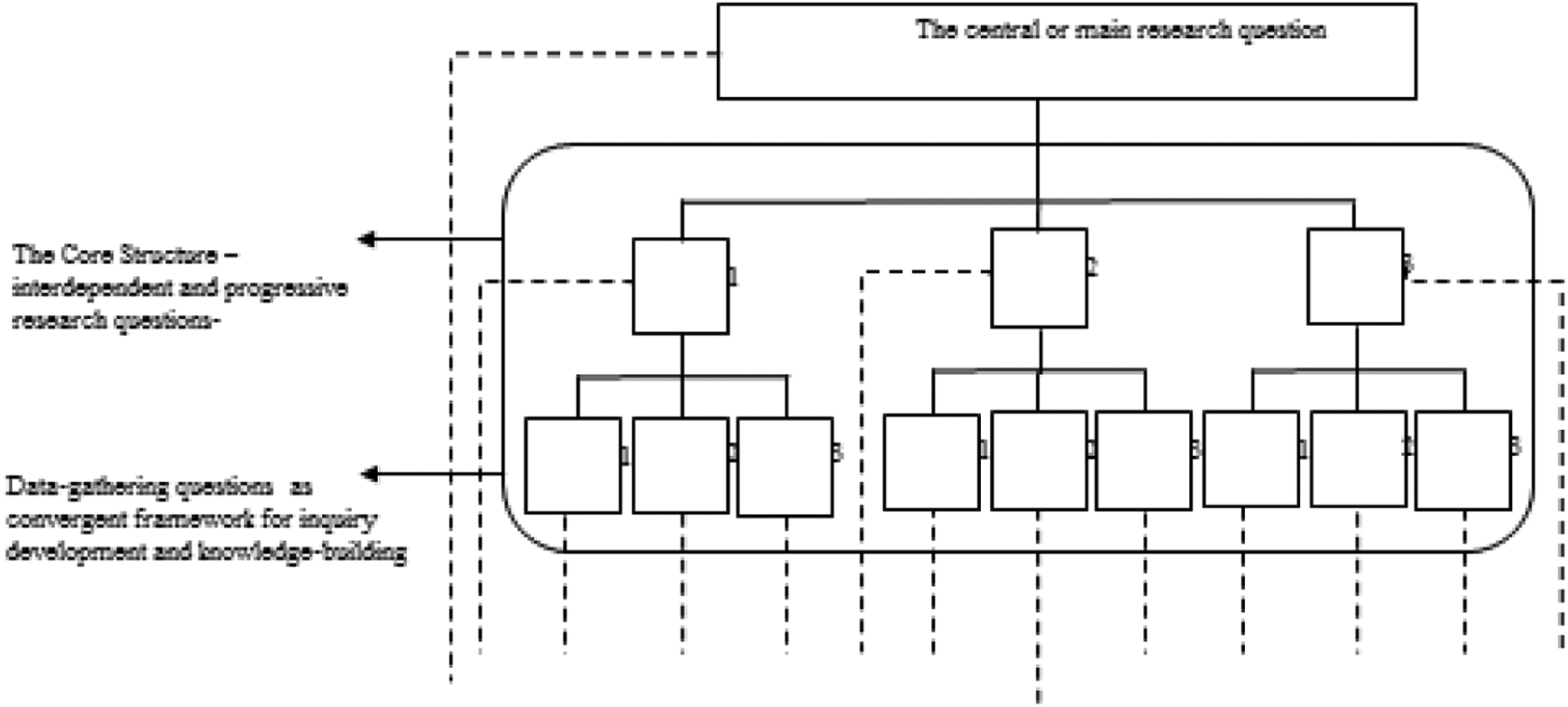
Translating an inquiry research design into a data-building framework.
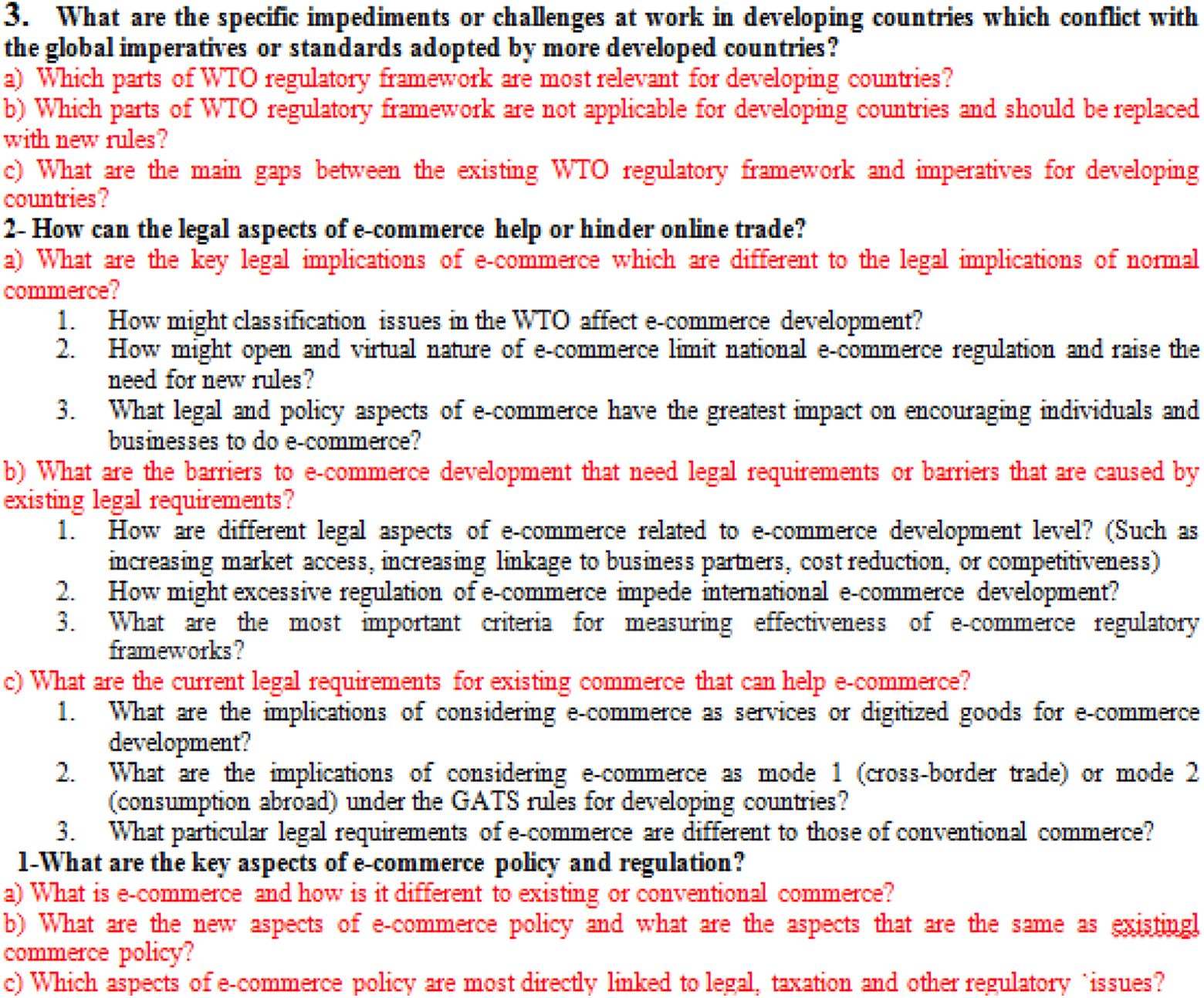
Data-gathering questions for focused, emergent, and comprehensive analysis of World Trade Organization e-commerce policy documents.
This process can be illustrated in relation to the example of the initial and foundational research question posed: What are the key aspects of e-commerce policy and regulation? (And how or which aspects of e-commerce policy differ from existing WTO GATS policies?). As had been established in an initial literature review, a wide range of issues and related concepts pertain to the challenges and opportunities representing by the emerging and related domains of e-commerce. Therefore, the study needed to comprehensively connect these as a basis for distinguishing the most relevant as a basis for further progressive levels and sets of data-building questions. The initial exploratory question of this initial stage is: What is e-commerce and how is it different from the normal commerce (i.e., the physical trade in goods and services)? The search for an adequate working definition then was followed up with a related question seeking to establish: Which aspects of e-commerce policy and regulation are the same (or rather which are different) in established policy notions of international commerce? Then a third question was then posed to direct the inquiry back in the direction of the larger regulatory dilemmas and challenges to WTO policies of e-commerce: Which aspects of e-commerce policy are most directly linked to legal, taxation, and other regulatory issues?
Figure 5 represents a more developed outline of the “intermediate” coding structure achieved after an initial process of refinement following efforts to come up with a foundational set of 27 (3 × 9) data-gathering questions. Figure 5 illustrates the detailed set of questions for the middle section. In this way, it exemplifies the overall process of constructing a comprehensive and emergent knowledge ecology or system to structure the knowledge-building process by linking an inquiry design to a related process of eliciting relevant information and feedback from the data collection and analysis stages. This is how a macro–micro framework of knowledge-building inquiry was applied to the study of e-commerce-related WTO policy documents.
The WTO website (www.wto.org/) includes a gateway for electronic commerce matters in terms of links to relevant information and documents. This provided a basis for an initial categorization of WTO e-commerce policies in relation to two main groups of documents—those linked to different WTO bodies and Members’ proposals. A number of such documents relate to not only General agreement on Trade and Tariffs (GATT) and Trade-related aspects of intellectual property rights (TRIPS) but also General Agreement on Trade in Services (GATS) and Trade in information technology products (ITA). Conversely until the end of 2012, our research identified a range of members’ proposals and other documents. As part of the data collection and analysis process, a number of secondary documents were also included in relation to exemplary national e-commerce polices from emerging or developing countries such as India, China, and Malaysia.
Key Words, Key Concepts, and Policy Challenges Related to the WTO Struggle to Consistently Classify “E-Commerce” and Related Concepts
Much of the policy research inquiry focus outlined above converged as part of a systematic investigation into some apparent discrepancies, dilemmas, and contradictions about the WTO’s ongoing positioning of e-commerce into existing policy frameworks. This is especially so in relation to the global context of a recognized developed–developing/emerging country divide at work in much WTO policy making. In this way, Question 2.1A in Figure 5 was particularly interesting as it focused on how the WTO has struggled to consistently classify e-commerce and associated terms within its existing frameworks. In a nutshell, the dilemma for the WTO is whether e-commerce should be primarily conceived in relation to the GATT or the GATS, with some related discrepancies and possible contradictions about how it should be positioned also in relation to the TRIPS and ITA.
WTO members have expressed divergent views about how and whether the full range and specification of e-commerce products fit within the GATT. This disagreement about the “classification of e-commerce products” surfaced from the outset of an initial search through WTO documents focusing on the “legal requirements of e-commerce.” The systemic dimension of the challenge was indicated by related references to how e-commerce fits into the GATT as an existing “harmonized system” with a specific “nomenclature.” Those WTO members who hold that e-commerce and related concepts should be contained within GATT give three basic reasons for their claim. They point out that “nowhere does the GATT say that it only applies to physical products” (WTO, 2003a, p. 5). In other word, they argue that there is no stipulation on the exclusive use of the GATT for physical goods. Some members believe that the content should be the base of classification rather than the form. Thus, an electronically deliverable product can be categorized under the GATT as far as its content can be qualified as goods (WTO, 1999a, 2002). Additionally, some WTO members draw a line between the “mass distribution” of electronic data and “more personalized distributions” (WTO, 1999). The former can be classified under the GATT, but the latter should be the subject of the GATS.
Taking an opposing line, a number of WTO members disagree about whether e-commerce products should be located at all under the GATT agreement. This group suggests the GATT “has not been designed” for this purpose and that there is no relevant nomenclature or tariff line in this regard. As a result, they argue that it is “not legally possible” to apply the GATT on the e-commerce products (WTO, 2003a). The opponents of using the GATT for governing e-commerce state that the form of a product, rather than its content, should be considered a basis of classification. Accordingly, the intangible form of e-commerce products does not let these products be categorized as goods (WTO, 2002, 2003b). In short, this group argues that the existing GATT provides for a nomenclature pertaining to products which have physical characteristics.
What was clear overall then from this analysis was the following: the ability of the GATT for fully covering the specifications of electronically deliverable products is contested and uncertain. Legal and regulatory frameworks within developing countries pertaining to e-commerce tend to be less stringent or developed to those conceived and applied in many developed countries. A key dilemma of the TRIPS agreement is that developed and developed countries sometimes tend to take a different view of the importance of protecting intellectual property in global as well as national contexts of public interest. As Shi (2004) points out, this dilemma is exemplified by how some of the very same transnational businesses which in their operations in developed countries espouse solid “corporate social responsibility” principles also set up in developed countries to avoid this.
For many members of the WTO, then, the e-commerce classification challenges and dilemmas are a low priority because of the risk of “premature classification” (WT/GC/W 436, 509), other more important priorities (WT/GC/W 486), and for some because of the perceived impossibility of “systemic progress” (WT/GC/W 556). Yet many other members are concerned about how a resolution should be considered a high priority with the growing importance and development of global e-commerce. Thus, members have pointed out how e-commerce classification challenges and dilemmas impact on or affect the following range of associated areas and issues: rules of origin (158/509/436), technological neutrality (436), market access rules (486), domestic regulations (509), customs valuation (158/509), import licensing (158/509), and new services (8).
Optimal Policy Building: Policy Research and “Knowledge-Building” Models of GT
In discussing the importance of using qualitative methods of data analysis for applied policy research in order to “understand complex behaviors, needs, systems and cultures,” Ritchie and Spencer (2002, p. 2) further argue that policy research needs “to be appropriately targeted towards providing ‘answers,’” and at the same time, “making its methods more explicit” (cf. also Schon & Rein, 1994). This is in order to instill confidence in those interested in making use of the findings such as decision makers, planners, and policy implementers in the government, private sector, and even wider community contexts. We have proposed in this article that a more focused and structured (i.e., knowledge building) version of the emergent process supported by a basic GT methodology can usefully assist in both these respects. We further propose below that such an approach is able to productively address the related “either-or thinking” tendency in established models of policy research to delineate and compare between rational and top-down versus more ad hoc approaches. This is as well as related distinctions such as macro versus micro domains of formal versus strategic analysis. As discussed earlier, GT’s basic focus on the interplay of key concepts and key words (i.e., knowledge and language) correspond to a similar distinction in policy analysis between a macro overview perspective and a rather micro focus on specific details.
Optimal GT (OptimalGT): Reconciling “Linear and Hierarchical” and “Network” Models of Research Analysis
The early classical model (CGT) tended to descriptively project a process of knowledge emergence from a chaotic network of concepts moving from a macro-level of “initial coding” to “focused coding” based on key concepts as well as key words used. Glaser and Strauss (1967) initially espoused a model of network emergence based on associative models of thinking and language use which stood in contrast to the top-down imposition of linear and hierarchical frameworks of a more logical and formal analysis suggested by Strauss and Corbin’s (1990) axial coding model. As discussed, the need to go beyond this is reflected in the constructive approach to GT outlined by Charmaz (2006) and others (cf. also Thornberg & Charmez, 2012). Thus, the optimal knowledge-building approach to adapting the GT model outlined in this article (OptimalGT) also represents a framework for reconciling logical and associative as well as interpretive and descriptive (as distinct from rational vs. empirical and observational vs. experimental) models of research analysis.
Such a convergent approach has two distinct if related applications of the policy-building process. On one hand, it can be directly used for the study of formal or existing policy documents against the backdrop or specific context of underlying or implicit diversity and often dilemmas and even conflicts of interest and perspective. On the other hand, such a framework is also useful for identifying or harnessing the indirect or implicit policy implications of “less formal” documents, communications, and perspectives. In terms of both applications, the knowledge-building framework of GT methods outlined in this article are just as applicable to brief, ad hoc, and media-crafted expressions of policy strategies and directions (in speeches, interviews, media presentations, etc.) as in formal documents of “public policy.” Conversely, policy researchers may adopt a more indirect strategy of harnessing the policy implications of either particular texts or rather the contextual domain of policy priorities.
The similarly emergent models of policy and knowledge “building” represent a convergent framework for reconciling linear and hierarchical and network models of analysis. In policy studies and research, mention is often made of an oppositional tendency between rational top-down and more ad hoc or slowly emergent (i.e., muddling) approaches to decision making and policy development (e.g., Parsons, 2002). Such an approach provides a basis for linking macro- and micro-levels of policy analysis and research in terms meaningful to specific inquiry purposes. In this way, the process of knowledge-building emergence proceeds as an inquiry-based or problem-solving dialogue by a researcher involving the inquiry design of focused research questions and selected texts, respondents, and related “data sets.” In this way, there is advantage in effectively replacing the descriptively (or chaotically) emergent coding structure of CGT with an alternative model which not only constructs (ConGT) but also optimizes the process in terms of choosing a conceptual design or framework as a “point of departure” (OptimalGT). This is to either directly conduct policy analysis or rather identify, harness, and address the implications of a focus policy problem or dilemma toward a sustainable resolution.
Optimizing the Policy Research Process Using a Knowledge-Building Approach
The OptimalGT approach suggests that the key to optimizing the policy research process is to frame it as a process of problem solving of some kind or at least needed policy refinement (e.g., Bardach, 2000) directed at achieving more effective solutions and improved outcomes in particular contexts. Because contexts of policy planning and decision making are constantly changing, even the most effective policies should also continue to be refined and improved. This is why merely descriptive and past accounts of fixed and formal public policy are almost by definition the study of inevitable failure. Conversely, the limitation of using “evidence-based” approaches is that many leaders as well as policy analysts often select the evidence to fit and also justify top-down decisions or rational plans already made. This represents a version of what is often referred to as “confirmation bias” which is also linked to the related problem of induction (e.g., Goldacre, 2008). By contrast, an outcome-based approach works backward in terms of the strategic challenge of implementing policy as both macro directions and micro interventions within specific contexts of implementation.
It is relevant here that Agyris (1976) initially applied the double-loop learning model to recognizing a negative and self-reinforcing circular tendency in much policy planning and decision making. This really reflected the top-down or at least rational leadership tendency in much modern governance. The so-called muddling leadership approach to policy making of responding in an ad hoc way to any situation compares with how the rational approach inevitably fails to be sustainable or to be transferable in time or space (Parsons, 2002). However, it is a very slow and cumbersome process of emergence—not unlike classical GT compared to the more optimal approach recommended here also corresponding to the transformative double-loop learning process interested in deep and not just surface meanings (cf. also Schon & Rein, 1994). In this way, we have elsewhere proposed an outcome-based inquiry and problem-solving approach to sustainable policy building addressing complex problems and challenges (Richards, 2015). As Figure 6 depicts, on this basis, we can project a transition from negative to positive policy analysis and development corresponding to the related transition from single-loop to double-loop learning in the policy research as well as policy-making process of planning and decision making.

Toward an outcome-based framework of optimal policy building.
Figure 6 further outlines a model of how a knowledge-building approach can likewise serve to optimize the process of policy research. Such an approach is to be distinguished from influential models of what might be called a downward and backward perspective toward rationally or theoretically imposed policy decision making analyzed as formal statements of public policy (Richards, 2012a). This alternation between top-down and either ad hoc or muddling approaches is typically conceived as a negative cycle that easily leads to policy paralysis. In contrast, an upward and forward approach conceives policy research as most effectively a challenge of problem solving or at least refinement directed at achieving solutions in terms of also anticipating future restraints and obstacles of implementation and emergence. Such an approach frames an emergent model of policy design, development, and implementation in terms of achievable outcomes which is based on an interpretively constructive rather than merely descriptive analysis of policy texts or data sets. In other words, policy building takes place upon a foundation of constructive policy analysis in terms of a systemic model which integrates the macro directions, principles, and outcomes of “big” or formal policies on one hand, on the other the micro interventions and details of an ecology of supporting “small” policies (support, incentives, regulations, penalties, taxes, etc.).
Deep Convergence? Using OptimalGT to Better Conceive an Integrated Model of Policy Research
Building on the related models outlined earlier, an OptimalGT approach may be applied to provide a framework and foundation for “deep” and not just surface or descriptive policy analysis and critique for improvement. Figure 7 diagrammatically represents how such an approach can be represented as an integrated model of four distinct yet interdependent modes of effective policy research to overcome related policy gaps. The first mode is of “direct” (i.e., formal descriptive) policy analysis especially applicable where either formal policy statements or documents are available. Big or “macro” policy positions, directions, or strategies are not only often made up of diverse and often contradictory sources but also an ecology of related small policies and supporting “micro” interventions in the forms of incentives, regulations, taxes, and so on (i.e., carrots and sticks). As illustrated by the WTO e-commerce case study in this article, not only are formal articulations of public policy often incomplete or contradictory but also need to be clarified in terms of secondary sources of commentary or critique and “nonformal” presentations or documents. Many government departments and public sector agencies release policy positions or directions as short media statements which then need to be deciphered or critiqued (e.g., Richards, 2012b). Thus, a second mode of analysis to complement or balance has to do with the more “indirect” interpretive-rhetorical analysis of both formal and nonformal policy sources.

Beyond “policy gaps”: An integrated model of the four distinct but interdependent modes of policy research.
This informs a third-related mode which is research inquiry to harness the “policy implications” of a range of direct and indirect policy sources. In addition to including relevant references such as specific policy documents, this may include a “needs analysis” of local stakeholders in any immediate context. Such consultations may be conducted either informally (e.g., as focus groups) or more formally in terms of surveys or interviews. This is also the key to how policy research can, should, and will be of growing interdisciplinary as well as specialist interest to academics from disciplines across the traditional social versus natural sciences divide (Richards, 2015). For instance, global issues of sustainability (climate change, energy security, the ethical dilemmas of biotechnology, etc.) increasingly mean that applied scientists and technology developers need to be aware of national or global priorities to achieve funding and also link their work for publication and dissemination purposes (Richards, 2012c). Like the third mode, the fourth also represents a strategy of “upward and forward” policy building which complements and builds upon the kind of deep constructive policy analysis which can be framed and guided by the convergent GT model. “Producing better policy solutions” reflects the kind of associated problem-solving approach which can promote designs for innovative policy solutions or at least significant policy refinement and improvement. An integrated framework serves to overcome related policy gaps between what is known and decided, planned and implemented, and formally stated and informally applied or practiced.
The wider relevance and application of an OptimalGT approach is exemplified by its application to an integrated model of policy research—especially where concerned with pressing issues and sustainability challenges of authentic complex solving with interdisciplinary implications or requirements. Cutting across the vertical “surface to deep” policy analysis axis is a horizontal axis of emergent and dialogical knowledge building which reflects the provisional or framing uses of linear and hierarchical modes of effective research design. The perpendicular axes represent the interplay between the related axes of knowledge and policy “building” also corresponding to the interplay of the four macro-stakeholders of sustainable policy development (governments, private sector, wider community, and knowledge agencies; Richards, 2013). The public–private dichotomy which especially informs the interplay of macro versus micro policy domains also applies to public awareness versus personal and domestic domains as well of governance versus private sector market forces. This intersects with the related knowledge-building interplay between particular local versus global knowledge communities and related knowledge-building versus policy-making “agents.” The challenge of sustainability should be the test which independently informs and convergently integrates both the critical analysis and problem-solving or inquiry-based building of policies. In this case, our critical analysis of the inadequacies of the existing WTO’s policy framework for e-commerce (in terms of an underlying OECD vs. developing country divide and its out-of-date reliance in the digital age on conventional commerce models) has provided the basis for a further or follow-up case to be made for sustainable policy change and improvement with real-world implications and relevance.
With its focus on the challenge of better linking knowledge to planning as well as performative, consensual, and decision-making contexts of “action,” policy research cuts across and goes beyond the traditional theory versus practice (or pure vs. applied) research divide. This is in addition to related divides such as that of the natural versus social sciences/humanities and qualitative versus quantitative methodologies of evaluation. As Rennie (2002) suggests—following in the footsteps of philosophers of science such as Thomas Kuhn, Mary Hesse, and Rom Harre—GT methodology represents the kind of hermeneutic tool which is relevant and applicable to every scientific and other knowledge-building context beyond as well as including the “human sciences” (Ricoeur & Thompson, 2001 ).
Conclusion
This article has outlined a framework of optimizing, convergent, and inquiry-based or problem-solving GT (OptimalGT) which has built on existing models to apply an optimal knowledge-building approach. Whereas the classical GT model was more suited to informal or conversational texts, the present version is able to also focus on and include both the formal and rhetorical analysis of policy documents and positions or directions. In this way, we have outlined an integrated and outcome-focused research framework which can assist with the growing importance of policy research as an academic option to undertake complex problem solving in authentic contexts and associated interdisciplinary collaboration. This is in addition to harnessing the policy implications of different areas or disciplines of knowledge as well as diverse and often informal sources of policy research. The knowledge-building power and application of the OptimalGT approach was outlined in relation to a case study focus on the dilemmas and challenges of enhancing as well as interpreting the WTO’s e-commerce policy ecology.
Footnotes
Authors’ Note
The qualitative research methods and related strategy described in this article were initially conceived and refined in postgraduate research workshops conducted by the principal author in the University of Technology Malaysia (UTM) Perdana School of policy studies. The case study focus on WTO e-commerce policies derives from the now successfully completed PhD undertaken by the second author also within the UTM Perdana School of policy studies.
Declaration of Conflicting Interests
The author(s) declared no potential conflicts of interest with respect to the research, authorship, and/or publication of this article.
Funding
The author(s) received no financial support for the research, authorship, and/or publication of this article.