




Abstract
Since its inception in the sociological field more than fifty years, Grounded Theory Methodology (GTM) has been extended to a range of research areas but there still be confusions and misconceptions about its history and methodological principles. This paper attempts to provide a full theoretical overview of the history of GTM and allows limiting misconceptions about the methodology itself. Drawing upon social sciences perspectives, the paper begins by briefly shedding the light on two major related concepts: Grounded Theory (GT) and Grounded Theory Methodology (GTM). It continues by defining what GTM really means and outlines the reasons behind The Discovery of grounded theory and further focuses on the big split that gave birth to three schools of Grounded Theory Methodology: Glaserian, Straussian and Constructivist GTM.
Introduction
Grounded Theory Methodology (GTM) remains a popular research strategy that can be used across several disciplines
Understanding concepts: Grounded Theory Methodology and Grounded Theory
This section provides full insights about defining and differentiating the key related terms of GTM and GT. It also offers some historical and philosophical perspectives on the subject.
Grounded Theory and Grounded Theory Methodology: what is the difference?
The two terms Grounded Theory and Grounded Theory Methodology are always confused and used to define the same thing: they seem interchangeable. But taking a look at the existing literature allows affirming that they are not substitutable and do not give the same meaning: “A Grounded Theory is the possible outcome of using the Grounded Theory Method” (Bryant, 2002, p. 27). Grounded Theory does not represent the methodology itself. It is a product, an outcome or a consequence that is directly derived from the correct use of the whole methodological approach, including its core principles and it “proves itself by being a GT of the method” (Glaser in Walsh et al., 2015, p. 23). However, the way of combining tools and techniques that really fits with generating a substantive theory designed as Grounded Theory (GT) is called Grounded Theory Methodology (GTM). One should say there is a causal relationship between GTM and GT. Otherwise, we should keep in mind that designing Grounded Theory Methodology is suitable at the empirical phase of the research process while Grounded Theory should be pronounced when the research comes to at the end.
Historical perspective of GT and GTM
Grounded Theory as the product of the methodology, periodically emerged during the 1960s and does not have an exact birth date contrary to what it was supposed to be. Barney Glaser and Anselm Strauss’s publication of The Discovery of Grounded Theory exactly backs in 1967 and this was the seminal work on the methodology. It is therefore inaccurate to consider the theory as something invented or created. It was not. Glaser and Strauss (1967) labeled their work The Discovery of grounded theory because it was discovered and constitutes a cue of the emergence of the methodology itself with a highlight of a few guidelines that allow reducing the gap between theory and method (Glaser, 2016). In addition, it must be emphasized that the methodology was not a single work that came out in 1967: it was derived from the combination of a range of basic texts and similarly to its product, Grounded Theory Methodology does not have a specific birth date that really marks its advent. It emerged in the 1960s and came from both Awareness of dying (1965), Discovery (1967), Time for dying (1968), and Status Passage (Bryant, 2009; Bryant & Charmaz, 2007; Birks & Mills, 2015). Glaser and Strauss strongly collaborate, combine their work and provide long term efforts covered by empirical and theoretical studies until they get a top ready methodology that innovatively differs from the existing ones known in qualitative and quantitative fields. The Grounded Theory Methodology (GTM) encompasses a set of guidelines such as theoretical sensitivity, theoretical sampling, theoretical saturation, constant comparative method, coding process, memoing, sorting etc. (Glaser & Strauss, 1967; Strauss & Corbin, 1990). Throughout these guidelines, the goal is to systematically collect and analyze data in order to discover (Glaser & Holton, 2004) or construct (Charmaz, 2006) a theory that is grounded in the data.
Philosophical underpinnings in Grounded Theory Methodology
The parameters for distinguishing GT from GTM.

Clearing up the Ambiguities About GTM as a Method or a Methodology
GTM is often considered as a method and sometimes confused with other qualitative methods. It is now necessary to clearly indicate what GTM is and what it is not, and to show why the term ‘Methodology’ is preferred over ‘Method’ in a Grounded Theory Study.
What Grounded Theory Methodology is?
Grounded Theory Methodology is a general methodology that stands on its specific tools and rules through high level of conceptualization (Glaser, 2016). In opposition to the descriptive nature of many qualitative approaches, Grounded Theory Methodology is deeply embedded in conceptualization:“Quantitative research and QDA (qualitative data analysis) provide description of aggregates and in-depth cases respectively and GT (grounded theory) provides the conceptual overview with grounded interpretation, explanations, impacts, underlying causes and so forth” (Glaser, 2003, p. 118). It is not about a tool for descriptive qualitative analysis but it is an innovative methodology with rigorous procedures for theory building where concepts appear at the crux of the analysis process: “Only concepts can relate to concepts to achieve hypothesis construction… Descriptions cannot relate to descriptions in any clear or precise way if at all. Hypotheses, if achieved, are unit empirical with no generalizability.” (Glaser, 2001, p. 38). As a general methodology, GTM requires a simultaneous data collection and analysis process in which the researcher sets aside all theoretical frameworks that could biaise his study and tries to generate a theory from the data (Charmaz, 2006; Glaser & Strauss, 1967). It may include all kind of data (interviews, questionnaires, observations, videos, documents, etc). Glaser (1999) reveals his dictum of All is data during a conference adress: “Let me be clear. Grounded theory is a general method. It can be used on any data or combination of data”. The outcome of a Grounded Theory study is neither presented as a narrative nor a descriptive form that underlines participants’ concerns, but it appears as a set of hypotheses that conceptualize the link between concepts (Glaser & Strauss, 1967). Doing a grounded theory study is not easy, it is both time and energy consuming. The researcher needs to be patient and creative, and he should look for the theory’s emergence rather than forcing it (Glaser & Holton, 2004). Whatever well done it is, the generated theory is not going to be perfect. A grounded theory is never perfect, it should be revised and adjusted according to a list of criteria: “A grounded theory is neither right nor wrong, it just has more or less fit, relevance, workability and modifiability. Readers of grounded theory should evaluate them against these criteria” (Thulesuis, 2008 as cited in Holton, 2008, p. 79). However, the existing literature informs that a number of scholars including Glaser himself, may sometimes use the term Grounded Theory instead of Grounded Theory Methodology or he even terms method instead of methodology. In this respect, getting into Glaser’s mindful conception may be quite helpful to understand that GTM is not just a simple method. For instance, a citation taken from “Getting started” clearly indicates the way Glaser considers GTM with the use of the term ‘methodology’ a number of times: “In comparison to preconceived description, there is no dilemma when choosing the grounded theory methodology...Once grounded theory methodology is chosen...The methodology process [uncovers] the emergent problem...” (Glaser, 2016, p.3). Therefore, the debate may be closed by keeping in mind that the term ‘methodology’ is preferred to method because GTM encompasses four main features which justify its methodological aspect. First, it breaks with traditional qualitative inquiries by relying on its own method of data collection and analysis through theoretical sampling, constant comparative analysis, and theoretical saturation. Second, it allows the combination of both qualitative and quantitative data. Third, it is possible for Grounded Theorists to use both qualitative and quantitative techniques of analysis in their study (Walsh, 2015). Fourth, it has the specific purpose of generating a theory grounded in the data. Glaser and Strauss (1967) emphasize two main kinds of theory: substantive and formal theory. A substantive theory is just applicable to a certain substantive field in opposition to a formal theory which can be related to many different substantive areas. In sum, GTM is a general methodology in the way it combines several methods in the course of the research process. These include methods of literature use and methods of data collection and analysis (See Charmaz, 2006; Nathaniel, 2022; Strauss and Corbin, 1990).
What Grounded Theory Methodology is not?
How to conceive Grounded Theory Methodology.

From the Causes Behind ‘The discovery of Grounded Theory’ to its Usefulness
Urquhart and Fernandez (2006) assert that one of the main reasons behind The discovery of grounded theory was a response to what sociologists using functionalist theories labeled ‘armchair theorizing’ in the 1960s (Kendall, 1999; Dey, 1999). At that time, there were a short number of books that dealt with qualitative research in social sciences (Hallberg, 2006) and the methodology was poorly developed and orally transmitted to students (Holton, 2010). Qualitative researchers used preconceived ideas and extant theories prior to data collection and analysis (Gibbs, 2012). In doing so, they have been subjected to a number of criticisms from quantitative scholars who viewed qualitative research as being “unsystematic, impressionistic, and unreliable” (Hallberg, 2006, p.142), hence leading it to a subordinate position behind the deductive approach that prevailed. This gives rise to a new way of challenging the underlined controversial ideas by undertaking a new methodology based on more rigorous procedures (Goulding, 1999). In response to the supremacy of deductive approaches in social sciences research, Barney Glaser and Anselm Strauss launch an innovative methodology in which the literature review was delayed and the data was simultaneously collected and analyzed through comparative method. The outcome was a product labelled Grounded Theory which directly reflects participants’ concerns (Goulding, 2005). This seminal work was quite revolutionary in the way in which it breaks with the idea of considering qualitative research as a means for quantitative methods development by laying the foundation of a methodology that could use scientific procedures based on its own right for a rigorous theory generation. Glaser and Strauss (1967) played a significant role in legitimizing and reinforcing the credibility of qualitative research in social sciences and later the methodology becomes one of the most famous in the world that impressed many young scholars particularly nursing students (Charmaz, 2006; Birks & Mills, 2015; Goulding, 1998).
How the Theory was discovered?
Glaser and Strauss (1967) studied the phenomenon of dying in several hospitals in the united states. They examined how medical staffs and their terminally ill patients perceived the new that they are going to die and how they reacted (Charmaz, 2006). Glaser and Strauss (1967) early set aside both the logico-deductive approach and the traditional qualitative method which consisted of using preconceived ideas and previous experiences related to the area under study. They delay the literature review and initially engaged in a systematic data collection and analysis. Doing so “they gave their data explicit analytic treatment and produced theoretical analyses of the social organization and temporal order of dying. They explored analytic ideas in long conversations and exchanged preliminary notes analyzing observations in the field” (Charmaz, 2006, p.4). The theory was inductively developed and grounded in the data through a systematic process of data collection and analysis that contrasts the well-known linear process of theorizing: “we define grounded theory as the discovery of theory from data–systematically obtained and analyzed in social research” (Glaser & Strauss, 1967, p. 1). Glaser and Strauss’s innovative approach works as a circular process and includes numerous guidelines as highlighted at the beginning of this paper: Delaying literature review, theoretical sensitivity, theoretical sampling, simultaneous data collection and analysis, comparative method, memo wriitng and sorting, looking for theory emergence (Holton, 2010). Accordingly, a completed grounded theory must be powerful in terms of explanation, useful, dense, close to the data and changeable (Glaser & Strauss, 1967). Further, it should be noted that these given guidelines constitute the basis of the divergent ideas between the co-founders of GTM that have led to the emergence of three schools of Grounded Theory Methodology.
From the Big Split to the Emergence of Three Schools of Grounded Theory Methodology
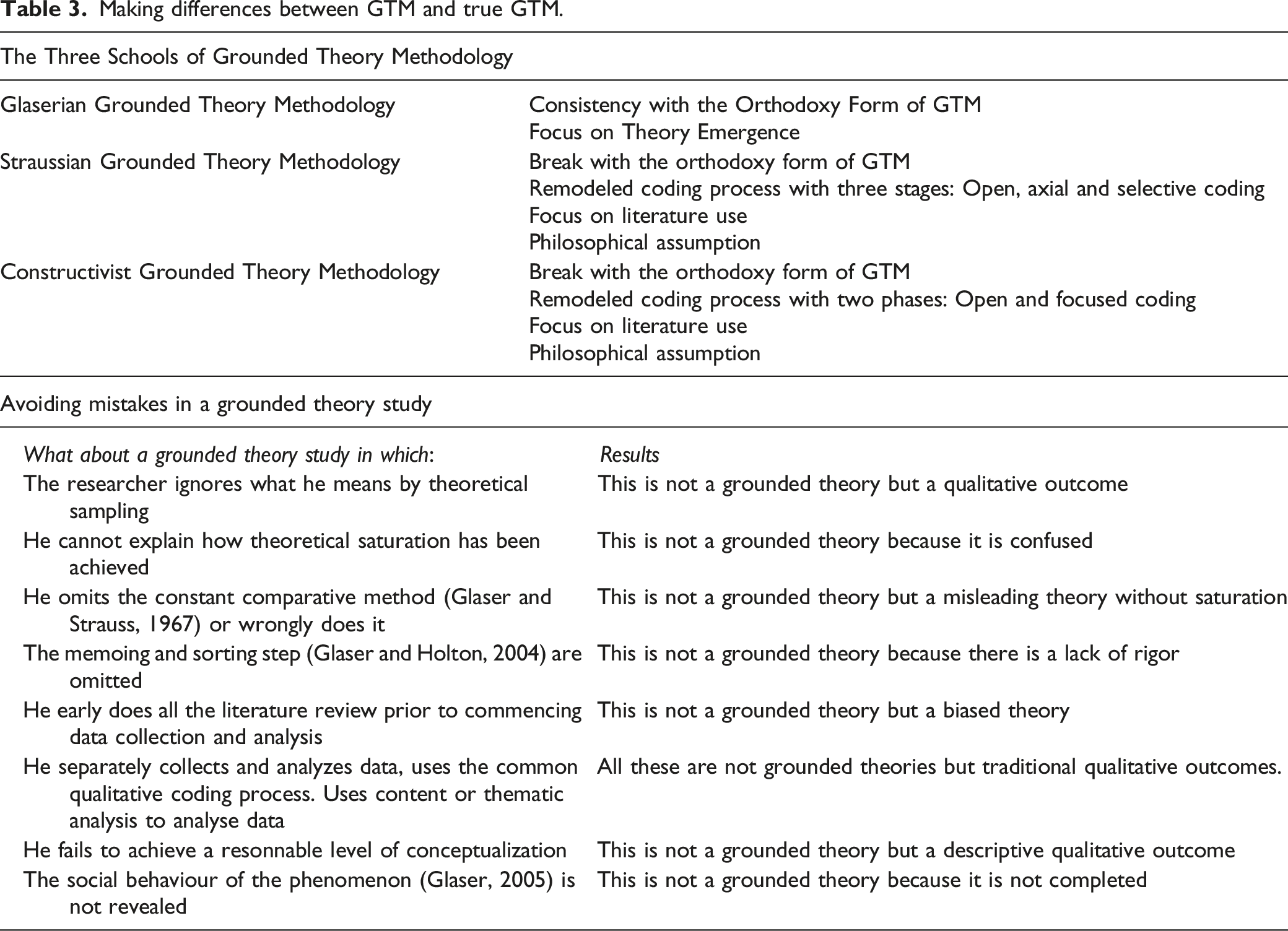
The history of Grounded Theory Methodology (GTM) has been marked by heated debates and certain cleavages between the co-founders. This has further turned the methodology into three forms: Glaserian, Straussian and Constructivist GTM. We first get inside the big split prior to focusing on the emergence of the three schools of GTM.
Inside the big split
It is sometimes argued that Glaser and Strauss have been separated and worked independently since their successful collaboration that backs in 1967. This idea is inaccurate and a misleading one. Many years after The discovery of grounded theory, Glaser and Strauss still work together and they have trained several students at the University of California San Francisco (UCSF) who became later experts in the methodology (Birks & Mills, 2015).They remained teaming up during the early 1970s and became co-authors (see Holton, 2008). They published three books that extend the GTM perspective during the 1970’s (Glaser, 2016). The first one was entitled Anguish: A Case History of a Dying Trajectory (1970), the second was Status Passage: A Formal GT Theory (1971) and the third was about Chronic Illness and the Quality of Life (1975). Later, Glaser (1978) published a small book entitled Theoretical sensitivity where he brought a set of theoretical codes and Strauss (1987) published the 'Qualitative Analysis for Social Scientists ' (QA), a book that mainly resulted from the workshop he did with research students particularly those interested in GTM (Bryant, 2009). At that time, everything was fine and there was no remarkable divergence between the two founders of GTM. But three years later, Anselm Strauss in collaboration with Juliet Corbin, attempted to help students without or with little knowledge about qualitative methods and GTM (Bryant, 2009). They published the ‘Basics of Qualitative Research’ (BQR) in 1990.Therefore, the ‘bifurcation’ as termed by Goulding (1999) widely came from this publication. This basically represents the flagship event that marks the split between Glaser and Strauss (Holton, 2008). Glaser was so frustrated and two years later, he gave a strong response in Basics of Grounded Theory: Emergence vs Forcing where he rejected Strauss & Corbin’s new version of GTM and viewed it as completely descriptive and contrasting the seminal work (Glaser, 1992). To confirm his disagreement, Glaser (1992) sent two personal letters to Anselm Strauss complaining against what he termed the ‘distortion’ and ‘misinterpretation’ of Grounded Theory Methodology and considers Strauss as someone who had never understood what they were doing before: this book is something “without conscience, bordering on immorality… producing simply what qualitative researchers have been doing for 60 years or more: forced, full conceptual description” (Glaser, 1992, p. 3). He then asked Strauss to withdraw the book and rebuild it on the basis of a bilateral consent with him in order to revise and correct what he had seen as contrasting 90 percent of the original version (Goulding, 1998). But Strauss (1987; Strauss & Corbin, 1990) had not seen a major difference between their publication and the original version of GTM. According to Bryant (2009), Anselm Strauss claimed receiving permission from Glaser by quoting some passages of theoretical sensitivity (Bryant, 2009). In opposition to Glaser’s call for withdrawing the book, Strauss and Corbin remained on their willingness to move the old version of GTM toward verification and refinement. In this respect, Glaser and Strauss ceased their collaboration and decided to work separately (Urquhart & Fernandez, 2006).
The emergence of three Schools of Grounded Theory Methodology
Making differences between GTM and true GTM.
Conclusion
This paper makes an overview of the History of Grounded Theory Methodology by stressing its purpose and addressing some misleading ideas. From a broader perspective, there is no doubt about the growing body of research that intends to legitimize the methodology since its birth date during the 1960s but the way in which it is conducted may be critical due to a lack of rigor in understanding the methodological principles. Confusions about GTM and its purpose should now be out of date and we urge junior researchers to renew their endeavors in terms of making significant strides towards understanding the use of GTM’s full package of guidelines in their studies since it may be a potential tool for theory generation in management and social inquiries. Definitely, all forms of disagreement derived from the Glaserian, Straussian and Constructivist stances may be seen as a cue of maturity of the methodology rather than an obstacle (McCann & Clark, 2003). There is no reason to adopt a radical stance while choosing one of the three grounded theory approaches because despite a central issue related to the use of literature and their philosophical underpinnings, they share the same purpose of building theory from data.
Footnotes
Declaration of conflicting interests
The author(s) declared no potential conflicts of interest with respect to the research, authorship, and/or publication of this article.
Funding
The author(s) received no financial support for the research, authorship, and/or publication of this article.
