




Abstract
While stories are a central focus in narrative inquiry to examine phenomena, storytelling deconstruct values, assumptions, and beliefs to challenge taken-for-granted meanings. The objective of this paper is to examine storytelling from the perspective of knowledge paradigms, methodology, quality criteria, and reflexivity. By recognizing the elements of stories sociality, temporality, and place, the scope of a qualitative narrative study is framed where factors are expressed, shaped, and enacted. Considerations of these elements can be linked with the critical paradigm and self-reflexivity for representing and designing narrative inquiry grounded in a set of ontological and epistemological assumptions. A significant contribution of this paper is to address a methodological approach in the form of narrative inquiry to better understand the meaning of stories as rooted expressions of participants’ lived experiences. The implications of this study are to bring critical lens to worldviews that would better inform policy.
Stories in narrative inquiry are helpful for leading the researcher toward a better understanding of phenomena. When engaging with narrative inquiry, we become co-participants to co-construct the knowledge alongside the participants across particular places and time (Lindsay & Schwind, 2016). Narrative inquiry calls for ways to engage in sociality, temporality, and place. The role as a qualitative researcher is as an intermediary in knowledge co-construction in the collection, interpretation, and revelation of the meaning behind the stories: “We are naturally drawn to stories because it helps make ideas easier to understand” (Yamagata-Lynch et al., 2017, p. 2). Narrative inquiry is deeply embedded in reflexivity—an ongoing, active process that permeates every stage of the research (Guillemin & Gillam, 2004). The primary purpose of this study is to focus on storytelling in the form of narrative inquiry within knowledge paradigms, methodology, quality criteria, and reflexivity that would better inform its potential contribution to policy (Figure 1). Storytelling in the form of narrative inquiry.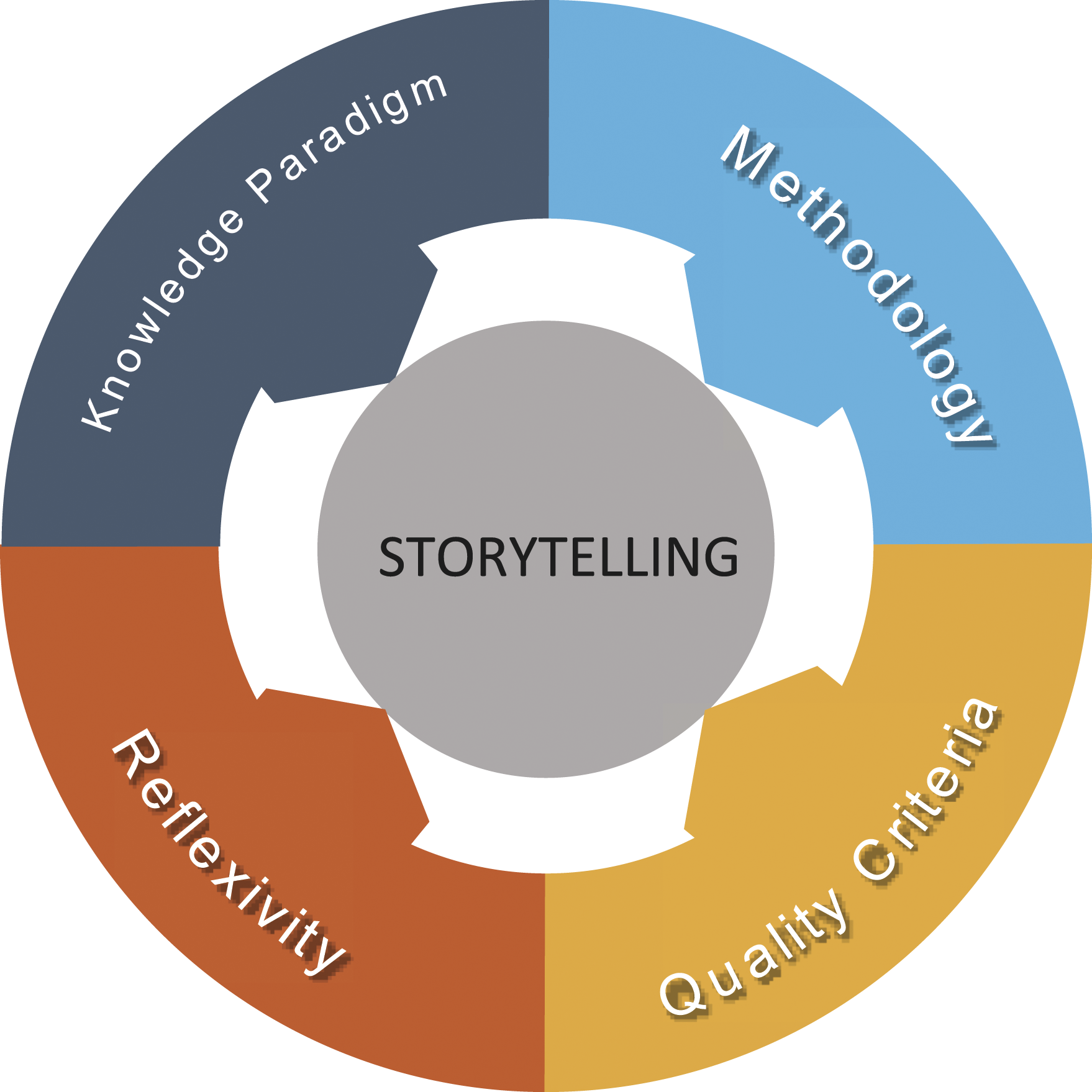
Knowledge Paradigms
Constructionism is one of the knowledge paradigms informing the philosophical assumptions in qualitative research, and considers two angles of analysis: (1) the interpretative paradigm, within constructivism, is the individual perspective on how people see the world (ontology). Knowledge is obtained by participating subjectively in meaning-making (epistemology); and (2) the critical paradigm, within social constructionism, is the philosophical assumption that meaning is already in the world (ontology). Knowledge is produced by social, political, economic, and cultural values crystallized over time (epistemology) (Ponterotto, 2005). In the critical paradigm, the social world is mediated by power relations in a constructed lived experience amidst social and historical contexts, which, in turn, shape social reality (Ravenek & Laliberte Rudman, 2013).
Narrative inquiry is carried out in terms of two paradigm-specific criteria, either an interpretative or a critical paradigmatic position in exploring and understanding the ways people construct meaning of their experiences in social contexts with emphasis on the dialectic stance between the researcher and participants that aims to reach deep insights (Ravenek & Laliberte Rudman, 2013). Social constructionism’s epistemology underpins how knowledge is constructed and embodied in the critical paradigm toward a reality shaped by social, political, and economic values (Ponterotto, 2005). The critical paradigm, therefore, suggests that “narratives do not spring from the minds of individuals but are social creations” (Smith & Sparkes, 2005, p. 3). The power dynamics of societies create practices, systems, and situations of marginalization (Laliberte Rudman & Aldrich, 2017).
Methodology
Narrative inquiry appeared in the educational field in 1990 through the work of Connelly and Clandinin with a central focus on lived experience (Clandinin et al., 2007). The quest for knowledge in this qualitative research methodology intends to advance understanding of the experiences of people across place and time (Dewart et al., 2019). Researchers are prompted to identify stories through elements of sociability, temporability, and place (Clandinin & Caine, 2008). The recognition of these elements emerge from each story that can be situated within social, cultural, economic, and institutional narratives (Clandinin & Caine, 2008).
Bruce and colleagues (2016) position narrative inquiry as “the study of experience as story and a way of thinking—through storying” (p. 2). Storytelling is socially constructed and inscribed. The idea of story lines elicits multiple themes based on more consistent concepts grounded in participants’ data (Bruce et al., 2016). Storytelling is the rooted expression of living, telling, and retelling experiences (Bruce et al., 2016). The word “story” is the anchor for the analysis, noting that various analytic approaches can take different forms such as stories within stories, memos, reflections, debriefs, individual interviews, team interviews, audio analysis, and metaphoric analysis.
The story elements underpinning the interaction and continuity of stories are sociality, temporality, and place (Clandinin & Caine, 2008). According to Connelly et al. (2007, p. 2), these elements offer a view of human experience that recognizes the use of story:
People shape their daily lives by stories of who they and others are and as they interpret their past in terms of these stories. Story, in the current idiom, is a portal through which a person enters the world and by which their experience of the world is interpreted and made personally meaningful.
In other words, the narrative methodology calls for the ways in which sociality, temporality, and place intersect in the stories of participants.
A description of sociality, temporality, and place acknowledges the lived experience of participants as the knowledge source. Sociality encompasses the personal and social conditions (Dewart et al., 2019). The personal conditions include hopes, aesthetics, feelings, and reactions, whereas the social conditions refer to the environment, surroundings forces, and existential conditions (Clandinin et al., 2007). Temporality remarks that stories are evolving based on the experience in a particular time period (Dewart et al., 2019). That means that events, people, and places always have transitions between past, present, and future conditions (Clandinin et al., 2007). Place is, the physical environment, where the experiences are unfolding over time (Dewart et al., 2019). The specificity of place represents an essential role in narrative inquiry with the reflection that events impact in each place (Clandinin et al., 2007). Generalizability is not the objective of narrative inquiry; rather the approach is to embrace the lived experience as story (Lessard et al., 2015).
Quality Criteria
There are quality criteria for assessment in qualitative research such as: Lincoln and Guba (1985), Finlay and Ballinger (2006), and (Ravenek & Laliberte Rudman, 2013). Lincoln and Guba (1985) explained that the trustworthiness of a qualitative study is examined through credibility, transferability, dependability, and confirmability. Frequent member checking following participants’ responses ensures credibility. Detailed description of participants refers to transferability. Audit trail to ascertain that the findings are linked to the data builds dependability. Finally, field notes and analytics memos gather participants’ contextual factors, which is confirmability.
Finlay and Ballinger (2006) focused on bridging criteria by demonstrating rigor to be transparent in offering a vivid and insightful interpretation of narratives grounded in the dependability of the methodological procedure. The rigor of a qualitative study explicitly clarifies transparency and yet offer a compelling narrative based upon interpretation. Rigor is also judged by understanding narratives through interpretation which acknowledges how participants attempt to make meaning through connecting events within a specific context in terms of significant interactions and relationships with family members, friends, and health professionals (Finlay & Ballinger, 2006).
Ravenek and Laliberte Rudman (2013) suggested that narrative inquiry is carried out systematically through sensitivity in terms of the paradigm and ethical considerations. This approach informed that the critical paradigm and ethics embrace social creations in time and place. For example, critical narrative analysis explores how people talk about social stories within social conditions and cultural understandings in which participants are embedded. Together, paradigm and ethics resonate with sensitivity which is being authentic. Quality criteria as applicable to narrative inquiry is recommended to consider earlier in the proposal of the study to ensure how the scholarly practice will be evaluated.
Reflexivity
Through the design of narrative research, Clandinin et al. (2007) called for justification about why your research endeavor is important personally, practically, and socially. For doing so, reflexivity is considered to be authenticity with oneself, research, and audience. It is not only the rational weighing of benefits and costs, rather it is an intensive process that demands self-critical accounts on why we are doing this study (Tracy, 2010). It is the self-awareness that influences how we understand who we are, and the values influencing our practices in the research process (Hickson, 2016).
The justification explicitly states the researcher’s interests and the relationships of the topic compared to other studies—moving inward and outward to being able to answer: who cares? and so what? Consequently, the narrative view of a phenomenon becomes clear about what we are inquiring into. This is the point to start thinking narratively in terms of storytelling over time and place. Then, the description of methods is incorporated in order to study the phenomenon with awareness of the social context. Such beginnings are through composing extensive field notes of who we are and how others see us within particular moments of interaction. In addition, field notes include research decisions, photographs of the context and transcripts of tape conversations, becoming important pieces of field texts.
The uniqueness of narrative inquiry allows to offer particular attributes or elements of representing and interpreting what can be known about stories. Researchers are encouraged to identify both their interpretations and participants’ stories as socially situated embedded in reflexivity. Due to the representation of participants into research texts, ethical procedures should also be accounted: “the ways lives became connected with one another evoked an ‘ethic of care’” (Clandinin et al., 2007, p. 30). The core ethical procedure is to work collaboratively in the entire process, rather than just justifying the research with a signed consent form (Symthe & Murray, 2000). These points of consideration lead to data collection and analysis.
Data collection occurs through typical methods of in-depth interviews, focus groups, and observations. The approach to analysis is intended to interpret the meanings of the narratives as a whole with the aim of providing a particular narrative type (Smith & Sparkles, 2008). Inductive content analysis, as described by Lincoln and Guba (1985), is also employed on the transcription to code the data used in the interpretation. The storytelling framework for representing and designing narrative inquiry ensures in-depth application of knowledge paradigms, methodology, reflexivity, and quality criteria throughout the research process (Figure 2). Storytelling framework.
Narrative and its Potential Contribution to Policy
The lives of participants represent the starting point for narrative inquirers: “When we begin research with policies and practices rather than with a focus on the lives of people and without attending to lives first can result in silencing the experiences of participants” (Caine et al., 2018, p. 7). Narrative inquiries engaged first in the conditions in which people live, grow, work, and age, and the set of systems shaping their daily conditions (Caine et al., 2018). It is problematic to know enough about practices and policies to shift the conditions in which people live without approaching the way people think, see, hear, and feel on how they compose their lives. The social environment of participants takes into account power dynamics that contraint their autonomy. As a result, narrative inquiry has the potential to inform policy because it is attentive to lives first. A significant contribution of narrative inquiry is to reform policy through a better understanding how people live, and how they make sense of the world by storytelling.
Discussion
Narrative inquiry clearly and explicitly calls for a discussion about how researchers should be prepared for anticipating evolving processes, and providing appropriate action, when unintended consequences arise in the process of research (Symthe & Murray, 2000). In doing so, narrative methodology as an evolving approach contributes to knowledge development in a meaningful and sustainable way which can inform future practices for issues of great social importance (Bruce et.al., 2016). Emergent design is what makes narrative research unique. Emergence comes from the process of evolving from the data collection and procedures towards analysis in order to generate new knowledge of using inductive reasoning from participants’ accounts (Bruce et al., 2016).
Reflexivity is an ongoing self-reflection during the research process: the sorts of factors that influence the construction of knowledge (paradigms) and how these influences are acknowledged in the methodology and quality criteria (Guillemin & Gillam, 2004). Reflexivity is used to explore assumptions about knowledge by deconstructing and constructing assumptions (Hickson, 2016). When reflexivity arises in narrative inquiry, the critical narrativist emerges (Hickson, 2016). This reflexive approach involves examination about the role of the researcher and the nature of the research, which means that narrative inquiry relies on both participants and researchers (Hickson, 2016).
Reflexivity resonates with what is happening and why in terms of understanding stories through the elements of sociality, temporality, and place. Researchers are reflexively aware of their roles and influences in the research process to deconstruct stories into question for knowledge co-creation, and pluralistic and multiple ways of understanding reality: “Narrative methodologies are based on social constructivist assumptions about storying lives, relationships and experiences and provide a useful way to explore the richness of people’s experiences” (Hickson, 2016, p. 4).
The demands of narrative inquiry led forth the experiences of participants into texts (van Manen, 2006). In this part, the challenge is holding up participants’ voices first, which can be achieved connecting textual materials that tie interpretation (van Manen, 2006). However, the challenges of the methodical approach in writing: is that one must bring into presence this phenomenon that can be represented only in words—and yet escapes all representation. The writer who aims to bring the object of his or her gaze into presence is always involved in a tensional relation between presentation (immediate “seeing” and understanding) and representation (understanding mediated by words) (van Manen, 2006, p. 6)
Stories in narrative inquiry are helpful to better understand our knowledge co-creators. The claims of knowledge within stories encourage self-reflection to look how storytellers make meaning from their experiences (Hickson, 2016). Through literary devices like stories, the researcher centers the voice of the storyteller into a coherent and functional whole. Stories from a critical paradigm actively engage the researcher to find dilemmas, problems, imbalances, and contradictions (Yamagata-Lynch et al., 2017). It is highly recommended to engage in conversations and reflections with the research team to identify whether what you come to understand from the data is truly in the data collection, and that does it not become merely fact telling through interpretation, referring to the need for systematic and transparent research conduct by detailed description and relevant interpretation.
Communicating critical narrative research requires personal involvement in how the researcher understands the stories of participants related to time and context, in a manner that establishes coherence and is connected to knowledge of existence through the systematic process of data collection, analysis, and interpretations into textual expressions. Indeed, qualitative researchers should carry out their studies in relation to the quality in writing as the reflection of coherent steps into the stories themselves to frame relevant concepts to the work.
Conclusion
Storytelling is what makes narrative inquiry distinctive. It is the relationship, the co-composed world that assists the narratives over time. In co-composing stories across time and place, it is a sharing knowledge embedded in participants’ lives. The knowledge landscape of experiences structure three elements in the analysis of stories: sociality, temporality, and place. It is, therefore, paramount to pay particular attention to subjective viewpoints about knowledge, and being aware of the myriad limitations associated at the time to start mapping narrative research. Hence, the taken-for-granted or tacit knowledge is also an important concept delving into storytelling, exploring issues that are not stated, issues that are assumed, and issues that are common sense. Then, the paradigm-specific criteria and epistemology continues in the design of the methodology to inform the nature of knowledge. The social constructivism paradigm considers that knowledge is socially constructed in ways that factors intertwine each other to reproduce inherent meaning. Last but not least, critical narrativists need to center the voices of their participants and knowledge co-creators first to reap the benefits of stories, resulting in storytelling.
Footnotes
Declaration of Conflicting Interests
The author(s) declared no potential conflicts of interest with respect to the research, authorship, and/or publication of this article.
Funding
The author(s) received no financial support for the research, authorship, and/or publication of this article.
