




Abstract
Card sorting has been used in qualitative studies in various fields to better understand how individuals organize information and make choices based on it. As part of a mixed-methods study of why Black engineering students initially chose their major and why they subsequently decided to persist in or switch out of it, we developed a card-sort activity and used it in 79 semi-structured student interviews. Besides generating data relevant to the mission of our study, the activity shifted the students' focus to their own experiences and away from the interviewers, who were not matched with them on race or age and with whom there was a power differential (interviewers with doctorates talking with undergraduates). The article contains a brief overview of the broader study, a description of steps taken to promote authentic storytelling by the interviewees, an outline of the development and application of the card-sort activity, representative findings, and recommendations for other researchers contemplating using a similar technique. We believe our experience in using the card-sort technique and our subsequent mixed-method analysis of the resulting data will benefit qualitative researchers seeking authentic stories.
Keywords
A challenge inherent in much qualitative work is the researchers’ need to interview people who are different from them in significant ways, such as race, gender, age, and socioeconomic status. In these situations, most interviewers are aware that they are interpreting the interviewees’ stories through the lens of their own experiences, but they also want interviewees to tell their stories as authentically as possible without being deterred by those differences.
The overarching purpose of this paper is to outline the development of a card-sort activity designed to facilitate the telling of authentic stories when strong interviewer-interviewee differences exist in qualitative and mixed-method studies. We briefly describe the broad study that the activity is part of and then describe the development and implementation of the activity, representative findings, and recommendations to other researchers contemplating using the technique. Future papers will report in more detail on the qualitative analyses of the interviews.
In our mixed-methods study, Black students at four colleges of engineering were interviewed as a part of an effort to elucidate why they initially chose their major field of study, how their reasons varied by type of institution (historically Black or predominantly White), gender, and major field (computer engineering [CpE], electrical engineering [EE], or mechanical engineering [ME]), and how those initial reasons related to their subsequent decisions to persist in their initial major or switch to a different one. The card-sort activity was imbedded in the interview and related to their initial choice of major.
Promoting Authentic Story Telling
How can researchers promote the goal of authentic story telling when the interviewees are of a different race, age, or other relevant characteristics? This was the question our interview team of three White middle-aged women faced as we prepared to interview Black men and women undergraduates. The pros and cons of matching interviewers and interviewees on racial or other characteristics is a frequent and somewhat controversial topic of discussion among qualitative researchers. Packard (2008) asserted that it is difficult to elicit authentic stories when topics are sensitive (such as about race) and when there are critical differences between interviewers and interviewees (such as in age, race, and educational levels). In their summary of the literature on the topic, Törmgren and Ngeh (2018) reported that advocates of matching contend interviewees will be more likely to tell their authentic stories to researchers they perceive to be similar to them on characteristics such as gender, race, age, educational level, and socioeconomic status. However, matching on only one characteristic, such as race, would potentially mean overlooking other factors that might be equally important, while attempting to match on more than one factor makes interviewer selection cumbersome and impractical.
In a study of the effects of racial matching in interviews of Black foster care providers in England, Rhodes (1994) noted some advantages to interviewers and interviewees coming from different racial groups. The interviewees are less likely to assume that “outsiders” have sufficient knowledge about their perspectives and experiences and consequently may be more inclined to explain them to a greater depth than they might with matched interviewers. Supporting that viewpoint, Ochieng (2010) wrote in a reflective account of interviewing persons with whom she shared African descent that her own professional and personal experiences often overlapped with those of the interviewees, making it harder to maintain appropriate distance and objectivity. Rhodes (1994) also found that Black interviewees welcomed the chance to get their stories out to a broader audience and so spoke openly with White interviewers about their experiences.
After considering these arguments, our team concluded that having a White middle-aged female team interviewing Black male and female undergraduates was not intrinsically a problem, but we set about to do as much as possible to mitigate the potential negative effects of the mismatching. We started down this path by taking advice from our External Advisory Board, which consisted of three Black professors with extensive experience in working with Black engineering students and researching issues of race in STEM fields. At their urging, we developed a team positionality statement, which can be found in Appendix A. It was helpful to begin with this group process before each of us went on to develop more personal individual positionality statements that we shared and discussed among ourselves. This process helped each of us formulate clearer views of our own biases and ways to minimize their potential effects on our analyses of the interviews.
As we proceeded on to the interviews, we knew that our positions as older White women with advanced degrees had the potential to be intimidating to the interviewees, and so we made all pre-interview contacts with them as casual as possible. We texted them to arrange interview times, maintained a conversational tone in all of our interactions, and invited them to call us by our first names. During the interviews, we seated ourselves at the side rather than the head of the table and invited the students to choose their seats.
We felt that it would be important to shift the focus in the interviews away from ourselves and toward the students’ reflections on their curricular decisions, and we sought techniques that might allow us access to the normally guarded worlds of mismatched interviewees (Tracy, 2013). To this end, we formulated the card-sort activity (the primary focus of this paper) and an identity circle activity (based on Mobley et al., 2019) and integrated them into the interview protocol in lieu of a more conventional interviewer-centric question-and-answer process. In the card-sort activity, interviewees selected or created index cards, each card containing a factor that influenced their choice of a major field of study, and then prioritized their selected cards in order of importance of the factors to their major selection decision.
Theoretical Framework for the Development of the Initial Cards
Social Cognitive Career Theory (SCCT) has provided a framework for understanding the reasons students choose an engineering major (Lent et al., 2002; Meyers et al., 2019). The theory was developed as an outgrowth of Bandura’s (1985) social cognitive theory and was validated specifically for Black students in engineering by Lent et al. (2010). The building blocks of SCCT are self-efficacy beliefs (beliefs about one’s capacity to perform a task or take a course of action), outcome expectations (beliefs about the consequences of taking certain actions), personal goals (intentions to engage in specified activities or attain specified results), personal interests, and environmental influences (which include barriers imposed on students such as financial need or racial or gender bias and sources of support for overcoming the barriers). The theory posits that people are more likely to pursue activities for which they have strong self-efficacy beliefs, positive outcome expectations, compatible personal goals and interests, minimal barriers, and supportive environmental influences. When they experience a lack of support or other barriers (like financial needs), they are more likely to make a pragmatic choice that does not necessarily reflect their interests.
In developing the card-sort exercise, we used the SCCT model as our framework, using as the operative factors in the choice of a major the students’ self-efficacy beliefs, goals and interests, outcome expectations, and environmental influences, the latter including personal relationships and educational experiences.
Study Protocol
Our study took place at four campuses with approval by the appropriate Institutional Review Boards. Our primary contacts on each campus obtained emails for all self-identified Black students in the three designated major fields and sent them emails encouraging them to participate, providing a link to a qualification survey and offering a $50 gift card upon completion of the interview. Potential interviewees completed the qualification survey, providing information about demographic characteristics, their first and current majors, and their availability for an in-depth interview. Seventy-nine interviewees were chosen to provide a roughly balanced distribution among the three major fields. We invited all switchers (students who changed majors) who volunteered and oversampled women and transfer students in order to get an adequate number from each subgroup for analysis. After being scheduled for an interview, each interviewee completed a second survey about their classroom experiences and their interactions with peers and instructors. Brawner et al., 2020 provide more details regarding interviewee demographics and survey responses.
The interviews were structured as follows: (1) warm-up questions about the students’ education and career goals and the assets and strengths they brought to their engineering studies; (2) the card-sort activity to explore their choice of initial major; (3) discussion of their choice of university; (4) discussion of their reasons for either staying in their initial major or switching out of it; (5) an identity circle activity to explore the importance of different identities (such as race, ethnicity and country of origin, gender, sexual orientation, and family roles) in their self-identification and decision making; and (6) discussion of their experiences with their classes and their relationships with their teachers, advisors, and peers. At the conclusion of the 90-minute interviews, the students completed a portion of the Multidimensional Inventory of Black Identity (MIBI) (Sellers et al., 1997, 1998) to further illuminate the role of race in their lives. The combination of these methodological tools and interviewer questions allowed for a full development of each student’s story of how they chose their major, what prompted their decision to persist in or switch out of it, and whether and how race may have influenced their experiences and outcomes.
Development and Implementation of the Card-Sort Activity
In the card-sort activity, the interviewees identified and discussed the factors that influenced their choice of a major. Each student was given 20 index cards, with each card containing a factor that research has shown to influence the choice for many students, and additional blank cards were also provided. The students selected cards relevant to their choice, added additional relevant factors on the blank cards, and then rank-ordered their cards in decreasing order of importance of the factors in making their choice. When they were finished, we photographed their ordered cards. Some students chose to describe their reasoning to the interviewer while they were ordering the cards, while others did their ordering in silence and then discussed their choices with the interviewer.
To arrive at our list of preselected factors, we first conducted an in-depth review of the literature on choice of a major and selected 30 factors found to be influential. We next pared the list down to 25 factors by combining some related items. For instance, the factors “time for family” and “time for self” were combined into “work-life balance,” and “mentor at college” and “mentor outside of college” were simplified to “mentor.” The resulting set of 25 cards was then pilot tested by several Black students and reviewed by a Black graduate student majoring in engineering education who offered suggestions. The team eliminated factors that the pilot testers thought were unclear (e.g., “social mobility”) and added cards for factors suggested by the testers (e.g., “good at math and science”), arriving at a final total of 20 cards.
SCCT Categories and Citations Supporting Inclusion of Cards.

Card sorts have been used in several prior studies, including a study on how individuals with multiple sclerosis manage fatigue (Thy et al., 2015) and another focusing on children and adolescents with chronic conditions (Rogers et al., 2021). More closely related to our study, card sorts were used by Chen et al. (2020) to explore novice and expert understanding of engineering, by Conrad and Tucker (2019) to investigate how expert and novice engineers organize engineering-related scenarios, and by Mosyjowski (2020) to explore engineering students’ perspectives on the qualities of an engineer they considered valued in their academic and professional experiences. Although their focus was on card sorting for conceptual understanding, Conrad and Tucker (2019) also described advantages for using it in in-depth interviews, including eliciting deeper reflection and recall, increasing interviewer-interviewee rapport, and providing an enjoyable hands-on experience.
Rugg and McGeorge (2005) wrote a tutorial paper describing card-sort methodology and analysis, focusing primarily on the use of card sorts for knowledge acquisition. They describe “fixed-card sorts,” in which all cards are defined by the researcher, and “open-card sorts,” in which the subjects can write some or all of their cards for themselves. We used an open-card design with an initial set of researcher-prepared cards.
The value of the card-sort technique for in-depth interviews about major field selection is three-fold. First, looking over the cards provides a natural opportunity for the students to reflect on their choices without having to worry about awkward silences during the interview; in effect, the resulting card sort serves as a visual aid that participants can use in narrating their stories. Second, the activity puts some common factors in front of interviewees to spark their memories about their own decision-making processes. Finally, the technique shifts the focus from interviews using a focused question-and-answer format to interviewees telling their own decision-making stories. While a number of researchers have surveyed students (e.g., Earl, 2018; Lent et al., 2010; Porter & Umbach, 2006) and interviewed them (e.g., Brawner et al., 2013; Brawner & Mobley, 2014; Matusovich et al., 2010; Shehab et al., 2015) regarding their reasons for their choice of a major, we are aware of no other studies using card sorting for that purpose.
Card Sort Data Analysis and Representative Findings
Since the card-sort exercise was used in a mixed-methods study, we were able to use some quantitative tools to help us identify patterns in the responses. In this section, we describe our analysis of the data and how we used the results to inform our qualitative analyses of the interviews, including several representative findings to illustrate the usefulness of the card-sort for that purpose. While this paper focuses on the methodological process and value of the card-sort exercise, future papers will focus on the results: why the students chose the cards they did and how their responses varied by race, gender, major, type of institution (Historically Black College/University [HBCU] vs. Predominantly White Institution [PWI]), and whether the students persisted in their original major (persister) or switched to a different one (switcher).
Preliminary Coding and Counts
After the interviews, each participant’s card rankings were entered into a spreadsheet. Figure 1 depicts sample card sorts generated during two of our interviews. For example, the cards on the left of Figure 1 were coded 1, 2, 3, and 4, in rank order from top to bottom of the display. Items for which the cards were placed next to one another were coded as a tie and the next number was skipped. For example, the cards on the right of Figure 1 in order from top to bottom of the display were coded 1, 1, 3, 4, 4, 6, and 7. The number of times each item was selected was listed from the most frequently selected item to the least. The data set was then split into several different groupings to compare different categories: (1) male-female, (2) major (CpE-EE-ME), (3) HBCU-PWI, and (4) persister-switcher. For this paper, we will focus on persisters and switchers to illustrate the card-sort methodology. Two completed card sorts.
Quantitative Analysis
One way to simplify ordinal data like those that result from card rankings is to consider each item’s presence or absence in the final selection or in the top n ranked position(s). For our analysis, we considered whether the student selected the card at all. We used Excel for data entry and manipulation and computed statistics using JASP, a free open-source statistics program with a simple point-and-click interface.
Descriptive Statistics for Number of Cards Selected.

Number of Cards Selected by Persistence in Major.

*p < 0.05.
Frequency Distribution of Responses
Pre-Printed Card-sort Selections for All Participants (N = 79).
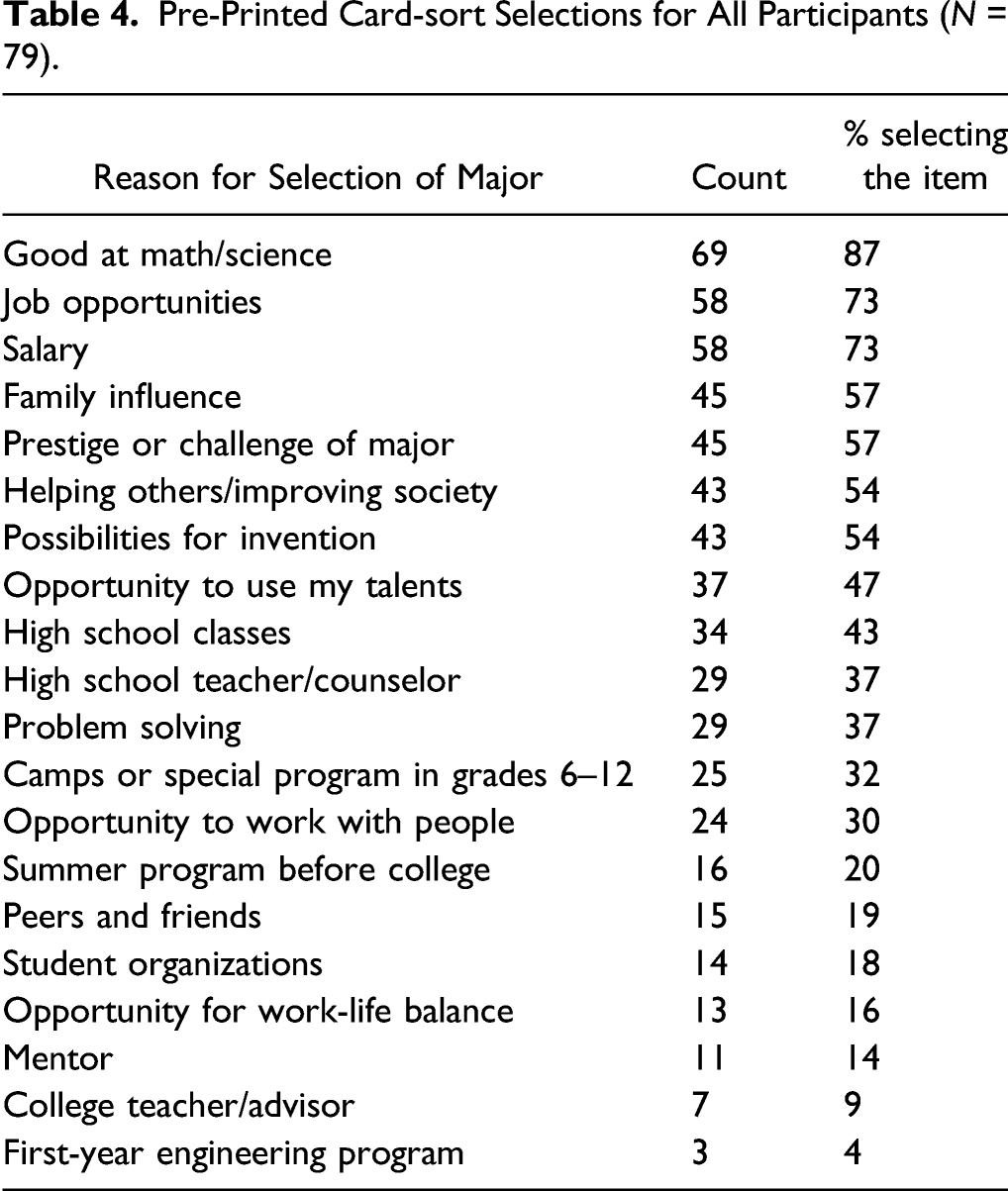
To identify significant differences in the proportions of persisters and switchers selecting each reason, we carried out a chi-square test with a continuity correction. Several items were excluded from the analysis because they had expected values less than 5, and thus the sampling distribution of the difference could not be assumed to be normal (Hinkle et al., 2003, pp. 280–281). (Note: Expected values are the values that would be in each cell—i.e., the number of persisters or switchers selecting the reason—if the reason is unrelated to being a persister or switcher.) The only differences found to be statistically significant (p < .05) were that persisters were more likely than switchers to cite “Helping others/improving society” and “Camps or special programs grades 6–12.” (See Figure 2. The complete tabulation is given in Appendix B.) Percentages of persisters and switchers selecting each card. ‡ Card used at 3 of the 4 sites.* p < 0.05 for persister-switcher difference.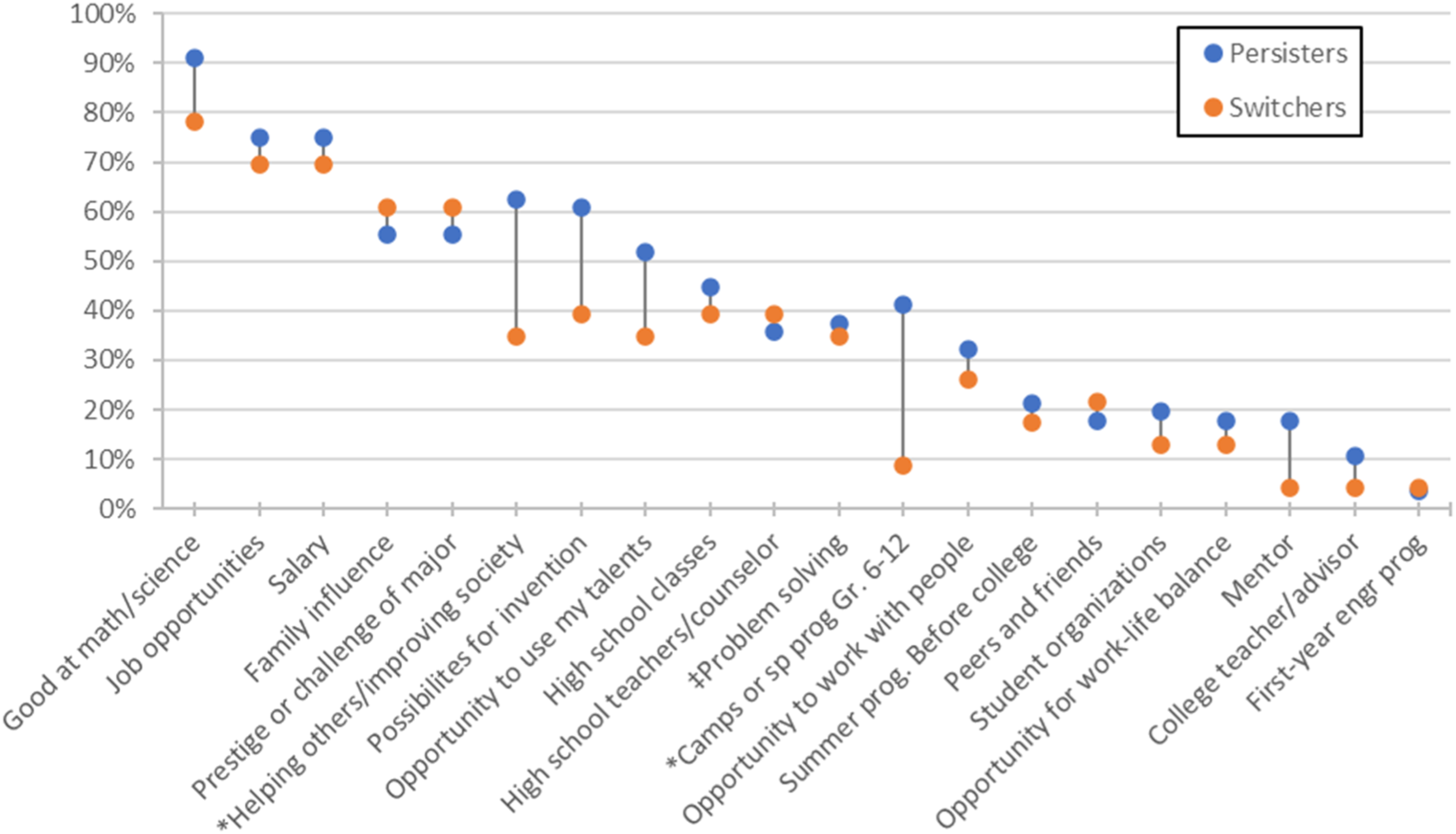
Cards Added by Students
Students were given the opportunity to write their own cards if they wanted to include reasons not on the pre-printed cards. Twenty-nine students added at least one handwritten card, nine of whom added two. Many of the added factors were idiosyncratic to personal goals (e.g., becoming a pilot) or unique experiences (e.g., gap year before starting college). A few students mentioned their long-term interests (e.g., having a childhood enthusiasm for technology; like coding). Some described the type of job they wanted as secure (2), stable (2), or meaningful (2) while others were specific about practical considerations (e.g., desired location; did not enjoy other majors). We considered the handwritten cards important because they gave students the chance to use their own words to describe factors influencing their decisions.
One of the written responses, problem solving, was added to the set of cards after two students at our first study institution added it to their list of reasons for choosing their first major. Thus, we used the problem-solving card at three of our four institutions. Because it was not part of the original set for the 26 interviewees at the first institution, the percentages shown in Figure 2 for “problem solving” may be slightly lower than if the card had been included in the card-sort activity at all four study sites.
Representative Qualitative Findings
Quantitative results of the card-sort activity helped us identify topics to explore further in the qualitative analyses of interview transcripts. For example, without our numerical comparisons of the choices of persisters and switchers, we might have missed the fact that 24 persisters (43%) selected both “helping others/improving society” and “possibilities for invention” as important factors in their initial choice of a major, while only four switchers (17%) did so. We could then look into the interview transcripts to find out more about the interviewees’ rationales pertaining to these two factors. For example, one persister described their major choice in the following way: Tied at the top is helping others, improving society, and also possibilities for invention. I thought they go hand-in-hand in terms of how important they are for me, because I want to be at the forefront of what technologies…exist and are utilized by our society. At the same time, I want to ensure that when I get there, that those things that I’m inventing are for reasons that improve society or help others.
Although fewer switchers selected the “helping others” card, for those who did, it was an important factor in their eventual decision to switch. Another interviewee spoke about motivations in choosing a major: “I want to make sure that whatever I’m doing is not just to make myself richer. Like it needs to have some sort of impact on society.” Yet another switcher talked about being in a leadership program starting in seventh grade. “You have to have 50 hours of community service every year. That kind of sparked my whole interest in helping society.” In both of these cases, the students switched into majors where they thought they had a better chance of helping others.
The card-sort activity also revealed a persister/switcher difference in the selection of the “camps or special programs in grades 6–12,” which alerted us to look more deeply into the interview data to see what types of programs and experiences might be responsible for the difference. The stories that stood out the most were those narratives that included the description of a pivotal experience. A persister described one such high school experience: Going into my junior year, I was at [a university] for three weeks for a program…the first week was…introductory and…[focused on] figuring out what we were going to do. Then we had to make a prosthetic heart and make a business model for it and pitch it in 2 weeks. It was the hardest thing I’ve ever done in my high school career… that’s where I…figured out prosthetics is what I was interested in.
Discussion
Card-sort activities have been described as a tool that can lead to deeper and more authentic storytelling (Conrad & Tucker, 2019), and they have been used for the exploration of conceptual understanding (Chen et al., 2020; Conrad & Tucker, 2019; Mosyjowski, 2020). They have not been widely used to explore factors in decision-making or to lessen the impact of differences between interviewers and interviewees, however. We believe that our experience in this study sheds light on the effectiveness of this technique at addressing these objectives.
Our initial rationale for developing and using the card sort in our interviews was to put the focus on the interviewees and encourage them to reflect on and tell their own stories, without self-censoring because of perceived differences between themselves and the interviewer. The card sort clearly achieved this objective. Most of the students visibly relaxed in the course of the activity, and they subsequently provided many details about their choices of a major and their decisions to persist or switch. In at least two cases, they gave rather stiff and seemingly rehearsed answers to the opening interview questions, as though they were applying for a job. As they became engrossed in the card sort, they gave lengthier and more natural responses.
For example, when students selected a card related to special programs such as camps, they were likely to follow their selection by describing their experiences in the programs and the impacts the programs subsequently had on their education and career goals. The same was true when they selected the cards for mentors, advisors, and family members and their selections sparked detailed storytelling about their experiences with those people.
Another benefit of the card sort stemmed from its use early in the interview. The conversations stimulated by the activity launched discussions of important and occasionally sensitive topics that might not have arisen in a traditional question and response interview, such as how certain experiences were influenced by the interviewee's. The card sort also provided a unique quantitative support tool for our subsequent qualitative analysis of the interview data, pointing us to important trends in the interviews that we could have easily missed from qualitative transcript analysis alone.
Recommendations for Use of Card Sorts
Pilot testing a card sort with a small group of individuals is invaluable in identifying items that may be difficult to understand and allows researchers to change those items before proceeding to full-scale implementation of the activity.
While a cardsort can be used as a stand-alone qualitative research tool, we believe it works best in conjunction with semi-structured interviews, in which researchers can supplement interviewee responses with follow-up questions and elicit deeper reflection and elaboration. In addition, situating the activity in the interior of interviews (not first or last) breaks up the monotony of a long progression of questions and answers, and making provision for interviewees to add additional items that might not have been pre-selected allows them to more accurately tell their own stories.
Finally, researchers should consider using quantitative analysis of the card-sort data to reveal response patterns not always evident from qualitative transcript analysis alone.
Conclusion
Based on our experience in this study, we conclude that card-sort activities can make several important contributions to interview-based research studies. When used early in interviews, they relax the interviewees, reduce their possible discomfort caused by interviewer-interviewee differences in such factors as age, race, and educational level, and encourage authentic story telling. The stories in turn lead to the raising of sensitive issues that might not emerge in the course of a traditional question and response interview, possibly opening important new lines of questioning in semi-structured interviews. We hope that our experience with the technique will persuade and enable others to use card sorts more widely and in broader contexts.
Footnotes
Acknowledgments
The authors would like to express appreciation to the External Advisory Board members for their help in encouraging us to write our positionality statement and for recommending a number of useful resources. We would also like to thank Richard Felder for reading several drafts of the article and providing valuable feedback.
Declaration of Conflicting Interests
The author(s) declared no potential conflicts of interest with respect to the research, authorship, and/or publication of this article.
Funding
The authors disclosed receipt of the following financial support for the research, authorship, and/or publication of this article: This work was supported by the USA National Science Foundation (Grant No. 1734347).
