




Abstract
This paper proposes the collaborative video-cued narrative (CVN) as an alternative methodological approach to studying professional learning. The CVN approach conceptualizes professional learning as a process in which teachers and students of professional education work collaboratively as “co-inquirers” to understand and enhance professional learning in practice. Aligned with this epistemological stance, CVNs capitalize on the advantages of three existing methodologies (i.e., video-cued ethnography, narrative inquiry, and action research) and cyclically use five key steps to study and improve professional learning, including 1) making video-recordings of learning activities, 2) identifying critical learning incidents, 3) cutting video clips of critical learning incidents, 4) using video clips to cue narrative reflections and develop action plans, and 5) taking action to improve learning in practice. In this paper, I first review the major epistemological and methodological issues in the existing literature on professional learning. Then, I elaborate on the theoretical and methodological grounds of CVNs and why, in theory, it can be a powerful alternative approach to studying professional learning. Next, drawing on interviews with eight students and my own reflective teaching journals in a doctoral course context, I analyze my experience in using CVNs to study professional learning in the context of teacher educator preparation. The analysis results suggest that CVNs seem effective in elevating students’ consciousness of professional learning, empowering their agency in enquiring into professional learning, and creating extended space and materials for professional learning. However, CVNs may cause ethical issues, such as coerced participation or “faked” learning, if a trustworthy relationship is not yet established and then sustained throughout the research process. In conclusion, I discuss how future studies can take on and further develop CVNs to pluralize the research approaches to studying professional learning.
Keywords
Introduction
Professional learning refers to the opportunities, encounters and experiences that promote enhanced skills, knowledge, capacities and practices throughout a professional practitioner’s career trajectory (Barry, 2018). In today’s fast-changing world, the requirements for performing professional services are becoming increasingly diversified, complex, and demanding. Professional practitioners need to ceaselessly seek improvement to better meet those needs through various types of learning in multiple sites and throughout their careers (Billett et al., 2014). This reality has rendered professional learning a fluid and complex phenomenon to study.
Previous studies have revealed several distinctive features of professional learning. The first is that professional learning is a long-term process. The length may vary across professions, but it takes several years or longer to prepare a qualified professional, not to mention the time spent on continuous in-service development (Kolb & Wolfe, 1981). Additionally, professional learning entails multiple dimensions of engagement and changes (Corbin et al., 2010). Differing from the training of workers in labor-intensive occupations (e.g., manufacturing) that mainly focuses on technical skills, the learning of professional practitioners involves multiple dimensions, including acquiring professional knowledge, mastering professional skills, and developing professional dispositions. Furthermore, professional learning is highly contextual. The characteristics of individual learners, the contexts in which they are situated, and the maturity of the profession can all significantly influence the process and outcomes of professional learning (Billett et al., 2014; Gruber et al., 2005).
The long-term, multidimensional, and contextual nature of professional learning has posed great challenges to research on such learning (van Meerkerk, 2017; Walmsley, 2004). The primary challenge is related to the conceptualization of professional learning. The existing studies have yielded two major and competing perspectives of viewing professional learning: the approximating perspective and the situative perspective (Billett et al., 2014; Grossman et al., 2009; Greeno, 1998). While the former sees professional learning as a process of professional practitioners gradually approximating prescribed professional standards, the latter treats it as a process of individual learners constructing personalized understandings of, beliefs regarding, and practices for a profession in context. Both perspectives attend to the generic features of professional learning to a certain extent, but they also both position the researchers and the researched learners as separate parties, failing to address the various, intensive, and consequential interactions among the two parties. Several methodological issues have also emerged and are being hotly debated in studies on professional learning. The issues mainly revolve around three questions: 1. What counts as evidence of professional learning, and how can such evidence be generated? 2. How can the generated evidence be processed? 3. How can the processed evidence be interpreted? To date, too few studies have examined these important issues or have proposed research approaches that can better attend to the generic nature of professional learning.
To begin to close this research gap, I piloted an alternative methodological approach that I refer to as the collaborative video-cued narrative (CVN) in my study of professional learning in the context of teacher educator preparation. CVNs are an integration of three existing methodologies: video-cued ethnography, narrative inquiry, and action research (Clandinin & Connelly, 2000; McNiff, 1995; Tobin, 2019). Apart from the “approximating vs. situative” dichotomy, the epistemological stance of CVNs is colored by critical theory paradigms and views processional learning as a process of researchers and the researched learners collaboratively construct understandings of and take action toward professional learning in contextualized learning practices (Bunniss & Kelly, 2010). Aligned with this epistemological stance, the CVN cyclically uses the video-recording of learning activities to generate research evidence, cut video clips of critical learning incidents to sift core evidence, and initiate video-cued narratives to interpret processed evidence (Adair & Kurban, 2019; Lister & Crisp, 2007; Raingruber, 2003). CVNs have the potential to pluralize methodological approaches to unpacking the growing complexities of professional learning. The study also contributes empirical evidence of the effectiveness of CVN in studying professional learning, which is hoped to serve as a starting point for future studies to refine, revise, and renovate this budding methodological approach.
Epistemological and Methodological Issues in Studying Professional Learning
Several epistemological and methodological issues have emerged from previous studies on professional learning. The epistemological issue mainly centers on two competing perspectives of viewing professional learning. This issue has further contributed to several methodological issues related to the generation, analysis, and use of research evidence. The debates on these issues have set up the backdrop for analyzing the effectiveness of using CVNs to study professional learning.
Approximating vs. Situative? Two Competing Epistemological Stances
As informed by modernism theories (Williams & Sewpaul, 2004), the approximating perspective conceptualizes professional learning as a process of approximating the prescribed professional competencies, usually in the form of qualification criteria, professional standards, and practical protocols that are commonly shared by members in a profession (Grossman et al., 2009; Ingvarson, 1998). From this perspective, the content of professional learning is a repertoire of knowledge, skills, and dispositional attributes that are collectively shared in a profession. Accordingly, the primary learning approach is to approximate those professional “norms” through a variety of specific learning strategies, such as learning about relevant theories, rehearsing core practices, and developing professional dispositions that are aligned with the core values of the profession. This perspective highlights individuals’ incremental socialization into a profession, earning memberships, and sustaining the existing structure and operations of the profession.
In contrast, the situative perspective emphasizes the contextuality, individuality, and constructiveness of professional learning (Feng et al., 2013; Johri & Olds, 2011; Korthagen, 2010; Walmsley, 2004). This perspective sees professional learning as a process of individuals constructing their understandings of, beliefs regarding, and practices for a profession in situated circumstances. As rooted in postmodern theories that reject the grand narrative of social phenomenon (McMahon & Watson, 2007), the situative perspective contends that the ways of becoming a professional entail personal engagement with the content of professional learning in its own context. This does not mean that the situative perspective takes on a completely idiosyncratic view and considers each individual’s learning process to be unique. Rather, the view holds that patterns of professional learning do exist across individuals and contexts (e.g., reflection as a core mechanism of professional learning; Schon, 1984), but they are by no means one-size-fits-all patterns.
In short, the approximating perspective and the situative perspective provide two qualitatively different conceptualizations of the natures, content and approaches of professional learning. The differences between the two perspectives have informed previous students’ methodological decisions, but they have also contributed to the emergence of several methodological issues about how professional learning should be studied.
Methodological Issues in Studying Professional Learning
Different evidence methods
The first issue is related to the generation of information to demonstrate professional learning. The continuity, multifaceted nature, and contextuality of professional learning make it challenging to generate research evidence. Researchers need to make decisions regarding several thorny questions, such as what counts as evidence of professional learning, where the evidence resides, and how it can be generated (van Meerkerk, 2017; Walmsley, 2004). For the studies informed by the approximating perspective, their short answers to these questions are that the learners’ development of prescribed professional competencies counts as the evidence, the evidence mainly resides in the learners’ various types of performances, and the evidence can be generated by methods that can help externalize learners’ performances, such as testing, structured observations and interviews, and questionnaire surveys (Tigelaar & van der Vleuten, 2014). A shortcoming of these methods is that they cannot sufficiently capture some deep-seated facets of professional learning, such as the microprocesses of professional learning and the changes in indirectly observable competencies (e.g., dispositional attributes, professional identity; Guskey, 2014).
As for inquiries taking a situative perspective, they consider individual learners’ beliefs, understandings, and practices in situated contexts as evidence of professional learning. The evidence is believed to exist in what the learners believe, know, and do. This perspective also posits that relevant contextual conditions are inseparable components of that evidence. Therefore, such studies tend to use methods that can dig deeply into individuals’ personal belief systems (e.g., narratives, autobiographies), document local practices (e.g., focal or participatory observations), reveal indigenous understandings (e.g., ethnographic interviews), and identify situational factors and their interactive relationships with individuals’ learning (Fenwick, 2014). However, these methods tend to suffer from a high degree of vulnerability given the uncertainties involved in accessing research sites and establishing trustworthy and sustainable researcher-participant relationships, which are highly relevant to the generation of research evidence.
Dilemmas in processing evidence
Regardless which perspective and evidence generation methods a study adopts, it usually ends up with a massive amount of research evidence. Ideally, researchers would be able to take advantage of each piece of evidence to develop a thorough understanding of professional learning. However, given the constraints of research focus, time, and other resources, researchers usually have to strategically process their evidence pool down to manageable levels (Morse, 2015). In particular, researchers face two major dilemmas in processing generated evidence: whose voices weigh more, those of the learners, the professional norms, or the researchers? To what extent should the raw evidence be kept as it is or aggregated to various levels?
From the approximating perspective, the voices of external norms, as understood and operationalized by researchers, are often prioritized in slimming down the evidence for further analysis. The evidence that does not fit in the prescription is dropped first from the evidence pool during evidence sifting. As for the second dilemma, researchers often convert the sifted raw evidence into calibratable units of data. The conversion of evidence can be achieved by a variety of analytical techniques, such as coding, counting, grouping, calculating, and modeling. Each of these techniques reduces the original evidence with a series of eliminations. The rationale undergirding these analytical techniques is that some generalizable truth about professional learning can be revealed by long-range reasoning that involves the sophisticated processing of sifted and calibrated evidence (Tigelaar & van der Vleuten, 2014).
In contrast, studies oriented from the situative perspective tend to prioritize the voices of individual learners. They focus on understanding how professional learning is valued, defined, and practiced in a given context. Thus, the evidence that contains important details of the various facets and processes of professional learning is often selected for further analysis. The studies also choose to keep the raw evidence intact to a great extent and try to characterize the phenomenon of professional learning in contextually comprehensible and appropriate fashions. A variety of analytic skills are often used, such as identifying indigenous concepts, bracketing illustrative quotes in the original data, and storylining the lived experiences of professional learning from learners’ own perspectives (Fenwick, 2014).
Evidence interpretation as researchers’ work or an extended learning opportunity?
Due to the long-standing divide between academia and the practical world, evidence interpretation is traditionally considered to be researchers’ work. The researched learners, the very subject and enactor of professional learning, are often excluded from the interpretation of research evidence. Many studies guided by the situative perspective do engage learners in research activities, such as seeking learners’ feedback on the generated or processed evidence (Goldblatt et al., 2011), but the primary purpose is still to produce new knowledge that is communicable to scholars in the academia, not to directly inform and improve the learning of professional practitioners in practice in time.
Rooted in critical theory paradigms, an action-oriented approach to studying professional learning has been taking form since the 1980s (Argyris et al., 1985; Kemmis, 2006). This approach blurs the lines between the researchers and the researched learners and orients research in and for practice. Improving students’ learning in action becomes a clear focus of the research design and throughout the process. Compared to those in studies taking either the approximative or the situative perspective, participants in action-oriented research can more actively engage with, influence, and benefit from each phase of the research process.
Nevertheless, action-oriented research can also cause power-related issues (Zeni, 2001). The researchers and the researched participants tend to possess unequal power in shaping the research process and outcomes due to their differing professional expertise, institutional capital, and social statuses. The unbalanced power relationship may lead to contrived collaboration between the two parties, which can jeopardize the ethics of the research process and the trustworthiness of the research outcomes (Löfman et al., 2004).
Proposing an Alternative Methodology for Studying Professional Learning: The Collaborative Video-Cued Narrative (CVN)
As a response to the aforementioned issues, the collaborative video-cued narrative (CVN) is emerging as an alternative methodological approach to studying professional learning in light of the converging consensus that professional learning is a process of contextualized, reflection-driven, and moment-by-moment changes (Billett et al., 2014). The CVN capitalizes on three existing methodologies: video-cued ethnography, narrative inquiry, and action research (Clandinin & Connelly, 2000; McNiff, 1995; Tobin, 2019). In brief, a CVN consists of five cyclic steps in which the teachers and students of professional education work together to understand and improve professional learning in practice (Figure 1). The steps include 1) making video-recordings of learning activities, 2) using semistructured interviews to identify critical learning incidents, 3) cutting video clips of critical learning incidents, 4) using the video clips to cue the students’ narrative reflections on the learning process and develop action plans for learning improvement, and 5) taking action to improve students’ professional learning in practice. The five steps can be repeated in several cycles throughout a curricular component of professional education, such as a course, a service-learning experience, or an internship.
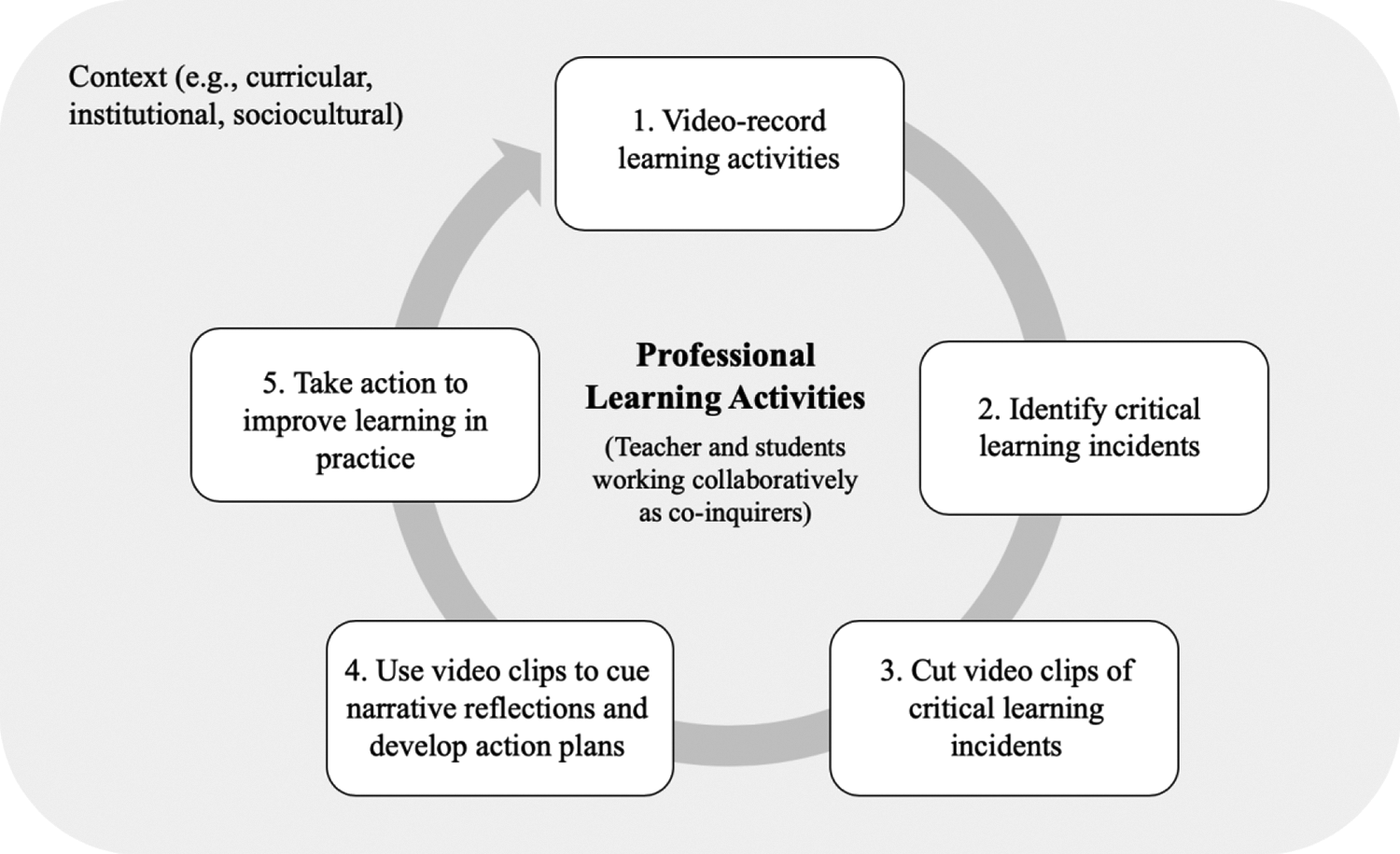
Key steps of the CVN methodological approach.
CVN positioning in the aforementioned epistemological and methodological issues highlights the approach’s features. First, similar to the situative perspective of professional learning, CVN posits that professional learning is highly embedded in multiple layers of context, including the curricula of professional education, the programmatic and institutional settings where professional learning takes place, and the sociocultural context that subtly shapes professional learning. Based on these beliefs, the epistemological stance of a CVN is that the knowledge about professional learning is plural and co-constructed by teachers and students of professional education in their situated contexts. Additionally, the epistemological stance of a CVN is informed by critical theory paradigms (Bunniss & Kelly, 2010) and posits that teachers and students should take collective action to improve students’ professional learning through a recursive process of inquiry rights in the practice of professional education.
Second, in terms of evidence generation, the CVN approach considers both students’ learning performances and their narrative reflections as the key evidence of professional learning. In particular, a CVN capitalizes on video technology to record the details of students’ learning performances to the greatest extent possible. It also uses students’ narrative reflections, a combination of narrative—the storied ways of meaning making (Clandinin & Connelly, 2000)—and reflection—a core mechanism of professional learning (Korthagen & Vasalos, 2005; Schon, 1984)—to manifest the processes and outcomes of professional learning.
Third, in processing the evidence pool, the CVN approach chooses to focus on critical learning incidents (Lister & Crisp, 2007)—the selected episodes of the continuum of professional learning that contain crucial information about the changes, challenges, and perplexities that are highly relevant to students’ professional learning—as the core evidence. However, differing from both the approximating perspective and the situative perspective, a CVN shifts the power from teachers (i.e., the researchers) to students (i.e., the participants) in deciding what learning incidents count as critical. Though teachers/researchers may suggest additional critical learning incidents as co-inquirers, the primary and major incidents are identified by the students themselves (Ross, 2017).
Last, differing from many previous studies, CVNs posit the reading of research evidence as a shared responsibility of both the teachers and the students of professional education. CVNs require teachers and students to collectively make meaning from professional learning and take action to further advance students’ professional learning in practice (Kemmis, 2006).
A Reflective Analysis of Using a CVN in the Context of Teacher Educator Preparation
In theory, CVNs have the potential to better attend to the generic nature of professional learning than previous research approaches do, but few studies have empirically examined their effectiveness in doing so. In one of my studies on professional learning in the context of teacher educator preparation, I used a CVN and collected data about my own and students’ reflections on our experiences with this methodological approach. In this section, I report on the findings resulting from the analysis of the data to shed light on the effectiveness of CVNs in studying professional learning.
The study being examined aimed to explore how culturally diverse doctoral students learn to become teacher educators in a doctoral course context. The course was a foundation course of an international teacher education doctoral program that I taught at a Chinese university. The goal of the program was to develop students’ foundational professional knowledge, skills, and beliefs regarding becoming a teacher educator. At the beginning of the course, I invited all nine students to participate in a CVN study to collaboratively understand and advance their professional learning throughout the course. Given the reality that China does not yet have a sound system for research ethics review in social sciences (Du & Yu, 2019), and the fact that participating in a CVN study would cause a considerable amount of extra work to the students, I used internationally shared protocols and procedures to seek the participants’ informed consent as follows. First, at the very beginning of the first class session, I proposed the idea of conducting a CVN study with the students in the course, explained that the main purpose of the study was to understand and advance the students’ learning, and clarified that participating students’ duties would include agreeing to be video-recorded in this course and attending two post-course interviews to respectively identify their critical learning events and reflect on those events. Second, to avoid the students making hasty decisions or being pressed to conform to their classmates’ decisions, I asked the students to think carefully after the first class. A few days later, I contacted each of them individually to check if they were willing to participate, and also addressed the questions some of them had. Third, in both the public announcement in the first class and the private conversations afterward, I emphasized that the students had the right to decline my invitation, and even if they had agreed to participate, they always had the right to withdraw from the study any time for whatever reasons without causing any foreseeable negative consequences to them.
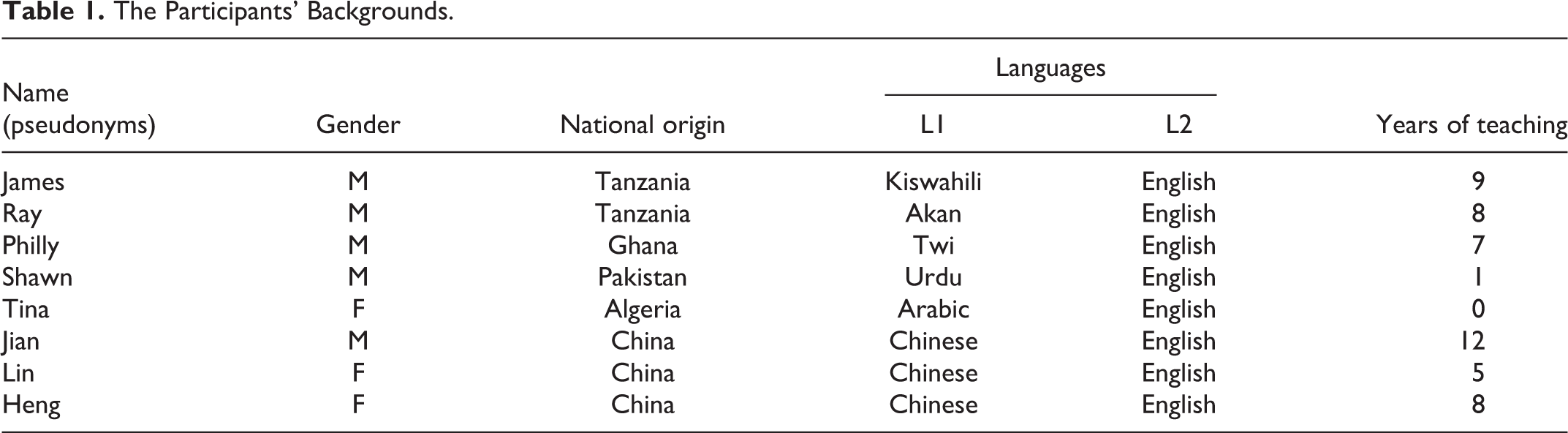
Eight of them agreed to participate, while one student declined due to, as she reported, her lack of time. Table 1 provides the demographic backgrounds of the eight participating students.
The Participants’ Backgrounds.
Following the major steps of the CVN approach, I first video-recorded all eight class sessions. Each class session lasted 3.5 hours, including a 20-minute break in the middle. The camera was placed at a corner of the classroom from where all class activities, including the lecturing, whole-class discussions, small-group activities, and individual work and presentations, could be captured. Then, I identified the participating students’ critical learning incidents through semistructured interviews with each of them right after the course ended, cut video clips of critical learning incidents for each participant, and conducted video-cued interviews in which the students narratively reflected on their professional learning in this course. The students and I also developed action plans for future improvement, but due to the constraints of the course structure and time, we did not have the chance to carry out the action plans and evaluate their effectiveness, the fifth step of CVN.
We generated two sources of data for this reflective analysis. First, in the video-cued interviews, each of the participants shared their perspective on how our use of a CVN in the course influenced their professional learning. Several loosely structured questions were used to solicit their perspective, such as, “What are your general reactions to the CVN?” “Did you feel uncomfortable that we put a camera in front of the group?” “What new understandings have you developed through this approach?” “What do you think of the dual roles we undertook in the process, that you were both a student and a research participant, and I was both your teacher and also a researcher?” “Would you consider using this methodology in your future work with teachers?” The other source of data was the reflective journals that I composed immediately after each of the eight class sessions. In each journal, I evaluated the overall effectiveness of the class session, identified the high and low moments of the class, unpacked the reasons that might have contributed to those moments, and reflected on how the use of a CVN influenced the class dynamics and the students’ learning.
It is worth mentioning that the purpose of studying my own course could be seen as action research because my students and I did use several typical steps of action research to improve our course practices, such as identifying problems in our practices, reflecting on the problems, developing action plans, and carrying out the plans to improve the practices. However, this study’s purpose is not only to improve my teaching or the students’ learning in this particular course, but also to examine the CVN’s methodological affordances and limitations for studying professional learning. In other words, this study is colored by the genre of action research. But it also goes beyond action research as it aims to contribute an alternative methodological approach to studying professional learning.
That said, I used the four epistemological and methodological issues discussed above as an analytical framework and conducted a thematic analysis of the reflective journals and the interview data (Boyatzis, 1998). The analysis has resulted in four themes on the strategies, strengths and potential risks of using CVNs to study professional learning.
Creating a Collaborative Inquiring Discourse for Professional Learning
We successfully created a collaborative inquiring discourse to sustain the enactment of the CVN study through two measures. First, at the beginning of the first class, I stated the following to help the students find meaning in collaborative inquiry for their professional learning: Teacher education, similar to the education of lawyers, doctors, and engineers, is a meaningful but complex process. There are no easy answers to many important questions that are being debated in our profession. Therefore, teacher educators need to consciously and constantly enquire into the problems they encounter in professional practices. To help strengthen our reflectivity and reflexivity, I invite you all to participate in a study through this course. We will video-record our lessons, watch selected chunks of the videos, and then do some collective reflection. (instructor’s reflective journal) I’ve been a math teacher for eight years. The school administrators often asked us to record our classroom teaching to document evidence for evaluative purposes. Sometimes, we were also asked to prepare a video of our “best” teaching for training beginning teachers or attending teaching contests. I thought nobody, including myself, would carefully watch those teaching videos. But it was the first time for me to watch a video of my own learning in a serious way. It helped me consciously reflect on my learning and think about how I could do better. (Heng, interview)
Furthermore, we reflected, individually and collectively, on the enactment of the course on a regular basis and made curricular adjustments accordingly. In particular, the students were asked to write a short reflective note on their learning at the end of the second, fourth, sixth, and seventh classes. I also composed reflective journals after each of the eight class sessions. In these individual reflections, we focused on the students’ performative, intellectual, and affective engagement in the course activities, paying closer attention to the challenges the students faced. I analyzed the students’ reflective notes and my reflection journals to identify the urgent challenges that the whole class needed to address. Then, I reserved a section of the next class for the whole class to discuss what actions we should take. The challenges we discussed in these collective reflections covered a variety of topics related to the students’ professional learning, such as the distribution of class time, course readings, language issues, among several others.
For instance, during the collective reflection in the fourth class, we examined the issue of time distribution that many students had reported in their previous reflective notes. In the first three classes, I used approximately one-third of the time to give a lecture on the core content prepared for the class and used the remaining two-thirds of the time to organize different forms of discussions and activities to scaffold the students’ personal (re)construction of their understanding of the core content (instructor’s reflective journal). Nevertheless, the collective reflection revealed that given the students’ lack of sufficient prior knowledge about the class topics, the students engaged with the class discussions and activities mainly based on their personal experiences and opinions. To tackle this issue, we discussed what actions we could take and then decided that in the following classes, I would spend more time lecturing on the core content with more explanations, cases, and examples so as to better prepare the students for deeper thinking and discussions. As indicated in our subsequent reflective notes/journals, the students believed that this adjustment helped them understand the course content more deeply and become readier to construct their own understanding of the content by relating to relevant theories and literature and other students’ perspectives (instructor’s reflective journal; students’ reflective notes).
In short, clearly articulating the CVN’s purposes and consciously reflecting and taking action on the course practices created a collaborative inquiring discourse that helped sustain the students’ engagement with their professional learning and the CVN study throughout the course.
Video-Recording as Evidence Documentation
Most of the students reported that recording the class sessions was helpful for documenting evidence of their professional learning in this course, especially in capturing details of their learning performances that their attention and memory could not possibly capture. Initially, the presence of the camera made some students feel uncomfortable. However, this issue eventually disappeared as the students increasingly routinized the video recording as an indispensable component of the learning setting.
First, there was a consensus among the students that video recording was advantageous in documenting their learning evidence in great detail. For instance, Lin said, It’s been a few weeks [since we completed the course]. I would have forgotten what we exactly did or said in the classes if you did not show me the video clips. But they [the video clips] immediately drew me back to those moments of my learning. For instance, I was able to notice what words I said and where my eyesight was placed. I didn’t and also couldn’t notice those details when I was busy with class activities. (Lin, interview)
Shawn was the only student who reported that the video recording caused discomfort to him in the beginning. He said, Well, I did feel a little bit uncomfortable in the first place. Sometimes, I had urgent issues to take care of or I was just not into the topics we were discussing. So, I wanted to chat on social media or just goof around for a while. Once, my mother was dealing with some visa issues at the embassy and she might have been contacting me for help anytime during the class time. So, I intentionally chose a seat far away from the camera to avoid my behaviors being clearly recorded in the class videos. (Shawn, interview) I didn’t feel uncomfortable at all because the purpose was clarified. I didn’t feel that I ever modified my performance because, you know, I am just who I am. I cannot change something because someone else is watching me or taking videos. (Tina, interview)
Creating Video Clips as Identifying Core Evidence
Video-recording the class sessions helped generate a pool of evidence for the students’ professional learning. However, it would be difficult, and inefficient, to treat every moment of the video-recording lessons the same. The moments that contain critical information about students’ professional learning, such as their most unforgettable moments, most frustrating moments, and “aha moments” (Napier et al., 2009), are worth greater attention and deeper analysis. In this CVN study, a critical learning incident, a segment of class time that contains one or more moments that the learners considered critical to their professional learning, was used as a unit to select the core research evidence. The students took the lead in identifying the critical learning incidents.
Table 2 lists the 37 critical learning incidents that were identified by the students. Creating video clips of the critical learning incidents was analytically useful in two ways. First, having the students identify their critical learning incidents motivated them to be conscious about the experiences that were most meaningful to them. This step resulted in a unique set of critical learning incidents for each student, which further highlighted the unique features of each student’s professional learning. For instance, Ray identified five critical learning incidents that focused on how he was struggling with the notion of pedagogical content knowledge (Shulman, 1987), how he recognized the distinction between high-quality teachers and high-quality teaching, how leading the discussion enhanced his confidence in becoming a teacher educator, how the icebreaker activity made him aware of the weakness in his academic background, and how benefiting from group work led him to value collaborative learning. On the one hand, this special set of critical learning incidents not only identified the important growth that Ray had achieved during the course (e.g., the enhanced self-efficacy) but also portrayed the circumstances and process of how the learning occurred. On the other hand, the critical learning incidents also revealed the specific aspects that Ray needed to develop further, such as his understanding of some foundational concepts (e.g., PCK) and his academic expertise for becoming a qualified teacher educator.
The Participants’ Critical Learning Incidents.

The 37 incidents certainly cannot cover all or even most of the incidents that were relevant to the students’ professional learning, but as the students in this study commented (e.g., Philly, Lin), these video clips provided windows for them to look backward, inward, and forward to deepen their understanding of their professional learning experiences.
Second, the collection of all students’ critical learning incidents enabled the exploration of the patterns undergirding all the students’ professional learning. In this study, I used a three-dimensional framework (i.e., knowledge, skill, disposition) that is commonly used in professional learning research to categorize critical learning incidents. Some patterns emerged from comparing and contrasting the incidents in each of the three dimensions. For instance, in terms of the learning of professional knowledge, the students identified that several pieces of professional knowledge were crucial to teacher educators’ professional learning, such as pedagogical content knowledge (e.g., Ray, Shawn, Jian, Lin) and lesson study (e.g., James, Shawn). Similarly, analyzing the skill-related incidents suggested that leading discussion (e.g., Ray, Philly, Shawn, Tina, Jian, Lin, Heng) and collaborative learning in small-group tasks (e.g., James, Philly, Shawn, Tina, Jian, Lin, Heng) were critical skills that prospective teacher educators needed to master. As for dispositional development, the critical learning incidents in this category suggested that affective experiences, such as feeling stressed (e.g., James, Ray), being impressed (e.g., Philly), getting lost (e.g., Jun), becoming interested (e.g., Jian), and resonating with others (e.g., Shawn), triggered a shift in the students’ dispositional positionings in relation to the profession they were preparing for.
In short, using the students’ own judgments to select video clips of critical learning incidents helped us zoom in on the core evidence that was meaningful to each of the students. This method not only helped identify each student’s development and challenges in their professional learning but also enabled the exploration of learning patterns across the individual students.
Video-Cued Narrative Reflection as Extended Professional Learning
The last step was that the students watched video clips of their critical learning incidents and then narratively reflected on those incidents to deepen their understanding of their learning and develop action plans for future improvement. All the students reported that the video-cued narrative was an extended learning opportunity to them. For instance, Jian said, I was very willing to participate in today’s interview. To me, the interview was just like an extension of our course. It’s a great chance to reflect on my own learning. Oftentimes in the past, my friends and colleagues asked me to fill out questionnaires. I felt reluctant to say no but had limited time to do it, so I just used two to three minutes to get it done very quickly. Even though I myself did not trust what I put in the questionnaire, how could we trust the results of the whole questionnaire survey? As a teacher with ten years of teaching experience, I understand that students learn and develop in very different ways. I like the ways in which the study focuses on each of us, hears our stories, and respects our voices. (Jian, interview) Early this semester, I attended the commencement ceremony for incoming doctoral students, including hundreds of students from other countries. However, most of the speeches at the ceremony were delivered in Chinese without translations. I felt very sorry for the international students because most of them couldn’t understand what the speakers were talking about. I was also upset about the organizer’s lack of consideration of the international students’ feelings. Finally, one of our university’s vice presidents stepped onto the platform and said, “Since we have new students from many different countries, let me use English to give my speech.” At that moment, I really appreciated that we had a leader who was attentive to the presence of the international students and adjusted his use of language accordingly. This experience did make me try to avoid using Chinese in this class even with my fellow Chinese classmates because I didn’t want to make my international classmates feel excluded. (Heng, interview)
Furthermore, many of the students perceived the CVN methodological approach to be additional material for their professional learning. As future teacher educators, the students considered the knowledge of research methodologies to be an indispensable component of their professional learning. For instance, Heng said, “It’s the first time for me to take a course that integrates learning and research together. It’s quite fresh and interesting to me.” Shawn said, “I never heard of this type of research before. So, part of my motivation [for taking part in this study] was to learn about this research methodology.” Similarly, Lin said, “When the instructor invited us to participate in this class, I said to myself, ‘wow, our teacher has a really strong sense of doing research, and I’d like to check out how this kind of study unfolds.’” Similarly, Jian mentioned, Teachers need to reflect on their practices on a regular basis. As future educators of teachers, shouldn’t we do the same thing first? I think this methodology helped us form the mindset and habit of constantly enquiring into our own practices. I will use it [the CVN methodological approach] in my future work with teachers. (Jian, interview)
Discussion
Overall, the analysis results highlight that the CVN is a collaborative, practice-oriented, and reflection-driven approach to studying professional learning, which can serve as an alternative approach to conceptualizing and researching professional learning.
First, the CVN view of professional learning as a process of co-constructing practical knowledge enriches the epistemological orientations in professional learning research. Apart from both the approximating perspective that views professional learning as one truth and the situative perspective that views it as many truths, the CVN approach highlights the practicality of the knowledge that is being pursued by professional learning research. Theoretically speaking, this alternative epistemological stance is supported by the action-oriented movements (e.g., Argyris et al., 1985; Kemmis, 2006) that have prevailed in professional education. Empirically, the student participants’ experiences in this study also suggested that this alternative conceptualization can help equalize the power relationships between the researcher and the researched students and encourage the students to consciously, frequently, and actively enquire into their learning practices. Nevertheless, the fact that one student declined to participate in this study cautions against romanticizing this alternative view. It was unclear whether it was truly a lack of time, as the student reported, or another hidden reason led the student to say no. However, this situation reveals the potential risks that may result from this alternative conceptualization, such as pretended participation if a trustworthy student-teacher relationship and a discourse of collaborative inquiry are not yet established and then sustained throughout the research process.
Second, CVN’s capitalization of video technologies in documenting research evidence addresses the shortcomings of many other methods (e.g., questionnaire survey, interview) in capturing the detailed, fluid, and performative evidence of professional learning. Owing to the video recording, some subtle but critical information about the students’ professional learning was documented in the video-taped lessons. Without the camera, the students would have not been able to notice their “oily hair,” the direction of their gaze, their wording, and their interaction with others in the learning activities, which all seemed trivial but carried crucial information about the students’ professional learning that was unconsciously evolving over time (Korthagen & Vasalos, 2005). In other words, the CVN videotaping of professional learning activities enables the documentation of how professional learning occurs moment by moment (Kim & Schallert, 2011). However, video-recording has its own limitations: it only captures the observable dimension of professional learning in selected settings; it may also cause discomfort to some learners or even lead to faked/pretended learning, as Shawn experienced in this study. However, no single method is able to generate all of the evidence about professional learning that is needed. Even if a research design can match the circumstances of “The Truman Show,” a movie in which a person’s life is surveilled by thousands of cameras from the time of his birth, it is still impossible to get into someone’s head and pull his or her every idea out. Therefore, videotaping should not be viewed as a better method for evidence generation. Rather, it needs be used synergistically with other evidence generation methods to serve specific research purposes.
Third, CVNs’ use of learners’ self-identified critical learning incidents can help focus on the core evidence. CVNs prioritize the learners’ voices in deciding which evidence is crucial to professional learning and which is not. In this study, having the students select the core evidence enhanced the students’ commitment to engaging with the subsequent video-cued narratives and the whole study because in general, people tend to be more committed to the decisions they can make and control by themselves (Brockner, 1992). Additionally, the landscapes within and beyond professional education are fast-changing and becoming increasingly complex, which requires future professionals to learn how to make professional decisions based on their own judgments in action (Higgs, 2018; Schon, 1984). Having learners decide what experiences are crucial to their professional learning, especially when guided by veteran professionals, can be a transformative experience for developing students’ ability to reflect during action and improvise during uncertainty (Kneebone, 2018; Lutz et al., 2017).
Fourth, video-cued narratives, the crucial step of CVNs, highlight the usefulness of storied reflection in helping students interweave their professional learning into their life histories. Connelly and Clandinin (1990) point out that “humans are storytelling organisms who, individually and socially, lead storied lives” (p. 2). Just as the case of Heng sharing stories and making connections across boundaries in this study shows, students of professional education also have the preference and need to make sense of their professional learning and its relationship to their personal lives in storied ways. This study also resonates with the findings of many previous studies (e.g., Moon, 2013; Korthagen & Vasalos, 2005) that reflection is a pivotal mechanism driving the continuing development of professionals. As indicated by the eight learners in this study, the video-cued narrative, which combines reflection with narrative inquiry, can amplify the strengths of both methods in supporting the learners to relive their critical learning experiences, reflect on the storied experience, and (re)construct meaning and action plans to advance their professional learning and development.
Several important issues regarding CVN have not yet been addressed in this reflective analysis, but they should be explored further in future studies. First, CVN may cause methodological and ethical issues. CVN entails university faculty to study their teaching practices with their students as research participants. Ferguson and colleagues (2004) point out that this type of faculty research has unique values for developing disciplinary pedagogy in the professions where student participation is essential, such as medicine, social work, and education. However, it also risks causing a variety of issues as the faculty juggles between the dual role of instructor and researcher, such as convenience sampling, coerced participation, and biases in reporting research findings (Ferguson et al., 2004). These issues can be exacerbated in contexts where research ethics protocols are unavailable, vaguely defined, or loosely practiced, just like the context of the present study (Zeni, 2001). Therefore, future research must examine how to carry out CVN in methodologically sound and contextually ethical ways in different settings.
Furthermore, preparing video clips involves making decisions about a series of questions, including whose voices should be considered and prioritized in creating video clips? What are the criteria for cutting the video clips? How many clips are sufficient? Should there be any connections between different video clips? Finally, what are the rationales for and consequences of the decisions made in response to each of the aforementioned questions? Only when the details of preparing video clips are scrutinized with regard to the underlying epistemological and methodological positionings can the overall rigorousness of the CVN methodological approach be strengthened.
Third, the timing and frequency of the video-cued narrative should be examined further and in different circumstances. To avoid causing too many disruptions to the students’ professional learning in the course, this study conducted the video-cued narrative only once after the course ended. It might be more beneficial for learners and teachers to conduct video-cued narratives several times throughout the course. However, several issues should be carefully evaluated, such as what the advantages and risks of the frequent use of video-cued narratives are and how students’ simultaneous commitment to professional learning and research activities can be sustained.
Last but not least, this study only examined the effectiveness of using the CVN in one particular site of professional learning—graduate courses. However, prospective professionals need to learn and develop in various sites at different phases of their professional learning (Billett et al., 2014). Taking the study’s eight participants as examples, they were doctoral students aiming to become teacher educators. The primary site of their professional learning at the present phase was graduate courses. However, as they continue to socialize into the teacher educator profession, additional learning sites will be involved. These include their own classrooms where they teach courses to prospective teachers, K-12 classrooms where they guide pre-service teachers on how to teach, and professional development programs in which they provide support to in-service teachers. Different sites often present distinctive characteristics, affordances, and challenges for shaping professional learning. It is unclear whether and to what extent CVNs would still be useful in other learning sites. Future studies could examine how to modify CVNs according to different learning sites to continue developing and benefiting from this methodological approach.
To conclude, this paper proposes the collaborative video-cued narrative as an alternative methodological approach to studying professional learning. The CVN approach views professional learning as a process of teachers and students of professional education collaboratively making meaning in and acting on professional learning in their situated contexts. It has the potential to enhance students’ consciousness of their professional learning, empower their agency in enquiring into professional learning, and create additional space and materials for their professional learning. It is hoped that the CVN methodology introduced in this paper can help pluralize the research approaches to unpacking the increasing complexity associated with the phenomenon of professional learning and can also serve as a starting point for future studies to empirically refine, revise, and renovate this budding methodology.
Footnotes
Acknowledgment
I am grateful to Drs. Chang Liu, Lynn Paine, and Joseph Tobin for their inspirations, encouragements, and constructive critiques. I also would like to thank Ms. Xuewei Wang for her assistance in brainstorming ideas and generating data for this study.
Declaration of Conflicting Interests
The author(s) declared no potential conflicts of interest with respect to the research, authorship, and/or publication of this article.
Funding
The author(s) disclosed receipt of the following financial support for the research, authorship, and/or publication of this article: This work was supported by the Fundamental Research Funds for the Central Universities [grant number 2018NTSS03]; the project “How to improve teacher preparation quality” funded by National Natural Science Foundation of China [grant number 71974016]; and the project “How to prepare a good teacher” funded by the International Joint Research Project of Faculty of Education, Beijing Normal University (grant number CER201905).
