




Abstract
Keywords
Introduction
About 20% of the working-age population in the average OECD country is suffering from a mental disorder in a clinical sense. The prevalence rates are especially high among young adults, women and people with low levels of educational attainment (OECD, 2012). According to the World Health Organization, common mental disorders ‘refer to two main diagnostic categories: depressive disorders and anxiety disorders. These disorders are highly prevalent in the population (hence why they are considered ‘common’)’ (World Health Organization, 2017). Common mental disorders (CMD) is a term incorporating depression, anxiety, adjustment disorders and stress-related ill health (Axén et al., 2020).
Most studies (Mather et al., 2015; OECD, 2012; Verdonk et al., 2008) conclude that women are at a higher risk for CMD and sick leave due to CMD than men, although the opposite has also been found (Jarl et al., 2020). Recent official numbers from Sweden confirm that for mental disorders, the risk of sick leave is 31% higher for women than for men, and for stress-related disorders, it is 41% higher for women than for men (Försäkringskassan, 2020b). Some risk factors for CMD are associated with working life conditions. Unsafe employment, inconvenient working hours, unclear work tasks, conflicting expectations from the employer and perceived unfairness at the workplace (Harvey et al., 2017), low support from the immediate manager and colleagues, and an imbalance between work performance and reward or recognition that the work provides increase the risk of mental ill-health (Rugulies et al., 2017). Individuals suffering from CMD face severe consequences. In addition to sick leave, CMD lead to reduced productivity at work and increase the risk of early retirement (Henderson et al., 2011; Sanderson & Andrews, 2006) and unemployment (OECD, 2012). Being on sick leave also affects the individual’s identity, self-respect and general health (Fossey & Harvey, 2010), and it increases the risk of social and professional isolation (Henderson et al., 2005). In addition to its health and psychosocial effects on individuals, sick leave also entails financial losses for the employee, the employer and society at large (Hewlett, 2014; Lagerveld et al., 2010). In 2015, mental ill-health in Sweden was estimated to have cost about EUR 21.7 billion, which is almost 5% of the country’s gross domestic product. The corresponding figure for the EU was 4% (OECD, 2018).
Young adults entering the work force are expected to have a long working life ahead of them. It is therefore a concern that many young men and women need to take sick leave due to mental ill-health despite having little experience of working life (Hanvold, 2016; Torvik et al., 2016). In contrast with other reasons for long-term sick leave, sick leave due to CMD is higher among young adults (Sumanen et al., 2017) than other age groups. Furthermore, it is higher among young women than among young men (Verdonk et al., 2008). Also, Helgesson et al. (2018) concluded that young adults in Sweden with CMD face a higher risk of long-term work disability or unemployment than young adults without mental problems (Helgesson et al., 2018).
Young adults are in a transition process from youth to adulthood (Lorentzen et al., 2019), a transition that is even more challenging for those who suffer from CMD (OECD, 2015). During this time, young adults need to deal with challenges such as how to order their life after leaving their families of origin and the compulsory school system, pursue further education, start a new family and enter the labour market (Lorentzen et al., 2019; OECD, 2012). On the labour market, young adults often have temporary employment, work in shifts or atypical hours, have uncertain income or are exposed to a high risk of bad work environment conditions (Hanvold, 2016; OECD, 2016). Adding to their vulnerability, their young age leaves them with little experience and a low level of preparedness for setback or failure (Hanvold, 2016). Moreover, young men and women live under partially different conditions, affected by gender norms and expectations. For example, the labour market is highly gender segregated, meaning that men and women are often employed in different work sectors (Ellingsæter, 2013).
Return to Work After Sick Leave for CMD
Several studies have evaluated interventions facilitating return to work (RTW) among the working population (Nieuwenhuijsen et al., 2020). However, there is a lack of studies focusing on young men and women with CMD. Previous research among older age groups has shown that low self-estimated expectancy of RTW (Haugli et al., 2011), previous sick leave (Koopmans et al., 2010; von Celsing et al., 2012), severity of the mental health problem and time until help is sought while on sick leave (Ubalde López et al., 2017) constitute barriers for RTW. There are also gender differences in relation to RTW, where women highlight work–home balance as a precondition for successful RTW more than men do (Försäkringskassan, 2020a). In one study on highly educated women in the Netherlands, it was concluded that one of the main causes leading to sick leave for women was the hardship of setting limits, which led to becoming over-worked. Absence due to sickness, in turn, ‘led to feelings of failure, guilt, and shame, and increased their social and psychological isolation’, which made RTW more difficult (Verdonk et al., 2008, p. 305). On the other hand, there are also factors that facilitate RTW. On an individual level, physical activities and increased mindfulness are coping strategies that are recognized as resources (Haugli et al., 2011). Workplace-related factors may also be important strategies, but the evidence for this is relatively sparse (Nieuwenhuijsen et al., 2020). However, a review from 2019 concludes that support from leaders and co-workers are important factors for sustainable RTW (Etuknwa et al., 2019). They also found that younger ages are associated with sustainable RTW (Etuknwa et al., 2019).
Furthermore, Hees et al. have shown that employers and employees have different experiences of what constitutes successful RTW after sick leave for mental ill-health. For example, managers considered sustainability the most important aspect, while employees emphasized job satisfaction, but there was also a great variance within the groups of employees and managers (Hees et al., 2012). Since employers have a significant impact on workers’ well-being and risk of being on sick leave (Kuoppala et al., 2008), their perspectives on the causes of sick leave and on support during RTW are important. Both individual factors and working environment factors are thus important for preventing sick leave and facilitating RTW. However, there is a lack of studies that investigate both young employers’ and managers’ experiences of barriers and resources for RTW.
In summary, CMD, sick leave and RTW are complex processes (Andersen et al., 2012) that may affect individuals’ life conditions over many years and relate to different parts of life, including medical conditions (Ubalde López et al., 2017), work–home balance (Boström et al., 2016; Hees et al., 2012), work-related factors (Rugulies et al., 2017) and lifestyle factors (Boström et al., 2016), as well as societal factors, such as regulations in the welfare system and the current situation on the labour market (Andersen et al., 2012). By applying a gender perspective, we will explore how employers and young employees experience these complex processes and thus fill an important knowledge gap in relation to the influence of gender and young age in the research field of sick leave and RTW.
The Coronavirus Pandemic
The ongoing coronavirus pandemic has changed living conditions for humans all over the world. It is likely to affect the mental conditions of people with no prior experience of mental ill-health as well as of those who have such experiences (Adhanom Ghebreyesus, 2020). After the epidemic disease severe acute respiratory syndrome in 2003, mental illness increased, including higher rates of suicide among people who had survived the infection (Fusar-Poli et al., 2020).
The labour market today includes a higher risk of being laid off temporarily or permanently due to the pandemic (Bartik et al., 2020; Cristea et al., 2020). Notably, young age and being female are associated with higher levels of perceived stress during the times of the pandemic (Kowal et al., 2020). Unemployment numbers are rising, especially in occupations with many young workers – for example, staff in restaurants, stores and the entertainment business. Bell and Blanchflower state, ‘the lowest paid, the least educated, the young and minorities as well as those in construction, manufacturing and transportation seem less able to work from home and they are the most vulnerable to lay-offs as a result of lockdowns and social distancing’ (Bell & Blanchflower, 2020, p. 66). For healthcare workers, the current situation has led to an enormous workload, and in combination with ethically problematic situations, this might cause an increased risk for mental ill-health (Cristea et al., 2020; Greenberg et al., 2020). Along with sacrifices in private life imposed by social distancing and other lockdown measures, there are reasons to believe that these matters will have consequences for the mental health of the working population in general and particularly of groups of vulnerable people (Holmes et al., 2020).
For obvious reasons, the pandemic’s impact on CMD and sick leave has not been fully examined. This study will consider the possible impact of the pandemic on young men’s and women’s experiences of CMD, sick leave and RTW. This has, to the best of our knowledge, not previously been investigated.
Gender Theoretical Framework
In this study, a theoretical framework is applied according to which gender is understood as a ‘fundamental organizational principle’ of societies (Landstedt & Gådin, 2012, p. 84) that can remain stable or change over time and between various contexts. How gender plays out in the patterning of social relations can be called a gender order (Connell, 2012) or gender system. As recently highlighted in the Lancet Series on Gender Equality, Norms and Health, most gender systems are unequal, privileging men and masculinity over women and femininity (Heise et al., 2019). Also, gender systems are upheld by constricting gender norms, which ‘reproduce and undergird power hierarchies, both between and among women and men, boys and girls, and gender minorities’ (Heise et al., 2019, p. 2441). These gender norms are reproduced through the (re)creation of repeated, everyday practices, famously conceptualized as ‘doing gender’ by West and Zimmerman (1987). Moreover, norms of femininity and masculinity exhibit different forms and features depending on the context. For example, gender norms may affect young adults’ gender-producing practices today in ways that differ from those of other age groups or previous generations. Gender norms also influence how women and men experience their health and their work. A report from the Swedish Work Environment Authority indicates that women find it difficult to maintain a boundary between themselves and the organizations in which they work (Vänje, 2013; see also Holmgren & Ivanoff, 2004). Similar findings have been reported for women in the Netherlands who were on sick leave due to mental health issues. The study found that it was difficult for women to maintain boundaries in highly strained work situations because they experienced a lower social status in a male-dominated work environment or with respect to a male manager (Verdonk et al., 2008). Masculinity norms, on the other hand, can make it more difficult for men to show vulnerability (Courtenay, 2000), especially in relation to mental ill-health (Swami, 2012). Hence, the current study will also consider how gender norms may affect the experiences of the study participants.
Finally, we interpret gender and other social categories as mutually constitutive (Shields, 2008, p. 302). Applied to the current study, this entails the exploration of differences and similarities both within and between the groups of young women and men. Hence, although the overall focus is on gender and age, we acknowledge that other social categorizations, such as ethnicity or class (Christensen & Jensen, 2012), might be brought to the fore by the young adults or managers in the interviews (Hankivsky, 2012). In this way, we aim to move beyond reductionist classifications of gender, which might ‘underplay diversity within the gender categories’ (Connell, 2012, p. 1676), and we will consider the implications of other social categorizations during analysis and interpretation of the data.
Aim
The aim of this study is to investigate perceived causes of sick leave owing to CMD as well as barriers to and resources for return to work for young employees, from the perspectives of both employees and managers. Furthermore, differences and similarities in the patterns of experiences of women and men will be analysed.
Research Questions
What factors related to work, home and lifestyle are identified by employees and managers as causes of sick leave? What resources and barriers related to work, home and lifestyle are perceived by employees and managers as enabling RTW? How does the coronavirus pandemic affect their experiences?
Methods
This study has a qualitative research design, which is beneficial when there is limited knowledge about a research topic, as it provides opportunities to explore unexpected aspects (Patton, 2015) and enables rich descriptions of the study subject (Kvale, 2008). A qualitative design is also useful when examining the study participants’ own experiences and perceptions (Kvale, 2008). It is therefore a suitable method to explore the understudied gendered experiences among young men and women and managers with regard to sick leave and RTW.
Setting and Participants
The study will be conducted in Sweden. Several channels will be used to recruit participants. Both employees and managers will be recruited via advertising in newspapers and social media networks such as LinkedIn. The research group will also cooperate with the Occupational Health Service (OHS) in Sweden to recruit both employees and managers since the OHS has many contacts with the targeted groups. The OHS will be provided with written and oral information about the project aim, inclusion and exclusion criteria, and instructions on how they can contribute to the recruitment of study participants. For the young workers, the consulting physician will be asked to identify patients who fit the criteria and inform them about the project. The physician will then provide the patient with a link to a web-based contact form where the patient can fill in contact details that will be sent directly to the research group. The researchers will then contact the patient by email or telephone. Managers will also be recruited from companies with which the research group has developed contacts.
Inclusion and Exclusion Criteria
The following inclusion criterion will be used: young people aged 19–29 who currently are, or within the past year have been, on sick leave for 3–12 weeks due to CMD, that is, depression, anxiety, adjustment disorders or stress-related ill health. The exclusion criteria are co-morbidities that severely affect the experiences of sick leave and RTW. Individuals suffering from posttraumatic stress syndrome, neuropsychiatric diagnoses, psychotic symptoms and bullying problems will also be excluded, as these conditions can affect their perceptions of the causes of sick leave. Persons without employment or employed by staffing agencies will also be excluded. Employers who are eligible to be included in the study are first-line managers who, during the past year, have had employer responsibility for young people (19–29 years) who have been on sick leave due to CMD for 3–12 weeks for depression, anxiety, adjustment disorders or stress-related ill-health. The managers must have had at least 1 year of experience as a manager and work at least half-time. Managers who are under investigation for abuses will be excluded. Criteria for inclusion and exclusion will be given to the potential study participants on the project webpage where they sign up for participation.
A purposive sampling strategy will be used, which means that the sampling will be done in a planned and strategic way (Moser & Korstjens, 2017) to select information-rich cases of the studied phenomena (Patton, 2015). Approximately 20–25 interviews with young employees and an equal number of managers will be conducted. The exact number of interviews will be determined during data collection, according to how many are needed to gather sufficient data to answer the research questions (Patton, 2015). Pragmatic considerations of time and resources will also be taken into account (Kvale, 2008). Although we aim for a gender-balanced sample of women and men, participants will be able to identify their gender themselves, and they will also be given the option of not indicating their gender at all or indicating a gender other than male or female in the survey or during the interviews. Including the experience of gender minorities or trans people would be valuable. Even though these perspectives are not a central category in the research design, experiences from these perspectives could enrich the analysis.
Data Collection
Primary data will consist of individual, semi-structured interviews (Kvale, 2008) with employees and managers. In addition, the employees will fill in a web survey with standardized questions to enable a background description of the participants. The survey will include questions about self-perceived gender, age, household composition, highest completed education and how long they have been working at their current workplace, as well as questions about depression, anxiety and self-reported exhaustion (Glise et al., 2010; Lisspers et al., 1997).
An interview guide for the young employees and another for the managers have been developed by the research group based on the literature in the background section of the study protocol and several discussions. The interview guides are designed in line with Patton’s description of semi-structured interviews (Patton, 2015), ensuring that the guide will give structure to the interviews and that all topics will be covered. The interviewer will be able to jump between sections or add questions during the interview in order to obtain rich data (Patton, 2015). Each section begins with open questions and then focuses on more specific questions. The interview guides cover the following topics: experienced causes for sick leave, previous history of sick leave, and experienced barriers and resources for RTW, as well as if and how the respondents consider age, gender or the coronavirus pandemic to be affecting the stated experiences. In each group of young adults and managers, two pilot interviews were conducted, with one man and one woman. The testing led to some minor adjustments.
The interviews will be conducted by researchers with previous experience with semi-structured interviews. The interviews will be done over telephone or Zoom as an adjustment to the coronavirus pandemic, which makes it impossible to conduct face-to-face interviews. Zoom has proven to be useful for qualitative research interviews. Researchers and interviewees emphasize that Zoom is easy to use, accessible and time saving (Archibald et al., 2019). The interviews will be recorded digitally and transcribed verbatim (McGrath et al., 2019).
Data Analysis
The interviews with employees and managers will be analysed with (1) conventional content analysis as described by Hsieh and Shannon (2005) and (2) an applied gender perspective.
Conventional content analysis is appropriate when the existing knowledge of the topic is limited or fragmented. The method is inductive, and categories are generated by the content of the data (Hsieh & Shannon, 2005). We will apply a gender perspective in the analysis by exploring similarities and differences in patterns of experiences among young men and women, grounded in the theoretical framework outlined previously. We will also consider other social identities if actualized in the data. See Figure 1 for an overview of the analysis process. Overview of the analysis process.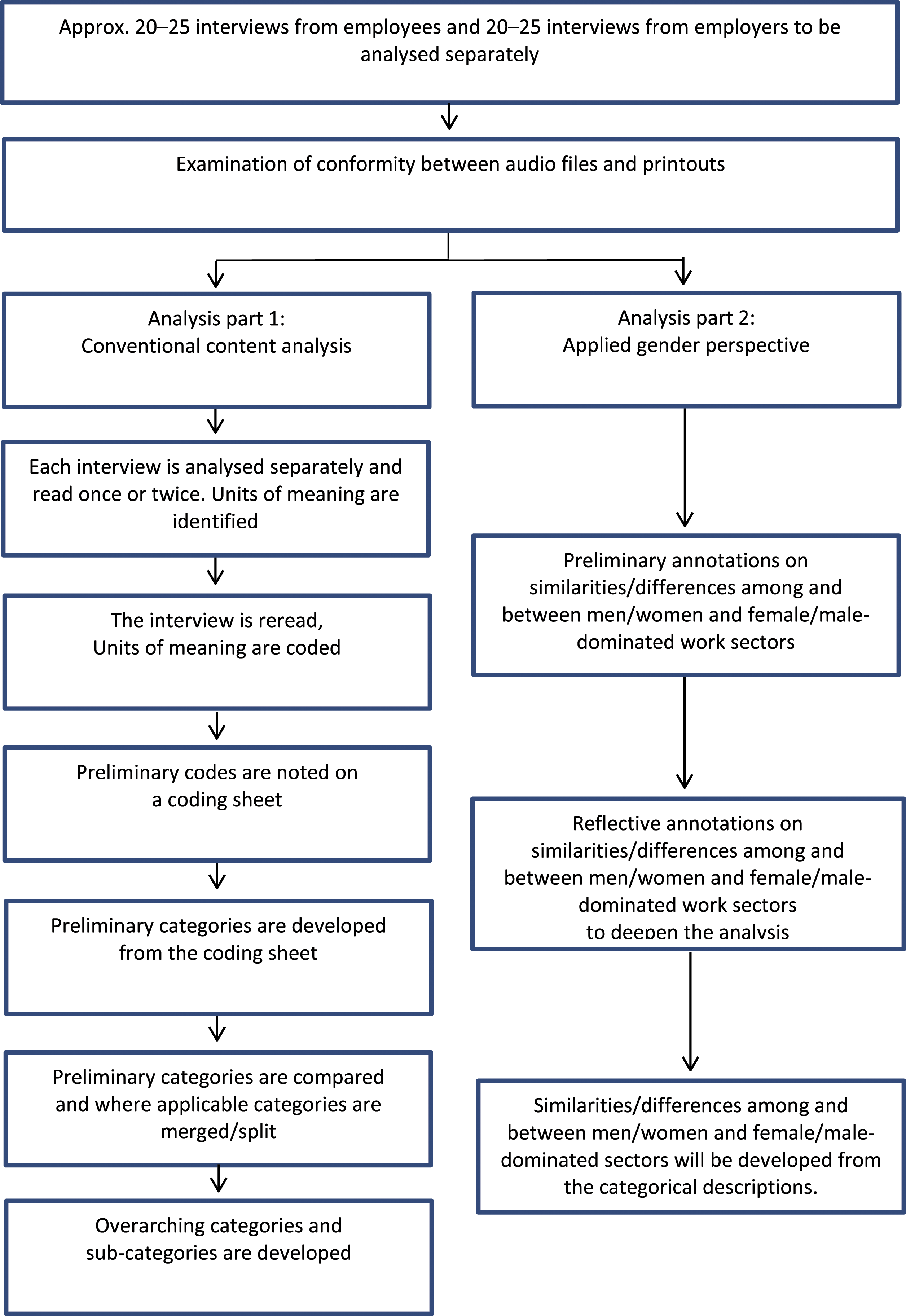
Ethics and Funding
This study was approved by the Swedish Ethical Review Authority (registration number 2020-03271). Written and oral information about the project, proceedings for the project and the research group will be given to the participants. They will be informed that participation is voluntary and that it is possible to withdraw from the study at any time. Informed consent will be collected from all participants. The project was funded by the Swedish Research Council for Health, Working Life and Welfare (Forte; grant number 2019-00883). The founding body will not have a role in the study apart from expecting the work to be done.
Discussion
This study draws its relevance from its focus on a long-lasting and global problem. Common mental disorders increase the risk of sick leave and have significant consequences for the affected person, the employer and society at large. Our focus is twofold, as we will investigate the perceived causes of sick leave due to CMD and resources as well as barriers during the RTW process from the perspective of managers and young employees. Furthermore, as there is a paucity of studies that apply a gender perspective to CMD-related sick leave and RTW, we will investigate differences and similarities in the patterns of experiences of women and men. Our intention is to add to the current knowledge base as well as to develop and evaluate a gender-aware intervention designed especially for young men and women with CMD to facilitate their RTW after sick leave.
The study has a qualitative design since we are interested in the respondents’ views on the underlying reasons for sick leave and on resources and barriers in the RTW process. In this study, we consider sick leave and RTW as processes, in the sense that we intend to investigate experiences that have occurred prior to, during and, where applicable, after the period of sick leave (Verdonk et al., 2008).
The current study protocol is written to improve the validity of the study. During data collection and analysis, the study protocol will guide the research group to follow the original plan of the study and enhance its transparency. The study protocol has been designed with considerations of SRQR guidelines (O’Brien et al., 2014).
Three principles will guide the analysis: relevance, reflexivity and validity, which have been proposed as important criteria for evaluating qualitative research (Malterud, 2001). Reflexivity is necessary in all parts of a research project to ensure high quality (Guillemin & Gillam, 2004). All major decisions will be discussed by the research group to allow for different perspectives and thoughtfulness in the decision-making process. The research group consists of individuals from different academic disciplines, which strengthens reflexivity.
A qualitative research design is applied, as it is appropriate for our aim. While a qualitative study cannot, for example, make generalizations on a population-based level or determine causality, considerations of transferability to other contexts can be made on its basis (Lincoln, 1985). Furthermore, a qualitative design allows for the development of in-depth knowledge and analysis of complex relations.
Finally, few previous studies have investigated differences and similarities in the patterns of experiences of women and men with regard to CMD-related sick leave and RTW. The current study applies a gender perspective to sick leave due to CMD among young adults and barriers and resources for RTW. This has affected several aspects of the project, including its aim, the design of the interview guides and the plan for analysis. By considering how gender aspects may become relevant to CMD-related sick leave and RTW, we will contribute to an increased knowledge on gender-related aspects within sick leave and labour market research.
Supplemental Material
sj-pdf-1-ijq-10.1177_16094069211032071 – Supplemental Material for A Gender Perspective on Sick Leave Among Young Adults – Barriers and Resources for Return to Work as Experienced by Young Employees and Managers: A Protocol for a Qualitative Study
Supplemental Material, sj-pdf-1-ijq-10.1177_16094069211032071 for A Gender Perspective on Sick Leave Among Young Adults – Barriers and Resources for Return to Work as Experienced by Young Employees and Managers: A Protocol for a Qualitative Study by Caroline Olsson, Helena Tinnerholm Ljungberg, Elisabeth Björk Brämberg, Irene Jensen and Lotta Nybergh in International Journal of Qualitative Methods
Footnotes
Author Contributions
The original study concept was developed by LN, EEB and IJ. The design of the study was developed by LN, EBB, IJ, CO and HTL. All authors drafted and revised the manuscript. All authors have approved the submitted version.
Declaration of Conflicting Interests
The author(s) declared no potential conflicts of interest with respect to the research, authorship, and/or publication of this article.
Funding
The author(s) disclosed receipt of the following financial support for the research, authorship, and/or publication of this article: This study was supported by the Swedish Research Council for Health, Working Life and Welfare (Forte; grant number 2019-00883). The founding body will not have a role in the study apart from expecting the work to be done.
Ethics Approval and Consent to Participate
This study was approved by the Swedish Ethical Review Authority (registration number 2020-03271). Written consent will be collected from all participants.

Supplemental Material
Supplemental material for this article is available online.
References
Supplementary Material
Please find the following supplemental material available below.
For Open Access articles published under a Creative Commons License, all supplemental material carries the same license as the article it is associated with.
For non-Open Access articles published, all supplemental material carries a non-exclusive license, and permission requests for re-use of supplemental material or any part of supplemental material shall be sent directly to the copyright owner as specified in the copyright notice associated with the article.
