




Abstract
While sense-making is a frequently used concept in everyday discourse and in several social science research areas, discussions about how the concept translates into methodology are currently scarce. This paper introduces a framework for analyzing how actors in different cultural contexts make sense of global concepts. By this we refer to expressions that are used and expected to find a common ground worldwide, yet are equivocal in their multiple meanings and connotations. The paper discusses methodological considerations of such a sense-making analysis. The paper cites examples from a mixed-methods, cross-country, sense-making analysis of societal transformations toward sustainability—a concept promoted by the United Nations 2030 Agenda. We identify three steps in a comprehensive sense-making analysis: 1) mapping relevant societal arenas for sense-making; 2) vertical analyses; and 3) horizontal analyses. We outline how different datasets can be approached vertically, focusing on the use of framing, metaphors, categorizations, and stories. This forms the basis for the horizontal analysis of societal narratives and recurrent themes across the different data sources. By presenting comprehensive vertical and horizontal analyses, researchers and state and non-state actors can gain insight into the broader varieties of sense-making that can enrich scientific analysis, enhance transparency and effectiveness in international relations, and support transnational governance and civil society collaborations.
Introduction
In a world of globalized governance and media, people in various countries and cultural contexts face key concepts that are generally expected to have global meaning, such as democracy, civil rights, equity, sustainable development, societal transformation, gender equality, and migration. However, the meanings of such equivocal superordinate concepts, which are general and abstract, are not stable and inherent but rather variable. The concepts are subject to different understandings of the root causes of problems confronting societies, the goals to be achieved, and the actions needed to attain the goals in different ways (e.g., Jernnäs & Linnér, 2019; Martinez-Alier, 2014; Onuf, 2013; Wang & Zhang, 2010). This variation may depend on actors’ temporal and spatial settings, their interpretative frames, and their values and worldviews. As noted by Linell (2009, p. 12), “/s/ense-making is strongly interactive and contextual.” To facilitate analysis of both commonalities and variations in a broad international context, this paper aims to develop a new methodological framework for analyzing how actors in different cultural settings make sense of concepts that are expected to find common ground worldwide.
With surging calls for policy-relevant research, the importance of understanding the sense-making of such global concepts is increasing. Examining the sense-making of central policy concepts is important for at least three reasons: a) from a democratization point of view, we need to illuminate implicit societal and political choices; b) conceptual clarity can facilitate transparent decision-making; c) collaborations can be hampered and organizational problems can arise if we do not know how different actors’ understandings of the concepts diverge.
Nonetheless, while sense-making is a frequently used concept in everyday discourse and in several social science research areas, 1 discussions about how the concept translates into methodology are currently scarce (with a few exceptions, mainly in the field of information science, e.g. Dervin & Foreman-Wernet, 2003). New methodological development and guidance on how to conduct comprehensive and systematic sense-making analyses is warranted. The present paper contributes to filling this gap.
Our framework for sense-making analysis takes its starting point in a dialogical approach to sense-making mainly inspired by the works of Bakhtin (1986), Linell (2009) and Marková et al. (2007). We define the concept of sense-making as “the cognitive and communicative processes through which humans understand, describe, and relate to phenomena” (Linnér & Wibeck, 2019, p. 11). To illustrate the framework, we cite examples from a sense-making analysis of the concept of societal transformations, among the most topical concepts in international sustainable development research and policy making today (e.g., IPCC, 2018; ISSC & UNESCO, 2013; UN General Assembly, 2015). This Sustainability Transformations project, which began in 2015, examines sense-making of societal transformations toward sustainability from an international perspective. The project addresses what the social changes described as transformational entail and whether and how transformations are perceived to be governable. It also explores commonalities and differences in actors’ understandings of goals and pathways for transformations, globally and in case-study areas.
To do this, we used multiple empirical sources. We 1) performed a broad international media study, 2) analyzed submissions of intended and decided nationally determined contributions to the Paris climate agreement from 190 countries (the EU makes one joint submission), 3) explored examples of historical transformations, 4) surveyed the peer reviewed scholarly literature, and 5) conducted focus group interviews and document studies in five case study countries, Cabo Verde, China, Fiji, Sweden and the USA. 2 The results are reported elsewhere (Linnér & Wibeck, 2019, 2020; Wibeck et al., 2019) and will not be discussed in depth here. In this paper, we instead use our studies in the Sustainability Transformations project to illustrate the methodological framework.
The paper provides a novel contribution to the literature on sense-making by presenting a methodological framework for systematic sense-making analysis that has been tested in a cross-country project. It also explores how a multi-method and multi-data approach can be used to this end. The paper outlines a comprehensive version of sense-making analysis that employs a multi-strand approach (Bryman, 2006), which entails a combination of several types of data and methods. We seek to take a deliberate and reflexive approach to multi-strategy research, with clear justifications for why, when, and how different methods and data sources are combined (cf. Bryman, 1988, 2006). We are convinced that the approach provides important observations relevant also for a small-scale sense-making analysis with more limited datasets.
We first discuss sense-making as an analytical concept. Thereafter, we describe and exemplify how we approached different datasets vertically, where we used multiple analytical approaches for each type of data, and horizontally, where we constructed recurrent narratives and explored themes across the data sources.
Sense-Making as a Dialogical Process
The sense-making concept has several connotations, such as “creativity, curiosity, comprehension, mental modelling and situation awareness” (Jivet et al., 2020, p. 2). We distinguish between three core features of sense-making (see also Linnér & Wibeck, 2019). First, as argued by Harré et al. (1999, p. 2), “the locus of meaning…is in actual discourse and its cultural context.” In other words, different types of language use and the settings in which interaction takes place, crucially affect the shaping of meaning. From this perspective, sense-making is not mainly a result of cognition within individual minds but is influenced by dialogues, such as between science and society, in the media, in policy, and in mundane conversations among colleagues, family, and friends (cf. Linell, 2009).
Second, following Marková et al. (2007), we distinguish between three levels of interaction that shape sense-making: interaction a) between interlocutors at specific communication events; b) between arguments, views, and lines of thought expressed in communicative situations; and c) within broader societal discourses where interlocutors fall back on “sociocultural traditions” (Marková et al., 2007, p. 133). In practice, this distinction means focusing on views and opinions that are explicitly expressed in text or conversation and that may fluctuate and shift relatively rapidly. This distinction also means focusing on entrenched and often unspoken value premises and assumptions that only alter slowly. The latter type of assumptions can underlie arguments expressed in, for instance, focus group discussions or media articles, or can serve as the foundation for different policy narratives (van Eeten, 2007).
Third, sense-making analysis benefits from integrating a focus on the content of communications with an analysis of communicative processes, noting the perceptions and understandings of different actors and how these perceptions are expressed, i.e. with which linguistic resources.
It is worth noting that the scope of sense-making analysis can range from what actors construct, how they do this, why they construct something in a certain way, to the effect this may have (cf. Weick, 1995, on sense-making in organizations). However, the framework outlined in this paper focuses on the first two elements: what and how. The rationales for and effects of different sense-making practices fall outside the scope of our analysis.
A Multi-Strategy and Cross-Country Approach to Sense-Making Analysis
We take a multi-strategy, cross-country approach to sense-making analysis. To this end, we perform the analysis in three steps (Figure 1), we focus on three features of sense-making (Figure 2), and consider three levels of interaction (as outlined in Section “Sense-making as a dialogical process”).

Steps in comprehensive sense-making analysis.
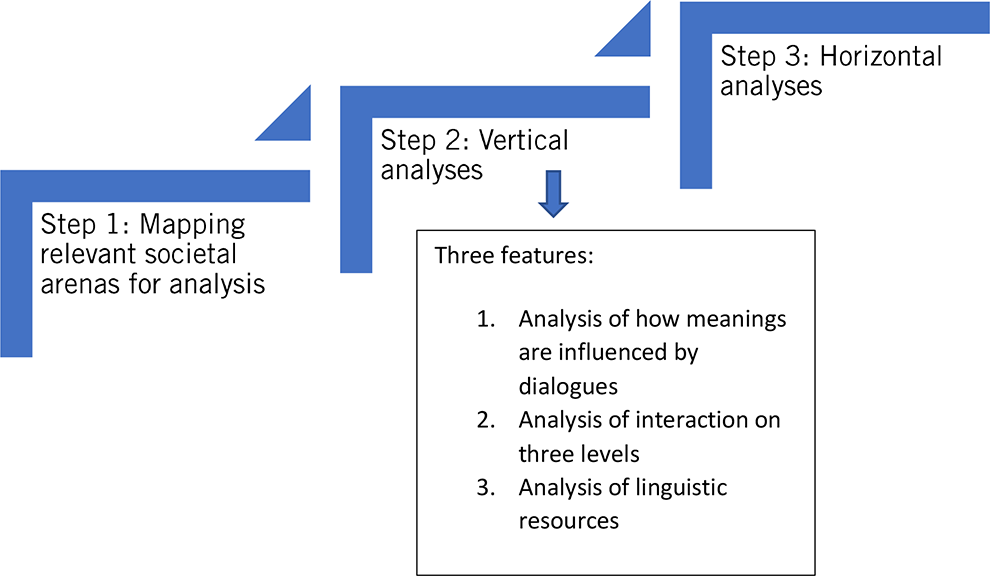
Steps in and features of comprehensive sense-making analysis.
The first step of sense-making analysis is to map the relevant arenas in which the concepts are discussed. For example, in the Sustainability Transformations project, research literature, policy documents, and international media texts provided wide-ranging settings for the varieties of sense-making of societal transformations over time and around the world. We used focus groups to gain insights into various actors’ understandings of societal transformations in particular case-study contexts, and in-depth analysis of sense-making processes (cf. Marková et al., 2007; Wibeck et al., 2007; Wilkinson, 1998). Comparing different types of data in various arenas not only gave us a richer picture of how the concepts could be understood, but contrasting different types of data also allowed us to better identify the sense-making that can be more or less pronounced in some of the study arenas.
The second step of a sense-making analysis entails a vertical analysis that scrutinizes each type of data in time. A particular focus in this step is on sense-making strategies, such as framing, metaphors, categorizations, and stories (see Section “Sense-making resources: framing, metaphor, categorization, and stories”). This step enabled our in-depth examination of each specific dataset, with a focus on the content of utterances and arguments and on how sense-making occurs.
The third step of sense-making analysis consists of a horizontal analysis across all the empirical material that identifies varieties and commonalities across the data. Particular focus in this step is on recurrent societal narratives and themes that synthesize recurrent lines of arguments (see Section “Horizontal analyses”). This step provides an overview of key results across the datasets, illuminating both agreement and conflict in interpretations of superordinate concepts.
The first feature of sense-making analysis in Step 2 calls for examination of how meanings are influenced by dialogues, i.e. the role of language shaped by interaction contexts. To this end, we chose focus group methodology. The second feature calls for distinguishing between three levels of interaction. To study interaction between actors in specific communicative situations and between standpoints, we used different datasets that represented specific communicative situations, such as international policy frameworks, media texts, and focus groups. A comprehensive discourse analysis is required to fully capture the third level, discourses, or communicative genres. While this is certainly important, we see it as the next step after the initial analyses, which need to incorporate a breadth of actors and standpoints to identify varieties and commonalities. Thus, we opted not to include proper discourse analysis in the framework.
The third feature concerns linguistic resources. We focus on four types of sense-making resources: framing, metaphors, categorization, and stories. These resources have also been identified in previous research as crucial to creating meaning in that they assist in bringing order to, and passing judgment on, what is considered to be relevant about particular events and phenomena (e.g., Goffman, 1974; Harré et al., 1999; Labov 1972; Lakoff & Johnson, 1980). Although this paper discusses each of the four sense-making resources in separate sections, they are often interrelated, and they provide complementary perspectives on how meaning is shaped. For this reason, we took all the sense-making resources into account in the analysis of each dataset. Not all of them were equally frequent in each type of data, which is why they do not have equal weight in each vertical analysis. We thus wrote up the vertical analyses separately for each dataset but not for each of the sense-making resources.
Sense-Making Resources: Framing, Metaphor, Categorization, and Stories
Frames and Framing
The framing concept deals with the importance of worldviews and cultural beliefs in sense-making (Goffman, 1974). The concept helps us understand how meaning is shaped. Through the acts of accentuating some dimensions of particular concepts while downplaying other aspects, actors define what is at issue, attribute causes to chains of events, and ascribe responsibilities (Entman, 1993; Gamson & Modigliani, 1987; Nisbet, 2009). Frames are not neutral but shape the ways in which people understand and respond to issues and events (Boykoff, 2007; Nisbet, 2009).
Keywords and stock phrases are among the linguistic resources through which dominant frames can be manifested (Entman, 1993). To give an example from our Sustainability Transformations project, frames in international news media reports were explored in a first stage through mapping the most frequent words (nouns and adjectives). After identifying relevant articles through the Retriever database, we entered all the documents into QSR NVivo, where we ran a word-frequency query. Such analysis can provide a snapshot of dominant frames and allow easy comparisons between particular countries at different points in time, or when different search words are targeted.
When looking at this broad dataset consisting of international news media items published between 2007 and 2018, identified through a Retriever data base search employing the search string “soci* transformation*” AND sustainab*, 3 we found that these articles were dominated by social sustainability and economic growth frames. These were signaled through frequent words, such as “development,” “people,’ “education,” “economic,” “business,” and “growth,” while environmental frames were less pronounced (Linnér & Wibeck, 2019).
Comparing the word-frequency analysis in international media with a similar analysis of media framing in Sweden 4 —a case-study country in our Sustainability Transformations project—during the same time period, a social sustainability frame emerged as dominant. Words such as “jobs,” “development,” “people,” and “society” appeared among the 15 most frequent words, while neither explicit economic nor ecological sustainability framings were signaled in the most frequent words. Although words, such as “countries” and “the world” featured in the top-15 list, the most frequently used word was “Sweden”, possibly suggesting a dominant domestic framing of sustainability transformations.
Other frequent words included “Swedish” and “example”. This could possibly indicate a common frame in much of Swedish climate and environmental discourse; Sweden should be an environmental leader, which reflects a common vision that Sweden is or should be a role model for other countries in setting good examples for environmental governance and action. The word frequency analysis thus, provided us with a lens for a closer reading.
This type of quantitative content-based frame analysis can preferably be complemented with in-depth qualitative frame analysis. For this purpose, we limited our sample to articles that explicitly addressed and with a main focus on societal transformations and sustainability. To qualitatively analyze how these articles framed societal transformations, we constructed an analytic template that included a number of categories that were identified through our readings of scholarly literature on transformation (see Table 1, and Linnér & Wibeck, 2019, p. 19).
Analytical Template for Media Analysis in the Sustainability Transformations Project.

Based on this step in the analysis, we found that two frames were pervasive in the media material: a visionary frame and a pragmatic frame. In the visionary frame, articles pinpointed the need for “fundamental changes” (Scattergood, 2013), and to dramatically change e.g., education systems (Bloomberg, 2015) or energy systems (Gitlin & Kinniburgh, 2016). The visionary frame was at times expressed through metaphorical language that helped establish the difference between incremental alterations and transformational change. Examples of such expressions included “giant strides” as opposed to “baby steps” (Scattergood, 2013), “a complete break with the past, equitable and democratic” (Sanwal, 2013), and “deep” transformations (e.g., Alcorn, 2016). The pragmatic frame, in contrast, focused on initiatives to connect current transformative changes rather than instigate new such changes. One example comes from the media coverage in multiple media outlets of a scientific conference in advance of the 2009 UN climate negotiations in Copenhagen. One of several similar versions of this news piece argued that “linking climate change with broader sustainable consumption and production concerns, human rights issues and democratic values is crucial for shifting societies toward more sustainable development pathways” (Science Daily, 2009).
The goals for societal transformations in our media sample were framed in two different ways: either as attaining a better future, or as avoiding future catastrophes. This key difference in what to expect from societal transformations mirrors a key debate in environmental discourse, namely whether emphasizing risks or opportunities is more useful in encouraging people to take action (e.g., O’Neill & Nicholson-Cole, 2009).
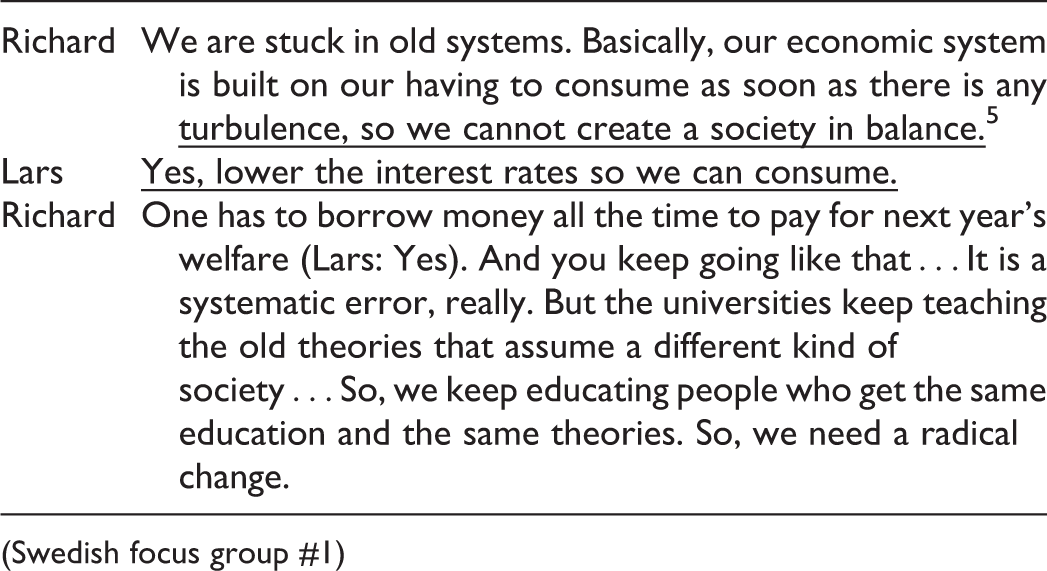
Our multi-method framework also facilitates other approaches to frame analysis. For instance, the use of focus groups enables exploration of how informants’ views can differ on the validity of particular framings (Asplund, 2014; Schön & Rein, 1994)—or what has been labeled “frame credibility” (Benford & Snow, 2000). An example from the Swedish focus groups sheds light on dimensions of frame credibility:
(Swedish focus group #1)
This example illustrates how Richard, with support from Lars, described what he saw as a core problem of today’s society, i.e. the current economic system. The “frame articulators” (Benford & Snow, 2000) were identified as the universities, which stick to old framings that they communicate to their students. This focus group quotation illustrates how not only the dominant framing lacked credibility among the participants but also how the frame articulators (“the universities”) were singled out and criticized.
In another example from one of the US focus groups, participants largely framed sustainability transformations as a matter of grassroots initiatives, individual action, and community engagement, while the efforts of government authorities and businesses were often criticized (cf. Wibeck et al., 2019). According to this group’s participants, “individual grassroots” are the credible frame articulators: “I think it’s gonna be an individual word of mouth. You know, I'll start, you start (…) I almost feel like it has to be at that level for anything to change (…) It has to be individual grassroots to start it. To get it going you know” (USA focus group #2).
Systematic analysis of frame credibility based on focus group or interview material is valuable in studies that seek to understand what frames particular audiences perceive as legitimate, consistent, and trustworthy, who the informants perceive as key actors and key frame articulators, and to what extent the audiences see actors who employ particular frames in communication as credible.
Metaphors
Metaphors facilitate the comprehension of new and/or confusing issues by drawing on the imagery of more familiar things as a vehicle to help us understand the new (Lakoff & Johnson, 1980; Nerlich & Jaspal, 2012) and give insight into epistemological change (Ricoeur, 1978). As a metaphor only exists in a context, it provides a statement, a short parable. Metaphors can have a constitutive function (Maasen & Weingart, 2000), going beyond transferring unaltered meanings to shaping brand new connotations (Wee, 2005). In the words of Nerlich and Jaspal (2012, p. 133), metaphor is “a tool we use to think and act with.”
For example, a frequent metaphor in the media material and policy documents analyzed for the Sustainability Transformations project was the pathway metaphor. This metaphor often suggested that when countries start their journey along a pathway toward low-carbon development, they will need particular mechanisms, such as financial support and long-term international cooperation, to preserve impetus and promote the right pathway choice.
In their Nationally Determined Contributions (NDCs) to the Paris Agreement, some fifty countries referred to transformations in relation to their climate-related policy goals. When examining the metaphors used, “pathway” or “path” stand out. These words were frequently used to describe transformation as a process. Even if it is often used in policy documents—two out of three of all NDCs use the concept pathway or path—it was more frequent among those that discussed transformation (three out of four). For instance, “[i]dentification of priority needs and investment opportunities to facilitate Dominica’s transformation to a climate-resilient development path” is key to the country’s climate resilience strategy (UNFCCC, 2015a, p. 15).
Ethiopia’s NDC illustrates a choice between two development pathways: “Despite being a Least Developed Country, Ethiopia has already placed itself on the path to undertake a substantial national program of climate action, outlined in the Climate Resilient Green Economy Strategy” (UNFCCC, 2015b, p. 7). Implementation of Ethiopia’s Climate Resilient Green Economy Strategy, which is integrated into the country’s Second Growth and Transformation Plan “would ensure a resilient economic development pathway while decreasing per capita emissions…” (UNFCCC, 2015b, p. 1), which would prevent “the unintended consequences of a carbon-intensive development path, such as fossil fuel dependence, health issues, traffic congestion and land degradation” (UNFCCC, 2015b, p. 11).
The next step after mapping metaphors across a dataset is to identify recurrent types of metaphors that can be clustered into categories. For example, the pathway metaphors in the Sustainability Transformations project were subsequently clustered into a larger category across the datasets of journey metaphors that underpinned a core narrative illustrating societal transformation as a journey (see Section “Horizontal analyses”).
An analysis should also take into account that metaphors can have an even greater influence on thinking and acting when they are used inadvertently, embedded in everyday language without people even reflecting on the metaphorical character of certain expressions. Metaphors that are repeatedly used can, with time, lose their character of evident imagery, thus going from what Goatly (2011) labeled “active” to “inactive” metaphors — or, in other words, shifting from living to “stale” and eventually “dead” metaphors (Chettiparamb, 2006, p. 177). Examples frequently used in environmental discourse include “green” to connote something that has a positive effect on the environment or a person, organization, or political party that puts environmental aspects high on their agenda, or the “greenhouse” metaphor for climate change—a metaphor that calls to mind certain aspects of climate change (temperature, radiation) while downplaying others (e.g., precipitation, wind, atmospheric pressure, extreme weather events) (Asplund, 2011). Thus, we need to identify not only obvious metaphoric expressions but also map inactive, stale and dead metaphors since these can shed light on implicit assumptions within specific cultural contexts and discourses.
Categorization: Analogies and Distinctions
Another related way of making sense of novel, unknown or “fuzzy” concepts is to compare them to something well-known. Making comparisons means to sort, categorize, and particularize (Billig, 1996). We can either categorize by drawing analogies, i.e. comparing a new, complex or abstract phenomenon with more familiar ones, classifying it into well-known or general categories (Billig, 1996; Marková et al., 2007), or we can particularize by using distinctions, i.e. to separate the phenomenon from other categories of phenomena by pointing out how they differ (Billig, 1996; Marková et al., 2007).
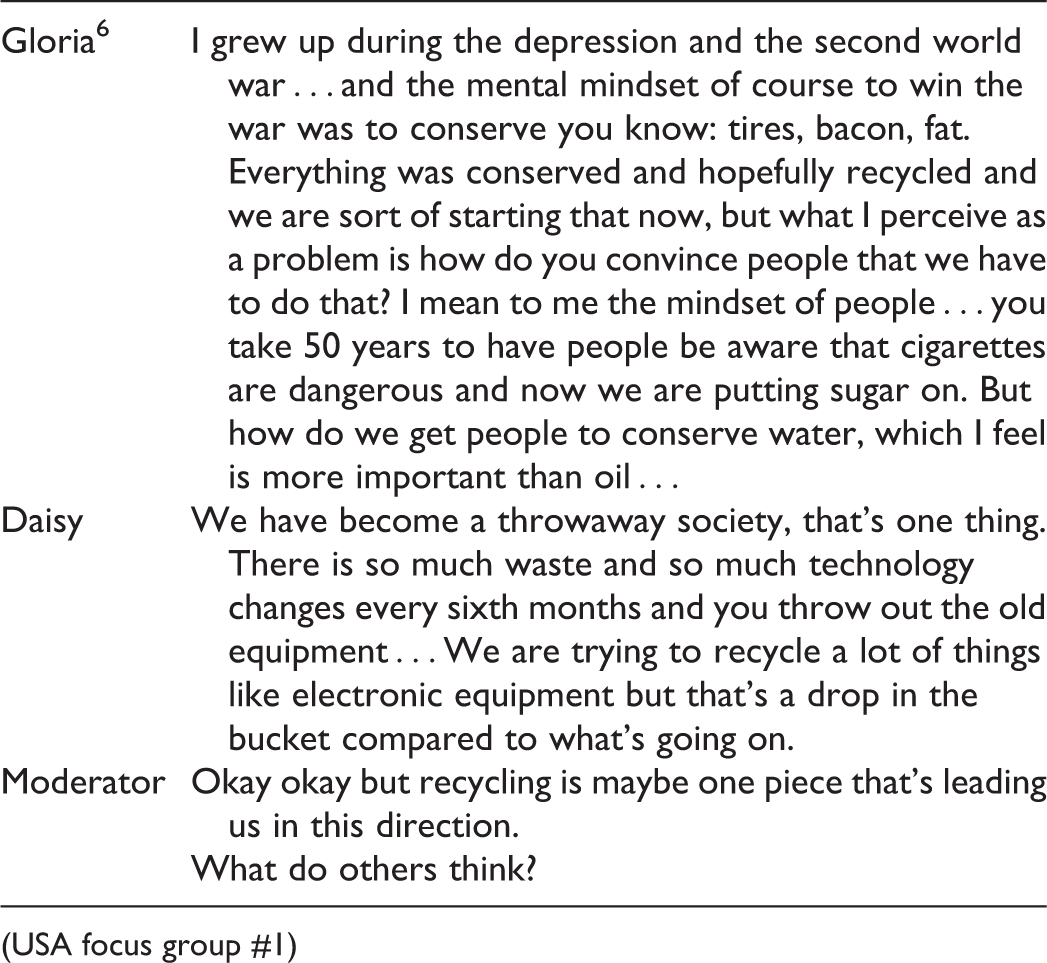
A quotation from one of the US focus group conversations illustrates the importance of comparison:
(USA focus group #1)
This focus group excerpt illustrates how the participants distinguished both between younger and older generations and between old and new everyday practices, but it also draws analogies with the awareness-raising of the negative effects of smoking and excess use of sugar in food. It is also worth noting that although the moderator draws on the pathway metaphor (talking about “direction”), this is not picked up by the participants. After the exchange quoted above, they change the topic.
Our cross-country approach allows us to explore how similar distinctions between today’s society and the scarcity of previous generations were made in several focus groups across countries, but to different ends. US and Swedish participants made such distinctions to argue that older individual practices of saving and conservation should be revived. In the Cabo Verde focus groups, participants contrasted today’s environmental and social problems against the even graver situation when the country gained its independence in 1975. They argued that although many problems remain, Cabo Verde has already made a rapid shift toward a better environmental and social situation. Here, transformation is rather to continue an on-going process than return to older practices. This view on how to achieve transformation can be further contrasted with another line of argument expressed by participants in the Fiji focus groups, where current unsustainable practices were counter posed to traditional values and ways of living in villages. In this view, change toward sustainability will take place through collectively going back to older traditions. For example, participants highlighted that reviving the tabu tradition, prohibiting fishing in particular areas during particular times, could be one way to attain sustainable marine stewardship and prevent overfishing (Wibeck et al., 2019).
Across the focus groups, analogies to previous transformations served the purpose of establishing societal transformations toward sustainability as amalgamations of older and newer practices. This stands in contrast to some of the civilization critique literature, which highlights the role of collapses of earlier structures as a prerequisite for transformative change (Friedman Ekholm & Friedman, 2008; Tainter, 1988).
Analyses of the analogies and distinctions that actors used to make sense of sustainability transformations helped us understand their perceptions of what such transformations could comprise, by offering tangible reference points for interpretation. Mapping, listing, and clustering analogies and distinctions into categories constitute practical steps of such an analysis. In scrutinizing whether the analogies and distinctions carry positive or negative connotations, we can also learn how actors assess and relate to various ideas connected to transformation.
Stories
Narrative theorists have identified the fundamental structures and functions of stories as sense-making strategies. The basic structure of a story entails a series of chronologically ordered events that are causally linked to one another, and the story’s actors usually have defined roles (Cronon, 1992; Harré et al., 1999; Labov, 1972). The basic type of stories is found, for instance, in the folktale and Bildungsroman genres. However, the key components of this type of stories — such as the Hero’s journey (Campbell, 2008)—can easily be combined and incorporated also into environmental storytelling (Harré et al., 1999). Stories also contribute to assigning meaning and values to actions and occurrences, thereby passing value judgments and positioning actors as moral subjects (Cronon, 1992; Goffman, 1981; Polanyi, 1985).
For instance, returning to the Cabo Verde example, both the country’s contribution to the Paris Agreement as well as personal accounts in the focus groups displayed the same narrative: the evolvement of the country from dire circumstances to progress toward democracy, stability and increased well-being, bringing forth the argument that transformative change is possible. At the same time, personal stories of poverty, sanitary problems and overfishing from fishing villages and drought-stricken islands did not contradict the narrative, but conveyed the hurdles to be overcome, signaling that the journey is far from completed and that many have not had the opportunity to follow along.
Another type of stories reoccurring in the project’s datasets dealt with the “inner dimension” of sustainability (cf. Horlings, 2015) and emphasized transformations at a personal level (Linnér & Wibeck, 2019). Here, we found focus group stories of how rapid urbanization was perceived to bring about increased unsustainability since it could alter ways of living in neighborhoods and break social communities apart. Other stories expressed in focus groups concerned personal lifestyle changes that participants had undertaken, or thought of making, to transform their ways of living toward increased sustainability. Some of the policy documents also alluded to the narrative of inner sustainability and transformations in the personal sphere, in emphasizing the need for profound shifts in mindsets, attitudes, behaviors and relationships for achieving sustainable development and addressing climate change. This was the case for instance in The Gambia’s and Papua New Guinea’s Nationally Determined Contributions to the Paris Climate Agreement (UNFCCC, 2015c, 2015d) and Fiji’s Green Growth Framework (Republic of Fiji, 2014), as well as the UN background report for the 2030 Agenda, commissioned by the then Secretary General of the UN and authored by an international panel of high-level representatives of governments, academia, businesses, civil society, and youth groups (UN, 2013).
Individual stories can be mapped and examined for each of the different datasets, as illustrated above. However, as discussed by Moen (2006), individual stories cannot be treated in isolation from their cultural contexts, but they are shaped by the contexts and societies in which the narrator finds her- or himself. In the following we will turn to this societal dimension of narratives.
Horizontal Analyses
After conducting the vertical analyses and mapping individual stories in the datasets, one might identify overarching core narratives, or “societal narratives”—lines of argument reappearing in the individual stories (Dicke, 2001). In practice, the identification of such societal narratives is facilitated by looking for recurrent examples, phrases, symbols and metaphors in the datasets, that taken together form so called leitmotifs in the data (Linnér, 2005).
In our project on societal transformations toward sustainability, we identified five core narratives that recurred throughout the datasets, and that were related to the process of transformation rather than transformation goals. Each of these core narratives was organized around the key metaphors and concepts we identified in the data: Transformation as a journey, Transformation as a building process, Transformation as a war, Transformation as co-creation, and Transformation as recuperation (Linnér & Wibeck, 2019).
The journey narrative was signaled through metaphorical expressions such as “embark,” “road,” “steps,” “pathways” and “milestones.” The data drawing on this narrative sought to rally actors for leaving practices and conditions that are not sustainable and to take action to arrive at a better future. The data using the building narrative, signaled through metaphors such as “foundation,” “structure,” “blueprints,” “architects” and “pillars,” presuppose active agents to accomplish the transformation, through careful design and co-ordinated, collaborative efforts to achieve long-term sustainability goals. The war narrative, by contrast, draws on a conflict frame, signaled by metaphorical expressions such as “combat,” “fight,” “frontline,” “struggle,” “mobilize,” and “eradicate.” The co-creation narrative, similar to the building narrative, conveys ideas of cooperation, emphasizing key words and metaphors such as “inclusion,” “engagement,” “collaboration,” “bottom-up,” “grass-roots,” “partnership,” and “participation.” The recuperation narrative, finally, tells of a need to “restore” or “heal” a society that is broken or ill, but still not irreversibly damaged.
The different narratives thus have different implications in our datasets in terms of ascribing agency and pointing to measures for supporting sustainability transformations. As such, each narrative has its strengths and weaknesses when it comes to spurring engagement for transformative change. From this, we draw the conclusion that multiple, complementary narratives are used for different audiences to make sense of a multifaceted concept such as transformation.
In addition, the horizontal analysis also poses questions to the data based on themes in the vertical analyses. In the Sustainability Transformations project, such questions included: What is the scope of the transformations discussed in the data—do the analyzed sources refer to civilization-wide, mega transformations encompassing entire societies, or to particular transformations aimed at specific (parts of) systems? At what pace are transformations envisioned to occur—are they sudden or protracted? What are key drivers in directing and enabling societal transformations? Who are the agents that need to take action, and what degree of agency are they ascribed?
We selected these four different elements as central in sense-making on societal transformations based on previous research on societal change (e.g., Buzan & Lawson, 2015; Feola, 2015; Grin et al., 2010; Osterhammel, 2014; Scoones et al., 2015) and tested them on a subset of our initial mapping (Step 1; see Section “A multi-strategy and cross-country approach to sense-making analysis”).
In writing up the results of the vertical and horizontal analyses, the Sustainability Transformations project addressed cross-cutting themes such as implications for governance, recommendations and implications for policy as well as further research (Linnér & Wibeck, 2019, chapters 7 and 8).
In any sense-making study that employs multiple datasets, once key themes are mapped in the vertical analyses, a horizontal sense-making analysis should scrutinize commonalities and variations in sense-making on these themes across the study’s different datasets (Figure 3).

Elements of horizontal sense-making analysis.
Discussion
Koenig (2006, p. 72) makes the case that “cross-national research remains the most important area of comparative research, even in the field of culture.” Taking a cross-country perspective on sense-making analysis is challenging but—as this paper has argued—indeed possible, provided a systematic analytical framework is employed.
As demonstrated by our analysis, societal transformation exemplifies a concept, which is often used in passing and its meanings taken for granted. This is the case, for example, in countries’ pledges to the Paris climate agreement, as well as in the social science debate, where established definitions of transformation are lacking (O’Brien, 2012), and where the concept of transformation is sometimes used metaphorically and not explicitly defined at all (Feola, 2015). When an associative concept, such as transformation, goes from rhetoric to operationalization, differences of opinions become obvious, and analyses of sense-making are warranted. As pointed out by Mertens (2015, p. 4), “/r/esearchers interested in the intersection of economic development, environmental justice, and human rights need to select methods that identify the different constituencies, their social and cultural positions, and ways to counteract negative or distrustful relationships.” To this end, the horizontal and vertical sense-making analyses presented in this paper can facilitate awareness of how actors across cultural contexts make sense of globally used policy concepts. In a world of global governance efforts as well as social media interactions, the need to study such globally used concepts is bound to increase.
This paper’s methodological framework was designed to explore varieties and commonalities in sense-making across countries and contexts, but also to enable in-depth analysis of sense-making processes. In line with Mangen (1999), we particularly highlight the advantages of a reflexive, flexible and mixed methods approach to cross-country studies to cope with the challenges of analyzing sense-making across cultural and linguistic contexts and across different types of data (see also Brannen, 2005, and Hantrais, 1999, for further discussion about contextualization in cross-national studies).
The Sustainability Transformations project represents a multi-strand study (cf. Bryman, 2006) combining several types of data. A similar systematic approach to sense-making analysis is of course also applicable in a single-strand study examining one particular type of empirical data, although for a richer sense-making analysis and when the study takes a cross-country approach, we argue that multi-data analysis should be encouraged.
The multi-strategy approach to research advocated here entails mixing quantitative and qualitative methods. Mixed-methods research has been forwarded as a suitable way of addressing and enhancing the analysis of social science research problems characterized by high complexity (Bazeley, 2017; Creswell, 2009; Mertens, 2015). We applied the mixed-methods approach to data collection, where we used both quantitative large-n and small-n qualitative studies. Although our framework also is applicable to concurrent design, we used a non-nested design, that is, we did not seek multiple data types from the same actors or arenas (Lieberman, 2005), as a key guiding principle of the design is to be aware of the differences in cultural contexts and empirical settings. We used the quantitative indicator word analysis of the policy documents to select documents for qualitative analysis. Based on this, we identified background documents and selected the case countries for further analysis.
As a means of going beyond rigid qualitative–quantitative divides, mixed-methods research is said to be a pragmatic way of designing studies that “often will provide the most informative, complete, balanced, and useful research results” (Johnson et al., 2007, p. 129). This being said, we do not advocate mixing quantitative and qualitative methods for its own sake or employing an overly eclectic “anything goes” approach (Buchanan, 1992). In line with Mason (2006) and Hesse-Biber (2010), we see the need for “qualitatively driven” multi-strategy research when it can enhance the analysis of social phenomena. For explorations of sense-making of equivocal superordinate concepts, we argue for complementing qualitative in-depth studies with broader quantitative approaches in selecting types of data and in data collection to provide a broad basis for cross-country comparisons. The mixed non-nested approach enables a qualitative analysis of commonalities as well as varieties in sense-making across geographical contexts.
Conclusions
This paper set out to develop a methodological framework for comprehensive sense-making analysis of global concepts. Drawing on literature on sense-making as well as on our experiences from a major cross-country research project, this paper identifies three steps in a comprehensive sense-making analysis: 1) mapping relevant societal arenas for sense-making; 2) vertical analyses; and 3) horizontal analyses.
The paper demonstrates that in order to understand sense-making of global concepts that are expected to find common ground internationally, yet are equivocal in their multiple meanings and connotations, there is a need to combine breadth and depth in analytical approaches. We therefore advocate combining vertical analyses of different aspects of sense-making, approaching different types of data separately, with horizontal analyses that scrutinize commonalities and differences in sense-making across different datasets.
Furthermore, we conclude that multi-strand approaches, combining different types of data, are particularly well suited for cross-country analysis. Since cultural contexts may influence to what extent different methods are apt to capture sense-making processes—for instance, whether group-based or individual interview approaches are best suited to encourage participants to share their stories and thoughts—it is helpful to combine different types of data, written as well as spoken.
An objection could be that such culturally sensitive methods selection may hamper comparability. However, the analytical framework does not aim for fully representative comparisons, but rather seeks to provide a deeper insight into how sense-making can vary within and between contexts. By presenting comprehensive vertical and horizontal analyses, researchers as well as state and non-state actors can gain insight into the broader varieties of sense-making, which can enrich scientific analysis, enhance transparency and effectiveness in international relations, and support transnational governance and civil society collaborations.
How key concepts are grappled with is critical for international cooperation, whether it is the United Nations 2030 Agenda, pandemic responses, economic relationships, or geopolitical interactions. In a globally intertwined world interest in surveying and comparing values across societies (e.g., through the World Values Survey) has grown in the last decades. Research plays an important role in enhancing understanding of variations in the sense-making processes of global concepts. Such analysis places new demands on research planning and funding. To conduct a comprehensive cross-country sense-making analysis, researchers need to work in international teams, partnering with colleagues who are familiar with the linguistic and cultural contexts of the study. There is often a need to work multi-lingually, enabling translations of transcripts and/or translating participants’ contributions on site, as well as to collaborate in the analysis phase of the study. Since this is both costly and time-consuming, funding agencies need to consider supporting larger cross-country projects that enable international teams of researchers to collaborate in exploring the multi-faceted ways of making sense of global policy-relevant concepts across societies.
Footnotes
Declaration of Conflicting Interests
The author(s) declared no potential conflicts of interest with respect to the research, authorship, and/or publication of this article.
Funding
The author(s) disclosed receipt of the following financial support for the research, authorship, and/or publication of this article: This research was made possible by funding from the Swedish Research Council Formas through the project “Decarbonisation leadership: Disentangling Swedish transformation pathways and their exemplary roles” (Grant No 2016-00589), as well as The Swedish Foundation for Strategic Environmental Research—Mistra through the research programme “Mistra Geopolitics” (Grant No 2016/11 #5). The work reported in this paper contributes to The Seed Box: a Mistra-Formas Environmental Humanities Collaboratory.
