




Abstract
This methodologic paper aims to update researchers working with adolescents and young adults on the potentials and pitfalls associated with web-based qualitative research. We present a case study of synchronous web-based focus groups with 35 adolescents and young women ages 15–24 years old recruited from a clinical sample for a mixed methods study of heart disease awareness. We contrast this with two other studies, one using asynchronous web-based focus groups with 30 transgender youth ages 13 to 24 years old and another using synchronous web-based focus groups with 48 young men who have sex with men ages 18 to 26 years old, both recruited via social media. We describe general and logistical considerations, technical platform considerations, and ethical, regulatory, and research considerations associated with web-based qualitative research. In an era of technology ubiquity and dependence, researchers should consider web-based focus groups a potential qualitative research tool, especially when working with youth.
Introduction
As the world becomes increasingly digitized (Llamas et al., 2013), many researchers are adapting traditional face-to-face research practices to reflect the changing societal culture (Denissen et al., 2010). This may be especially true for those who study adolescent and young adult (AYA) issues, given this demographic spends much of their time during and outside of their educational, occupational, and social pursuits consuming digital and social media (Anderson & Jiang, 2018; Jiang, 2018; Larson, 2001; Lauricella et al., 2014; Lenhart, 2015). Even if the research question does not directly address media use, abundant screen time (Bucksch et al., 2016; Jiang, 2018; Moreno et al., 2012) coupled with conflicting responsibilities (Caldwell et al., 1996; Fredricks, 2012) may limit AYA’s time or desire to commit to research study participation. Choosing a digital research strategy is one way to enhance enrollment of AYA research participants that harnesses this population’s familiarity with and preferences for electronic over face-to-face communication (Common Sense Media, 2015).
Market and consumer research has become largely dependent upon web-based research methods, including web-based focus groups (Murgado-Armenteros et al., 2012; Oringderff, 2017). Since web-based focus groups were introduced, the adoption of this valuable tool outside of these fields has been growing rapidly and it is an emerging method used among researchers working with adolescent populations especially (DuBois et al., 2015; Neville et al., 2016; Wettergren et al., 2016). Several methodologic guides have described the use of web-based focus groups and interviews with adolescents (F. E. Fox et al., 2007; Neville et al., 2016) and adults (Oringderff, 2017; Reisner et al., 2018). The goal of this methodologic paper is to assist researchers interested in conducting web-based focus groups with youth by comparing and contrasting features of the various options using a case study.
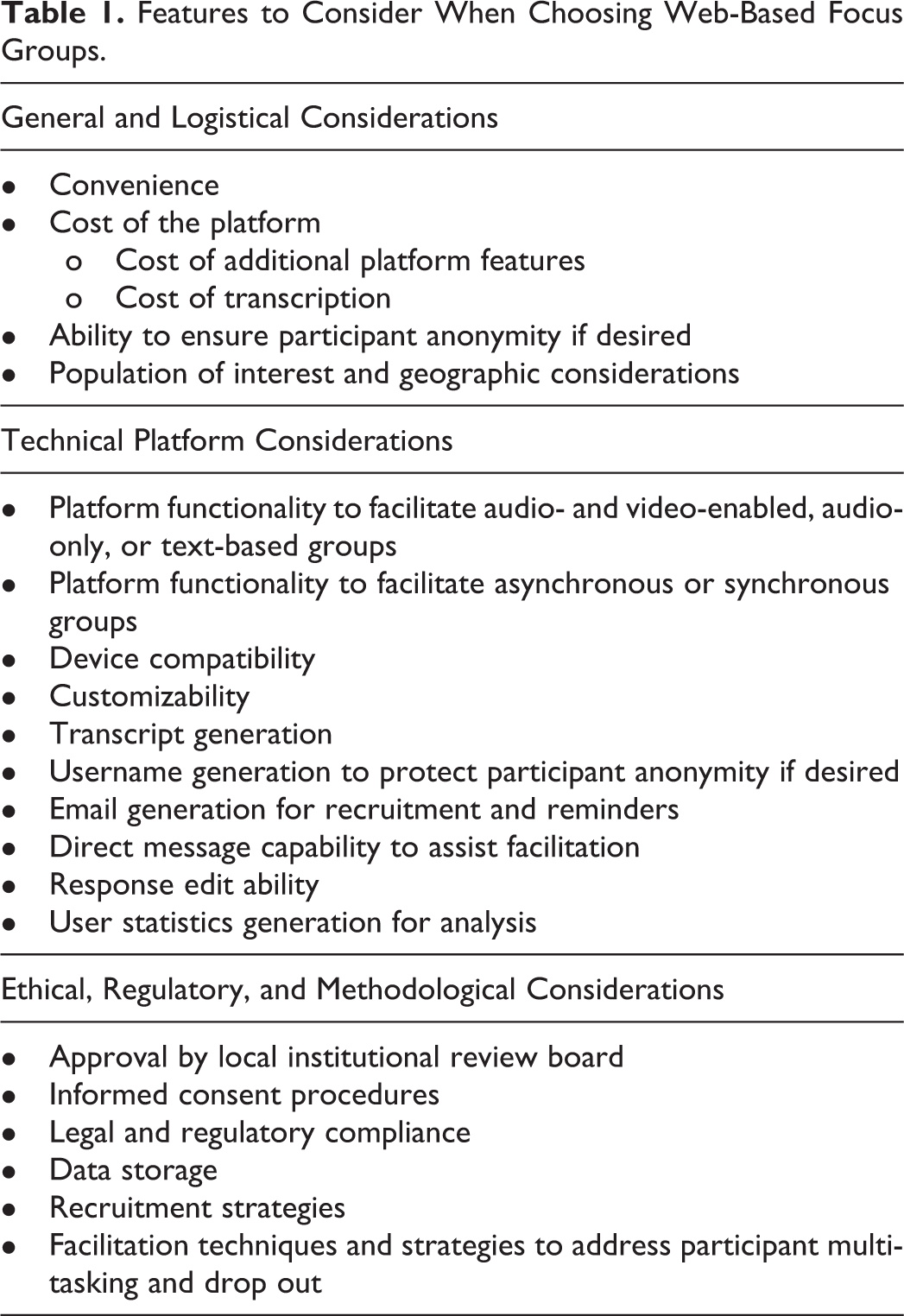
With web-based software, AYA researchers can capitalize on young people’s technical aptitude and facility with social media while tailoring user experiences towards this population’s preference for digital communication (Common Sense Media, 2015). When designing our study of heart disease awareness and preventive behaviors in AYA women (Figure 1; Gooding et al., 2020), we considered the functionality, convenience, logistical considerations, cost, and anonymity of in-person and web-based focus groups. We also considered the advantages and disadvantages of the different types of web-based focus groups while addressing recruitment and retention, as well as ethics and compliance issues associated with web-based qualitative research. We present these features to consider when choosing web-based focus groups in Table 1. We further describe our case study and contrast it with two other AYA projects in Box 1. It is important to note that all of these projects were completed before the current COVID-19 pandemic, and thus represent a practical resource for researchers looking to conduct qualitative research remotely both during and after the pandemic.
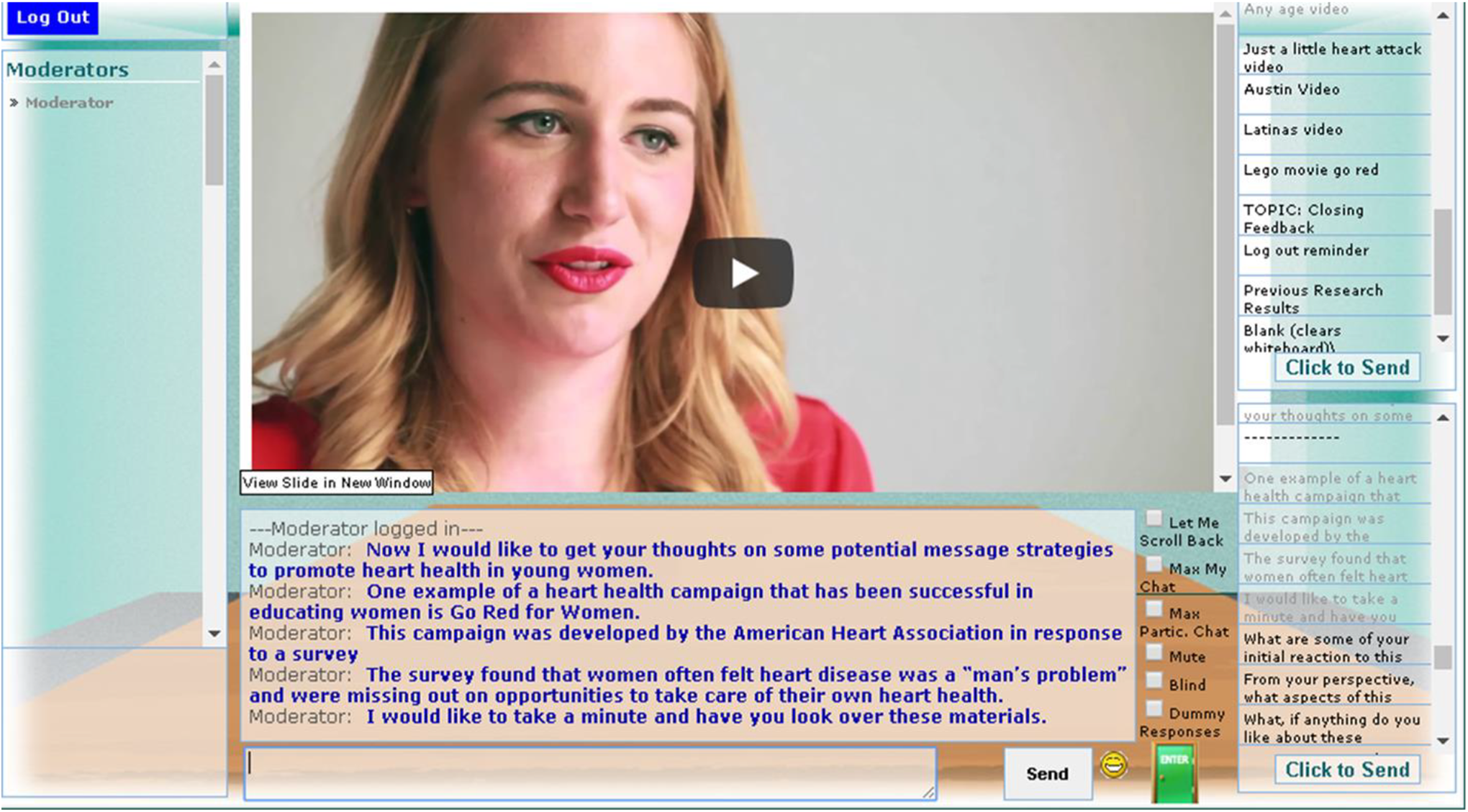
Screenshot from adolescent and young adult (AYA) heart health awareness and preventive behavior web-based focus group case study. Note. This image is from the moderator’s perspective in InsideHeads, a market research company that owns and operates an online focus group platform. The individual photographed above participated in a publicly available video about heart disease sponsored by the American Heart Association. This video was shown to participants during the web-based focus group.
Features to Consider When Choosing Web-Based Focus Groups.
Three Case Studies of Web-Based Focus Groups for Adolescent and Young Adult Health Research.

Functionality of Web-Based Focus Groups
Web-based focus groups come in three primary formats: audio- and video-enabled, audio-enabled only, or text-based focus groups. Text-based focus groups can be either asynchronous (i.e., a discussion board) or synchronous (i.e., simultaneous chat). Asynchronous discussions typically remain open for a predetermined length of time (usually 24–72 hr but can be weeks or months) during which participants can log in to a platform when it is convenient for them to answer moderator questions and communicate with one another. Synchronous groups are fixed duration discussions that require participants to access the platform and respond to the moderator and one another in real time, typically 45–90 min. Audio- and video-enabled and audio-only groups typically exist in a synchronous format, although recent platforms such as FlipGrid and VoiceThread allow users to share video and audio with researchers in an asynchronous fashion.
Audio- and video-enabled synchronous groups are functionally similar to in-person focus groups as participants interact face-to-face and can respond to verbal and visual cues. Like in-person groups, audio- and video-enabled and audio-enabled groups promote sequential discussion. Audio-enabled and text-based groups, in contrast, lack face-to-face, non-verbal communication and may make it more difficult for moderators to determine when to move to the next question.
The functionality of all web-based groups may be impacted by environmental disturbances (i.e., loss of internet connectivity and external stimuli), which can prohibit participants’ full engagement in the group discussion. As adolescents are accustomed to multitasking when using the internet (Moreno et al., 2012), web-based groups have the potential to include more passive participants compared to in-person groups. However, many platforms have capabilities to privately engage youth during the discussions to prompt further engagement. Web-based groups may also have lower retention rates as participants may drop in and out of the conversation or discontinue participation halfway through the group; incentive strategies can counter this occurrence.
Text-based groups are also unique as they introduce a new element of participant communication and transcript analysis as participants use emojis, characters (e.g., the carat symbol ^ to indicate agreement with the text written above), and short message service (SMS) language and abbreviations (e.g., NM to specify never mind or nothing much and LOL to denote laugh(ing) out loud) to communicate their ideas, agreement, and disagreement. Text-based groups also allow participants to respond simultaneously and may result in more data in a shorter period of time.
Synchronous groups are typically limited in size due to moderator capacity to foster group interaction and meaningful participation from all participants, as well as scheduling constraints. They are most similar to in-person groups in that they allow for “spontaneity, dynamism, [and] immediacy” (F. Fox, 2017). In contrast, asynchronous groups can accommodate a greater number of participants, as moderators and other participants are not required to follow the discussion in real time. Asynchronous groups also allow researchers to communicate with the same population over a period of time, allowing researchers to dive deeper into individual participant responses, which may be longer and more reflective, and better adapt research questions to elucidate divergent participant experiences (F. Fox, 2017). Because asynchronous focus group participants contribute when they are available, there is the potential for less inter-participant communication as participants are not immersed in the discussion at the same time. Researchers can set upfront engagement rules and incentives for inter-participant communication to address this issue. Lastly, as with any longitudinal study, asynchronous groups may be at greater risk for increased participant dropout.
Convenience
Web-based groups are generally more convenient than in-person focus groups for most researchers and participants. However, the perceived participant convenience of in-person and web-based focus groups may be dependent on cohort age and computer literacy. Web-based groups can operate outside of facility hours and allow users (including research staff) to participate from anywhere. In-person groups, in contrast, are subject to facility and space availability and require participants to travel to a designated location at a designated time. In-person groups, therefore, are constrained by transportation access, availability, traffic, and other competing time demands on adolescents, which are numerous. Depending on the intended study population and the approved recruitment method, it may be faster and more convenient to enroll participants in web-based focus groups (Tates et al., 2009). Specifically, if the eligibility requirements for the research are broad, web-based group participants can be recruited quickly from a wider geographic area (Fontenot et al., 2015) than in-person groups by using social media (e.g., Facebook, Instagram), Craigslist, Reddit, and research lists. Text-based groups can also shorten the proposed research timeline as transcripts are available for review and analysis immediately following each discussion.
Logistical Considerations
Web-based groups are dependent upon the web and the operation of the selected platform. Researchers should consider device compatibility with the platform, internet connectivity, and platform updates and downtime when selecting a web-based platform. Additionally, researchers should assess if owners/operators of online platforms offer technical support prior to, during, and after the online discussions. Most adolescents and young adults have access to a smartphone or laptop with rates ranging from as low as 46% to as high as 96% in emerging countries (vom Orde & Durner, 2020), 90% in the 28 countries of the European Union (vom Orde & Durner, 2020), and 95% in the United States (Anderson & Jiang, 2018). Internet access may still be suboptimal for youth, particularly in rural areas, so providing participants with the equipment required for the group and/or a data plan can minimize technical limitations. Selecting a platform compatible with desktop computers and with a variety of mobile devices reduces compatibility concerns. While many of these logistical concerns can be minimized, web-based groups, by default, remain subject to internet connectivity and platform issues.
Cost
Budgetary limitations must be considered when selecting a qualitative research method. In-person focus group expenses include participant compensation, participant travel reimbursement, food and beverages, space and equipment fees, transcription fees, and moderation costs. The cost of web-based groups, however, largely depends on the type of focus group selected and the associated platform fees. Costs also depend on existing institutional arrangements with specific platforms (i.e., Webex, Zoom).
There is an abundance of web-based platforms available, some of which have no or low associated costs. Commercial platforms may range from $0 to 500+ per group. Depending on the platform used, web-based groups may be more economical for researchers, although web-based groups still include the expense of participant compensation and moderation costs. Audio- and video-enabled and audio-enabled groups may require transcription costs. Web-based groups may also incur an optional cost of electronic devices if these are provided to participants.
Anonymity
Anonymity can be a significant concern in qualitative research about sensitive or personal health topics, and a project’s ability to guarantee anonymity may increase participant’s willingness to disclose sensitive information. Participants may also be less subject to social status, social desirability bias, or groupthink in online groups (Nicholas et al., 2010), which may increase participation from historically marginalized groups. In-person face-to-face groups and video-enabled web-based groups inherently lack anonymity. Anonymity may also be a concern for audio-enabled web-based groups as participants may be identified by voice. Because participant identity is better protected in text or audio-based groups, these methods may be preferable for both participants and researchers when investigating sensitive topics (Graffigna & Bosio, 2017). Anonymity in web-based groups may also be preserved through anonymous participant usernames that the researcher or participants may select via the platform.
Selecting a Web-Based Platform
After assessing functionality, convenience, logistical considerations, cost, and anonymity, researchers may find that web-based focus groups are a good fit for the research population or research topic of interest. Key features for consideration then include web-based focus group type (i.e., video- and audio-enabled, audio-only, or text-based; asynchronous or synchronous group) and ethical and legal considerations (i.e., consent procedures, compliance with state laws and regulations around data privacy, data management).
Features to Consider
When selecting a web-based focus group platform, researchers should consider the functionality of the software. A potential benefit to multifunctional platforms is that they permit moderators to speak, present data, or play short videos during groups. Researchers should also investigate whether the software is desktop and mobile compatible and whether its software requires participants to install an application on their device, which may be a barrier to enrollment for some participants. Other features that warrant deliberation are platform usability (for moderators and participants), ability to message inactive participants to encourage participation, screen sharing capability, recording ability, and transcript generation.
Additional software features may enhance participant recruitment, group moderation, and analysis. Features that facilitate recruitment and retention include allowing participants to enter the group by clicking a link in their email inbox, automating reminder emails to participants before the group commences, and creating digest emails that notify participants of new comments or questions in asynchronous groups. Features that facilitate moderation include the ability to upload the focus group guide and visual content prior to the start of the group, generation of automatic anonymous usernames, allowing a moderator to edit or remove a response, or eliminate a participant from the group if needed. Features that facilitate analysis include user statistics, such as time in the group and the number of utterances, and transcript generation and import into an analysis program.
Ethical and Compliance Issues
Web-based focus groups present special considerations and require collaboration with the local institutional review board, research computing, and privacy and compliance department. AYA researchers may need to apply for a waiver of written consent/assent for participants, and depending on the age of participants, a waiver of parental consent as participants and their adult guardians are not presenting in-person for the research study. Alternatively, participants could provide electronic consent prior to or at the initiation of the focus groups via the platform or a link to quantitative survey software. This technique may be useful for collecting demographic data prior to the focus group as well. Lastly, participants could be mailed consent/assent forms, but this will increase the study timeline and may lead to the loss of potential participants. In addition, with mailed consent/assent forms, it is difficult for the research team to verify who actually completed them. Researchers will need to investigate and evaluate each platform’s compliance with relevant laws and statutes, encryption, data storage, and data access. If protecting participant anonymity, participants should be cautioned against disclosing personal information during the group and researchers should consider adopting a standardized method of username generation (i.e., color & animal) that excludes participant identifiers. To protect participant confidentiality, participants should be asked not to share personal information disclosed during the group discussion with non-participants.
Recruitment Strategies
When recruiting participants for groups, researchers may employ various recruitment schemes, including approaching potential participants in person, sending electronic messages to listservs (i.e., email or text message), or non-direct methods (i.e., leaving voicemails, distributing flyers, and posting on message boards and social media). To reach target enrollment, we found it useful to send participants a confirmation email/text with information about the study group as soon as they agreed to participate. For in-person recruitment, this allows the research team to immediately check that routes of electronic communication work and to troubleshoot any technical questions. After an initial synchronous group in the heart health study had low turnout, we found success recruiting participants within a week of the intended group date, double or triple enrolling the intended number of participants, and sending reminder emails/texts 2 days before, the day before, and the day of the group. This strategy was also effective in our other studies (Fontenot et al., 2019, 2020).
Web-Based Focus Group Facilitation
When conducting focus group sessions, it is helpful to have at least two members of the research team on hand for moderation, taking field notes, and administration. With a pre-programmed guide and content slides, the moderator can primarily focus on progressing the conversation, responding to participant questions, and asking further probing questions. A second research team member can assess for inactive participants and privately send engagement reminders during the focus group as needed. This second team member can also follow along with the discussion, closely taking field notes and providing ideas for probing questions to the moderator. A research administrator should also be available to work with the platform support to solve technical issues, verify participant consent, update the group content, and send private messages to late or non-attending participants to invite them to a future session. During synchronous groups, it may also be useful for moderators to gauge what device participants are using. This allows researchers to tailor the pace of the discussion to users’ screen dimensions as small screens cannot accommodate as much text. In particular, the rapid flow of text-based groups may allow participants using devices with larger screens (e.g., computers) to better follow and potentially dominate the discussion compared to participants using devices with smaller screens (e.g., mobile devices).
Conclusion
While face-to-face focus groups are an accepted and widely adopted tool for qualitative research (Kitzinger, 1995; Wilkinson, 1998), web-based focus groups are increasingly utilized, particularly with adolescents, marginalized, or hard to reach populations (DuBois et al., 2015; Wettergren et al., 2016). Both in-person and web-based focus groups can provide researchers with rich data (Woodyatt et al., 2016) that capture participants’ insights about a topic of interest, and both in-person and web-based focus groups present individual advantages and disadvantages. For researchers, the functional, convenience, logistical, cost differential, and anonymity differences between in-person and web-based focus groups warrant consideration. Ultimately for any focus group data to provide useful data, researchers must adhere to other best practices in group facilitation and data analysis (Freeman, 2006).
For AYA researchers in particular, web-based groups may prove to be a valuable tool as adolescents and young adults are generally technologically savvy, prefer electronic communication, and are constrained by time and transportation. Furthermore, as adolescence is a time of identity development, identity formation, and risk taking, researchers working with this population may host web-based groups about sensitive topics such as sexual orientation, gender identity, sexual practices, body image, substance use, etc.; the anonymity offered by web-based groups may bolster enrollment and participation in groups centered on these topics. Similarly, for parent or caregiver-centered research, this methodology may prove useful as it opens participant enrollment to individuals impeded by transportation or childcare needs. For older, less technologically proficient, or less technology dependent populations, web-based focus groups may not be ideal.
Notably, all of the projects highlighted in this case study were conducted before the COVID-19 pandemic. The pandemic has forced the move to remote data collection methods for many more researchers (Lupton, 2020). Here we focus on considerations that were important prior to COVID-19, are applicable during COVID-19, and will also be relevant post-COVID-19, where in-person groups are again an option. In an era of technology ubiquity and dependence, researchers should consider both web-based and in-person focus groups as possible qualitative research strategies. Moreover, as interpersonal interactions are increasingly relegated to non-verbal, digital communications, research capitalizing on web-based resources should be considered. The impact of web-based discussions on group dynamics and participant experiences with research, as well as thematic or discourse differences compared to in-person groups, are areas ripe for future investigation. Both in-person and web-based focus group approaches have pros and cons, and the ideal methodology is the one that best aligns with the population of interest, minimizes participant risk, and maximizes enrollment and participation.
Footnotes
Acknowledgments
The authors would like to thank Sierra Patterson for technical assistance preparing the manuscript.
Declaration of Conflicting Interests
The author(s) declared no potential conflicts of interest with respect to the research, authorship, and/or publication of this article.
Funding
The author(s) disclosed receipt of the following financial support for the research, authorship, and/or publication of this article: This project was funded by a National Heart, Lung, and Blood Institute (NHLBI) K23 grant awarded to Dr. Holly Gooding (K23 HL122361).
