




Abstract
The need for the ‘voice’ of people living with dementia to be present in research has been gaining prominence in recent years. This has been realised through the rise of ‘inclusive research’, seeking to redress unequal power dynamics that have long dominated research. However, the impact and merit of inclusive research have been questioned, with questions around what value the involvement of disabled people as co-researchers adds to the research process and impact. With reference to an inclusive photovoice project on dementia post-diagnosis experiences, we address these debates through exploring the arc of the research project in three phases. In Phase 1 project notes and reflective conversations between the research team are drawn on to examine how the lived experience of researchers living with dementia shaped the focus and the methods employed. In Phase 2 conversation analysis is used to examine the interactional delivery of the focus group, showing that the researchers living with dementia used a mix of facilitation techniques to encourage and support talk, drawing on their own expertise by experience as an interactional tool to encourage participants to talk. In Phase 3 thematic analysis of participant follow up interviews is employed to examine experiences of taking part in the research. Participants reported improved positive self-image, benefits from peer support, and increased motivation to engage in future activities because of participation. We argue that the value the researchers with dementia added was not just confined to the focus of the research, but was ‘baked into’ project design delivery, and impact upon participants living with dementia. We show that the ‘added value’ of inclusive research shaped the research methods and delivery to fit participants, supported increased participation and agency from participants during the research, and enabled participants to contest deficit framing(s) of dementia after leaving the research project.
Introduction: Doing Research Together With People Living With Dementia
People living with dementia have traditionally been excluded from taking an active role in research (Innes & Manthorpe, 2012; Webb et al., 2020, p. 686), and were thought to be unable to add to an understanding of the condition (Cottrell and Shulz, 1993). However, in recent years the opportunities for people with dementia as participants in qualitative research have expanded (Carmody et al., 2015; McKeown et al., 2010; Williams et al., 2020), allowing academics to shed a better-informed light on what it means to ‘live with dementia’ (Williams et al., 2020). There has been increasing focus on reshaping research to be more inclusive (McKeown et al., 2010; Webb et al., 2020), but this has focused on people living with dementia as participants rather than as researchers (Novek & Wilkinson, 2019; Webb et al., 2020). Academics still usually choose research topics, design, analyse and disseminate research, hence we need to better understand how people living with dementia can lead research, impacting the knowledge that is produced (Davies et al., 2022). ‘Emancipatory research’ takes a stance where the ‘objects of research’ actively define the research agenda and outcomes (Barnes, 2003; Barton, 2005). However, as Williams et al. (2020) point out, ‘it is hard to find examples of emancipatory research amongst those who need allies and support to conduct research’ (p.722).
‘Inclusive research’ is an umbrella term (Nind, 2014; Walmsley & Johnson, 2003) referring to several approaches which all support non-academic researchers in taking an active role in shaping research projects. Inclusive research with people living with dementia is, compared to the field of inclusive intellectual disability research, in its infancy (Davies et al., 2022). Whilst there is increasing discussion of how research practice must be adapted so that people living with dementia can actively lead (McKeown et al., 2010; Williams et al., 2020), relatively little has been written about how the contributions of people living with dementia shape the research process itself. Within the more developed field of inclusive intellectual disability research, Walmsley et al. (2018) have noted that ‘after at least two decades of inclusive research, and calls for its contribution to knowledge to be validated… very little literature addresses the question of its added value’ (p.751). We take Walmsley et al.‘s description of ‘added value’ representing ‘the contribution inclusive research makes to the quality of the research process and outcomes, and in terms of its effects on those involved in it’ (p.752) as our starting point. This is echoed by Slaley (2009) who argued for the need to find ways for assessing the impact of involvement and finding nuanced ways to capture it. In this article we highlight and explore these areas in a dementia research context.
This manuscript aims to explore what value inclusive research with researchers living with dementia adds to the creation, implementation, and impact on participants of the research. We meet this challenge by examining a research project exploring everyday experiences of life and support post dementia diagnosis, co-led by the Forget Me Nots; researchers with dementia. We describe how the project was conceived by the Forget Me Nots and conducted collaboratively with the academic researchers (Phase 1), show the interactional impact of the researchers living with dementia in co-facilitating the focus group (Phase 2), and explore in follow up interviews the impact that the project and the Forget Me Not’s involvement had on participants (Phase 3). Whereas the project was framed as a co-produced (Boyle & Harris, 2009) and collaborative endeavour, we use ‘inclusive’ as a term to capture the variety and complexity of ways that the co-researchers were involved, or led, on aspects of the research.
The Research Team
Author 1 began working with the Forget Me Nots 6 years ago as part of a separate project, Getting Things Changed. The academic researchers approached a centre for people recently diagnosed with dementia to meet people who may be interested in doing research together. The three final authors expressed an interest in working collaboratively on a project. The three researchers with dementia were already close friends, brought together by their involvement in a post-diagnosis support service. They all lived independently (i.e., in their own homes without social care support), and managed their own lives with support from family and friends. They gave themselves the collective research group name, ‘the Forget Me Nots’. When the academic authors first met them, capacity was assessed through meeting on several occasions, talking through the potential research project and what their involvement would entail, and through them asking us questions about how they would like to be involved in the research team.
The Forget Me Nots subsequently brought up potential new research ideas that were born out of their experiences, which Authors 1 & 2 began to support them in developing. There was regular contact, in person and by phone, in the intervening time as the project took shape. Their participation in the project was considered in the ethics application for this research. The academic researchers applied for pre-research funding to work with the group so that they could be paid for their expertise. The Forget Me Nots opted for voucher payments of £100 for each meeting (between 3 - 4 hours) for their work on the project.
The research team had initial discussions about the expectations for all parties in the project. The Forget Me Nots said they would like to decide on the project focus and collaborate with the academic researchers on deciding about the research method(s). There were certain aspects of the project that they preferred not to do (project admin, budgets/finances, booking rooms, etc.). The Forget Me Nots contributed to this manuscript through developing and conducting the original research project, conversations about the article’s focus and their role(s) within the research, and through adding their own words at the end of the article about their perceptions of how their involvement shaped and contributed to the research.
Photography Study Summary
Together we conducted a research project to explore everyday life experiences following a diagnosis of dementia. The research aims of the project were to: (1) explore post-diagnosis life with dementia and (2) use data collection methods as a form of peer support and confidence building for the participants. Readers should note that this article does not report the findings of this study. Here we examine the mechanics of planning and enacting this inclusive research project to explore what value researchers living with dementia added to the creation and implementation of this research, and what (if any) impact this had on the participants who took part.
In the project, 5 participants with recent diagnoses of dementia jointly received a photography lesson from a trained photography teacher and were given cameras to take photographs of their everyday lives. This was followed by a focus group co-facilitated by the Forget Me Nots in which each participant chose 5–6 photographs to share and discuss. The talk typically focused on both the content, meaning and composition of the photographs. All participants were within two years of the date they were diagnosed. The study received ethical approval from the University of xx. All participants in the study were able to independently give written, informed consent for research participation and for their photographs to be published. The participants retained rights and access to their photography and were given professionally printed copies of their chosen photographs, as well as digital copies of all photographs. Participants were given £40 vouchers per session to thank them for their time.
A modified, reflexive thematic analysis (Braun & Clarke, 2006) was conducted by the whole research team. For a detailed account of the study and the findings, see Dooley et al., 2021.
Analysis
This article examines 3 distinct phases of this research project: (1) how the project was conceived and planned (before the project); (2) the role of the co-researchers in facilitating the focus groups (doing the data collection during the project); (3) participants reflections on their experience of taking part in the study (after the project).
For Phase 1 we draw on project notes and recorded team meetings to present a descriptive account of how the project was formed. We used these data resources to present a project timeline, the challenges faced, and reflect on the Forget Me Nots’ impact on the project.
For Phase 2 we present the interactional role of the Forget Me Nots in facilitating the focus group. We use conversation analysis (CA) (Stivers & Sidnell, 2012) to examine the video footage of the 4-h focus group. A CA approach focuses on the structure and shape of talk, and the actions accomplished in everyday interactions (Schegloff, 2007). The he interactional contributions from the Forget Me Nots were examined and transcribed them in detail using the Jeffersonian transcription system (Jefferson, 2004). Their interactional contributions were then grouped into the primary action(s) they accomplished: (1) questions; (2) sharing experiences; and (3) formulations and interpretations.
For Phase 3 we examined the impact of taking part in the project on the participants themselves. The academic authors (Webb & Dooley) conducted post-project interviews with the participants 4 months after the project. Interviews were semi-structured and followed a topic guide. They were transcribed and we used an inductive thematic approach to identify, analyse and report patterns within data (Braun & Clarke, 2006). NVivo analysis software was used, following a line-by-line coding approach. Codes were grouped together into broader categories and overarching themes according to meaning.
Recruitment and Ethics for the Project
Researcher Information Table.

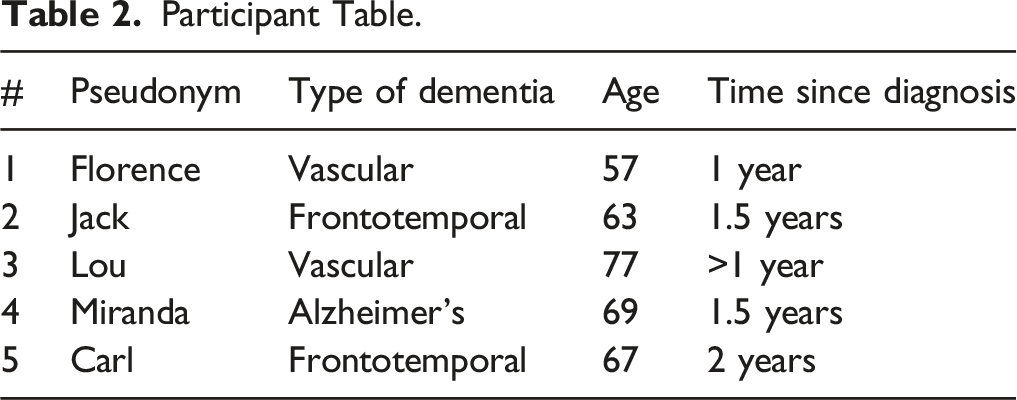
Participant Table.
Findings/Results
Phase 1: Creating and Planning the Research Project
Choosing the Focus
The project began with initial seed-corn funding from Brigstow Institute to pay the Forget Me Nots for their time in developing the research idea/agenda. The co-researchers with dementia decided they wanted to explore experiences of post-diagnosis support, to see if things had changed for the better since their diagnoses.
Our first step was organising a one-day workshop attended by stakeholders from social care organisations, dementia service providers, councils, dementia wellbeing services, dementia charities/advocacy organisations and the NHS from across the local area, to get feedback and information about the range of issues facing people after diagnosis. The stakeholder attendees identified a number of areas for further research: the variation in type and quality of available services, the need for the voices of people living with dementia to explore what post-diagnosis life actually looks like, and the potential for people living with dementia to be assets in supporting others. The final point was that many people ‘fall through the gaps’ because they do not want to engage with services such as memory cafes (places where people living with dementia and their carers go to socialise, do activities, and engage with each other and experienced dementia staff). There was a suggestion that research could change this by being organised around a common interest that provided a focal point, and which foregrounded opportunities for meeting new people and learning new skills.
Choosing Photography as a Research Method
Over several group meetings, photography was chosen as a research method. One of the researchers living with dementia had found: (1) pursuing photography gave him more impetus to leave the house, (2) the nature of medium puts the photographer ‘in the moment’ which can be grounding for someone living with dementia and (3) he gained confidence by show discovering he could learn new skills.
The Forget Me Nots hoped that learning photography would counteract feelings of disempowerment, self-stigma, negative impact on self-identity and reduced engagement in activities that often follows a dementia diagnosis (Low et al., 2018). The Forget Me Nots wanted to avoid participants feeling they were ‘put on the spot’, which may occur in interviews (Lloyd et al., 2006; Nyga˚rd, 2006). Because of their own positive experiences of peer support, the Forget Me Nots also wanted to show newly diagnosed people the benefit of talking with other people living with dementia and sharing experiences. For these reasons, they chose to run a focus group.
Planning the Project
We secured additional funding for a 10-month project to develop and conduct this research.
We met together 3 times to plan the photography project and workshops with participants. The researchers with dementia wanted to ensure that the people who took part felt empowered by their participation. While photovoice studies have been conducted with participants with dementia (Evans et al., 2016; Genoe & Dupuis, 2013), they have not foregrounded the opportunity to learn photography as a creative endeavour. We provided the participants with a DSLR camera and offered a photography lesson at the Royal Photographic Society.
The Forget Me Nots decided that a maximum of 6 people should take part. This was to allow people to build peer support networks, to be able to opt in and out of the conversation, but not be overwhelmed by a large group. Given the feedback from the initial stakeholder meeting, we avoided recruiting from congregate settings like memory cafes of activity groups, both because they are attended by people who are already engaging in activities and services, and because their ready availability/accessibility leads to them being over-researched, resulting in certain views and experiences of post-diagnosis life being over-represented.
Creating an Inclusive Research Environment
The Forget Me Nots decided where they would like the meetings to take place. They opted for a mixture of meeting venues, some at a local café near to where they lived, and some at the University of Bristol. We also used some of the budget to book a meeting room at a railway museum venue near to where they lived. This was because we wanted a dedicated space to work for the day, but also with something to do to break up the day. To prepare for each meeting, Author 1 wrote accessible notes from previous meetings that were posted to each researcher with dementia one week in advance of the meetings detailing where we had got to in the project, and to help remind each other of the project progress. Author 1 phoned each of the researchers living with dementia a few days before the meeting to check if they agreed with the notes, or if there was anything they wanted to add. At the end of each meeting, we agreed action points to cover next time. The notes were written with short sentences, bullet pointed to help clarity, in Arial Font 16. Different topics/matters were separated by different colour-outlined boxes to help visually separate the topics. The notes followed Dementia Engagement et al., 2013 guidance on making written information accessible for people living with dementia.
The research budget was used to buy lunch/snacks at the various locations we met. This helped to build in time to chat and make the meetings social as well as work occasions which was important for all team members. When the Forget Me Nots visited the University, taxis were booked from their homes to the train station. They always travelled together, because they could support each other with the journey, and because they enjoyed taking trips together. Author 1 picked them up from the train station in his car to avoid looking for taxis upon arrival in a busy place. The academic researchers also booked accessible rooms for their visits (i.e., open, airy, quiet, with ramps or lift access).
Roles evolved naturally over time. For example, author 5 (Roy James) helped to organise the researchers living with dementia as a group, often phoning and liaising with author 1 about upcoming meetings and project plans to disseminate to the team, and author 6 (Sandy Read) generally called meetings to order after some socialising and was often the decisive voice in project decisions. Knowing who wanted to do what, and how to work to individual strengths, came from extended time working together and from discussions of what they would like to do at each stage.
Photography Lesson
All participants had chosen to take part specifically because of their interest in learning photography. We spoke to all participants on the phone and met in person to discuss what would happen in the lesson, and to get a sense of any adjustments that may be needed. We offered all participants the opportunity to attend with a companion for support. We also produced accessible summaries of the project, including about the photography lesson. We invested in a professional photographer who had previously given photography lessons to people living with dementia. They gave a 1-day ‘crash course’ photography lesson at the Royal Photographic Society. After initial introductions from each person and a brief explanation about the project from the research team, the lesson began. This was designed to overcome potential difficulties and anxieties about using the camera and to give tips and ideas for how to be creative with composing pictures. Participants had time to familiarise themselves with their cameras, with support from the researchers and photography teacher. We chose cameras that could be used on a manual setting for participants that wanted to experiment, but which could also be switched to an automatic mode. After the lesson, we had lunch and a free tour of the photography exhibitions.
We finished the meeting by reiterating the aims of the research and giving them written guidelines. The researchers with dementia were explicit that we should not be overly prescriptive, giving the following information: ‘We want you to decide what to take photos of. We are interested in anything that tells us about your everyday life and how you are feeling. What makes you happy or sad? What helps or is a hindrance in your daily life? It could even be something that represents how you feel. The photos should be meaningful to you. They don’t have to be works of art’.
Participants were given easy-read camera instructions with an annotated picture of the camera to take home. They were told they could also call the researchers if they had any issues with the equipment. Authors 1 and 2 met with participants individually within 4 weeks of the workshop to help them choose a final 6 photographs to share in the following workshop.
Focus Group
The focus group lasted 4 hours including lunch breaks and tea breaks and was held just over a month after the first group. The format was discussed in advance between the research team. The Forget Me Nots decided they did not want a topic guide to follow, because they wanted the participants to have space to tell their own stories. Rather, we collaboratively produced 3 prompt cards they could use if they wanted. Prompt card 1 focused on prompts for ‘Describing the photo’, prompt card 2 focused on the ‘Photo-taker’s interpretations’, and card 3 focused on ‘Everyday life and support’. In the event, they did not need the prompt cards, and asked questions based on their own interest, experiences and expertise.
The Forget Me Nots were not given formal training on running the focus group because they had the skills needed to engage the participants in conversations about their photos. This decision speaks to wider debates in which questions have arisen about the wisdom of introducing research training for co-researchers whose key contribution comes from their expertise by experience, rather than their knowledge of research methods (Nind et al., 2016, p. 549). The researchers living with dementia decided they would like to be the ones who asked participants questions, and their intention was to make them feel comfortable by taking an informal approach. They requested that author 1 keep track of time and facilitate moving between participants turns at describing their photos. In this way, they identified their own strengths, and chose which areas they wanted the academic researchers to support them. This is an example of how the Forget Me Nots decided what tasks they would like to take on, and which they would like to divide out (see Nind, 2014).
We decided to project the photographs on a wall so that there was less social pressure because the focus would be on the photo rather than the participant(s). We looked at one photograph at a time. The photographer/participant was given an opportunity to explain why they took the photo and the meaning behind it, followed by discussion and questions from the group.
The last hour of the group was kept aside for discussion of themes or links between the photographs. At the end of the session, in line with power sharing photovoice approaches (Wiersma, 2011) we discussed what the participants wanted to do with the photographs. They decided that they would like the photographs to be seen by others so that the public could understand more about their lives, and to dispel stigma and negative depictions of dementia. We will return to these impact activities in the discussion. The researchers with dementia were sensitive to the possibility that the conversations the photos elicited could be emotional. For this reason, and with the participants’ consent, we shared contact details so participants could continue to support each other after the project. We also created a list of local groups and support services for participants.
Summary
The process from the first meeting to discuss a possible research project and putting on the focus groups took 18 months. The researchers with dementia had life commitments and priorities, so the academic researchers adapted to a time frame that was feasible for them. Additionally, multiple small pots of funding were applied for so that the Forget Me Nots would be paid throughout for their expertise. Payment is a token of power (Devotta et al., 2017), and without this the research group could not have operated as equals. However, this presented a practical tension between the need to pay the Forget Me Nots to start from the basis of parity and respect for their expertise, and the time it took to obtain funding. The need to apply for multiple pots of funding prevented working as quickly as all the researchers would have liked. At other points, the Forget Me Nots needed time to attend to other aspects of their lives (health, family, friends, etc.), which meant a great deal of flexibility was necessary in the project timeline. Additionally, building relationships in the team, confidence and skills all took time, as has been noted in other types of inclusive research (Abell et al., 2007). Extra time and planning was necessary to avoid inclusive research becoming tokenistic or steered excessively by academics (Chappell, 2000; Nind & Vinha, 2012).
So, what was the added value from the lengthy project planning stage? The idea of exploring experiences of post-diagnosis life came directly from the researchers with dementia and their experiences of this period. The lived experience of one of the researchers with dementia highlighted how photography could be a catalyst for positive change after a diagnosis that led to choosing photovoice as a method. The goal of the researchers with dementia was to ensure that the research process was not a one-way transaction, but that the participants experienced value in taking part by learning a new skill and through peer support. The group also planned how the focus group would look and run, with an emphasis on informality and positive engagement, a topic we will return to in more detail in subsequent sections.
We now turn to how this careful planning played out in the data collection process.
Phase 2: Conducting the Focus Group
The Forget Me Nots co-facilitated the photography focus group. Here, we use conversation analysis to explore how their interactions impacted the focus group to better understand their role in the implementation of the research. We identified three ways that the researchers with dementia fed into the discussions as co-facilitators and reflect on what value this added to running the focus group. The co-researchers Sandy, Harry and Roy are represented as S, H and R in the transcripts. The participants’ pseudonyms (Florence, Carl, Jack, Lou and Miranda) are represented by F, C, J, L and M. A glossary of conversation analysis transcriptions symbols is available in the appendices for those unfamiliar with Jeffersonian transcription conventions.
Questions
The Forget Me Nots asked follow-up questions to participants about the photographs. In this sense they were deploying traditional interviewer or facilitator ‘skills’, what Tanner (2019) describes as actions to ‘achieve the task’ of the focus group. In Extract 1, Miranda is talking about her photograph of a robin on her fence, and describing why it means so much to her: she used to sit with her friend and watch the robin, but her friend has since died.
Extract 1
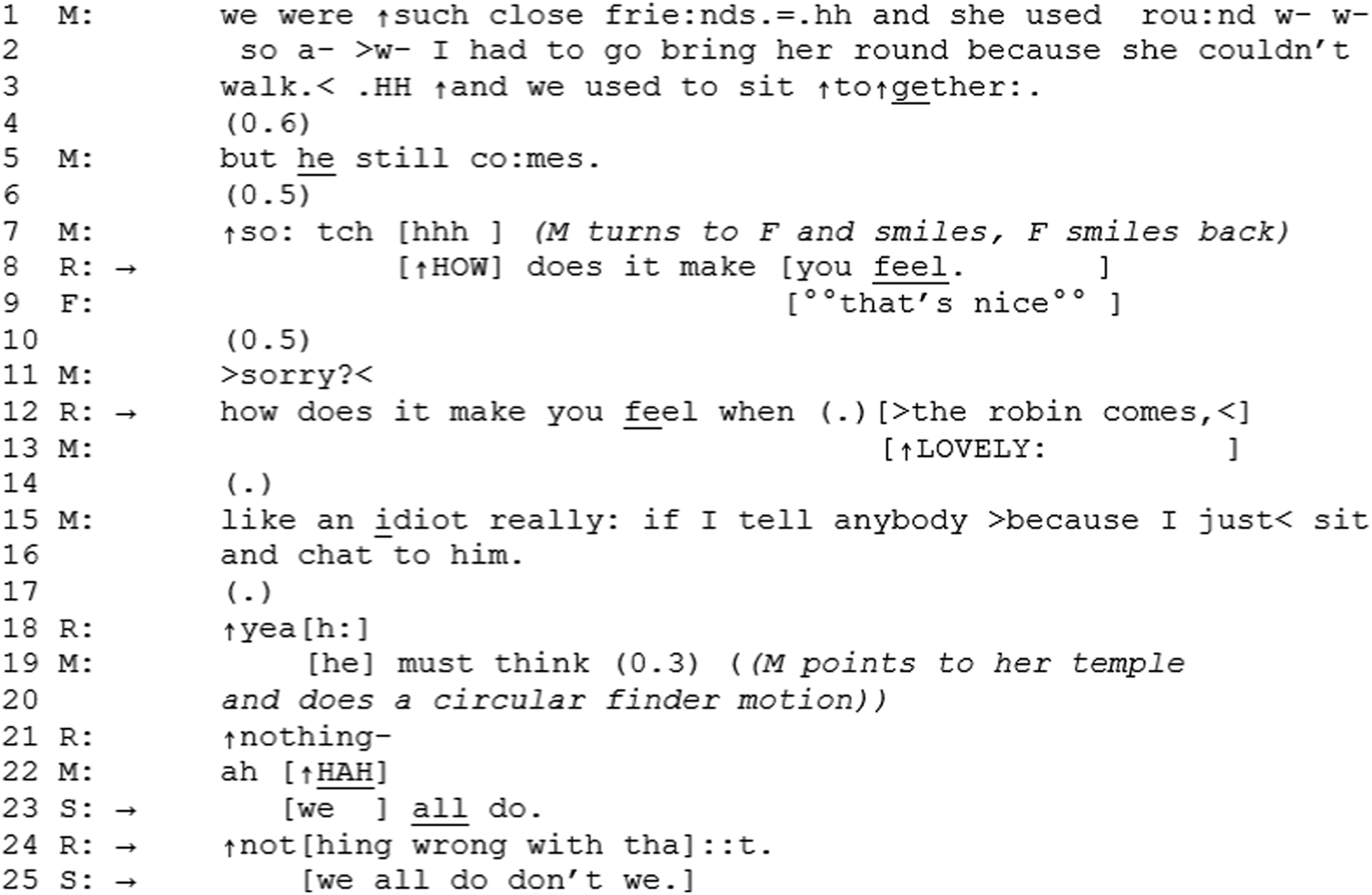
Miranda reaches the end of her narrative and there’s a .5 second silence with no initial verbal uptake. Miranda starts to continue in line 7, when fellow participant Florence, who is sat to Miranda’s right, looks at her and smiles, with Florence’s quiet acknowledgement of the sadness and beauty of the story in her comment ‘that’s nice’ in line 10. Roy is sat at the other end of the table to Miranda’s left and comes in loudly in overlap to question Miranda further: ‘how does it make you feel’ (line 9). As this all occurs at once, Miranda initiates repair (‘sorry?’ line 12) and Roy repeats the question (line 13). Roy’s contribution here is, in Tanner’s (2019) terms, ‘high skill’ in that it moves forward the focus group discussion, but lower in ‘connectedness’ in that it does not affiliate with the emotional side of Miranda’s story. However, when Miranda then jokes that the robin must think she is strange for talking to him, both Sandy and Roy chime in with affiliative statements, Roy’s ‘nothing wrong with that’ (line 25) and Sandy’s ‘we all do that don’t we’ (line 25). Sandy’s comment particularly echoes a shared experience, which we discuss in more detail in the next section.
Another way that the researchers with dementia used questions was to get the conversation back to task when it had taken a tangential direction. This extract follows a discussion of Florence’s photograph of a bee, where the conversation has developed into a discussion of beekeeping, partly encouraged by co-researcher Sandy.
Extract 2

There is a short break in Lou, Sandy and Florence’s discussion of bees, with Sandy’s minimal acknowledgement token (line 5). Roy uses this as an opportunity to bring the subject back to photography and thus the photograph itself, asking a methodological question of how Florence had captured the image (line 7). This is one of many examples in which the Forget Me Nots used highly skilled facilitation techniques of questions to successfully bring group discussion back to task.
Shared Experience
The co-researchers drew on their own experiences and invoked a ‘shared identity’ in response to participants' disclosures. This differed from a traditional focus group where it is only the participants who may share experiences (Ivanoff & Hultberg, 2006; Krueger, 1988).
Just prior to the start of Extract 3, Jack had been describing his photo which shows a flowering plant with some parts in focus and some blurry and out of focus. He described his intention for the photo was to show how he sees the world: when he concentrates some parts come into focus, but some things remain out of focus and difficult to make sense of.
Extract 3

On lines 1–3 Jack wonders what the photo would mean to other people who viewed it without the context. Despite being prosodically and grammatically incomplete on line 3, Sandy (one of the researchers with dementia) produces a continuer (‘yeah’), aligning to her role as ‘listener’ (Stivers, 2008) and giving Jack the interactional space to continue, whilst projecting the trajectory of Jack’s continued telling. Florence, another participant, gives her own epistemically marked subject-side assessment (Heritage & Raymond, 2005; Edwards & Potter, 2017) (‘I think when you explain it, it does make sense’), which Sandy agrees with and expands upon (lines 8–10). Initially in overlap (line 13) with Jack’s imagined criticism (‘cos they’ll just say, ‘that’s out of focus or something’’ line 12), Sandy draws a distinction between what they as group members living with dementia see in the picture, and what others (presumably without dementia) may see (lines 13–16). She hence invokes a shared experience, drawing on her identity as a person living with dementia who understands the meanings of the photographs due to lived experience. This not only elicits agreement from Florence but prompts Carl to begin making connections between his photography work which incorporated the use of ‘blur’ to explore a similar way of presenting via photography how dementia impacts how he sees the world (lines 18–26). This led on to further discussion from the group about the overlapping themes in the photos, thus facilitating and prompting discussion by the foregrounding of a shared ‘insider’ experience and identity.
Another way that the co-researchers facilitated and prompted further talk was through the sharing of specific experiences related to what participants had said. Take the following extract, preceding which Florence had been talking about a photo she had taken of her dog, explaining that the dog relied on her and did not treat her differently because of her diagnosis. This led on to her further explaining that protective family members could sometimes ‘kill [her] with kindness’ trying to do things for her, rather than allowing/encouraging her to do them herself. This disclosure then led to Sandy to share her own related experience.
Extract 4

Lines 1 - 7 see Sandy share her own related story, drawing a distinction between how her son is overprotective, whilst her daughter allows her to do what she wants. Florence seeks clarification (‘the girl who will let you do something?’ lines 10–11), and after receiving confirmation from Sandy, Florence then describes the same experience with her daughter and son, a detail missing from her original turn. Further, she expands on this with a specific example of how she feels her son is overprotective and believes her to be not capable (lines 15–17), a characterisation which she overtly resists (lines 19–20), which she contrasts with her daughter’s approach (line 21–22, & 24). This leads to a positive assessment from Sandy (‘I think it’s good’), with which Florence agrees in second position (line 27). Although omitted for reasons of space, Miranda then shared her own related experience about going out on the bus without telling her daughter, because her daughter would attempt to help too much and, as she says, ‘that’s not helping me’. So, whilst Florence started the topic, it was framed generally about way others could ‘kill you with kindness’. Sandy offering a specific example from her own life led to two further participants sharing their related, and specific, experiences of family members enabling or disabling them through their actions. These extracts demonstrate that the Forget Me Nots sharing their own experiences at key points often led to participants sharing more of their own specific experiences, and therefore promoted engagement and participation; a key aim of focus groups (Kitzinger, 1994).
Interpretations
A third way that the Forget Me Nots facilitated the focus groups was by providing their own interpretations, or formulations, of the participants’ narratives around their photographs. In Extract 5, Carl is describing a photograph of a dark path into some woods, which he is using as a metaphor for the ‘unknowns’ involved when looking into the future as you live with dementia.
Extract 5

There are signs Carl was open to input from others: prosodically completing sentences in lines 5, and he has started to repeat himself. The other participants are picking up on this, with Florence’s positive assessment in line 10, and Jack’s alignment in line 15. But Roy’s interjection at line 16 is stronger, he provides a formulation of Carl’s meaning behind the picture using new wording. This plays in a similar way to how formulations in psychotherapy (e.g., Peräkylä, 2019): where therapists put forward a candidate understanding of participants’ descriptions, which directly encourages (dis)confirmation or elaboration. However, Roy’s delivery (‘it’s where your life is going’) is direct and authoritative, as opposed to a suggestion or proposed interpretation. In this case, Carl responds very positively, repeating Roy’s wording (line 21), and when Roy builds on this (line 29), Carl confirms this matches his intended meaning (‘that’s exactly it’, line 25).
Conversely, in Extract 6, the formulation put forward by Sandy is not wholly accepted by Jack. Jack is describing a photograph of a child’s date chart on his fridge. He is telling the group how he bought this to teach his granddaughter, but that now he is forgetting things she is using it to teach him instead. LW (Lou’s wife) and JW (Jack’s wife) feature in this extract.
Extract 6
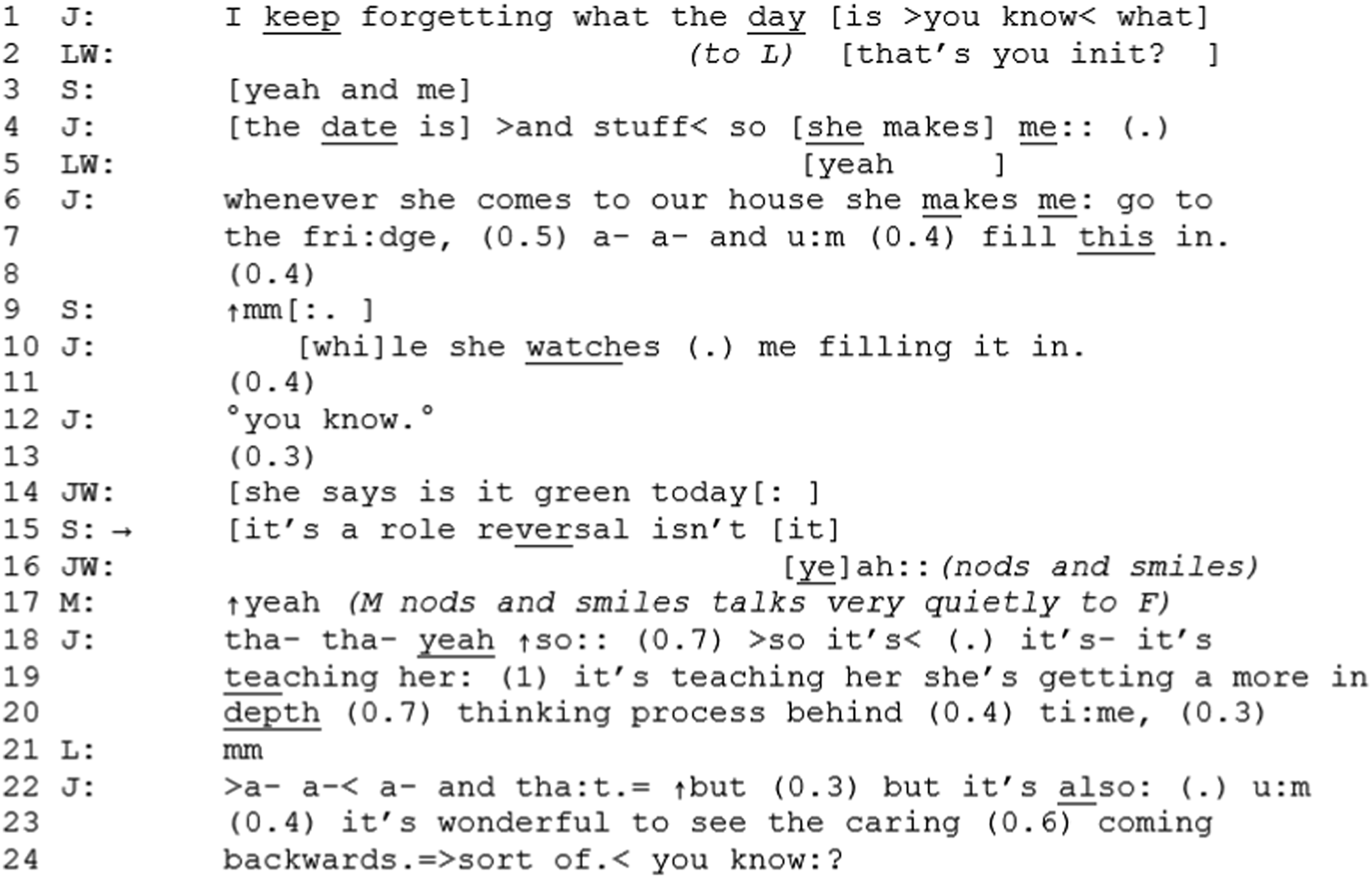
Jack’s description of his dementia symptoms evokes two demonstrations of shared experience in overlap from Lou’s wife and Sandy, showing peer support as described in the section above. Jack, similar to Extract 6, appears to have finished his narrative by line 10, coming to a pause with a quiet ‘you know’. Jack’s wife starts to pick up on the narrative, but Sandy comes in louder in overlap with her interpretation: ‘it’s a role reversal isn’t it’ (line 15). Again, this is delivered with authority, with the tag question seeking agreement. Jack’s partner agrees (line 16), as does Miranda, but Jack’s agreement is more reserved; while he does say ‘yeah’ (line 18), he then provides his own ‘so’-prefaced turn (Bolden, 2009) to draw his own conclusion from his narrative, demonstrating that Sandy’s was not wholly adequate gloss of his experience. His description in lines 18 – 20 and 22 - 24, provides a more reciprocal description than Sandy’s characterisation of a ‘role reversal’, because he is still providing his granddaughter with an ‘in-depth’ education, whilst agreeing that seeing her caring for him in return is ‘wonderful’.
These interpretations therefore tend to come in the position where a participant has come to the end of their narrative describing their photograph. The authoritative stances from the Forget Me Nots in these interpretations demonstrate understanding and high epistemic authority (Heritage & Raymond, 2005), perhaps due to their shared experience with the group participants. In putting forward their own candidate understandings of the narrative, the Forget Me Nots enabled participants to elaborate and ensure they have achieved a shared understanding in the group of what the photograph represents. This is a subtle and important form of facilitation that not only shows active listening, but also supports participants to express themselves.
Summary
Whilst the co-research team drew on established focus group facilitator roles, by asking to follow-up questions and encouraging participants to go into more detail, they also drew on their own experiences of dementia and their ‘insider’ identities to accomplish actions outside of the role that focus group facilitators may traditionally play. They evoked shared experiences which encouraged participants to further elaborate or take news turns, a key aim of focus group research (Krueger, 1988, p. 2007). They frequently engaged in interpretations of participants' turns, often asserted with a high degree of epistemic authority (Heritage & Raymond, 2005); something which would seem inappropriate if delivered by someone without direct experience of living with dementia. These formulations were attuned to the participants own turns, arriving at points when the participant had finished their narrative. They helped to facilitate a shared understanding, or elicit further clarification, from participants.
Phase 3: Participant Reflections on Taking Part
The academic authors (Webb & Dooley) conducted post-project interviews with the participants living with dementia between three and four months after they had taken part in the project to explore their experiences of taking part, what it meant to them and what (if any) impact it had on them after leaving the project. The Forget Me Nots did not conduct these interviews, in part, because some questions related to their involvement. The focus and topics were discussed as a team.
The 3 overarching themes identified in the analysis are outlined below.
Peer-Support as a Therapeutic Tool
Participants saw the Forget Me Nots as a bridge between the research, university academics, and themselves. “Because they’d been talking to you and they were talking to us… They were sort of translators.” (Jack)
The Forget Me Nots created an informal atmosphere, which helped the participants feel confident to speak about their experiences. “I think they made it more relaxed, it was not formal. Knowing that they had been through the same thing, you knew they'd understand how you were.” (Florence)
All the participants credited the group dynamic as being key to their positive experience, also reflecting on their underlying anxieties in other social occasions. “I remember thinking ‘We’re all the same so I’m not that bad’. Does that sound silly because I was able to talk to them? I do find that I don’t sit and chat to people outside of home like I used to do.” (Miranda)
Meeting the Forget Me Nots, who have lived with dementia for over 10 years, also provided a sense of hope for the participants’ future with dementia. “After the diagnosis, you go online… ‘What’s the life expectancy of somebody with a diagnosis of dementia’, it generally says two to ten years, so you instantly think, ‘Oh crikey. Well I’ve had it for two years, so I’ve only got eight years left’… that’s one of the main unanswered questions that the three people that [they] answered for us” (Jack)
Meeting peers not only helped with thoughts about the more distant future, but also helped reframe current negative thoughts having received a recent diagnosis. “Definitely it had an impact on me, I was depressed at one point and on antidepressants … [the focus group] was sort of the beginning of me getting better from it, was actually going out, meeting other people who have similar sort of things wrong with them… I found it a very positive thing to think that I wasn’t the only one.” (Florence)
This also helped on a practical level, with the group often talking about help and support you can receive when living with dementia, as well as ways to live with symptoms. “I picked up lots and lots of extra help from the other people that were in the group and we did swap and change lots of ideas, so yes, it was like a lesson to me, in effect, on other people’s dementia.” (Jack)
The focus group being led by researchers living with impacted participants positively both through providing examples of successfully living with dementia and through learning from the experience of others in similar situations. This meant that it was a useful and a affirming experience for participants, promoted peer support, and enabled successful data collection by creating an environment in which participants felt comfortable and willing to share their experiences.
Using Photographs to Reflect on the Experience of Dementia
The positive impact that discussing shared experiences had on the participants was represented in a tangible way in their discussion of the photographs. The participants reported benefited from drawing comparisons between their chosen photographs and identifying shared experiences. “It’s an experience that we thought we were all suffering by ourselves I suppose whereas the group and the photographs help bring us all together and realise that we have a commonality.” (Carl)
In addition to the value of identifying shared experience, the participants found the process of taking photographs representing their lives with dementia extremely valuable. “I guess initially I was a little bit apprehensive. I couldn’t quite understand the connection between having dementia and photography… of course it woke my mind up or took me back to when I had my own cameras … so I knew there must have been some way I could bring my memory failings or whatever and somehow put it into a photograph” (Jack)
In the process of taking photographs and discussing them as a group, the participants found a new way to discuss their personal and emotional reactions to their diagnosis. “You can say ‘Oh, I’m depressed today’ or ‘I felt a bit grey’ or ‘I’m really low or down at the moment’, but if you just show them that photo and say, ‘That’s how I feel’… ‘A picture says a thousand words’ doesn’t it and it’s very, very true. In fact it’s even more true, possibly, to people that are starting to lose their memories” (Jack) “It gave me an excuse to express myself, and it was a way of opening up about it.” (Florence)
There was hope that this would allow people without dementia to understand more about living with the condition, which Lou’s wife confirmed from a carer’s perspective. “I did as well, I looked at them completely different to what some people were saying they were. They gave you more insight into how their minds worked.” (Lou’s wife)
In having the opportunity to discuss their emotional and psychological reactions to receiving the diagnosis, the participants described changing their approach to living with the condition. “Even though the world has become even smaller now, [the group] sort of opened it up…Actually something creative and making you think about how feelings can be reflected in - conversation even, and photographs obviously which was the main thing.” (Florence) “I think it’s not what I got out of [the project] necessarily, but it was what I was able to leave behind in it, which was a lot of anxiety.” (Jack)
Sharing experiences through photography was therefore reported as being a positive experience and of therapeutic value. Participants reported the benefit of realising their commonalities with one another, and of a shared understanding of their experience with the world. Participants reported feeling less anxiety and more positive as a result of these discussions.
The Benefits of Learning Photography
One of the main aims the Forget Me Nots had when they designed the project was to empower people with dementia to live well beyond the project itself. The participants spoke about how easy it is to stop engaging in activities when after receiving a dementia diagnosis. “If I stop doing things, I don’t get back to it. Like I used to go dancing but I don’t anymore cause my partner stopped and I don’t do it because I can’t remember where I went anyway…” (Miranda)
The participants all spoke of the benefits of learning a new skill, with many of them continuing to engage in photography. “Before, I just took a photo, whereas now I can think about it a bit… I would say we’ve never gone backwards have we.” (Carl) “He went and bought [a camera] because it done him so much good. It was better for him than medicine.” (Lou’s wife)
The process of learning a new skill and socialising with others gave them the confidence to pursue social engagements and other personal projects which had been lacking since diagnosis. “I imagine myself in a big biscuit tin, filled with jobs to do when I was working… And all of a sudden, [on receiving a diagnosis] all those things is taken out and I’m just left there in an empty tin, you know… so I’m just starting to fill my tin and the photographic project when it came along, that was half the tin filled up, if you get what I mean” (Jack) “Since he’s been here he’s changed… He wants to go to the memory club, he wouldn’t go before. We’ve got a camera, he’s using it. Next week he’s joining a photography class… Before we couldn’t find anything that would interest him…That’s what this has done…you’ve opened something up with him.” (Lou’s wife)
A diagnosis of dementia is often accompanied by feelings of disempowerment and a reduction in engagement in activities (Low et al., 2018). Participants in this project reported learning a new skill helped build confidence, resilience, and willingness to try other activities.
Summary of Phase 3
Participants greatly valued the presence of the Forget Me Nots because of the chance for peer support, as positive role models, as translators between experiences of dementia and the academic researchers, and because they helped create an informal atmosphere. The act of talking about their photographs was seen as beneficial in helping them reflect on and share their experiences with others, finding commonalities, solidarity and strength. The act of learning photography was also reported as helping empower participants and provided a creative outlet in and beyond the project.
Discussion
We started this article by responding to Walmsley et al.’s (2018) call for further exploration of what added value inclusive research brings to research. In our project, the researchers with dementia shaped the research agenda from the start. The focus on post-diagnosis experiences came directly from their negative lives. The intention to create a space where newly diagnosed people could share feelings and experiences was a direct result of their positive assessment of peer-support as a tool to (a) understand and accept the diagnosis, and (b) to support more positive ways (and give positive examples) to adapt to this new phase. They chose photography not only as a method of data collection, but as a catalyst for participants to leave the house and learn new skills. It is important for people post diagnosis to build an identity on social ties and shared interests, rather than just a diagnosis of dementia (Mason et al., 2005). By foregrounding the opportunity to learn photography, the project was framed from the outset as providing value and a shared endeavour for participants beyond only talking about their lives and experiences.
The researchers with dementia were instrumental in creating an interactional space which encouraged participants to talk, accomplished through traditional facilitation techniques and through sharing their own related experiences. These came at the point where participants had signalled grammatically and/or prosodically that their turn was over. This both demonstrates attentiveness to the rights of participants to share their experiences, and attunement to their role as facilitators. These turns frequently created new opportunities for participants to share their own related experiences, or to expand on previous points. Crucially, these were experiences and expertise that the academic researchers did not have. Creating an environment where sharing was not just encouraged, but modelled, resulted in rich findings. The group also offered interpretations of the meaning behind the photographs where they distilled participants’ narratives into a short statement. At their core, these formulations did ‘intersubjectivity work’ (Drew, 2003), making cumulative sense of the participant’s input and showing their ‘in-touchness with the talk so-far’ (Heritage & Watson, 1979, p. 130). They also offered additional detail, often in the form of a statement demonstrating authority and high epistemic rights (e.g. ‘it’s where your life is going’). The academic researchers did not attempt interpretations in this manner. This may be because such formulations implicitly claim an understanding of the prior talk; something that would perhaps problematic or disingenuous for people without lived experience of dementia to claim. The researchers with dementia treated themselves as having the right to interpret the participants’ talk, suggesting that they not only drew on status as facilitators, but also as people with lived experience who could understand, and therefore summarise, their meaning. Such formulations offered the participants an opportunity to agree with the characterisation of their turns (extract 5), or to further elaborate and add more detail if they were not wholly what they intended (as in extract 6).
Lastly, we demonstrated that the considerations of the researchers with dementia in the planning and data collection phases had a positive impact on the participants’ experience of taking part. As they hoped, the use of photography enabled the participants both to express emotions and to build confidence through discovering strengths and capabilities to learn new skills (Foster-Fishman et al., 2005). Moreover, sharing with and learning from others was perceived as a positive experience, both because the researchers with dementia were seen as positive role-models, and because of the therapeutic aspects of discussing dementia with others in similar positions. The act of learning something new, and engaging in such discussions, was a catalyst for new outlooks and engaging in new activities.
We should note that the inclusive research approach described here was not without challenges. The planning stages of the research were protracted for various reasons: applying for small pots of money to pay the Forget Me Nots to build the project from the ground up; identifying strengths and where people needed support with aspects of the project; working around life events and other non-research priorities; periods of time between small pots of research funding that led to project lags; ongoing discussions together about how best to accommodate and support the Forget Me Nots (e.g., the way they wanted meeting notes formatted and written, when to send them in advance of meetings, how long meetings should be to get work done but not be draining, making research and meeting environments accessible, etc.). All the above was only possible through sustained communication, usually through phone calls between the team, and because of bonds of friendship and respect that developed over time between all team members. However, relationships, skills and confidence also take time to grow. Lastly, there was a tension between the Forget Me Nots desire to get on with the research and make an impact, and academic timeframes which can impede this goal. Reconciling these tensions is a challenge, particularly for people for whom time is precious and who are living for the day (see Williams et al., 2020).
Since this article research was conducted, the photographs have been on near constant display as exhibits in two local hospitals, educating the public on how newly diagnosed people see the world and experience life with dementia. The co-research group has gone on to co-produce new research focusing on how post-diagnosis support can be improved.
Inclusive research will always have a campaigning edge at its heart (Gelech et al., 2017), and it was this agenda that shaped the focus, aims and delivery of the project. This was central to the quality of the data collected and the value participants derived from taking part. As such, it is fitting for the Forget Me Nots to reflect in their own words on the value they believed they added, and why they believe this mattered for the participants.
Forget Me Nots Reflections on the Project
We were pleased that it has gone the way it has, and people picked up on it. [The participants] used photography as an ice breaker, and it gave them the opportunity to branch out. They were all coming from the same place. I think it helped people understand more. They started to feel that there is something still there for them to do, that they’re not a ‘write off’. The range of photographs surprised us. [The participants] showed emotion and they told a story, and it made them feel better because they got something out. They probably spoke about something that they hadn’t spoken about before, and in front of strangers. I think the photographs brought it out. If we’d have billed it as ‘come and talk about dementia’, it wouldn’t have worked.
It’s not until you’ve been around a bit that you discover that there is life after dementia. You’re not told what you’re capable of doing. You get your diagnosis and that’s that. You don’t get people coming up to you and saying ‘there’s a photography/dance group you can join’ etc. When I took up photography, I felt that I could do something. You can learn new skills, there is part of your brain that is great, and you can learn new things. The key thing is that there are things you can do, not endless things you can’t, if you put your mind to it. [The participants] were sat at home not doing anything because they weren’t told they can do something. Photography gives you a reason to go out and about. [Living with dementia], you get to see things in a different way. Life is different, everything is different. [A photograph] a way of recording that difference. The photographs gave them the opportunity to speak about things, and we put them in that position. We gave them these cameras, we said take photographs, and they opened up. They also had time to think about it. Whereas if you take a photograph and say straight away, “why did you take that?”, then you don’t know! But this time they had the chance to give their version of why they took it. They weren’t put on the spot. It’s being given the chance to think about it and have something to say about it. I don’t think we would have got the same information from these people [without the photographs].
To a certain extent we’ve all had the same experience. We’ve all been diagnosed. We’ve all been left out to dry. We found it emotional; what the photos meant to them. But I think we kept it upbeat. They wanted to get things off their chests. It worked because we had something in common. And I think we all wanted to learn from each other. They weren’t alone anymore. People like us [who were diagnosed over ten years ago], we can tell you that there’s something out there for you still, you can still do things. Life is an adventure; you’ve got to take everything you can from it.
In Memory of Roy
This article is dedicated to the memory of Roy James. He was a dear friend, a wonderful colleague, and is greatly missed by us all. He made a difference. Take care, mate.
Footnotes
Declaration of Conflicting Interests
The author(s) declared no potential conflicts of interest with respect to the research, authorship, and/or publication of this article.
Funding
The author(s) disclosed receipt of the following financial support for the research, authorship, and/or publication of this article: We would like to thank Brigstow Institute and the Elizabeth Blackwell Institute for funding the original research.

Appendix
The symbols in the text in section 3 describe the detail in the participants talk, and are standard practice in Conversation Analysis. They are derived from Gail Jefferson’s transcription notation, as described in Atkinson, J. M., & Heritage, J. (Eds.). (1984). Structures of social action. Cambridge University Press.
Symbol
Name
Use
[text]
Brackets
Indicates the start and end points of overlapping speech
=
Equal Sign
Indicates the break and subsequent continuation of a single interrupted utterance
(# of seconds)
Timed Pause
A number in parentheses indicates the time, in seconds, of a pause in speech
(.)
Micropause
A brief pause, usually less than 0.2 seconds
. or ↓
Period or Down Arrow
Indicates falling pitch
? or ↑
Question Mark or Up Arrow
Indicates rising pitch
,
Comma
Indicates a temporary rise or fall in intonation
-
Hyphen
Indicates an abrupt halt or interruption in utterance
>text<
Greater than/Less than symbols
Indicates that the enclosed speech was delivered more rapidly than usual for the speaker
<text>
Less than/Greater than symbols
Indicates that the enclosed speech was delivered more slowly than usual for the speaker
°
Degree symbol
Indicates whisper or reduced volume speech
ALL CAPS
Capitalized text
Indicates shouted or increased volume speech
Underline
Underlined text
Indicates the speaker is emphasizing or stressing the speech
:::
Colon(s)
Indicates prolongation of an utterance
(hhh)
Audible exhalation
? or (.hhh)
High dot
Audible inhalation
(text)
Parentheses
Speech which is unclear or in doubt in the transcript
((italic text))
Double Parentheses
Annotation of non-verbal activity