



Abstract
In a UK context, encouraging the uptake of energy efficiency measures at the household level is an ongoing challenge of ever-increasing importance. A combination of economic and psychological factors influence green investment decisions and so this study aims to determine whether online focus groups are a viable means of interacting and evaluating the effectiveness of personality tailored marketing strategies. Here, we present the learnings from over 70 synchronous online focus groups undertaken with a UK energy provider’s household customers (N = 143) to test the effectiveness of two energy product propositions (smart thermostat and hybrid heat pump) through two channels of communication: video and discussion. The researchers examined and analysed the online engagement and focus group method, focusing on the customer feedback, appropriateness of the approach and how it works in practice, providing key learnings for further research. The approach allowed for greater interaction with a geographically and demographically diverse pool of participants, many of whom are time poor and would ordinarily be unwilling or unable to participate. In this article, we report the differences between implementing online focus groups and face-to-face focus groups and examine the difficulties and uncertainties, in particular relating to entry to sessions and drop-out rates. Online focus groups were found to be a viable, flexible and convenient method for engaging with an energy company’s current customer base in the comfort of their own home.
Introduction
Interview and focus group research is one of the most widely employed research methods, able to study a theme or topic in depth, understanding a variety of alternate views and interpretations (Bryman, 2016; Stewart & Shamdasani, 2014). Applied across a diverse spectrum of disciplines including conservation, education, health and marketing (Catterall & Maclaran, 2006; Davidson et al., 2010; Nyumba et al., 2018; Wilson, 1997), focus groups have particular application within advertising research to help develop insights into purchasing motivations, with the aim to construct more persuasive messaging to explore relatively unknown topics (Stewart & Shamdasani, 2017).
In this article, the researchers present findings and learnings from an online ‘face-to-face’ focus group approach, over a 5-month period (August to December 2019) with existing UK household energy customers of a web-based energy provider (Igloo Energy, 2020). Over 70 synchronous online focus groups were conducted to test the effectiveness of two personality tailored energy product propositions (smart thermostat and hybrid heat pump) through two channels of communication: video and discussion. In this article, we document the approach and recommend best practice for the benefit of those planning to undertake similar studies.
Focus Groups
Focus groups are an established research technique to efficiently explore and understand similarities and contrasts in behaviour, attitudes, perceptions and preferences towards a topic or issue, through a moderated interaction with members of the public (Hayward et al., 2004; Iacobucci & Churchill, 2018). This first-hand contact can help guide the content and language of messaging and can generate innovation and customisation (Stewart & Shamdasani, 2017). Participants are also able to interact and assert a level of control in guiding the session, empowering respondents to voice their honest opinions, in contrast to the stark power dynamic present within an interviewing format (Barbour, 2007; Bryman, 2016). This being said there has been criticism towards the utilisation of focus groups, including participant monopolisation, peer influence/conformity and reduced idea creation (Schirr, 2012; Stam et al., 2013). The greatest perceived limitation however is the perceived reliance upon small, favourably located sample sizes with researchers having to recruit participants willing and able to meet at a fixed location and set time. This limitation can greatly reduce the method’s efficiency and restrict the demographic of participants, often excluding the time poor and geographically constrained, be that for physical or monetary reasons (Iacobucci & Churchill, 2018; Stewart & Shamdasani, 2017).
Focus groups have been used by sociologists and psychologists since the 1940s (Merton et al., 1956; Merton & Kendall, 1946), ranging in type from single focus group, the prevailing method, to two-way, dual moderator, duelling moderator, respondent moderator and mini focus groups (Casey & Krueger, 1988; Kamberelis & Dimitriadis, 2005; Luny & Livingstone, 1996; D. Morgan & Krueger, 1998). Telephone focus groups (Allen, 2013; Cooper et al., 2004; Koskan et al., 2014) were the initial technological adaptation and development of the technique; however, online focus groups are now the main emerging evolution (Kite & Phongsavan, 2017; Matthews et al., 2018; Stewart & Shamdasani, 2017). This is particularly evident as internet penetration becomes ever more widespread. The World Bank records that by 2017, 49.7% of the world population were using the internet, up from 40% in 2014 and 29% in 2010 (2017). In the UK, only 7.9% of adults have never used the internet, with 95% of adults aged 16–74 using the internet at least once every three months, 10% higher than the EU average of 85% and only behind Luxembourg (97%) and Denmark (98%) (ONS, 2019). This trend is showcased by the UK’s conversion towards online shopping, where, even before the onset of the coronavirus epidemic (COVID-19), online sales accounted for 15–20% of total retail sales (Figure 1). The UK is one of the leading countries in the world for e-commerce, with a far higher share of sales than the European average of 8.8% (Centre for Retail Research, 2019). This ever-increasing level of virtual connectivity should enable research, particularly UK-based research, to adopt an online, resource efficient, approach. Internet sales as a ratio of total retail sales (%) in the UK from 2007–2020 (ONS, 2020).
There are three main forms of online focus group; asynchronous, virtual world and synchronous focus group. Asynchronous often referred to as bulletin board focus groups (BBFGs) only involves chat-based interactions held from a few days to a number of weeks/months (Lijadi & van Schalkwyk, 2015; Poynter, 2010; Sintjago & Link, 2012). This method requires minimal bandwidth, is relatively easy to use for both participants and moderators and allows participants an extended amount of time to read and review questions/comments. This is useful for (i) areas with reduced internet penetration, (ii) minimising the impact of difference in writing skill and time zone, (iii) obtaining participation from those with busy schedules and (iv) collecting more detailed responses allowing longer time to compose perspectives (Oringderff, 2004; Tates et al., 2009; Williams et al., 2012). Focus groups in virtual worlds or massively multiplayer online worlds (MMOW), also known as avatar-based focus groups (AFG), is an approach whereby participants interact in computer-simulated environments through personal avatars (Bartle, 2003; Houliez & Gamble, 2012) such as in World of Warcraft or Second Life. Communication can be through voice or text with a variety of collaborative tools available dependent upon the virtual setting. The main positive being cited is that of increased engagement through the use of avatars (Gadalla et al., 2016; Tatar, 2008). This method, while innovative and engaging, requires a far higher degree of expertise with participants required to be able to run and understand the platform. Synchronous online focus groups are the closest semblance of a traditional face-to-face session as it involves real-time communication led by a moderator in a set ‘room’ (Jiang & Cohen, 2020; Poynter, 2010). Many platforms allow participants to share their video feed and enable the use of social cues and nonverbal responses, further mirroring a traditional focus group (Kite & Phongsavan, 2017). Sessions can be conducted over a variety of electronic devices (desktop, tablet and mobile) with audio and text options available for those with insufficient bandwidth or technology. The increase in pace, compared to an asynchronous approach, can however lead to data loss, either from participants speaking over each other or from difficulties for those with lesser communication skills, for example, fluency in the spoken language (Galloway, 2011). There are a number of commercial providers of platforms that allow voice, chat and video conferencing including, but not limited to Skype, Adobe Connect, Microsoft Teams, Google Hangouts, WhatsApp and Zoom, the latter of which was selected 1 following in-house suitability trials.
Whilst online focus group research has been used across a spectrum of disciplines including advertising, health care, marketing and social science (Brüggen & Willems, 2009; Gaiser, 2008; Galloway, 2011; Peacock et al., 2009; Stancanelli, 2010), there are arguments against the approach. This includes concerns that undertaking a virtual session within the comfort of one’s own home will result in a greater level of distractions from background noises or activity hindering not only the findings, but reducing the available time for discussion (Kite & Phongsavan, 2017; Lijadi & van Schalkwyk, 2015). Caution is also given regarding whether a virtual approach will result in a loss of human interaction, reducing spontaneity and nonverbal communication, with the latter particularly important when trying to elicit further comment (Stewart & Shamdasani, 2017). Research has shown however that online environments can foster/replicate the social interactions present in face-to-face focus groups (Hoffman et al., 2012). Studies indicate many similarities, including the reliance upon social cues and stereotyping on the basis of gender, race, attractiveness and age (Dotsch & Wigboldus, 2008; Groom et al., 2009; Hoffman et al., 2012; Yee & Bailenson, 2007). There is caution that a virtual approach will result in a more constructed discussion with less self-reflection and shorter, simpler responses (Murgado-Armenteros et al., 2012), research however shows that online focus groups are able to elicit an equivalent quality of data from participants (Abrams et al., 2015; Reid & Reid, 2005; Underhill & Olmsted, 2003; Woodyatt et al., 2016). Even when using a text-based medium, with no capacity for nonverbal cues, participants are still able to fully convey their perspectives through the use of emoticons, bold/capital letters and digital colloquialisms, such as lol and facepalm (Jiang & Cohen, 2020; Nilsson et al., 2014). Research by Yoon and Vargas indicates that people’s behaviour in the real world is affected by their behaviour in the virtual world (2014), demonstrating the strengthening importance of an online setting.
Online focus groups can also pool participants from a wider geographic network, allowing alternate time slots optimised for different time zones in order to reach a global audience (De Groot et al., 2018; Gibbs et al., 2016; Muttiah et al., 2016). This flexibility makes it possible to conduct activities with highly specialised groups such as customers from a common energy provider with similar home and heating conditions. Those participants with limited mobility also appreciate the added convenience and flexibility provided by attending online, removing barriers to participation (Brüggen & Willems, 2009; Jones et al., 2015; Zwaanswijk & Van Dulmen, 2014). With this wider geographical reach, it is likely that participants will be unknown to each other without any natural groupings (friends/co-workers) which can often be found in traditional focus groups (Bryman, 2016). This relative anonymity is likely to have a built-in levelling effect, resulting in participants, particularly introverted individuals, being more willing to put forward and expand upon their views and perspectives regardless of whether they fit to social convention (Morgan, 1998; Stewart & Shamdasani, 2017). This is particularly pertinent for research into domestic energy efficiency measures as while it is not an overly sensitive area, there are political and societal tensions around one’s concern/approach to the environment.
This research project was conducted pre-COVID-19; however, one must take note of the significant impact of the pandemic upon the suitability and applicability of a virtual approach. The lockdown and enforced social distancing of the UK and much of the world resulted in a vast increase in online usage with Vodafone reporting a 50% rise in internet usage in parts of Europe (Sweney, 2020). Entire populations have been undergoing intensive training in online conferencing/communication platforms, be it for work or socialising, as shown by the vast increase in UK daily active users of Zoom (Figure 2). One of the main downsides of an online focus group is the upfront technology barrier, in essence the required learning and potential technological problems, with many of the participants in this project having never used the Zoom platform before. This is unlikely to be the case anymore due to the increased knowledge and confidence (Batat, 2020), and the relative strengths and merits of a virtual approach will only further strengthen over time with increasing bandwidth and familiarity. Daily active users of the Zoom app on android and iOS devices in the UK from November 2019 to November 2020 (Statista, 2020).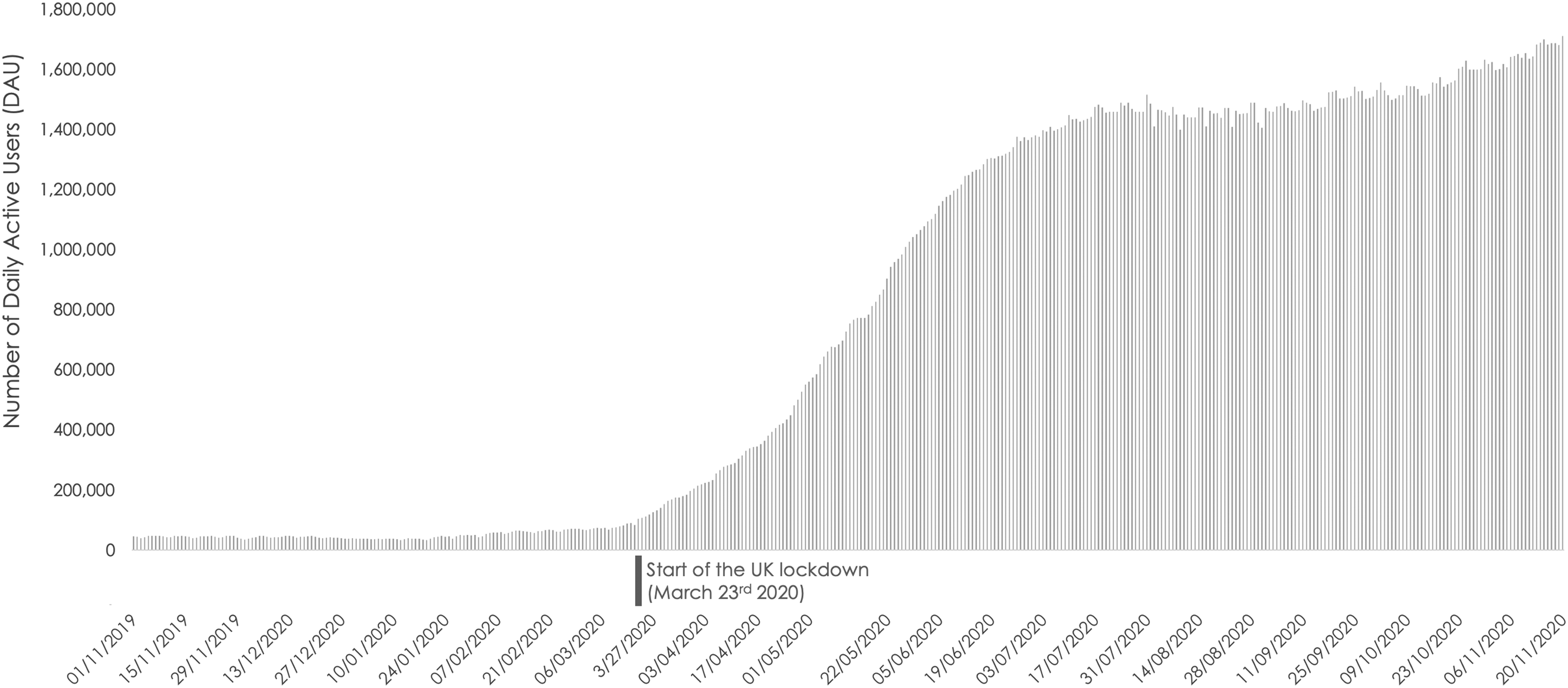
In the following sections, we document the study design, including sampling, recruitment and focus group procedure, and then discuss the results in terms of focus group dynamic, evaluation, limitations/benefits and the applied learnings with final conclusions and plans for future research. The authors hope that these findings will help others capitalise on the recent boom in online video conferencing in order to further understand how best to influence and encourage green investment.
Study Design
Sampling and Recruitment
Potential participants were randomly selected from households within Igloo Energy’s customer base (N = 26,739) who had previously expressed a willingness to participate in future research studies (N = 2372). This subset of customers were contacted in March 2019 to take part in an online survey 2 collecting household demographic and contextual factors, energy usage and personality trait factors, with a total of 660 responses, corresponding to a response rate of 28%. Of these respondents, two exclusion conditions were set; participants had to be homeowners, due to the lack of ability and incentive for renters to undertake energy saving installations (Busic-Sontic & Brick, 2018), and have a single personality type. The focus groups pooled participants into single personality groups, so that they could be shown a personality tailored energy product proposition. Studies have investigated the relationship between personality and group performance (De Dreu & Van Vianen, 2001; Peeters et al., 2006; Rhee et al., 2013) with Kucukozer-Cavdar and Taskaya-Temizel (2016) finding that assigning virtual groups based on personality had a limited impact on enhancing collaboration. The reason for the personality groupings however was to (a) determine whether personality tailored messaging increased willingness to invest and (b) to mirror potential tailored marketing customer journeys that could then be implemented by an organisation if the former was found to be true.
The final sample of survey-participants (N = 405) was characterised by their personality group using the BFI-S method, a short scale 15-item adoption of the Big Five Inventory (Gerlitz & Schupp, 2005). This was selected as it is a well-regarded, reliable and fast method previously utilised in similar large-scale surveys (Busic-Sontic et al., 2017; Busic-Sontic & Brick, 2018; Hirsh, 2010; Lang et al., 2011; Rammstedt et al., 2010) which used the OCEAN typology (McCrae & Costa, 1987), namely, Openness (appreciation for variety, acknowledges experiences and adept at creative thinking), Conscientiousness (organised, responsible individual who strives for achievement), Extraversion (enthusiastic, outgoing and pursues engagement and conversation), Agreeableness (trusting and kind individual who values social harmony) and Neuroticism (individual who is prone to depression and anxiety with non-adaptive coping strategies) (Costa & McCrae, 1992; John & Srivastava, 1999; McCrae & Costa, 1997). While there is some uncertainty over the merits and meaning of the five traits (Block, 1995), they have been widely accepted and used as the principal model of personality in a number of studies concerning environmental decision-making and behaviour (Brick & Lewis, 2016; Busic-Sontic & Brick, 2018; Wuertz, 2015).
The majority of participants were within three personality types, Conscientiousness (35%), Openness (20%) and Agreeableness (20%), with a fourth group ‘Other’ composed of the remaining participants. An email strategy document and workflow (Figure 3) was created for the recruitment and scheduling of focus group sessions with online focus groups leading themselves to an online recruitment process (Stewart & Shamdasani, 2017). This workflow ensured all potential participants were contacted in a consistent manner and were provided three opportunities to participate, with an escalation in the level of detail revealed about the sessions as a means of incentive and to reduce potential annoyance from repeat emails. A modest incentive of £25 to each participants’ energy account was offered to further encourage participation. It was deemed prudent to approach participants twice and then leave a 1-month gap before the final approach. While for a traditional focus group it is often customary to provide several weeks’ notice, the flexibility of an online focus group lends itself to a shortened notice period. The first contact (Email 1 in Figure 3) gave an introduction to the online focus group, details on the incentive, and asked participants to select suitable times and dates from an array of potential slots for the following week using the online scheduling tool, Doodle Poll (anonymous to other participants). Upon the closure of the Doodle Poll, those selecting a suitable time slot would be sent a calendar invitation with further details on the focus group, including the format for the session (Figure 5) and details on the Zoom software. Typically, a Doodle Poll was sent out on the Tuesday morning, allowing 4 days for completion with calendar invites sent out at 5p.m. Friday evening for sessions as early as Monday midday. Simplified communication strategy workflow for online focus group recruitment.
From the participant pool of 405 Igloo customers, 844 Doodle Poll invitations were sent out with 233 focus group invitations and 143 participants attending across 73 sessions run from August–December 2019 (Figure 4) with an overall conversion rate (invited participant to attendant) of 35%. The majority of sessions were undertaken from Monday–Wednesday because it was found that email response rate for Doodle Poll invitations was highest mid-week (Tuesday–Wednesday) as opposed to at the start or end of the working week with higher levels of absenteeism on a Friday, as opposed to Monday–Wednesday, with a general preference for Monday sessions. A further advantage of Monday sessions was that if a participant was unable to attend, they could be invited to a later mid-week session without the need for them to go through the Doodle Poll recruitment phase. Focus group participation across the study period.
Demographics and Characteristics of Online Focus Group Participants (ONS, 2016). Note. The asterix used at (5+O levels/GCSEs,A*-C) is used for the A-star grade. This is the standard for grades however if required this can be changed to text, please let me know and will make the edit if required.

Focus Group Participation.

Focus Group Procedure
The focus groups involved watching and discussing tailored introductory marketing videos for either one or two energy saving upgrades (a smart thermostat and hybrid heat pump). The sessions had a planned (and advertised) duration of 30–35 minutes (Figure 5), considerably shorter than the typical one to two hours (Nyumba et al., 2018). The main reason for reducing the duration was to retain willingness to participate, with 45 minutes or more considered too great a burden on participant’s time. An additional benefit of the short format is that a moderator can schedule consecutive hourly focus groups, allowing them to begin hosting each session 15 minutes before commencement. This being required to provide assistance and reassurance to those joining early to test out the software, which was commonplace for those unfamiliar with the platform. As a result, a single moderator was able to host six focus groups a day from 12:00 to13:00 and 19:00 to 22:00, highlighting the enhanced flexibility and capability. Format for the online focus group as sent out to participants.
Upon starting the video call, an introductory slide would be shared by the moderator containing the format of the session (Figure 5) and a brief introduction. This was accompanied with an individual verbal introduction whenever a participant joined the call. While the general discussion was primarily led by the participants, the welcome and closing of the session was strictly scripted in order to convey the required introduction, ground rules, information on recordings and the incentivisation payment process in the most time efficient manner (Then et al., 2014). Within the introduction, participants were instructed that the sessions would be recorded for transcription purposes and while camera and audio use were advised it was not mandatory, allowing individuals to determine their own degree of anonymity.
An identical poll was deployed at three time points to allow for a greater level of data extraction and comparison, capturing participant awareness and intent to purchase the energy upgrades (i) before being shown the video, (ii) immediately after and (iii) post-discussion. The questions were kept simple and direct, minimising the time taken to complete and while the discussions are generally comparable, the inclusion of short polls provided directly comparable data. Furthermore, these data were automatically captured and viewable during the session itself, not easily replicable in traditional focus groups.
Three pilot focus groups were conducted in advance of the survey, the first being with Igloo staff, who were relatively aware of the energy upgrades, and the following two with friends and family, whom had little to no knowledge of the propositions. The pilots tested not only the suitability of the platform but also the format and content of the session. Within this pilot process, we trialled sending out videos to be watched in advance of the session, thus enabling more time for discussion, which revealed a number of complications including trouble with opening and accessing the files, forgetting to watch the videos and being unable to recall their thoughts on the videos.
Within the script, which provided a small number of general questions and comments that could be used to guide/ensure comparable conversation, the moderator was instructed to provide minimal intervention, acting only if the discussion had drifted beyond the research aim or the participant required further prompting (Bryman, 2016). A session-specific checklist was generated to be used as a guide, containing key contact information such as name, email (for use in troubleshooting scenarios) and key participant information (heating controls and type of heating). This document included a table to record participation across a number of themes to ensure all participants had an opportunity to provide feedback. Moderation was conducted by the same researcher (PT) bar one session (VA) with efforts taken to ensure replicability and commonality for all sessions as detailed in the following section of the article. The sessions were audio and video recorded and automatically transcribed, allowing the moderator to focus on the discussion as opposed to recording notes.
Results
In this article, we report on the method, evaluation and learnings from undertaking over 70 online focus groups, rather than the substantive results from the focus groups. Within the results, we discuss the learnings relating to the focus group attendance, the post-evaluation, limitations and benefit of a virtual approach and learnings for future practitioners.
Virtual Focus Group Attendance
The size of the focus groups throughout the project was relatively small, with the majority consisting of two participants. The desired group size was 2–5 (3–4 being optimum) with any larger deemed difficult to manage within the 15 minutes scheduled for discussions (Figure 5). The difficulties of larger groups include needing to allow everyone time and scope to talk, increased pressure to agree to the group collective, participants talking over each other and managing technical issues and late arrivals. Peek and Fothergill (2009) suggest that larger groups have a tendency to be dominated by an individual, noting greater difficulty in encouraging contributions from those who are more reserved. When multiple people join simultaneously, it can be difficult to troubleshoot any difficulties they experience using the software. Typically focus group sizes are recommended to be between 6 and 10 participants (Morgan, 1998), although there are numerous examples of groups ranging from 2–4 (Bennett et al., 2009; Silva et al., 2009; Wiles, 2014). Smaller groups have been found to be easier to manage with a greater diversity in opinions, increased number of contrasting perspectives and greater ability to attend to and involve each participant (Carey & Asbury, 2012; Kite & Phongsavan, 2017; Peek & Fothergill, 2009). The speed and ease of hosting online focus groups increases a study’s capacity to opt for smaller, more intense focus groups, reducing the time requirement and as a result enhancing uptake, as shown with a 35% overall conversion rate. Smaller groups do however result in a greater workload in undertaking and analysing the sessions. The suitability of such an approach will depend upon whether the focus of the sessions is on further understanding the views and perspectives of a population (as was the case with this research) as opposed to analysing the debate and social influences.
Of those that completed the Doodle Polls and were invited to a focus group, 61% attended the sessions with 26% of sessions having nobody attend. The issues of absenteeism will be discussed in a later section; however when reviewing invitation interaction and personality, there are some clear findings. Participants that were classified as Conscientious were found to have a higher level of interaction (64%) and attendance (73%), with the latter far higher than other personality types such as Openness/Intellect (47%). Furthermore, for those Conscientious participants that did not attend, a greater proportion would provide notice of their absenteeism (Table 2). Thus while typical advice to over-recruit by 10–25% (Rabiee, 2004; Wilkinson, 1998) was followed, for the conscientious groups, the maximum invite size was set at 5 as opposed to 7 due to the increased certainty of attendance.
Participants’ Post-Evaluation
From the 143 participants, 103 (72%) completed the post-evaluation survey which was emailed out within a follow-up ‘thank you’ email without any form of incentivisation scheme. The vast majority of participants (80%) thought the focus group was of sufficient length with the rest stating it was too short, which is positive considering the average length of a session was 42 minutes, as opposed to the advertised 30 minutes. The communications and planning of the focus groups were rated positively (Figure 6) with the short time periods between invitation, confirmation, reminders and commencement strongly endorsed. Focus group post-evaluation findings.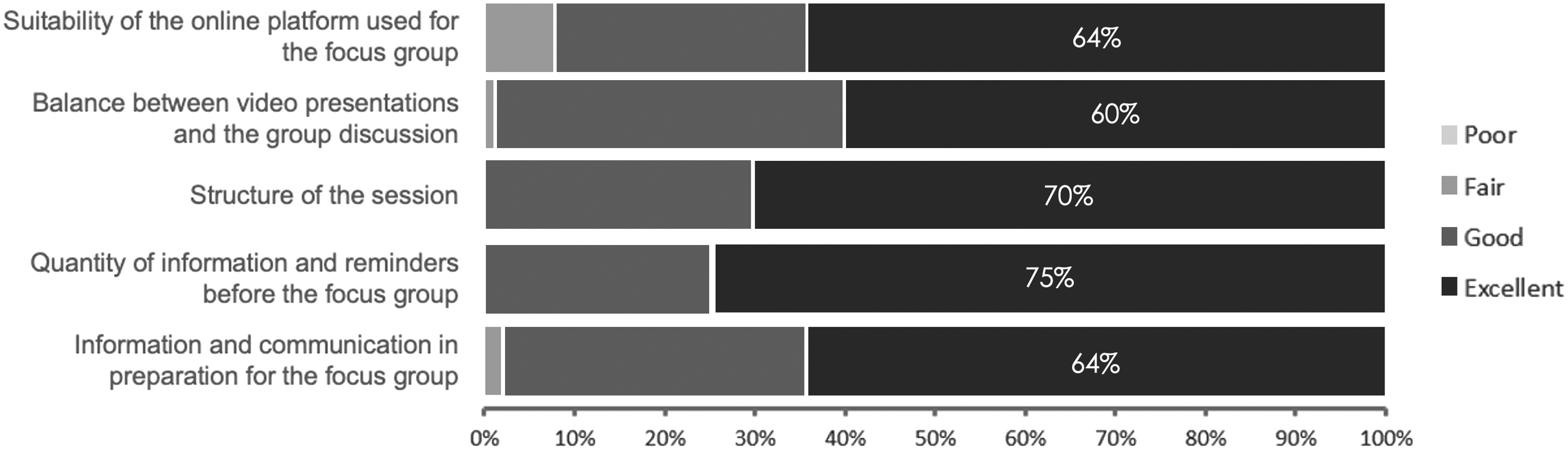
The evaluation revealed that most participants considered the online platform suitable for use with focus groups (Figure 6), although comments from those stating it to be fair, indicated a preference to see and communicate with people in person. This was in contrast to the comments from those in favour of the online format, who stated a preference for the ability to connect via audio and retain some anonymity through not sharing their camera feed. Further to this, were the numerous comments on the benefits of not needing to travel, these were primarily for time purposes but a number mentioned the reduced cost and impact on the environment. When asked to state whether they would have preferred a face-to-face focus group or virtual session, 88% stated a preference for virtual with 8% opting for face-to-face and 4% stating an equal preference. While this preference for online is to be expected when participants are selected from an exclusively online energy provider, it is still a considerable leaning, with many stating that they would likely not have participated if it had not been hosted online further highlighting how the method enables participation from those who would normally not take part (Williams et al., 2012).
Participants were also in favour of the structure of the session and the balance between video presentation, polling and discussion.
A follow-up control study was undertaken in March 2020 asking focus group participants to watch and rank (in terms of effectives for capturing their interest) five short, 25 second, personality tailored energy upgrade videos to further support the qualitative findings from the focus groups. These videos had nuanced marketing messaging to match personality types, such as the agreeableness video describing how the upgrade could help the customer and others. 102 participants (71%) took part during a 2-week period further highlighting the high level of engagement with the research project, which must in some part be associated to the convenience and flexibility of participation and engagement through an online approach.
Limitations and Benefits of an Online Focus Group Approach
It should be acknowledged that when hosting a virtual focus group, there will inevitably be technical issues, particularly when inviting larger groups with no vetting on technological experience or/and skill. Alongside thorough troubleshooting planning (see later section), many issues can be resolved if identified during the planning stage. For example, it was found that a small number of participants were unable to view videos or polls despite being able to view a shared screen and work their audio and video feed. These issues were found to be linked and so when the moderator opened the session, they would run a poll, checking that everyone joining the call could see it. This allowed the moderator to easily ascertain whether an attendee was OK to proceed and fully participate in the focus group; furthermore, it gave participants confidence that the software was working.
Another additional limitation emerges from the absence of direct verbal contact in advance of the session (either through telephone or face-to-face) which can be useful in screening participants and identifying potential conflicts that could derail a session. As mentioned previously, the topic of household energy upgrades is not the most sensitive, especially when compared to topics covered in health research (Gijzen et al., 2016; Macapagal et al., 2017; Thomas et al., 2013); however, polarising issues including Brexit and climate change denial did occur. Pre-focus group surveys, which are often used alongside focus groups (Nyumba et al., 2018), are a potential virtual means of resolving said issues with particular questions posited as screening measures. Additionally, partnering with a commercial organisation with a data agreement plan permitting access to a customer database could also help avail this issue and potential concerns over false representation. This approach enables researchers to obtain access to a select customer base with specific known data and traits as opposed to random sampling from the general population.
A third limitation is the reduced bond a person has for an online commitment as opposed to an in-person, physical commitment, leading to a relatively high drop-out rate. This is a double-edged sword as the ease of virtual commitment is likely to generate a relatively high interaction rate, as shown with the 60% participation rate with the scheduling platform, but also a low attendance rate of only 61% (Table 2), a problem previously found with an online approach (Kite & Phongsavan, 2017; Tuttas, 2015). Further to this, the increased sense of anonymity (Ahern, 2005; Jiang & Cohen, 2020; Tates et al., 2009) can also reduce the level of connection with the session and thus increase the likelihood of disengagement (Tuttas, 2015). Attendance was found to differ across personalities (Table 2) with Conscientiousness grouped participants 1.6 times more likely to attend than Openness grouped participants, allowing the moderator to anticipate a higher level of drop-outs for particular sessions. The shortened time scale and reduced commitment of the online method means participants are more likely to drop-out and a moderator needs to be flexible to allow for multiple points of entry with some participants requiring three attempts to join a focus group. This flexibility has to be carried over to usage of the platform, while the majority of participants, regardless of their experience, found the Zoom platform to be easily manageable, there were those requiring considerable assistance which had to be administered and managed in a way that did not interrupt the flow of the focus group. Added to this is the time lag associated with text responses, particularly noticeable when the majority of participants are active over audio. Text responses were uncommon with only six participants predominantly communicating using the chat function, three of which were as a result of technical issues, while the other three were participant preference. This can be mitigated by prompting participants to start typing responses while someone is conveying their perspectives audibly; however, a moderator should allow everyone equal opportunity to interact and respond with the group. In this respect, the moderator will be required to continually monitor the chat field in order to voice any comments from the muted participant. Proficient typists were found to effectively contribute to discussions; however, those with limited experience in typing were less likely to respond and interact and instead only provided summaries of their opinions and perspectives. Added to the relatively high level of absenteeism is the potential for non-engagement from participants as there were two cases of attendees not communicating during the entire process despite being present for the entirety of the session and completing the polls.
Alongside the issues of no-shows is the problem of late attendance, which is to be expected in any focus group with members of the public participating voluntarily. As participation is in effect a courtesy, one should allow for lateness and thus hold off from starting if not all people are present. However, if absenteeism is relatively high there is a good possibility of wasted time and potential annoyance for participants. It was for this reason that there were multiple lines of communication/prompts in advance of the meeting (Figure 3). This was not solely to encourage participation but to elicit a notice of non-attendance, which was found to be more forthcoming from particular personalities (Table 2). With this being said, one of the benefits of a virtual setting is marginally easing the impact of waiting for late attendees. In a traditional setting, participants generally remain seated in anticipation of the session, whereas when attending the online meetings, many muted their microphone and conducted work or leisure in the background while awaiting the commencement of the session. This was not the case for all, with a minority sitting and waiting in the same way they would for a traditional focus group, with the occasional occurrence of ice breakers and conversation between participants.
These issues of enforced waiting and unnotified non-attendance were the reason for the number of individual focus groups; all invites were for a minimum of two participants; however, it was deemed inappropriate to cancel a session if a participant had attended the call and waited 7 minutes for potential late arrival. This is a considerable downside of working with a commercial organisation; the positive experience of the customer must be prioritised, meaning that the focus group must go ahead despite it becoming effectively an interview as opposed to a discussion. This being said individual sessions followed the same format as all other sessions with the moderator having to take a greater role in the discussion. To guard against this, it may be appropriate to invite a minimum focus group size of three participants; however, our study included a case of one attendee despite five invites. All contact was through email and text messaging (for those that provided a mobile number) and potential direct conversation via a telephone call may result in higher attendance; however, this approach would result in a more time-consuming communication workflow.
Other limitations include the preference of around 50% of participants to not share their camera feed, thus requiring the moderator to be more attentive to verbal cues when deciding on whether to intervene in the discussion. Morrrsion-Beedy et al. (2001) note this also reduces capacity to elicit and encourage comment from reserved participants. It is however suggested that this relative anonymity creates increased comfort and as a result reduces response bias (Jiang & Cohen, 2020). Attention retention is also a potential concern with far more distractions in one’s own home to interrupt proceedings (Kite & Phongsavan, 2017). In a traditional focus group, the moderator is likely to have the undivided attention of participants, unable to mute their microphone or walk away to make a coffee or continue another conversation. In the study, there were cases of participants joining in public houses or keeping their television and sound on in the background. This limitation however is also a benefit with participants able to participate while undertaking basic tasks such as cooking or cleaning, while this may be viewed as partial engagement, most were fully engaged and instead highlighted the ease of attendance with participants able to allocate the time knowing they were also able to complete rudimentary tasks. There were even cases of couples attending the sessions on one device as they were joint financial decision-makers and so felt the discussion pertained to both of them. Interaction among participants is vital (Albrecht et al., 1993) and in agreement with Kite and Phongsavan (2017), participants were found to engage in debate and discussion among themselves as opposed to just conversing between participant and interviewer as akin to a group interview.
Alongside the benefits previously mentioned including increased speed, geographical reach, participation and reduced cost, turnaround time and time commitment (Jiang & Cohen, 2020; Stewart & Shamdasani, 2017) is the speed in reviewing the sessions. With auto-transcription files and video/audio recordings were available within an hour of completion. This enabled moderators to either embed initial thoughts and comments to the full transcript or re-review the recordings on the same day as the focus group itself. Sound quality has been cited as an issue in terms of participants being able to hear each other and causing difficulties in the transcription process (Kite & Phongsavan, 2017; Tuttas, 2015). This however was not found to be the case with a 98% coverage for the transcriptions (conducted by a third party) which were predominantly from unclear speech as opposed to sound quality issues. The accuracy of the auto-transcription was found to be lacking with terms and phrases often mis-quoted; for example, the word Igloo was transcribed as Italy, loo, Peru or even Ireland. We did not investigate the quality of other providers or scope to improve accuracy as this was not a major factor when selecting the platform. For those with limited budget or time however, auto transcription services do offer considerable savings and with further enhancements will be an additional reason to go with an online approach.
As previously indicated, the majority of sessions overran the allotted 30 minutes; however, drop-out rates during the session itself were incredibly low with only 4 of the 143 participants leaving in advance of the session closing. The four withdrawals occurred during midday meetings where participants also had work or social commitments. The removal of travel constraints on participants appears to allow for a far more forgiving response to the adherence of the schedule. Paired with the ability to undertake menial tasks alongside engaging with the focus groups, this highlights the power and possibilities provided through the ease of participation. This increased level of engagement (also shown by the response levels to the post-evaluation and control survey) was further revealed through over 20 follow-up detailed emails and comments from participants wishing to add further to the debate.
Learnings for Future Practitioners
Selection of Online Platform
Ten-Item Consideration Checklist for Generating Platform Selection Criteria.

Preparation of Moderators and Troubleshooting
The demands on an online focus group moderator are largely similar to those for a traditional focus group (Brüggen & Willems, 2009), although it will have additional technical responsibilities (Jiang & Cohen, 2020). Much like a face-to-face session it requires rehearsal, for those with limited experience this is imperative and should be conducted multiple times with various attendees and group sizes. The moderator needs to become familiar with all the web conferencing features (polling, breakout rooms, etc.) and experience multiple roles (host, co-host and attendee) from multiple platforms (PC, Mac, tablet and mobile) to better understand each participant’s experience and what they can and cannot do, in order to provide instruction and troubleshooting advice. With features such as altering display name, audio/video settings and chat often appearing on different areas of the screen or within alternate menus dependent upon a participant’s role and device.
Multiple back-up moderators should also undergo training sessions as a contingency plan for sickness, internet outages or in case of overbookings for a particular time slot. They should also familiarise themselves with the features of the chosen platform and be given explicit instructions on their roles and responsibilities. It is best practice to prepare a guidance document for back-up moderators providing a script, documents (paper and virtual) required by the host and instructions on the process of what to do before starting the meeting, actions to take once someone joins the meeting, if participants are late, if nobody joins the meeting and when ending the meeting. Instruction on how to lock meetings in the event that no invitees join is of particular importance if participants are given permission to join the meeting without the host (see 4.4.3 below). This can result in (late) participants joining an empty meeting after the host has closed the session, without receiving notification that the group is closed. Thus, moderators were advised to lock the meeting and to leave it running for the expected duration of the meeting in order to avoid this scenario. Most importantly, any guidance document should outline the troubleshooting process.
During the practice sessions, it is recommended that a method of reporting and solving technical issues is prepared. If focus group sizes are to be capped at five participants, then a single moderator should be able to handle the majority of technical issues by themselves. The process is made more efficient if the moderator has access to a live in-meeting data interface such as the Zoom Dashboard 3 which enables the account administrator to review meeting and participant details, including location, user device/platform and network/connection quality. In our study, the Zoom Dashboard and thorough testing of various devices and platforms enabled the moderator to provide participant specific advice and even anticipate potential issues such as those encountered if participants joined through a non-optimal web browser. When preparing troubleshooting advice, instructions need to consider the full range of potential problems. For example, problems can often be solved verbally; however, if their speakers are not working, you may need to use the chat. If the participant does not know how to locate the chat, then instructions can be provided either through a whiteboard, screenshare or an additional channel such as email or mobile text. Added to this, it is likely that the moderator will at the same time be having to welcome additional participants or be answering questions. Virtual focus groups however allow for a moderator to have all the information and advice pre-prepared ready to ‘copy and paste’ allowing for a single moderator to efficiently resolve the majority of technical issues. For groups of over five, it is recommended that two moderators are deployed (Fox et al., 2007; Wettergren et al., 2016); however, others suggest it is beneficial to always deploy a second moderator to document notes and prompt the lead moderator through a private message platform (Dodds & Hess, 2020). If there is particular concern for lost time from technical issues, certain software packages will provide technical support staff as part of the contract and so this would be key platform selection criteria.
While a researcher will need specific skills, guidance and temperament to effectively run and manage an online focus group, because it is held virtually, there is reduced anxiety towards managing such a discussion compared to a traditional setting. As long as a lead researcher is able to fully investigate the specifics of the platform and prepare sufficient instructions and guidance, moderation can effectively be transferred. In a traditional focus group, it would appear unnatural if a moderator had a script with suggested questions and guidance; however, when facing a web camera, participants will be unaware if the person is looking at themselves or a script.
Preparation of Participants
It was deemed necessary for participants to be allowed to join in advance of the meeting (requiring that each focus group has an independent meeting ID) so that they may test the platform and their own audio and visual devices. This advance testing was undertaken by 30% of participants and led to a small number emailing the moderator asking for further advice and tuition on how to use the platform. Alongside this, it is recommended that moderators provide joining information within the focus group invitation providing detailed help and instructions. The document should outline how a participant joins the event and what they should expect to experience when they join the focus group (i.e. methods of communication and what features they will have access to) with additional links to the chosen platform’s help pages.
Management and Execution of Virtual Focus Group
When hosting a virtual meeting, it is advised that a moderator employs a minimum of two screens, whereby one is used solely for the focus group session and the other presents the script, shared videos/visuals and the live in-meeting dashboard. The moderator should have their camera turned on at all times as they are inviting others to join the meeting with it deemed appropriate as a way of earning trust, a green screen can be employed to provide a more professional setting when undertaking home-based sessions. Further concerning trust, the internet with its myriad of possibilities and methods of data collection does raise concerns for many with regard to privacy and confidentiality (Data & Marketing Association, 2018; Dodds & Hess, 2020; Open Data Institute, 2018). With sessions being recorded, it is important that this is made abundantly clear in advance and at the start of the session. The introduction should also make note that while microphone use is encouraged, participants may type responses if they prefer and that there is no requirement for camera feeds to be turned on, or for participants to reveal their real name (as long as they confirm their identity to the moderator through the private chat). This building of trust not only lessens the privacy concerns but can also help combat potential influence of cultural norms and empower participants to state their honest responses.
When planning a virtual focus group, one needs to consider the planned duration, whereby if it is an hour or less then all processes should be relatively quick and easy to learn, with all actions preferably hosted within a single platform. Surveying, for example, within a focus group platform may be generally limited; however, the required data needs must be weighed up with the need to conserve time. Moderators must have the ability to control all participants, such as muting and removing, with the former imperative if the session involves watching a form of media, but also required to ensure any excessive background noise does not impinge upon others during the discussion. Participants who were unable/resistant to muting their microphone were found to not notice if they were being muted and unmuted by the moderator. This was however only used for watching the videos and if there were cases of high levels of background noise as ideally all microphones should be unmuted in order to encourage back-and-forth conversation.
During the log-in period alongside sharing an introductory slide with format of the session and key information, it helps to either have low level music playing or regular communication from the moderator so that the attendees know their sound is working. Then, when introducing the focus group, it is vitally important to succinctly summarise the purpose of the conversation. In the case of trying to understand customer perspectives and opinions on energy upgrades, it is important to emphasise on multiple occasions the specific research aims and objectives. Upon early testing, the discussion would often turn to a question about specifications and pricings of the energy upgrade as opposed to participants’ personal perspectives and responses. The introduction format, as a result, was revised to focus on distancing the research from the energy company and instead providing a context for the importance of the research aim to ensure participants fully understood the required aims and objectives.
Conclusions
With a number of qualitative studies adapted to provide an online offering (Kozinets, 2010; Murray & Sixsmith, 1998), online focus groups can provide a convenient, time- and cost-efficient approach for engagement, able to reach a large audience (global or national) and allow participants to determine their own level of anonymity. This is not to say that there is not a trade-off here; some participants will be opposed to being recorded or having to engage with a particular platform and one is likely to encounter some technical issues. This study has however shown that you can obtain a good level of participation and interaction with no serious difficulties (2020). Concerns over large periods of time being spent on discussing technical issues (Kite & Phongsavan, 2017) were not confirmed during the study as a result of considered planning, preparation and providing simple but detailed participant instructions alongside early joining and practice sessions.
As time evolves, the general public will become ever more comfortable interacting online, although there may be an over saturation of the use of virtual meeting spaces as a result of the COVID-19 pandemic. During this study, there were a number of questions as to what Zoom was, or why we were using it; this is unlikely to be the case anymore as the platform has become more ubiquitous. The increased proficiency, and more importantly confidence, generated as a result of this new-found reliance (Dodds & Hess, 2020) means that this methodology should no longer be promoted to participants that are particularly suited to an online setting as was the case with the Igloo Energy customer base. Concerns around the lack of depth within discussions (Abrams et al., 2015; Woodyatt et al., 2016) can be calmed as online approaches can be considered an appropriate form, within the UK context, for the vast majority.
A limitation of the research presented in this article is that we did not conduct any traditional face-to-face focus groups with which to compare the results and interactions of the online focus groups. This however does not invalidate the findings as there are relatively limited detailed guides within this field, with the majority of similar research within the realms of health or marketing (Jiang & Cohen, 2020; Kite & Phongsavan, 2017; Stewart & Shamdasani, 2014). Work is being conducted into smartphone-based mobile messaging to further capitalise on the convenience which has so far been unable to match the richness of data (Chen & Neo, 2019). We recommend that future work should focus on ways to encourage participation and ensure notified absence to avoid one-person focus group sessions, as the random nature of attendance is not entirely resolved by over-sampling, which can lead to oversized groups. This approach shows how in a relatively short space of time, one can canvas and engage with a wide array of participants to further understand how to influence and encourage green investment.
Footnotes
Declaration of Conflicting Interests
The authors declared the following potential conflicts of interests with respect to the research, authorship, and/or publication of this article: The authors whose names are listed immediately below certify that they have NO affiliations with or involvement in any organisation or entity with any financial interest (such as honoraria; educational grants; participation in speakers’ bureaus; membership, employment, consultancies, stock ownership or other equity interest and expert testimony or patent-licensing arrangements), or non-financial interest (such as personal or professional relationships, affiliations, knowledge or beliefs) in the subject matter or materials discussed in this manuscript.
Funding
The author(s) disclosed receipt of the following financial support for the research, authorship, and/or publication of this article: This work is part of the activities of the Energy and Climate Change Division and the Sustainability Energy Research Group at the University of Southampton (www.energy.soton.ac.uk). This work is also in partnership with Igloo Energy (https://igloo.energy). The work is supported by the BEIS Thermal Efficiency Innovation Fund, Project: Seamless & ENgaging home SErvices: making efficiency desirable (SENSE) (TEIF1017020).
