




Abstract
The COVID-19 pandemic has sped the adoption of online data collection approaches among qualitative researchers. While videoconferencing software has been a tremendous resource for replicating key aspects of the face-to-face focus group environment, online approaches to data collection also face unique challenges. Prior work has offered insights on the value of face-to-face versus online focus groups and strategies for improving the online focus group experience for participants and moderators. However, little has been published on the unique needs of participants from low socio-economic status (SES) populations. In light of the digital divide and the ways in which COVID-19 has exacerbated existing inequalities, researchers must seriously reflect on the ways in which SES and online methods intersect. To address this gap, we present reflections on two online focus groups conducted with low SES African American adults during COVID-19 to offer recommendations on areas of concern and potential solutions for researchers to consider. Three areas stand out as particularly important for reflection: (1) participant privacy, (2) online connectivity, (3) support and time allocations. Greater attention to the impact of SES can help ensure improved opportunities for full and equitable participation, allowing the voices of those who have been marginalized to be heard more clearly.
Introduction
As noted by Lobe et al. (2020), Coronavirus Disease 2019 (COVID-19) has hampered the ability of qualitative researchers to engage with participants in face-to-face environments, forcing many to shift to online forms of data collection. Videoconferencing tools have been particularly promising due to their ability to collect data remotely while still offering many of the benefits of the face-to-face environment (Han et al., 2019). In addition to distinct benefits, however, this approach also brings new challenges for researchers. One such challenge is the ways in which the digital divide and other socio-economic inequalities impact data collection online (Robinson et al., 2015). Further, COVID-19 has exacerbated existing social and economic inequalities, making the intersection of online methods and research participants of low socio-economic status (SES) a pressing concern for researchers and funding agencies, particularly in light of calls for researchers to take the lessons of the Black Lives Matter movement seriously in their work (Garcia & Sharif, 2015). Although prior work has offered helpful reflections on online focus groups (Daniels et al., 2019; Han et al., 2019; Matthews et al., 2018a; Rupert et al., 2017), equity issues are rarely touched on at length. Attention to the participation of low SES populations in focus group research is needed to ensure that qualitative methods reach their full potential during COVID-19 and beyond (Teti et al., 2020). This is particularly critical given that focus groups have long been identified as valuable for studies with underrepresented populations and for topics where power differentials may make participants uncomfortable with one-on-one interviews (Madriz, 1998; Wilkinson, 1999).
In this article, we describe the factors that researchers should consider if they hope to conduct online focus groups with participants from low SES populations. Grounded in the socio-ecological model (Baral et al., 2013; Taylor & Distelberg, 2016), we position research participation not just as an individual behavior but as an outcome shaped by physical, social, economic, and political factors. Accordingly, we also argue that the economic impacts of COVID-19 have exacerbated existing inequalities that impacted research participation. We present researcher reflections on two recent qualitative focus group studies with low SES African American participants during COVID-19. This work captures the experiences of the focus group moderator, who is also the founder of a small, woman-owned African American research firm with over two decades of experience conducting international and domestic health focused in-person interviews and focus groups with diverse (African American, Latinx, LGBTQ+, and Native American) and low-income communities in urban, suburban, and rural areas. Although this work if informed by a U.S. context, we believe it is broadly applicable as racial and ethnic inequities and digital divides are not limited to the U.S. (Grishchenko, 2020; Hong et al., 2017, Watts, 2020). Accordingly, the reflections here are anticipated to hold value for researchers seeking to involve marginalized populations in online qualitative research across a breadth of contexts, with readers encouraged to reflect on transferability to their unique settings (Tracy, 2010).
Implications of COVID-19 for Research With Low SES Populations
To participate in online focus groups using videoconferencing software, participants at a minimum need a stable internet connection of sufficient speed, physical access to a technological device (e.g., computer, tablet, or smartphone) with audio and video capabilities, and access to a quiet place to minimize interruptions and outside noise (Lobe et al., 2020). Additionally, digital literacy is needed to navigate devices and videoconferencing software (Beaunoyer et al., 2020). Even before COVID-19, digital divides impacting these factors have been notable both within and between countries, with overlaps between social exclusion and digital exclusion (Watts, 2020). For example, data from the U.S. Department of Commerce indicate that just 57% of those with family incomes under $25,000 used the internet at home in 2019, compared to 82% for those in the highest income group (U.S. Department of Commence, 2020). Studies from Russia, China, and the United Kingdom have found similar divides rooted both in SES and geography (Grishchenko, 2020; Hong et al., 2017; Watts, 2020). With regard to digital literacy, there are notable differences by level of education, race/ethnicity, country of birth, and age (Mamedova & Pawlowski, 2018). SES is also likely to contribute to divides in access to a quiet, safe, and private space to participate in research (Hernández, 2016). While research participants from all backgrounds may hold discomfort about video cameras disclosing the inside of their home (Lobe et al., 2020), lower SES participants may also have heightened sensitivity about turning on cameras due to fear of social stigma.
COVID-19’s financial and social distancing implications have further exacerbated these inequalities by making it more difficult for families to afford to update or replace technological devices in the home, reducing access to computers and internet in public places, and making it more difficult for those who need help using devices to get it in person (Beaunoyer et al., 2020). COVID-19 has also disproportionately impacted the communities and populations that were already most vulnerable. In the U.S., African American and Hispanic/Latinx workers are significantly more likely than white workers to be employed in front-line jobs and be unable to do telework, which has contributed to both higher rates of COVID-19 and higher rates of unemployment (Maxwell & Solomon, 2020; Raifman & Raifman, 2020; Saenz & Sparks, 2020). African American and Latina women have experienced the greatest economic impacts from COVID-19 (Saenz & Sparks, 2020). A recent research report from Oxfam International indicates that these trends are not limited the U.S., with the report noting that “the heaviest toll of this pandemic falls onto people of color and women both across and within nation-states, and will serve to further increase existing inequality and vulnerability” (Berkhout et al., 2021). These divides, and their exacerbation due to COVID-19, suggest that those who are most economically and socially vulnerable are also least likely to have access to the resources needed to fully participate in online research. The reflections below illustrate how many of these challenges play out in practice and identify strategies to assist researchers as they engage with low SES populations online.
Grounding and Reflexivity
In July through August of 2020, two separate qualitative focus group studies were launched among a low and middle income African American population in Milwaukee, Wisconsin to ensure cultural competence of materials to address underage drinking and tobacco use among African American youth. These focus groups took a “basic qualitative research” approach (Merriam & Tisdell, 2016), as the primary goal was to help inform the development of the aforementioned materials. Participants included parents, caregivers, and educators (teachers and coaches) of African American children. The poverty rate for African Americans in Milwaukee is 33.4%, which is the highest of all metropolitan areas in the United States (Levine, 2020). As an applied project not seeking generalizable knowledge and led by an independent community-based researcher, Institutional Review Board approval was not required for the focus groups. Additionally, findings from focus groups are not presented in this article.
Due to COVID-19 and the preferences of the funder, all recruitment and screening for 11 focus groups and 59 participants took place remotely, and all data collection occurred using the videoconferencing tool Zoom. This software is frequently recommended as it is free for participants, relatively easy to use, and allows for high quality recordings (Daniels et al., 2019; Lobe et al., 2020). Two of the 11 groups involved pretesting the discussion guide, technology, participant Zoom aptitude, and access to reliable technology with the target audience. With significant experience working with vulnerable populations, the lead researcher had previously made regular use of best practices such as in-person screening, childcare and meals offered on-site to focus group participants, immediate distribution of cash-stipends or gift cards, and financial assistance for transportation (Umaña-Taylor & Bámaca, 2004). Moderation also focused on building a safe space, collective brainstorming, and creation of a sense of trust and connectedness established verbally and via non-verbal body language and visual cues. In the new online format, not all of these practices were easily translatable.
The experiences of the lead researcher, who organized and moderated these focus groups, ground the reflections shared here. While discussions of positionality and reflexivity work can be inherently limited (Pillow, 2003), they still serve an important role in published work and provide transparency that aids readers in assessing the assumptions and focal points that shaped research (Soedirgo & Glas, 2020). As an African American woman who runs a community-based research consulting firm and is also a single parent mother of two, raised by a large family of six and the extended village, the lead researcher brings significant lived experienced and self-awareness to her research with Black and Brown communities. She used her experience and identity to build rapport and facilitate rich dialogue with focus group participants. In reflecting on these focus groups, the researcher notes that she asked participants to join her on a journey of authentic, unfiltered, non-judgmental discussion with the objective of supporting parents, teachers, and caregivers of Brown and Black children in lending their voices to the design of media campaigns that will resonate with their demographics. Throughout the focus groups, the researcher related to many of the stories and experiences shared by participants, most of which were rooted in systemic racism, and in the pain and fears of raising or teaching Black and biracial children in the United States. While insider research is not without its own complications (Chavez, 2008), she used her life experiences to ask follow-up questions that may have been missed by someone outside of the community. Participants also recognized her as a trusted and non-judgmental insider who engaged in “code-switching” by altering linguistic elements based on social context (Nilep, 2006), with some asking that she speak about the Black rather than African American community.
It is critical to note that this rapport was present even in an online setting and that moving to video did not hamper the ability of the moderator to create a safe, non-judgmental space for caregivers, parents, and teachers of Black and Brown children to share their opinions, experiences, truths, and recommendations. Still, however, the lead researcher felt that the online format had a meaningful impact on not just on the focus group process, as discussed below, but also on the experience of being a moderator more generally. The online format and accompanying need to fit body language into a space viewable on a smartphone, tablet, or laptop created a feeling of physical restriction and confinement not usually present in in-person focus groups. Additionally, she felt that the format required use of heightened facial expressions and intonation to build rapport relative to in-person focus groups.
During the study, the lead researcher kept records on her experiences and the research process, which she later turned into a longer memo capturing both her initial reflections and later reflections born from revisiting focus group recordings. Additionally, some participants shared unstructured reflections on their focus group experiences immediately after the focus groups, in follow-up phone calls to schedule participants for future focus groups, and via unsolicited emails. The lead researcher also considered this feedback in her own reflections on the online focus group experience. Through discussion with an academic research collaborator trained in qualitative public health methods, the lead researcher determined that her experiences may also aid other researchers working with low SES populations and might be published for further dissemination. Together, the two reviewed her memo to identify cross-cutting challenges and position her reflections within the broader qualitative literature. Memo content was also translated into summary tables of distinctions between focus groups before and during COVID-19.
Lessons for Online Focus Groups With Low SES Populations
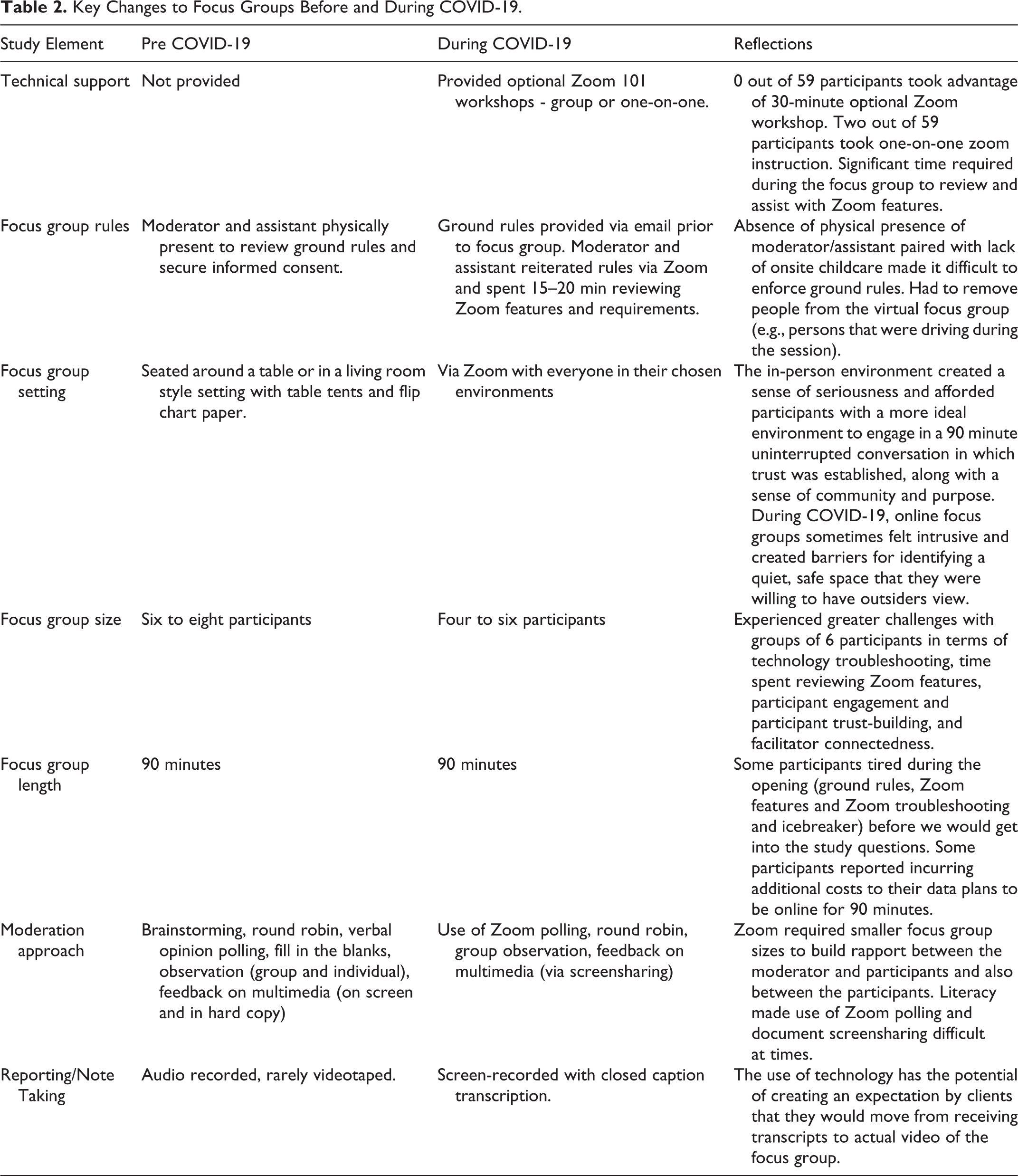
Three overarching challenges were identified from reflections on the research process: (1) Participant Privacy, (2) Online Connectivity, and (3) Support and Time Allocations. As suggested by the socio-ecological model, these challenges are not rooted in participants but rather in the social and economic constraints they face. Issues of inequality and differential impact are cross-cutting throughout all three areas. Below we present illustrative examples for each and offer recommendations for practice. Tables 1 and 2 provide an overview of the differences between previous face-to-face studies with similar populations and the focus groups conducted with online COVID-19 adaptations. Table 1 considers aspects of recruitment, support, and incentives, while Table 2 considers the focus group process itself.
Key Changes to Focus Group Recruitment, Support, and Incentives Before and During COVID-19.

Key Changes to Focus Groups Before and During COVID-19.
Participant Privacy
During COVID-19, individuals were no longer coming to a physical location to participate in focus groups. They had to be willing to disclose potentially sensitive information about their personal environment to participate virtually. Many participants avoided providing camera exposure to their homes by participating in the focus group discussion while in their car or other less intrusive settings. Confidentiality in some of these settings appeared to be an issue, as family members would walk in on the conversation and/or children would be seated in the car, off-camera during the focus group. In addition to privacy concerns during the focus group, greater privacy concerns arose following the focus group due to the presence of a full video recording rather than just audio. This created mistaken assumptions on the part of the client about if they would be allowed to view the video recording. As video would allow for easy identification of participants, clear communication with clients about what they will receive in light of the informed consent statement is critical.
Recommendations
Create opportunities for focus group participation that allows for video but does not involve required on-camera exposure of the home. One approach for this may be to instruct participants on how to use virtual backgrounds that would obscure the actual background setting (Lobe et al., 2020).
Identify strategies and strategic partnerships for providing safe, private, and quiet spaces for focus group participation. For example, public libraries with COVID-protected study rooms and conference spaces.
Identify strategies for providing COVID-19 safe childcare to participants. For example, community partners may be able to provide childcare services for essential workforce families. Alternatively, a stipend to help offset informal childcare expenses during the focus group may be an option for those uncomfortable with outside providers.
Provide as much flexibility as possible for scheduling in order to ensure that participants are able to join focus groups during the time when they are most likely to have a safe, quiet, and private space. Smaller focus groups, as already suggested as best practice for online focus groups (Daniels et al., 2019), make such flexibility easier.
Online Connectivity
The eligibility requirements for focus group participation were heightened as a result of the groups being conducted virtually. Participants now had to have access to reliable internet service, sufficient lighting, and reliable devices (tablets, smart phones, laptops, or desktops) to participate in virtual focus groups. Smartphones, which are the primary means of online access for at least a quarter of lower-income adults (Anderson, 2019), present unique challenges. Researchers can request that higher SES individuals use a personal computer to join focus groups. This is less likely to be feasible for lower SES individuals. In the focus groups, participants who used smartphones to join were more likely to multitask or be in transit due to their easy portability. Participants attempted to participate in focus groups while driving, shopping and in other potentially unsafe and or disruptive environments, preventing them giving their undivided attention to the focus group. In these instances, the moderator requested that the participant pull over in order to continue as an eligible focus group participant or risk being removed from the group. It is also difficult to review documents on Zoom when participating via a smartphone. Some participants also indicated using their stipend to cover the cost of using their data plan to participate in the full focus group discussion. Concerns about data usage present an additional concern and potential distraction for lower SES participants. Over 50% of low SES adults in the U.S. worried about being able to pay their smartphone bills, compared to just 9% of high SES adults (Vogels et al., 2020).
Participants also had to have basic Zoom skills. While this is required of all participants regardless of SES, lower SES individuals are less likely use the internet at home and more likely to have low digital literacy (Mamedova & Pawlowski, 2018; U.S. Department of Commence, 2020). To help address anticipated barriers, group Zoom instructional sessions were offered prior to the focus groups, but no participants chose to participate. Two participants chose to join one-on-one Zoom instruction. As a result of limited interest in pre-focus group instruction, 20–30 minutes of the 90-minute focus groups had to be used to review Zoom features and deal with technology issues. Some participants were fatigued and frustrated with the technology by the time it came to participating in the actual focus group discussion. Familiarity with Zoom cannot be assumed, which is a key reminder of the digital divide given widespread white-collar discourse about Zoom fatigue during COVID-19 (Fosslien & Duffy, 2020). Accordingly, required videoconference tutorial sessions may be needed for low SES populations, with compensation increased accordingly.
Technology also created barriers for social connectedness and effective interpersonal communications. Pre COVID-19 focus groups often involved an intimate setting with participants seated around a table. This was conducive to establishing rapport among the participants and the moderator. The online setting increased demands on the moderator to maintain connection and engagement. The videoconferencing technology also challenged participants to stay engaged in the discussion while multitasking to use the technology such as mute and unmute, raising their hands virtually, writing in the chat box, taking opinion polls, etc. Additionally, participants sometimes got disconnected during focus groups, forcing the research team to develop both additional focus group procedures and clearer incentive distribution policies for these scenarios.
Recommendations
Offer and require Zoom workshops prior to the focus group in order to reduce the time of the group from 90 minutes to 60 minutes, providing a gift card for participating in the Zoom workshop. If attrition is a concern, participation in the actual focus group could be required for the Zoom workshop incentive.
Identify strategies for making mobile hotspots available to focus group participants.
Identify strategic partners to make technology and devices more accessible to focus group participants. Incorporate expenses arising from needed technologies and hotspots for participants into research grants and contracts.
Identify more time for icebreakers in order to build rapport among participants and between the moderator.
Consider reducing the number of focus group participants from six to four to facilitate greater participant engagement.
Adopt moderation and incentive policies for participants facing technological challenges before focus groups begin.
Support and Time Allocations
The new format disrupted the provision of needed supports and incentives, resulting in challenges for participants and the research team. For example, the absence of childcare created not just privacy issues, as discussed above, but also made it difficult for participants to focus on the discussion. This was a particular concern for parents who also had to help children with their online classes. Further, children may need to use the primary technological device in the home for school, making it inaccessible for the focus group participant. Additionally, while the research team assumed that transportation support would no longer be needed as focus groups would occur in the home, some participants did travel to other locations in order to get access to the internet and private, quiet space. Transportation benefits may thus need be offered on an ad hoc basis even for virtual focus groups.
Participants also faced new challenges that require support. In addition to the aforementioned participant costs associated with the data needed for focus group participation, literacy became a bigger barrier to fully participating in focus group activities, such as opinion polls and reviewing written material as a group. As with digital literacy, overall literacy is closely tied to SES (National Center for Education Statistics, 2020). In offline settings, poor literacy is both less of a concern (e.g., polling would be done verbally rather than in writing) and easier to accommodate. In person, participants would receive individual folders with the printed materials that were being discussed. This enabled participants to review the materials with the group, but also discreetly refer back to them as needed. All written materials for the online focus groups were shared with participants using the Zoom screenshare feature. This approach was selected because many participants did not have access to printing. Additionally, for client related privacy it was not advisable to email or mail copies of the unfinished media campaign materials that participants were asked to provide feedback on. This new way of viewing text-based materials may have made it challenging for participants with poor literacy to fully participate, particularly in light of any perceived stigma associated with requesting that materials be reviewed again by the entire group.
Prior to COVID-19, participants received stipends or cash immediately following the focus group discussion. These funds were readily available and often used to cover survival expenses such as groceries, unpaid bills, clothes or other expenses. In the new online setting, gift cards and other incentives, such as face masks, snacks, trinkets and health educational materials were sent to participants via certified mail. Financial incentives were sent physically rather than via digital gift card, as is frequently done for higher SES participants, because of concerns with digital literacy and shared devices/accounts. In some instances, the packages, including the gift cards were returned as undeliverable. In these cases, pick up locations were arranged. In one case, the phone was disconnected, and the participant never received their gift card. Asking for mailing addresses may also create additional confidentiality concerns.
Recommendations
Consider having a boxed meal delivered to focus group participants and children in their care.
Consider increasing the incentive for participation in virtual focus groups in order to help offset both new participation costs and the loss of other incentives previously received in person.
Schedule focus groups at times that do not coincide with school if children are attending classes virtually from the home.
Identify icebreakers and interactive activities that do not require reading or writing.
Consider if it would be appropriate to mail focus group materials to participants prior to the actual group.
Provide technical assistance for participants who wish to receive gift cards online, while also partnering with a food pantry or other community partner where participants can physically go and pick up their gift card in an environment that is practicing COVID-19 precautions.
Discussion
As outlined in the reflection above, online focus groups can help facilitate engagement with low SES populations during COVID-19 and beyond. However, successfully recruiting and facilitating full participation among those who are most vulnerable presents a challenge for researchers, even those well versed in working with low SES populations in face-to-face settings. Thus, while it is a vital time for qualitative research (Teti et al., 2020) and online methods can help overcome several recruitment barriers (Daniels et al., 2019; Lobe et al., 2020; Rupert et al., 2017), the reality of distinct barriers to online research with low SES populations must be acknowledged and addressed in order to realize the full benefits of online focus groups. As long as digital divides persist within nations, online research will favor the voices of those with access to digital skills and resources.
Many of the challenges identified above are posed by the digital divide or by technology use itself. In these instances, the provision of needed technologies to participants and the lessons from prior studies of qualitative online research (such as using a smaller focus group size) can help minimize barriers (Beaunoyer et al., 2020; Daniels et al., 2019; Lobe et al., 2020). For example, large survey panels such as the Pew Research Center American Trends Panel provide participants with a tablet and wireless internet in order to ensure more representative sampling (Pew Research Center, 2020). A similar approach could be considered for participants in qualitative studies. Accordingly, funders have a key role to play in ensuring that low SES groups are able to be heard in the research process. Until these resources become widely available, all researchers working with resource constrained populations online should consider the ways in which the digital divide has shaped their data and whose voices might be absent.
However, not all barriers are rooted in access to and familiarity with technology. Based on the experiences of the lead researcher documented above, some are rooted in other aspects of the interface between technology and SES, such as a desire to keep cameras off due to concerns about social stigma tied to the home environment, lack of access to safe, quiet, and private spaces, and literacy challenges posed by Zoom polls and other videoconference functions. Considered within the socio-ecological model, these barriers shed light on the physical, social, and economic influences that shape the ability of individuals with low SES to fully participate in research. Literacy represents a key concern since focus groups are traditionally one of a handful of data collection approaches in which poor literacy does not pose a barrier for participants to fully engage (Umaña-Taylor & Bámaca, 2004). The online environment may have altered this. Further research is needed to tangibly document the impact of the online setting on the experiences of research participants and the extent to which they feel like they are able to fully participate in this setting, particularly with regard to challenges like reviewing text-based materials over Zoom. While a failure to consider these factors is likely not grounds for rejecting a study, Institutional Review Boards should be attentive to structural barriers to participation for online studies.
Other challenges were caused by the interface between COVID-19 and SES, such as the inability to provide childcare to participants. While familial obligations are documented barriers to focus group participation for low-SES women in particular (Madriz, 1998), the traditional solution of on-site childcare is hampered by social distancing requirements during COVID-19. The reality of some participants needing to tend to children during the focus group due to an absence of childcare and remote schooling during COVID-19 poses an inherent problem to their engaged participation. If the alternative is to exclude those without childcare, the sample will also exclude the perspectives and experiences of an important segment of the population.
In essence, the move to an online environment has shifted responsibility for items like childcare and meals, that were previously provided by researchers, onto participants. For higher SES populations able to absorb these financial, emotional, and time expenses, this is likely manageable. However, lower SES populations may not consistently have the capacity to take on these additional burdens. One approach mentioned above may be to increase the compensation for participants. As suggested by Umaña-Taylor and Bámaca (2004) in their guidance for in-person focus groups with Latinx populations, higher compensation for lower SES populations is justified because these participations often need to put forth additional effort to participate in the study in light of factors such as working multiple jobs. For academic researchers, Institutional Review Boards may also need to consider that some participants are now using incentives to offset costs associated with focus group participation.
Finally, recruitment also needs additional attention when in-person recruitment becomes constrained. Prior research indicates that face-to-face contact and a personal touch are particularly important for recruiting under-represented populations into focus groups (Jarrett, 1993; Umaña-Taylor & Bámaca, 2004). In the absence of this, the role of gatekeepers and community organizations with standing ties to participants becomes increasingly relevant. While social media recruitment can also help fill gaps (Fenner et al., 2012; Yuan et al., 2014), it is inherently limited by the digital divide. Fenner et al. (2012) for example found that Facebook recruitment led to over-representation of more highly educated individuals. Accordingly, researchers are advised to use multiple modalities to reach their target population (Namageyo-Funa et al., 2014).
Despite the aforementioned challenges, the focus groups discussed here ultimately yielded valuable data and the client was extremely satisfied with the results. This confirms prior findings that online focus groups using videoconferencing tools can yield rich data (Abrams et al., 2015). Focus groups can be particularly valuable for low SES populations because they allow participants to share experiences and have their voices heard in a group setting, both contributing to meaningful research and providing an opportunity for empowerment (Linhorst, 2002; Madriz, 1998; Wilkinson, 1999). Even in the online setting, the above held true for those participants who were able to participate. Several participants noted that they enjoyed participating in the focus groups, would be happy to do so again, and felt that their participation reflected an important opportunity to have their voices heard. Some also noted that they appreciated the opportunity to connect with others, even in the virtual setting.
Thus, the intent of the authors is not to dismiss online focus groups as inappropriate for low SES populations. Indeed, online focus groups with low SES populations recruiting based on criteria other than geographic location may benefit from being able to enroll geographically dispersed participants (Matthews et al., 2018b). Rather, the authors hope to encourage researchers to consider if they are being as inclusive as possible in their approach to participants. Although prior literature on online focus groups with specific populations in still highly limited, researchers are also encouraged to explore prior research on in-person focus groups with vulnerable and under-represented populations in order to sensitize themselves to the potential ways in which online focus groups may interact with the unique experiences and needs of their study population (Kroll et al., 2007; Umaña-Taylor & Bámaca, 2004; White et al., 2019). Researchers should also note that online moderators must overcome greater participant distractions and novel technological challenges (Abrams et al., 2015; Daniels et al., 2019). As documented above, these challenges are likely be heightened when conducting research with low SES populations. Flexibility, quick thinking, and a strong familiarity with the community the participants are drawn from all become critical assets. The insider status of the lead author/moderator relative to the participants may also have helped participants adjust to the online focus group format. Accordingly, researchers are encouraged to reflect both on the on the technical skills of their moderation team, as well as their positionality.
Conclusion
Online focus groups conducted via videoconferencing tools can be a valuable asset during COVID-19 and beyond. However, it is critical to recognize the impact of digital divides and other socio-economic inequalities on the research process. Any approach aimed purely at improving online focus groups for the average internet user, while critical, will not be sufficient to address barriers to participation among low SES populations, particularly during COVID-19. Ultimately, policy action will be needed to end digital divides within nations. Until then, researchers should reflect on the limitations of their methods while striving to incorporate current strategies to approach full and equitable participation for low SES individuals.
Footnotes
Declaration of Conflicting Interests
The author(s) declared no potential conflicts of interest with respect to the research, authorship, and/or publication of this article.
Funding
The author(s) disclosed receipt of the following financial support for the research, authorship, and/or publication of this article: Funding for the focus groups was provided by public and commercial entities. No funding was received by public, commercial, or not-for-profit entities to support the authorship or publication of this article.
