




Abstract
This article reviews the case study research in the operations management field. In this regard, the paper’s key objective is to represent a general framework to design, develop, and conduct case study research for a future operations management research by critically reviewing relevant literature and offering insights into the use of case method in particular settings. To achieve our objective, a systematic literature review (SLR) was considered in one of the best OM journals in 1990–2018. This study represents a general structure to guide, design, and fulfill a case study research with categorized steps necessary for researchers to use in their research.
Introduction
Operations management (OM) involves complex interplays of people, technological systems, and organizational and physical processes, most of which change their nature over time (McCutcheon & Meredith, 1993). Global competition, codevelopment, cocreation of products, innovation, technology integration, global supply networks, sustainability and corporate social responsibility, all have created new challenges for the field of operations management (Narasimhan, 2014). This discipline has evolved in response to these different forms of challenges over time. Hence, examining the discipline’s emerging and enduring challenges facing OM scholars underscores the need to revisit the mainstream methodological approaches to OM research (Soltani et al., 2014).
On the other hand, investigating ongoing business operations in organizations does not allow conditions to be controlled or variables to be manipulated to affect outcomes. This restriction eliminates the use of controlled experimentation, and with it, the robust procedures that are the basis of laboratory experiments and mathematical simulations (McCutcheon & Meredith, 1993). Accordingly, the researcher must study the phenomenon by noting the states, in each case, of all the conditions that might affect outcomes. If there are many cases and if the researcher knows which situations are likely to affect results, quasi-experimental methods (Campbell & Stanley, 1966) might be employed (whereby the conditions’ possible impacts can be accounted for statistically). However, with unfamiliar situations or ones for which there is little theoretical background, the researcher might not know which conditions are relevant or important. Moreover, there may be very few examples to study, especially compared to the number of conditions that must be accounted for (Yin, 2017). Under these circumstances, the case study approach may be the only available means of investigating a problem (McCutcheon & Meredith, 1993).
In the majority of case studies within the OM domain, several common themes stand out. The first relates to qualitative research preference over other research paradigms to examine emerging research areas in OM, especially concerning its interface with other functional areas (Hines et al., 2002; Pagell, 2004). Second, OM’s qualitative research is often attributed to the need to understand better emerging, contemporary phenomena in their real-world settings (Flynn et al., 1990; Meredith, 1998). Lastly, it is worth noting that many OM areas lack a cohesive and general theory (Swamidass, 1991) to explain, predict, and master phenomena (Soltani et al., 2014). Even though Swamidass (1991) raised his concern nearly 2 decades ago, the field of OM research is still heavily immersed in analytical and quantitative-based methods, and therefore weak in terms of theory-building efforts, especially at the grand theory level. Thus, the underlying idea for promoting case study research is based on its strength in building and extending OM theories (Barratt et al., 2011; Eisenhardt, 1989).
Building theory from case studies is a research strategy that involves using one or more cases to create theoretical constructs, propositions and/or midrange theory from case-based, empirical evidence (Eisenhardt, 1989). Therefore, it is particularly appropriate if new fields of research are emerging. The advantage of this approach is its ability to address “Why?” and “How?” questions in unexplored research areas particularly well (Seuring, 2005). Dai et al. (2020) also emphasize the case study is a valid methodology for generating new insights and building new theories because it links rich qualitative evidence to mainstream deductive research (Eisenhardt & Graebner, 2007). Therefore Meredith (1998), as noted earlier, the field of OM can advance through the generation of “big ideas” leading to theories. Such ideas can be generated through the use of observational data by synthesizing and integrating past research to provide new conceptualizations (theories) of OM issues (Narasimhan, 2014).
The need for the operations management (OM) field to pursue more empirical methods, especially the case study method, has been noted in many research types. Recently there have been several reviews of case study method, focusing on operations management topics (Barratt et al., 2011; Flynn et al., 1990; McCutcheon & Meredith, 1993; Meredith, 1998; Meredith et al., 1989; Scudder & Hill, 1998; Stuart et al., 2002). For instance, Barratt et al. (2011) reviewed the state of and research outcomes from qualitative case studies in the OM field, as captured by the inductive and deductive articles published in five prominent OM journals between 1992 and 2007. Meredith et al. (1989) detailed the state of the research methodologies used historically and presented in OM research. The authors describe three stages in the research cycle: description, explanation, and testing. Then they discussed historical trends in the philosophy of science and their impact on research in operations. Flynn et al. (1990) presented a logical process for designing and conducting empirical research in operations management. Scudder and Hill (1998) noted that they complement the previous literature with an extensive 10-year review of all empirical research published in 13 OM journals during 1989–1995. The following is a brief description of the literature review articles in OM research in the Journal of Operations Management.
According to the above, the differences between these review papers are the narrowness or broadness of the study’s scope, the number of the journals reviewed, the period, and the purpose and result of paper. According to different criteria, most of these review studies contributed to a classification of empirical articles in operation management. Some other research also provided a general framework or process for conducting empirical research in OM research. A subtle but important point here is that these investigations did not expressly provide a rational and transparent process for conducting case study research in operations management. A critical and significant point is the stage after conducting the case study, i.e. the reporting phase. Although general reporting guidelines exist for case studies, there are none in the specific field of operations management.
Based on the above, there is a lack of systematic approach reviewing the literature to provide general guidelines to use case study methods in operations management research, especially in theory building. With this in mind, this paper aims to critically review relevant literature and offer insights into the use of case method in particular settings. Thus, our core research question focuses on how case study research has been applied in extant OM literatures. In this regard, we use a systematic literature review (SLR) to explore published studies in one of the top operations management journals in 1990–2018.
In what follows, we first present a literature review of the case study method. Next, we describe the methodology-systematic literature review methodology—used for this study. In the following part of the article, we explained our analyses’ findings and focused on the details of the case studies’ contributions relative to the existing guidelines. We end with a general discussion and implications for future case studies in the OM field.
Literature Review of Case Study Research in OM
A case study is in-depth contextual analyses of one or a few instances of a natural phenomenon, such as a person, an organization, a program, an event, a geographical location, or a decision (Tracy, 2019, p. 61) which the investigator has little control over that (Yin, 2017). A case study typically uses multiple methods and tools for data collection from several entities by one or more observers in a single or several natural situations that considers temporal and contextual aspects of the contemporary phenomenon under study, but without experimental controls or manipulations. The methods and tools employed include quantitative and qualitative approaches and obtrusive and unobtrusive methods (McCutcheon & Meredith, 1993; Meredith, 1998).
Operations management is a very dynamic field in which new practices are continually emerging in a complex environment. Therefore research in this area has some particular challenges: a scarcity of theory, complexity, and lack of well-supported definitions and metrics. All this has made the use of a study method such as a case study essential. While survey methods may be beneficial for comparing results and attitudes within the same context, they may be much less suitable for comparisons across organizations with different contexts. As long as complexity remains part of the OM environment, a case study method that allows the knowledgeable researcher to observe and accurately assess the impacts of those contexts are likely to be needed. Case studies remain one of the best ways to make sure that researchers make valid observations and contributions to the OM knowledge body (Stuart et al., 2002).
Advantages of Case Study Research
Case studies should not be seen as a methodology appropriate for understanding and the preliminary stages of theory development. Because of their observational richness, they also provide a means of refutation of, or extensions to, existing concepts. Observations using the case method are often more potent at indicating causal, predictive relationships than many other empirical research forms (Stuart et al., 2002
). Benbasat et al. (1987) identify three outstanding strengths of the case study approach: The phenomenon can be studied in its natural setting and meaningful, relevant theory generated from the understanding gained through observing actual practice; The case method allows the much more meaningful question of why, rather than just what and how, to be answered with a relatively full understanding of the nature and complexity of the complete phenomenon; The case method lends itself to early, exploratory investigations where the variables are still unknown and the phenomenon not understood. An operations management example that well-illustrates all three of these strengths is the case study conducted by Gerwin (1981) on one of the first flexible manufacturing systems (FMSs). Yin (2017), McCutcheon and Meredith (1993), and Eisenhardt (1989) identify other advantages of the case method, such as the richness of its explanations and its potential for testing hypotheses in well-described, specific situations.
Sampling Issues, Case Selection, and Number of Cases
In multiple case studies, a vital question is the case selection or sampling. Miles and Huberman (1994) state that sampling involves two actions. The first is setting boundaries that define what you can study and connect directly to the research questions. The second step is creating a sample frame to help uncover, confirm, or qualify the necessary processes or constructs that underpin the study. In the case of research, we often build a sample of cases by selecting them according to different criteria (Eisenhardt, 1989). In most case studies, researchers utilize a theoretical or biased sampling approach where cases are chosen for theoretical reasons, instead of statistical sampling from the defined population. A biased sample is a generalization of uniform random sampling, which has been used extensively to speed up data mining tasks. In uniform random sampling, every point has the same probability of being included in the sample. In contrast, in biased sampling, the probability that a data point is added to the sample is different from point to point (Kollios et al., 2003). The theoretical (analytical) sampling has been distinguished from statistical sampling by noting that the purpose of statistical sampling is simply to obtain accurate statistical evidence on the distributions of variables within the population. The purpose of theoretical sampling, however, is to replicate or extend the emergent theory by identifying extremes, polar types (opposite situations along some dimension), or candidates for niche situations. to help discover categories, properties, and interrelationships that will extend the theory (Glaser & Strauss, 1967; Yin, 2017). The other sampling strategy is convenience sampling what the case(s) were selected out of convenience of the researchers; for example, the case companies were located within close geographical proximity of the researchers. Random sampling is the fourth strategy that the case(s) were randomly chosen (Barratt et al., 2011).
After sampling strategy, the question arises about the number of cases selected in the study. The researcher has a choice in selecting cases. Single cases allow for great depth and lead researchers to see new relationships and question old ones (Dyer & Wilkins, 1991). Still, they also risk biases from single events and limit generalizability (Eisenhardt, 1989). Multiple cases can augment external validity and help guard against observer bias. In particular, for theory building purposes, the use of numerous cases is likely to create a more robust and testable theory than single-case research (Eisenhardt, 1989) of statistical sampling from the defined population (Barratt et al., 2011).
Single case studies may be useful for longitudinal research and can be used if they are extreme exemplars or opportunities for unusual research access (Barratt et al., 2011). Voss et al. (2002) also confirms this, the fewer the number of cases, the more excellent the opportunity for depth of observation. However, multiple cases can augment external validity and help guard against observer bias. As a result, there is no easy answer to how many cases; Eisenhardt (1989) specifically suggested that in the range of 4–10 cases “usually works well.” She cautioned that if less than four, it may become difficult to capture the complexity of the real world, and if more than 10, it may become difficult for the researchers to process the information cognitively.
Data Collection and Analysis
The case study researcher observes, firsthand if possible, the events surrounding a situation. The researcher may also try to develop an understanding of the mechanisms involved. Direct observation of events may play only a minor role. The researcher may gather information through a number of other means, primarily interviews of key individuals. Interviews may be structured to ensure coverage of critical topics but the interview format is generally open-ended, allowing the interviewer to explore areas that come to light during the discussion. Observations and interviews may be supplemented with documents, historical records, organization charts, production statistics, and other sources that provide a more precise understanding or corroborate other data (McCutcheon & Meredith, 1993). While some researchers have used only one method (e.g., observation), others have used multiple ways for “triangulation” of data from different sources. Triangulation refers to using more than one particular approach when researching to get richer, fuller data and/or confirm the research results (Jentoft & Olsen, 2019). Flick (2018) points out data triangulation means using different sources of data. This includes other data collection times, different places to collect the data, and different people involved in the research study. Using multiple data sources provides increased data reliability and more robust substantiation of constructs and propositions (Eisenhardt, 1989; Voss et al., 2002). Researchers will also have the opportunity to understand better the phenomenon under investigation (Jentoft & Olsen, 2019).
At the core of theory building is data analysis (Eisenhardt, 1989; Glaser & Strauss, 1967; Yin, 2017). Central to useful case research is the coding of the observations and data collected in the field. Acceptable documentation of observations and multiple sources of evidence allows a chain of evidence to be established. Incidents of phenomena in the data are coded into categories. Comparing each incident with previous adventures in the same category, the researcher develops the theoretical properties of types and the dimensions of these properties (Partington, 2000).
The most crucial challenge behind data analysis is demonstrating the objectivity of the process through which the data and field notes are developed into conclusions (Eisenhardt, 1989; Van Maanen, 1988).
The first step in the data analysis process is within-case analysis, where a single case description is offered, and the emerging constructs and their relationships are delineated. At this stage, detailed, descriptive write-ups are created. Despite being descriptive, such case write-ups are core to creation insights (Gersick, 1988) because they help researchers cope early in the analysis process with the often enormous data volume. However, there are no standardized formats for such write-ups (Yin, 2017). For example, Gersick (1988) prepared transcripts of team meetings. Leonard-Barton (1988) used tabular displays and graphs of information about each case. Eisenhardt (1989), quoting Abbott (1988), suggested using sequence analysis to organize longitudinal data. In fact, there are probably as many approaches as researchers. However, the overall idea is to become intimately familiar with each case as a stand-alone entity. This process allows each case’s unique patterns to emerge before investigators push to generalize patterns across cases. Also, it gives investigators a rich familiarity with each case, which, in turn, accelerates cross-case comparison.
A cross-case analysis is an act of comparing and contrasting the patterns emerging from the detailed case write-ups (Benbasat et al., 1987; Eisenhardt, 1989; Yin, 2017). The systematic search for cross-case patterns is a crucial step in case research. It is also essential for enhancing the generalizability of conclusions drawn from cases. Miles and Huberman (1994) suggest several approaches to facilitate cross-case analysis. One tactic is to select categories or dimensions and then look for within group similarities coupled with intergroup differences. A second tactic is to select pairs of cases and then to list the similarities and differences between each team. A third strategy is to divide the data by data source. For example, one researcher combs observational data, while another reviews interviews and other works with questionnaire evidence.
Overall, the idea behind these cross-case searching tactics is to force investigators to go beyond initial impressions, primarily through structured and diverse lenses on the data. These tactics improve the likelihood of accurate and reliable theory, a theory with a close fit with the data (Eisenhardt, 1989).
Reporting
An empirical study cannot be distinguished from its reporting. The report communicates the study’s findings and it is the primary source of information for judging the study’s quality. It may has different audiences, such as peer researchers, policymakers, research sponsors, and industry practitioners. Therefore, it may be necessary to write various reports for qualitative research, especially case studies. Therefore, many researchers such as Yin (2017) discussed the characteristics of a case study report and Kitchenham et al. (2008) and Rashid et al. (2019) Provided guideline and structure for reporting case studies.
Rashid et al. (2019) defined the structure which a case study report should have: Case descriptions Participant descriptions Relationship descriptions Details of field protocols Empirical material interpretation and analysis Conclusion
This structure can be used as a guideline to assess the quality of a case study.
There have been some processes that describe case study research that these are presented in a table. From Table 1, it can be determined that there are significant overlaps and differences between the processes. For example, Barratt et al. (2011) explicitly discuss the role of theory, while Eisenhardt (1989) recommends that researchers remain agnostic about it.
The Process of Conducting Case Study Research.

Method
This paper, to achieve the purpose, used a systematic literature review (SLR). SLRs are especially useful where large volumes of evidence over long periods are involved. The steps of systematic literature review (Henry et al., 2013; Higgins et al., 2015) in the present study are as follows:
Select Relevant Journals
This search was limited to journals based on the operations management field and impacted the field. Accordingly, we selected one top of the OM journal (Petersen et al., 2011), Journal of Operations Management (JOM), for our SLR.
Time Horizon
Our study reviewed the case studies published in the Journal of Operations Management during 1990–2018. There were in total of 117 articles published during the specified period.
Article Sampling
The articles included in the data collection have an OM topic and use case study research. An extensive manual search of journals identified the articles. We conducted our “within-journal” searches using a systematic Boolean keyword search including the terms: (“Case study” OR “Case studies” OR “Case study method” OR “Case study methodology” OR “Case methodology” OR “Case method” OR “Case study research” OR “Case research” OR “Case approach” OR “Case study approach” OR “Case design” OR “Case study design” OR “Case study framework”) in “title,” “Abstract,” subsequently in “keywords” fields.
In this regard, in the present study, first, we excluded any special issue editorials, calls-for-papers, book reviews, purely conceptual articles, and teaching cases. Based on search strings, articles with an OM topic and use case study research methodologies are extracted. In this step, we found 117 papers. Of these, 11 articles were the literature that we excluded. Subsequently, more in-depth reading led to us exclude articles where the term “case” referred merely to “incident,” or where the author(s) only commented on case methods used in other studies, or where the term “case” did not mean the use of case method.
On the other hand, considering the study’s purpose is to examine theory-building case studies, hence the abstract of each article was reviewed. Also, sometimes the full article was reviewed if there were further questions about the article. In the in-depth review of an OM paper, the research method, data analysis method, and topic of the paper were considered. By utilizing our sampling criteria, we ended up with a total of 59 case study papers.
Coding and Analysis Approach
Higgins et al. (2015), and Henry et al. (2013) constructed a thematic reading guide and devised an appropriate coding system. The reading guide focused on the particular research topic under investigation in each of the articles, the number of cases involved, the unit of analysis, the case source, the nature of the data gathered, and the type of case analysis conducted. The particular country and sector on which the case was based were also noted (see Table 2). As cited in Henry et al. (2013), the authors decided early on in the SLR process to use a manual coding system because not all of the variables explored were “explicit” or “clear-cut,” and thus required reading, re-reading, and additional reflection on the part of the authors.
Description of Coding Criteria.

Reporting
Case study reporting is as important as empirical material collection and interpretation. A case study’s quality depends on the empirical material collection and analysis and its reporting (Denzin & Lincoln, 2008). There are vital points in case study reporting that Rashid et al. (2019) presented comprehensively. The following points (see Table 2) should be taken into consideration while reporting a case study.
We have coded all 59 case studies by the coding criteria shown in Table 2.
The selected journal data were analyzed and coded; then, we summarized all coding results on a large spreadsheet to identify longitudinal trends. Our analysis of the data helps to develop a greater understanding of contributions from case studies in the OM discipline. The following (Figure 1) is an overview of the research steps.

General steps of SLR.
Findings
In this section, we present the findings of a systematic review of the literature in detail. In the following, we explain the results of coding each of the articles. We coded the data based on a research topic, the number of cases involved, the unit of analysis, the case source, the nature of the data gathered and the type of case analysis conducted, the particular country and sector where the case study was conducted.
Key Research Topics
Our systematic literature review revealed a diverse range of research topics and contexts in which the case study method has been applied. The most frequent of them are “Supply chain,” “Manufacturing /operational strategies,” “New product development,” “Quality management,” “Service management,” respectively (Table 3).
Research Outcomes by Topic.

Geographical Scope and Sectoral Focus
Across our 29 year SLR period, it was clear that a significant portion of case studies in operations management are concentrated in a specific geographical area, which includes the United States (n = 12). While in other countries, a limited number of case studies have been conducted, including Italy (3), Netherland (2), Finland (1), Japan (1), China (1), Korea (1), Germany(1), and so on. Some articles cover a wide geographic area like Northern Europe (3), UK (3), and Asia (1). Meanwhile, a series of studies did not mention the geographical area under study. A subtle but important point here is that most of our SLR cases were based in a single country.
Case Design
The case papers analyzed in our SLR adopted both single and multiple case designs, although more than 70% of the studies used various cases. The average number of cases involved was five, and the largest was 35.
Sampling
The majority of articles used theoretical sampling (64.5%) followed by convenience sampling (2 or 3.4%) and no logic offered (19 or 32.2%) and random sampling (nothing) (Figure 2). We obtained a clear pattern in terms of sampling approach and research results. We found that theoretical sampling is one of the most widely used sampling methods in operations management studies.

Research outcomes by sampling strategy.
Number of Cases
Since we examined research in theory building, a considerable part of the research involved multiple case studies. Across all 59 case papers, approximately 80% of the articles discussed the number of cases between two and eight, and the rest of the studies studied more than 10 cases. These findings support the claims of Eisenhardt (1989), Yin (2017), and Barratt et al. (2011) that multiple case studies are used in theoretical research because of the validity, robust and testability of the theory.
Data and Analysis
In analyzing the case papers in our SLR, we explored the nature and quantity of the data types gathered within case settings and identified the various data analysis methods. As for data sources, Yin (2017) suggests documentation, archival records, interview, direct observation, participant observation, and physical artifacts. As for data collection instruments, (Merriam, 1998); Stakes (1995) suggests using observation, interview, and document review in qualitative case study research. Merriam (1998) suggests conducting compelling interviews, being a careful observer, mining data from documents as techniques and procedures that researchers need to become influential users of the collection tools. Dul and Hak (2007) also propose a qualitative interview, using archives, questionnaires, and observation (Ebneyamini & Sadeghi Moghadam, 2018).
Our analysis results appear in various data types; concerning the former, we classified them into four groups: interview, observation, archival source, and questionnaire (Figure 3).

Research outcomes by data sources.
It is noteworthy that in most of these studies, multiple data sources have been used. Theory-building research typically combines numerous data collection methods. Table 4 shows the different combinations of data sources used by the researchers. For example, 19 case studies used three data sources, including interviews, observation, and archival sources. Eleven case studies used a single source, such as an interview or archival source only.
Research Outcomes by Multiple and Single Data Sources.

Goffin et al. (2019) believe that the number of data sources employed depends on the particular nature of the case study setting and the subject being investigated on data availability. What is essential from a quality standpoint is that more data collected from multiple sources allows triangulation to be conducted. This triangulation provides the more robust substantiation of constructs and hypotheses (Heikkilä, 2002) and the findings of this study confirm this.
In data analysis, since a large part of the research has used multiple case studies, the use of within & cross-case analysis to enhance the generalizability of conclusions drawn from cases is essential. Therefore approximately 65% of articles used within & cross-case analysis (Table 5). Column “others” contains methods that are not in a specific category and are rarely used, for example, statistical analysis, pattern matching, content analysis, text analysis, scenario analysis, etc.
Research Outcomes by Data Analysis.

Reporting
Research should be reported transparently so that readers can follow what was planned, what was done, what was found, and what conclusions were drawn. Our findings indicate that the reporting structure of Rashid et al. (2019) has been used in most articles reviewed.
Discussion
This paper intends to review relevant literatures and offer a comprehensive framework for using the case study method in particular settings. To address this, we used a systematic literature review (SLR) to explore published research in one of the best OM journals in the period 1990–2018.
The systematic literature review focused on the particular research topic under investigation in each of the articles, the number of cases involved, the sampling strategy, the case design, the nature of the data gathered, and the type of case analysis conducted. The particular country and sector on which the case was based were also noted. Finally, what was the reporting structure of the reviewed article?
Based on our findings, most of the case study papers covered the “Supply chain management” topic. These findings emphasize the increasing attention of researchers to supply chain management in the past few decades. The contribution of this research in theory building has included 13 propositions, two models, five theoretical or conceptual frameworks, two approaches, and two perspectives, each of which has tried to develop theoretical concepts of the supply chain.
Our study in sampling approach revealed that 64.5 percent of articles used theoretical sampling. So, these dictate the theoretical selection of cases as a prerequisite for rigorous case study research. Since our research focuses on theory building in operations management, “theoretical sampling” helps present and expand new and emerging theories. Dai et al. (2020) quoted Eisenhardt and Graebner (2007) “theoretical sampling is a method, in which cases are selected because they are particularly suitable for illuminating and extending relationships and logic among constructs.” For example, cases can be chosen to demonstrate similar results, or to generate contrary results, or to include cases that exhibit extraordinarily high or low values on the constructs of interest (Goffin et al., 2019).
The number of cases in most studies has been less than 10. Alam (2020) has stated in his research that qualitative studies employ a small number of samples. As the sampling aim of qualitative research is to gather information, which helps understand the difficulty, complexity, difference, or context within a phenomenon, it works with small sampling sizes instead of representing numbers as in quantitative research.
Geographical scope and sectorial focus show that most of our SLR cases were based in a single country, 60 percent of papers. This focus in a single and particular section indicates researchers’ efforts to increase the robustness of gathered data and their results’ reliability.
One of the distinguishing characteristics of case study research is that it utilizes multiple sources of evidence such as interviews, observation, archival sources, and evaluation questionnaires. Each type of data strengthened the analysis by allowing triangulation on essential issues to verify insights and findings. Especially, theory-building research typically combines multiple data collection methods. This triangulation provides the more robust substantiation of constructs and hypotheses.
In design, the papers adopted both single and multiple case designs, although around 80% of the studies used numerous cases. As Ellram (1996) and Eisenhardt (1989) pointed out, using a single in-depth study can engage insightful analysis because of the opportunity it provides for focus and intensive data gathering. On the other, multiple cases enhance the generalizability of the findings. So neither is superior to the other. Numerous cases offers an opportunity to compare and contrast different cases, which improves external validity because comparative results could be analyzed through “within-case” analyses and a “cross-case” analysis, thereby utilizing a replication logic.
Indeed, the two main components of data analysis included within-case and across-case analysis. Almost the majority of articles used these two levels of analysis for enhancing the generalizability of conclusions drawn from cases.
Therefore, according to our study’s findings, in the next section, we provide a comprehensive framework to guide researchers for theory building in operations management using the case study method.
Conclusions
The field of operations management (OM), faces multiple new research challenges in service operations, productivity, quality, technology, and many other areas. Recently, researchers have paid more attention to case study methods in investigating operations management issues.
The importance of case study research lies in its ability to enhance the current understanding of a phenomenon by comparing different cases and what we, as students of scientific pursuit, can learn from such comparisons (Samaddar & Kadiyala, 2006).
Many scholars have emphasized the importance of case studies in operations management as well as other disciplines. However, in many of the case studies we reviewed, some research design details, data collection, and data analysis were missing. For instance, some studies do not offer sampling logic or a description of the analysis through which research outcomes are drawn.
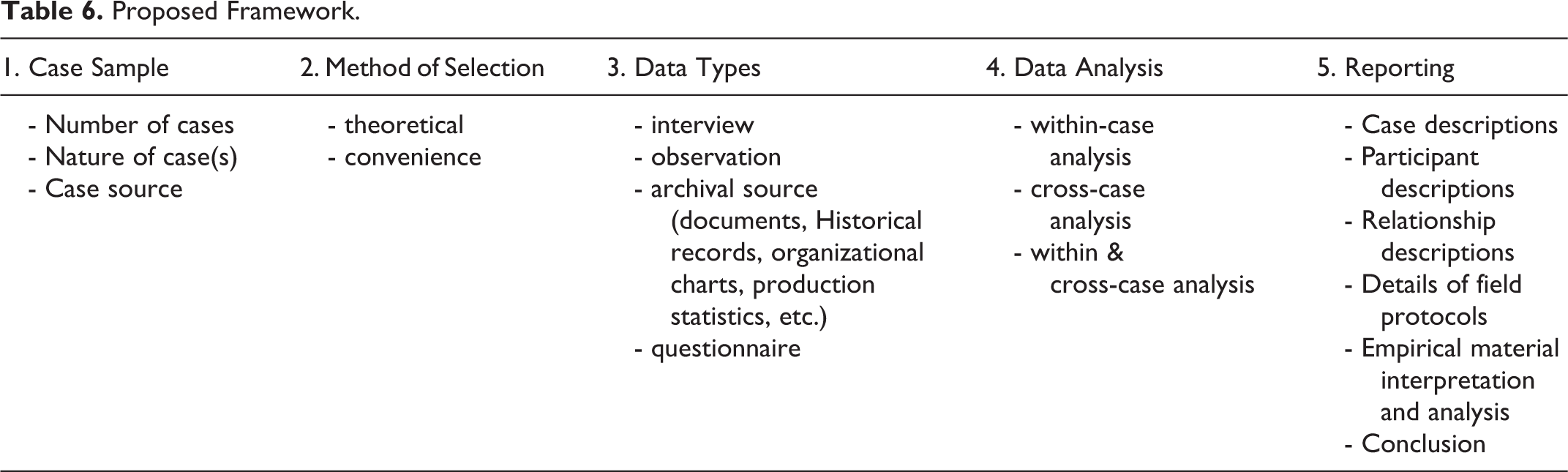
This paper seeks to update our understanding of conducting and reporting good case study research in Operations Management. With this in mind, our main research question focuses on how case method has been applied in current operations management literatures. Since, by reviewing almost all the literature on case study methodology, we try to develop a comprehensive framework to help researchers use the case study methodology in their research. Since our focus has been on theorizing in case studies, we suggest that the research’s starting point is case selection, which includes determining the case’s nature, the number of cases, and. In the next step, we have to set our selection method, for example, theoretical sampling or convenience sampling. After that, in the next step, we need to choose gathering data that includes four methods (see Table 6). We should then decide how to analyze the data based on Barratt et al. (2011), shown in Table 7.
Proposed Framework.
Literature Review of Empirical Research in OM Research.

This process is almost the same for any empirical study; compare, e.g. to the methods proposed by Smith (2014) and Voss et al. (2002). But we add one step end of the research process that ultimately presents the research’s achievements to the audience. Although researchers like Eisenhardt (1989), Stuart et al. (2002), and Barratt et al. (2011) referred to this stage generally, we pointed out the components of a complete report according to Rashid et al. (2019). The last step of the process is the reporting phase, where the description of cases and participants is presented. It also documents the details of research protocols, empirical material interpretation, and analysis. The report concludes with a summary of the case profile, facts, and resolution of the problem under study.
We believe that researchers can use this framework as a checklist in their research with case study methodology.
This article intends to provide a general framework for designing, developing, conducting, and reporting case study research and describing some recent case study research methods in operations management. For further studies, researchers in other fields can use our framework to see whether the articles published in their field cover the framework or not. Also, the researcher can develop the proposed framework in other case study strategies.
Footnotes
Declaration of Conflicting Interests
The author(s) declared no potential conflicts of interest with respect to the research, authorship, and/or publication of this article.
Funding
The author(s) received no financial support for the research, authorship, and/or publication of this article.
