




Abstract
Background:
The effects of waste on the environment and human health continue to increase despite behavioral, technological and policy actions for the management and minimization of waste. We plan to undertake a realist review of waste management and minimization interventions within New Zealand to inform effective approaches to waste minimization and management interventions. This protocol paper describes the steps of the realist review, including the objectives, theoretical frameworks and steps used.
Methods:
Realist review is a theory guided approach that seeks to understand the context-mechanism-outcome configuration of an intervention and generate insights on what works for whom, under what conditions and how. The protocol presents an integrated working theoretical framework comprising of three social theories (Social Learning Theory, Collective Action Theory and Social Practice theory), set within an indigenous Māori implementation framework, He Pikinga Waiora. The initial program theory generated from a first stage rapid review is presented. This initial program theory will be tested through a full literature review and analysis, as well as participatory sense making workshops with key stakeholders.
Discussion:
The review will help to generate insights on the generative causal mechanisms of waste minimization interventions in the context of New Zealand. This protocol emphasizes the initial program theory of change as a starting point for further review and design of improved interventions for waste minimization. Through identifying and testing the program theory, with insights from both indigenous and social practice theories, the proposed review will support the design of policies, programs and activities required to achieve the desired outcome of waste minimization in the context of New Zealand.
Introduction
New Zealand faces significant challenges of managing waste arising from industry, transport and households, including emerging issues of micro-plastics and other contaminants of concern which seriously hamper the aspiration of achieving environmental sustainability (Clunies-Ross et al., 2016; Ministry for the Environment & Stats NZ, 2019; Stewart et al., 2016). The waste has caused serious pollution, affecting human health and causing irreparable damage to the environment in terms of ecosystem degradation and loss of biodiversity (Ministry for the Environment & Stats NZ, 2019). One persistent challenge in New Zealand is effective solid waste minimization and management practices, and it is this challenge which is addressed in this protocol. Solid waste minimization and management is a major issue for communities, businesses and local authorities (Melville & Middleton, 2009; Ministry for the Environment, 2019c; WasteMINZ, 2018).
The effectiveness of current interventions in reducing and recycling solid waste is patchy and slow. Ministry for the Environment (2019b) reported that waste levy introduced in 2008 was less effective as the levy price was set very low and applied to only few landfills. Innovative waste frameworks are emerging and slowly being adopted, such as 6Rs (rethink, refuse, replace, reduce, reuse, recycle) (Office of the Prime Minister’s Chief Science Advisor, 2019), a focus on the circular economy (Circular Economy Accelerator, 2018; Ministry for the Environment, 2019a), product stewardship (WasteMINZ, 2020) and rethinking the plastics design and production system (Office of the Prime Minister’s Chief Science Advisor, 2019). Despite this, for a variety of reasons individuals, communities and agencies are yet to fully actualize the benefits and impacts of effectively managing and minimizing waste. The waste system can be defined as the interaction of policies, governance, resources and infrastructure both nationally and locally, which affects both consumption and production patterns. Current interventions often focus on the consumer behavior as the source of waste problem (Ministry for the Environment, 2019d). As a result, interventions often target individual behavior, including waste segregation, household composting, commercial composting and recycling (Ministry for the Environment, 2019c). Most of these interventions adopt various behavior change models to educate and motivate individuals and communities to uptake new behaviors (Wellington City Council). Such approaches ignore the historical and social contexts driving the adoption, modification and persistence of behavioral habits. In addition, the structural factors driving the behaviors are often missed, such as poverty, a plastic-driven economy, waste policies, resources directed toward waste disposal compared to waste minimization, and availability of waste data.
Some commenters argue that individual behavior change approaches are limited in their effectiveness, particularly for complex environmental and health protection issues (Cohn, 2014; Maller, 2015; Shove, 2003). Waste is a complex issue which requires a combination of theoretical and methodological orientations to understand and address. There have been calls to move beyond behavioral change interventions and focus on an alternative interventions based on systems thinking (Seadon, 2010), social practice theories (Shove, 2010) or indigenous thinking (Magni, 2017). Systems thinking provides a holistic view of the issue and helps shape intervention through understanding how interaction between key elements of a system produces certain outcomes (Seadon, 2010). Social practice theory helps to understand the interaction of social structure (social stratification, institutions, resources, tools, rules and meanings that affect agents’ decisions) and agency (capacity of an agent to act freely and independently) that shapes group practices as well as the trajectories of such practices over time (Blue et al., 2016; Maller, 2015; Shove, 2010; Shove et al., 2012). Social practices are nested within historical and social contexts (Hargreaves, 2011; Shove, 2010). An indigenous thinking or knowledge lens provides an alternative to western science. There is global recognition that indigenous knowledge systems have potential to protect and sustain environment for future generations (IPBES, 2019; Magni, 2017). In the context of New Zealand, Māori (the indigenous people of New Zealand) feel a strong sense of responsibility as kaitiaki (guardians) of the local environment, based on Māori worldviews and cultural practices (Kawharu, 2000; Roberts et al., 1995). In New Zealand, projects to protect the environment are being increasingly led by Māori communities and based on mātauranga Māori (Māori knowledge) (Barrett et al., 2019; Hepi et al., 2018). However, Hepburn et al. (2019) stressed the need for structural and functional transformation of the current government system before these culturally based interventions can be fully effective. The sustainable cultural practices that connect Māori to the land, water and sky have been long displaced by the socio-economic system that is rooted in colonization, capitalism and unlimited economic growth.
This paper describes an approach to reviewing waste minimization and management interventions in New Zealand, for the purpose of supporting effective intervention design. A realist review approach is taken, with a specific interest in interventions that align with Māori ways of knowing and viewing the world. Protocol papers are a common practice in health-based realist reviews as a way of providing transparency and accountability (Coles et al., 2015; Mukumbang et al., 2016; Penney et al., 2015). The objective of this paper is therefore to outline the protocol, including the objectives, theoretical frameworks and steps used in the realist review.
Realist Review Process
Realist review is a theory-driven approach that acknowledges the inability of scientific endeavor to completely understand complex reality, requiring iterative reflections to interpret the impacts of an intervention (Cooper et al., 2017; Justin Jagosh, 2019; Pawson et al., 2005). A realist review focuses upon understanding how social interventions work (or fail) within particular contexts. The whole review process constantly undergoes theoretical and empirical triangulation, making realist reviews distinct from other evidence review approaches in generating a richer and pragmatic understanding of complex interventions (Cooper et al., 2017; Pawson et al., 2005).
One key assumption of a realist review is that all interventions are guided by implicit or explicit program theories and that understanding program theories can help illuminate the complex causal mechanisms of interventions. These program theories can be made explicit by identifying the context-mechanism-outcome (CMO) configurations within interventions and making sense of their connections, interactions and meanings (Justin Jagosh, 2019). The review aims to undertake a theory-guided approach to review interventions designed to influence waste minimization practices in New Zealand and present a program theory of change. The protocol was constructed collaboratively and iteratively by the five Social Systems team members based at the Institute of Environmental Science and Research. The research team has extensive knowledge of local waste management and health systems, and this enabled robust discussion on the conceptual framing of the realist review steps. Figure 1 shows the protocol outline, illustrating the 10 process steps adopted in this study based on the Realist And Meta-narrative Evidence Syntheses: Evolving Standards (RAMESES) guideline (Wong et al., 2013). The first five steps relate to the development of the initial program theory (IPT), and the next five steps outline the rest of the review process.

Steps of realist review of waste minimization interventions targeting social practices.
Define the Concept of Positive Waste Minimization Practices
The first step was to focus the review by defining the concept of positive waste minimization practice as the desired standard for interventions. The desired intervention outcome was defined as groups and communities adopting pro-environment and sustainable waste minimization practices based on their personal, cultural and/or social values and beliefs. Factors such as the level of formality of the group, organizational structures and functions, and existing policies were all considered to influence such practices.
Develop a “Social Practices Change” Theoretical Framework
To develop a theoretical framework for the review, a range of theories were explored that might explain the desired social practices shift to waste minimization. Team members agreed that the framework should be based on a combination of behavioral, sociological and indigenous theories due to the complex nature of the waste minimization system. In the context of New Zealand, publicly funded research is encouraged to incorporate Māori worldviews and knowledge systems. The team looked to the interface of mātauranga Māori and western approaches to develop an integrated working theoretical framework (Figure 2) comprising of three social theories (Social Learning Theory, Collective Action Theory and Social Practice theory), set within a Māori intervention implementation framework—He Pikinga Waiora (Harding & Oetzel, 2019; Oetzel et al., 2017).

Integrated framework for waste minimization interventions realist review.
He Pikinga Waiora (meaning ‘enhanced wellbeing’) is a framework for evaluating and designing interventions for indigenous communities. It is based on a kaupapa Māori approach (an approach where Māori worldviews guide all processes) and is placed centrally in the review framework. He Pikinga Waiora has four elements: cultural-centeredness, community engagement, systems thinking, and integrated knowledge translation. These are shown in Figure 2 as encompassing the three social theories (Harding & Oetzel, 2019; Oetzel et al., 2017). These social theories provided different perspectives on the overall system, from individuals to communities to whole systems.
Social cognitive theory draws from cognitive psychology, sociology and political science and has been widely applied in public health research and practice to understand and address behaviors such as smoking and alcohol consumption (Glanz et al., 2008). The theory recognizes environmental influences on individual behavior and efforts to change the environment to benefit the group. This theory is useful for understanding individual waste minimization behaviors and practices including recycling efforts, minimizing food waste, and composting.
Collective action theory focuses on understanding cooperative behavior among individuals to tackle a social issue (Gram et al., 2019; Holahan & Lubell, 2016; Medina, 2013). The theory considers the mechanisms behind rational individuals’ decisions to coordinate their efforts, i.e. what conditions allow and sustain collective action. The structural elements of collective action although necessary, are not sufficient to explain the eventual outcomes. This is because humans, as social animals, do not always act in a rational, self-interested way, and factors such as language, habits and cultural expectations can work both toward and against coordinated action. Collective action theory is therefore a tool that encompasses both structural and social influences.
Social practice theory emphasizes understanding everyday practices or routine behaviors on a community and society scale, which change across time and space (Blue et al., 2016; Shove et al., 2012). Social practice theory posits that the combination of social meaning, material arrangement and competencies determine the emergence, sustainability, replacement or modification of a social practice (Shove et al., 2012). For example, cycling is a social practice that is affected by how people view the purpose of cycling (for health or because they are unable to afford a car), the availability of cycles and cycleways, and the general level of cycling skills in the population. The unit of analysis for social practice ranges from everyday practices in a community through to political practices within government. Many such social practices interact and interlock to produce a ‘wider system of interlocking practices’ that can explain shifts in social practice over time (Strengers & Maller, 2014). In terms of waste management and minimization, the social practice lens can provide a critical lens to understand how practices emerge, have shifted over time, and whether past sustainable practices can be recoverable.
These three theories represent different analytical lenses for the review and are nested within He Pikinga Waiora as a core framework, as shown in Figure 2. This integrated framework will be used to develop and analyze program theories from CMO configurations identified through a literature review (Punton et al., 2016). This will aid moving from specific program theories within individual interventions, to a more generalized theory that might guide the design of new interventions.
Rapid Document Review to Support Initial Program Theory
Ten pieces of literature were selected in an initial rapid literature review, covering academic and gray literature (Table 1) (Blumhardt, 2018; Kawharu, 2018; Matata-Sipu, 2018; Ministry for the Environment, 2017; Pauling & Ataria, 2010; Piddock, 2018; Simon et al., 2019; The Councils of the Wellington Region, 2017; The ReMakery; Tucker & Farrelly, 2016). The criteria for selection were: relevant to the topic of waste management and minimization from New Zealand; detailed enough to identify context, mechanisms and outcomes; published within the last 10 years; and, Māori initiatives or viewpoints were given priority.
Description of Documents Selected for Rapid Review.

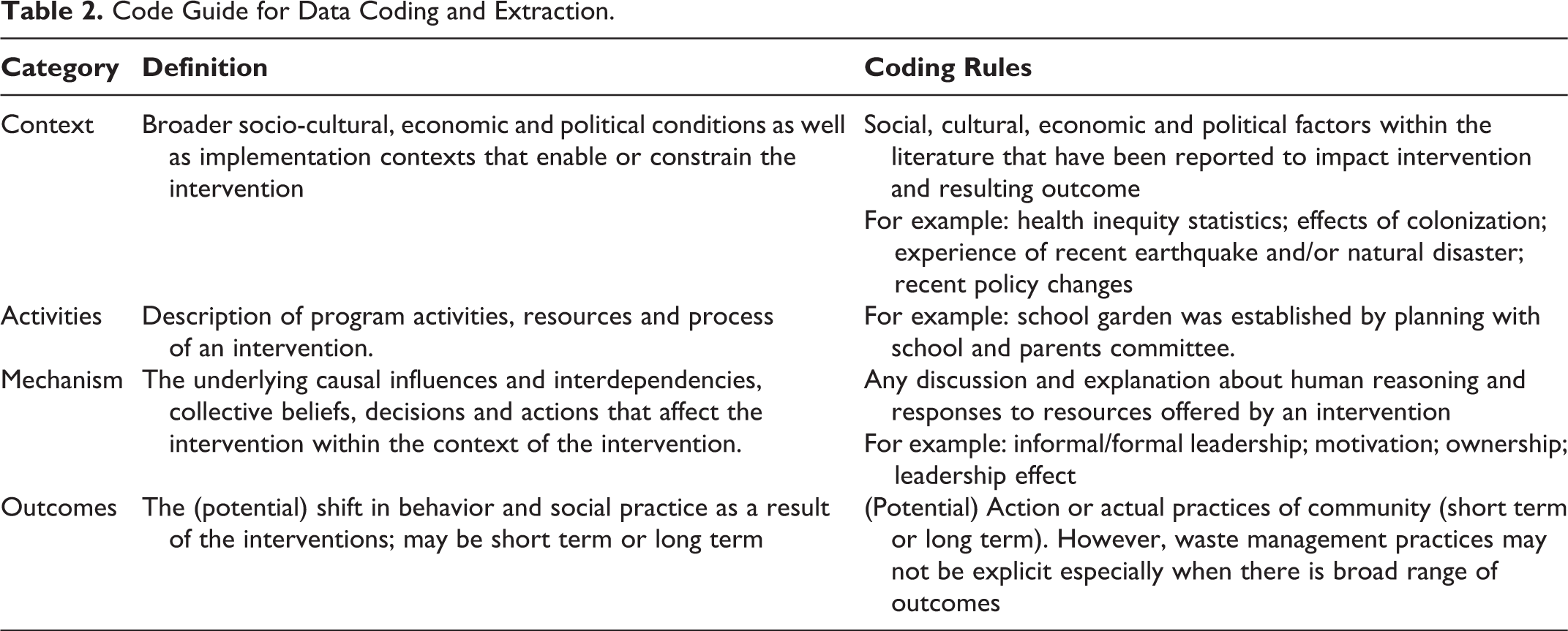
All team members were involved in the coding of the selected literature. This process also ensured all team members were engaged in defining codes and sub-codes, and developing codes tree for the main full-text review. As outlined earlier, the selected literature was coded for context-mechanism-outcome configurations, as well as the activities carried out (see code guide in Table 2). Activities were coded to distinguish them from mechanisms but were not included in subsequent analyses.
Code Guide for Data Coding and Extraction.
Develop Initial Program Theory (IPT)
The integrated theoretical framework guided analysis of the CMO configurations that were derived from the initial rapid review. CMO configurations for each piece of literature were cross tabulated with three interlinked levels: community, local agency and policy actors. CMOs from the literature were reviewed multiple times to identify patterns across interventions and at different levels, which in a realist review are known as demi-regularities (J. Jagosh et al., 2012). Demi-regularities across CMO configurations were the basis for the propositions that make up the IPT. Table 3 presents these demi-regularities as propositions, which together constitute the IPT for the review. This IPT will be further improved through stakeholder interviews and then developed further through the subsequent stages of realist review.
The Initial Program Theory (IPT) for Waste Minimization Practice in New Zealand.
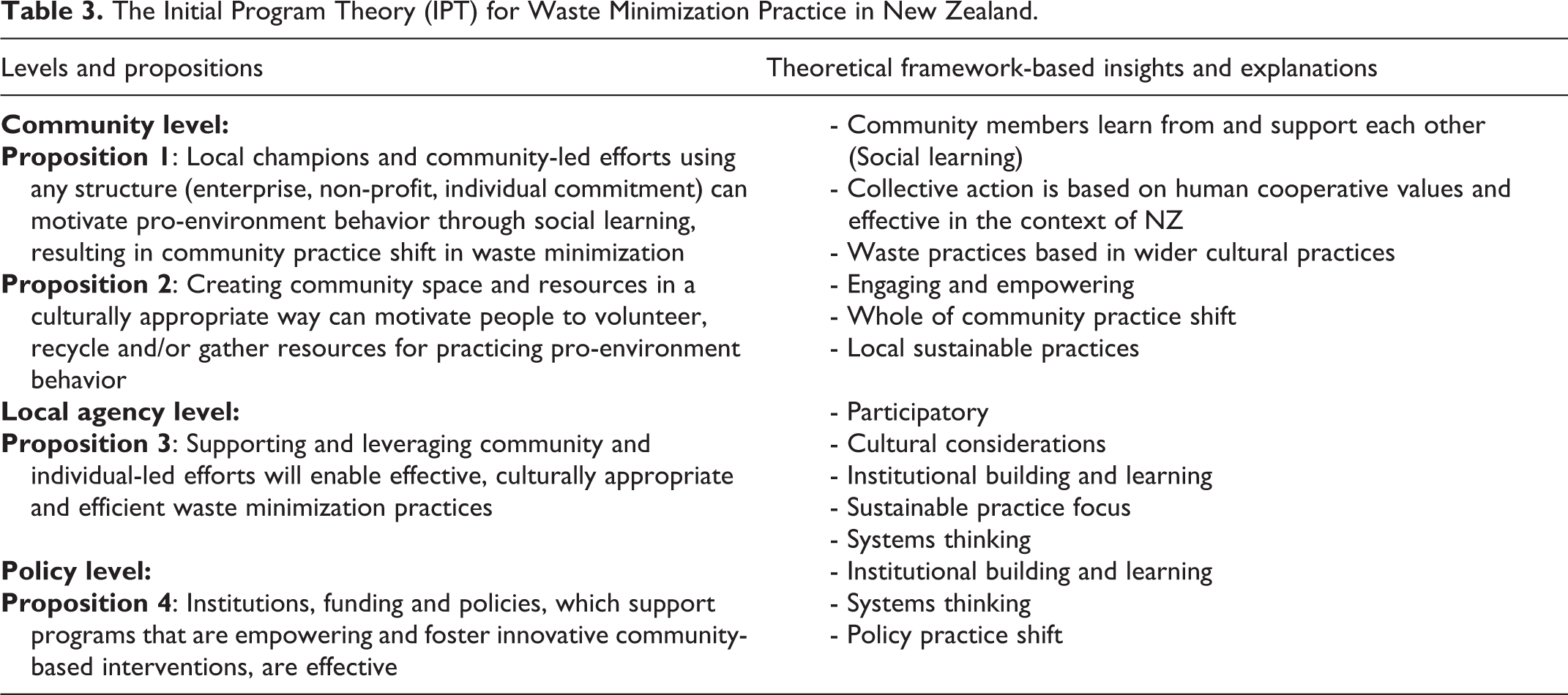
The community level propositions highlighted that community initiatives generally started from concerned individuals who championed sustainable or pro-environmental behavior, often founding an organization of some sort around them. These champions were role models, mentors and educators to a wide range of people, and effects rippled out from them. For Māori initiatives, interventions were most successful when the champion was also Māori and drew on Māori worldviews. Physical community spaces with activities, resources and a meaningful purpose, created environments of social learning where the champions were in a position to influence others.
The local agency level proposition recognized that outcomes could be achieved by engaging with community initiatives in a strategic way while also fulfilling their required service roles in waste management and disposal. However, gaps existed in understanding the complexity of the waste issue, including differing cultural perspectives, as well as in effectively collaborating with communities, iwi, hapū and whanau. 2 Council leadership and support for community initiatives was vital for sustainable waste management.
Finally, at the policy level the proposition emphasized creating a systemic structure that allowed for support of community-based waste minimization interventions, alongside waste disposal services. For example, there were indications that appropriate policies and funding have empowered innovative community-based waste minimization programs (The Councils of the Wellington Region, 2017; Xtreme Waste, 2006). However, shifts in social practices were not possible without coordinated government structures and mechanisms at both the local agency and policy level.
Interviews to Refine Program Theories
Key experts and practitioners will be interviewed to refine the IPT and then to supplement the final program theory that will be based on a full literature review and analysis. The intention is to interview 10 waste minimization practitioners and experts on existing and emerging practice specific to the New Zealand context. As discussed earlier, one of the aims of this review is to identify theories and approaches with potential to influence social practices that are based within Māori settings and draw on mātauranga Māori. Therefore, the review team aims to privilege a Māori perspective by conducting interviews with about five Māori experts. All interviews will be transcribed, coded and analyzed using CMO configuration and the integrated theoretical framework.
Select Literature for Full Text Review
This step is the selection of a range of literature relating to waste minimization in the New Zealand context, using similar criteria to the initial rapid review. Literature may include research articles, reports, perspectives, field reports, case studies, web information or other gray literature. The literature will be searched in, but not limited to, the Web of Science, ProQuest Central and PubMed databases. Further searches will be carried out utilizing Google and Google Scholar search. The search will use combinations of the key words and their variations: waste minimization practice [Waste, Waste, Solid Waste, Recycle (ing), Compost (ing), Refuse, Landfill, Food-waste], intervention (Policy measures, Management, Behavior change, Minimization, Reduction, Prevention and Māori (Indigenous, Culture). In addition, the research team’s relationship with experts in the waste minimization field in New Zealand will be leveraged to find specific examples of interventions, particularly those relating to mātauranga Māori. Interventions aiming at any level (community, local agency, policy or multi-level) and with any scope (broad or narrow) will be reviewed if the research team considers them to be relevant to the review. The team has set the broad inclusion criteria to provide breadth to the literature search but acknowledges the limitation to only English-language literature.
Extract Data
The data will be extracted utilizing the code guide (Table 2). The Dedoose (2016) data analysis software will be utilized for coding and analysis along with collaboration and cross-checking among the research team. Data extraction will be done by two lead researchers within the research team. Extracted results will be regularly shared by lead researchers with the wider research team to enhance transparency and consistency, and resolve any questions and discrepancies relating to coding and interpretation. The research team will critically review the extracted data, re-read the selected studies if necessary and participate in several intensive team discussions to synthesize the evidence across studies.
Data Analysis and Synthesis
The data analysis and synthesis will focus on identifying CMO configurations and underlying program theory guiding the intervention for each of the selected pieces of literature. As with the initial review analysis, the aim will be to assess if the program theory explained: how, why and in what circumstances did the programs produce certain outcomes; and, what were the underpinning causal mechanisms and contextual factors? The team will compare findings with the IPT utilizing the integrated theoretical framework. This may mean adding new or modifying propositions or removing existing propositions to generate critical insights and improve the IPT.
Test and Refine Program Theory
Two participatory workshops are proposed, one with interview participants and the other with non-participant experts, to make sense of findings, generate insights and refine the IPT. A reflection on how the theory may be applied in different science, policy and community areas would also be carried out. A revised working program theory will be shared with all the participants for their final feedback. The final program theory will take into account this last feedback from workshop participants.
Disseminate Revised Theory
The results will be disseminated through a workshop with key stakeholders as well as publications, possibly in the form of policy briefs, newsletters or journal articles. The research team aims to contribute to learnings relating to both waste minimization interventions in New Zealand as well as the realist review approach to address similar complex issues.
Discussion
This section reflects on the realist review approach and process adopted in this protocol to review waste management and minimization interventions in New Zealand. Calls for effective interventions to address numerous environmental issues, including waste issues, are increasing as the effects are being felt across multiple sectors (Ministry for the Environment & Stats NZ, 2019). Such interventions are inherently complex as they have to consider multi-level determinants and social contexts that may affect the target social problems (Byrne, 2013), in this case waste minimization. Arguably, critical insights on generative causal mechanisms of such complex interventions are required to shift toward desired social practice across individuals, households, communities, businesses and government agencies. Realist review methodology helps identify those generative causal mechanisms, and contextual factors required to activate those mechanisms and achieve the desired outcome. Through identifying a program theory, the review aims to support design of policies, programs and activities relevant to New Zealand context and inclusive of mātauranga Māori.
The steps adopted in this review (Figure 1) are often overlapping and researchers are required to move back and forth for better iteration, testing and finalization of the program theory. From a realist perspective, however, the final program theory in itself is not complete and needs to be continually updated as new evidence emerges. Such step-wise approaches have been adopted for realist review across areas of health and other complex social issues (Coles et al., 2015; Cooper et al., 2017; Keady et al., 2012; Mazzocato et al., 2010; Mukumbang et al., 2016; O’Campo et al., 2015; Penney et al., 2015). While there are some variations in the processes, common aspects are utilizing a theoretical framework, identifying the IPT, understanding CMO heuristics for each intervention and stakeholder-based sense making.
The study will emphasize an indigenous worldview and engage in sense making sessions with practitioners. The participatory sense making approach is well established within realist review approaches (Pawson et al., 2005; Rycroft-Malone et al., 2012). In particular, indigenous perspectives are increasingly recognized as sustainable practices useful to prevent the current environmental impacts (IPBES, 2019). In the context of New Zealand, a social practice focus is incomplete without the recognition and guidance of Māori worldviews and expert practitioners. For example, Māori belief and values like kaitiakitanga, i.e. guardianship of the native land and environment, can guide social practice interventions in a culturally appropriate and sustainable way (Walker et al., 2019). Currently western science-based approaches continue to dominate the research and practice over indigenous approaches, and are not proving to be effective (Magni, 2017; Smith, 2013). This review will help illuminate different theories and perspectives of mātauranga Māori to help design social practice interventions based on both western science and indigenous knowledge in the context of New Zealand.
Footnotes
Acknowledgment
We would like to acknowledge the ESR SSIF committee and internal peer reviewers at ESR for comments on improvements to the protocol.
Author Contributions
SRS and MW conceived and drafted the initial manuscript. MW, VB, MH and SM all critically reviewed and revised the initial manuscript. SRS and SM prepared the final manuscript. All authors read and approved the final manuscript.
Declaration of Conflicting Interests
The author(s) declared no potential conflicts of interest with respect to the research, authorship, and/or publication of this article.
Funding
The author(s) disclosed receipt of the following financial support for the research, authorship, and/or publication of this article: This study was funded by the Institute of Environmental Science and Research (ESR) Strategic Science Investment Fund (SSIF) originating from the Ministry of Business, Innovation and Employment, New Zealand.
