




Abstract
This paper presents the use of thematic collages as a methodological innovation to participatory photography as a research framework. Participatory photography was used to understand the subjective “off-script” motivations behind the full or partial adoption of Zero Budget Natural Farming (ZBNF) by members of women’s self-help groups in Andhra Pradesh, India. The addition of thematic collages to existing participatory photography methods was developed as a mechanism to better support the dialogic generation of new Freirean “generative themes” for investigation by a group. Further, the use of thematic collages invites the integration of “renegade” or non-thematic images into participant group analysis. ZBNF is an agricultural practice that has become an extension priority in Andhra Pradesh. It emphasizes the use of defined chemical-free inputs and regenerative farming techniques as a holistic approach toward socio-ecological resilience. As part of an interdisciplinary research project, this participatory photography design was piloted parallel to a soil science experiment in three geographically distinct agroecological zones in Andhra Pradesh. We show how participatory photography, with the novel addition of thematic collages, can be integrated into interdisciplinary research as a method to discover the underlying motivations to adopt agricultural practices and participate in agricultural movements like Zero Budget Natural Farming.
Keywords
Introduction
This paper presents a participatory photography methodology developed to understand the subjective motivations behind the full or partial adoption of Zero Budget Natural Farming (ZBNF) by members of women’s self-help groups (SHGs) in Andhra Pradesh, India. ZBNF is an agricultural practice that emphasizes the use of defined chemical-free inputs and regenerative farming techniques as a holistic approach toward socio-ecological resilience. Using an interdisciplinary approach, a participatory photography activity was piloted parallel to a soil science experiment in three agroecological zones in Andhra Pradesh. The ongoing soil science experiment is testing the soil health and microbial activity found in ZBNF fields and comparing the results to organic amendment and chemical farming plots. Successful interdisciplinary research presents a range of challenges, however. Among these is the imperative for the differing disciplines to achieve an understanding of a phenomenon that is greater than the sum of what each inquiry may reveal independently. While the natural sciences can explain, for example, whether or not there are measurable increases in crop yield in ZBNF when compared to other methods of farming, they are unable to reveal that increased green cover on the fields invokes a sense of nostalgia, and the memory of a cleaner and simpler childhood among farmers. Understanding how both the objective and subjective impacts can harmonize to drive adoption, or even offset one another, can be achieved through interdisciplinary research. By describing the biophysical processes and their quantifiable outcomes, as well as uncovering the socio-historical subjectivity of ZBNF farmers with its unquantifiable characteristics, our research aims to develop a richer portrait of a complex system that defies one-dimensional analysis.
Central to this aim is the participatory photography method we employed to uncover underlying ZBNF farmer subjectivity—a method in which participants take photographs and interpret them in a group through a facilitated process that incorporates multiple narratives and perspectives into a visual thematic collage. The analytical and critical transition is continuous, as new groups of photographs and analyses then provoke a new set of visual responses. Drawing on traditions of Freire and participatory action-research (PAR), we built on established participatory photography practices, such as Photovoice (Wang & Burris, 1997) with the integration of thematic collages aimed at the investigation of generative themes—an element central to critical pedagogy (Freire, 1970). Embedded within a participatory photography activity, the thematic collage is used to determine themes for group investigation by supporting a transition among the participants from description to analysis. Individual photo responses to a theme are assembled together in the center of the meeting circle to produce group representations in the form of a photo collage, which becomes the starting point for dialogue about the subsequent theme. This process allows for the differing views of participants to be discussed dialectically but avoids the pitfalls of prescriptive influence and hegemony, in that each subsequent photo investigation of a theme results in a subjective response. “Renegade” images—photographs that are outliers, which have been purposefully taken by participants to represent something other than the theme in question—are integrated into the collage, which opens the space for the dialogic analysis of divergent representations.
As participatory action-research, this process enables participants to uncover and critically investigate, through subjective representation and group dialogue, the underlying reasons for the adoption of a heterodox agricultural practice in an environment of competing agricultural extension messaging. PAR approaches can penetrate beneath surface-level reasons for adoption, which are invariably based on the influence of official messages, traditional clichés, and “on-script” responses. They can reveal the underlying root causes behind the full or partial adoption of ZBNF. From the perspective of academic research, the etic data from this activity can be analyzed in a number of ways, depending upon the researcher’s lens of inquiry.
Background of the Study
Zero Budget Natural Farming in Andhra Pradesh
ZBNF is a local and regional grassroots agrarian movement and regenerative agricultural practice that has the potential to enhance the socio-ecological resilience of smallholder farmers to climate and land use change. At the same time, it can increase their food autonomy and reduce their dependence on costly external inputs such as agrochemicals, which have been linked with high levels of debt and the resulting phenomenon of farmer suicides across India (Khadse & Rosset, 2019; see also Münster, 2016). In Andhra Pradesh, the expansion of ZBNF is a state-wide agricultural priority that is being facilitated by a centralized organization called Rythu Sadhikara Samstha (RySS), which delivers ZBNF training and advisory services to farmers through village-based Natural Farming Fellows (NFFs). These NFFs are supported at the cluster (group of villages), district, and state level by other RySS agents and officers. Operating parallel to the expansion of ZBNF in the villages is the state agricultural extension system, which promotes conventional agriculture that depends upon chemical inputs and emphasizes monocropping practices.
Participants in our study reported that the messaging from ZBNF NFFs is often competing with messaging provided by the state agriculture extension system. This issue was particularly salient in Anantapur, a dry, drought-prone district in Andhra Pradesh’s southern scarce rainfall zone—one of the three agroecological zones in which we established activities. The other two are the South Coastal Zone (Guntur District) and the North Coastal Zone (Visakhapatnam District). These sites were chosen purposively to mirror the agroecological distribution of the soil science experiment and reflect the different livelihood challenges across the State.
The cadre of NFFs trained in ZBNF by RySS is composed of young, recently graduated agriculture students. In a given community they are able to link with an existing women’s self-help group (SHG) in order to leverage the group’s network as a means of sharing information about ZBNF practices. SHGs have a long history in South India, and specifically in Andhra Pradesh, going back to the 1990s (Tesoriero, 2005). The groups are local institutions, formed with the purpose of implementing microcredit programs to address poverty, and are often supported by local civil society organizations (CSOs). Generally, the objective of the SHG program in India is to promote social and economic empowerment and offer opportunities for capacity building (Tesoriero, 2005). The leveraging of the SHGs was both a strategic and opportunistic decision. These groups already have a history and track record of operation in the villages. According to the NFFs we worked with, the women members are not the primary decision makers on the farm, but the hope was that they would be able to influence their menfolk to adopt ZBNF practices.
Seeking Subjective Knowledge Through Participatory Action-Research
Connections (and disconnections) between objectivity and subjectivity can be investigated through interdisciplinary research. Within the social science hemisphere, a methodology widely used to support participants in their articulation of subjectivity is participatory action-research. This is because subjectivity is not always readily accessible, especially to marginalized and oppressed groups (Freire, 1982). These groups have often internalized the objective descriptions attributed to them and their reality by dominant groups, who possess control “over the means of knowledge production, including control over the social power to determine what is useful knowledge” (Rahman, 1991, p. 14).
The term participatory action-research (PAR) was first formulated by Orlando Fals-Borda, a Colombian intellectual who had a vision of a “science of the common people” that was severed from the notion of detached positivist inquiry (Hall, 2005, pp. 10–11). Broadly, PAR is a methodology, or research design framework, which merges theory with action and participation, while challenging institutionalized academic methods of collecting and curating knowledge. It relies on the accumulation of knowledge through participant action and seeks to advance the interests of underrepresented groups and classes (Fals-Borda, 1987; see also Fals-Borda, 2006).
In order to understand the deeper meanings, root causes, and social context of ZBNF innovation and adoption, a PAR design is ideal. Otherwise, there is a danger from a research perspective that the inquiry never penetrates beyond the “on-script” understanding of ZBNF (the official pronouncements, clichés, and widely repeated opinions). The way we conceptualize “on-script” is derived from Scott’s (1990) notion of a public transcript. While intended to be used as a means of understanding the way dominant and dominated groups moderate their actions, Scott’s concepts of a performative public transcript, and a secret hidden transcript can be applied to different interactions where power is a determining factor, such as the interactions between knowledge holders and recipients (e.g., NFFs and women’s self-help group members in the context of ZBNF), or researchers and the objects of research (e.g., our social science team and ZBNF farmers). The imbalance within these power relationships is mitigated by using participatory action-research and Freirean critical pedagogy methods, specifically, the investigation of generative themes.
As generative themes progressively penetrate more deeply into the lived experiences of participants, or go “off-script,” their “expert” knowledge of the subject matter increases, while the NFF’s expertise decreases. While the NFFs may be the gatekeepers of what constitutes truth, right, and wrong when participants are discussing a theme such as ZBNF innovations, they no longer have that power when participants generate themes themselves. Participant-generated themes are owned by the participants and their analysis of them captures their subjectivity at that moment in time; therefore, the ability of the NFFs to influence or exert their knowledge power upon the dialogical analysis is curtailed. This contraction of the power of the facilitator proportionate to the expanded power of the participant was recognized by Freire (1970), who defined the facilitators as teacher-students and the participants as student-teachers. Other studies of the use of visual methods in participatory action-research have shown this dynamic to be a milestone on the path toward critical consciousness or Freire’s concept of conscientization 1 (Walker, 2018).
The approach we took as social scientists in this study was to use a PAR methodology to move beyond what can be observed, counted, and tested by outsiders in search of an objective “truth.” While seeking to understand an objective, empirical “truth” is not in contradiction to the scientific method employed by our soil science colleagues, we wanted to know more about the way the participants in our study subjectively perceived their historical reality, as opposed to how we (or our colleagues from RySS) perceived it. This distinction was central to Freire, who writes: The concrete reality for many social scientists is a list of particular facts that they would like to capture; for example, the presence or absence of water, problems concerning erosion in the area. For me, the concrete reality is something more than isolated facts. In my view, thinking dialectically, the concrete reality consists not only of concrete facts and (physical) things, but also includes the ways in which the people involved with these facts perceive them. Thus in the last analysis, for me, the concrete reality is the connection between subjectivity and objectivity; never objectivity isolated from subjectivity. (1982, p. 29)
The Advantages of Visual Methods
Broadly, visual methods involve the use and interpretation of photography, film, video, painting, drawing, collage, sculpture, artwork, graffiti, advertising, and cartoons in research (Glaw et al., 2017). While they are now widely accepted in qualitative research and gaining in popularity, they have a history dating back to the 19th century as an ethnographic method (Glaw et al., 2017). Nevertheless, there are still debates in the social sciences about the extent to which visual images, specifically photographs, can be considered “evidence” in an empirical research sense. Becker (2002) addresses the question in the social sciences that asks what pictures can do that words or numbers cannot do. He calls images “specified generalizations” (p. 11): what the images depict are real, showing us real people or places, but what they represent is a “general story of which they are instances” (p. 11). Crafting a general story gleaned from specificity is the purpose of the thematic collage in this study, which will be described in detail in the next section. Glaw et al. point to photo elicitation as a method that uses photographs to generate discussion (2017), but this approach still maintains the observer/informant pattern of research that we have been conscious not to replicate. Therefore, visual methods can be used in PAR, but they can also be used in empirical research that is contrary to the aims and objectives of PAR.
In Pedagogy of the Oppressed, Freire shares an anecdote that is a relevant reminder of the ways that context and prefacing an image matter: The psychiatrist Patricio Lopes was conducting thematic investigations in Santiago. He had hoped to discuss the effects of alcoholism on the community, so he produced an image of a drunken man walking down the street with three men standing on a nearby corner in conversation. Rather than preface the thematic discussion with a moral position condemning alcohol, he asked the tenement residents he was working with to describe what they saw. The participants responded that the only person there who is useful to the country is the drunkard, who is clearly a worker like them. One commented that he saw in the image a man returning home after working all day for low wages and “worried about his family because he can’t take care of their needs.” Another stated that the drunkard is “the only one useful to his country, because he works, while the others only gab” (1970, p. 118).
Freire argues that had Lopes’s image been shared alongside a questionnaire about alcoholism, it would have “elicited” different responses from the participants. In fact, if asked about alcohol consumption directly, the tenement residents may have even denied ever having a drink (p. 118). That the photo was not prejudiced with moralistic framing, however, meant that in “their comments on the codification of an existential situation they could recognize, and in which they could recognize themselves, they said what they really felt” (p. 118). Therefore, seeking to understand simply what a photo elicits among participants can be problematic; the elicitation must be contextualized within a participatory action-research paradigm. This same point is argued by the developers of Photovoice, Caroline Wang and Mary Anne Burris, who state, “photography provides the medium through which people’s visions and voices may surface” (1997, p. 382).
Integrating Elements From Freirean Pedagogy
Photovoice, the most widely known participatory photography methodological design, was developed in the 1990s. Decades earlier, however, Freire and other early practitioners of critical pedagogy were using the analysis of participant-captured photographs as part of praxis, or the action element of critical pedagogy. Wang and Burris (1997) acknowledge that Freirean theories of education—widely known as critical pedagogy and include problem-posing and the identification of common themes through dialogue—form the theoretical basis of Photovoice (p. 370). Critical pedagogy is defined by Ira Shor (1992) as Habits of thought…and speaking which go beneath surface meaning, first impressions, dominant myths, official pronouncements, traditional clichés, received wisdom, and mere opinions, to understand the deep meaning, root causes, social context, ideology, and personal consequences of any action, event, object, process, organization, experience, text, subject matter, policy, mass media, or discourse. (p. 129)
Returning to the Lopes anecdote, had the image been prefaced with a condemnation of alcohol, the participants may have responded with their own “on-script” repetition of a cliché about the negative impacts of alcohol. Instead, they were given the freedom to filter the image through their own subjectivity. Of course, critical pedagogy was not conceptualized to stop at the mere subjective perception of what Freire called an objective-problematic situation, but would require action to prepare participants “for the struggle against the obstacles to their humanization” (1970, p. 119).
While our research to understand the “off-script” reasons for ZBNF adoption did not address the political preparation for a Freirean emergence, a precursor to conscientization, it does not mean the activity explained in this paper cannot be directed toward social change—we argue the opposite. As a research team, we grappled with the notion of initiating what could amount to a partial Freirean replication. Freire (1997) warned against partial replications of his praxis, stating that they could conceivably dilute the process and in fact move away from his proposals for social change. This would apply to an activity or investigation which sought to achieve the goals of critical pedagogy, however—an emergence followed by an intervention into historical reality (Freire, 1970). Our study did not have those aims, which we were transparent about at the outset. Had we begun with those aims, the investigations would have continued beyond a pre-determined conclusion point, and the NFF would have been trained to problem-pose in a role more closely approximating Tilakaratna’s sensitized agent in PAR (1991), with the aim of directing investigations toward a more just world (Giroux, 2011).
Participatory Photography: Using Thematic Collages
The Research Design
We trained three women NFFs—one stationed in each of the three aforementioned agroecological zones—as participatory photography facilitators, and each of those NFFs worked with two SHGs in her respective village. The NFFs’ relationship with the SHGs and their members extends beyond the participatory photography activity because, as mentioned, the NFF interactions with the SHGs form the foundation of RySS’s ongoing ZBNF rural advisory approach. The participatory photography activity was introduced by the NFFs as an independent interaction, separate from the existing engagements they had with the SHGs. SHG members were given the option to participate in this new activity if they were interested.
Each NFF was provided with two simple point-and-shoot cameras; one to share with each SHG. Point-and-shoot cameras were chosen because of their singular functionality and their inability to go “online.” A majority of the SHG members who participated in the study across all of the three districts owned a smartphone, which they were already using to take snapshots. A newly introduced, single function, dedicated camera created an added layer of deliberateness to the act of taking a photograph. We wanted to create a distance between photos taken for the activity and snapshots a smartphone-owning participant might take independently. Additionally, offline cameras prevented images from being shared in advance of meetings over WhatsApp or other messaging services. When participants borrowed the NFF’s camera, they were conscious that they were using it for their thematic investigation.
The NFFs resided in the village and were known to SHG members. However, they were also outsiders because RySS’s policy dictates that NFFs cannot be stationed in their home communities. Each SHG we worked with had between eight and ten members. The SHGs comprised a mix of participants—both landowners and tenants with varying degrees of power within the group—including farmers who had fully adopted ZBNF practice, farmers with partial ZBNF practice, and non-ZBNF farmers. Because the groups we worked with had already been established as SHGs, it made the process easier in terms of establishing trust and securing time commitments from the members. The disadvantage of this was that we were unable to address power imbalances at the time of group formation. These imbalances in power dynamics were a challenge that the NFFs already faced in their regular extension duties and had to continue to manage in the participatory activity. The critical pedagogy training they received helped the NFFs address power imbalances, and indeed they reported that they would continue to use many of these new critical pedagogy skills in their regular ZBNF extension interactions with the group. In total, 52 women participated in the photography activity, with each woman taking between four and five images with the group’s camera. Across three districts and working with six SHGs, the activity produced 221 images with written and translated descriptions.
Thematic Collages, and How the Method Works in Practice
The diagram below (Figure 1) illustrates the overarching process the NFFs followed and can be used as a framework to clarify the underlying process described in the following pages. While the diagram takes the form of a step-by-step description, we do not intend for it to be prescriptive, thereby limiting the freedom researchers have to experiment within a methodology. Our main purpose in this paper is to describe the use of thematic collages and explain the theories that would inform their use within a participatory photography methodology. Researchers would then be free to integrate them into their work and innovate with them in visual methods research in ways that are theoretically consistent rather than attempt procedural replications.

A step-by-step diagram of the activity facilitated by the NFFs.
The participatory photography activity began with the NFF explaining the process to the group. It was important that participants understood the entire process from the outset and knew what to expect. The SHG members were asked to consider what they had in common with one another in the context of their meetings with the NFF (as opposed to their regular SHG meetings when the NFF was not present). Participation or interest in ZBNF farming was the group fabrication mechanism (Latour, 2005) for meetings with the NFFs; therefore, ZBNF Innovations was chosen as a topical theme that every participant could immediately relate to.
After an initial meeting that involved camera training and practice (see Figures 1 and 2), participants met again to reflect before borrowing the camera in turn to each capture an image that represented the topical theme ZBNF Innovations, or in the case of some SHGs, specific pre-selected individual innovations drawn from ZBNF practice such as mulching, or cow-based farming. For the most part, these images were captured in the farms or gardens of participants or their neighbors.

SHG members in Guntur practice with the camera.
During the period between meetings, the NFF printed out the images taken by the SHG members onto A4 sheets and returned them so that each photographer could write a description of her image and how or why it was a representation of the theme, essentially answering the question: why did you choose this image to represent the theme?
Participants arrived at the next meeting with their printed images and descriptions prepared to be shared with the wider group. While seated in a circle (see Figure 3), participants took turns sharing their photos and descriptions with the other SHG members. They discussed each photographed innovation in a dialogue facilitated by the NFF. The NFFs had been trained to play the role of a problem poser. The purpose of the problem-posing was to direct the discussion away from description and toward analysis of a particular theme. For example:
I chose intercropping in ZBNF as the innovation I wanted to share with all of you.
Why is intercropping important?
The income I earn through intercropping goes toward my expenditure on our main crop, therefore it is important.
So, is income the main reason you make an innovation on your farm, or are there other reasons you would innovate?
This initial analytical questioning was preparation for the construction of the thematic collage, which is when the generalized analysis that concludes with the generation of a new theme would take place.
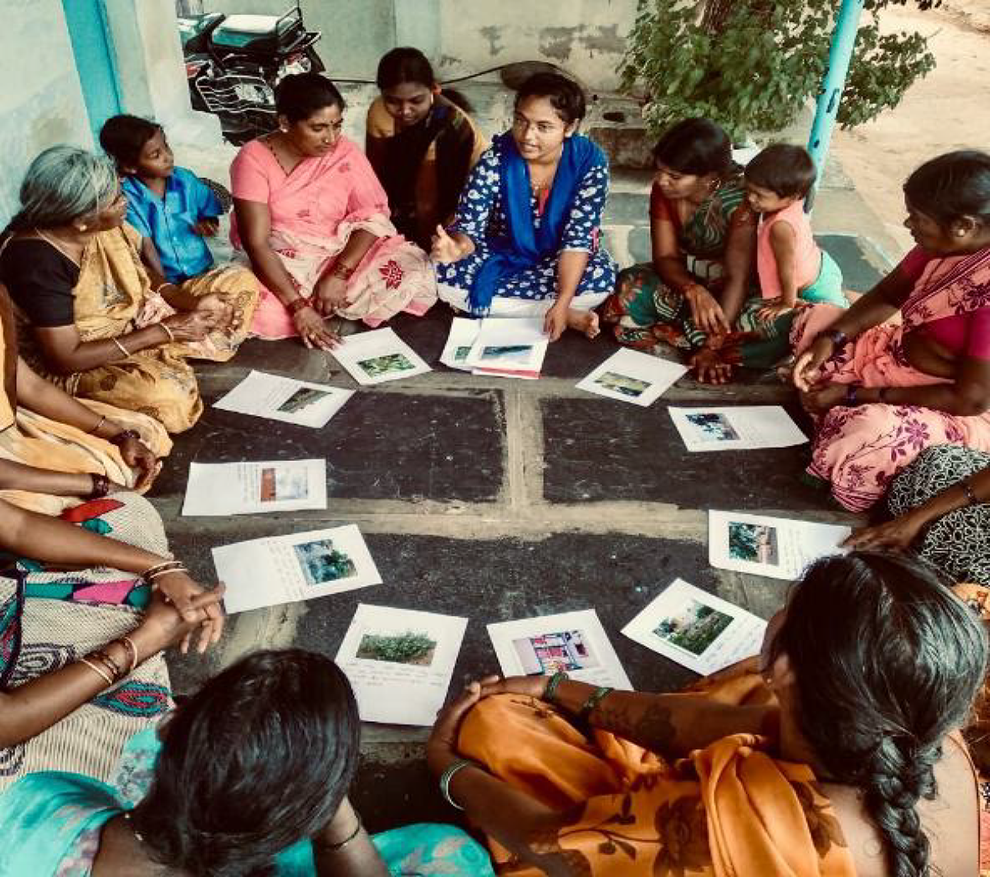
Participants in Anantapur sit in a circle as they discuss the images captured to represent their topical theme.
After all participants had shared their photo with the group, the printed images were placed by the NFF in the center of the circle to form a collage (see Figure 4). A thematic collage takes the thematic representations out of the hands of the individual and places them in the context of the other representations captured by the remaining SHG members. When the individual participants first shared their images, they were specific representations of the topical theme ZBNF Innovations, for example, “My Kitchen Garden.” The collage juxtaposed them so that together they formed a general representation, recalling Becker’s (2002) notion of “specified generalizations.” Focusing attention on the collage, the NFF then indicated that it was now the “group’s representation” of that particular single theme, and she followed it with a discussion about the similarities or differences among the images, asking participants to highlight distinctions that they saw, or comparisons that they found interesting.

Participants in Anantapur discuss their thematic representations using a thematic collage.
With the collage functioning as a singular representation produced collectively by the group, rather than a series of individual images, it opens up what Frank (2010) calls a critical distance—a constructed space necessary for thinking objectively. The differences or similarities between the image elements of the collage become an accessible starting point that leads to a discussion resulting in the generation of the next theme. The thematic collage also brings the group back together to agree upon what that theme will be and reintegrates “renegade” images to the group through the generalization of the previous theme. A renegade image is a photo taken by any participant at any stage in the thematic progression who openly rejects the theme chosen by the group and opts to take a photo of something entirely unrelated (see Figure 5). Capturing renegade images was not discouraged in any way by the NFF because she was aware that the thematic collage would integrate that specified image back into the generalization, and the participant who photographed the renegade image would be involved in the dialogic process of determining, through group consensus, the subsequent single generative theme. While there were not many renegade images taken during the course of the activity, several participants who were not ZBNF farmers rejected the topical theme ZBNF Innovations. At other times, certain participants just chose to return to the meeting with a photo of something that interested them but had no connection to the thematic discussion at hand. Following the conclusion of the meetings, the thematic collage—an ephemeral object of analysis—was disassembled and the original photographs were returned to their owners who retained them.

A renegade image taken by a participant. Note. The topical theme participants were investigating was Pest Management (as a ZBNF innovation). The photographer named her image “The Rest Canopy Beside My Field”. Her description reads: After completing my work in the field, I take rest and also eat food under the shade of this canopy. It benefits me for many other uses as well.
The NFF’s goal during a thematic collage analysis discussion is to help the group achieve consensus on their next theme, without applying influence or direction apart from the aforementioned problem-posing, which was employed to advance thematic discussions from a descriptive to an analytical level. For example, in Visakhapatnam District, participants took photos to represent the theme Integrated Farming.
3
In the following meeting, analysis of the thematic collage, composed of photos depicting diversified income streams, led to a decision to select A Secured Life as a generative theme. In the discussion about integrated farming, participants commented that integrating farming with other sources of income was a means to an end. Relying on more than one income generation method was important because it would lead to a “secured” life in the future, a life in which the women would have enough savings to provide food and education for their children, and live in peace. They set out to take a photo of A Secured Life. The participants met again as a group, and the sequence was repeated again. The subsequent theme, Happiness with Satisfaction, was likewise generated based on an analysis of the A Secured Life thematic collage. That thematic collage analysis sparked a discussion among members of the SHG about childhood memories, family traditions, culture and festivals, ethics and responsibility, the security of one’s life in contrast to the security of a neighbor’s life, and the satisfaction derived from being a master of one’s own fate. As an example, the two images below (Figure 6a and 6b) were taken by the same participant and show clear links to their respective thematic collage discussions. The first (Figure 6a) is her representation of the theme Integrated Farming, an image that she named “Time Saving.” Her description reads: If we have all the things that we need during our day-to-day life, then we don’t have to go outside [the village]. Instead of going out, the time saved can be applied to other work such as tailoring and other things.

Two photographs (Panels A and B) and their descriptions produced by a single participant in Visakhapatnam district.
Her next photograph (Figure 6b) is her representation of A Secured Life. She named this photo “Oral Storytelling,” and her description reads: In the olden days during Jagarana [a period during which people stay up all night while fasting] some programs are conducted such as oral storytelling to keep the people awake. Both children and elders attend this program. The performances are about historical events, which teach children morals, ethics, and how to behave in society. People get together and happily enjoy themselves. But now, the storytelling [during Jagarana] is very rare [she explained that people today prefer watching movies].
While both photographs are specific, subjective representations of a theme as interpreted by the individual, they also form part of a broader generalization of that theme when placed in the context of a collage. The generalization allows participants to analyze the theme objectively, from a figurative birds-eye view, before departing again for a subjective investigation of the next theme, each time moving further “off-script,” but while still on a subjectively logical trajectory anchored by group consensus.
Depending on the group, participants met in total five or six times to conduct investigations of one or two topical themes and three to four generative themes. While the length of the activity in our particular research study may seem arbitrary, it was influenced by time constraints and resources. As far as the research project was concerned, the hope was that by the third generative theme, insight into the “off-script” motivations for adopting ZBNF practice would begin to be revealed. Of course, in isolation, a single “off-script” response might not have any discernible connection to ZBNF whatsoever; however, when taken in the context of the entire thematic progression of an individual participant, or an entire SHG, connections begin to emerge. In reality, not all groups will move into analysis and away from “on-script” descriptions at the same pace. In our study, much of this depended on the group, their level of exposure and investment in ZBNF, and the personality and dedication of the NFF. The two images below (Figure 7a and 7b) are photo responses from the same participant in Visakhapatnam district, and are examples of an “on-script” response to a topical theme (Farming with Natural Resources—a principle of ZBNF) and an “off-script” response to a generative theme (Health), selected by the group after analysis of the topical theme.

Examples of an “on-script” (Panel A) and an “off-script” (Panel B) response from the same participant in Visakhapatnam.
The participant gave her first photo (Figure 7a) the same name as the topical theme, “Farming with Natural Resources.” In her description she writes: By using the desi seeds, which are seldomly available, we can reduce the usage of fertilizers and pesticides. As a result, the soil health has improved. If someone uses the desi seeds the remaining farmers will be aware of it [the implication is that they will clearly notice the quality of the crops].
Her description comes from the public transcript of ZBNF. It contains information that the NFF, or any ZBNF farmer for that matter, could have reported. It is clearly “on-script,” as we would expect from a topical theme. As mentioned, topical themes are introduced by the NFFs and participants have not had the opportunity to layer any of their subjectivity into the theme. Analysis of the thematic collage led to discussion about the positive health impacts of natural farming, and Health was chosen as a generative theme. Health is an abstract concept, open to interpretation, and although it has a clear connection to natural farming, both due to its proximity to the topical theme and to “on-script” associations of “natural” with “better health,” participants could still visually represent it in any number of ways that began to move “off-script,” or in a way that reflects a greater share of their subjectivity. The participant gave her photo representation of Health the name “Sunrise” (Figure 7b). Her description reads: The early morning rays of the sunrise are very good for the health. In the olden days people used to keep small children under the early morning sunlight and then bathe them, but nowadays they are not even allowing a little measure of sunrays to fall on the children. Sunrays are very good for the health.
This representation of Health conjures memories of practices that she believes were once widespread (“people”) and contrasts them with the present day in which they have been neglected or forgotten. The image itself is aesthetically evocative and was clearly consciously composed. In isolation, the image and its description have no discernible connection to ZBNF. When using a thematic collage and placing it in the context of the SHG and responses of other participants—the majority of which connected natural farming to a time gone by, and to a practice that seeks to recapture memory itself—its specificity yields to a generalized subjectivity, which when analyzed iteratively becomes progressively reified. The next theme generated by this group was Good Habits, and in their investigations of that theme participants began to penetrate further into their historical realities and interrogate the contradictions of modern life. These were the “off-script” subjective responses we were interested in revealing as researchers. We echo Wang and Burris (1997) who write, No claim is made that the data that emerge from the process are representative in a social scientific way. But taken together, there may be enough internal and external replication to suggest that the findings provide a reliable picture of people’s priorities at a particular historical moment. (p. 382)
Limitations of the Method
Researchers who seek to establish the same pattern of control in the field that one might encounter in a laboratory will no doubt find dimensions of participatory action-research in general, and participatory photography specifically, problematic. While notions of control in participatory social science research have been, with a few exceptions, discredited, interdisciplinary projects that have been built with pillars that are positivist-leaning may still struggle with clear epistemological mismatches. Hall et al. (1982) point out, Participatory research is not a set of ideas that can be applied at random times with predictable results. It is not neat, it cannot be rounded off to two decimal points, and it is even difficult to translate into charts. It does not eliminate the need constantly to evaluate the political implications of one’s work. (p. 25)
As discussed, there are limitations involved with the partial replication of a Freirean praxis. Avoiding what is known as the “pseudo-Freirean” trap depends largely on the claims being made at the outset of any project or activity. Kidd and Kumar (1981) name some characteristics of pseudo-Freirean education, such as the positioning of an activity as “neutral,” the characterization of poverty as “self-inflicted” rather than systemic, and the proposal to treat the symptoms of root causes with the “transmission of information and skills” (p. 28). Furthermore, problem-posing, rather than a means to reveal subjectivity, is instead used as a mechanism to deliver “pre-packaged information” (p. 29). Generative themes, meanwhile, in pseudo-Freirean methods, are “one-dimensional and flat, incapable of leading the learner to a better understanding… through associative thinking” (Kidd & Kumar, 1981, p. 33). Conversely, Freire writes that generative themes are named so because they “contain the possibility of unfolding again into as many themes, which in their turn call for new tasks to be fulfilled” (1970, p. 102).
The pseudo-Freirean dilemma was carefully considered when developing this methodology, as it rightfully should be by any researcher applying critical pedagogy principles to their investigation. While structured, time-bound academic research must grapple with a number of challenges that render theoretical purity nearly impossible to attain, our position is that those challenges are limited to project parameters, not the method itself, and the above pseudo-Freirean traps and pitfalls of partial replications can be mitigated.
Criticisms of participatory photography methods have pointed to ethical risks associated with power and surveillance (Prins, 2010). These are important concerns that scholars, educators, and activists must balance before choosing to introduce a camera to a group. Prins (2010) suggests that increased corporate and state surveillance through new technologies necessitates the need for a circumspect stance toward photography. One benefit of introducing participatory photography as academic research—as opposed to a political activism program, for example—is that the project has to pass an ethical review, which requires that researchers consider criticisms of a method and explain what measures will be taken to address them. Regarding concerns about surveillance, one of the benefits of using simple point-and-shoot cameras, as we did in this study, is that they are not connected to any network. As mentioned in the section on research design, most participants in all of the SHGs already owned smartphones, which they regularly used to take snapshots. While the risk of surveillance is valid, it is a generally valid risk across the entirety of a society with very high mobile phone ownership rates, not one specific to participatory photography. An organized activity can introduce measures that limit this risk, such as the use of “offline” cameras. While surveillance of SHG member activities by the state or a private corporation was not an identified concern in our study, we recognize that there are contexts in which this praxis might be deployed where it would be a genuine consideration.
A further danger posed to the use of visual methods in general, whether in research or other activities where there is a sponsoring or supporting organization, is organizational capture. Participants are producing media that can be appealing to an organization as material for marketing, PR, reporting, or other functional uses outside of the boundaries of the activity itself. While there is nothing wrong with this per se, a judicious and critical evaluation of organizational intentions is prudent. Capture can occur when someone with power or authority asks ostensibly innocent questions such as “Why can’t the participants take photos of [a priority topic]?” or “Can they focus in greater detail on [a particular issue]?” Again, externally funded academic research can be more resolute against capture, but when an organization is supporting an activity internally, participant subjectivity can be vulnerable to capture, and the dangers of partial replications Freire warns about will arise. A distinction should be made between photography for marketing and reporting purposes and participatory photography, whose goals are substantially different.
Conclusion
We have presented an addition to participatory photography design that incorporates the use of thematic collages into the activity as a method of supporting the dialogic generation of new themes for investigation by a group. This activity was initiated to understand the subjective motivations behind the full or partial adoption of Zero Budget Natural Farming (ZBNF) by members of women’s self-help groups (SHGs) in Andhra Pradesh, India. We have shown how participatory photography can be integrated into interdisciplinary research in the context of agricultural movements.
The imperatives to understand subjective “off-script” motivations—recalling the hidden transcript—do not detract from the importance of surface-level or “on-script” motivations—recalling the public transcript—for adopting particular agricultural practices. In agrarian society, yield is unquestionably important, just as reducing expenditures on inputs is important. Portraying these in isolation as the reasons behind farmer decision making is problematically reductive, however, in much the same way that the blanket logic of neoliberalism is reductive. While positivist research can reveal the extent to which a farmer depends on a market for their material livelihood, to suggest that those quantifiable reasons alone are the drivers of farmer decision making is specious. An interdisciplinary design that includes methods developed to understand participant subjectivity, and the way people involved perceive facts, will provide researchers with a more layered and multidimensional understanding of an issue in context. Participatory photography was deployed in this instance to add those additional layers of understanding, and thematic collages were the central feature of the activity.
Furthermore, we would be remiss to not emphasize that participatory photography is an enjoyable activity. Participants were eager to learn how to use the cameras and take photos of elements of their lives for the purposes of sharing with peers. They were proud of their work and were delighted that they were able to keep the original prints of their photographs. Likewise, the experience was rewarding for the NFF facilitators, who are now confident in their abilities to facilitate participatory photography activities and innovate with the method on their own. One of them responded in her observation notes that the participatory photography research was “one of my most pleasant and wonderful moments in life as I got involved in my favorite and passionate work.” This is not meant to be celebratory, but rather to illustrate the benefits gained from conducting qualitative research with a creative method that participants and researchers alike appreciate.
Because we piloted this methodology within an interdisciplinary academic research project, we faced certain constraints and limitations. First, the time scales of the project (1 year) placed a hard boundary on what we were able to achieve. Additionally, as stated previously, social change or Freirean conscientization among the participants were not project objectives. Further research is needed that will engage with community members for a longer undefined period of time, directed toward the outcomes of critical pedagogy and PAR: an emergence and an intervention into historical reality. Such research would help refine conclusions about the extent to which the use of thematic collages engenders an emergence on the part of participants and allow facilitators more freedom to innovate with the collages themselves, such as exhibiting them for broader community engagement. Working with a partnering organization also meant remaining cognizant of their organizational goals in the spirit of partnership. This relationship involved striking a balance between innovating within a novel methodology and remaining true to our overarching research questions. Our research aims informed the direction of the praxis, which was facilitated by NFFs from the partnering organization. While the use of generative themes allowed participants to depart from the initial topical theme of ZBNF Innovations, the subsequent analyses would invariably be refocused on natural farming. An activity organized outside the boundaries of academia may have more freedom to innovate and continue in perpetuity, or until a fitting denouement.
The purpose of this paper is to highlight the methodology and design innovations developed for this study and piloted in context with six different women’s self-help groups. While examples of data are shown, these comprise emic data—the outcomes of participant investigations. Etic data, or the basis of our empirical academic analysis of the entire sample of photo responses, does not feature within the scope of this paper. That level of analysis is independent of the methodology itself, and we offer no specific prescription in this paper for empirical analysis of data generated by this process. Indeed, there are a multitude of ways scholars may wish to proceed with analysis at the conclusion of a study. Our hope is that visual methods and participatory action-research become increasingly integrated into interdisciplinary research, and subaltern voices and narratives can be highlighted in projects with dominant meta-narratives. And to that aim, we hope that the methodology described here will be subjected to further refinement and advancement.
Footnotes
Declaration of Conflicting Interests
The author(s) declared no potential conflicts of interest with respect to the research, authorship, and/or publication of this article.
Funding
The author(s) disclosed receipt of the following financial support for the research, authorship, and/or publication of this article: This work was supported by the University of Reading’s Research England GCRF (Global Challenges Research Fund) QR allocation.
