




Abstract
In qualitative research, the importance of knowledge production is illustrated by the confidence in logos, that still flags. Although there is significant attention for approaches that are inclusive to the body, affect and non-rational dimensions, these approaches still aim to generate understandings by the appropriation of knowledge. This paper critiques that view and proposes another view of inquiry that centers the praxis of living the questions instead. Here, research is seen as a gradual unfolding of a process. The quest that belongs with this view of research is concerned with how to make space for life phenomena to emerge. We frame this as apophatic inquiry, a non-methodology, as it is not a matter of applying activities in a set of steps. For apophatic inquiry, a process of unknowing and wonder is imperative. The paper discusses how to foster a triadic inter-beingness in a research praxis that fosters the calling forth of and reflection on phenomena. For that, the researcher nurtures awareness and reflection on a triadic sphere of three closely connected spaces: the Inner Space, the Aesthetic Space, and the Wondrous Space. By being receptive to the impressions that unfold within and between these spaces, the research becomes part of a process of living a question in real-time. Thus, living and life itself become the heart of the research.
Introduction
This paper critiques the view of qualitative research as appropriation of knowledge, and proposes another view of inquiry that centers the praxis of living the questions instead. Our approach to research is featured by making space for life phenomena that are the focus of our inquiry to emerge.
According to recognized standards for qualitative research, the purpose of research is to increase the “stock of knowledge” (Frascati Manual, 2015), or to “contribute to new knowledge and to provide new perspectives” in order to improve practices (QOREQ by Tong et al., 2007). In Western countries, the importance of knowledge production is illustrated by the confidence in logos, that still flags (Franke, 2005, p. 161). Implicit is a view of reality as knowable, graspable and representable by following a careful and methodological rigorous approach. Many researchers perceive objects “out there” and understandings about these objects and their relations are considered useful for improving our lives and that of the planet. Positivistic and constructivist views originated in the natural sciences since the Middle Ages and have been adopted by the social sciences and the humanities. Although scholars have contested the validity of positivistic and constructivist views on reality for the humanities, the view that knowledge can give us a hold onto the world by appropriating the world—a world “out there”—still dominates qualitative research.
There has been, however, an upcoming interest in approaches that seek different models for understanding our relationship with the world and qualitative methodology. Think, for example, about new materialist approaches that decenter us as “knowers” and that argue for a view of the researcher as entangled with her material and non-material context. Or take non-representational theory and methodology, that seeks answers to the “more-than-human, more-than-textual and multisensory worlds” (Lorimer, 2005, p. 83). This theory and methodology are accepted to be the successor of postmodernism and based on post-structuralist thought (Vannini, 2015, p. 5). Another significant development in qualitative inquiry is the work of Elizabeth St. Pierre on post qualitative inquiry in an ontology of immanence and empirical transcendentalism (Pierre, 2018). Her work rejects the demands of application of qualitative research and is methodology-free. It centers concepts as vehicles for reorienting our thinking and promotes practical experimentation (Ibid., p. 1).
We also encourage methodology-free and open practices for experimentation. In this paper, however, we will show that we arrive at that point by following a phenomenological pathway. In addition, we would like to introduce something else: an apophatic way (Visse et al., 2019, p. 8). The history of the word “apophatic” goes back to the Greek apophatikós, which means negation or “denial.” In short, apophatic refers to describing something by what it is not. Instead of capturing phenomena that we study by describing or analyzing what it is, in an apophatic approach we would “meander” around the phenomenon, we would not aim to capture it by appropriation but by actively seeking out a relationship with it. Before we go deeper into the practicalities of this approach, we briefly describe its philosophical underpinnings.
We have coined this apophatic inquiry as it is based upon the apophatic traditions of philosophers, theologians and artists in Western and Eastern history. In his philosophy of the unsayable, William Franke (2014, 2007a, 2007b) has worked on rethinking philosophy through an apophatic lens. Such a lens is sensitive to what does not appear in our consciousness or what cannot be said. An apophatic approach favors processes of unknowing and learning through detour, by meandering around phenomena that are hard to articulate, pinpoint, or in other words: the unsayable. In this paper, we present and illustrate how to follow an apophatic approach to inquiry.
In our preceding publication, we theorized this as a poetics of inquiry that is about being open and responsive to phenomena within and by the arts (Visse et al., 2019). In this paper, we will broaden our scope to qualitative inquiry. The purpose of the poetics of inquiry we propose, is to think questioningly (Hubick, 2017), receive “living understandings” (Hansen, 2019) or “truth experiences” (Gadamer, 1960/1975) and become response-able to the call of phenomena in everyday situations. In our previous paper, we argued that by being receptive in an aesthetic, wondrous and spiritual way, the enigma of phenomenality or life itself becomes the heart of inquiry (Visse et al., 2019, p. 7).
The apophatic poetics of inquiry that this paper presents, is a way of non-knowing that points toward the phenomenon, never fully express it, but leans toward it through a silent receptiveness, wonder, metaphor, rhythm and analogy. Here, our approach to inquiry occurs through allowing the working of three interdependent spaces: Inner Space, Aesthetic Space, and Wondrous Space (Hansen, 2015a, 2015b, 2018, Leget, 2007). These spaces are not physical or spaces as objects, but they can be seen as qualities of our awareness.
The paper is structured as follows. It begins with a general description of an apopathic approach to knowing and non-knowing. Subsequently, the three spaces are presented, and their inter-relations. We also present practical exercises that foster living apopathic inquiry through inner space, aesthetic space and wonder.
Apophatic Inquiry
Dimensions of our experience like mood, time and space, or ethical and existential life phenomena like love, hope, joy of life, loneliness, inner peace are all hard to grasp through logos alone. The philosopher William Franke (2014, 2007a, 2007b) studied forms of non-knowing, found in the language of art, philosophy or myth, religion and spiritual wisdom traditions, that offer an alternative. In his philosophy, he draws from aesthetics, negative theology and Eastern philosophical traditions, especially the work of the French philosopher and sinologist and philosopher François Jullien (Franke, 2007a, 2007b, 2014, Franke, 2018; Jullien 2000, 2004, 2016b). As Western philosophers, Franke and Jullien heuristically work with Eastern thought. Franke, in his book Apophatic Paths from Europe to China, discusses the limits of language in the context of cross-cultural understandings (Franke, 2018). He compares the Daoist way of Chinese wisdom with Western apophatic thought that acknowledges the unsayable. Franke builds on the work of Jullien, who closely studies the Chinese classics to rethink consciousness and life by a holistic approach to thinking. Jullien relativizes logos and proposes a Daoist principle that guides our thought, focused on process. These Eastern philosophies infused our thinking on apophatic inquiry.
In an apophatic approach to inquiry we leave the goal to grasp a phenomenon directly, because this would still be concerned with the desire to know and with the process of knowing. Instead of wanting to comprehend a phenomenon by knowing, in apophatic inquiry, we aim to be with a phenomenon in a state of non-knowing that is like seeing-with-the-heart. Being in this realm means being driven by an attitude of letting go of the need to know, of preserving silence and being receptive to pointing to that which we cannot speak of (Visse et al., 2019, pp. 6–7). Art, wondrous thinking or spiritual and contemplative exercises in the apophatic sense are seen as “pointers” toward that, which we can never fully know or linguistically express. The apophatic approach is driven both by a fundamental “linguistic skepticism” (Hansen, 1981; Pisano, 2017), and by a trust and a gratitude in life as such, that it is deeply meaningful despite that it can only meet us on that level as a mystery (Marcel, 1950). The enigmatic phenomenon can never fully be disclosed, but we can “lean into it” indirectly and negatively (by addressing what it is not) through negation and a “poetics of the unsayable” (Franke, 2014; Marion, 2002; Rhodes, 2012).
Here, our attentiveness and gaze move toward receiving a phenomenon or insight passively in silence, which someone can be open toward by being in a listening and dialogical relationship to the world around him/her and others who are part of that world. Some speak of apophatic insights that occur through wonder (Fink, 1983; Hansen, 2010, 2018; Rubenstein, 2011), or being in a saturated silence (Picard, 1952), or being open to enter a dialogue with the artistic work (Davey, 2013) or in an I-Thou-relation with the world (Bresler, 2015; Buber, 2004 [1923]), or, from an ethical perspective, in the moments of seeing the face of the Other (Levinas, 1998). In her paper on aesthetic-based research, Liora Bresler aptly describes that when researchers are in an I-Thou relationship with the subject of their research, the subject “speaks” to them, it addresses them. In an I-It relationship, the subject is “merely” something to study objectively, without it speaking to us in a dialogical way. “This dialogue involves a change of self where the shaping of meaning involved in a “re-seeing,” implies in turn being reshaped by the encounter” (Bresler, 2015, p. 57).
In our previous publication, we addressed that these different articulations share a vision on knowing and non-knowing or being and non-being (being-yet-to-come) as intrinsically intertwined (Visse et al., 2019, pp. 6–7). Here, an “inter-beingness” between the inquirer and the phenomenon is received, gifted through a praxis of indirect inquiry, silence and being in wonder (Hansen, 2018, 2019; Hansen & Jørgensen, 2020). The inquirer and phenomenon (the “known,” the “said,” the It) are not separated in a subjective and objective dichotomy (inside-outside), but are entangled as in a “chiasm” 1 (the “unknown,” the “saying” and the “Thou”). This endeavor requires a radical opening-up. It demands for the inquirer to detach from worldly (instrumental, pragmatic, ideological) concerns in order to become as open and responsive to life as such and to the call of the unknown. This is what Hansen (2018) names the praxis or event of life as such. It is based or called forth by the experience of the phenomenon in question as being a Mystery (Marcel, 1950; Rhodes, 2012). In our previous publication, we argued that our research is then no longer (only) directed toward solving concerns, but on relating to them by “living our questions” (Rilke, 2011, p. 46) through our practice. This includes recognizing their mysterious nature:
“A problem is something which I meet, which I find completely before me, but which I can therefore lay siege to and reduce. But a mystery is something in which I am myself involved, and it can therefore only be thought of as a sphere where the distinction between what is in me and what is before me loses its meaning and initial validity” (Marcel, 1950, p. 117).
Previously, we argued that this requires a praxis of openness and self-forgetting that can lead to an attentiveness to see the phenomenon as if one sees the phenomenon for the first time “…in full glory, as the first morning of a world” (Marion, 1996, p. 77; Marion, 2002).
Praxis denotes a particular way of action that is not instrumental, teleological nor intellectual 2 but is an activity for the sake of itself. This praxis is featured “by a process of thinking via questions,” or “thinking questioningly” (Findlay, 2002, p. 66 citing Patočka, 2002). Through this praxis, possibilities to receive the phenomenon are revealed. Hence, apophatic inquiry is “a praxis of research that is sensitive and open for a work and insights to emanate” (Visse et al., 2019, p. 8 citing Buber, 2004 [1923] and Hansen, 2014, 2018).
Interplay in Triadic Space
In apophatic inquiry, we no longer work with the dichotomy of the subject and the object. Instead, there is a non-differentiation between the phenomenon and its receptor or witness. The distinction between the knower and the known dissolves. In apophatic inquiry, the “In-Between” is where the addressee experiences being addressed by a phenomenon, not “primarily an object to be put to use, or an object of experience: it is the voice of You speaking to me, requiring a response” (Bresler, 2015, p. 39). Here, the self of the inquirer is more of a witness than an inquirer, reshaped by the encounter with the Other, the Thou, instead of seeing it as an “I-I,” “It-It,” “We-We,” or “Us-Them” relationship (Bresler, 2015, p. 57).
Previously, we argued that the phenomenon under study is not a distant object, an “It” for our cognitive I. When we are genuinely experiencing the phenomenon, the process of inquiry becomes a medium for the Thou of the phenomenon to be called forth (Visse et al., 2019, p. 7). Therefore, we speak of a praxis of inquiry that is sensitive to, and open for insights to emanate, and for us to resonate with the Thou of the phenomenon (cf. Buber, 2004/1923; see also Hansen, 2014, 2018).
In everyday research settings, the researcher becomes part of a dynamic and resonant open and unfinalized process of “living” the questions. Researchers subtly move between engaging with the people and events in an “I-It-world,” where the cognitive and conscious self relates to the world “out there.” At the same time, people may have an attentiveness for the “I-Thou-world,” which is also present—but often silently and invisible for the participants. Here, instead of the cognitive self, the heart connects with the world. To live this praxis of apophatic inquiry, ethical care for the self and the soul 3 is imperative. But how can researchers cultivate this? How to practice this?
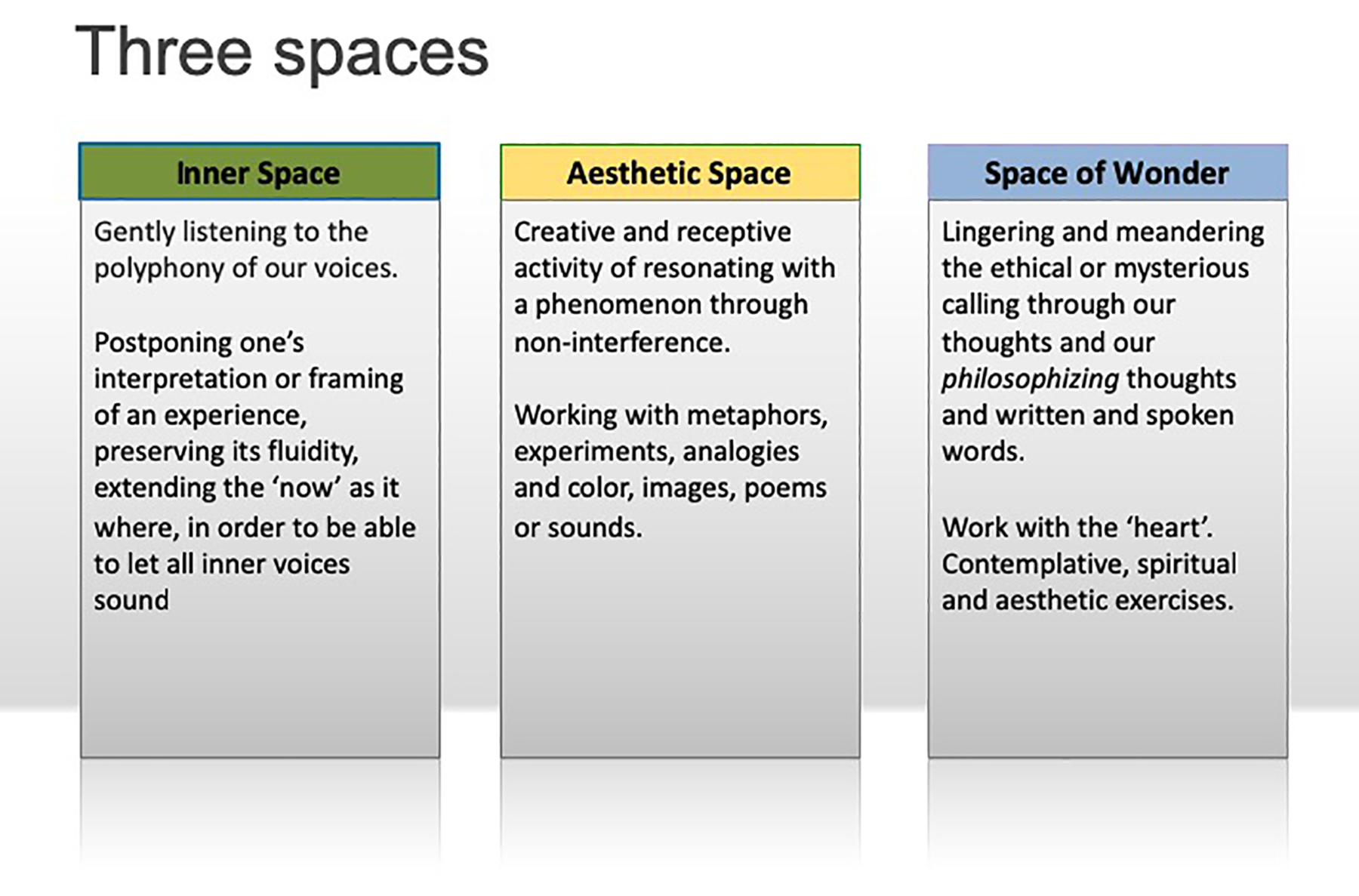
To answer that question, we propose a space in which the interplay in apophatic inquiry occurs. This space is three-dimensional and is not objective in terms of physicality, length or measurements, but it is experiential and qualifies our awareness of the world. The inner space, the aesthetic space, and the space of philosophical wonder are visualized in Figure 1. These spaces are interdependent and not clearly delineated: their boundaries are fluid and we experience them from time to time by a process of attunement. If we see the three spaces as three ways of approaching the unsayable, and if they may or may not be overlapping and combined, the best way of depicting them might be as three partly overlapping circles.

Three spaces.
Inner Space
Marie de Hennezel has worked for many years as a psychologist with dying patients. In her book Intimate death: how the dying teaches us to live (Hennezel, 1998), she tells the story of a friend who has an unusual request. Afraid of the possible perspective of suffering from dementia, he has planned to end his life at a certain age, and asks her to be by his side at the moment of his self-chosen death. The author describes her first spontaneous reaction, confronted with a question that shocks her. She feels resistance, disappointment and even anger: what about all their conversations in which she had told him how life is full of unexpected good events and life confirming surprises? But as she witnesses and dwell upon her inner turmoil, before saying or doing anything, she feels that there is something behind his question: an appeal to their friendship and her support in his loneliest hour. Although she deeply disagrees with his intention, she promises him to be at his side when he might need her most.
This story shows a remarkable quality of our human awareness: the possibility of experiencing one or more feelings, emotions or cognitions simultaneously, combined with the ability to not immediately judge or act. The example of Marie de Hennezel witnesses a quality of postponing one’s interpretation or framing of an experience, preserving its fluidity, extending the “now” as it where, in order to be able to let all inner voices sound. One could call this quality of our awareness “inner space,” using a metaphor that avoids the language of psychology (Leget 2007, 2017).
This “inner space” has an apophatic element: intuitively Marie was aware of the fact that she did not immediately know what was asked of her. Although she did feel a variety of negative emotions, she was not overtaken by them. By keeping the process of experiencing fluid, the appeal she was confronted with revealed to have more layers and dimensions than it might have appeared. By postponing her reaction and judgment it was soon clear to her that one voice in her inner polyphony was the key of the, so to speak, “ethical piece of music” or “call-in-the-moment” that she heard. This key—the appeal to friendship—was literally key to interpreting the cacophony she heard—interpreting, not so much as a deliberate and conscious act, but as an emerging awareness that she was called by something beyond her initiative or control.
Inner space, as a possible quality of our awareness, is something which is needed in many situations and activities. It can also be applied to attitudes and virtues that help dealing with ambiguities, tensions, ambivalences and situations of emotional impact. Inner space is present in every day phenomena like friendliness, politeness, or humor, and is a necessary condition of attentive listening, good conversations and encounters.
It can also assist us in how to carry out a heartfelt research as such: that is, research that is conducted from an open, gentle and loving attitude. Our inner life can be peaceful and quiet or can be filled with upheaval and contradictory “voices.” As our experience of “the self is basically polyphonic” (Leget, 2017, p. 49), this polyphony contains emotional, physical, socio-cultural, political, existential and spiritual voices. Not just from within ourselves, because we are not isolated, autonomous persons who operate independently from others and our socio-cultural, political and existential context. Instead, our inner lives are permeable, interlaced with others and our contexts (Ricoeur, 1995).
Thus, Inner Space not only holds voices of ourselves and the other, but also the traditions we were raised in, the socio-cultural voices that shape us and our practices, and indeed the voice of the subject matter itself, the phenomenon or mysteries that shines through to us. Inner Space not only includes attention for our feelings, but also for our physical experiences, like relief, and spiritual experiences, like awe. Having an awareness of these voices is a prerequisite for deep, aesthetic and wondrous listening during research as such when approached from an apophatic perspective.
Practically, this means we should take seriously the richness of emotional, physical, socio-cultural, political, existential and spiritual voices that sound (and sometimes disturb us) during our praxis as qualitative researchers. When cultivating an Inner Space, the researcher can learn to listen carefully and deal with tensions in these areas, like contrary emotions (Leget, 2007). Attention to one’s Inner Space can support researchers to find a right balance between care for themselves and care for the work and others involved in one’s project, and indeed care for the phenomenon itself. The Inner Space, as we understand it, can work as a means or window to show or give way, the phenomenon, or call of the phenomenon can appropriate us.
The Inner Space must not be confused with being “mindful” or learning to work with “mindfulness” in professional work (Spinelli et al., 2019). The reason is that mindfulness supposes a split between a subject (the mind) considering objects (feelings, thoughts, emotions) drifting by like clouds in the sky. Inner space is more radical in that there is a fluidity between subject and object: it departs from realizing that is not so easy to distinguish between my mind and my thoughts, emotions etcetera, by which I become aware of having a mind. Inner Space is open to the mystery of a human being, to that dimension of our being which is beyond all our capacities and qualities, and is sometimes called the soul.
Inner space is not something that can be learned by following a method or steps. It is a way of opening up that resembles the phenomenon of love in a number of ways. Just like love can be experiences and observed, but not learned by a method, inner space can only be developed from what is already there. It can be developed by being aware of it, embracing it, playing with it, desiring it, but it is beyond the distinction between activity and passivity, just as love is.
Finally, the example of Marie de Hennezel, however, is also instructive in a second way: the story is an illustration of the way our emotional life is rooted in our bodily existence. Our awareness is deeply rooted in our sensory perception of the world, and being aware of what we are told by our senses can be a second, more specific way to live our apophatic poetics. That brings us to what we call the “Aesthetic Space.”
Aesthetic Space
An important part of the education and of the everyday practice of the medical, nursing and other care professions, is the learning of palpation techniques. This is a technique of physical examination to diagnose and learn about a patient’s body. Care professionals learn these techniques not just by a rational approach—by logos—but also by developing “their sense of sight, touch, hearing and smell” (Van Manen, 1999, p. 6). Van Manen already discussed the pathic nature of these techniques and the importance of the development of our sensory organs for giving appropriate care. He also discussed the nuanced difference between a patient being professionally palpated—touched—as in technically accurate for purposes of diagnostic examination, and the “gnostic touch” (Van Manen, 1999, p. 9). Note the difference between “diagnosis” and “gnosis,” where the first refers to a rational approach to naming a bodily disequilibrium, and gnosis involving a dimension of knowing that reaches beyond language. “Gnostic,” Van Manen clarifies, is about “one who knows” (ibid), based on tacit knowings that reach beyond language. An apophatic way, would not solely be based on what we already know tacitly (in a gnostic way), but would start with calling forth a phenomenon, entering a relationship with it and experience a resonance. Not from a position of knowing-already (tacitly or consciously), but from a non-knowing (a-gnostic), or an understanding-yet-to-come. When we would follow an apophatic way, we would let ourselves be guided by the particularities of the situation in front of us, and not imposing ourselves on it. Something would be generated or shown to us, but by being accommodating to that as much as we can, we would be able to do what needs doing. Aesthetically, this is possible because we go beyond “sensing” as in seeing with the eyes solely. The senses are necessary, but they “know when to stop” (Mattice, 2015, p. 255), but there is still an unknown. This is part of the practice of many artists. Of course, in qualitative inquiry, we benefit from both approaches: we need to rely upon what we already know, either tacitly or not, and if we work apophatically, we also open and empty ourselves to be able to hear that which we do not know. The following poem illustrates how aesthetic space is not only about our sensory experience, referring to touch, smell, seeing or hearing, but also leans into an experience that we cannot capture in words. Male Nurse Washing a Nun by Geoffrey Bowei
(source: Davis and Schaefer, 2003)
This illustrates that in our paper, Aesthetic Space can, but does not necessarily need to refer to beauty or aesthetic properties of a practice or professional 4 . In apophatic inquiry, aesthetics is understood two folded. On the first hand, we refer to perception—in its broadest meaning—going all the way back to the Greek aisthesis (sense perception) and aisthetikos (sensitive, perceptive). Here, aesthetics refers to our pathic, lived-bodily experience and cognition of the world, in other words: the integration of affective, motor and sensory capacities. These lived understandings always arrive through our bodily being in the world, and through the sensations that form our experiences (Merleau-Ponty, 1968). The care professional touching a patient, or the male nurse washing the nun: both of these examples take us into the realm of conscious or tacit sensory experience. In addition, reading about these experiences might have evoked a new sensory experience too. Did you experience certain sensations during or after reading the poem yourself?
Secondly—underexplored in the field of qualitative inquiry—aesthetic space is about the creative and receptive activity of resonating with a phenomenon. This creative process is fostered by focusing on particular aesthetic values and moods such as balance, harmony, detachment, resonance, blandness, purity, spiritedness, vital energy, and naturalness (Mattice, 2017, p. 251). While reading the poem, as a reader you may have experienced a phenomenon that was not mentioned in the poem literally. It was not “named,” but it may have been present for you as a reader, in the In-Between (you and the poem). Here, in the poem, aesthetic space emerges from the encounter between the nurse, the nun and a phenomenon that we cannot name, “which is a going beyond, a joyful leaping out” of person and project (ibid).
Cultivating an aesthetic sensitivity fosters a stance of letting things unfold naturally by an “integration that leaps beyond” the nurse washing the nun or the subject washing the object (Mattice, 2017, p. 252). With “integration” is meant that the phenomenon stakes center stage: that the dichotomies between inside and outside, subject and object disappear. There will no longer be a split between the poles of “without” and “within” and of “visual experience” and “inner experience” (Jullien 2007, p. 38). This integration is fostered when the researcher cultivates an aesthetic space that is featured by the aforementioned values and moods (Mattice, 2017, p. 251). “Naturalness” is best illustrated by an example of the arts. Watercolor painters “like the motion of the brush to be as natural as water sliding down from a leaking wall or a stick drawing on sand—this kind of stroke has no arbitrary smoothness, and never appears to be running out of energy” (Ni, 1999, p. 22). Un-naturalness would imply that the watercolor would be forced or controlled to work as an oil paint: being without its fluid and transparent properties, or being thick and dense, which it is not.
Let us look at other examples that may be closer to home: a researcher may foster openness to resonate with a research question through practicing non-interference. This does not mean that there is no activity, but activity should have a particular “quality,” e.g. the quality of naturalness. To cultivate this as a researcher, it is important to practice an attitude of non-interference, letting the insights to unfold in their own pace and shape and not assuming that one knows (tacitly or consciously), but being open to receive insights. In other words: the researcher cultivates being receptive and open to receive a call through a process of un-knowing (Visse et al., 2019). Just like the nurse who washed the nun, if the washing would be hasted or if the nurse would primarily be concerned with washing according to protocol, the process would become instrumental and closed, lose space for attunement and naturalness.
Because we propose apophatic inquiry as a non-methodology, we dub this as a praxis. In this praxis, the formation of meanings is postponed as long as possible, because meanings that fixate too quickly can distort the process of receiving the phenomenon. Instead of gathering data and representing them instrumentally, our interviews, for example, are much more about creating a space in order for the respondent and us to relate, for the phenomenon to appear through silent receptivity. Thus, being in aesthetic space entails a subtle process of suspending meaning and naming, indirectly pointing toward a phenomenon, not forcing its formation. Not-naming is important here. If the subtle and complex experience of the nurse in the poem would have been named in a single or few words, would it still be present in the poem? Van Manen gives the example of asthma that medically is defined (named) as “an obstructive disease of the pulmonary airways that is due to spasms of airway smooth muscle, increased mucous secretion, and inflammation. But if we want to understand the experience of asthma closely, we must attend to how it presents itself in life to those who live it” (Van Manen, 1999, p. 5).
“Naming” also closely relates to processes of data analysis in qualitative research. We all know that analysis comes with the coding of fragments of transcripts of interviews and observations, and clustering codes into categories or meaning units. From an apophatic stance, we revisit the process of analysis, as coding and categorizing needs to be opened up and postponed as long as possible, for otherwise our resonance with a phenomenon cannot occur or get lost. Other strategies of analysis that leave space for the meanings and themes to unfold naturally, are required. The apophatic inquirer needs to learn how to -paradoxically—work with processes of delay and detachment while resonating with the phenomenon at the same time.
When the researcher can hold multiple meanings into tension and work with that tension in a productive way, there is an interplay. There is still space to resonate with the phenomenon. The researcher who cannot control this intrinsic interplay of images and the meanings that emerge, or who aims to fixate meanings or steer the research in a certain direction because (s)he draws upon what (s)he thinks (s)he knows, will be overwhelmed by the presence (and force) of contradictory meanings. The analysis will appear incoherent, confused, and inconsistent. This is often the case when an analysis is directed by the researcher too much. Instead, it is better to “linger longer” with the phenomenon (give space for naturalness), than to force the process of unfolding. This is both a concentrated as contemplative state that is directed to the work (Bresler, 2006, p. 56).
By practicing one’s aesthetic sensibility, we can gradually open up to the phenomenon, experience resonance with it, and let it unfold by the use of metaphors, (social) experiments, playfulness, myths, analogies and by working with color, images or sounds. The analysis will be focused on being receptive toward “evocating” the phenomenon and presenting an “impression” of the phenomenon, leaving space for others to “tune in” or “lean into” the phenomenon themselves, just like you were able to when you read the poem. This adds to or replaces more traditional approaches to reporting the outcomes of a research project in the form of descriptive or interpretive themes. An image might bring “…forth nuances of meaning which transcend those initially articulated” (Davey, 2013, p. 9).
This kind of research requires for a courage without forcefulness, a willingness to share and experience our vulnerabilities and a thinking with the heart. Philosophizing with the heart, which is a characteristic way of thinking in the Wondrous Space, promotes intimacy, but it also demands for an aesthetic consciousness that is able to work with detachment (Gelassenheit) (Hollywood, 2001) and distance (Bresler, 2006, p. 56). This is the distance between us and our physical, bodily and emotional state while we do our research. For this heartfelt “work” to emerge, a gentle, vulnerable and humble mode of the researcher is required.
Both “inner space” and “aesthetic space” are important qualities of our awareness engaged in living an apophatic poetics of inquiry. There is, however, as we indicated, a third space when living this apophatic poetics of inquiry, which is oriented toward the unavailability (“Unverfügbarkeit”) and Mystery or Wonders-in-our-lives. This is the philosophical and Wondrous Space. In this space, the living values and experience of meaningfulness in the lived experiences are dwelled upon in a reflective and wonder-based way.
The Wondrous Space
In apophatic inquiry, the presence of an atmosphere of wonderment—an experience of being in a fundamental “touched not-knowing”—toward the work that we seek out and call upon is imperative. Just like philosophers, researchers can actively prepare and be attentive to “…ontological openness and receptiveness for the wonders of and in everyday life that they ‘give birth to’” (Hansen, 2015, p. 222). “Giving birth” refers to the wondrous insights that they bring into this world. To get into a state of wonder is not to be confused with curiosity or critical reflection or scientific explaining-seeking wonder or the pragmatic form of wonder of the problem-solution oriented practitioner (Hansen, 2015). These forms of wonderments could be named epistemological and inquisitive wonder, where we wonder about something.
The kind of wonder that we are intrigued by is the ontological and contemplative wonder, where we wonder at something. This kind of wonder is also called “deep wonder” (Schinkel, 2017, 2018), and when we wonder at something—a living phenomenon seen as a wonder—we can do that in both a phenomenological and hermeneutical way. The phenomenological way of wonder is a sort of passive wonder, being opened to and sensitive toward and receiving the call of the phenomenon or hearing the Thou of the phenomenon. The hermeneutical way of wonder is an active form of wondering at something. You are indeed in a resonant and dialogical relation with the living phenomenon—in a kind of “negative certainty” (Marion, 2015) of the importance and value of this experience for you also on a personal and existential level—and yet, you also actively strive to give a personal response to the call of the Thou.
Where The Inner Space is concerned with silence and ways of gentle and loving listening to the polyphony of voices in our bodies, hearts and heads, especially to the “ethical music” in this polyphony, and where the Aesthetic Space is where you cultivate a praxis that opens you to hear and express the calling of insights through metaphors, experiments, analogies and by working with color, images, poems or sounds, the Space of Wonder is the place for lingering and meandering this ethical or mysterious calling through our thoughts and though especially our philosophizing thoughts and written and spoken words.
Here, to be philosophizing means being driven by a fundamental wonder after being touched or gripped by an experience (Heidegger, 1995). It also entails seeking the wisdom in that particular experience, which might not only be true or relevant for the person experiencing it (as a subjective experience) but as a universal or ontological truth for a human being as such (as an ontological experience).
This kind of movement and abstracting from the subjective and particular to the general and universal must not, though, be confused with common analytical and abstract “academic discursive philosophy” seen in “professional philosophy.” This is exactly the kind of theoretical philosophizing that the existential philosophers and phenomenologist warns against, at least when philosophizing about or around existential, aesthetical, ethical, metaphysical or spiritual questions and experiences.
The apophatic approach to philosophizing is deeply connected to the philosophical tradition of understanding philosophy as a way of life and as an art of life (Hadot, 1995). It also connects to the kind of philosophy that understands philosophy not as “a search for knowledge” or as a “love for wisdom,” but as the practice of “the wisdom of love in the service of love” (Levinas, 1998, p. 162). This kind of philosophizing through deep and love-driven wonder can especially be found among Neosocratic and ethical phenomenologists such as Levinas, Nancy, Marcel, Late Heidegger, Arendt, Murdoch and Patočka.
This also means that when we are focusing on deep ontological wonder through the eyes of these philosophers and phenomenologists, the phenomenon of wonder is not to be understood as a “psychological state of mind” or as something that can be understood and described through “ontic” terms like “affect” and “cognition.” Wonder appears when touching upon or being touched by something (a wonder), which is “meta-physical” and “meta-psychical” (Buber, 2004/1923, p. 11) it its essence.
Modern philosophers of wonder like Jordan Petersen could be an example of a wonder-approach that stays on the ontic level and describes wonder as primarily a cognitive and affective dimension, source and state of mind in a person. In the apophatic approach to wonder, however, wonder is understood as a metaphysical and meta-psychical way of being, or rather a metaphysical and meta-psychical space or zone of being, that the person(s) enters when being grasped by or getting in a resonance with a wonder, that is, a call from a Saturated Phenomenon.
As both Heidegger (1994) and Wittgenstein (1980) have emphasized, deep ontological wonder is not to be confused with seeing something extraordinary, weird or unexpected in our lives. It is to see as if for the first time the extraordinary in and wonder of the ordinary in our daily living. This wondrous seeing the hidden dimension in plain site is also connected to a deep sense of meaningfulness, joy and gratitude. In the moment of wonder you simultaneously experience a radical openness (being in the Open), and yet also a kind of “existential homecoming” (Heidegger, 1995). In the wondrous moments, you feel connected or in resonance with something of deep value, which is experienced as something that goes beyond or transcends the daily meanings and understandings of the person that is stroked by wonder. In those moments, you become silent, but it is not an “empty silence” but a “saturated silence” one experience in the moments of deep wonder. We become silent in order to hear or step aside for the phenomenon.
Pointing to both an ontological and an apophatic wonder means that language (also the language of art and poetry as well as the language of rituals, myth and spiritual exercises) always falls short or is limited when trying to express what touched the heart. But, in contrast to the aesthetic and inner spaces, the philosophical wonder space is deliberately staying inside or running against the borders of the discursive and concept-driven language so to speak from within. This is exactly what Wittgenstein points to when he claims that the ethical, existential, aesthetical and spiritual dimensions in human life can only be approached from within the discursive language if this language is diffusing and opening itself again to the voice or call of the phenomenon through deep philosophical wonder.
The practical implications of the Wondrous space can be exemplified through an action research project, which was conducted by the second author with the Danish School of Design where over a time-span of 2 years 10 designers experienced Wonder Labs
5
. One of the designers described his experience of the difference between curiosity and wonder as follows: […] For me the difference between curiosity and wonder has something to do with tempo. When I am curious, I am a kind of uneasy and restless. Wonder is slower. Where curiosity is about getting answers to some questions, like “How is this connected?”—I think wonder is more like…. [long pause]…that it will always be about how it relates to me in one way or the other. Or me and “it”…. […] when I examine something, I do it with the purpose of gaining specific knowledge, which then can make me do something else. If I do something motivated by wonder—it is a bit the same but nevertheless of another character. It is not so schematic, but it is maybe at this point where the experiment starts?!…. In wonder I step out of reason in a way…, well, I don’t want to sound like a Hippie [she smiles], I have a scientific background, I am rational, etc. etc. but anyway in wonder it is like one is…hmm…one is united with the project…and it is nearly like a spiritual experience. I, of course, don’t mean Spiritual Experience in a religious or New Age sense! But something happens which is more than the human being who sits here. It is like the design project, together with me, takes over. And this is what happens in wonder and which doesn’t occur in curiosity.
Getting into a state of philosophical phenomenological (passive-listening) and hermeneutical (active-reflecting) wonder, is a relational endeavor between the researcher and the questions at hand. It is, as we previously argued, not a curious or fact- or cause-seeking venture, but a reverent, existential, ethical and philosophical process (Hansen, 2010; Hansen, 2015, p. 222).
This continuously requires a dialogue with the “work in becoming” as well as a particular kind of “new beginning” or “birth to presence” (Nancy, 1993) of the phenomenon of the work. Careful listening to the work and receiving “something” that is like a silent but saturated meaningfulness (Halling & Hansen, 2014, p. 6).
For wonder to occur, the researcher needs to work with her or his “heart” in a state of presence. As we already indicated, only when you so to speak philosophize and wonder with your heart, you will be able to get in a deeper resonance with what Rilke aptly describes as “the heart of the things” (Rilke, 1987). There is a strange connection between wonder and love, as if our hearts are out in the open—having a leisure time—when we are captured in deep wonder. Or as the Christian philosopher Sct. Augustine said: “Wonder strikes the heart without hurting it.” (Augustine cited in Verhoeven, 1972, p. 40)
This can be nurtured through different contemplative, spiritual 6 and aesthetic exercises (Hansen, 2015, p. 234; Lahav, 2016). We can only hear the heart, when we silence our own voices and accept living with uncertainty of not-knowing all the answers. Here, Hansen refers to Pierre Hadot’s praxis of presence (Hadot, 1995, 2002, 2009).
One of the designers from the Danish School of Design addresses the relation between stillness and wonder: And, I think that these moments of wonder are periods of stillness, and it can also happen when you are about to fall asleep or take a bath or do the dishes where you are not going anywhere. One is then not in one’s project, one might be really tired or just want to finish this wash and suddenly, out of the blue, you are nevertheless in it [wonder]. And I think, actually, that this is as important as to sit for instance with the material. This is also a kind of wonder you are in… (1) becoming silent on a cognitive, intentional level (our epistemological and methodological understandings run into errors and epistemological silence appears); (2) becoming silence on an evocative, existential level (the person experiences that something in the way she or he lives disturbs or prevent her or him for getting entrance towarddeeper insights into the phenomenon. An existential and ontological silence then emerges. Here, on this level, he or she is still not “living the question”). This is done, though, on the last level of apophatic and action-immersed silence. This silence happens when, (3) becoming silent from an action-based and dialogical stance while “living the question” (apophatic form of silence where one is addressed by something of deep importance, in those moments experiences of deep meaningfulness emanate and one has to be silent and listening in order to hear it).
Practicing these forms of silence not only fosters our awareness of the flow of thoughts that disrupt silence on a cognitive level (“How do I live the thoughts I have?”), but it also involves Silence itself as a dialogical partner in our research (Hansen, 2018, 2019).
Three Spaces
Another way of creating spaces for wonder and the “ethical self-care”(Patocka, 2002) that may follow, is to connect to the “Seven Socratic Virtues” or “The Ethics of Wonder” (Hansen, 2015). These are: Love, Silence, Humbleness, Humor, Courage, Discipline and Friendship (Hansen, 2015, 2018).
For the qualitative researcher the ability to wonder, not only in a scientific explanation-seeking and problem-solving way, but also in a personal, existential and ontological way, is of profound importance if the researcher wants to get into a phenomenological understanding of practice and the subject matter in focus.
The ethics of research is not only about knowing the right standards and ethical guidelines of a scientific system, organization, a profession or to have developed a clear personal ethical stance as a researcher. The ethics in research could here also be described as the Ethics of Wonder, where the Seven mentioned virtues above can help the researcher into a slow thinking and attentiveness toward the voice of the subject matter or phenomenon rather than only listening the voices and demands of the systems, professions or individual ethical preferences of a researcher.
Synopsis
The three spaces can be discerned by and encounter one another as shown in the image above.
These spaces are not to be practiced instrumentally or by appropriation, nor by seeing them as methodological steps. Instead, being aware of the spaces and their interplay may evoke a “triadic inter-beingness” that is required for living the questions, and for becoming receptive and open to phenomena and insights.
In the introduction, we mentioned that our approach is non-methodological and that it distinguishes itself from most other non-methodologies. The main reason for that, is that our approach works from ontological, pre-linguistic and apophatic view on reality, instead of an ontic view on reality as socially constructed. We refer to our previous article for a thorough description of these differences between an ontic and an ontological, pre-linguistic and apophatic approach (Visse et al., 2019). All these approaches—favoring an ontic or other perspective—are welcome, have merit and can assist researchers in finding answers to particular questions.
Footnotes
Acknowledgment
We thank Nancy Gross for sharing this poem.
Declaration of Conflicting Interests
The author(s) declared no potential conflicts of interest with respect to the research, authorship, and/or publication of this article.
Funding
The author(s) received no financial support for the research, authorship, and/or publication of this article.
