




Abstract
Background:
Violence against children (VAC) in Uganda is recognized as an urgent dilemma; however, most research has been quantitatively oriented and has seldom involved children in the research process.
Objective:
We discuss what we learned about child participation in the research process as a means of informing ethical praxis in future child- and youth-led research initiatives. As an overarching aim of this paper, we utilize our engagement with YPAR as a springboard to reflect on methodological best practices for VAC research that involve children themselves as part of a movement to democratize the research process.
Participants and Setting:
The study includes street-connected children (40), sexually exploited children (19) and domestic workers (34) in Kampala.
Methods:
The YPAR team led participant observation, 52 semi-structured life history interviews, 31 auto-photographic exercises, and 4 focus groups. All data collection, analysis and dissemination activities were led by the YPAR team including four Ugandan street-connected youth between the ages of 16–25 and two Ugandan university-trained youth researchers.
Results:
The results are framed as a methodological reflection regarding the complexities and transformative potential of including children as researchers in the framework of YPAR.
Conclusions:
We urge scholars to create spaces for sustainable YPAR movements, both in academic and policy arenas, and to design participatory initiatives that prioritize knowledge produced by and for the improvement of children’s lives globally. We encourage challenging traditional, extractive research practices through participatory approaches that carve out spaces for child participation in research.
Keywords
Introduction
“Engaging young people in research helps challenge social exclusion, democratize the research process, and build the capacity of young people to analyze and transform their own lives and communities” (Cahill, 2007, p. 298).
Violence against children, especially in the global South, has recently emerged as a major priority for donors, UN agencies and governments. Academics and policymakers alike have called to end violence against children globally (Kyegombe et al., 2015; Meyer et al., 2017; Miller et al., 2018; Ministry of Gender, Labour and Social Development, 2018; Namy et al., 2017; Rubenstein et al., 2017; Stark et al., 2013; Svevo-Cianci et al., 2011). Ending violence against children (VAC) has been prioritized in recent global development initiatives including the incorporation of VAC as one of the targets within Goal 16 of the Sustainable Development Goals on ending all forms of abuse, exploitation, trafficking and VAC by 2030 (https://www.un.org/sustainabledevelopment/gender-equality/). Additionally, global alliances such as Together for Girls 1 , the Global Partnership to End Violence Against Children 2 and the INSPIRE initiative 3 have joined forces over the last decade, reaching across sectors and partnering with governments and key civil society organizations to prioritize the elimination of violence against children in global funding initiatives and in government policy agendas in multiple country contexts in the global South.
Inclusion of VAC within these large-scale donor initiatives and inter-governmental summits and policy frameworks is informed by and has influenced the conduct of Violence Against Children Surveys (VACS) globally. The VACS research design aims to quantify prevalence, types and perpetrators of violence against children in particular country contexts in the global South. This survey has been implemented by the Center for Disease Control in alliance with multiple international organizational partners in 15 country contexts including Cambodia, Nigeria, Haiti, and Uganda (https://www.cdc.gov/violenceprevention/childabuseandneglect/vacs/reports.html).
Uganda, in particular, has seen high rates of VAC in its post-war years (Saile et al., 2014). Despite being banned in 1997 and outlawed in 2016, corporal punishment in Ugandan schools continues to persist regularly (Knight et al., 2018). Children with disabilities face particularly high rates of school-based violence, including emotional abuse from school staff and sexual violence from peers (Devries et al., 2014). Across all ability ranges, girls see disproportionate levels of violence (Devries et al., 2014; Murphy et al., 2011).
Several determinants of VAC in Uganda have been cited. In Northern Uganda, chronic community violence, family disintegration, HIV contraction, and financial instability among formerly internally displaced persons (IDPs) have been linked to higher rates of VAC (Saile et al., 2014). Displacement is articulated as one of multiple risk factors for violence, among household composition changes, early marriage, exposure to conflict, and a dismantling of child protection systems (Rubenstein & Stark, 2017).
While previous studies have focused on children’s forced participation in the armed conflict and the challenges for child protection in the context of repressive political regimes in Uganda and other country contexts in the continent (Wessels, 2005), less is known about the state of violence against children perpetrated in households and outside of households (i.e., in the streets, in situations of domestic servitude, in situations of sex trafficking and sexual exploitation, etc.). The results of the VACS in Uganda, released in 2018, highlight alarmingly high levels of sexual, physical, and emotional violence among youth (Ministry of Gender, Labour and Social Development, 2018). The national survey provides “detailed analysis of myriad aspects of violence against children in Uganda, from the prevalence of violence, to its perpetrators, to the location and time of day of the offense, and finally to the aftermath of the violence, including survivors’ service knowledge and uptake and the behavioral consequences resulting from the experience of violence” (Ministry of Gender, Labour and Social Development, 2018, p. xiv). The report makes recommendations for violence prevention and response to VAC in Uganda including working to change societal norms and values that reinforce violence against children and creating safe environments for children in high-violence zones. Additionally, the report calls for the creation of mechanisms that promote child participation and empowerment, which, according to report authors, is an issue that “should be prioritized and scaled up, instilling in children the confidence to resist and/or speak up regarding experiences of VAC” (Ministry of Gender, Labour and Social Development, 2018, p. xviii). As participatory researchers, however, we still remain far from connecting the micro-worlds of children affected by violence with the often-impenetrable structures of child-oriented public policy both at the national scale and within the global development apparatus, and it is difficult to envisage how children in Uganda could interact with or influence policy-spaces and resist violence as suggested by the report authors. In the context of expanding quantitative data on VAC in Uganda, how can we promote more radically participatory initiatives that place children and youth at the center of child welfare policy dialogue and research in Uganda and beyond? In this article, we discuss our research process that places children and youth, considered agents of social change, at the center of policy? decision-making and implementation. We contend that the process knowledge shared throughout the article may be taken as a starting point for initiating policy mobilization against VAC, led by youth themselves.
Discussions of the effects of adult-centrism in both research and practice speak to broader arguments on participation that have emerged across disciplines since the United Nations Convention on the Rights of the Child CRC gained force globally in the 1990s (Valentine, 2004). These debates across disciplines created space for discussions on child-centered methods that promote the principle of empowerment through research and autonomy and agency in decision-making processes, both set forth in the UNCRC and other global discussions of children’s rights and child welfare.
In this paper, we address the ongoing call for child participation and the democratization of the research process (Aitken, 2001; Cahill, 2007; Qvortrup, 1997; Valentine, 2004; Van Beers, 1996), reflecting on the lessons learned from our methodological exploration and use of child- and youth-driven participatory action research (hereafter, YPAR) on violence against children in Uganda. As Cahill reminds us, “…‘[d]eep’ participatory research
This paper is divided into two main sections exploring first the methodological approach of how to include children and young people as researchers in the framework of YPAR and second, what these young people flagged as urgent recommendations for child welfare policymakers. The first section of the paper on YPAR answers the broad question of how to include children in research and other related sub-questions such as: What does a YPAR approach entail? What qualitative methods were employed? What reflections does this team have about the inclusion of children and young people in research about violence in their lives? In a general sense regarding research on violence against children, we encourage challenging traditional, extractive research practices and unilateral capacity-building through child-driven methods and participatory approaches that incorporate child participation in research and policy.
On the Limits of Child Participation in Research
Considerable attention has been given to the methodological issues and ethical considerations of conducting research with marginalized children in general and street-connected 4 children in particular (Aptekar & Heinonen, 2003; Beazley & Ennew, 2006; Bennouna et al., 2017; Bordonaro & Payne, 2012; Christensen & Prout, 2002; Ennew, 1994; Hopkins, 2008; Morrow & Richards, 1996; O’Kane, 2003; Thomas de Benitez, 2001, 2003, 2007; Van Blerk & Ansell, 2007; Vans Beers, 1996; Young & Barrett, 2001). Scholars in the past have called to give children control over the research process through the destabilization of generational hierarchies and by differentiating their decision-making capacity and power in crucial moments that shape both the outcomes and impact of the project (Alderson, 1995; Alderson & Morrow, 2008; Christensen, 2004; Morrow, 2008; Punch, 2002; Ritterbusch, 2012; Sime, 2008; Skelton, 2008; Williamson et al., 2005).
Additionally, scholars have called for child-focused methodological practices that emphasize the importance of semantic precision when we discuss our research initiatives, referring to research
Participatory visual methods have been used in previous work as a powerful dissemination platform for catapulting policymakers toward action by “haunting” them with images (Mitchell, 2011; see also Mitchell & De Lange, 2011; Ritterbusch, 2016). Thus, participatory dissemination through child-led visual data and texts may be the starting point for clearing the roadblocks between the micro-worlds of children growing up in violent contexts and high-level policy-makers (see Photograph 1).

At the nexus of child welfare and participatory action research (PAR) with a multi-country, multidisciplinary and intergenerational team, we collectively designed a research process that was meaningful for the young people involved and created contexts through teamwork and daily reflection that inspired them to catalyze change both in their immediate contexts and in broader spheres, particularly that of public policy.
Method
The qualitative study was conducted in a YPAR framework and was designed as part of a large-scale qualitative study on VAC occurring in and outside of households in Uganda. The in-household component focused on learning from parenting practices in multiple contexts throughout Uganda (Boothby et al., 2017). The outside-of-household component, which is the focus of this methodological reflection, focused on learning from children surviving in contexts of extreme adversity outside of households, including the city streets, sites of domestic exploitation and sites of sexual exploitation, as the way in which we spatially conceptualized adversity outside of households in this context. A third component of the study focused on VAC in child welfare institutions. The outside-of-household qualitative VAC study consisted of participant observation in key street-connected study sites in Kampala, 52 semi-structured interviews, 4 focus groups, and 31 photo-elicitation interviews following auto-photography exercises with three subgroups of children outside of households. All qualitative research instruments and activities described in this paper were designed by the YPAR team and prioritized children and youth researchers’ vision of their socio-spatial worlds. Qualitative data collection techniques and research population subgroups are described below.
Research Population
A purposeful sampling strategy was employed to guide subject recruitment (Palinkas et al., 2015). The recruitment process was led by the four street-connected youth researchers of the YPAR team in four zones where other street-connected children spent the majority of their days and nights either working, sleeping or engaging in other survival activities. Data collection continued until saturation was achieved (as established in our youth-driven preliminary analysis sessions). The four street-connected youth researchers are from Kampala and once lived in the streets themselves. The youth researchers are seen by other children in the streets as part of the community. The adult researchers from both Uganda and the global North accompanied most activities in the research process but were by no means driving the process or regarded as authority figures. There were three overarching research population subgroups including street-connected children (40 participants in total), sexually-exploited children (19 participants in total) and domestic workers (34 participants in total). Each of these subgroups were divided evenly across multiple inclusion criteria including age, gender, type of survival activity outside of the household, and different methods were designed to address the particular context and differing vulnerabilities within each subgroup.
Data Collection Techniques
Our team utilized different methodologies tailored to the context of each age group and subgroup of children, considering the circumstances contributing to potential revictimization and evaluating which set of techniques (visual, group or individual) were the most appropriate. Our team of youth researchers also led the selection of the appropriate methods to be employed with each subgroup and during the design of the research instruments employed in each project phase. Interviews and all YPAR activities were conducted in participants’ primary language to ensure understanding of both the consenting process and complete immersion and comfort in all YPAR activities. The primary language of the majority of participants is Luganda. All participants provided written consent, which included permission to publish photographs.
Given the intensity of the contexts of adversity where data collection took place, the YPAR team was trained to listen to the needs of the children who participated in each activity, to empathetically evaluate their well-being during the activities and to connect children with nearby social and protective services. At the end of each YPAR activity, team members provided information on where services were located and accompanied children to these locations.
The complete data set included 122 qualitative data components including 35 fieldnote summaries from participant observation completed by peer leaders and university-based researchers, 52 semi-structured life history interviews (including a social cartography component completed with subgroup 1), 31 auto-photographic exercises followed by photo-elicitation interviews, and 4 focus groups. All data collection, analysis and dissemination activities were led by the young researchers involved in the project, including four street-connected youth between the ages of 16–25 who are transitioning out of street life and two university-trained youth researchers who provided training and technical support throughout the phases.
YPAR Training: Building the Community of Child and Youth Researchers
The YPAR team received intensive training on the topic of violence against children in Uganda, on child protection protocols throughout the study, on data collection techniques and institutional research ethics protocols and on the use of computer-aided qualitative data analysis software (NVIVO11).
Throughout the training, there was an emphasis on practical skills and feedback between team members as a means of generating a collective identity within the group of youth researchers. Each day of training began with practical field experience to apply and reflect on the new research skills and ended with group reflections on the day.
As part of the qualitative data collection training process, our team engaged in an exploration of researcher positionality that we call the “
Beyond technical research training and aligned with the YPAR framework underpinning this qualitative project, our research team worked to achieve research proficiency across generations, education levels and socio-economic differences.
Participatory Ethics in YPAR
In terms of institutional ethics, the project passed through two levels of Institutional Review Board approval in Uganda and at the Universidad de los Andes in Bogotá, Colombia (the affiliation of one of the principal investigators at the time of fieldwork).
Beyond institutional ethical compliance and in order to diminish the disparities in power between adults and children in the research process, we employed “methods which are non-invasive, non-confrontational, and participatory” (Morrow & Richards, 1996, p. 100). Accordingly, many of the “ethical problems in research involving direct contact with children can be overcome by using a participatory approach” (Thomas & O’Kane, 1998, p. 336). After conducting research with street children in Kampala, Young and Barrett emphasize the importance of making “every effort to become accepted and trusted by the children” and to overcome the language barrier by learning street slang, which are both necessary stages in the process they refer to as “mutual familiarization” (Young & Barrett, 2001, pp. 385–387). The researchers found that the use of child-led and participatory methods “…resulted in the research becoming important to the children, rather than imposed upon them” (Young & Barrett, 2001, p. 389).
In YPAR terms, we urge scholars to place their research protocols and design within the framework of participatory ethics, understood as an “ethical commitment to creating conditions for social change to be used by the community for their own purposes” (Cahill, 2007, p. 362). The key here is determining the usefulness of the research in project afterlife. Part of participatory ethics in YPAR work is determining how research products are meaningful for the youth who catalyzed the research process. During the process of “future search” as described below in section 4.3, youth researchers and participants determined how the research should be employed in the future to catalyze actions toward social justice. One of the street-connected youth researchers spent the last 2 months (September and October of 2019) as a visiting scholar in the Department of Social Welfare at the University of California, Los Angeles in order to establish contacts for the grassroots social justice movement he is mobilizing in the streets of Kampala. This action was established in the youth researcher’s future search activity and in conversations with the research team about how to keep our collective work going in the project afterlife.
Methodological Reflections: Key Elements of the YPAR Process
Our research team launched this study as a means of opening a window on experiences of violence and resilience of children living outside of households, in order to catalyze child-focused policy making and community-driven transformations in society. In our YPAR process, street-connected and other marginalized youth are in charge of opening a window on their world through deep participation in decision-making about what types of questions and methods should be used to explore and represent their lives. Additionally, these children, adolescents and young people drive the decision-making process about what stories can and should be urgently told upon opening this window onto their world before policy and community-based audiences.
Youth-Driven Qualitative Data Collection

Our youth-driven research process involved child-led interviewing techniques (Photograph 2). Children across the three subgroups were interviewed by one of the street-connected youth researchers. When conducting research on violence, peer-led interviewing is a strategy that helps convert spaces of potential revictimization, fear and shame into safe spaces of rapport and empathy between peers who hold a deep understanding of the stories and experiences shared. This peer- and child-led process reframes the research environment as a space for collective reflection on the past, present and future and creates contexts for self-empowerment where young people recognize the strength implicit in their survival strategies and resilience. This child-led data collection process guided all research phases.
In the first data collection stage, the six adolescent and youth researchers wrote fieldnotes on their experiences during immersion activities in the trust-building process in the center of Kampala. These fieldnotes were used to guide daily collective reflection between members of the YPAR team regarding each researcher’s positionality and rapport with youth in street spaces. In the social cartography exercise, child-led mapping also yielded interesting results on perceptions of violence in urban space through a youth-centric vision of the city. In the following map excerpt (see Figure 1), for example, one of the participants described the traumatic place memories of a particular location known as dangerous for street-connected girls where she witnessed the murder of a peer.
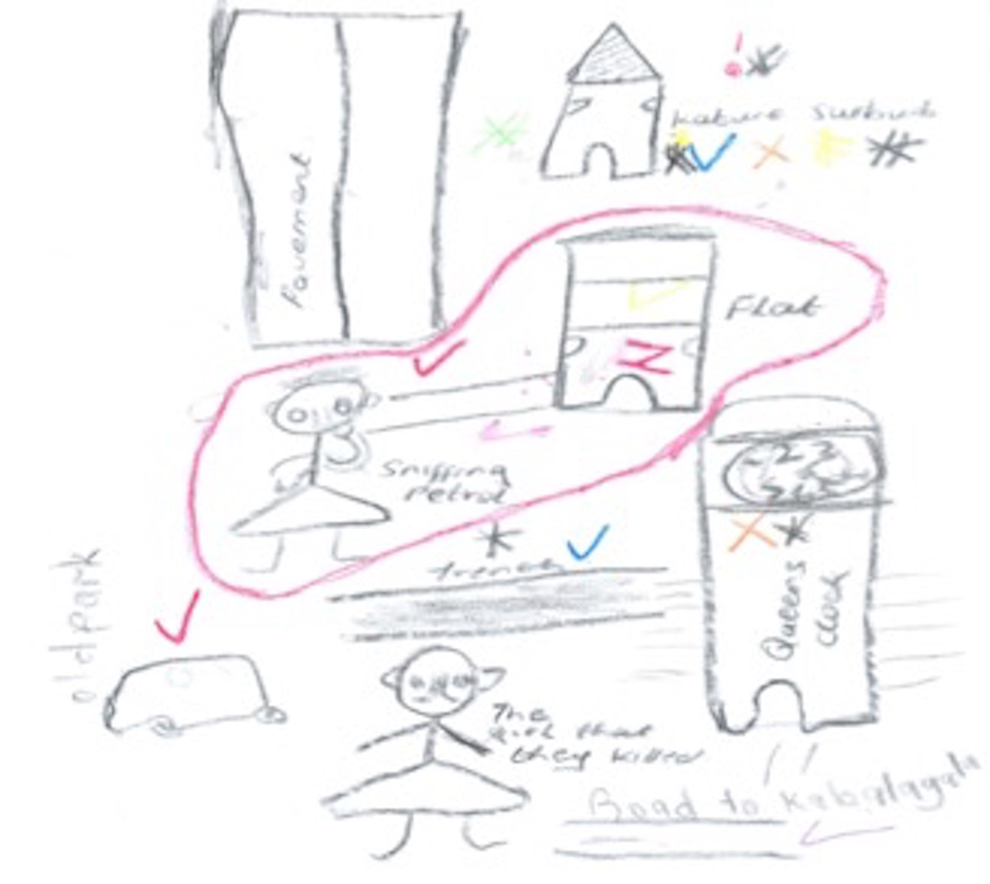
Street-connected girl’s vision of the city: Child-Centered VAC mapping.
As she maps her place-based perceptions of violence in the city, she describes this place, “I avoid queen’s clock near the trench because there are thugs who can lay you [down] and beat you up or even rape you. They killed a girl there at night. Katwe two is a dangerous place at night” (Street-connected girl, Semi-Structured Interview with Social Cartography Exercise).
Youth-Driven Qualitative Data Analysis
The qualitative data analysis process led by youth researchers of the YPAR team involved the following seven participatory phases (see Figure 2 below).

Participatory data analysis process, elaborated by YPAR team PI.
Following the participatory dissemination exercise described below in section 4.4, the data analysis process consisted of coding using NVIVO11 and participatory analysis of all 122 data components, including transcribed interview, focus group and visual data and the fieldnotes written by the 6 youth researchers.
Following the transcription process, the YPAR team held multiple sessions to construct the codebook. This step was particularly important in our analytic process, as conceptualizations of each analytical category were not limited to academic definitions or typologies of violence and resilience in relevant literature. Instead, the YPAR team prioritized youth researchers’ understandings and experiences of each category, placing them at the center of the codebook design process. The codebook was designed using three overarching analytic themes including contexts of adversity, violence, and resilience, which youth researchers defined as “overcoming violence.”
Youth researchers led these preliminary analysis sessions and supported the organization of the data set by ranking the most important narratives and photographs and prioritizing which data were the most urgent to communicate to the world. Subsequently, NVIVO11 was used to code the entire data set into the 21 thematic nodes and 15 sub-thematic nodes.
The YPAR team selected sub-nodes by grouping common themes into more specific categories. Two coding cycles were completed by two separate coding teams using NVIVO11 in order to establish inter-coder reliability; street-connected youth researchers also participated in multiple NVIVO11 coding sessions to ensure that the interpretation of each item in the codebook was consistent with their interpretation of each story and corresponding category/node in NVIVO11.
Throughout the data analysis process, we employed Saldaña’s (2009) model of a two-tiered process of descriptive and axial coding within our YPAR framework of placing children and youth participation at the center of the analytic process. Word clouds and word frequency tables were also developed in order to guide collective analysis sessions and discussions of the data with youth researchers (Photograph 3). Youth researchers were also trained in NVIVO11 and participated in multiple participatory coding sessions and visual analysis of the word clouds reflecting their peers’ voices.

Seeing the Future through Collective Imagining: Youth-Driven Action in the Afterlife of Data Collection
A group problem-solving mechanism described as “future search” in organizational management and leadership studies was also employed after completing formal data collection as a means of articulating goals individually and thinking through possible routes to achieving them in a collective, youth-driven space. During this activity, the children and youth involved in the YPAR process identify problems in the past and present and explore ways to overcome these issues in the future. In this exercise, children are asked to draw themselves in an ideal future, in 5 years’ time (see Photograph 4 below). They are asked to specify the following in their future search drawings: 1) Who are you with?; 2) What are you doing?; 3) What are your needs?

Much of this conversation centered on connecting these children and young people with empowering services that may support them in their pathways out of street-connected and domestic exploitation activities. Many drew images of the future reunited with their families, studying and needing love and affection from their support network.
Youth-Driven Dissemination: Participatory Forum With Policymakers and Institutional Actors
In order to disseminate principal findings and provide visualization of children’s experiences of violence in the study sites, the YPAR team set up an exhibition booth at the National Child Welfare Conference, where multiple policy and program actors were present, such as various faith-based child development organizations, global child-focused organizations and high-level government officials, including the First Lady of Uganda. This participatory venue for the dissemination of preliminary findings with policy actors was one strategy the YPAR team employed to destabilize the hierarchies implicit in traditional academic conferences and contexts of research dissemination. As discussed by participatory researchers doing YPAR with young people in contexts in the global North, YPAR creates a space for children and young people participate in “…their own engaged praxis—critical and collective inquiry, reflection and action focused on “reading” and speaking back to the reality of the world, their world…their research is designed to contest and transform systems and institutions to produce greater justice…YPAR is a formal resistance that leads to transformation” (Cammarota & Fine, 2008, pp. 2–3).
As illustrated in Photograph 4, the YPAR team explained the visual content and narratives they selected for showcasing to the different national and global policy actors as a form of resistance. The preparation for the participatory forum was also an important transition from data collection to the participatory data analysis process. Youth researchers led the selection of transcription content, ranking the most urgent stories to be communicated and selecting the photographs and maps to be displayed for the public (see Photograph 5 below for outdoor setup).
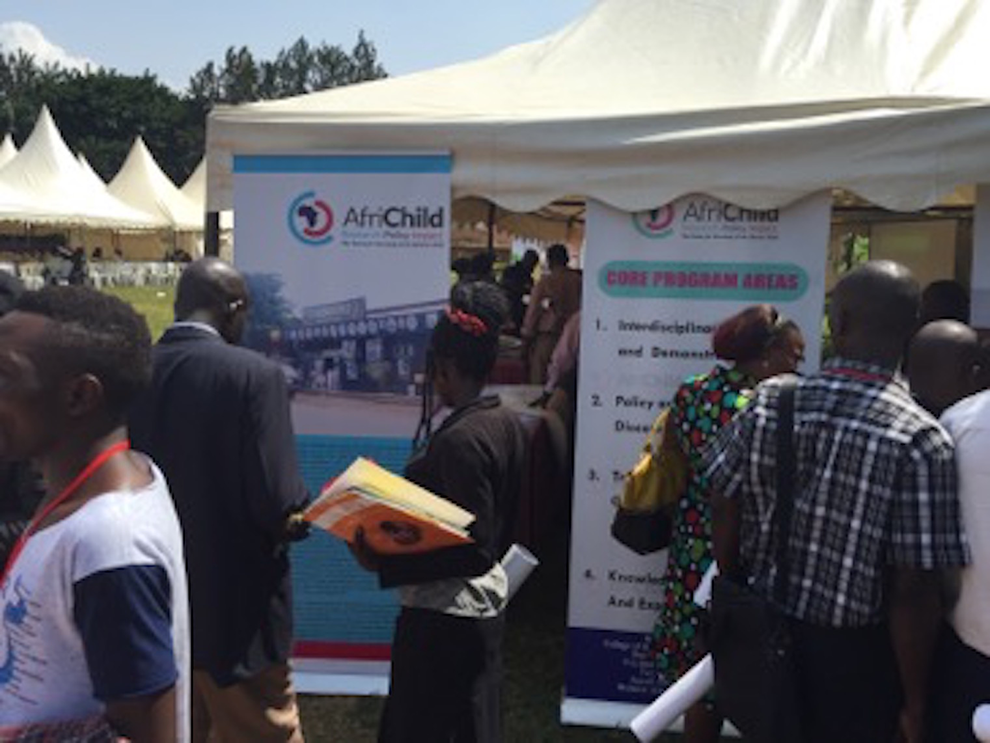
There was a lively exchange between the youth researchers and multiple policy actors who were interested in learning more about the methods employed to create this window on the world of child adversity (see Photograph 6).We also inspired some critical feedback from the police officials who accompanied the First Lady to the event. As the police and military officials walked through the content of our booth, they expressed anger regarding the quote on police violence and rape and demanded we take down the content. Our university partners were unsettled by this interaction and told us to be careful when generating consciousness about state violence. This example illustrates the way that children’s voices, as they want and choose to be heard, are muted in public policy and politicized spaces.

Recommendations: The Transformative Potential of YPAR
In this paper we have highlighted the importance of youth participation in the research process as a means of democratizing child welfare research, particularly on violence against children. Additionally, we have mapped out four key components of the YPAR process that can be seen as potential ways to include children as agents of knowledge production in the research process. These key components include: data collection and analysis led by youth research actors; a process of collective imagination of the future; participatory dissemination in a venue that ensures contact with policymakers; and a training of the YPAR team that creates a sense of collectivity and community among the university-based and street-based research actors. Through our experiences working with the young people driving the YPAR process, we observed the transformative potential of this approach in mobilizing youth communities for social justice and carving out spaces in research where children, adolescents and young people work as agents of change against violence in their daily lives and contexts.
Recent work on the inclusion of children’s experiences and voices as a mechanism for reporting violence in the court system has highlighted the complexity of child participation in child welfare legal decision-making processes and the challenges presented by “adult gate-keeping” in legal proceedings surrounding VAC (Macdonald, 2017, p. 1). Through our experience in this YPAR process against violence, we contend that child participation throughout all phases of research is a crucial starting point for connecting children’s experiences of violence at the street-level to high-level policymaking and resource allocation for the prevention of violence against children. Specifically, child participation in data collection is rarely extended beyond superficial consultation regarding research instruments or study design, and “adult gatekeeping” in the data analysis process, while possibly more efficient in terms of meeting deadlines, is overlooking the value-add of involving young people in coding. In the policy arena, and as illustrated in the policy recommendations of the VACS final report for Uganda, there is a tendency to promote state-driven responses to VAC including heightened policing and institutional interventions at the judicial level rather than explore community-based, interpersonal and child-driven responses. We advocate for the latter and think that this is an important strategy for complementing government responses to VAC at the community level.
Additionally, we observed how the community of youth researchers challenged traditional divisions in Ugandan society, a paradigmatic shift that, if scaled up and sustained by long-term policy, may be the basis for building child-led initiatives against violence. The spaces in which resistance and transformation takes place have been described in previous YPAR work as “
Through our methodological reflections on the YPAR process, we have described our experience of what “child participation” looks like in the contact zone of YPAR. We situate our practices and definition of “child participation” in the research and policy making process in the sense set forth by Cahill:
“We need to be wary of broad applications of the term ‘participation’ because it often masks tokenism and the illusion of consultation…it is important to articulate more clearly what we mean by youth participation in collaborative research and to specify the degrees of participation in our practice” (Cahill, 2007, p. 299).
In the design of our project in Kampala we were careful to avoid tokenism; however, the challenges of sustainability (i.e., when the research funding runs out and/or funding priorities shift in the global NGO scene) to ensure the continuation of our contact zone in the streets and in policy spaces presented significant roadblocks in our YPAR process. We urge scholars working with children in adversity in general, and children outside of family care in particular, to move beyond theoretical discussions of their lives and experiences of violence and toward long-term YPAR endeavors that make space to enable young people to speak for themselves and propose ways of catalyzing social change in their daily lives that can be scaled up to collective strategies against violence in the policy realm (Ritterbusch, 2012, 2013). In terms of the use of participatory approaches in research as a means of informing decision-making in child welfare policy, the act of listening to children is the first step in involving them as agents of change in policies that seek to improve their lives and well-being.
We kept this principle at the center of our research process in three main ways. Firstly, in the context of research training, youth researchers led multiple activities to explore their positionalities in our fieldwork and as a means of checking adult gatekeeping throughout the project. Secondly, in the context of data collection and analysis, youth members of the team led all research activities, with adults only shadowing. Finally, in the context of participatory dissemination in our YPAR project, the YPAR team chose a national policy event as a direct channel of communication for young people to communicate their recommendations and experiences to policymakers.
Pushing this call for child participation in research further to global development initiatives and policy implementation, many times this active listening to children is the missing element of the evidence-based policy programs, such as INSPIRE and the Global Partnership to End Violence, that are being replicated globally. While the compilation, scaling up and digestible packaging of evidence-based programs are of great importance for building pathways out of adversity globally and through collective commitments made by the funding giants of child protection and well-being, we must also stay attentive to the voices of children, which are always important to incorporate in our decision-making. Furthermore, we question the extent to which evidence-based programs are being adequately adapted to context and to the specific needs of children in different socio-economic and cultural contexts.
We can then ask of policy relevance: for whom and with whom? This may be a way to articulate the empirical evidence gathered in both quantitative and qualitative VAC initiatives in Uganda with innovations in child participation in future spaces of dissemination and decision-making regarding the policy priorities highlighted in both data sets.
In terms of the methodological findings on child- and youth-driven participatory action research, one of the youth researchers from the YPAR team attributes much of his gradual transition out of street life to an example that was set for him and reflects on the importance of the example he sets for other children. While both peer-led outreach and research work have become increasingly more popular in child protection programs, we need to seriously rethink the structures built to support young people. We need to invest in their futures as agents of change and build sustainable structures of care from which they can continue to inspire other children. This has budgetary implications when designing VAC prevention programs and participatory research on VAC. A principal line item should be for young people’s involvement in the process. In practical terms this means including their salaries for the duration of the program in the budget, investing in their long-term professional development and showcasing their achievements through their participation in global political forums and other key spaces of advocacy.
Conclusion
As a concluding reflection, we present the following questions: Have our initiatives strengthened children’s capacity to continue growing as agents of change upon project completion? Have children been tokenized in the process, leaving them with little advancement at the end of the process? One YPAR team member discusses this point in more detail: I was volunteering…because it was my dream to help children leave the street…When I was in that organization they started to pay me…They helped me to survive and even gave me accommodation…with time I joined AfriChild…We are researching the challenges children both girls and boys face on the streets…I inspire these youth and also counsel them during day…[W]e talk about ways we can protect our lives,…prevent ourselves from backsliding. I use my life examples to encourage them and inspire them so that they don’t go back to the streets…Right now I have where to stay and…I can pass near the police with no fear…when I left the street I stopped stealing, smoking marijuana, I stopped sniffing fuel, I can no longer be arrested. Right now I am thinking about work and helping other people…I am trusted, I am helping fellow youth to leave the street and I have seen many leaving because of me being able to leave…I have friends who are helping me to make good decisions (25-year-old street-connected young man, Life history interview, December 14, 2015).
As discussed by this member of our YPAR team, the support of other children and youth was key in supporting his pathway toward a more stable and less violent future. This interview excerpt holds useful insight for policymakers on possible ways for moving beyond tokenism and rehearsed spaces of participation in research and policymaking. It is time for policymakers to come down to the street level and listen to children’s recommendations, both from formal research they are driving and from their daily lived experiences. The child-driven methodological experiences and research practices that we shared throughout this article reflect the urgency of creating a sustainable contact zone that facilitates constant communication between children surviving in spaces of violence and university-based researchers and policymakers who many times live worlds away from these children, even if they technically inhabit the same city. In terms of future research, we urge scholars to create spaces for sustainable YPAR movements, both in academic and policy arenas, and to design participatory initiatives that prioritize knowledge produced by and for the improvement of children and young people’s lives globally.
Footnotes
Acknowledgments
The team writes this methodological reflection in honor of all children, adolescents and other street-connected research actors who were involved in the YPAR process and thanks them for their time and commitment to the process of child-driven social change. Additionally, the team also thanks the AfriChild Centre for serving as the institutional home for this project in Uganda and to the multiple funders of the overall qualitative VAC initiative including the Oak Foundation and the Bernard van Leer Foundation.
Declaration of Conflicting Interests
The author(s) declared no potential conflicts of interest with respect to the research, authorship, and/or publication of this article.
Funding
The author(s) disclosed receipt of the following financial support for the research, authorship, and/or publication of this article: This research was supported by Oak Foundation and the Bernard van Leer Foundation.
