




Abstract
Interpretive phenomenology presents a unique methodology for inquiring into lived experience, yet few scholarly articles provide methodological guidelines for researchers, and many studies lack coherence with the methodology’s philosophical foundations. This article contributes to filling these gaps in qualitative research by examining the following question: What are the key methodological and philosophical considerations of leading an interpretive phenomenological study? An exploration of interpretive phenomenology’s foundations, including Heideggerian philosophy and Benner’s applications in health care, will show how the philosophical tradition can guide research methodology. The interpretive phenomenological concepts of Dasein, lived experience, existentialia, authenticity are at the core of the discussion while relevant methodological concerns include research paradigm, researcher’s stance, objective and research question, sampling and recruitment, data collection, and data analysis. A study of pediatric intensive care unit nurses’ lived experience of a major hospital transformation project will illustrate these research considerations. This methodological article is innovative in that it explicitly describes the ties between the operational elements of an interpretive phenomenological study and the philosophical tradition. This endeavor is particularly warranted, as the essence of phenomenology is to bring to light what is taken for granted, and yet phenomenological research paradoxically makes frequent assumptions concerning the philosophical underpinnings.
Background
Originating from philosophy, phenomenology presents a unique opportunity for capturing the lived experience of participants. Indeed, this methodology allows for the unearthing of phenomena from the perspective of how people interpret and attribute meaning to their existence. Many scholarly writings have delved into phenomenology from a philosophical lens, but few have provided methodological guidelines (Groenewald, 2004), making it challenging to operationalize quality phenomenological research. Groenewald’s (2004) article explicating a Husserlian phenomenological design is one of the most widely read publications in the International Journal of Qualitative Methods (Sage Publications, 2019), attesting to the need for such explicative pieces. According to Van Manen (2014), the challenge lies in making phenomenology “accessible and do-able by researchers who are not themselves professional philosophers and who do not possess an extensive and in-depth background in the relevant phenomenological literature” (p. 18)—with philosophical underpinnings often being loosely applied in interpretive phenomenological research (Horrigan-Kelly et al. 2016). Similarly, Sandelowski (2000, 2010) cautions that many qualitative studies claiming to be phenomenology are actually descriptive studies with phenomenological overtones. Although the research community experiences difficulties in the application of phenomenology, this philosophy has great potential to enrich research methodology (Horrigan-Kelly et al., 2016; Zahavi & Martiny, 2019).
Hence, the main objective of this article is to highlight philosophical and methodological considerations of leading an interpretive phenomenological study with respect to the qualitative research paradigm, researcher’s stance, objectives and research questions, sampling and recruitment, data collection, and data analysis. First, this article will trace the philosophical underpinnings of interpretive phenomenology to illuminate human sciences, with particular attention to the concepts of Dasein, lived experience, existentialia, and authenticity. Second, methodological considerations, drawn from this phenomenological basis, will be explicated and illustrated through a research study of pediatric intensive care unit (PICU) nurses’ lived experience of a major hospital transformation project in Canada—thus offering guidance on how to align qualitative research methods and process with this philosophical tradition (see Frechette et al., 2019, for further details concerning this study).
Philosophical Underpinnings
The beginning of contemporary phenomenology can be traced back to German philosopher Edmund Husserl, who proposed a descriptive approach to discovering the essence of a phenomenon (Mapp, 2008; Moran, 2000). Husserl suggested that, through bracketing presuppositions or epoche, this essence would emerge from the things themselves, “zu den Sachen selbst” (Mapp, 2008; Moran, 2000; Van Manen, 2014). Heidegger, a mentee of Husserl, is considered the founding father of interpretive phenomenology or hermeneutics (Mapp, 2008). Interpretive phenomenology and hermeneutics are often used interchangeably, even if hermeneutics has a narrower focus on the interpretive process. Indeed, hermeneutics draws on interpretive phenomenology to illuminate interpretations of meaning (e.g., from human experience, from a text, from artifacts, or from other sources that hold significance; Polit & Beck, 2012). Two schools of phenomenology are most salient, the descriptive school originating from Husserl’s work and the interpretive school following hermeneutic philosophy (Laverty, 2003; Mapp, 2008). This article will focus more specifically on the latter, Heideggerian interpretive phenomenology, and the hermeneutic philosophical tradition as the foundations of the qualitative research methodology.
The research phenomenologist’s stance stems from Heidegger’s (1927a) proposal that everyday phenomena are mostly hidden, covered in multiple layers of forgetfulness (Vergenssenheit); herein this concealment lies the possibility of recollection or disclosedness for Heidegger. To illustrate this, if asked to describe the walls of the neighborhood grocery store, most of us would find this task difficult even if we have been there on multiple occasions. For Heidegger (1927a), a phenomenon can only be unveiled ontologically through being Dasein, a phenomenological concept denoting an interpreting entity such as a human being. Hence, phenomenology represents the activity of pulling existentialia out of forgetfulness, through discourse (Buckley, 2018; Heidegger, 1927a); existentialia are conditions of possibility for Dasein, which include comportments (existentiell) and structures of being (existential) (Buckley, 2018; Heidegger, 1927a). In sum, the main objective of interpretive phenomenology is to uncover or disclose a phenomenon by pulling away layers of forgetfulness or hiddenness that are present in our everyday existence.
As phenomenological researchers, our epistemology is anchored in an existential understanding of Dasein and their existentialia. One overarching existentialia for Dasein is being-in-the-world which speaks to Dasein’s everydayness, forgetfulness, projectivity, and being-with-others (Heidegger, 1927a). For Heidegger (1927a), everyday life—the way Dasein are in their everydayness—is of primordial importance. As previously mentioned, this everydayness is characterized by forgetfulness. For Heidegger (1927a), forgetfulness is not a lesser state than disclosedness; it simply represents another mode, the other side of the same coin. Dasein’s projects (i.e., life goals), and the means to achieve these (i.e., equipment such as tools, processes, and materials), are mostly forgotten in everyday life (Heidegger, 1927a; van der Hoorn & Whitty, 2015). Equipment discloses Dasein’s projectivity, meaning that equipment shows itself to Dasein through circumspective concern (in-order-to) in projects (Heidegger, 1927a). “These projects are not necessarily on a large scale,” according to Paley (2014) “Getting up from my chair, to go through the door, to walk across the hall, to enter the kitchen, to put the kettle on, to make a cup of tea…is a project” (p. 1522). For example, the old toys from one’s youth stored in the garage will remain forgotten until the project of entertaining a child is activated. Then, suddenly the old bunny rabbit will be pulled out of forgetfulness “in-order-to” stop a child’s crying. Equipment is referential, in that it is always perceived in relation to or in reference to the needs of Dasein’s projects: “people find meaning and terms of existence through their referential associations” (van der Hoorn & Whitty, 2015, p. 723). When equipment serves the purpose intended for the project, or is ready-to-hand, it goes unnoticed in our everyday lives. If one takes the car to go to work, the action of driving the car will go almost unnoticed, on autopilot one could say, until suddenly the car breaks down, is unready-to-hand, then the car suddenly becomes apparent. Moreover, the breakdown does not only reveal the equipment, the car itself, but Dasein’s projectivity—the desire for Dasein to get to work. A broken car in the scrapyard will not show itself to the owner, but the unready-to-hand equipment needed to accomplish one’s project will. Breakdown or dysfunction is, therefore, a great source of illumination of Dasein’s motives, the so what?
Importantly for researchers, Heidegger’s philosophy focuses on the individual level (Renaut et al., 1997), and his work has been critiqued for lacking social dimensions. This critique is not surprising, as for Heidegger (1927a), the social reality or being-with-others is a mode of being for Dasein versus an external reality. It is not possible to dissociate others from being; the individual level of analysis can never be devoid of the social dimension that inhabits it. The das Man or the “They” functions as a representation of the perceived social norms prescribed by others: what they do, what they think, and so forth. For Heidegger (1927a), being authentic is to be uncovered, to be a disclosed self, and to stand in resoluteness within the “They,” in acceptance of what we are. On the contrary, inauthenticity results from disowning who we are to be covered up by the das Man as taking the place of self. In the same way that forgetting opens up the possibility of recollecting, authenticity and inauthenticity present two equal modes of being—with not one having superior moral quality. Death represents Dasein’s ultimate impossibility, which creates the condition for all other possibilities as Dasein is always being-toward-death (his or her own death; Heidegger, 1927a). These possibilities offer the researcher an ontological window into mortality and humanity.
Through this ontology, Dasein’s existentialia includes comportments (existentiell) and structures of being (existential) (Buckley, 2018; Heidegger, 1927a) relevant to qualitative research methodologies. Comportments concern the behaviors that are exhibited and often taken-for-granted in everyday life (Benner, 1994a). Heidegger writes of four equiprimordial existentials: Befindlichkeit or mood, understanding, discourse, and everydayness (Buckley, 2018; Heidegger, 1927a). Mood is described by Heidegger (1927b) as something that is always there (e.g., a gut feeling, an atmosphere or an emotion) and changes as Dasein is attuned to being-in-the-world; “Mood has always already disclosed being-in-the-world as a whole” (Heidegger, 1927b, p. 129). Phenomenology studies embodiment which includes “skillful comportment and perceptual and emotional responses” (Benner, 1994a, p. 104). The body’s sentiments provide a window into human understandings (Benner, 1994a); the body and its emotions provide “…the entry point to deeper insights into the lived reality of others” (Sharma et al., 2009, p. 1645). As Heidegger (1927a) mentioned, since Dasein is being-towards-death, angst or anxiety is always a basic mood. Understanding represents the original possibility; it functions as a forestructure, allowing interpretations to be laid out in an “as” structure (Buckley, 2018; Heidegger, 1927a). For example, it is the understanding of a door as separating two spaces and as having the possibility of being opened, which allows one to use a door “as” an exit. For Heidegger (1927a), “interpretation is…the development of possibilities projected in understanding” (p. 149). Discourse for its part is embedded in everydayness, with inauthentic forms (i.e., idle talk, or small talk) and authentic forms that are disruptive of everyday discourse, such as silence and poetry (Heidegger, 1927a); with authentic forms allowing for disclosiveness of phenomenon. Of importance to note in phenomenology, truth does not represent objective reality like in positivist research (Guba & Lincoln, 1994), it represents the state of disclosiveness of a phenomenon. Everydayness for Dasein holds the possibility of fallenness, to get caught up in inauthentic forms of discourse, and to display curiosity (being nosy or voyeur), and ambiguity (accepting things at face value; Heidegger, 1927a)—with researchers not being spared from these risks.
Fundamentally for interpretive phenomenological research, phenomenology and more specifically hermeneutics focuses on the interpretation of meaning (Laverty, 2003; Polit & Beck, 2012), as is evident by the hermeneutic definition of lived experience. The German word for experiencing (verb), Erleben, simply means to be alive when something is grasped (Gadamer, 2004). The experienced (noun), das Erlebte, refers to what lasts once the experiencing is done: “This content is like a yield or result that achieves permanence, weight, and significance from out of the transience of experiencing” (Gadamer, 2004, p. 53). Lived experience, Erlebnis, fuses these two meanings; the immediacy of experiencing provides the raw material to be shaped through interpretation, reinterpretation, and communication into its lasting form, the experienced (Gadamer, 2004), what Weick (1995) calls the sensemaking process in organizational studies. A lived experience is not only something that is experienced, “its being experienced makes a special impression that gives it lasting importance” (Gadamer, 2004, p. 53). This hermeneutic conceptualization of lived experience shows the centrality of the meaning attributed to the experience. An account of lived experience is incomplete if it remains purely descriptive; it must contain an interpretation of significance for the person. Ricoeur (1981) argues that a person’s life story has two dimensions that contribute to its forward movement or directedness: (1) a chronological sequence of episodes and (2) a construction of “meaningful totalities out of scattered events” (p. 240).
As a way of exploring lived experience for researchers, the hermeneutic circle suggests a back-and-forth movement from the part to the whole and other parts of the story (Gadamer, 1976; Rodgers, 2005; Taylor, 1987; 1991, p. 38). The part is never detached from its relation to the whole and how it makes sense in light of other partial expressions (Taylor, 1987). The whole must be kept in constant view for elements to truly stand out (Heidegger, 1927a). The meaning that we give to a situation is always shaped by what matters to us, our “horizon of significance” (Carnevale & Weinstock, 2011; Taylor, 1987; 1991, p. 39). In contrast to Husserl, Heidegger (1927a) maintains that bracketing presuppositions, as a way back to the essence of the phenomenon, is impossible. Presuppositions or forestructures actually create the clearing necessary to uncover phenomena (Buckley, 2018; Heidegger, 1927a). Heidegger (1927a) wrote about forestructures of understanding, which represent the ideas and embodied experiences that we bring with us to a situation. Gadamer (1975) and Taylor (1991) took this concept further by identifying these forestructures as formative of a backdrop or “horizon of significance” from which we can attribute meaning to new situations. According to the interpretive phenomenological tradition, a pre-suppositionless stance is neither possible (McManus Holroyd, 2007; Moran, 2000) nor desired since it is this “horizon” which allows the bridging of new understandings or “fusion of horizons” (Gadamer, 1976, p. 39; Rodgers, 2005). The philosophical underpinnings of interpretive phenomenology offer much to enrich research methodology.
Methodological Considerations
This section will highlight methodological considerations of interpretive phenomenology concerning the research paradigm, researcher’s stance, objective and research questions, sampling and recruitment, data collection, and data analysis. Table 1 provides an overview of the main distinctions between interpretive phenomenological research and generic qualitative research. The distinguishing methodological features of interpretive phenomenology will then be further explicated. Examples from a study concerning a major hospital transformation project will illustrate the operationalization of this philosophy within qualitative research. This research project was undertaken in a 32 single-patient bed PICU in a large Canadian pediatric hospital; the unit had undergone a major transformation, which included the construction of a new unit centered on children and families, and associated quality improvement projects.
Comparison of Interpretive Phenomenological Research and Generic Qualitative Research.

Research Paradigm
What distinguishes interpretive phenomenological research paradigm?
A constructivist paradigm orients phenomenological research by way of a relativist ontology whereby human “realities are apprehended in the form of multiple, intangible mental constructions, socially and experientially based, local and specific in nature” (Guba & Lincoln, 1994, p. 110). This paradigm emphasizes the contextual nature of qualitative research findings, which are elicited through a co-construction between the participant and researcher (Guba & Lincoln, 1994). Although much qualitative research rests on a constructivist paradigm, interpretive phenomenology is set apart by anchoring its research tradition in a unique understanding of being (i.e., Dasein, a human researcher or participant).
How to operationalize these distinctive features?
As the following methodological sections will demonstrate, this understanding of being guides every step of the research process. The philosophy of interpretive phenomenology becomes an integral part of the researcher’s horizon of significance.
Researcher Stance
What distinguishes interpretive phenomenological researcher stance?
The researcher’s reflexive stance is probably the first and foremost consideration in qualitative research (O’Brien et al., 2014; Tong et al., 2007). More specifically for phenomenological inquiry, the researcher is called to contemplate horizons of significance, embodiment, and being-in-the-world. Hermeneutics purports that new understandings are created through the bridging of the researcher’s and the participant’s horizons of significance (Gadamer, 1976, p. 39; Rodgers, 2005). This bridging requires self-knowledge on the part of the researcher as well as an openness to others—elements that can be cultivated through reflexivity. The researcher’s body senses differences, commonalities, and absences in their own horizon of significance that are elicited by situations and participants (Sharma et al., 2009), being attuned to our body offers a window to our horizon of significance. The same is true of the participant’s body—it is more than a physical object; it is a sentient being (Merleau-Ponty, 1986). Moreover, through unique insights into being-in-the-world, interpretive phenomenology opens the door for reflection on being a researcher, a participant, etc. (i.e., through our everydayness, forgetfulness, projectivity, and being-with-others).
How to operationalize these distinctive features?
A reflective journal is an essential tool for documenting the researcher’s reflections. This documentation starts with a reflective piece about what brings the researcher to the particular study at hand and then continues with the researcher’s reflections on how their own horizon of significance is brought to light via attunement to the research process. For example, the principal investigator for the study about a major hospital transformation (first author) comes from a background in nursing and management. As a manager, she felt frustrated at having to implement top-down projects, which were often poorly adapted to the reality of health-care professionals. This experience frequently made her wonder how bedside nurses lived projects that were imposed on them, not only in their practice, but also on an existential level. This horizon of significance provided the springboard to initiate the research project, as well as the first stepping-stone of the bridge between horizons. The key to keeping this type of research rigorous is to be transparent about how one’s horizon of significance plays out in the research process. Therefore, the final manuscript should include a short mention of the researchers’ horizon of significance to allow readers to make up their own minds about the “potential or actual interaction between researchers’ characteristics and the research questions, approach, methods, results, and/or transferability” (O’Brien et al., 2014).
Hermeneutic research favors an embodiment epistemology in which the researcher pays close attention to their own and the participant’s emotions and bodies (nonverbal cues from participants) and documents these states in their reflective journal (Giacomini & Cook, 2000; Sharma et al., 2009). Nonverbal cues offer the researcher a window into a person’s moods (Befindlichkeit)—their own and the participant’s. A researcher can train themselves to be more receptive to these bodily cues by using their six senses—eyesight, hearing, taste, touch, smell, and gut feelings—and being reflective about these states (Sandelowski, 1986). Today, it was planned for me to observe a nurse who was taking care of a burn patient. When I saw his assignment, I was scared, thinking “oh no, it’s Monday, couldn’t I have a less challenging case?” After having the patient and father consent, I observed in the room. I was already stressed in the hallway, waiting for the nurse to come get me before the observation. I was scared of fainting again, of not being able to watch the dressing change. I watched the dressing change and the room was hot, because a burn patient has difficulty keeping his warmth, they put up the heat and because I wasn’t feeling so good. The patient was repeatedly saying it hurt him and nurses were working on him at various places, he had to move his legs, his eye was burning—it was too much suffering for me. I rationalized that I had seen enough, did I? Should I have pushed more? I don’t know. Does the quest for data have such high supremacy that it supersedes my own wellbeing as a? I just felt so sad/distressed at seeing this young man try to go through this procedure, with dignity, with bravery—the music he listened to spoke about “being brave” on many occasions, in different songs. I couldn’t bear to see him suffer, I kept on wondering why they are not giving him more drugs, why are they questioning when he asks for more drugs? How are the nurses dealing/coping with seeing that much pain on a daily basis? And the father, who seemed to try his best to comfort his son, putting the music up for him, wiping his eye that was burning, standing close to him as soon as there was room. And this balloon “Happy Birthday” inflated at the back of the room and a decorated pumpkin—reminders of a life he’s not living, stuck in his bed. How much suffering can one see before one becomes functional in its presence/indifferent? How do you cohabit with this human distress as a nurse?” (Reflective Journal [first author]—October 29, 2018)
Research Objective and Questions
What distinguishes interpretive phenomenological research objective and questions?
An interpretive phenomenological study aims to explore the lived experience of a phenomenon, representing an individual level of analysis with an understanding that social contexts are embedded within an individual’s being (i.e., being-with-others). The overarching goal is to uncover a new understanding of the phenomenon—to pull existentialia out of forgetfulness (Buckley, 2018; Heidegger, 1927a).
How to operationalize these distinctive features?
Research objectives in phenomenological studies will often qualify “whose” and “what” lived experience are being investigated, and the context in which Dasein are situated. The objective and research questions will often integrate the terms “lived experience” verbatim. For example, the main objective of the exemplar research study is to explore PICU nurses’ (whose) lived experience of environmental and quality improvement changes (what) in the context of a major hospital transformation project (context). As mentioned previously, exploring lived experience does not only allow the researcher to ascertain a series of events through time but also aims to elicit the meanings and interpretations that people attribute to these experiences. Generally, the research questions will flow from the objective and break down the phenomenon to be examined into smaller parcels. This parceling of the phenomenon will favor the back-and-forth movement from part to the whole in the analysis (described further in the Data Analysis section). Research questions will sometimes take up Heidegger’s or another hermeneutic philosopher’s terminology to highlight elements of the philosophical tradition that will orient the inquiry more specifically. This terminology can capture very rich understandings (of being for example) in one or a few words that would otherwise be impossible to include succinctly in a research question. The exemplar study involves three research questions: What are the existentialia (Heideggerian terminology) or conditions of possibility for PICU nurses’ experience of a major hospital transformation? What are PICU nurses lived experience of environmental changes in their workplace (including the physical environment as well as the place occupied by technology)? What are PICU nurses lived experience of changes resulting from quality improvement projects (practice projects, people projects and process projects)?
Following the phenomenological tradition, no hypotheses are presented in the methods, as these “anticipations” are part of the researcher’s horizon of significance and ongoing reflexivity.
Sampling and Recruitment
What distinguishes interpretive phenomenological sampling and recruitment?
A purposive sampling strategy is most commonly used in phenomenological research as it allows selecting participants who have rich knowledge of the phenomenon (Mapp, 2008; Polit & Beck, 2012). Compared to quantitative research and descriptive qualitative designs using thematic or content analysis, the sample sizes in interpretive phenomenology are smaller (about n = 10 is common; Groenewald, 2004). The richness of the data collected takes precedence over the actual size of the sample (Mapp, 2008). A small sample size is not seen as a limitation in phenomenological studies, since the primary objective is not generalizability, but to illuminate the lived experience and context in as much depth as possible. In describing the context in great detail, readers can then judge the possible transferability to their own settings (Lincoln & Guba, 1985). A small purposive sample with rich and diverse lived experiences of the phenomenon is most coherent with phenomenological studies’ main objective of uncovering the multiple layers of hiddenness of a phenomenon within its context.
How to operationalize these distinctive features?
The exemplar study used purposive maximum variation sampling to seek participants who experienced both the old and the new infrastructure of the unit and could thus be informative of the transformation. Recruitment was tailored to optimize chances of obtaining maximum variation according to gender, age, educational background, work experience, and experience with the transformation project; these demographic characteristics were identified through a literature review as potentially shedding a different light on the phenomenon. For example, in order to increase the chances of having nurses from every work shift, the principal investigator presented the research project at team meetings on every shift. The demographic information of the emerging sample was continually analyzed, and the recruitment strategy adjusted to obtain a maximum variation of demographic characteristics (e.g., emphasizing the importance of having night nurses represented in communications). Recruitment unfolded until a sample size of n = 15 had been reached; recruitment would have resumed later if more data had been needed for saturation. Saturation in qualitative research is considered attained when new data do not contribute significantly to the understanding of the phenomenon (Carnevale, 2002).
Data Collection
What distinguishes interpretive phenomenological data collection?
Authentic modes of communication, enabling greater disclosiveness according to interpretive phenomenology, are used as data collection methods. To enhance the data collection process, researchers must also guard against the presence of inauthentic modes of communication through constant reflexivity. In-depth interviews are usually the primary data collection method in phenomenological research (Kvale, 1996). Although interviews are ideal to elicit experienced meaning (Kvale, 1996), Paley (2014) suggests this data collection method may be insufficient to uncover phenomenon in a Heideggerian sense since interviews pose the risk of representing the voice of the das Man. The use of multiple data collection methods, known as method triangulation, is therefore particularly warranted, as each data collection method informs the other through a back-and-forth movement (hermeneutic circle).
How to operationalize these distinctive features?
To illustrate this hermeneutic circle, the exemplar study used multiple data collection methods (see Table 2), with information retrieved in the document review allowing for more pointed questioning in the interviews, narratives during the interviews providing a greater focus for the participant observation, and so on. The following sections will further explore phenomenological considerations for interviews, participant observation, and art-based data collection methods.
Actual Recruitment, Data Collection, and Data Analysis Timeline (2018–2019).

The bands of colour represent the timeline for different study activities.
Interviews
What distinguishes interpretive phenomenological interviews?
Individual interviews elicit a participant’s narrative, which allows the storyteller to remember a past event and recount it in light of what is meaningful for them (Benner, 1994a)—with the meaning being an essential component of lived experience. In order to uncover this lived experience, the interviewer is called to committed listening—a desire to unearth what people care about and to listen for more than words, for their “underlying beliefs, assumptions, and interpretations” (Hargrove, 2008, p. 99). Interpretive phenomenology cautions the interviewer not to fall into complacency (fallenness) and informs the formulation of probing questions. Complacency, in this sense, occurs when the interviewer falls back into everyday small talk. It is quite easy for an interviewer to subtly start filling in silences, accept a phrase said by the participant at face value (ambiguity), and go on a tangent out of curiosity—with these inauthentic forms of discourse further veiling the phenomenon (Heidegger, 1927a). In order to move beyond the voice of the das Man to the authentic voice of the participant, the interviewer must be ready to sacrifice the comforting ease of everyday conversation. Silence, probing questions, reflection on nonverbal cues, and integration of elements captured by other data collection sources enable the researcher to peel away at forgetfulness of the everyday experience of a phenomenon; these modes of interviewing allow breaking down little by little the veils covering the phenomenon (like an archeologist brushing away the sand covering an ancient fossil).
How to operationalize these distinctive features?
Since hermeneutics involves a dynamic co-construction of data between the researcher and the participant, interviews are usually unstructured or semistructured with some guiding questions as a starting point (Benner, 1994a). Individual interviews usually last 60–90 min to allow for an in-depth discussion to occur and, if participants consent, allow for the possibility of follow-up interviews to validate preliminary understandings. In the exemplar study, the interviewer (first author) entertained a state of hyper-vigilance, with a constant awareness of her own fallenness and an internal dialogue between what occurred during the interview (verbal and nonverbal cues), and what this meant in light of other data (hermeneutic circle), and horizons of significance. I was proud of myself today because in the interview I asked a nurse “and you feel this is a nursing role…[role in supporting and hearing the suffering of parents]” I felt that this was important because it was implicit in what she was saying and I didn’t want to assume what she was saying/thinking. What made me realize it was important was her reaction; she seemed upset, as if this was obvious. I was happy that I didn’t fall (fallenness) into a certain kind of complacency that we all do in small talk—acquiesce to things without full understanding, to keep the conversation going and pleasant. I was happy because her reaction did not upset me, it confirmed that I had picked up on something that was powerful and meaningful, that would not have been uncovered so forcefully/strongly without my inquisitive question. (Reflective Journal [first author]—November 28, 2018)
Sample Probing Question From the Exemplar Study.

Observations
What distinguishes interpretive phenomenological observations?
Unstructured observation provides valuable information into the social interactions of teams, the context of the study, and the processes at play and situates the collected information within the bigger picture (Mulhall, 2003), with this bigger picture supporting the back-and-forth movement from part to the whole (hermeneutic circle). Phenomenologically, observation is important since phenomena can be veiled (Heidegger, 1927a) and mostly located at the level of taken-for-granted practices (Benner, 1994b). Methods for participant observation and field notes are borrowed from the anthropological tradition, which has a very long history of doing fieldwork, and are adapted to be coherent with the phenomenological design. Whereas an anthropological study will generally focus its observations on culture (Geertz, 1973), a phenomenological study will attempt to observe existentialia (comportments and modes of being) in their everyday form, hence as mostly forgotten or taken-for-granted. Moreover, observations that last for 3 months or longer allow enough time to develop the trust necessary to lower participant reactivity and increase what people say in confidence (Bernard, 2002), allowing for deeper disclosiveness during the interviews. This prolonged engagement with the field also allows a better understanding of the “context in which [the phenomenon] is embedded” (Lincoln & Guba, 1985, pp. 301–302), which is of primordial importance in interpretive phenomenology. In addition, Heidegger (1927a) suggested that certain forms of discourse such as silence and art are particularly unveiling. Silence was previously discussed in the section about interviews and is particularly central in observations. Observation allows for long periods of silence from the researcher and opens up to other ways of capturing information in an embodied sense. When one is silent and open, one can see, hear, taste, and feel.
How to operationalize these distinctive features?
Two adaptions of participant observation most significantly represent the phenomenological tradition: the observation guide (see Table 4 for excerpts of exemplar study observation guidelines) and the researcher’s embodied stance (as previously described). Generally, participant observations “place few restrictions on the nature of the data collected,” but a guide can be useful as a starting point to stimulate “observational possibilities while in the field” (Polit & Beck, 2012, pp. 546–547). Spradley (1980) suggests that observers start by trying to grasp as much as possible during the observations, and as the inquiry progresses, to focus on key elements related to the research objective (Polit & Beck, 2012). For the PICU study, Hammersley and Atkinson’s (2007) three dimensions were used to focus the participant observation: (1) time—certain activities/comportments may occur more frequently at certain times (i.e., rounds, handoff), (2) people—certain types of team members may need further observation (i.e., nurse clinicians in interaction with physicians, etc.), and (3) context—certain places may require further inquiry (i.e., patient rooms, nursing station). More specifically for the exemplar study, participant observation was conducted 2 days a week, in 2-h blocks, for 3 months followed by more specific observations for another 3 months. Participant observation included embodied observation of the PICU, shadowing nurses and informal discussions.
Excerpts From the Pediatric Intensive Care Unit Study Observation Guidelines.
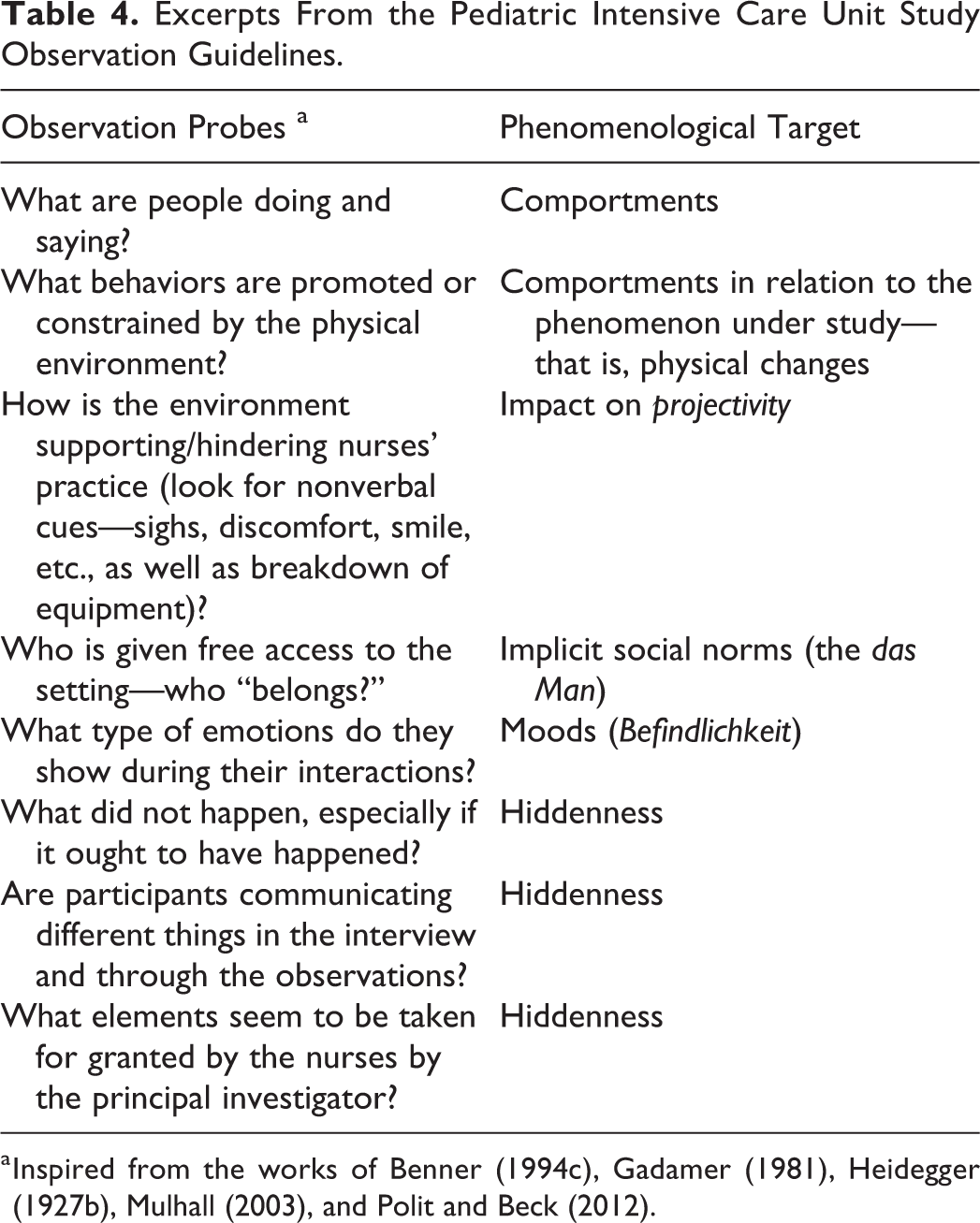
a Inspired from the works of Benner (1994c), Gadamer (1981), Heidegger (1927b), Mulhall (2003), and Polit and Beck (2012).
Art-based methods
What distinguishes interpretive phenomenological art-based methods?
Art-based research methods represent “an effort to extend beyond the limiting constraints of discursive communication in order to express meanings that otherwise would be ineffable” (Barone & Eisner, 2012, p. 1). This is consistent with Heidegger's (1927a) view that art, such as poetry, present more authentic (unveiling) types of discourses. Art-based research includes, but is not limited to poetry, music, dance, and visual arts (Leavy, 2009).
How to operationalize these distinctive features?
The exemplar study used photovoice whereby participants were asked to take pictures of environmental and practice changes in the PICU that they considered meaningful. Originally developed by Wang and Burris (1997) with an emancipatory perspective (Evans-Agnew et al., 2017), photovoice uses photographs “to elicit, draw out, evoke responses from participants” (Riley & Manias, 2004, p. 400). It allows participants to actively share their vision of the phenomenon through the “immediacy of the visual image” (Wang & Burris, 1997, p. 369). Following the photovoice methodology, the PICU participants were encouraged to capture images that illicit a particular feeling for them, no matter what this feeling was (mood, Befindlichkeit) (Evans-Agnew et al., 2017; Olausson et al., 2014). Participants could also take pictures outside the PICU environment that reminded them of the environmental and practice changes they experienced in the PICU—representation pictures (Evans-Agnew et al., 2017). Participants were instructed to exclude people from the photographs (i.e., colleagues, patients, visitors) as well as identifiable objects (i.e., staff identification cards, patient charts). The participants took these photographs digitally for 1 month prior to the interviews, using their personal phone. The pictures were then used to elicit discussion during the interviews. As interviews represent a more artificial reality created by the researcher, the photos serve as a way of bringing everydayness into the interview to elicit everyday life (S. Ybema, personal communication, July 9, 2019).The photograph (Figure 1) showing a nursing workstation within a deeper alcove spurred discussion about the isolation felt by nurses and the longing for past team spirit. The following are sample interview questions that were used specifically for photographs (inspired by the questioning strategy recommended by Evans-Agnew et al. (2017):

Photograph taken by Cindy (nurse participant, pseudonym).
Can you tell me about what you see in this picture? What emotion does this picture elicit for you (mood, befindlichkeit)? What is the most meaningful detail in this picture for you? What about this is important? If you had to choose a title for this picture, what would it be?
The pictures are also used to enrich the observational data as the researcher positions the delimited picture within the larger unit context. The researcher is called to observe what is within the picture frame and what is left out (i.e., what is right next to the object of focus, but excluded from the photo). This art-based data collection method further stimulates a reflection about the lived experience, and how the phenomenon may be concealed or taken for granted. Interestingly, the participants who did not take part in photovoice (i.e., did not bring pictures to the interview due to discomfort or lack of time), had all previously thought of the research question in terms of visual representation, which allowed delving into rich imagery for discussion—tapping into a more authentic form of discourse. For example, one participant, speaking of the ergonomics of the workstation, compared nurses to meerkats, moving backward simultaneously to see where call bells are coming from.
Data Analysis
What distinguishes interpretive phenomenological data analysis?
A hermeneutical approach to data analysis distinguishes interpretive phenomenological research from other types of qualitative inquiry. Stemming from the concept of the hermeneutic circle, a back-and-forth movement from part to the whole is privileged (Gadamer, 1976; Rodgers, 2005; Taylor, 1987, 1991), with co-constructions constantly “compared and contrasted through a dialectical interchange” (Guba & Lincoln, 1994, p. 111). Data analysis is an interpretive process, and imprinting lived experience in writing opens up the possibility for interpretation (Ricoeur, 1981). Early writings also serve the purpose of illuminating the researchers’ preunderstandings (Benner, 1994a) or horizon of significance. The researcher cycles from preunderstandings to new understandings, which are integrated with future preunderstandings as the analysis continues (Benner, 1994a; Gadamer, 1976; Rodgers, 2005). As a recent work by the first author and colleagues suggests: Hermeneutics reminds us that listening to the meaning attributed by others does not require the dissolution of our own perspective, but rather, it is our own horizon, from which we distance ourselves that serves as a backdrop of understanding (Ricoeur, 2016). Our own perspective, in coexistence with the other person’s horizon, opens the possibility for transposing ourselves into a foreign horizon (Gadamer, 2004). To listen hermeneutically is to “recognize one’s own in the alien, to become at home in it” (Gadamer, 2004, p. 13; Ricoeur, 2016)—bringing what is near to what is far, back, and forth (Ricoeur, 2016). (Frechette & Carnevale, 2019)
How to operationalize these distinctive features?
Different methods can be used for data analysis, but the process generally begins at the same time as data collection—with preliminary analyses of trends, highlights, and differences—documented in an ongoing fashion in analytic notes or memos. In the case of the exemplar study, the principal researcher wrote a preliminary analysis and a synthesis for each data collection episode (see Figure 2).
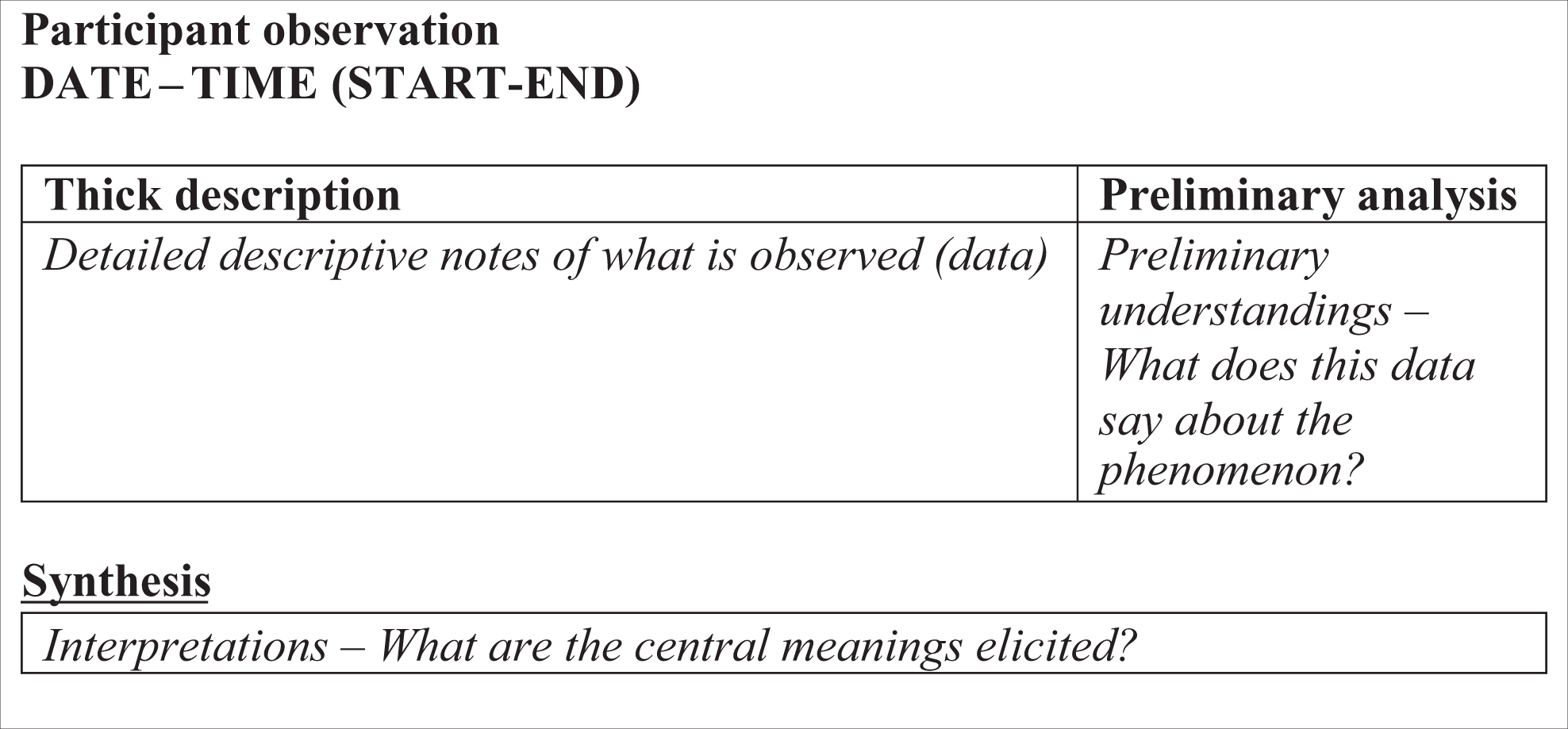
Participant observation template.
In constructing the syntheses, the researcher(s) “move in and out of the detail [of the transcripts and field notes] in an iterative manner,” asking repeatedly, “What is happening here?” (Benner, 1994a; Thorne et al., 2004, p. 14). From a hermeneutical tradition, the following questions are used to dialogue with the texts (Gadamer, 1981): How is the phenomenon being expressed in this encounter? What is the meaning for the interviewee and the researcher about this element in relation to the studied phenomenon and why? “What do I now know or see that I did not expect or understand before I began…?” (Benner, 1994a, p. 101) The first constructed narrative synthesis provides a paradigm case from which other narrative syntheses can then be examined: “in its own terms and in light of the first paradigm case…for comparison of similarities and differences” (Benner, 1994a, p. 114). In the PICU study, a back-and-forth movement between synthesized and discrete pieces of data occurred (hermeneutic circle) until no new key meanings emerged from the interchange with the data (see Figure 3).

Data analysis process.
Phenomenological analysis necessarily immerses the researcher in the study data—listening to interview recordings and reading observation, document and interview transcripts/notes on multiple occasions in their entirety and then zooming in to key sections (hermerneutic circle). The data, preliminary analyses, and syntheses for the exemplar study were entered in the NVivo Version 12 Pro software to facilitate this back-and-forth movement from part to the whole. Moreover, participants can be called to validate interpretations (Carnevale, 2002; Guba & Lincoln, 2005) through follow-up interviews, for example, as was also done in the PICU study.
Conclusion
In conclusion, the interpretive phenomenological tradition takes root in a rich understanding of being that opens methodological possibilities for researchers. Interpretive phenomenology presents a unique way of orienting research that allows in-depth exploration of the lived experience. Interpretive phenomenology provides researchers elements of reflection concerning their being-in-the-world as a researcher, their horizon of significance, and their embodiment—for enhanced reflexivity and presence. Moreover, this methodology allows for the pointed definition of research questions and objectives as well as guidance in recruiting a diverse sample that can offer a rich account of the phenomenon. Researchers’ understanding of interpretive phenomenology can enrich their selection of data collection methods and how these methods are operationalized (e.g., observing for what is hidden). An interpretive phenomenological methodology calls for data analysis that truly moves beyond description, to interpretation, in getting at the “so what?” The main methodological contribution of this article is its detailed articulation of how research methods can be developed in coherence with the interpretive phenomenological tradition. It aims to bring to the fore taken-for-granted practices by qualitative researchers and make them explicit in light of the interpretive phenomenological philosophical foundations.
Footnotes
Acknowledgments
The authors would like to thank Dr. Franco Carnevale, Dr. Alfons van Marrewijk, and the European Academy of Management Conference community of scholars, for their feedback concerning a preliminary version of this article. The first author would like to thank the Fonds de recherche du Québec—Santé (FRQ-S), the Quebec Network on Nursing Intervention Research (RRISIQ), the Ministry of Education, the Institut universitaire en santé mentale de Montréal—Research Center, Mitacs, and McGill University for their doctoral financial support.
Declaration of Conflicting Interests
The author(s) declared no potential conflicts of interest with respect to the research, authorship, and/or publication of this article.
Funding
The author(s) received no financial support for the research, authorship, and/or publication of this article.
