




Abstract
Despite the field’s interdisciplinary nature, academic specialization and the academic norm of in-field referencing have limited the scope of possibility that journalism studies may draw upon fields not part of its interdisciplinary repertoire. This paper invites readers to explore Interpretative Phenomenological Analysis (IPA), a rich analytical tradition from qualitative psychology and health studies and demonstrates its applicability in journalism research. By analyzing in-depth interviews with journalists at the cusps of two epochal ages of digital disruption in journalism—the rise of user-generated content (UGC) and social network sites around 2010, and the current explosion of generative AI—we show how IPA can serve as a powerful approach for journalism researchers. Paying tribute to the journalist as ‘expert’ of their own occupational lived experience, IPA provides a nuanced understanding of how journalists negotiate technological transformations in their occupational spaces. Through a triple hermeneutic analysis, where researchers attempt to make sense of journalists critically making sense of UGC and AI as a journalistic tool while reflectively engaging in sense-making of what it means to be a journalist in the age of social media and the age of AI, we explore the profound implications of these digital disruptions. Thematic findings reveal occupational identity crises, ethical dilemmas, and organizational challenges, all within the context of methodological reflection. This study underscores the value of IPA in capturing the depth and reflexivity of journalists’ sense-making during significant technological transformations, advocating for a reflective turn in journalism research.
Keywords
Introduction
Interpretative Phenomenological Analysis (IPA) is an established research approach for qualitative inquiry of lived experience as it relates to a particular phenomena of interest, whether making sense of the existential, or meaning making of mundane daily life. IPA as a qualitative approach is concerned with the detailed examination of individual lived experience, involving multiple stages from research question formulation to data interpretation. Each stage of IPA keeps record through note making, revealing emergent themes, and grouping or ungrouping themes for the final write up. IPA mainly focus on themes making sense of a research participant’s sense of self (Nizza et al., 2021).
IPA is largely used in the health sciences, particularly psychology and nursing. In the recent decade, qualitative studies in education with its appreciation for reflective inquiry has also begun to embrace IPA for its double hermeneutic reflections. Research in journalism studies, however, has been slower in realizing the interpretive potentials of IPA in drawing out nuances of social reality and lived experience. (Larkin & Flowers, 2021; Tuchman, 1978)
Research and inquiry in the field of journalism traditionally focused on quantitative research on mass communication, politics, and society (see Journalism and Mass Communication Quarterly). In the last two decades the leading academic journals in the field of journalism has largely been focused on “critical discussion of journalism” (Journalism Studies), “social, economic, political, cultural and practical understanding of journalism” and “current developments and historical within in journalism” (Journalism), and more recently, focusing on technology and journalism (Digital Journalism) as well as reflective and critical studies on the professional practice of journalism (Journalism Practice).
As such, journalism studies thus far has been well-served by post-positivist quantitative methods and statistical analyses, as well as textbook qualitative methods such as focus group discussions (FGDs), in-depth interviews, and ethnographic studies, occasionally. Discourse analysis, thematic analysis and other textual analyses methods are most commonly employed for interpreting and analyzing qualitative data in journalism studies. The work of making sense of qualitative interview data is a highly iterative and subjective process (Church et al., 2019; Döringer, 2021). The field of media and communication in general, and journalism studies in particular, have employed numerous ways to make sense of findings from qualitative interviews (Gabor, 2017), most often through thematic analysis (Brennen, 2021; Kazmer & Xie, 2008).
The above qualitative research methodologies have undoubtedly served the field well as it sought to examine and understand news and journalism in social, political, economic, technological and/or cultural contexts. These meso- and macro sociological contexts have undergone transformations that impact the institution, the practice and the products of modern journalism. However, it is only relatively recently in the past two decades that journalism studies have begun to pay real attention to the microsociological context of news production and news consumption, as technological and socioeconomic transformations begin to impact individual journalists and news consumers on a large scale. Digital convergence, newspaper shutdowns, loss of advertising revenue, news algorithms, partisanship, the spread of ‘fake news’, – all have repercussions on the lived experience of journalists and news consumers.
Where textbook methods of qualitative textual analyses may have served journalism studies well for discourse and debate on meso- and macrosociological social phenomena, these methods may not allow for deeper sensemaking of microsociological phenomena shaping the physical-, psychological-, emotional-, and spiritual-selves of individual journalists and news consumers.
Therein lies the potential and promise of IPA for journalism studies, as methodological tool of analyses and interpretive approach well-suited for making sense of the lived experience of individual persons affected by (or affecting) transformations and disruptions in journalism.
While technological innovations that gave rise to the daily newspaper, radio, television, satellite broadcasting, and digitization, all played their own roles in transforming news and journalism, these earlier forms of ‘new media’ did not encroach upon the occupational boundaries of journalism. Journalists’ professional role and occupational identity remained intact throughout the first 100 years of modern journalism. News and journalism was produced by journalists – namely human persons working for news outlets, reporting on daily news, current events and issues of the day. Whether these journalists were national network news anchors, international correspondents, small town newspaper reporters, freelancers or part-time stringers, and whether they produced Pulitzer-prize worthy reportage, sensationalist stories, or even bias and polarizing news, news remained the purview solely of the journalist, at least up until the mid 2000s..
However, the rise of user generated content (UGC), citizen journalism and social networking sites (i.e. social media) in the late 2000s and early 2010s, and the current explosion of generative AI is different from earlier times of technological transformations (Cools et al., 2022) . These two epochs of digital disruptions transform not only the journalistic ecosystem, but also challenge the fundamental core of what it means to be a journalist and even who/what is responsible for the core task of producing what we call news.
The first decade of the 21st century was a poignant period in the history of journalism when the possibility of using “user generated content (UGC)” in the news production process was a novel, new practice whose influence on the journalistic profession was then yet to be fathomed. It was a time when non-professional, untrained laypersons bearing “camera-phones” arose as an existential challenge to the professional journalists’ very identity and purpose in this world. It was a time when journalists were reluctantly forced to share the honour and respect associated with “bearing witness” to the world’s most important events. And it was a time when journalism and journalists’ role in “breaking the news” and “setting the agenda” began to be challenged by citizen journalists with no professional training. IPA offers a powerful way to dive deep into the lived experience of journalists and their inner world as they negotiated Web 2.0’s intrusion into their occupational space, and attempted to make sense of the new norms and structures of their profession (Firdaus, 2018).
The exponential explosion Artificial Intelligence (AI) in late 2022, may prove to be even more disruptive to journalism and journalists. AI algorithms, including Large Language Models (LLMs) (Naveed et al., 2023) and Deep Learning Models (DLMs) (Goldstein et al., 2022), are increasingly being incorporated into journalism practice to aid in news reporting. Additionally, beyond mere AI tools, Generative AL (GAI) has the potential to automate news operations, increase productivity, and open new avenues for narrative and content creation in news organisations (Grimes et al., 2023). While journalists’ own adoption of AI tools gives rise to questions of ethics and journalistic practice, they do not form an ‘encroachment’ into journalists’ occupational boundaries. However, newsrooms and other non-journalistic adoption of Generative AI (GAI) is to generate ‘news’ may very well pose an existential threat to the professional of journalism and the occupational identity of the journalist, not to mention the jobs that offer journalists their livelihoods.
Drawing upon analysis of in-depth interviews with journalists at the cusps of two epochal ages of digital disruption in journalism – the social media age and the age of AI – we demonstrate how Interpretative Phenomenological Analysis (IPA) may serve as a powerful approach for journalism researchers to make sense of the ways in which professional journalists negotiate technological transformations in their occupational spaces. Paying tribute to the journalist as ‘expert’ of their own occupational lived experience, the paper delves into the value of IPA as an interpretive approach for understanding human journalists’ sense-making of technological encroachment into the journalistic occupational boundary.
This paper will first present a literature review of related research using IPA within the context of lived experience of various occupations and professions. Next, the paper will touch upon the rise of user generated content (UGC) and the current explosion of generative AI, two epochal technological transformations disrupting journalism and challenging journalists’ occupational boundaries. We then turn to two separate IPA studies employing during each of these two digital disruptions. First is an IPA study of how journalists in 2010 perceived the encroachment of UGC and citizen journalism into their journalistic space and their newswork routines. Next is study of journalists in 2024 trying to make sense of what generative AI means for their journalistic newsflows and their jobs in journalism.
Interpretative Phenomenological Analysis (IPA) Research Applications
IPA was first established in the field of psychology to assist in examining personal experiences and perceptions and “understanding the meaning or contents of thought” (Smith & Fieldsend, 2021, p. 192). This qualitative turn in the field of psychology is partially related to an emergent hermeneutic and existential approach to psychological therapy (Larkin et al., 2019; Pringle et al., 2011). The phenomenological qualities of IPA however are equally useful to qualitative inquiry outside of the field of psychology and health sciences (Smith, 2011, 2015).
Over time IPA gained popularity and established academic significance in multiple disciplines apart from psychology (Eatough & Smith, 2017), eventually emerging as a well-established methodology within the realm of qualitative research (Smith & Fieldsend, 2021). IPA is widely used in various fields to explore how individuals make sense of their personal and social experiences (Mavhandu-Mudzusi, 2018). This is motivated by the method’s effectiveness in helping researchers understand the scope and focus of a study in depth and detail (Rajasinghe, 2020). Several important factors drive this effectiveness, such as exploring individual lived experience, the idiographic approach, flexibility, depth, and the involvement of hermeneutics. These aspects make IPA suitable for fields of study like psychology, health, and social sciences, helping researchers to make sense of the personal experiences and reflections of individual research participants. Consequently, we can observe how IPA has been employed in various major research fields today (Love et al., 2020).
IPA is often applied in studies focusing on people’s experiences and reflections regarding their occupation, technological transformations and digital disruptions. In IPA studies concentrating on workplace experiences and reflections, several researchers, such as Clarke (2009), Oxley (2016), Guihen (2020), Francis (2023), and Valdivia (2023), have conducted research across various occupational domains, including educational psychologists, child and adolescent psychotherapists, and deputy headteachers. In occupational therapy research, IPA has contributed to developing a deeper understanding of how work is experienced and imbued with meaning by those involved (Clarke, 2009). Similarly, in educational psychology, IPA has been utilized to explore the career experiences of female deputy headteachers, underscoring its potential to investigate the perceived experiences of individuals (Guihen, 2020; Oxley, 2016). These findings collectively highlight IPA’s value as a methodology for understanding individual experiences and reflections across various work contexts (Clarke, 2009; Guihen, 2020; Oxley, 2016; Palmer et al., 2010).
The same is true for IPA studies conducted across various spectrums to examine individual experiences related to technological transformation and digital disruption. These studies are carried out by several researchers, such as Stolterman and Fors (2004), Molla et al. (2016), and Kasavina (2019), who focus on different aspects of individual responses to and perceptions of digital change. In Molla et al.’s (2016) study, the IPA method was employed to explore the experiences and feedback of IT managers regarding digital disruption. Meanwhile, Stolterman and Fors (2004) similarly utilize the IPA method to investigate the impact of information technology on society, focusing on ongoing digital transformation and its significance for quality of life. Lastly, Kasavina (2019) underscores the importance of critically assessing the socio-humanitarian consequences of digitalization, suggesting a potential role for IPA in this area. Together, these contributions underscore the versatility and relevance of IPA in shedding light on the multifaceted dimensions of technological transformation and digital disruptions across diverse academic and practical contexts.
Following on the heels of qualitative studies in the fields of psychology and education, journalism studies and media production research however, is only recently exploring IPA as possible method for making sense of the lived experience of journalism, with much of the effort coming from more traditional perspectives of newswork focusing narrowly on journalists’ lived experience of trauma and disability (Gekoski et al., 2012; Powers, 2020; Takahashi & Tandoc, 2016). Others in journalism studies such as Schumacher (2016), Powers (2020), Bradshaw (2021), Eccles (2023), and Kurnia et al. (2022), use the IPA method to explore the experiences of journalists from various perspectives. These include exploring and deepening the understanding of the journalistic experience in traumatic news coverage, the transition of journalism practitioners to journalism educators, the use of technology in news reporting, challenges in journalism careers, and ethical conflicts in journalism. Through the application of the IPA method in most of these studies, researchers obtained various in-depth experiences and feedback related to the technology adaptation process, especially among journalists. Similarly, in identifying issues and challenges in career aspects and ethical considerations, researchers found the specific issues and challenges journalists face, particularly from the perspective of those who experience them. These studies offer nuance in explaining the studied phenomena. Phenomenological studies about journalists have explored influences on journalistic work and how journalists themselves make sense of these influences on their journalistic practices, providing a deep and humanistic understanding of the journalist’s lived experience of navigating profound challenges in their occupational lives.
Interpretative Phenomenological Analysis (IPA) of Journalists’ Lived Experience of Digital Disruptions in their Occupational Lives
As a working illustration of IPA for making sense of journalists’ lived experience of technological encroachments into their occupational boundaries, we analyze (using IPA) interviews from two separate studies conducted at the cusps of two epochal digital disruptions.
The first study took place in 2010 not long after news media around the world reported on a devastating earthquake in Haiti by using UGC video clips and photos. The year before in 2009, the global news media relied on Tweets to report on the Green Revolution in Iran. Two years prior in 2008, news media broadcasted UGC images of Tibetan monks protesting Chinese.
The 2010 study explored Malaysia-based ‘glocal’ journalists’ perceptions and response to user generated content (UGC), social networking sites (i.e. social media), alternative news and citizen journalism. Interpretative Phenomenological Analysis of the study’s interview transcripts facilitated multilayered interpretative analysis of both the multiple hierarchies of influences shaping journalists’ new newswork routines, as well as journalists’ negotiation of new media encroachment into their occupational role of ‘bearing witness’ (Firdaus, 2014, 2018).
The second IPA study of digital disruptions in journalism takes place in 2024 exploring journalists’ in Pakistan and their sense-making of ethical issues surrounding of AI adoption in news workflows and the implications of AI-generated news on journalism as an institution and an occupation (Baloch & Firdaus, 2024). Here, interpretative phenomenological analysis allows for a triple hermeneutic analysis, wherein researchers attempt to make sense of journalists critically making sense of AI as journalistic tool whilst reflectively engaging in sense-making of what it means to be a journalist in the age of AI.
IPA Study 1: Journalists’ Negotiation of UGC Encroachment into News Routines and Occupational Boundaries
Journalists Interviewed at the Cusp of the Age of UGC and Citizen Journalism (2010).

BJ = Broadcast Journalist.
An initial interview guide (interview questions) prepared before the interview stage of the study focused specifically on the use of user-driven platforms/social networking media in newswork. This interview guide served as a general guide, but questions evolved as warranted by the amount of time each journalist was willing to spend doing the interview, and emergent themes arising out of individual interviews (Kallio et al., 2016).
As the first batch of interviews progressed, a trend emerged in which participants talked as much or even more about other aspects of newswork, as compared to journalistic use of user-driven platforms/social media.
This is partly due to the fact that traditional routinized forms of doing journalism for conventional news outlets are so resilient, and therefore and still relevant to news production, true in 2010 during social media’s infancy and even now in the age of digital journalism. Although diffusion of user-driven platforms/social media as journalistic tool occurred organically through 2010 journalists’ sporadic use of Twitter and YouTube as news source during crisis events, and/or individual journalists’ ‘habitualized’ use of such media platforms in their daily work, it had yet to reach the level of being ‘institutionalized’ at the organizational level. Whilst still retaining core questions related to journalistic use of user-driven platforms/social media, the semi-structured form of the interviews left sufficient room for participants to raise issues more salient to their conception and experience of news production, and these same issues resonate among colleagues in similar situations. Questions were phrased openly, for example “How about Twitter, do you use that?” where the question was answered through the emergence of themes relating to the intersections between Web 2.0 adoption and professional journalistic norms and routines, and also ideological news values and extra-media influences of the news system. But these themes emerged not from the formal framing of the question, but through journalists’ reflexive conceptions regarding forces that shape their adoption Web 2.0 as news production tools.
IPA Reflexivity in Interview and Analysis
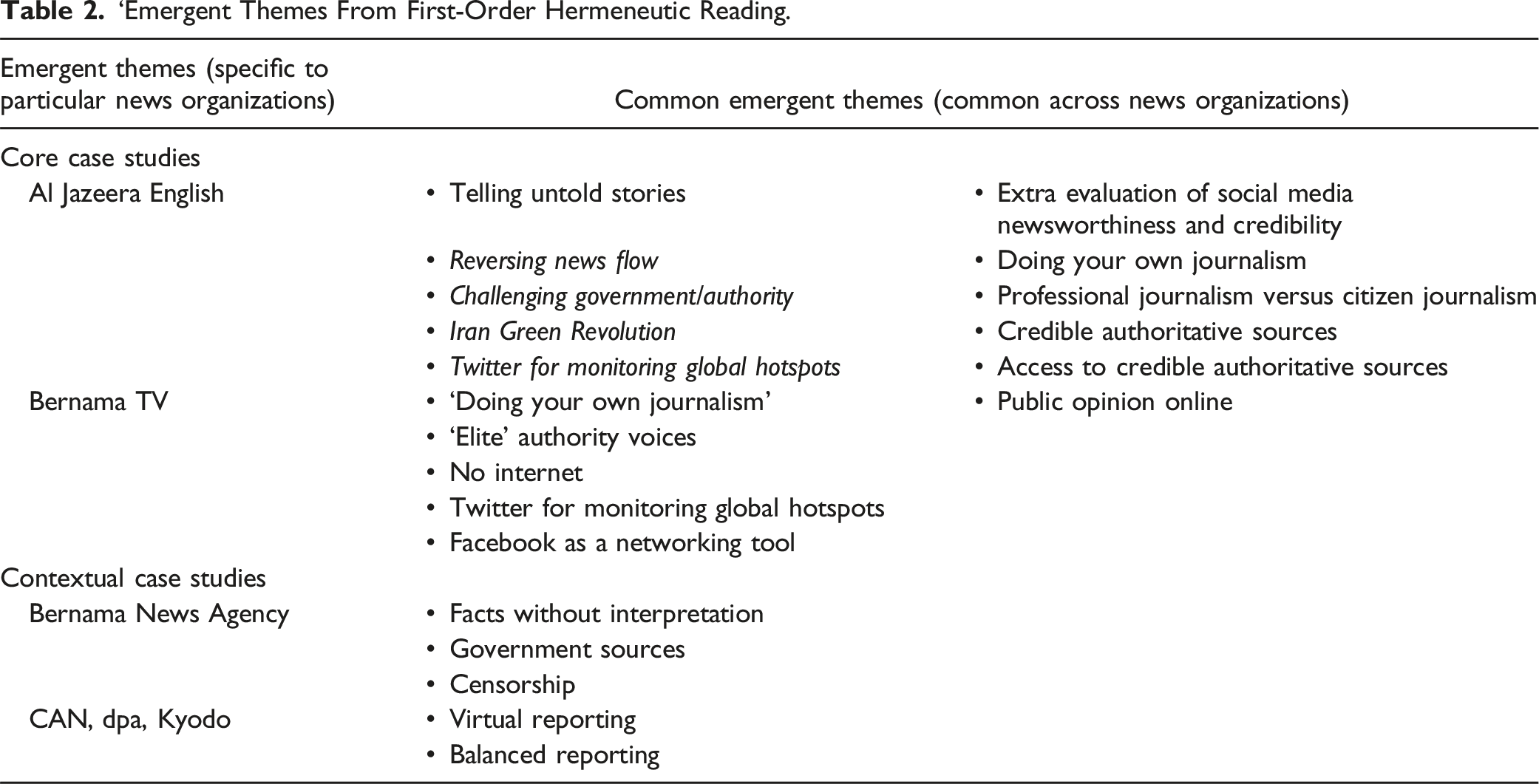
IPA’s flexibility extends to the method of applying its stages of analysis, which Smith (2004) note doesn’t require strict replication, but rather should be adapted to suit specific conditions of different research studies. Accordingly, IPA has been used to ‘theme’ and interpret the 2010 study’s interview transcripts by adopting Smith and Osborn’s approach which respects the structure of data.
‘Emergent Themes From First-Order Hermeneutic Reading.
Clustering ‘Emergent Themes’.

The second stage of IPA analysis, which is essentially an ‘iterative’ stage, I attempted to identify connections between themes. This procedure followed Smith (2004) approach in listing out emergent themes in order to cluster related themes. The third stage of analysis involves developing a ‘superordinate theme’ out of each cluster of similar ‘emergent themes’. This development of ‘superordinate themes’ involves my attempt to interpret my journalists’ interpretation of their own professional reality (i.e. ‘second order’ hermeneutic reading) (Tandoc Jr. & Takahashi, 2018).
This relates to the notion of reflexivity and the evolution of questions in semi structured interviews. Here this reflexivity is extended to the data analysis. Most relevant to exploring journalistic adoption of networked technologies is the way in which IPA aims to ‘respect convergences and divergences in the data’, thus drawing out and identifying transnational commonalities and divergences in news production, and illuminating the ways in which the professional realities of Malaysian-based ‘glocal’ journalists’, vis-à-vis a globalized networked media ecology, are ‘similar but also different’. Finally after ‘superordinate themes’ have been identified, I subsequently identify recurrent ‘superordinate themes’ as I analyzed one transcript after another and one set of ‘case studies’ after another.
‘Superordinate’ Themes and Corresponding Levels of Analysis.

IPA Study 2: Journalist Sense-Making of Journalistic Occupation in an Age of AI
The second IPA study in the paper was conducetd by the 4th author. 13 senior journalists from Pakistani digital newsrooms and media development specialists were included representing array of experience in varied journalism roles. All participants are currently associated with digital media and well-aware of media convergence and further transitioning to automated news generation concepts. Their experiences range between 3 to more than 30 years, while majority made transition from traditional media to digital modes. Some of them hold expertise of deeply studying the media transition who previously also worked as practicing journalists themselves.
Journalists Interviewed at the Cusp of the AI Age.

Emergent Themes, Recurrent Themes and Superordinate Themes in IPA Study of Journalists’ Lived Experience of AI.

Drawing up the themes in Table 6, in the following paragraphs we illustrate the reflexivity, depth and nuance that IPA method offers for making sense of journalists’ sense making of their lived experience during epochal digital disruptions where AI encroaches into journalists' occupational boundaries.
Beyond merely organizing research findings into themes to answer pre-determined research questions, reflexivity in IPA themeing brought to fore dimensions of sensemaking.
IPA Dimensions of Sensemaking
Firstly, as journalists engaged in occupational sensemaking of the AI explosion in journalism, there is a perceptible emergence of an occupational identity crisis in the journalistic fraternity. Journalists grapple with shifting skillsets, changing values, and ethical concerns. Journalists question what it means to be a journalist in a new age where generative AI can not only take over the task of newswork, but may even push human journalists out of the journalistic occupational space. These reflections highlight the existential concerns that arise with as AI encroaches into the journalistic occupational space, fundamentally changing what it means to be a journalist (Linden, 2018; Túñez-López et al., 2020).
As journalists negotiate the AI encroachment into the newsroom, they are engaging in organizational sensemaking, understanding that their place of work is now organized around new priorities that value new AI-driven skillsets which many journalists still lack. IPA brings to fore journalists’ acute awareness that this new digital disruption is unlike any previous technological transformation, as it restructures how journalism is organized in this the age of AI.
Finally, journalists engage in institutional sensemaking of the disruptions to their industry, challenging the normative foundations of the institution of journalism. Where journalism was traditionally associated with accuracy, fair and balanced reporting, holding powers accountable, the explosion of both social media, news algorithms and generative AI gives rise to a norm that includes disinformation, polarized partisan bubbles, and very real potential misuses of data, including breaches of privacy and confidential information. IPA brings to fore; journalists’ concerns of what journalism will look like in an age of AI.
Discussion
As illustrated above, IPA allows for a triple hermeneutic analysis, wherein we have conducted a third-order reading of the two IPA studies’ researchers’ attempt to make sense of journalists critically making sense of epochal digital disruptions in journalism whilst reflectively engaging in sense-making of what it means to be a journalist in the age of AI.
The individual lived experience of doing newswork under specific contexts (i.e. technological transformations, organizational goals, politico-ideological institutional values) presented the study with a rich, multiperspectival view of what is it like to be making news at the cusp of major technological disruption to journalism.
Themeing using IPA drew out the experiential differences and differing factors influencing how journalists incorporate new technologies into their routine newswork, whilst also navigating threats to their occupational identities.
Gans (2004) notes that “phenomenological-inclined researchers have made a major contribution to understanding journalists and their work by showing that whatever the nature of external reality, human beings can perceive it only with their own concepts, and therefore always ‘constructed’ reality.” While this quote from Gans comes from a discussion on the different theoretical perspectives for understanding news selection, it is also relevant to journalism studies more generally, as it highlights the power of IPA in bringing to fore journalists’ “own concepts” for perceiving the “external reality” of their profession (Gans, 2004, p. 312).
For this paper’s professional journalists and their introspective sense making of the emerging external reality of disruptive technological transformations, IPA provided an additional layer of reflexivity through a heuristicity of interpretation between scholarship and the practice of journalism.
The ‘reality’ of newswork is as much ‘real’ in a journalists’ (re)construction of it as he or she talks about it, as it is ‘real’ as he or she goes about the daily news gathering or news production activities required of a journalist. And this interpretation is then re-interpreted by the scholar who examines and documents and makes further sense of the journalists’ world. As Zelizer highlights: Thinking about journalism takes shape in patterned ways, and these ways reveal not only a wealth of cognitive information but also a social map of points of commonality and difference that goes beyond journalism per se . . . For journalism, that social map has two valuable referent points – journalists and journalism scholars. Both groups are invested in the shape of inquiry about journalism as it persists and changes. Both play a part in shaping that inquiry, and both have much to lose if that inquiry is not made explicit to those it touches. Conversely, the common interest of both groups necessitates a workable and ongoing awareness of what each group thinks in regards to journalism (Zelizer, 2004, p. 6).
Zelizer refers to the general reflexivity inherent to the relationship between academia and the institution of journalism. And one manifestation of this relationship occurs in the act of research, when in the name of inquiry, the journalism scholar looks to the journalist in his or her capacity as a “referent point”, and actively engages with that referent point in order to learn about journalism, while the journalist does the same in order to “play a part in shaping that inquiry.” IPA and its attending in-depth interviews offer one instance in which both journalist and scholar engage in “a workable and ongoing awareness of what [the other] thinks in regards to journalism.” And reflexivity is a likely consequence as well as a possible factor in the journalist’s and the researcher’s “ongoing awareness” of each other.
Researchers’ reflexivity may be characterized by two processes, one of discovery and one of construction (Kleinsasser, 2000). The researcher strives to identify and discover incongruities, and having done so, treats them as sources of new knowledge; thus, researchers combine both processes when reflecting on the studied phenomena (Dodgson, 2019). Such activity may lead researchers to a new way of conceptualizing the meaning of previously acquired information. As shown above, IPA offers a nuanced approach for making sense of the phenomenon under study (Goldspink & Engward, 2019).
Conclusion
The aim of this paper we to explore the relevance and usefulness of IPA methodology for the field of journalism studies. We have argue d that ‘epochal' digital disruptions such as the rise of user generated content and social network sites and citizen journalism around 2010, as well as the current explosion of generative AI, bear implications on the lived experience of journalists, necessitate a reflective turn in journalism research. This reflective turn in journalism can be well-served by IPA.
Footnotes
Declaration of Conflicting Interests
The author(s) declared no potential conflicts of interest with respect to the research, authorship, and/or publication of this article.
Funding
The author(s) disclosed receipt of the following financial support for the research, authorship, and/or publication of this article: IPA Study 1 was funded by a PhD scholarship from the Malaysian Ministry of Higher Education (MOHE). IPA Study 2 received no funding from any funding body.
