




Abstract
The video recording of lessons allows the analysis results to provide data about the teaching practice. Analyzing the pedagogical practice itself allows the teacher an exercise of self-reflection, as they become aware of their behavior in the classroom, leading to the revitalization of their teaching model. This study aims to present the use of autoscopy as a stimulus to reflection, to a new understanding of the pedagogical practice of teachers, in an action research. This is a case study, with a qualitative and descriptive approach, performed with a new nursing teacher. The data were initially collected through a semistructured biographical interview and subsequent video recording of the classes, characterizing nonparticipant observations. The application of autoscopy followed the proposal of action research, with its phases: exploratory phase, in-depth research, action phase, and evaluation phase. The autoscopy was a useful strategy to stimulate teacher reflection because during the projection of the sketches selected for the video of the autoscopy session, the teacher can see himself or herself in action and self-analyze and discuss the selected pedagogical moments, stimulating reflection and generating a new understanding about his or her teaching practice. In this way, the use of autoscopy under the epistemological perspective of action research stimulates the self-analysis and reflection of the teaching practice.
Keywords
Introduction
The action research is configured as a research strategy in which the intervention in the studied environment occurs through the active participation of the researcher and participants, once it investigates the practice itself, with the purpose of improving it (Thiollent, 2011; D. Tripp, 2005). The interaction between the researcher and the participants generates cooperative action on the part of the people involved in the problem under observation, so that a problematic action detected can be investigated, elaborated, and conducted, not only describing the situation but generating events and results that can trigger changes (Thiollent, 2011).
Among their possibilities of development and existing classifications, Heidemann, Fonseca, and Fernandes (2013) bring the so-called diagnostic action research, where the researcher, in contact with the existing situation, establishes the diagnosis and recommends measures to solve the problem.
And regardless of its classification, the application of action research follows a cycle, with predetermined phases such as nominated exploratory phase, in-depth research phase, action phase, and evaluation phase (Thiollent, 1997).
In the educational field, D. Tripp (2005) argues that this method can be used to improve teachers’ teaching and, consequently, student learning, being a research method that starts from the real environment, where the researcher reports his or her impressions about the problem and on the investigated solutions, being configured as an action research proposal. Thus, an action research process that generates new knowledge and allows improvements in professional practice attends to the moral, political, and emancipatory dimensions of teaching and research (Newton & Burgess, 2008).
This collaborative approach is useful for teacher training because when studying the process of learning to be a teacher, researchers acting as mentors can identify research problems and possible solutions to these problems, helping teachers to become reflective, and understanding their own practice (Qing-li, Torres, & Shi-Ji, 2018).
The autoscopy as a data collection technique is shown as an adequate proposal for the intervention on the teaching practice in studies whose design is the action research. Its use constitutes a possibility of stimulating teaching reflection, since it consists of a strategy of filming the practice of the teacher, to submit it to an analysis session, by the teacher himself or herself, a posteriori of the action, when his or her verbalizations and awakened perceptions can promote the apprehension of the learning resulting from the reflexive process (Sadalla & Larocca, 2004).
The use of video technology allows the capture of rich and detailed data, providing a permanent record, which can be analyzed from multiple perspectives, as it allows the recording of the complex aspects inherent in teaching and learning (Fitzgerald, Hackling, & Dawson, 2013). Thus, video recording of professional practice in qualitative research can be used in different contexts, with different purposes of research, since observation creates a learning space for all involved, and in this way, methods must be developed for applicability in different configurations with different populations (Kragelund, Moser, & van Zadelhoff, 2015).
In educational research, video is an excellent tool to be used, being a prominent tool to be used in teacher training programs, due to its capacity to capture the wealth of data and complexity of the activities in the classroom, for later analysis (Sedova, Sedlacek, & Svaricek, 2016). Based on the real experiences and the classroom work process, the video recording of classes allows the results of the analyses to provide data about the teaching practice, where these findings contribute to improvements in the teaching learning process, by allowing the incorporation of these elements into teacher training programs (Leblanc, 2018).
This type of observation with the use of video recording, which focuses on the particularities of observed teaching practice, can bring positive and negative emotions to the teacher under analysis and under favorable conditions, mediated by the researcher, these emotions can be channeled to lead to professional development because it allows the integration of new knowledge to its teaching model, enabling practical and concrete changes in the classroom (Hamel, Viau-Guay, Ria, & Dion-Routhier, 2018).
Thus, observation allows data to be generated, and in this dialogue, which involves respect and affection, researchers, who are more experienced teachers, provide guidance and advice. In this way, teachers gain knowledge and new skills and researchers advance in their studies, benefiting mutually (Qing-li et al., 2018). The questions and suggestions of the researcher aim at the teacher to verbalize his or her activity, from their prereflective awareness, while watching the recording of his or her classes (Leblanc, 2018). In this moment of self-confrontation, teachers relive and comment on their own classroom activity, making a narrative of what they were really experiencing in that situation of the classroom being viewed (Leblanc, 2018). In this way, these questions, together with the visualization of the video clips, enable the teacher to acquire new learning, accessing new resources suggested by the researcher, making him or her aware of the specific learning and professional development objectives resulting from the observation of his or her practice (Hamel et al., 2018).
This learning arising from reflection, derived from the study of Schön (2000) as a reflection on reflection-in-action, which is the result of the study of the practice itself, is pointed out as one of the ways to revitalize teacher praxis by stimulating the formation of a teacher reflective. Teachers need to be reflective, and they can develop professionally through the study of their own practice, which, through the stimulation of this critical and reflexive consciousness, may end up creating reflective habits that favor professional improvement (Qing-li et al., 2018).
As a product of this meaningful learning, we can have a teacher who will stimulate the learning of his or her students, through pedagogical strategies that stimulate student reflection, thus opposing to the traditional model of teaching, centered on the figure of the teacher.
The autoscopy is extremely powerful because when reviewing his or her action, the teacher attributes meanings within the context in which the presented situation happened, actively analyzing his or her performance, which allows the discovery of areas that need improvement, thus promoting self-knowledge (Martins, Campos, & Costa, n.d.). This communication channel allows the participant to reinterpret his or her experience (Wabule, 2019). In this way, the self-analysis that the individual performs, when confronted with the self-image on the screen, implies contemplation and reflection on one’s behavior, leading to a reappropriation of oneself, by the privileged opportunity of self-criticism, thus making autoscopy useful as a research and training technique (Sadalla & Larocca, 2004).
Several studies (Hamel et al., 2018; Kleinknecht & Schneider, 2013; Kragelund et al., 2015; Piratelo, Teixeira, Arruda, & Passos, 2017; T. R. Tripp & Rich, 2012) with teachers have used autoscopy as a strategy to stimulate teacher reflection. Among them, we highlight the study by T. R. Tripp and Rich (2012) in which the participants reported that the autoscopy sessions made it possible to analyze their practices in video in an easier way than to try to reflect at the moment of action. This generated a new perspective of their teaching models, enabling the identification of the need to implement changes, committed to the desired advances in pedagogical practice. Participants also emphasized the importance of the trust relationship with their mentor, at the time of feedback, because the ideas were specifically discussed and contextualized, according to the observed behavior (T. R. Tripp & Rich, 2012).
Another study points out in its results that the participation of the teacher in this proposal of teacher training, in which the visualization of their own classes occurs, modifies their concerns related to their offered teaching model, representing, in this way, an opportunity for professional development for all involved (Hamel et al., 2018).
By visualizing and examining their teaching practices, teachers-in-training are able to reflect, analyze, evaluate, develop, and improve their own skills (Fitzgerald et al., 2013). Thus, observing the practice itself provides unexpected and valuable learning opportunities. For the stimulus to reflection to take place, the image of the researcher is necessary because it acts as a catalyst for reflection, and a relationship of trust between the participant and the researcher is necessary, since they jointly study the teaching work, resulting in the recognition of the learning potential arising from the reflection, being understood as a strategy used to develop the teaching practice (Kragelund et al., 2015).
This process of reflection on the action for Shulman (2005) promotes a new understanding, comprising one of the stages of the of pedagogical reasoning and action (MPRA). For the author, the MPRA evaluates the learning teaching process, occurring cyclically in six phases: at the time of understanding, the teacher identifies and understands his or her performance, so that from that moment, he or she can transform his or her knowledge and apply it in practice, thus improving the process of teaching and this moment of evaluation and consequent reflection, by observing his or her pedagogical path (with its potentialities and fragilities), allows the teacher a new understanding about his or her practice, which consequently enables improvements in the entire context of teaching, with the consolidation of new understandings and learning resulting from the reflection experience.
In this way, the use of autoscopy allows the teacher to identify his or her MPRA by the a posteriori observation, in a process of self-evaluation, when seeing in action, resulting from the reflection provided, generating a new understanding. This movement allows the development and expansion of the pedagogical content knowledge (PCK) considered by Shulman (2005) as the fusion between content and pedagogy, that is, the teacher’s ability to transform his or her own knowledge into something understandable and teachable to students with pedagogically adaptable forms to the different needs of the students. The PCK is an individual manifestation of knowledge for teaching, which can be accessed and expanded by the MPRA, when the teacher can evaluate and reflect critically on his or her own performance, leading him or her to a new understanding of his or her praxis.
Research strategies such as action research in education stimulate reflection, since when teachers recognize their problems at the time of teaching, become aware and able to explore solutions to the problems of their own practice, which leads to strengthening the performance of the teacher (Qing-li et al., 2018). Thus, this article aims to present the use of autoscopy as a technique to stimulate reflection, for a new understanding of the pedagogical practice of teachers, in an action research.
The Design, the Operationalization of Action Research, and the Use of Autoscopy
In this study, the two best teachers indicated by the students of a Technical Nursing Course of a school in the south of Brazil participated. The definition of the participants was made by means of a poll with the final students of the mentioned course, who indicated, in a freeway, the best nurse teacher that they had in their trajectory of formation. The site of data collection and study was in the premises of the participating school, conducted from September 2015 to August 2016.
This is an excerpt from the thesis, approved with Certificate of Presentation for Ethical Assessment nº 48333815.3.0000.0121, with a qualitative and descriptive approach, used as a research strategy, the study of collective cases of Stake (2012), and for data analysis, it was chosen as the content analysis, following the operational proposal of Ludke and André (2012). In all phases of the research, ethical principles were respected, as recommended by Resolution 466 of the National Health Council (2012).
For this article, as an element of evidence of the method, which used autoscopy to stimulate the reflective teaching process, it was decided to present the results of the case of the novice teacher, fictitiously nominated, as Isabella, with 27 years old and a bachelor’s degree in nursing, indicated as one of the best teachers by the students. It is understood by novice, a teacher with up to 5 years of teaching experience, as proposed by Shulman (1987) and Backes, Moya, and Prado (2011).
Phases of Action Research and the Path Made
Next, it will be presented methodologically the phases of action research, as proposed by Thiollent (1997), following with its phases: exploratory phase, in-depth research phase, action phase, and evaluation phase.
Exploratory Phase
Thiollent (1997) defines this phase as a field research of a diagnostic character of the situation, identifying the needs of the actors involved, which is the moment of approximation to the reality under study. In this phase of observation and data collection to diagnose the situation, a semistructured biographical interview (transcribed and validated by the participant) was made. This interview allowed to know information related to the pedagogical trajectory of the participant, being recorded with the help of a voice recorder.
After the interview, the nonparticipating observation schedule of the teacher’s classes was organized, excluding technical visits and evaluation activities (tests) previously scheduled. The nonparticipant observation in the field was recorded with video recording of the teaching activity in the classroom, totaling six sessions (13 hr 30 min observation), and the number of sessions was defined according to the period of performance of the teacher in the semester, consisting of the observation of a full semester.
The observation sessions were recorded in video, having as purpose, the production of images of the teaching action, and from the analysis of the teacher’s practice, it was possible to carry out later the implementation of the autoscopy technique.
Being careful not to interfere with the dynamics of the classroom, the camera was positioned at the back of the room, directed at the teacher, allowing a broad view of the classroom. It also used the field diary to record the observations and help in data analysis, containing operational, methodological, and theoretical records used in all observation sessions, subsidizing the preparation of the use of the images for the subsequent autoscopy session. One advantage of using video recording compared to other classroom research techniques, such as observational notes or audio recording, is that video recording can capture and present teaching and learning behaviors as they occur, thus adding a new dimension to the ways in which teaching and learning can be seen, described, and interpreted (Fitzgerald et al., 2013).
In-Depth Research Phase
This phase from Thiollent (1997) is also called the main phase, that is, the planning phase, when the data collected from the clear diagnosis made about the reality and the events or points that are desired to search, allows the interpretation of the results directing the investigation, enabling the definition of the themes and priority problems to be investigated, with the search for solutions and proposals for action.
Thus, after the nonparticipant observation, with recording of the video sessions and the field diary, the impressions/observations/annotations of the researcher were fully typed with the help of the editor and word processor Microsoft Word® 2010. The data were organized into folders in the computer’s directory, containing subfolders with the collections identified with the chronological order of the collection date, containing the videos and the field diary. At the end of the collection, the information was compiled and the data set constituted the corpus of the research.
With these records, content analysis was carried out, following the operational proposal of Ludke and André (2012). The content analysis process was started with the decision on the unit of analysis for codification, and in this research, it was chosen as the unit of context. Ludke and André consider it is more important to explore the context in which a particular unit occurs and not just its frequency. Thus, at the end of the observations, a floating reading of the recorded data was performed, seeking to identify the potentialities and weaknesses of the observed case.
After coding, the next step, that Ludke and André (2012) guide, consists of the need to register and classify the information obtained from the data collection. For the organization of the data, after numerous readings and rereadings, Ludke and André advise that the researcher reexamine the data to try to detect themes and more frequent subjects, being this procedure essentially inductive, culminating in the construction of categories or typologies, in a dynamic process of confrontation between theory and empirical evidence. At the moment of obtaining the initial set of categories (called the convergent process), the aspects that have emerged on a regular basis appear, which for Ludke and André reflect the categories of the purpose of the research, with the criteria of internal homogeneity, external heterogeneity, inclusiveness, coherence, and plausibility.
Watching a video sequence in its entirety allows the identification of the main events occurring at the time of teaching and, the analysis of the data in its entirety, allows the identification of patterns in teaching practices, by identifying the different emerging components of the interactions and practices of the classroom (Fitzgerald et al., 2013).
For the case under observation were identified several times in which Isabella had difficulties in the perception of the microcontext of the classroom (related to lighting, the communication, the time available to the students for the accomplishment of the activities, and the perception of the students’ behavior), besides the difficulty of stimulating the reflection of the students. From these observations, two categories were created, entitled: situational awareness and reflective dialogue.
Thus, it was identified in the recorded sessions, the moments in which situations pointed these elements in the practice of Isabella. This process allowed the definition/prioritization of the cutouts of video recording to create the sketches. The sketches, understood as small fragments of video recording, are the clippings of the footage that will be projected to the teacher and contain the episodes of the lesson that will be used in the autoscopy session, for observation and analysis of the teacher’s practice under study (Kleinknecht & Schneider, 2013).
Sketches were selected, which represented moments related to the teaching posture and to the conduction of the teaching learning process; moments for questions related to teaching planning, with her proposed objectives, contents, methodology, and learning teaching strategies (always guided by the field diary and video recording of the sessions), as well as sketches with moments to clarify specific situations of the observed sessions, thus constituting the film for projection in the autoscopy session, to stimulate the self-analysis and later discussion/reflection of the projected images.
Aiming at projecting these situations in the autoscopy session, for each highlighted element, one or two moments related to the same topic were chosen, so that the projection did not become very extensive, with an average of 2 min in duration each set. Thus, with the sketches defined, two videos were made known “Awareness” and “Reflection” referring, respectively, to the categories situational awareness and reflective dialogue. With the help of the Microsoft® video editor, the Windows Movie Maker, the films were edited for the projection in the autoscopy session. A total of 23 sketches were created, of which 18 were sketches for the video entitled “Awareness” (total duration of 56 min) and 5 sketches for the “Reflection” video (lasting 8 min).
The next step followed the process called divergent, with the deepening, connection and extension of the analysis of the material. This moment, for Ludke and André (2012), allows a new examination of the material, in order to increase the knowledge of the researcher, allowing the discovery of new angles and deepening of the vision.
This stage of the study showed that in Isabella’s practice, her activities were more dialogic, with explanations about the content, using examples derived from the practice itself and encouraging the participation of students.
Thus, this last step consisted in rejudging the categories as to their comprehensiveness and delimitation, when the data became redundant, with the sense of integrating the information obtained, signaling the conclusion of the study (Ludke & André, 2012).
The analysis of content from the video images of the teacher’s practice made it possible to organize the next two moments of the study: the preparation of a new interview (pre-autoscopy) and the autoscopy session itself.
Action Phase: The Use of Autoscopy as a Technique of Teacher Self-Reflection
From the results of the previous phase, Thiollent (1997) proposes the action phase, with the dissemination and discussion of the results of the research, with wide discussion among the actors involved. In addition to being informative, this phase has the objective of raising awareness when the discussion and definition of achievable objectives occurs, through concrete actions and are presented and forwarded the proposals for improvements of the aspects studied and actions to be implemented, aiming at improvement and changes, which later, without the presence of the researcher, will be assumed and extended by the actors involved (Thiollent, 1997).
The action phase, considering the objective of the study, was characterized by Isabella’s self-reflection process, about her pedagogical practice, mediated by the mentor (the principal researcher) and supported by the MPRA of Shulman (2005). And for the implementation of this process, autoscopy was used.
The autoscopy session was preceded by an interview with the objective of encouraging Isabella’s self-reflection about the conduct of the discipline and her perception about her didactic-pedagogical performance. This interview had its reflective proposal structured according to Figure 1, following the MPRA of Shulman (2005), with its six stages.
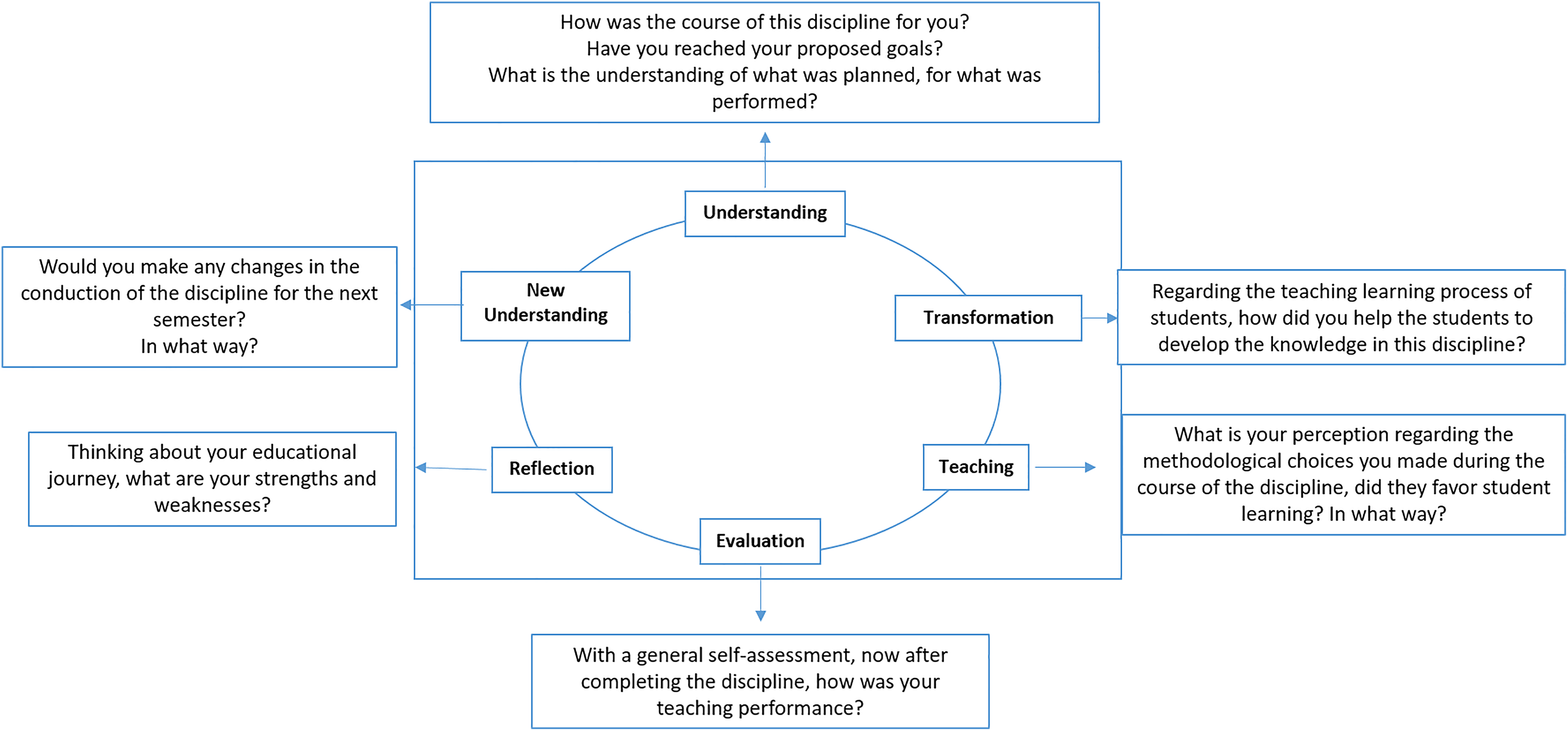
Structured reflection from the model of pedagogical reasoning and action of Shulman (2005). Source. Research data.
Following the structured reflection from the MPRA of Shulman, the understanding of Isabella related to the proposed objectives of the discipline and its planning was positive, reports believing that the development of the curricular unit was satisfactory.
Thinking about the transformation of content, for the students to develop the knowledge of the discipline, the teacher reports: It is difficult sometimes to say, if they really learned or absorbed the knowledge, I always remain at least in doubt, if indeed I was able to do this transmission and if they were able to absorb […]. (Isabella)
In the moment of teaching, the teacher believes that her choices were favorable and that contributed to the students’ learning, and even so, she believes that she needs to review her classes constantly to improve each semester.
In the evaluation related to her own performance, the teacher believes that in general, she was good and that she could improve in communication (reports that she speaks fast and too much) and believes in maintaining a good relationship with the students, stimulating the dialogue.
In the reflection about her pedagogical trajectory, the teacher reveals how potential the interaction and openness to the dialogue she has with the group and as fragility believes that because she does not work daily with the content taught, with less professional experience, does not present the necessary mastery of the subject to conduct the discipline.
And in the moment of new understanding, when asked, the teacher does not remember the need for any changes that would be made in conducting the discipline for the next semester. This preautoscopy interview had a duration of approximately 15 min, and in the sequence, the autoscopy session itself was carried out.
The visualization of the video serves to rekindle memories of the past, being an important condition for access to the unconscious aspects of the teaching activity, such as emotions, actions, and the motives that intended these actions (Leblanc, 2018). And by making these aspects conscious, the researcher discovers elements of the activity that were present in the situation, and in this process of self-analysis and orientation, the teacher, when verbalizing his or her perception from past experiences, allows the construction of a new shared understanding (Leblanc, 2018).
In order to achieve these objectives, initially, the objective of autoscopy (self-analysis) was contextualized to the participant, the criteria for choosing the sketches (representation of pedagogical moments that attracted the attention of the researcher) and the work process during the autoscopy session (projection of the sketch, pause of the projection, reflection by the participant, and contextualization by the researcher/mentor). The autoscopy session was also recorded with the assistance of the voice and video recorder, and for this new moment, the study participant was asked to reflect and discuss the projected sketch, using two triggers: her interpretations and meanings related to the learning teaching process carried out and her observations/reflections related to her performance in the selected pedagogical moment.
For this session, we used the two videos, previously mentioned, titled “Awareness” (56 min 1 ) and “Reflection” (8 min). Each video contained the sketches selected according to the category under observation: “Situational Awareness” and “Reflective Dialogue.” The autoscopy session with Isabella lasted a total of 1:52 min.
In the category entitled “Situational Awareness,” sketches related to the difficulty of perception of the classroom context were projected, when the teacher does not perceive the need to turn lights on or off, low volume of projected audio, insufficient time available to the students to carry out the proposed activities, and difficulty in identifying the behavior of students.
When projected the classroom sketch, with the front light off, with students working in the penumbra and a student later asks to turn on the light, the teacher reflects: […] we sometimes even have to realize, they were going to work in a group and I left the room dark. This I could have realized myself and did not have to let the student notice this. (Isabella) I ran over everything (laughs). I think we as a teacher are there to lead them and […] I could have arranged a time for them to discuss […]. (Isabella) I opened more space for them to participate than in the other. The form of organization and everything else, allowing them to really be present in the classroom and to be an integral part of the lesson, not only the teacher who holds the knowledge as the other […] Looking at this, the difference between the two classes is clear […]. (Isabella)
When she sees herself in action and questioned about her performance, the teacher identifies the absence of the stimulus to reflection: […]I made an interruption, now we go to the break and it’s over […] And sometimes I do not give that space for them to finish with the doubts they have. (Isabella) The question is contextualized, bringing the reflection directed to the subject. (Isabella) I already said that the assistances were different [laughs], I already gave, let’s say, the answer that one service was probably with humanization and the other without. If they were different, then. (Isabella) I think it could be, that they talked about the cases, so we could reflect on how the assistance was. (Isabella) […]in fact I end up not making them reflect, I’m reflecting for them [laughs] […] really, we do not notice ourselves. I always think I’m making them reflect and in fact, now seeing myself I really see that I’m not. That some things really have to change. A change of posture, of leading. (Isabella)
Evaluation Phase
At this phase, Thiollent (1997) points out that several aspects of the experience can be object of the evaluation and stand out: the identification and resolution of problems, with effective involvement of the actors; the effect of self-knowledge through action research, with the learning capacity to promote changes, occurring the redirection of actions and recovery of the knowledge acquired throughout the process.
In the last three phases, there is a simultaneity of research and action and the generation of knowledge and the development of theories happen at all steps; due to the dynamic nature of the research, when from the mobilization of the participants, in a space of collective discussion, with formulation of concrete proposals, the knowledge produced is consistent, leading to an awareness (or form of learning; Thiollent, 1997).
Thus, this phase allowed the study participant, based on the self-assessment generated by the reflection stimulated by the autoscopy session, mediated by the presence of the mentor, a new understanding of their practice.
The sketches selected for the autoscopy session enabled Isabella to understanding of her teaching model offered during the conduction of the discipline in which she was observed, also allowing the identification of how she performs the transformation of her knowledge, contributing to the students’ learning, observing her own performance at the time of teaching.
Autoscopy allowed the evaluation of the teacher’s own practice and this stimulus to reflection, it enabled a significant learning by new understanding aroused by the observation of her own practice. Where constantly, the reflections resulting from autoscopy were related to the student’s need to also be a protagonist in the reflective learning process.
To offer reflective teaching, the teacher first needs to be reflective (Souza, Backes, Prado, & Moya, 2019). In this way, the whole process of conducting the autoscopy was based on the stimulus to reflection, structured from triggering questions that stimulated student reflection. This behavior was related to the teaching position of Isabella, evidenced in the findings of the category “Reflective Dialogue” and were shared, so that Isabella could relate the learning resulting from this moment of autoscopy to her own professional practice, rescuing, for example, her difficulty in asking questions that stimulated student reflection.
It is known that the use of open questions is an indicator of a dialogical teaching, since a good debate is not possible without a good question; therefore, the capacity to use open questions requires a high cognitive demand of the teacher, being aware that this stimulus to the expression of the student increases the reasoning, playing a crucial role in learning, resulting from the deepening of the thought and enrichment of the understanding (Sedova et al., 2016).
And this deepening of thought with enrichment of the understanding nominated in this study as a new understanding was made possible by the autoscopy session, which opened a space for dialogue for the teacher to expose their perceptions and reflect on their actions.
At the end of the session of autoscopy, we also rescued and shared the potentialities observed in the practice of the teacher and Isabella thanked the learning opportunity: I see that if everyone had the opportunity to stop, watch and reflect on what you are doing, as we have done now […] is very interesting […] for sure this will reflect in the future […] I believe that many things I will manage to take from now on, […]. Change the way of asking and all this […] take a moment to stop and really think. Because sometimes, I reflected on my class […], but I’m not seeing it like this, as I saw now […] being here right now, I see how important it was for me, to see me and really see, stop to think about this practice that I’ve been doing. (Isabella)
In teacher training, the use of videos in individual interview sessions, methodologically guided, allows the teacher to understand the nature of affective, cognitive, and motivational involvement, consequently promoting professional development and judging the necessary changes as realistic and possible (Leblanc, 2018).
With self-confrontation, the interview that accompanies the projection of the video is considered a highly effective professional development tool because it places the teacher in a reflexive rather than passive position (receiving tips or suggestions), thus being a rich source of learning, allowing the appropriation of new knowledge related to teaching, resulting from the evaluation and reflection of one’s own professional experience and performance (Hamel et al., 2018).
Advances in teaching practices are not possible without appropriation processes and reflexive interviews stimulated by video recordings facilitate changes in teaching practices (Sedova et al., 2016). The reflection of the practices of their daily life in the classroom led the teacher to become aware of the need to seek their pedagogical training, and this critical thinking, in the search for a more dialogic and problematizing posture, signals a movement of construction and expansion of her PCK (Backes et al., 2013).
The new understanding of Isabella learned at the end of the autoscopy was related to the recognition of the need to become more conscious about the classroom microcontext, considering the behavior of the students, the organization of space, and the administration of time, being aware of the need for perception, initiative, and responsibility for classroom management. Also, the need to adopt a posture stimulus to student reflection, with the appropriation of how the questions can be elaborated to stimulate reasoning and student participation.
The new understanding made possible by the autoscopy session enabled Isabella to perceive the error as acceptable and a catalyst for new understandings and learning. Shulman (2016) points out that the mistakes that occur in this trajectory are perfectly acceptable, since learning from experience itself is a technical and moral challenge and recognizes that there is no learning process free from mistakes, as they are a source of experience for learning practices and professional methods, that is, it is necessary to forgive oneself for the mistakes made, to learn from them, and to remind them as always being a possibility for professional improvement.
Final Considerations
Autoscopy is a methodological mechanism whose main objective is to discuss the practice in order to improve it, and it suggested its inclusion in the programs of permanent teacher training, so that in a continuous way, counting on the mediation of a mentor, the teacher can recognize his or her potentialities and weaknesses, thus evaluating his or her progression, continuously identifying the needs for improvements in his or her practice. Mentors are responsible for stimulating this reflective practice, and the action research involves teachers in reflective dialogue, considering strategies that can contribute to improvements in the teaching and learning process, gradually creating a stronger professional community with a collaborative work culture through discussions (Qing-li et al., 2018; Wabule, 2019).
Being a researcher/mentor requires sophisticated observation and communication skills, with a mediator position, without judgment, offering continuous support, adapted to the needs of the participants, and it is recommended to prepare a step-by-step manual, so that the researchers are sufficiently prepared to generate high-quality data (Hamel et al., 2018; Kragelund et al., 2015).
And in order to achieve a process of continuous improvement, autoscopy should not be performed as an occasional practice but incorporated into teacher training programs, following a structured methodological proposal. In this way, this study allowed us to share how a structured autoscopy from the MPRA of Shulman, from the epistemological perspective of action research, can be applied to examine and strengthen the teaching practice, indicating elements that can be inserted in the teacher training programs. To form a reflexive process, student requires a reflexive teacher, and the autoscopy used in this study, with its script that allows its replication, was shown as a useful strategy to stimulate teacher reflection, being indicated to guide the practices and make the teacher more aware of themselves and the needs of the other, with an expanded understanding of her performance and consequent teacher strengthening.
With the use of autoscopy, mediated by the mentor, it was possible for the teacher to observe her performance retrospectively and to understand her way of conducting the course, with the strategies used to transform the content to the needs of students and to the objectives of the discipline, so that at the moment of teaching, she saw herself in action and could conduct a critical evaluation of her conduct, with emphasis on reflection, which consequently made possible a new understanding of her teaching model, showing new possibilities of action to expand her PCK.
Following the methodological orientation of the action research proposed in this study, it is observed that the perception of the new understanding that Isabella had regarding the changes in the course of the subject, reported before the autoscopy, differs from the conclusions after autoscopy, demonstrating advances in the new understanding, that is, autoscopy had as a conductor, the questioning of the reality observed, allowing that in an active and shared way, with the help of a mentor, the teacher becomes aware of her teaching model and can define her learning objectives to strengthen her educational practices.
By expressing their feelings and reasons, discussion and confrontation with reality stimulate the feeling of trust and the development of positive emotions, so action research stimulates the transformation of the participating teachers to respond to the individual challenges identified in the stimulated reflexive process, committing themselves to take responsibility for the process of changing their attitudes in the classroom (Wabule, 2019).
By seeing his or her MPRA in action, through critical reflections structured from his or her own practice, the teacher manages to broaden his or her understanding of his or her praxis, seeking teacher strengthening strategies, that is, he or she can learn from his or her own experiences, being reflection the key to teacher development (Shulman & Shulman, 2016). Thus, this method, which followed the MPRA of Shulman, allowed a significant learning to the teacher, consolidating new understandings resulting from this learning experience.
Footnotes
Declaration of Conflicting Interests
The author(s) declared no potential conflicts of interest with respect to the research, authorship, and/or publication of this article.
Funding
The author(s) declared the following potential conflicts of interest with respect to the research, authorship, and/or publication of this article: This study received funding from FUMDES (UNIEDU Program), Coordenação de aperfeiçoamento de pessoal de nível superior (Grant No. 88881.134121), and Programa de Doutorado Sanduíche no Exterior (Grant No. 2016-01).
