




Abstract
Interpretive description is recognized as a valuable and credible qualitative approach for answering applied research questions. However, guidance for novice researchers on how to apply it remains scarce. This paper responds to that gap by presenting a reflective account of my doctoral research process, illustrating how interpretive description can be operationalized from study conceptualization through design, analysis and knowledge translation. It contributes additional methodological guidance to the literature, particularly for novice scholars whose research questions address practice-oriented problems. As a nursing researcher passionate about creating change in nursing education, I aim to create safer and more equitable learning environments in undergraduate nursing programs. When I embarked on my doctoral research, I sought a methodology that could tackle this complex and real, education and practice-driven goal. Interpretive description was an accessible and rigorous qualitative framework that respected my disciplinary knowledge and supported practical solutions for nursing education. In this paper, I share my personal journey of using interpretive description as the primary methodology for my dissertation. I offer reflections and recommendations to support other novice researchers considering interpretive description as a framework for generating credible and clinically meaningful insights that are relevant and actionable in their real-world practice contexts.
Keywords
Interpretive description is increasingly recognized as a credible qualitative research framework for advancing nursing science. It offers a non-categorical methodological approach or framework for generating an understanding of complex clinical phenomena, without the rigid constraints of traditional methodologies (Thorne, 2016). Interpretive description involves an inductive analytic approach to create ways of understanding clinical phenomena that produce various applications (Thorne et al., 2004) within practice disciplines (Thorne et al., 1997) rather than functioning as a qualitative research methodology or discrete method (Gariepy, 2021). As a result, interpretive description is now being used with increasing frequency by researchers in other health professions (Burdine et al., 2021), including nutrition (Williams & Haverkamp, 2015), social work (Miller, 2019; Ocean et al., 2022), pharmacy (Murphy et al., 2016), physiotherapy (Atkinson & McElroy, 2016; Olsen et al., 2013), medicine (Burdine et al., 2021; Chan et al., 2017), and library science (Gariepy, 2021).
Despite this freedom from the rigid ‘steps’ inherent in some traditional qualitative traditions, users should not view interpretive description as an easier way to conduct qualitative research. In fact, Thorne (2016) continues to expand her writing on study design and methodological rigour, some of which is complex and begs more questions than answers for novice researchers. When undertaking an interpretive descriptive study, doctoral students are challenged to understand diverse philosophical perspectives, take an ontological and epistemological disciplinary stance (Thorne, 2016), and critically develop a logical structure for locating, positioning, and executing their research projects (Burdine et al., 2021; Gariepy, 2021). They must clearly articulate the relationships between the research question, the techniques chosen, and the limitations of the resulting knowledge (Baker et al., 1992; Floriancic et al., 2024; Oliver, 2012; Thorne et al., 2004).
There is limited published guidance on how novice researchers can practically and rigorously apply interpretive description to inform their projects, from developing the research questions to study design, analysis and knowledge translation. As novice researchers, doctoral students must come to know and understand diverse philosophical perspectives and take an ontological and epistemological disciplinary stance (Thorne, 2016) when undertaking their research. They must critically develop a logical structure for locating, positioning, and executing their research (Burdine et al., 2021; Gariepy, 2021). Unfortunately, current interpretive description resources are mostly conceptual and assume prior expertise in qualitative methodology. This leaves a methodological gap in practice-based accounts that illuminate the application of interpretive description (Burdine et al., 2021; Hunt, 2009).
Therefore, the purpose of this paper is to address the literature gap for novice researchers to apply interpretive description effectively. By explaining Thorne’s (2016) interpretive description framework, sharing methodological strategies and personal insights, this paper highlights the significance of this flexible framework for advancing rigorous, practice-oriented nursing research. It offers recommendations and practical examples for promoting epistemological congruence, managing positionality, analyzing data, and translating findings into practice. In summary, this paper is the article that I wish I had read at the start of my dissertation. I do not intend to replicate Thorne’s (2016) book, Interpretive Description; instead, I extend the methodological literature by offering insights and suggestions to other novice nurse researchers who wish to use interpretive description to tackle urgent practice problems, using tangible examples from research, including my dissertation work.
Discovering Interpretive Description
When I (RE) began my doctoral journey as a nurse educator, I was determined to address a research question rooted in nursing practice: how nurse educators understand, teach, and integrate trauma-informed care (TIC) in undergraduate programs in Ontario, Canada. Like many novice researchers, I first turned to traditional qualitative methodologies such as phenomenology, grounded theory, and ethnography. While each offered strengths, their strict epistemological commitments did not align with my goal of generating practice-oriented knowledge that could inform nursing education and address the gap in trauma-informed educational practices. I struggled with the pressure to force my research question into a rigid theoretical framework (Cutcliffe, 2005).
During this phase of searching and with guidance from my PhD supervisor, I discovered and immersed myself in reading Dr. Sally Thorne’s work on interpretive description (Thorne et al., 2016; 2016). This gave me permission to honour my disciplinary knowledge as a nurse and educator (Thorne, 2016). It invited me to trust my practical insights, my classroom experiences, and even my frustrations as legitimate sources of interpretive power.
Understanding Interpretive Description
Nursing researchers have relied on traditional qualitative research methodologies with origins in other disciplines (e.g., philosophy, sociology, anthropology). Knowledge generation within these traditions depend on strict adherence to the research method (Thorne, 2011, 2016). Nurse researchers adhered to procedural rules as they were deemed essential for gaining integrity and credibility within nursing science (Morse, 1989; Thorne, 2011). However, this often limited the usefulness when answering clinical questions (Hunt, 2009; Teodoro et al., 2018; Thorne, 2011, 2016). At the same time, scholars began to recognize a mismatch between theory, research methodology, and the type of clinical knowledge they intended to generate (Gariepy, 2021; Thorne, 1991; Thorne et al., 1997, 2004; van Wissen & Blanchard, 2021). There was an identified need to move away from what was described as ‘hollow allegiance’ to established qualitative traditions and methods (Hunt, 2009; Thorne, 1991; Thorne et al., 1997) and toward the discovery of more critical and creative perspectives and suitable methodologies (Goodwin et al., 2023). Thorne and colleagues (1997) recognized that methodological eclecticism would not produce good science and that a different framework was needed to generate credible and meaningful nursing knowledge (Sandelowski, 2000).
Interpretive description was then presented by Thorne et al. (1997) as an inductive, practice-oriented analytic approach emphasizing methodological coherence. It is aligned with a constructivist and naturalistic orientation to inquiry (Thorne, 2011, 2016), and goes beyond mere qualitative description (Sandelowski, 2000). Interpretive description acknowledges the importance of subjective, experiential, and co-constructed knowledge. It offers a structured yet flexible framework for producing theoretically and scientifically sound associations between research findings and clinical practice (Goodwin et al., 2023; Hunt, 2009; Yous et al., 2019). To generate meaningful scholarship, interpretive description demands that the researcher pay careful attention to the theoretical integrity of the study (Burdine et al., 2021) and requires the judicious and critical use of logical arguments and a logical structure for locating, positioning, and executing research (Burdine et al., 2021; Gariepy, 2021).
Choosing Interpretive Description
Espousing a pragmatic view of being and doing drove my decision to select interpretive description as the methodology for my dissertation work. As an intensive care unit nurse turned nursing faculty member and novice researcher, I have witnessed how trauma affects people’s clinical recovery, its influence on nursing education and practice, and the learning environment for students. When I began framing my dissertation, colleagues, committee members, and mentors often asked, “Why not phenomenology? Why not grounded theory? Why not ethnography?” Initially, I attempted to make my research questions fit those molds. However, the more I read and engaged in my coursework, the more I realized I aimed to critically interpret the messy, practice-based knowledge and strategies that nurse educators use when teaching about TIC, and to accomplish this in a way that could directly act on the barriers and facilitators to integrating TIC in undergraduate nursing education.
Interpretive description, developed to address this gap, provided me with the framework to balance philosophical and sound methodological grounding with practicality, enabling me to generate findings that I hope will impact educational change. Interpretive description reassured me that my insider perspective as a nurse educator was not problematic, but rather an asset, provided I was reflexive and transparent about my positionality. The research question, “What are the barriers and facilitators to integrating trauma-informed care in undergraduate nursing education in Ontario?” was inherently practical and context-bound and could not be fully answered through a descriptive lens. My study participants described barriers, such as educator knowledge and readiness, and systemic issues, like an overloaded curriculum and gaps in administrative support. This led me to ask critical questions: Why do educators recognize its importance but still feel powerless to embed it explicitly? What structural and institutional factors maintain this invisibility? How do unspoken norms in nursing education shape such contradictions? The interpretive description provided me with the freedom to explore these tensions. It allowed me to hold space for nuance and contradiction. These are traits that, as I learned, are hallmarks of interpretive description, if done well.
In the following sections, I outline how I sought to better understand interpretive description and operationalize it across my study, from situating myself within the discipline to designing and executing my data collection and analysis, and finally, ensuring that my findings were directly relevant to nursing educators and policy stakeholders in meaningful ways.
Building Your Research Foundation
The philosophical framework of interpretive description assumes that absolute, entirely objective knowledge is unattainable through any one type of analysis (Hunt, 2009). In contrast to generic qualitative research (Caelli et al., 2003) and most forms of descriptive qualitative research (Sandelowski, 2000), interpretive description provides explicit epistemological underpinnings (Figure 1; Thorne, 2016) and coherent logic for designing and implementing an inquiry (Thorne et al., 2004, 2016). Epistemological underpinnings of interpretive description. Interpretive description and its philosophical roots. Note. Adapted from Interpretive description: Qualitative research for applied practice (2nd ed.), by S. Thorne, 2016, Routledge.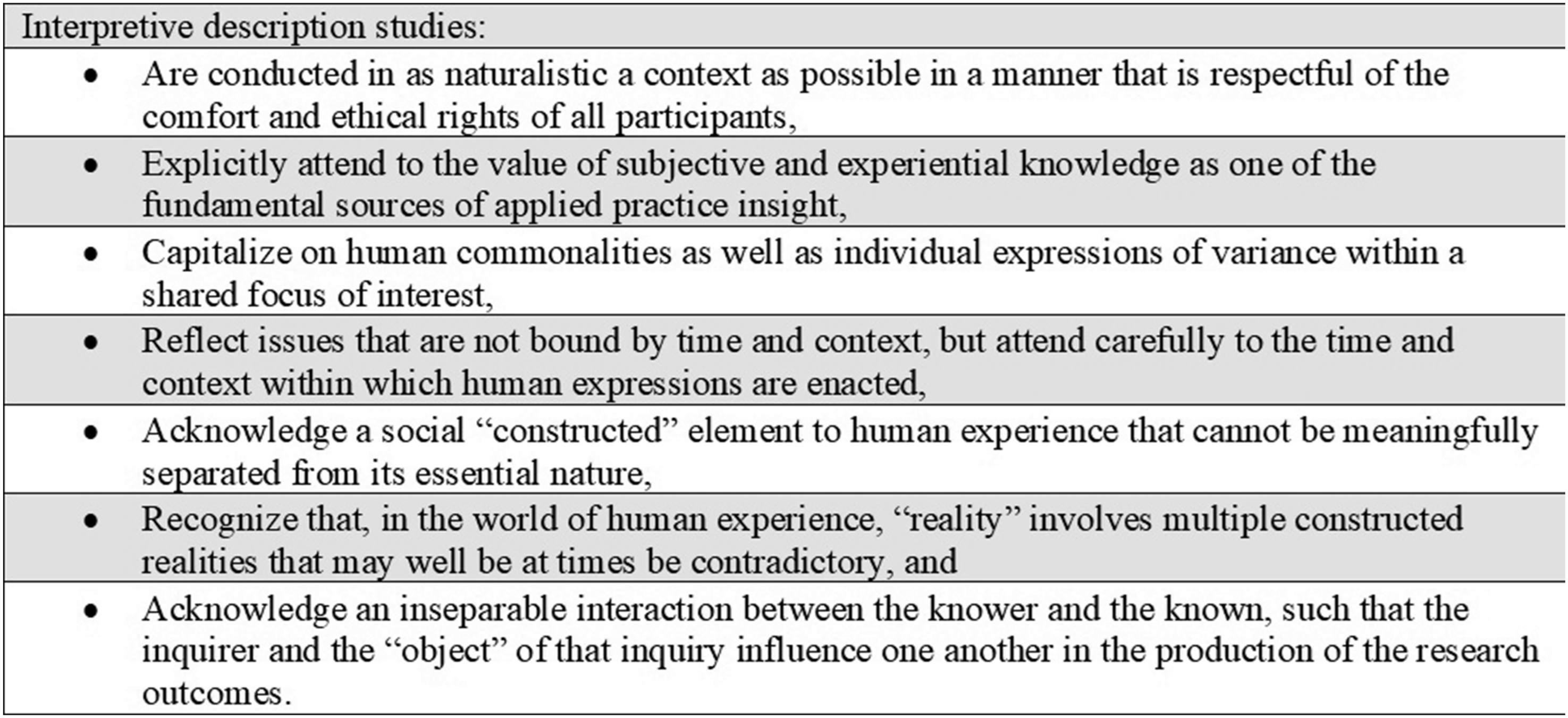
Considering Philosophical Perspectives
It is imperative for novice nurse researchers to deeply consider philosophical perspectives and the commensurability of the underlying ontological, epistemological, and methodological assumptions. As the instrument of the research process (St. George, 2010; Thorne et al., 1997), a novice researcher must have a foundational understanding of the philosophical assumptions underlying traditional qualitative methods and the ability to articulate various intellectual positions logically (Thorne, 2016). Without careful conceptualization, a researcher can be guilty of ‘method slurring’ (Thorne et al., 2004) or ‘methodological acrobatics’ (Berterö, 2015; Sandelowski, 2000), critiques that are expressed in the extant literature (Hunt, 2009). Method slurring is blurring or misusing different research methods that lead to philosophical incompatibility and a lack of clarity and rigour in research design (Thorne et al., 2016). Methodological acrobatics occur when a researcher fits their study into an established qualitative tradition, such as grounded theory, phenomenology, or ethnography, to obtain credibility and imply rigour (Gariepy, 2021; Stern, 1994).
Novice nurse researchers are encouraged to explore various philosophies and methodologies in their coursework. They should seek feedback from their course professors to ensure sufficient understanding before engaging in study design. I strategically used my coursework as a useful way to explore, inform, and refine my research questions and plan, as well as to receive feedback while working toward building the overall study design. Finally, engaging in research as a research assistant under the direction of a larger research team was another way to help ‘sharpen my mind’ (Thorne, 2016), and solidify my understanding of research methodologies, try new research strategies, receive feedback, and build competency as a researcher.
Locating Yourself in Your Discipline
Interpretive description explicitly locates itself within the applied disciplinary domain and departs from conventional methodologies for theorizing disciplines (Hunt, 2009; Thorne et al., 2016). Interpretive description rejects the idea that it is possible to set aside preconceived ideas before investigating the phenomenon of interest (Thorne et al., 1997). In fact, Thorne et al. (2004) assert that it would be problematic for qualitative health researchers to begin a research study without properly appreciating the current state of practice knowledge in the discipline.
The notion of entering the research with a blank slate, popular in other qualitative methodologies, is entirely inconsistent with advancing disciplinary knowledge and could contribute to misapplication (Thorne, 2016). As a form of disciplinary knowledge development, interpretive description requires a sufficient grounding in the discipline for researchers to discern its scope and boundaries (Burdine et al., 2021). Thus, researchers must own up to their ‘disciplinary hardwiring’ and explicitly position their research questions within it (Thorne, 2016, p. 67). The explicit intention to support clinical practice is a unique feature of interpretive description (Dreher-Hummel et al., 2021). Ultimately, nursing and other practice disciplines require knowledge about the practice discipline (Thorne, 2016). In fact, Thorne (2016) suggests that within interpretive description, the practice discipline should be considered “as theory” (p. 68) in the sense of understanding the way it will inevitably shape knowledge creation. While nurse researchers can help respond to the need for evidence-informed practice by answering nursing questions (Aveyard & Sharp, 2009) that improve clinical outcomes and patient care experiences (van Wissen & Blanchard, 2021), they must be able to articulate the history of their discipline. Novice nurse researchers need enough practical experience to know which clinical questions need to be asked to be ‘situated knowers’ who can contribute to solving nursing problems (Floriancic et al., 2024; Thorne, 2016).
The nature of the clinical knowledge generated through interpretive description must be applied in context, with recognition of the infinite variations in patterns of patient and clinical phenomena (Figure 2; Thorne, 2022). Nurses must approach knowledge creation and knowledge transfer differently to ensure their application in the clinical context (Ryan & McAllister, 2019; Thorne et al., 2004). In interpretive description, description and interpretation are combined to analyze a phenomenon with the added element of returning the findings to clinical practice (Ng, 2021). Epistemological differences (e.g., social scientists seeking to discover human universal principles) may privilege certain types of analysis and obscure others. For interpretive description, the direction of knowledge generation always trends toward the ‘so what’ and builds knowledge mobilization into design logic to avoid losing sight of the study phenomenon (Thorne, 2016). A novice researcher will require time and guidance to understand disciplinary tradition and the historical underpinnings when making design decisions (Thorne, 2016). They will also require additional support to generate questions from the clinical field. Furthermore, they will need guidance to review the literature critically, theorize, draw logical conclusions about the clinical problem, and effectively scaffold the study (Teodoro et al., 2018). Disciplinary hardwiring and the nature of clinical knowledge Note. Adapted from International Qualitative Research Network (IQRN) webinar series: Data analysis using interpretive description methodology [Video], by S. Thorne, 2022, YouTube.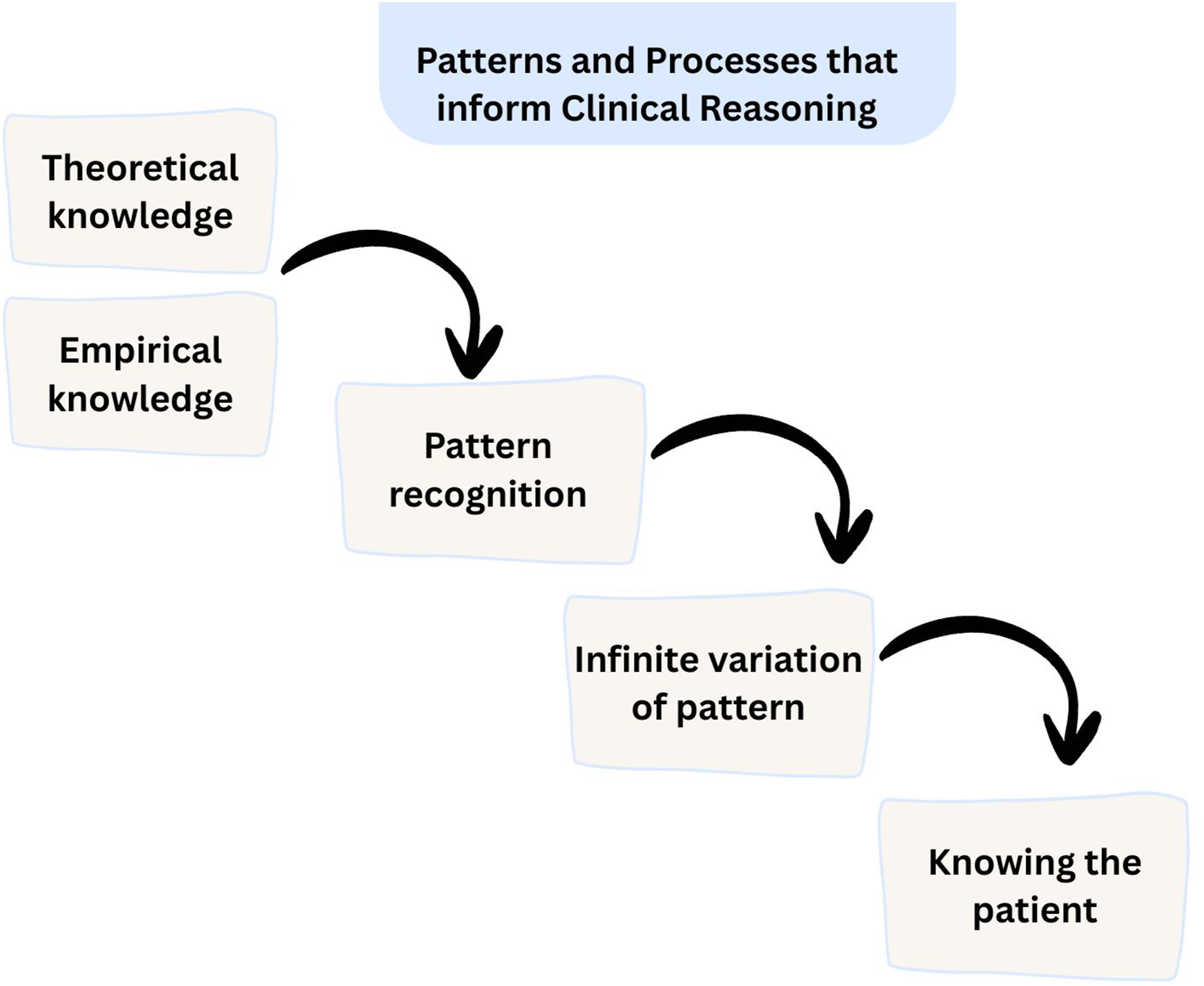
Locating Myself in My Discipline
As a novice researcher, one of my early challenges was embracing the idea that my background was not a bias to be eliminated, but rather a methodological resource for data interpretation. As a previous critical care nurse and sexual assault nurse examiner, I worked with clients who experienced trauma and witnessed the ways in which registered nurses were unprepared to provide TIC in their client interactions. After transitioning to nursing education, I recognized the curricular gaps that leave nursing students transitioning to practice ill-equipped to practice from this lens. This disciplinary hardwiring is critical to my dissertation work and formed the background of my study design.
I recall feeling uneasy in a committee meeting after being asked about my positionality and its potential impact on the research process and findings. It took deliberate reflection and discussion with my supervisory committee to accept that, in interpretive description, my disciplinary hardwiring was not only acceptable but necessary. To manage this responsibly, I maintained a reflexive journal from the earliest stages of my dissertation. For example, after interviewing a faculty member who firmly believed that TIC was “already covered” under general cultural safety content, I wrote in my journal: “This resonates with my own frustration: the assumption that TIC is implicit may actually make it invisible. I need to be careful not to impose this frustration on my coding. Stay open to the possibility that implicit teaching may work well in some contexts.” This journalling practice highlighted a central methodological lesson that disciplinary “hardwiring” should be explicitly acknowledged and harnessed as interpretive power, provided it is balanced by transparency and reflexivity. Finally, locating myself within the discipline meant owning up to and making my disciplinary experiences explicit (Thorne, 2016). This meant clarifying that my lens was shaped by trauma-informed practice, nursing education, and a commitment to equity in learning environments. Instead of masking this, I made it part of my study’s interpretive scaffolding.
Scaffolding Your Study
Scaffolding a study frames the initial position from which the researcher will build a design plan (Thorne, 2016). There are three crucial elements to scaffolding a study: (1) reviewing the literature, (2) deciding what specific methods will support knowledge development, and (3) locating yourself within the discipline and the research.
The first element of theoretical scaffolding is the literature review, where one learns and draws conclusions about the state of the science of the clinical problem (Thorne, 2016). This allows the researcher to confirm or challenge the initial idea that the problem is worth studying. It also gives insight into who has already studied it, problems and conclusions drawn, and identifies gaps and opportunities to further existing knowledge (Thorne, 2016). Practically speaking, it is impossible to make a significant contribution without understanding the context of the literature. I highly encourage using required and elective coursework to grow your expertise in your topic of interest. A formal review of the literature helps build a reference list for future work. I used my comprehensive exam to conduct an integrative review on the current state of TIC in undergraduate nursing education (Elliott et al., 2024). This helped inform my perspective on the current research landscape as I sought to address the existing gaps in my dissertation work. The second element of scaffolding involves understanding the relationships between the research question and the methods chosen, the nature and scope of its epistemology, and the limitations of the resulting knowledge (Thorne, 2016; Thorne et al., 2004). The final element of the scaffolding involves locating yourself as a researcher within the field. The process of scaffolding is challenging work (Hunt, 2009), and mentorship from the research supervisor and committee members is essential.
Researcher as Instrument
Interpretive description acknowledges the researcher’s theoretical and practical foreknowledge of the phenomenon under study (Nkulu Kalengayi et al., 2012). Within the early stages of study design, a novice researcher will spend considerable time and intellectual labour when strategizing a credible blueprint (Thorne, 2016). Clinical expertise is a helpful starting place for orienting research (Teodoro et al., 2018), particularly when the area of inquiry has yet to be evaluated rigorously (Hunt, 2009), and the researcher is learning to scaffold their study (Thorne, 2016). The researcher’s foreknowledge of the phenomenon under study is a platform to design the project; it helps establish its anticipated boundaries (Hunt, 2009) and acknowledges the theoretical and practical knowledge the researcher brings to a project (Thorne et al., 1997). Although interpretive description recognizes no strict boundaries between researchers and participants, ‘othering' should be avoided (Shannon & Truman, 2020), and researchers must understand and express their positionality.
Within interpretive description, the researcher is considered an instrument of the research and research process (Thorne et al., 2004). The researcher must be held to a high standard of integrity, both personally and professionally, as the quality of the product and process is inexorably dependent on it (Thorne, 2016). The term positionality describes an individual’s worldview, position in the research task, and social and political context (Foote & Bartell, 2011; Rowe, 2014; Savin-Baden & Major, 2013). For example, Ocean et al. (2022) used interpretive description to explore the possibilities for anti-oppressive scholars to participate in decolonizing work. They stated that interpretive description can advance research in ways that do not contribute to oppression and consciously work towards structural change through anti-oppressive partnerships (Ocean et al., 2022).
Positionality also implies that the social-historical-political location of a researcher influences their orientations such that they are not separate from the social processes they study (Holmes, 2020). Novice researchers need to recognize that their positionality does impact all aspects and stages of the research process. Savin-Baden and Major (2013)’s work helped me to identify the following ways a researcher can identify and develop their positionality, which are supported by Thorne (2016): (1) acknowledging personal positions or biases that have the potential to influence the research; (2) grounding yourself within the literature, and recognizing that it may not be possible to do this without considering in-depth critical analysis, and; (3) understanding the research context and process.
Asking the ‘Right’ Research Questions
Interpretive description facilitates critical and creative approaches to generate knowledge and encourages the researcher to explore novel questions that may not be sufficiently answered using traditional methodologies (Goodwin et al., 2023; Thorne, 2016). Thorne (2016) reminds us that interpretive description is not prescriptive. As such, the kind of research questions nurses ask will set the stage for the study design decisions (discussed in the next section). As highlighted previously, a novice researcher needs to grapple with the general epistemological stances from within traditional methodologies. This will inform the methodological decisions for answering the research question (Hunt, 2009; St. George, 2010). While interpretive description produces description, it also pushes the ‘so what?' question, and an uncovering of the deeper meaning within the data (Lundin Gurné et al., 2021). Interpretive description should ask questions like: “what are the dimensions of this clinical concept?”; “what variations exist”; “what can be learned from?”, and; “what is missing?” Other examples of framing research questions can be found in the literature (Clark et al., 2021; Kopchek, 2020; Wong et al., 2017; Yous et al., 2019).
Study Design in Interpretive Description
Regarding design, interpretive description is not a prescription, cookbook, or a circumscribed sequence of steps for the researcher to follow (Thorne, 2016), a challenge for a novice researcher, including myself. Interpretive description encourages the thoughtful utilization of methods from various qualitative traditions to answer specific research questions, and questions are posed in ways that allow answers to be resituated within the context of the applied field (Gariepy, 2021).
The novice researcher may be challenged to distinguish and differentiate between interpretive description and similar qualitative methodologies (Hunt, 2009). Perhaps even more challenging for novice researchers, interpretive description requires the researcher to conceptually and mentally maneuver the foundations of the literature and the knowledge discipline to justify the application of various techniques and procedures outside of conventional contexts (Thorne, 2016). Interpretive description gives researchers the structure and permission to articulate distinct methodological approaches designed to address the kinds of complex experiential questions that they might be inclined to ask (Ryan & McAllister, 2019; Thorne et al., 2004).
Interpretive description recommends using multiple data sources to triangulate the phenomenon under study. This contributes to the trustworthiness of the generated findings (Hunt, 2009). I designed my dissertation as a two-phase study:
This design enabled an iterative, layered understanding of the phenomenon. The survey data confirmed that while most educators had heard of TIC, only a small group felt confident teaching it. I used this finding to inform my interviews. I asked participants, “What contextual factors influence the integration of TIC into courses (theory, lab/simulation, and clinical courses)?” and “How could you see yourself incorporating TIC into the courses you teach in the future?” I was able to uncover why faculty members felt underprepared to teach TIC content and what barriers or supports influenced this integration gap. In the next section, I explain design considerations for recruitment and sampling procedures, data sources and collection, data analysis, and strategies to promote rigour.
Decisions Regarding Recruitment and Sampling Procedures
Decisions regarding sampling and data collection techniques are guided by the current state of knowledge about the subject and the research question (Thorne et al., 2004). Thorne (2016) suggests three main areas of concern regarding recruiting participants for a study: representation, sample size and sampling methods. According to Thorne (2016), generating a representative sample is a noble idea but an unattainable goal in applied qualitative research (Thorne, 2016). Instead, researchers must acknowledge that the sample generated reflects “a certain kind of perspective from an auditable set of angles of vision whose nature and boundaries we can explicitly acknowledge and address” (Thorne, 2016, p. 173). While accurate population representation should be strived for, a researcher must simultaneously acknowledge that it is impossible (Thorne et al., 1997, 2004).
According to Thorne (2016), sample size is the researcher’s judgment or best guess. The construction of the sample size becomes auditable through the inclusion and exclusion criteria, and the researcher’s critical reflection on how the sample is constructed brings integrity and credibility (Hunt, 2009). In qualitative research, most study designs rely on variations of purposive sampling to identify which participants will be included in a study (Morse, 1989; Sandelowski, 2008). The most common sampling approaches in interpretive description are convenience sampling, purposive sampling, maximum variation and theoretical sampling (Thorne, 2016). Convenience sampling recruits a sample that is accessible and close at hand, which is helpful in the early stages of documenting a phenomenon (Thorne, 2016). Purposive sampling selects participants based on their presence in a population of interest, such as nurse educators in Ontario. Maximum variation sampling involves recruiting individuals based on unique characteristics or experiences to enhance understanding of the phenomenon (Burdine et al., 2021). Finally, theoretical sampling, a term borrowed from grounded theory (Glaser & Strauss, 1967; Strauss & Corbin, 1998), explicitly evolves the sampling strategy from the theoretical variations in the data as the study is being conducted.
The Problem with Data ‘Saturation’
Deciding when to stop recruitment is not a simple decision for a novice researcher (Malterud et al., 2015; Thorne, 2020a). It is not in the nature of clinical knowledge to hit endpoints or to make the claim that all insights reached the end of the sample (Thorne, 2020b; Thorne et al., 2004). Further, there is no pre-set notion of whom and how many to recruit (Yous et al., 2019). The novice researcher may be challenged to reconsider their previous knowledge about the concept of data saturation. In interpretive description, true data saturation is considered a “hollow language signifier” (Thorne et al., 2004) and not a desired sampling outcome in interpretive description (Thorne, 2020a). This is because there are infinite patterns and variations (Thorne, 2016) within samples. Instead, the researcher should focus on obtaining a deeper understanding of participant perspectives while recognizing and acknowledging that variations in perceptions and outliers exist (Thorne et al., 2004). Therefore, the researcher must balance feasibility with project scope to determine what is knowable and what still needs to be known (Thorne, 2016, 2020b).
In my dissertation, I was challenged to provide a practical and methodologically sound rationale for proposing a sample size in my research project. I obtained feedback from committee members who were experts in both content and methodology to project a sample size that would: (1) capture rich, detailed and meaningful data; (2) enable sufficient information power (Malterud et al., 2015) to seek out both confirming and contrasting cases, and most importantly (3) answer my research questions without justifying an end point in data saturation (Thorne, 2020a). We proposed a sample size of 25 to 30 nurse educators and ended data collection with a final sample size of 28 participants.
Data Collection Considerations
No one data source is inherently preferable across interpretive descriptive studies (Thorne, 2016), although semi-structured interviews are a preferred strategy (Clark et al., 2021). When it became time to collect data, I knew that interpretive description demanded more than just asking set questions and recording answers. It required me to stay present, responsive, and willing to follow unexpected paths when conducting the interviews. This was both liberating and intimidating.
Within interpretive description, researchers have leeway in deciding what data to collect, provided they align with the knowledge goals of the applied discipline and answer the research question (Thorne et al., 2004). For example, Coyne et al. (2021) take a child-centred approach by using hand puppets and show and tell to help children express meaning and encourage dialogue. Data sources that can generate meaningful results include interviews, focus groups, participant observation, policy documents, and documentaries (Thorne, 2016). Interpretive description encourages the use of other creative data collection strategies Coyne et al. (2021); Thorne (2016). Goodwin et al. (2023) applied a “draw and tell” data collection strategy in their research that required participants to draw an image in response to a question. The researchers listened carefully to participants and explored the research topic with improvised follow-up questions (Goodwin et al., 2023).
The aforementioned data collection strategies can engage participants in exploring the research topic in their own way, encouraging a highly inductive process (Thorne, 2016). While operating outside the realms of traditional/branded methodologies can be challenging, they can open possibilities to explore research questions in novel ways (Goodwin et al., 2023). In my doctoral project, I sent a pictorial representation of theoretical framework that informed my study - the Transformational Learning Theory (Mezirow, 1991) was a tool to encourage participants to: (1) think about how they might shift their thinking about TIC; (2) to show participants that the research questions were grounded in a well-established adult learning model, and; (3) to create transparency, thereby deepening trust and valuing participants as co-learners and collaborators, rather than just as data sources.
The novice researcher should ideally transcribe their own data as a way to immerse themselves in it. While tedious, transcribing qualitative data enables one to form connections with the data and helps inform subsequent interviews. Writing down initial field notes after each interview enabled me to document my key insights and defend my analytical decisions. I used a simple memo template to note what worked, what surprised me, and what to refine in the following interview. These memos doubled as audit trail material, strengthening trustworthiness.
Analyzing Your Data
Thorne et al. (1997, 2004) assert that it is impossible to describe reality objectively (Dubois, 2015). Generating new truths or coherent wholes extends beyond the scope of interpretive description (Thorne et al., 2004). Rather, the intended products of interpretive description do not constitute a new truth but a tentative truth claim (Thorne et al., 2004) about what is common within the clinical phenomenon (Hunt, 2009). As such, Thorne et al. (2004) suggest that data analysis should guide inquiry and involve openness to ideas, much like thinking in clinical practice in the analytic phase.
True to the principles of interpretive description, I analyzed data alongside collection. Being overwhelmed by the volume of data and the possibilities for analysis, I posted my research questions on sticky notes on a wall as a means for engaging in constant self-reflection: “What am I asking of this data set?” and “What will nurse educators as stakeholders need to know?” Other reflective questions might include, “What ideas are starting to take shape, and will they do justice to answer the research questions?” (Thorne, 2016, p. 160).
Data analysis follows an iterative process involving concurrent data collection and analysis, with constant reflection, raising critical questions, and considering all interpretive options (Clark et al., 2021; Hunt, 2009; Thorne, 2013). When looking for patterns in the data, constant comparative analysis, rooted in grounded theory (Charmaz & Belgrave, 2007), is used most often in interpretive description (Burdine et al., 2021; Thorne, 2000a), although thematic analysis is also used (Nkulu Kalengayi et al., 2012; Yous et al., 2019). Constant comparative analysis allows for flexibility in generating interpretations that best serve the purposes of the study (Burdine et al., 2021).
I used Braun and Clarke’s (2022) reflexive thematic analysis framework, which aligns well with interpretive description’s goals. As Thorne (2016) recommended, I began by reading each transcript to identify interesting data features and quotable quotes (Thorne, 2016), generated initial memos, and abstracted quotes to a document. After every interview, I revisited emerging codes and memos to identify patterns and refine the codes. I also shared the transcripts with my supervisor for review to ensure fidelity of the interview guide.
When ready to code the data, I deliberately avoided forcing codes into preconceived categories. Starting with an open coding process may help novice researchers read data broadly before engaging in axial coding or building a codebook structure. In fact, line-by-line coding is not recommended as is the practice with conventional content analysis (Down-Wamboldt, 1992), but some coding is required. Thorne (2016) cautions novice researchers not to code data prematurely and focus so much on the coding line-by-line that they miss the bigger picture and generate ‘bloodless findings’ (p. 147-149). Interpretive description favours asking broad questions such as “what is going on here?” and “what am I learning about this?” (Burdine et al., 2021; Stevens et al., 2020; Thorne et al., 2004). During regular debriefing and touchpoints with my supervisor. I shared not just my interview transcripts, emerging codes, codebook structure and themes, but also my memos and self-questions. This created space to challenge my assumptions, think differently about confirming and disconfirming cases, and strengthen the credibility of my analysis. Interpretive description requires you to be both the instrument and interpreter of your data. Naming your assumptions is not a methodological weakness; it is your most important tool for generating credible and useful insights.
In interpretive description, the data analysis process goes from pieces to patterns, then from patterns to relationships (Thorne, 2016) to describe the story emerging from the data that needs telling to answer the research questions. It may feel overwhelming to begin this process. Starting with printed transcripts may support the development of the codebook in the early stages of data analysis. Using a data analysis tool like ATLAS.ti® or NVIVO® can help refine codes and themes later in the analysis. I recommend maintaining a data analysis notebook to help keep track of coding decisions, to check if themes ‘work’ in relation to coded extracts, and to generate a thematic map of the analysis. I wrote analytical memos capturing my interpretations and sharing these with my supervisor, which helped me test my logic, identify outliers, and guard against confirmation bias. This can be helpful to continue searching for themes and mapping them for clarity as themes are being defined, enhancing credibility. My early coding highlighted how many educators believed TIC was “covered implicitly,” yet struggled to pinpoint where. This contradiction became a crucial analytical thread.
Thorne et al. (1997, 2004) assert that findings do not emerge in the sense of having their own agency (Morse, 1994); neither do participants have a voice in representing their interests, nor does data speak for itself. As the analysis progresses, the researcher must go beyond the initial theoretical scaffolding to further develop an understanding and interpretation of data (Hunt, 2009; Thorne et al., 2004). The researcher is encouraged to build a ‘thoughtful clinician test’ for critical reflection to avoid analytic errors that impose study limitations (Thorne, 2016, p. 85). Engaging a mentor or colleague representing your project’s target population may help a novice researcher avoid analytic errors. Thus, the mechanics of interpretation depend on the processes of intellectual inquiry (Burdine et al., 2021), and to illuminate what is happening and develop a deeper awareness toward the best clinical response (Clark et al., 2021; Thorne, 2016). Ultimately, findings of an interpretive descriptive inquiry represent a co-constructed tentative truth claim about the phenomenon intended to yield clinically applicable insights and meaningfully account for experiential knowledge from applied disciplines (Thorne et al., 2004).
Ensuring Quality, Rigour and Trustworthiness
Within an interpretive descriptive inquiry, the researcher must demonstrate methodological coherence (Burdine et al., 2021) as credibility rests on the ability to adequately account for decisions in study design (Oliver, 2012). Engaging in a reflexive approach should reduce bias (Rowe, 2014) and enhance rigour and trustworthiness (Thorne et al., 2004). Further, quality depends on the extent to which findings are seen as applicable, defensible, and relevant to the applied discipline (Burdine et al., 2021). Interpretive description demands the skilled application of research methods and knowledge of the applied practice discipline to meet ambitious evaluation criteria, ensure rigour in study design (Thorne, 2016), and ensure the relevance of findings to practice.
Ensuring Rigour in Interpretive Description

Knowledge Translation
Recommendations for the Novice Researcher

Conclusion
Interpretive description offers a rigorous yet flexible framework for generating practice-relevant knowledge in nursing and other applied health disciplines. It enables the advancement of knowledge without compromising the methodological integrity that long-established qualitative approaches are renowned for providing (Thorne, 2016). Combining disciplinary grounding with methodological creativity enables researchers to move beyond rigid traditions and produce findings that directly inform education, practice, and policy. This paper contributes to the methodological literature by providing a transparent, reflective account of how interpretive description was operationalized by a novice nurse researcher. It offers recommendations for how methodological coherence, reflexivity, and practical decision-making can be balanced to generate credible and clinically meaningful insights relevant in real-world practice contexts. Embedding knowledge translation helps produce actionable findings. For novice researchers willing to openly embrace their disciplinary lens, interpretive description is an empowering choice.
Footnotes

Funding
The authors received no financial support for the research, authorship, and/or publication of this article.
Declaration of Conflicting Interests
The authors declared no potential conflicts of interest with respect to the research, authorship, and/or publication of this article.