




Abstract
This article introduces a methodology, “Iconic Legisigns-Guided Interviewing,” which aims at understanding and addressing communicative, cultural, and contextual gaps at the margins that have historically muted underserved populations. Grounded in the theories of visual and sensory research, this new method aims at overcoming the limitations of technology-dependent video-/photograph-elicitation research in geographically isolated regions and seeks to create an open and enabling dialogic environment for illiterate (and low-literate) politicoeconomically marginalized people. This method was developed with active participation of low-literate community members and iteratively tested in underserved spaces of rural Bengal. In this approach, organically cocreated images, more specifically iconic legisigns, were employed as prompts to make interview processes focused and inclusive and to complement conventional semistructured in-depth interviewing. This local-centric method helps research participants to cocreate knowledge, decide discussion pointers, and come up with respondent-generated questions/probes and also seeks to ensure inclusivity and discursive control of participants over the research.
To understand and address ever-increasing inequalities and disparities in the global South, contemporary ethnographers are invested in studying underserved communities and their contextual realties (Charmaz, 2011; Madison, 2005). The challenges in these contexts are many and include unfamiliar cultural praxis, skepticism, illiteracy (and low-literacy), linguistic gaps (including lack of proficiency in mainstream languages), and communicative obstacles (Dutta, 2018). Moreover, geographic isolation, economic and sociopolitical marginalization (and stigmatization), and various response effects (Bernard, 2006) often hinder conversational opportunities and create barriers to research interactions.
To address the aforementioned challenges, ethnographers have paid attention to sensory components of communication (Pink, 2009) and have proposed visual-communicative approaches for collecting data (Buckingham, 2009). Scholars argue that imagistic/iconic visual approaches (and thought processes) that operate on a conscious as well as unconscious level are useful in gaining the attention and triggering memories of cultural participants and thereby enhance the quality of dialogue (Macleod & Holdridge, 2013). While the photograph- and video-aided elicitation methods (e.g., photointerviewing, Collier, 1957; Hurworth, 2004; photoelicitation, Clark-Ibañez, 2004; Lapenta, 2011; participatory photography, Byrne, Daykin, & Coad, 2016; Gotschi, Delve, & Freyer, 2009; photovoice, Catalani & Minkler, 2010; Wang & Burris, 1997; and video elicitation, Erickson & Shultz, 1982; Henry & Fetters, 2012) work well in a variety of settings, their effectiveness in overcoming certain cultural/communicative challenges as well as technology (including production process) and (electric) power dependency, especially in isolated regions and marginalized contexts, is underresearched. Moreover, photographs/videos often (unintentionally) reveal actual identities of people/objects/contexts, which could potentially pose challenges to anonymity and privacy in research processes.
Being at the margins, rural and indigenous populations of West Bengal (located in eastern India, where this research was conducted) not only face multidimensional poverty 1 but also experience dominant oppressions and misrepresentations, which delegitimize voices of underserved people as well as aggravate their silence in discursive spaces. Long-term ethnographic engagements in remote rural Bengal to study adversities/needs (both structural and communicative 2 ), and situated negotiations of marginalized populations as well to legitimize underrepresented voices and agencies, have prompted this research to explore avenues and come up with locally and culturally appropriate interviewing methods. This article, by embracing principles of qualitative and visual/sensory research approaches, introduces a new method, developed actively with cultural participants and iteratively tested and modified in rural and indigenous spaces of Bengal. This method (which is primarily visual but also has tactile 3 components) incorporates elements of graphic-/drawing-based research (more specifically, hand-drawn iconic legisigns or cartoon-like graphic images) to complement purely verbal semistructured interview practices. To address cultural and contextual communicative challenges, this method seeks to create an open, inclusive, and noncoercive dialogic environment for historically muted underserved populations, by paying attention to local-centric meaning-making processes, collective memories, and focused ideations.
Literature Review
Scholars have pointed out that visual/sensory research approaches pay attention to local voices, issues, and absences (Pink, 2003) and are useful in underserved and/or less-known/unfamiliar social contexts (Crilly, Blackwell, & Clarkson, 2006). These methods help researchers establish rapport more easily with participants (Clark-Ibáñez, 2004; Collier, 1957) as well as aid interviewees to express their views and thoughts more directly and with less intimidation and interference (Pauwels, 2013). Such methods not only elicit spontaneous and less predictable responses, retain attention, and evoke memories, experiences and expressions of the interviewees (Buckingham, 2009; Pauwels, 2013), but they also help participants in overcoming “ambiguity” (Fontana & Frey, 2000) and “the fatigue and repetition of conventional interviews” (Collier, 1957, p. 858).
Visual elicitation methods that employ drawings and hand-drawn graphics are often useful in conducting research in underserved and geographically isolated contexts as they are less technology-dependent (Mitchell, Theron, Stuart, Smith, & Campbell, 2011) in comparison to processes (e.g., those mentioned above) that use machine-produced images such as videos and photographs. Moreover, drawings cost less, take less time to create (particularly line drawings), and can be produced and/or modified in situ, and the visual content “is not limited by form; the creative depiction of both physical and abstract realities is, in the sense, unbounded” (Literat, 2013, p. 88). Again, in participatory drawing method, “respondent-generated images” (Pauwels, 2013) are produced with active involvement of participants; such representations, based on collective understandability of the images/local issues and feedback of interviewees, potentially cogenerate thick descriptions and yield rich discussion pointers, thereby help in expanding the scope of knowledge production.
This research embraced a specific drawing form called iconic legisign. The term was introduced by semiotician C. S. Peirce (as a part of theorization of signs) in 1960 and was defined as “drawings or cartoons abstracted from real appearances, but still perceived as resembling some real things” (Manning, 1998, p. 66). Later, McCloud (1993) graphically demonstrated that abstracted cartoons could amplify new ideas and/or messages in a more effective and a more a general/universal way than photorealistic images (e.g., refer Appendix A). Later, Manning (1998) identified similarities between human cognition and cartoon-like representation, noting that “in their theory, thoughts and ideas likewise exist mainly as vaguely sketched (e.g., cartoon-like) forms” (p. 69).
Mackenzie, MacDougall, Fane, and Gibbs (2018) argued that visual scholarship could explore more creative/engaging avenues by embracing new concepts. They further noted that researchers are increasingly working with computer-literate people of the industrialized nations (and of urban spaces of the developing world) by utilizing simplified imageries such as emoji to learn about practices/experiences of children and youth populations particularly in mediated and digital spaces. However, in the underserved spaces of the global South, where people are often challenged by illiteracy (or semiliteracy) and impoverishment, we need to come up with culturally and contextually meaningful research approach(es) to explore and better understand the experiential realities at the margins.
Again, active tactile, visual and dialogic engagements of underserved rural populations, in a way, reduce unilateral control of community outsiders such as researchers over the interview process (Munro, Holly, Leisten, & Rainbird, 2000) and thereby envision participants as central and more-equal partners/coresearchers in interviews (Carspecken & Apple, 1992; Madison, 2005). This research, toward codeveloping a culturally/contextually appropriate approach, seeks to address/overcome various communicative barriers, response effects, and other situated sociopolitical disparities, which tends to reduce community participation in less-researched underserved contexts/cultures.
Field Research Process
Since 2009, I have been conducting ethnographic field research in three remote rural and indigenous regions of rural Bengal (including a forest, a coastal, and a Himalayan region). Broadly, my research program examines how marginalized populations of these regions negotiate situated sociopolitical challenges (e.g., poverty, scarcity of infrastructural and domestic resources, societal discrimination) and exercise agency to cocreate meaningful solutions/initiatives within limited scope and availability of structural and cultural resources. It was in the course of conducting this research that my coresearchers (villagers) and I codeveloped the Iconic Legisigns-Guided Interviewing (ILGI) approach.
During the initial phase of trust building, I noticed participants’ skepticism and their cautious (i.e., not spontaneous) responses, which were rooted in memories of past experiences of hegemonic oppressions and discriminations. I was (and will remain) largely an outsider to the rural participants because of my sociocultural privileges (i.e., middle-class, educated, patriarchal elite from an urban society), and such privileges gave me the legitimacy as a “knower,” who was seeking to learn about the participants (the so-called subjects to be known). My unearned privileges and situated communication and contextual barriers (discussed in the next section) necessitated my long-term involvement with local community members; therefore, I made multiple visits to the villages of each geographical region and learnt some local dialects and several words in local indigenous languages. My native/full proficiency in Bengali and Hindi languages and partial proficiency in several local dialects (of Bengali, Hindi, Nepali, and Santali languages) helped me to communicate with local communities of the three aforementioned geographical regions. In addition, I sought help from village leaders, senior members, and other key informants to reach out to cultural participants and conducted research in spaces where they spent most of their times such as school premises, courtyards, and public meeting spaces.
Initial Challenges
As noted, working among the underserved in remote geographic regions posed unique contextual, cultural, and communicative challenges including the following: Literacy/language issues: Many of the community members were illiterate and not proficient/conversant in mainstream languages; oftentimes, they preferred to communicate in local indigenous languages among themselves and used dialects of Indic languages (e.g., Bengali, Hindi, and Nepali) to communicate with outsiders. For instance, rural people of Junglemahal region (in Southwest West Bengal) talk in Simantararhi and Jharkhandi Bengali language, which contains several Santali (an indigenous language) words. Situated skepticism: The majority of participants were uncomfortable and cautious in interactions with outsiders because of their bitter past experiences of discrimination (practiced by both colonial and Brahmanical/upper-caste stakeholders). Moreover, traditionally, most of the indigenous communities of rural India discuss their community matters in internal meetings where participation of outsiders is not welcome. Such age-old communicative praxis prevented them from discussing local issues, particularly in one-on-one settings, with an outsider like me. In other words, interviewing individual members would not only affect the quality of the collected data but also adversely influence the trust building process. Only after spending some time and closely observing my initial interactions with a few participants, did other community members, one by one, gradually join the conversation (group interview). Community settings: While community members strongly preferred to participate as a collective, some of them participated while doing (i.e., not interrupting) domestic activities (e.g., cooking, cleaning, doing agriculture-related jobs); therefore, I had less control over participants’ mobility. For instance, villagers freely visited (and returned back to) interview settings and sometimes joined the interview process in an “on-and-off” basis.
Other contextual constraints included geographical isolation and lack of technological access such as electricity, telecommunication signals in the difficult-to-access villages, mandated contextually appropriate logistical plans, for example, formulating a data collection process that was less dependent on external power supply and using cost-effective locally appropriate visual method (i.e., paper and pencil) instead of video/photoelicitation method (Clark-lbáñez, 2004).
Moreover, various response effects (i.e., how people respond differently owing to presence/absence of particular stakeholders and/or for various sociocultural and contextual reasons; Bernard, 2006) were high in the underserved spaces, especially when villagers were speaking with/in front of unknown or less-known people. For instance, due to (i) deference effect (most of the participants were shy and polite and never wanted to offend an outsider) and (ii) societal skepticism (as they did not want to talk privately with researchers to avoid unintended consequences such as speculations and gossip about the interactions with an outsider), it was often difficult to engage with the villagers using conventional semistructured interviews. In addition, secondary data–based predetermined questions that yielded general answers contributed little in enhancing in-depth understanding about local people, culture, and contexts. These challenges pushed me to search for an alternative method for conducting qualitative interviews.
Emergence of a Process
In 2011, in the coastal villages of Sundarbans, I was struggling to initiate the interview process with villagers using preconceived questions based on secondary data; my questions seemed too generic and lacked specific cultural/contextual nuances (refer Appendix D).
I wrote in one of my memos, When I discussed the interview questions in the University with faculty members, they sounded really good, and we discussed and refined them to make them “appropriate.” Now, when I am re-reading them after spending some time in the village, they do not look like contextually appropriate questions. Frankly, I do not feel like using the questions in my interviews; they will fail to create meaningful dialogue. I need to think beyond my regular interviewing practices to create a more context-specific approach.
Description of the ILGI Process
This new/alternate approach was organically and iteratively developed over time owing to active engagements, feedback, and guidance of the villagers. The following subsections describe the aspects of (i) preparing for and conducting the first few interviews (Appendix B describes the interviewing process schematically); (ii) cocreation, addition, modification, and deletion of discussion pointers; (iii) building trust and ensuring inclusivity; (iv) creating culturally appropriate discourses and local-centric inquiry; (v) making the process accessible and flexible; and (vi) facilitating ranking and brainstorming activities toward solving local issues.
Preparing for the first interview
At the beginning of this research journey, I visited various spaces in the villages to learn about the local issues. I collected textual- and visual discourses including slogans and comments written in Bengali and Hindi languages from a variety of local sources including publicly displayed posters, graffiti, and local newspapers. The majority of these discourses were drawn or posted by the political parties or local administrations for election campaigns and public-awareness purposes. I discovered that many of the discourses (visual and textual) addressed contemporary local issues (e.g., agriculture, education, unemployment). I started taking photographs and making notes to collect key words to learn about current/key issues of the villagers.
The next step was to devise culturally appropriate images that correctly represented local issues and realities. Initially, based on the collected visual discourses, I drew sketches (of local issues) in a notebook. I also closely interacted with local people to learn how to prepare those visual depictions that would be meaningful to local communities. As a response, sometimes they guided/taught me how to visually represent the issues, and sometimes they drew images using local materials, which I collected and/or photographed.
Then, based on the collected visual- and textual discourses and secondary data (from academic literatures, government records, etc.), I jotted down a few preliminary key words in local languages as a preparation for the first interview and subsequently shared them with local people to obtain feedback, before selecting them for my first interview. To make the images (of local issues) consistent so that they appeared to be part of a same visual family, I took two visual design decisions. For production of visuals, I decided to use drawing materials available in local shops (Kesby, 2000), and for the style of representation, I chose to draw iconic legisigns; it is less time-consuming to draw line diagrams, and researchers with minimal sketching skills can produce the images while conducting interviews. As a preparation for my first interview, I drew eight iconic legisigns (i.e., the outline sketch/simplified graphic representation) of the preliminary key words (e.g., health, transportation) using color pencils and chart papers.
First interview
At the beginning, I shared information about my research and the interview process with the villagers. In addition, I abandoned my previously chosen/designed interview questions (please refer to the lists of “first version” and “second version” questions presented in Appendix D). I also carefully maintained caution in posing any predesigned questions/probes; that is, instead of seeking opinions/comments on any predetermined issues/cards, I asked villagers to collectively determine the suitability of the topic/cards in local context(s). In other words, I initiated the interview by showing the handmade cards, one card at a time, and sought their feedback on (i) relevance of the visually depicted issues in their local context and (ii) appropriateness/quality of the visual representations. While the villagers agreed to some of the images, they advised me to include some more local issues as key words. After in-depth discussions, we (villagers and I) came up with some new key words (e.g., sanitation, electricity) which were used during the interview session.
In terms of visual representations, appropriate imagistic depictions were important for conveying the exact meaning/essence of local issues, as many of the participants were illiterate (and semiliterate). As an outsider, I was not very conversant about various sociocultural aspects, praxis, and artifacts of their society. For instance, during interviews, I learned that fish farming was important for coastal communities, but I did not know how to depict that as a visual. Local people showed me the actual process and then drew their preferred visual depiction using local materials, that is, by drawing on soil using fingers or a small wooden stick. I copied the drawing on paper, and after getting local approval for the visual, I used the card for interview purposes. This process not only made the visual representation culturally appropriate but also made the process bottom-up, where community members’ voices, worldviews, experiences, knowledge, and praxis were involved in the image production process (Guillemin, 2004; Wang & Burris, 1997). It is also worth mentioning that initially I drew only images on the cards. Villagers pointed out that an image can convey more than one meaning and suggested that proper labeling of the cards in local language(s) was necessary in order to bring clarity. Based on their suggestions, I wrote one to three words to describe the local issues on the cards in local languages and/or their dialects (refer Appendix C).
Second and subsequent interviews
Thus, at the end of the first interview, I had more cards and key words, which I shared with the community members in a neighboring village as a starting point of the second interview. They, too, added a few discussion pointers/issues, which were shown in subsequent interviews in other villages of that region. In this process, a total of 34 key words/local issues were identified (i.e., 26 new key words were added after initiation of the first interview, where the interview began with 8 key words/cards) after conducting 12 interviews in the coastal regions. After finishing the first round of interviews in that region, I went back to the first few villages, where I had used 15–18 (or fewer) key words/cards for conducting initial interviews. During my revisits, I primarily focused on new and unused key words and collected additional data from the region.
Cocreation of discussion pointers
This research paid careful attention to the aspects of human interactions (i.e., both interviewer–interviewee and interviewee–interviewee interactions). During interviews, participants not only brought forth multiple perspectives and added discussion pointers but also influenced the flow and sequence of the research conversations (Karnieli-Miller, Strier, & Pessach, 2009).
After showing the cards and asking about appropriateness of the visual representations and relevance in local contexts, I initiated discussions by posing a few generic questions. For example, by showing the card “health,” I often asked “what are the things or needs that first come to your mind when you hear the word health?” Until that point (from the perspective of verbal interaction), I followed the flow of semistructured interview. However, when the villagers began to go deeper into the issues by responding to the questions and subsequent probes, they often started adding new and/or multiple perspectives and respondent-generated questions; consequently, more subtopics and/or newer discussion pointers/chain of thoughts emerged. For example, let us assume that at a certain point in an interview, “sanitation” was the lead prompt or issue for collective conversations, gradually, based on various inputs and responses from the participants, other related subtopics might emerge such as (i) “health” (e.g., individual hygiene and community health), (ii) “water” (e.g., proximity of water sources from their home and sanitary latrine), (iii) “household income” (e.g., lack of funds to construct family toilets) and (iv) “law and order” (e.g., rape of women who openly defecate outside during night or early morning; refer Appendix E). Thus, this process enabled us to deliberate as well as connect with other relevant local issues, thereby gaining a more nuanced and holistic understanding about a topic. A new main topic was introduced in the conversation only when villagers expressed that they had talked about the issue in sufficient depth and attention.
Adding, modifying, and discarding discussion pointers
During interviews, by collectively deliberating about the local issues/cards, the participants suggested (i) addition of new issues, (ii) modification (including redefining, merging, and dividing key words), and (iii) deletion of irrelevant local issues. Accordingly, when required, cards were created, modified, and discarded in situ.
While interacting, the villagers added several key words or phrases; one of them was “life-threatening employment opportunities.” During a discussion about poor domestic economy and lack of income, the villagers of the forest region told me that they had no other option but to accept job opportunities in illegal coalmines, which were often life threatening, and that many local laborers had died in those mines in recent years. Eventually, “life-threatening employment opportunities” became a new card/discussion pointer for the villagers of the forest region.
Villagers not only added new discussion pointers but they also identified some cards as “not so relevant” and suggested discarding the topic(s). For instance, “insurgency” was a key issue in the Purulia district of the forest region, which was evident from newspaper articles and depictions in printed posters. In reality, such unrest was not prevalent in various locations in the eastern part of the district. Dinu, a villager said, “we never saw such things here; you might find them in the western part of this district.” Consequently, the villagers politely disapproved the topic and removed the key word (i.e., “insurgency”) from discussion.
On the other hand, some of the topics were modified during the interview sessions as well. For example, initially I introduced a key word “water related issues” to the villagers of the drought-prone forest region. Villagers collectively examined the key word and opined that the key word was too broad. They came up with more context-specific discussion pointers such as “water for irrigation purposes,” “drinking water,” and “water for other purposes” (e.g., washing, bathing, and cleaning).
Combination of cards to dig deeper
Oftentimes, new discussion pointers emerged when a combination of two or more cards was discussed by the participants. For example, two separate cards, namely “road” and “health,” were about road infrastructure and health issues, respectively. When, by following interviewees’ prompts, both the issues emerged together, Himalayan villagers shared how the absence of proper road infrastructure caused lack of access to health care and aggravated risks of accidents/death for local patients. That is, those in remote hilly regions had to (i) carry patients on their shoulders using bamboo stretchers, (ii) trek for about 2 hr, and (iii) (iii) rent vehicles to reach a nearby hospital, which was about 50 km away. In the past, many patients fell to their deaths as they were carried on stretchers over treacherous mountainous roads, especially in the monsoon season, and yet the government is still reluctant to construct roads in those villages. Thus, a combination of two cards triggered their collective memories of experienced realities and yielded rich and nuanced responses.
Building trust and ensuring inclusivity
Memories of historical oppressions and experiences of being abused often invoke social/individual skepticisms (one form of response effect), which eventually influence trust-/rapport-building process. The ILGI process helped villagers to physically verify two aspects (i) that a research interview (as opposed to governmental enquiry, political propaganda, or product advertising) was taking place and (ii) the topic of the discussions (particularly the cards as physical entities) visually depicted the discussion pointers (e.g., transportation, fish farming, and electricity). Such visual/physical proofs helped in demystifying research conversations and potentially in enhancing the trust among the cultural participants. For instance, on several occasions, senior or locally important villagers (such as teachers, doctors, members of local government) stopped by and asked a few questions about my interview activities; such interactions also alleviated collective skepticism (i.e., as my responses to their questions seemed satisfactory, and my research activities were approved by the local stakeholders) about my research. Moreover, some of the participants reported that they were visually attracted to the cards, as the size and shape of the cards resemble playing cards. In other words, cards drew participants’ attention and added a playful factor in the interviewing process and also served as a sort of ice-breaking activity.
Habitual shyness (often muteness) and a sense of inferiority among the indigenous cultural participants often caused hesitation in sharing opinions and narratives openly. In some cases, after introducing new cards/topics, I noticed that some participants preferred to discuss the topics (particularly, the sensitive domestic and political matters such as hunger and corruption) internally/informally in their local/indigenous dialects, that is, before sharing their collective responses. While the visuals of the cards kept them focused, the ILGI process also helped them to share their thoughts by overcoming deference effects (one of the response effects).
In some cultural contexts (especially those are underresearched), it may be helpful if community members rephrase and repose the questions for better understating of the topics for fellow villagers (particularly those less literate villagers). That is, after a topic was introduced (i.e., after providing a general overview of the topic), villagers talked to each other to weigh the relevance of the topics. In these initial discussions, cultural participants oftentimes assumed more responsibility by debriefing a topic to other community members (often in local dialects), thereby explicating social phenomena/events as well as bridging local communicative and cultural gaps. Again, sometimes more literate, experienced, or senior participants took leads in describing and/or elaborating topics (including going back and forth over the local issues) and even posing relevant questions to fellow interviewees. Such introductions were more helpful for those topics that are little abstract such as “law and order,” “cleanliness,” “savings,” and so on. Such internal conversations led by community members helped the research process to be more locally/culturally inclusive.
Moreover, while watching the images closely or in sharing their thoughts about a topic with participants who were seated farther away, villagers often touched the cards; such tactile engagement brought the participant closer to the interview process. Most of the interviewees were lower caste and untouchable populations, and as per the social norms, their touch “polluted” the cards. When I (or any other researchers/people) touched those “polluted” cards, it not only subtly challenged the social custom but also created a sense of trust and inclusivity among the cultural participants. In a way, such interactions thereby helped reduce the power differentials between researcher and participants.
Culturally appropriate discourses (texts and images)
As mentioned previously, based on villagers’ suggestions, I wrote one to three words in local languages/dialects on every card to increase understandability of the topics. Unlike English, Indic languages often use ligatures and compound consonants while writing. Such ligatures, compound consonants, and elegant/polished words are often difficult to read or understand for those participants, who have less proficiency in mainstream languages. As many of the villagers were semiliterate and/or school dropouts and could only read simple and colloquially used words, it was particularly important for this research to use simple, commonplace, in vivo words after consulting with them. For example, for “education” card, I used  instead of
  (comprising compound consonants) and for “toilet” card, I used
  (in vivo word) instead of
  (formal/refined usage) to make the cards culturally accessible and appropriate. Similarly based on local feedback, I modified some images to make them locally meaningful and village-/region-specific; for instance, with changing local crops, I modified the “agriculture” card.
Local-centric inquiry
For conducting interviews, this method devised key word–based interactions, that is, research conversations were never initiated by asking predefined/determined questions relying solely on secondary data. Rather, this research encouraged the villagers to come up with examples, questions, and recent debates around the chosen local topic. This aspect not only helped in the research process to reveal unfamiliar but important facets of the local issues but also made the interaction local centric as well as enriched the quality of data. For instance, in the coastal village context, participants were discussing agriculture issues. While they were reporting information regarding low agricultural productions, one villager brought some soil samples to show how salt deposits were affecting their agricultural outputs. The visual clue prompted other villagers to express their individual opinions about potential solutions. One senior villager talked about a traditional agricultural practice that was suitable for salty environments and told how seed-conservation practices saved their lives in the recent past. In other words, participant-driven discussion went above and beyond reporting of the agricultural situation and led to a deliberation, through which more in-depth information and local-centric perspectives emerged.
Region-/village-specific sets of local issues
As discussed above, the ILGI process essentially yielded village-/region-specific sets of locally, culturally, and contextually relevant key words. At the end of interview sessions, the villagers’ chosen set of local issues for each region and for each village was carefully documented. Thereafter, whenever I revisited those regions/villages, I used only those cards/key words as discussion pointers; this approach helped the participants to recollect past discussions by looking at the cards or the combination of cards. Evoking memory also helped the data gathering process to be systematic in the second and subsequent interviews in a particular site. For example, during the first interaction, villagers of a plateau region (near the Himalayan foothills) talked about elephant activities (e.g., destruction of crops and local houses) and its impact on their domestic economy. When I met the villagers the next summer, after seeing the “elephant” card, villagers recollected their previous reporting and then updated me about recent incidents that had happened since our first interactions. Thus, the process helped the participants to quickly connect with previously discussions, thereby creating a flow and continuity in the conversational processes.
Maintaining the flow of the interviews
In the ILGI method, participants were constantly visually reminded of the discussion topic, which kept the discussion focused on that very topic. This was particularly useful when the participation was not continuous. As the participants often came and went during the interview process (unlike a conventional focus group interview), it was important that everybody at any given point should have adequate clues about the discussion topic(s). In the case of verbal (only) interviews, it would break the interview flow if researchers had to inform participants (particularly new participants) repeatedly about the discussion topic. In addition, not all the participants were similarly involved throughout the interview process; for example, when participants engaged in sidebar conversations or were mentally preoccupied, they were temporarily distracted from the interview process. Apart from helping them to refocus, a visual reminder was also effective for visually depicting the hierarchy of topics and subtopics that were recently discussed. For example, when talking about local employment matters, participants reported that some landless villagers worked in local stone crusher units, which was extremely health hazardous for the laborers, as the stone dust severely damaged their respiratory systems. Consequently, under the main topic of “local employment,” a subtopic “health” emerged. Therefore, for this specific instance, I put the health card a little below the local employment card to depict the hierarchy of current topic(s) (i.e., local employment)/subtopic(s) (i.e., health) under discussion. The arrangement of the cards thereby visually provided the participants a hint about the discussion situation/scenario.
Flexibility and accessibility
In order to make interview processes more accessible, it was important to make the research conversations flexible spatially, logistically, and discursively. The flexibility of this method, in terms of space and time, allowed us (the interviewees and I) to participate in various physical settings. Unlike technology-dependent photo/video elicitation methods, this method could be used in low-light situations and during any time of day. In addition, this method could be employed in both indoor and outdoor settings and in a variety of weather conditions. Such flexibility and less tech-dependency were crucial to make the research responsive to participants’ convenience (e.g., many of the participants preferred to participate in evenings/nonprime times of the day) as well as to various geographical regions (e.g., especially remote and disaster-prone regions) and/or environmental conditions.
The ease of handling the cards was also helpful in facilitating interviews in a variety of scenarios, especially while walking (and interacting) with the villagers. In such interactions, villagers often explained various social processes as well as described local issues by visiting actual sites; sometimes, new key words or discussion pointers emerged through such experiential engagements. In a village of southern Bengal, while discussing the topic of “toilets,” villagers mentioned the poor quality of toilets built by government contractors, which were unusable. To demonstrate the scenario, they suggested that I visit the sites, where they showed me several dilapidated toilets located throughout the village. The visual journey/experience enriched the quality of collected data as well as yielded more discussion pointers such as corruption in and failure of governmental projects. Discursive flexibility was also crucial for creating an open environment for discussion, where participants foregrounded local perspectives as well as took ownership to enrich the overall interview process.
Collective ranking of local issues
One goal of my broader (i.e., beyond ILGI) research program was to collaboratively create community-centered solutions that addressed community-identified local needs and challenges. As an initial step to codesign locally appropriate solutions, it was often important to rank and determine the relative importance of the local issues. In doing so, after discussing all local issues in-depth, participants engaged in another round of discussion, where they ranked the local issues through deliberations. They first individually selected their top three to five local issues, those that affected their life most. Then, they compared individual ranking of the issues and started sharing their thoughts to reach a communal consensus. For example, let us say, the top choices of three participants were as follows: Participant A: road, health, electricity, school, and transportation; Participant B: land ownership, road, electricity, health, and drinking water; and Participant C: health, school, sanitation, and transportation. Thus, road and health were chosen by all three participants, while electricity, school, and transportation were chosen by at least two participants. In this process, after listening to all the participants, gradually the collective ranking emerged. The outcome of the process was that community members of each village collectively created a list of top few (five to seven) key local issues, which potentially marked the initiation of strategizing community-led solutions.
Brainstorming to foster initial problem-solving discussion
To further facilitate the processes of developing community-centered solutions, the ILGI method helped the villagers to come up with initial ideas/options through brainstorming. In brainstorming sessions, they discussed and deliberated about ideas both logically and intuitively (i.e., by not just following incremental or linear flow of the collective discussion/thought process), which in turn enriched the contextual meaning-making process (Guillemin, 2004) as well as increased the probability of formulating solutions for local issues. For instance, when participants discussed about the “skill” (a topic) card, they not only brought up various aspects and types of locally relevant skills to enhance local/domestic economies but also examined several socioeconomic and cultural dynamics that either enhance or constrain the skills of local people. Specifically, participants talked about skillset demands in local areas, availability of raw materials and resources, communication opportunities, training and trainer availability, the dynamics and nature of market, and emerging opportunities. Thus, the participants created a forum for evaluating current scenarios and exploring future possibilities. In a nutshell, the ILGI method helped the participants to collectively and interactively identify, elaborate on, and rank local issues as well as to explore avenues to address conditions of marginalization—all from participants’ (not the researcher’s) point of view.
Relevance and Contributions of the ILGI Method
The ILGI method emerged primarily to facilitate research dialogue with underserved people who were negotiating with cultural, communicative, and contextual barriers such as illiteracy, lack of/limited language proficiencies, sociopolitical marginalization, and various response effects including the deference effect and societal skepticism. The method also aimed at overcoming the limitations of technology-dependent video-/photograph elicitation in isolated and marginalized contexts. Grounded in and shaped by sociopolitical, traditional, and contextual imageries (Pauwels, 2013; Rose, 2011), the cocreated visuals and the emergent discourses sought to foreground thick and intricate nuances of their cultural relations, lived experiences, and praxis (Wang & Burris, 1997). To overcome aforementioned cultural and communicative obstacles, the ILGI method (i) helped the participants to create, combine, modify and discard discussions pointers, focus/refocus on discussion topics, and come up with plans/solutions to local problems by ranking issues and visual-aided brainstorming; (ii) made the process culturally appropriate and local centric; and (iii) ensured inclusivity, flexibility, access, and discursive control of cultural participants over the research. The ILGI approach was useful for the researchers as well; the low-tech method helped to organize notes/findings in a systematic way.
ILGI method also helped me (as a researcher) to memorize, document, and organize memos, notes, and collected data. This method helped in systematic data collection/organization as each card marked starting point of a topic/discussion pointer (Kuehne, 2011). The process of keeping accurate record of respondent-selected key words, cards and their rankings, yielded important cues for recollecting the research interactions and reflecting on the collected data. These cues/information, sequences, and rankings also helped me organize my notes, memos, and jottings in later phases of research. Interviewing in a community setting with a large number of participants can be challenging in documenting and taking in-depth notes about research interactions. The interviews usually included more than 15 people (i.e., exceeding the number of participants in a standard focus group), and the villagers sometimes participated in “on-and-off” basis, while doing their daily activities, which differentiates ILGI interactions from conventional focus groups. Visual cards helped me to keep track of the interview processes—they also helped me come up with an outline/a preview at the beginning of interview (i.e., second round onward) and aided me in writing a summary at the end of the research conversations.
In the ILGI method, active engagement (both sensory and discursive) of participants sought to give “some degree of power back to the subjects” (Markwell, 2000, p. 92). In underserved spaces in South Asia, various prevalent sociopolitical/cultural disparities, including coercion and caste-based discriminations, often result in participants’ skepticism, silence, and/or reluctance to talk in public. Involved research interactions and tactile engagements (such as collective drawing, touching cards) in public settings could be considered as welcoming and inclusive gestures for some untouchable communities such as dalits and adivasis (i.e., lower caste and indigenous people). In addition, such active engagements at the margins could encourage research participants to break their silences, thereby challenging the practices of discursive violence and erasures by hegemonic forces and creating possibilities of more inclusion, diverse participation, and dialogue. However, it must be noted that, by no means will the ILGI method claim to address/eradicate all types of inter-/intracommunity (and intercultural) power disparities and practices of co-opting.
Future Directions
This method can be used in a variety of underserved contexts in the global South where the participants (particularly less educated communities) are negotiating with various conditions of marginalization, discrimination, and stigmatization. More specifically, the method can be useful for bridging linguistic gaps in multilingual interview contexts, where visuals can play an important role in creating a common dialogic space and discursive convenience. Although ILGI method can be applied in a variety of contexts, a researcher should restrain any tendency of image overgeneralization; in other words, locally meaningful images need to be created for each geographical region/cultural context as and when necessary. To ensure better understandability of complex topics (e.g., sociopolitical or environmental processes/phenomena), a set/series of multiple images could be used instead of a single image per topic in future research conversations.
In addition, collective visual mapping of the flow of discussions could be integrated into the existing ILGI process in the future. Through such an information-organizing mechanism using visuals/diagrams, various local issues and their interrelationships can be mapped with active involvement of the community insiders. It would help the ILGI process to reflect on the flow and organization of the discussion pointers and find gaps (if any) exist in the interview/discussion process as well as to collectively come up with creative solutions/ideas by visualizing the bigger/broader picture.
Footnotes
Appendix A
Appendix B
Appendix C
Appendix D
Emergence of Discussion Questions.
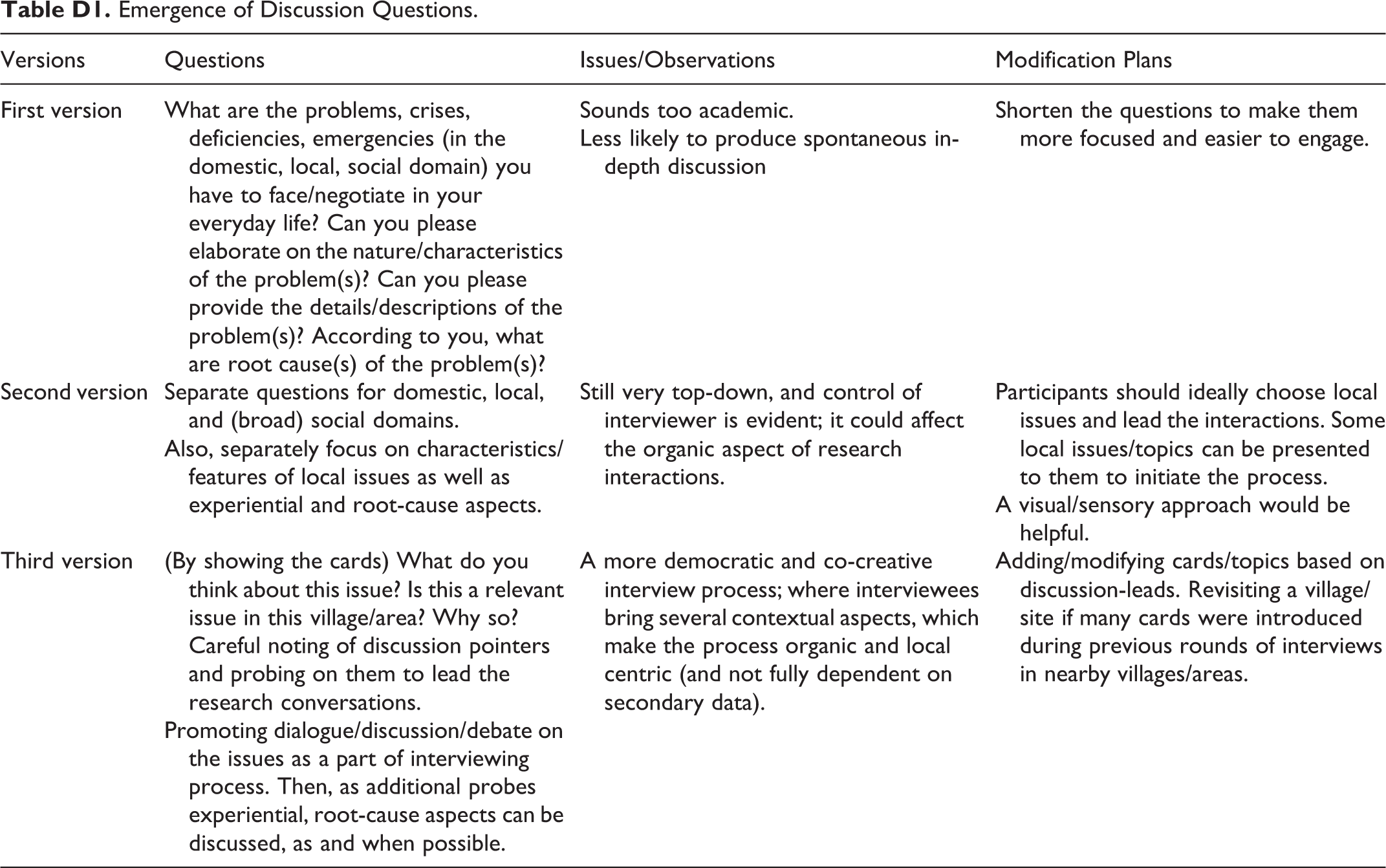
| Versions | Questions | Issues/Observations | Modification Plans |
|---|---|---|---|
| First version | What are the problems, crises, deficiencies, emergencies (in the domestic, local, social domain) you have to face/negotiate in your everyday life? Can you please elaborate on the nature/characteristics of the problem(s)? Can you please provide the details/descriptions of the problem(s)? According to you, what are root cause(s) of the problem(s)? | Sounds too academic. Less likely to produce spontaneous in-depth discussion | Shorten the questions to make them more focused and easier to engage. |
| Second version | Separate questions for domestic, local, and (broad) social domains. Also, separately focus on characteristics/features of local issues as well as experiential and root-cause aspects. | Still very top-down, and control of interviewer is evident; it could affect the organic aspect of research interactions. | Participants should ideally choose local issues and lead the interactions. Some local issues/topics can be presented to them to initiate the process. A visual/sensory approach would be helpful. |
| Third version | (By showing the cards) What do you think about this issue? Is this a relevant issue in this village/area? Why so? Careful noting of discussion pointers and probing on them to lead the research conversations. Promoting dialogue/discussion/debate on the issues as a part of interviewing process. Then, as additional probes experiential, root-cause aspects can be discussed, as and when possible. | A more democratic and co-creative interview process; where interviewees bring several contextual aspects, which make the process organic and local centric (and not fully dependent on secondary data). | Adding/modifying cards/topics based on discussion-leads. Revisiting a village/site if many cards were introduced during previous rounds of interviews in nearby villages/areas. |
Appendix E
Declaration of Conflicting Interests
The author(s) declared no potential conflicts of interest with respect to the research, authorship, and/or publication of this article.
Funding
The author(s) received no financial support for the research, authorship, and/or publication of this article.
