




Abstract
This article describes the use of music and music videos as an elicitation tool within life-story narrative interviews. The study focused on the lives of men who had experienced domestic violence and abuse in childhood and become involved on road and/or with gangs. Music elicitation was used as participants were asked to select three music tracks that aided them telling their life stories, with particular reference to their experiences of domestic violence in childhood and their involvement on road and in gangs. The music tracks and in many cases the accompanying music videos were viewed in the interview space by both the researcher and participant together. In this case, music elicitation was found to be a very valuable element to the interviews and enhanced the experience for both the participant and researcher. Music elicitation operated in three main ways. Firstly, music often had been used as a personal coping mechanism, and this was recalled in the interview, acting as an anchor to the memory. Secondly, at points, both the music lyrics and their accompanying music videos were used as tools for communication by the participant, through them being used as metaphors, or as illustrations of the past. Lastly, the music was used by the participants as a narrative tool to structure and pace the interviews, giving them greater control over the interview space. This article shows promising results in using music as an elicitation tool for research with this participant group discussing sensitive issues.
Introduction
In this article, I will outline the use of music elicitation within life-story narrative interviews. Music used as a creative research tool, alongside other expressive elicitation techniques, has been emerging in research for some time (DeNora, 1999; Keightley & Pickering, 2006). The term “music elicitation” as a distinct method was coined by Allett (2010) in a study about heavy metal fandom. Recently, music elicitation has been used in group interview situation (Dos Santos & Wagner, 2018). Music elicitation is distinct from auditory elicitation, which is a method within psychology that uses classical music as a way to stimulate memory recall (Pilcher, Cortazzi, & Jin, 2013).
The focus of this study was on the narratives of men who had experienced domestic violence and abuse (DVA) in childhood and self-identify as being involved with gangs or on road. To take part in this research, participants were recruited based on their own self-definition of being involved in gangs and/or on road as opposed to having a predetermined criteria. This helped navigate the complexities of external gang definitions (Ball & Curry, 1995). The term on road was used as it is a phrase that is used to refer to aspects of street life, often but not necessarily, including gang activity. Young (2016) asserted that the term, on road, was a term that often young people were more able to relate to rather than “gangs” which is why it was used in this study. It is a nuanced phrase which has both positive and negative connotations. Gunter (2010) noted that it was on a continuum, from, “hyper masculine modes of behaviour, incorporating violent and petty crime…and low-level drug dealing,” to “friendships, routine and the familiar” (p. 352). The term rests on a gendered and masculine experience which is the antithesis of the domestic and constrained life (Earle, 2011). In this study, the term “on road” was often used by men to refer to the individualistic aspects of street life, whereas the term “gang” was more often used to refer to street activity in groups.
Music elicitation was shown to be a beneficial tool in the interviews. Many of the participants discussed using music as a coping mechanism in childhood when they experienced adversity and found listening again to the music encouraged them to access memories of listening to it in the past. In several of the interviews, the historical cathartic function of music was mentioned. In some interviews, both the music tracks and their associated videos were used as a means of communication by the men, as metaphors, or as illustrations of their past. Some participants used the act of playing the music in the interview as a narrative tool. Their selection often signified a differing “chapter” in their life-story narratives and in many cases functioned as giving a break from a topic before moving on to the next theme. This gave participants greater control of the interview space as well as the ability to plan their answers in advance. Some participants mentioned that the challenge to find three songs to convey parts of their life story was intriguing to some participants and positively affected their interest in taking part. Ultimately, using music and music videos as an elicitation tool has shown promising results when used in sensitive research.
Overview of Existing Literature on Elicitation and Music
Creative Research Methods
The movement toward more creative research methods to complement traditional interviews has come from concerns that interviews alone can produce, “rational, sanitized, and self-conscious responses within the confines of language which, in and of itself, filters and limits expression of meaning” (Porr, Mayan, Graffigna, Wall, & Vieira, 2011, p. 31). Using creative methods in interviews, as forms of arts-based inquiry, aims to enable participants to, “express meaning embedded in the historical, cultural, and biographical contexts of their lives” (Porr et al., 2011, p. 31). Kearney and Hyle (2004) used drawings as part of unstructured interviews and found that participants used creative means to “frame their own experiences” (Kearney & Hyle, 2004, p. 362). Dos Santos and Wagner (2018) conducted a group study using music elicitation. They found that using music elicitation put participants at ease, acted as a springboard for discussion, and ultimately resulted in the research encounter being more of a shared experience through the interpretation of music, uniting the participants and researchers in a new way.
Keightley and Pickering (2006, p. 153) note how popular music can connect a person in a very direct way to their own past. They note that music can, “recreate for us the texture of a specific experience [which is then]…felt in a quality that we never quite put into words.” Through this way, music becomes an aid to memory. Music is particularly emotive when used in this way, as it captures both a personal memory and a wider sense of popular culture and trends of the past. “Music is very often a product of its time—both a reflection of the ‘here and now’ and a ‘recaller’ of memories” (Laughey, 2006, p. 1).
Using music as an elicitation tool is powerful when used with a topic where music has played a role in the coping and recovery. In the case of DVA, listening to music is a tool that some children and young people who live with DVA use as a coping strategy, both as a “form of self-expression, and self-soothing” (Callaghan, Fellin, Alexander, Mavrou, & Papathanasiou, 2017, p. 339). It offers a mechanism for comfort and enables young people to get “lost in the music” which helps them stop thinking about their difficulties (Callaghan et al., 2017, p. 340). It is worth considering that, if music has been used by a child as a coping mechanism to deal with their home life, then using it as an elicitation tool could be a very powerful way to enable the participant to locate their memories. DeNora (1999) noted that music is used by people as a “device for on-going identity work and for spinning a biographical thread of self-remembrance” (p. 31).
Music Elicitation as a Participatory Method
Due to the sensitive nature of the topic being discussed, as well as the underrepresentation of adults who experienced DVA in childhood in research, it was important to attempt to design the research in a way to make it a positive experience for participants. Historically, people who have experienced DVA in childhood have seldom been heard in research, policy, and practice, partly because until relatively recently they were not considered victims of DVA themselves, but rather as “witnesses” (Callaghan, Alexander, Sixsmith, & Fellin, 2015). Notable studies which began asking children about their own experiences of DVA have paved the way for this to change (McGee, 2000; Mullender et al., 2002). Recently, there has been work done to focus on the child as both a victim of DVA in their own right (Callaghan et al., 2015) and active agents in their own and mother’s recovery (Katz, 2015). In addition to the inclusion of child survivors in research about DVA, there has been research carried out speaking to adults who experienced DVA in childhood (Hague, Harvey, & Willis, 2012).
Concerns around an empowering research design were noted by Houghton (2015) in her study with young people who had experienced DVA. They noted that young people are silenced by DVA, so to counter this and ease anxieties were helped when, “creative, empowering, cooperative, respectful methods were used” (p. 243). It has been important to try and find a method that goes further than just being “listened to” in a passive sense and instead promotes active participation (Sinclair, 2004). Indeed, it is not just the elicitation that provides this function, but narrative interviews are also recognized as promoting more active engagement from participants when carried out in an unstructured way. Gausman, Othman, Otoom, Shaheen, and Langer (2019) noted that open-ended narrative interviews give participants, “the power to direct and focus on the discussion on the situations, contexts, and experiences that they consider to be influential to their lives” (p. 2). In this way, they give participants more control and agency to decide the topics discussed (Gausman, Othman, Otoom, Shaheen, & Langer, 2019; Mmari et al., 2017). Similar was found in a study of children who had witnessed violence. Walker, Schratz, and Egg (2008) noted that to treat the children as “research subjects” could “be seen as a further act of symbolic or methodological violence in that it would necessarily position the child as victim” (p. 167). Researching people who have experienced the disempowering effects of witnessing violence needs to be handled sensitively in order not to capitalize on their vulnerability. One way in which this approach counters some of the concerns of power inequality in traditional methods is that the participants become experts on their own circumstances as they convey their realities (Clark-Ibanez, 2008). This enables a process of disrupting the existing power dynamics between the researcher and participant. Participants discussing their own materials with researchers promotes, “story-telling responses rather than a potentially intimidating ‘question-and-answer’ approach” (Clark-Ibanez, 2008, p. 103). The music being thought out in advance it means the participant has the chance to preplan their contribution in some ways, through selecting the music and choosing when to play it in the interview. After the interview participants were sent the complete interview transcripts for their review and offered a second interview. This is not to say we were able to entirely remove the power dynamic between researcher and participant. Hydén (2012) notes that “the relation between the teller and listener in narrative research
Scope and Design of Research
Procedures
Participants were recruited via social media and professional networks. Adverts were also distributed to frontline support agencies. Participants self-identified as meeting the research criteria. The participants ranged from 26 to 50 years old and had each experienced a period of time between their road/gang involvement and their participation in the research. In several cases, this had been punctuated with a prison sentence. Due to this, they were speaking from a retrospective position.
Participants sent the track list ahead of the interview and then on the day dictated which order and when the music should be played. Music was accessed via an online media-sharing platform (YouTube), and many tracks had accompanying videos. Participants were then able to draw on whichever aspect of the music that they decided. The creative choices and the curation of the music were up to them. The participants were then all sent a copy of the interview transcription for their records, and they had the offer to discuss it with the researcher afterward in a second interview. Engaging in a reflexive process has been important throughout the research (Dean, 2017). I carried out a reflexive journal throughout the process of fieldwork, which enabled me to reflect on the process of using these methods. Using music elicitation seemed to accelerate an intimacy in the interview room quicker than a traditional interview. It also gave both the research and participant quiet pauses during the interview, which broke up the intensity at times. Having the music video available offered a visual focus when the music was playing.
Ethical Considerations
There was an acknowledgment throughout the research design that the topics dealt with in this study were sensitive. Hydén (2012) noted that DVA is a sensitive topic to research because it “(a) is research that intrudes into the private sphere and delves into deeply personal experience and (b) could be concerned with deviance and social control” (p. 227). DVA was also only half of the topic, the other being life on road and in gangs, where the participants also went through traumatic experiences. Due to this, the ethical implications were of utmost importance in the research design.
The study gained clearance from the Human Research Ethics Committee at The Open University. Careful consideration was made to ensure that the research would not be carried out in a way that would retraumatize participants. Through this method, participants were not compelled to share any more than they chose to. The interviews were unstructured with no scripted questions asked and, in some interviews, no questions were asked at all, as the participant used the music to structure their time. Using unstructured interviews is a technique used in other DVA research by Hydén (2012), who noted that when interviewing about DVA, it is likely much of the material will be “untold stories,” and so it is not appropriate to use a preprepared question format (p. 227).
I was conscious and reflexive about the impact that my intersectional identity as a White, female, researcher conducting a study with men who largely identified as mixed race and/or Black may have on the research; however, this did not appear to be a barrier. In fact, in some ways, our differences may have helped, as the participants were sure to clearly outline their perspectives to me as a perceived outsider. One participant noted our racial differences in the interview as he explained the impact on racism on his life, which he felt I would not understand as a White woman. In this case, the differences between us initiated more explanation rather than limiting the keenness to open up. Croghan, Griffin, Hunter, and Phoenix (2008) found, when conducting elicitation research using photos, that using participants own material in the interview was “more likely to bridge the culturally distinct worlds of the researcher and the researched” (p. 346), which was also apparent in this study. Through asking a participant to bring their own music to the interviews, it served as a way to promote the participants power in the interview space; “If participants choose the music this may diminish the researcher’s influence and empower the participants” (Pilcher et al., 2013, p. 486). It also creates a “shared business” between the researcher and participant who can observe and discuss an external resource together, creating a more relaxed environment (Loizos, 2011, p. 98).
Findings
Music used as a personal tool (for coping, for support, and for memory)
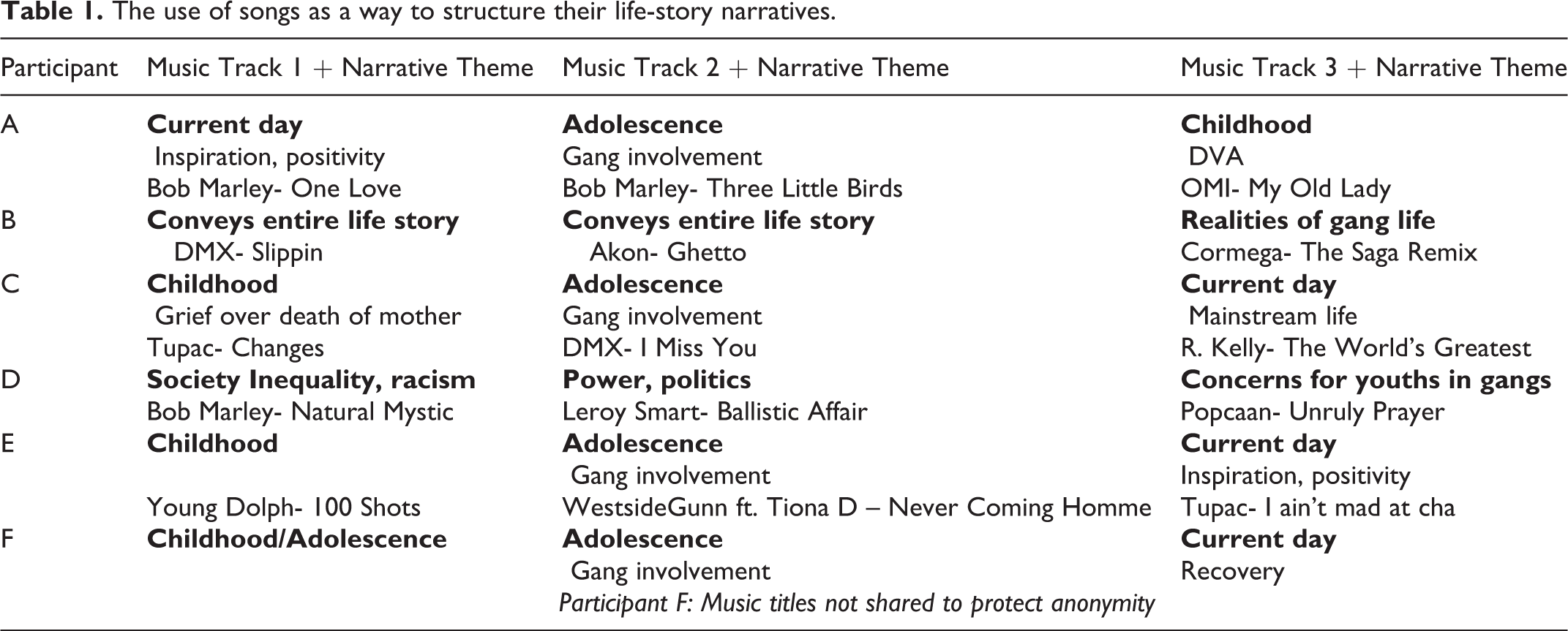
Music was used in the interviews as a vehicle to access memories (see Table 1). Being asked about the music, they wished to bring at the outset promoted the men to consider their past in a different way. The quotation in the title of this article was referring to one participant noting that it was the music element of the interview that intrigued him about taking part in the research.
It’s heavy going back over it, back to the past?
Yea it is, it is, but those songs were the ones that made me, nobody ever asked me this question before, it got me excited in a sense like ooh yea, I actually had to think about this
The use of songs as a way to structure their life-story narratives.
In some cases, men discussed how the particular tracks had played a part in their past, sometimes as a song or artist that kept them going in tough times or as a track that brought back a particular memory. In the example below, a participant discloses how listening to the song opened up his memories that led to him talking about his time in prison. As I’m listening to that song just (coughs) it makes me erm, reflect on situations. So I’ve been to prison 7 times, I’ve been locked up in solitary confinement (.) all the time. I remember being in the block listening, well actually in my cell listening to this, but when in the block they take away everything and it’s just an empty room and there’s a bed but it has a metal thing and they take the mattress out in [prison] so you can’t go to sleep you just gotta sit there, so yea, I remember many days down there. (Sam)
Even though the memory of the song was tied up with his time in prison and solitary confinement, what is significant is that he chose to use the song as a catalyst for this story to be told. As a song can travel with a person both in prison and out, they can transcend social and spatial boundaries. In the interviews, despite the fact that the participants themselves selected the songs and chose them when to be played, at times it seemed that they were surprised at their emotional reactions to hearing them and talking through them. This was particuarly the case with Eric who said that he had stayed away from listening to these particular songs because of their emotional resonance. I’ve stayed away from listening to this song because…(.) I tend to not listen to it because…I feel sad, I hear that song and there’s just so much, its like I actually feel like crying that’s the weird thing, but then people don’t know that about you, you wouldn’t want them to know that. Because then you wasn’t crying, you felt it, you felt sad yes, but now when I hear it, it it yea, it takes you to a different place, so yea. (Eric)
Eric is clearly noting how the music element of the interview brought back old memories to him that he has otherwise not accessed in recent years. The imagery of the music taking him to a different place is powerful and illustrates the way that music aids memory recall.
Some of the participants mentioned that certain songs had had a positive effect in childhood and acted as a supportive role in their youths. In the section below, Eric talked about how he was introduced to music by a teacher at school. He used the music not only as a tool within school by being part of the choir, but also he used the words as conveying a voice of guidance. I didn’t smoke or start drinking until I was in my 20s like, 21, 22, so I never really had an escapism…I had a teacher who introduced us to music and R Kelly was one of them as well, and being in choir. What’s crazy is I would be in a choir and finish and go there with these guys [gang], and so there was a gospel kind of choir um, yea so the greatest, so when I found it, it was one of those songs, you need someone to motivate you or something to motivate you and this literally was one of those songs and it would be, I would have this playing on the CD’s and I would play them to always see beyond my situation because its like, that’s what I told my friends, now that they saw that situation that made a hard decisions because they just think this is my life and they made some crazy decisions, I’m not saying I’ve never made bad decisions coz I’ve made a lot but like I said I needed it, this music I need, it literally was a part of my life because I needed something to make me think you’re great, you can do this, you can do that, so I would put all of my eggs into this creative or all my eggs into music or whatever, then I didn’t really worry about my situation so I was like, if you go and be the greatest, literally this is what I would tell myself in my head. (Eric)
Using the lyrics as a way to garner advice from an alternative source is an interesting element that was mentioned here by Eric, using R. Kelly’s “The Greatest” as an inspirational message that he could also be great and could achieve things. The same participant also used another song lyrics that are an ode to the rappers late grandmother. Eric would listen to the lyrics and think of his late mother, and he said he would use the words in the song to think about what she may have been saying to him. So in this way, the function of the music was both to articulate but also to provide an empathic and supportive voice from a distance. When my mum died we never really mourned her, and then when we grew up we grew up with a step mum who was getting beaten up every day so she never showed us some sort of love and there was never anyone to talk to. So literally whatever your gunna go through your gunna be fine its gunna be ok, so literally as sad as it may sound I play that to hear its gunna be ok, you listen to it imagining someone is saying it to you, someone who cares for you. (Eric)
Using the song lyrics as a voice from a distance was also used by Dylan who chose a song that his mother used to play to him and her advice was woven in the lyrics. He noted that he chose Bob Marley, Three Little Birds, because “as a kid growing up my mum used to always play it and she always used to say we shouldn’t be worrying about things” (Dylan). The main chorus line in the song is “Don’t worry about a thing, coz every little things gunna be alright.” So in a similar way to the others, playing the music served a function to repeat the advice of his mother who has passed away and was no longer there to give it. This example also shows how the participant using the music elicitation as a tool to get to the heart of a story which may not have surfaced in a traditonal interview setting.
Where there was not a positive family role model who was being referred to in the music, for some men, the musician themselves were centered as the source of inspiration. One participant explained how Tupac’s music played a big role in his youth, from being a role model that he looked up to which gave him the confidence to persue ecuation as well as manage the street life at that time. His explanation of why he chose the song highlights the use of music as a coping mechanism, as he noted that listening to Tupac allowed him to “go to school instead of crying.” When you are, it’s like, I don’t want to say depressed, but when you are down and when you can’t tell no one, his music was always so good, like an escapism when this person feels you as well, especially with someone who was at some points living such a hard life. …Tupac, changes was definitely the first song to me that kinda, introduced me to who he is and then, obviously you can do both but you definitely need to be educated regardless of what it is. So for me it’s a very very, he played a big role in my life, his poems don’t get the, they don’t get what they deserve but it’s like he’d write poems about how sometimes id feel so alone, and this and that, and I was like yea…someone like him for definite, every time I would wake up in the morning and go to school instead of crying I would literally, it was so therapeutic, its so hard to explain, his music is like, for me to go to school, I would listen to some of his music and it would be like yea, that’s just the way it is, and erm, that’s the kind of thing ive lived with, it is what it is, you can’t sit there and cry about it, you just have to go with it, you know, but yea this is Tupac. (Eric)
Another participant also had an admiration for Tupac. Interestingly, the two participants who mentioned Tupac were the two that had managed to have a period of life in a gang/road life but also had managed to gain university degrees at other times. So Tupac functioned as a positive Black male role model that offered the young men an example of being that balanced the street life and an educated and/or artistic life. So that’s one of my all-time favourite songs by the artist called Tupac whose been very big inspiration not only on a musical term, but as a person, as a survivor, as a black man, as a man on the streets and the roads, and as a role model, (.) just for what he stood for, the content of his lyrics and his perspective and vision and how real he kept it and the same struggles that I believe I have lived to face. (Jordan)
Another reason that Tupac was discussed as a role model is that his music, as well as DMX, showed a man being open with his emotions. There were two DMX songs and two Tupac songs chosen during the fieldwork. They offered a dual masculinity, one where they had street capital but also were able to articulate their emotions and show a sensitive side. One participant noted that “the two rappers were these hard guys but they’re very very soft and very open about their emotions” (Eric). In this way, they offered an alternative masculinity to relate to. Tupac is an interesting figure because in some senses, he performed hypermasculinity, through emulating, “the mob image of power, toughness, ruthlessness, elite, ruggedly classy, wealthy, and womanizing ways” (Iwamoto, 2003, p. 46). Iwamoto (2003) noted that this performance of hypermasculinity is attractive to young Black men who adopt these behaviors, “to combat the degrading effects of racism on their self-esteem” (p. 45). He goes on to say that there is a dearth of positive role models for young Black men, as the media often portrays Black men as “negatively or one-dimensionally depict Black men as villains, murderers, gang members, boxers (Latinos), and martial artists (Asians)” (Iwamoto, 2003, p. 45). The effect of these one-dimensional portrayals is to reinforce wider societal stereotypes. Tupac conveyed positive messages about being Black in his music. Tupac felt a sense of “pride, empathy and appreciation for black culture” (Iwamoto, 2003, p. 48). Tupac was not only about promoting gang stereotypes, however. Iwamoto noted that his music often had an empowering stance, for young Black men as well as for women. His music often sometimes portrayed, “narrations of the struggles and intense hardships people in poverty face on a daily basis” (Iwamoto, 2003, p. 46). He talked about inner-city living conditions and the structural barriers that Black people faced in America (Iwamoto, 2003, p. 46).
Music elicitation as a communication tool
A further way that some participants used their music tracks in the interviews was as a way to expand or enhance their verbal life stories. This either centered on the lyrics or the music video, or sometimes both. When using the music track as an illustration for one’s own life, it also reduces the need for the participant to explain the details of their personal experience. Ok erm (…; sigh) so both of these songs (cough) literally word for word, just everything, that I lived, 100% (Sam)
This comment shows how, through using the lyrics to the song, it reduces the need to explain a lot of things. It decenters the story from the teller and so instead of telling their story in a traditional way, the participant can share through the selection of music that they brought to the research interview. In some cases, this was accentuated by the music video, some of which featured a visual representation of life experiences that the participants were discussing. A key example of this was through the use of the music video as a way to illustrate their own history in the track “Slippin” by DMX (see Figure 1). This video features two parallel threads, one of which is the current day rapper DMX talking about a life path from childhood, neglect from his mother, getting a dog, gang involvement, then ends up in an ambulance on the way to hospital. The video switches between DMX rapping to acted out sections of the life story. This was used by Sam as a way to open up the discussion about his own experiences. I can relate to like obviously how he said he started to get angry and was an angry child and he was growing up and he just, he became feared by others, even the bigger boys like they was actually scared of me and I was always angry and then I remember like getting a dog and the dog was like my best friend. (Sam)

Clip from music video on YouTube. DMX—Slippin (1998).
The portrayal of a boy who Sam could relate to in the song was not just significant in the lyrics but also was shown in the music video which followed the story of a boy who had similar circumstances, even getting a dog himself.
The similarities between the story in the song, illustrated through the music video and the participant’s childhood, made it an extraordinarily powerful tool in the interview. Using the song as metaphor was also furthered by the way that the participant swtiched between talking about the song to referring to his own story. In this section, you can see how Sam switched from talking about the characters in the song “he” to then talking about himself, “I.” I, I left, and that’s what the songs saying, he said he mum was on some fly, and then he he chipped he left, erm (.) then I was out on the streets. (Sam)
Jordan also chose a song based on both the lyrics and the accompanying music video, which he referred to as “the visuals.” He noted that the combination of the two enabled him to convey his own childhood, again by switching between language referring to the video and then switching back to his own experiences; So that song there I guess for me…it’s a song that I would say probably represented the early parts of my life in terms of growing up and the visuals, lots of kids in the house, single parent, kids looking like not really (.) not not being looked after but their environment that they’re living in is a hard environment, the kids that they are going to school with, it’s harder, maybe there’s a lack of opportunities, there’s not enough money, as a result your just drawn, for me anyway, drawn to the streets, making bad choices, and drawn to trying to find a way out. (Jordan)
The visual portrayal of the children in the music video for WestSideGunn is powerful, as, like Jordan noted, it shows poverty, overcrowding, and hints at neglect.
In addition to Jordan choosing this song to convey a sense of children growing up in difficult circumstances, he noted that the way that the rapper was portrayed is aspirational to him. He noted that contrast in the music video between the main singer and the “gritty” environment that he is featured in; It’s more than just a song, I really relate to it and the flyness of it in terms of the artist himself, being dressed so nice and suave yet you can see bandos and trap houses and rubbish heaps and alcohol bottles on the floor and you can see it’s a gritty place but you can see he stands out and is shining. And that’s another thing you is that you know you don’t have to succumb to what your environment or where you live, you don’t have to be a product of your environment, you can change your destiny, you can change your life. (Jordan)
In this case, it is worth considering how the music video accentuated his message, in particular, how hard it may have been to convey his feeling of “shining” among a gritty background without the aid of the video (see Figures 2 and 3). In the video, the rapper is in smart sports clothes and at points is featured with an assistant holding an umberella for him, hinting at affluence and the ability to have staff doing tasks for you.

Clip from music video. Westside Gun Ft. Tiona D: Never Coming Home (2014).
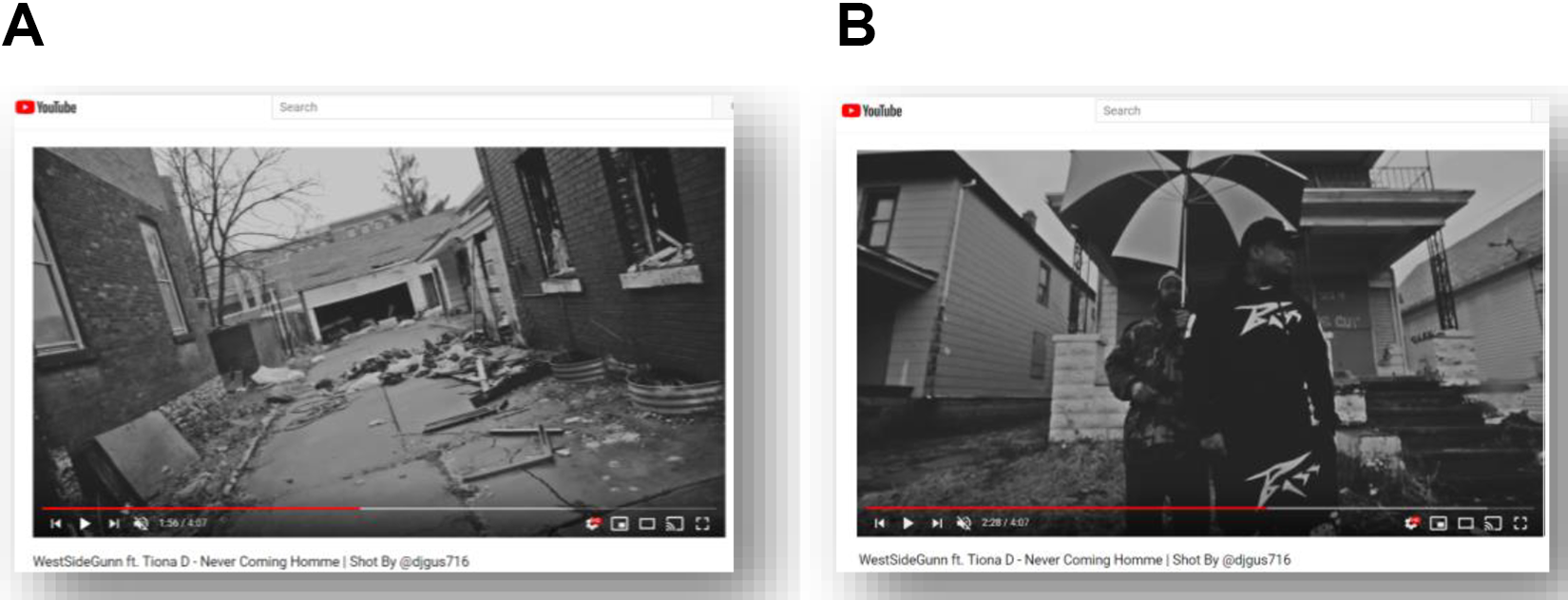
Clip from music video. Westside Gun Ft. Tiona D: Never Coming Home (2014).
This is in contrast to the gritty neighborhood that he is standing among. The title of the song “Never Coming Home,” which was also significant to Jordan. The songs called never coming home and that signifies two things really, some people in this lifestyle as a result from coming from a broken home or not having a home and never coming home because they’re going to prison for life for a murder case or for a series of things, and they’re away for a long time, so they’re never going home. The other thing to this I guess of never coming home is the transition from when you move, I got kicked out of my house from when I was 15 and I’ve never been home since, obviously I’ve seen and visited my mum but I’ve never gone back to stay or live back there since then do you know what I mean, 12 years later, I’ve been living on my own for 12 years. And I’ve never gone home, I’ve had to make my own home and as a result you’ve had to become a man and take care of your responsibilities and you start to build your future and that’s what it’s about and that’s what that song really represents, it’s more than just a song. (Jordan)
This passage really shows how the lyrics were also used by the participant to act as a spring board for him to tell his own story. It opened the door for him to talk about his experience of prison, leaving home, his relationship with his Mother, his feelings of becoming a man. And what makes it all the more powerful is that these experiences were shared not through structured interview questions but by the music that the participant himself initiated.
Using the lyrics to articulate an element of their story was another way that the men used their music selections in the interviews. In some cases, they used selected song because the lyrics articulated a pertinant sentiment. To illustrate that I have put the lyrics in bold in the following excerpts; I chose that because it relates to me to a T literally everything erm…it said at the start to live is to suffer and to survive is the ending of suffering and I think that’s how it felt for a long time. (Sam) this song is kinda like sums up my mum to a T, I don’t know if you have listened to the lyrics, so you know, this is my mum because my mum mothered and fathered me, do you know, my mum done everything she could for us. (Dylan) even I relate to, how can you put a baby in a prison cell? I was about 13 when I first went to prison. (Sam) The One love. That’s the way I feel right about now. I feel like everyone should spread love and positivity and everybody can live together. (Dylan)
This was even more relevant for the participant who wrote his own music which he presented in the interivew. For him, the lyrics in rap form served several functions. They were a way of expressing his feelings so that he can refer to the music instead of retelling his story, shown in his comment below he noted that his story was contained within his music. If someone tells me to speak about something I say listen to my music…you’ve all heard my music, you know…it’s very personal…so (.) listen to my music if you want me to open up. Opening up to someone’s face is very different, like I express myself through my music. I try nowadays to veer away from stuff in the past coz ive said it so many times over. I like to do more upbeat music now. I dunno, it depends how I feel. (Shaun)
By putting his feelings into rap music, it is a form of coding of his story, as it becomes entrenched in a street language that you can decipher if you have the street capital to do so. In the interview, he talked me through the lyrics of the songs that he had chosen and explained the meaning of the phrases. It also functioned as a test for the researcher, as there were disclosures in his music lyrics which he did not reveal in the intervew. As he noted above, there were elements of his story his chose not to discuss anymore outside of his music. It functioned as a boundary enforcing tool.
Music elicitation as a narrative tool
The participants all curated the way music featured in the interviews in different ways. One way this was done by the participants was to broadly choose the three songs to represent childhood years (0–10 years), then the teenage years or the gang involvement years (10–22 years), then a song that represents where they are now. By choosing songs in this way, the participants dictated a chronological structure to the interview, although they didn’t necessarily start with the younger years first. The second way that songs were chosen to offer structure was to use the songs to highlight three distinct key messages that the participant wanted to share. One participant chose Bob Marley, One Love and then straight after it played said, “The One love. That’s the way I feel right about now. I feel like everyone should spread love and positivity and everybody can live together” (Dylan). This opened up the opportunity for him to talk about the youth outreach work he is currently doing. When he had said what he wanted to in this section, he signified this by concluding, “So that’s why I chose that one love song” (Dylan) which then prompted me to put on his next song. What this shows is the extent to which the music elicitation when combined with an unstructured interview space gave the control to the participant to dictate the pace, length, and structure of the sessions. In some interviews, the participant used their ability to decide what and when the songs were played as a way to change the subject once they felt they had said what they wanted.
So what I had to do I had to suppress the caring, I had to do things that I didn’t want to do,
Ok
{Plays song 3]
So (.) ok, (.) so, I had to do things that I didn’t want to do.
This excerpt shows how the participant used the song as an interlude in what he was saying. Another interesting element is to look at the way that the song choice indicated a distinct “chapter” or narrative shift in the participant’s stories. Looking at the narratives in this way is to see how the men position themselves in relation to their past experiences. Through focusing on how they organized their answers to the research can reveal the way they see their identities in relation to their past. It is also of interest how they position the DVA and the gang/road life in their stories—what the center as being important;
This table illustrates the similarities and differences between the ways that the participants used the music to organize their narratives.
Participants A, C, and E all chose to use the tracks to create chapters of their lives, broadly their childhoods (0–10 years), youth (11–20 years) and current day. Participants B, E, and F began with their childhoods, offering their stories in a chronological pattern and then working through their life stories in age order. This was inverted by Dylan who chose to start with a very upbeat song conveying positive messages about his current situation. Since his reform, he carries out charity work raising awareness to an anti-gang/violence message. From the outset in his first choice of song, he conveyed a redemption narrative, positioning him first and foremost as an educator and as someone who does charity work. Perhaps he started there, as opposed to a different point in his history, as an attempt to neutralize his gang involved and criminal past.
The songs that Sam chose explained his life story from a perspective of being driven to the streets (first two songs), with the third a bleak portrayal of gang life. Although he had had several years away from gang involvement, he gave a raw and dark portrayal of his life. Eric similarly poured out his story from the moment he walked into the room in a stream of consciousness style testimony. Eric told me his life story before we had played the music, then chose to play the songs afterward, which prompted more specific anecdotes. The interview had a confessional tone that was emphasized with his comment that the interview was like “free therapy.” The interview with Lester was discussing political content, as he chose songs that he used to comment on wider societal and structural inequalities.
Challenges
There are some practical considerations to be noted when using this approach. Firstly, that the use of a web-based music streaming service such as YouTube relies on a stable Internet connection. There were issues with the recording of the interview at times when participants spoke over the music, although most waited for the track to finish to resume talking. The use of music and music videos also presents questions around analysis, as due to the personal use of the music in each interview, in some cases, the lyrics feel pertinent, in others, the musician is significant, or the visual representation in the music video. This raises analytic challenges as the data are different for each individual and so in some cases the music functions as an elicitation tool, whereas in others the music itself becomes the data.
Conclusion
This article has shown promising results with the use of music elicitation. However, this was a small study, and so it is recommended that this method is trialled in other contexts. In this study, there were a range of benefits that were found in this case of using music elicitation within a life-story narrative interview. It enriched the participants’ experience as well as the breadth of what they share in the interview. It was an interactive and creative addition to a life-story narrative interview. When the music track or accompanying video is used in a way to tell part of the participant’s story, it enhanced and enriched the data gathered. It enabled the participant to offer up different information than they would have in a words-only interview, as some complex concepts or feelings were communicated through the music or video format. By offering an alternative way for the participants to convey or illustrate their experiences, they can instead bring the music track and say that was what happened to me.
Using music elicitation proved to be a beneficial addition to the interview when used with men who experienced DVA in childhood and who were involved with gangs or on road. Typically, this group is “less heard,” and yet music elicitation combined with life-story narrative interviews encouraged very personal issues to be shared. Enabling participants to curate their own interview space through music gave them greater control over the interview process. Participants were able to select the music tracks themselves and fully control the topics and messages that they wish to convey, as opposed to a traditional interview. This gave participants greater control to change the subject, pace, and portion out the interview as they choose. It also gives them control by having the chance to preconsider the interview and plan their contribution in advance, which can lessen the uncertainty for them. All these factors change the dynamic of the interview and put the researcher in the role of listener or audience, rather than investigator. Overall, it can make participation in research a more engaging and empowering experience when conducting research on sensitive areas.
Footnotes
Declaration of Conflicting Interests
The author(s) declared no potential conflicts of interest with respect to the research, authorship, and/or publication of this article.
Funding
The author(s) disclosed receipt of the following financial support for the research, authorship, and/or publication of this article: The research was as a result of PhD research fully funded by The Open University.
