




Abstract
This research arose from a moment when one of the author’s interviewees said, “Wait, where was I?” Through 60–90 minutes, in-depth phone interviews, shared highly detailed accounts of their personal stories of entering underemployment in South Korea. However, the first six interviewees talked about many different topics during their interviews, and confused the chronological sequences of multiple episodes. The interviewer recognized these instances as emergent chaotic moments, so she decided to incorporate various methods into her interviews. Among the many elicitation strategies that can be employed in qualitative interviewing, the author applied timeline elicitation to more accurately document their life events. Timeline elicitation is useful for extracting narratives of individual journeys and delineating the meaning of specific events. This technique proved the most effective strategy for minimizing confusions and successfully completing the interviews. This study used comparative analysis to assess the transcripts of two different groups (with/without applying timeline drawing elicitation), and presents findings showing their different reactions to dealing with the transition of time. This study demonstrated the potential of visual timeline approaches to reflect and illustrate the complexity of women participants’ experiences of underemployment. Moreover, the efficacy of this timeline drawing elicitation method will be critically discussed, along with its limitations within the context of innovative qualitative methodologies.
Keywords
Background of this Study
“Interviewing is rather like marriage: Everybody knows what it is, an awful lot of people do it, and yet behind each closed front door there is a world of secrets” (Oakley, 1981, p. 30). Among the many data collection strategies employed in qualitative methodology, interviews have long been favored by researchers. This technique allows scholars to uncover and explore the meanings of an individual’s vivid life experiences, behaviors, and feelings, and the relationships between different aspects of various situations (Arksey & Knight, 1999; Creswell & Poth, 2016). As qualitative research examines the complexities of individuals lives and experiences, it is inevitable for researchers to encounter unexpected situations.
Scholars in this field have, therefore, developed a large number of creative variations to successfully guide interviews and obtain resources necessary for their studies (Monico et al., 2020; Qualpage, n.d; Wheeldon & Faubert, 2009). Elicitation tools are one such approach to enhancing data collection (Pell et al., 2020; Qualpage, n.d). Elicitation is defined as “to draw out something, such as information or a response” (Merriam-Webster, n.a) and qualitative researchers can apply elicitation tools in different ways: (a) visual methods (e.g., pictures, graphic materials, collage, sandbox) (Collier, 1957; Duara et al., 2018; Grant, 2018; Pell et al., 2020; Vacchelli, 2018); (b) object elicitation (interviewees bringing objects to an interview and reflecting on the significance of the object) (Nordstrom, 2013; Qualpage, n.d; Willig, 2017; Woodward, 2016); and (c) timeline elicitation (Hope et al., 2019; Kolar et al., 2015; Monico et al., 2020).
Among the variety of the elicitation strategies available to the qualitative interviewer, timeline elicitation was selected for this study. Participants construct timelines by arranging their life events chronologically, including visual cues indicating the significance or meaning attributed to the highlighted occurrences (Berends, 2011; Kolar et al., 2015). This study interviewed 10 Korean Millennial women who have experienced overqualification in their past or current workplace due to the social structures that shape the Korean job market. Although the interviewer (I; the researcher of this study) shared the interview questions with the interviewees prior to the actual interview, participants still at times struggled to track the pathways of their career trajectories, and often transitioned between discussing personal and professional experiences.
The timeline elicitation strategy was different terms depending on the timeline methodology employed (Chen, 2018; Monico et al., 2020), such as visual timelines (Pell et al., 2020; Rimkeviciene et al., 2016), graphic elicitation (Bravington & King, 2019; Bridger, 2013), timeline mapping (Kolar et al., 2015), or time-lining (Duara et al., 2018). Despite such variation, these previous studies have all pursued the same methodological approach: reduce the complexity within the interview, open up participants’ interpretations of the research questions during the interview (whether in-person or virtual), and, possibly, provide participants the opportunity to find the hidden creativity necessary to express their thoughts (Duara et al., 2018; Kolar et al., 2015).
Previous studies have used timeline elicitation as a data collection approach in qualitative inquiry to address participants’ sensitive stories and uncover vulnerable or marginalized populations’ lived experiences (Sheridan et al., 2011; Qualpage, n.d), specifically trauma (Kolar et al., 2015; Saltzman, 2016), suicide attempts (Rimkeviciene et al., 2016), anxiety (Duara et al., 2018), and disease (Kolar et al., 2015; Pell et al., 2020).
Pell and colleagues’ (2020) study “Using visual timelines in telephone interviews: Reflections and lessons learned from the STAR family study” applied visual timelines in telephone interviews to women participants of the “STarting a family when you have an Autoimmune Rheumatic disease study” (STAR Family Study). The main reason the authors used timeline-facilitated interviews is that participants were able to visualize their journey chronologically, and this helped them to organize their narratives during the interview. They first approached the visual timeline elicitation via phone due to geographical conditions (participants were dispersed across the United Kingdom). Through the phone interviews, the authors elicited and collected rich data because participants were able to disclose their sensitive experiences through the screen or receiver.
Although the participants of this study were also asked to answer questions about sensitive topics related to their lived experiences in their career trajectories, the study’s approach differed somewhat from those of other researchers. This study applied timeline drawing elicitation to minimize the chaotic moments during the phone interviews the researcher conducted in Summer 2021. Interviewees were provided five pages of interview questions, and the first six participants often said “wait, where was I?” and seemed off-track while attempting to describe several episodes simultaneously. Among the available elicitation strategies, timeline drawing elicitation seemed to fit best, as it would ensure that participants remain on track while describing their career trajectories. Interestingly, after applying timeline drawing elicitation in interviews with the four remaining participants, and thereby encouraging them to construct “life episodes” that specifically focused on their life events, their experiences prior to entering the job market, and their overall job trajectories, they asked neither “wait, where was I?” nor struggled to share their life episodes with the interviewer.
Moreover, this study selected timeline drawing elicitation over other available visual methods for the phone interview, as this would enable the women participants to visualize their career trajectories chronologically and help them to stay on the right track during the limited interview hours. This approach also provided participants with the space and opportunity to recall important events related to their decision making in the job market and to their lives overall.
Research Questions
1. How was the timeline drawing elicitation used by women and researchers in the phone interviews? 2. What impact did timeline drawing elicitation have compared to the group that did not experience timeline drawing elicitation? 3. What impact did timeline drawing elicitation have on the quality of data collection in phone interviews in areas such as involvement, detail, and coverage of sensitive topics?
Methodology
This study used timeline drawing elicitation as a methodological tool to facilitate phone interviews with women who experienced underemployment 1 and who were sensitive about sharing their lives and career trajectories in public. This article focuses on how this approach can minimize confusion (the author calls these moments of being off-track chaotic moments), specifically during phone interviews, which limit non-verbal communication (e.g., gestures, facial expressions, or non-verbal cues). (IRB #: PROJECT00002603).
Data Collection Journey
In order to examine the three research questions above, the author first began to recruit women interviewees from the Women’s Career Development Center located any cities in Korea (In February 2021). However, many such centers in Korea were still closed due to the ongoing COVID-19 pandemic, and many restrictions on in-person group activities remained in place at this time. To recruit interviewees for this study, the sampling strategy shifted from purposive sampling (a non-random technique that collects rich data from the participants (Etikan et al., 2016)) to snowball sampling (a non-probability technique in which existing informants suggest other individuals for the study (Tongco, 2007)). To begin the data collection process, the author created two fliers and posted them on her personal social media pages (e.g., Instagram, blog) to share the purpose of this interview and seek connections through her existing social networks. By the end, the small snowball had become a rather large one, and data collection could thus commence.
Each phone interview was expected to last between 40 to 60 minutes, but the actual interviews ranged from 40 minutes for the shortest to 100 minutes for the longest. From March 2021 to July 2021, 10 Korean women from the Millennial generation (born between 1980 and the late 1990s) were interviewed: (a) Group 1: #1-#6, who were not prompted to draw a timeline during their phone interview, and (b) Group 2: #7-#10, who were prompted to draw a timeline during the phone interview. All interviews were communicated in Korean (the researcher’s and the participants’ native language), audio-recorded, and transcribed verbatim by the researcher. Prior to conduct the actual interviews, all participants were contacted via Kakao Talk (카카오톡), the most common online communication app in Korea. Both groups were sent reminder messages with an updated list of what to prepare in advance of the interview: (a) responses to interview questions, (b) the consent form, and (c) pen and paper for the timeline drawing activity, with a sample of visual timeline methods.
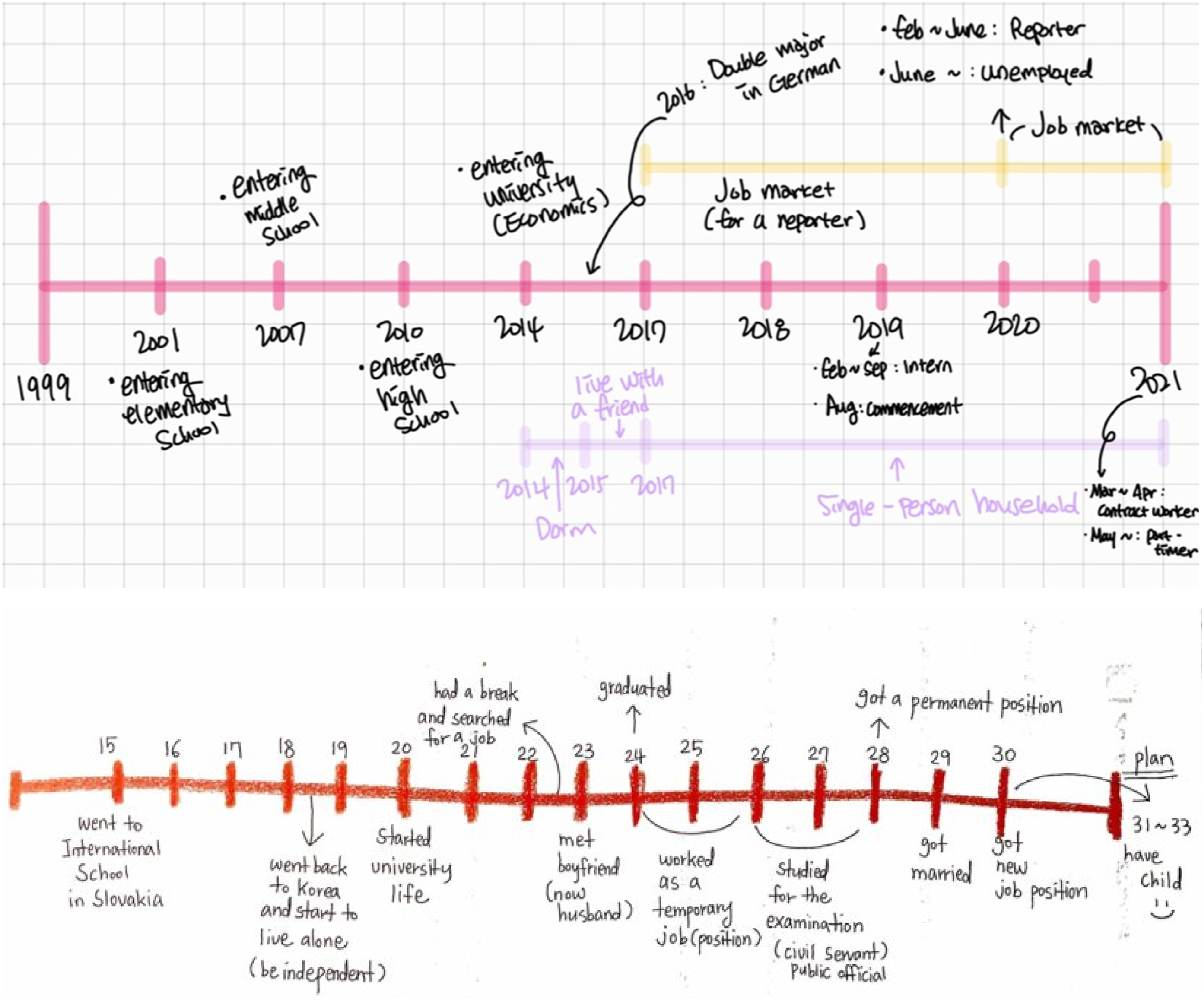
Most of the interview participants were already familiar with the timeline drawing activity, so they did not ask further questions. They tended to respond, “Okay, I will prepare” or “Sure! See you tomorrow.” Since the interview questions addressed sensitive topics, to maintain confidentiality participants were asked to choose a private place where they could share their deeply personal stories freely. So, interviewees themselves chose the best time and locations for their phone interviews, such as in a dressing room, their car, or early in the morning, to complete the interview while other family members were still asleep). The interviewer and the interviewee simultaneously drew timelines, which were then shared and compared between the two. The researcher intentionally completed this action to demonstrate her attentiveness as an interviewer to the interviewees’ stories, and to remain actively involved in the conversation rather than passively sitting and collecting data. Moreover, the interviewer took reflective field notes both during and after interview (Figures 1 and 2). A reminder message before the interview: Introducing the timeline drawing elicitation approach. Note. A reminder message before the interview (KOR/ENG). Timeline elicitation samples during the interview. Note. Participants used digital tools to draw timelines (The author translated the first figure from Korean to English).
Data Analysis
Interviews with each participant were transcribed on the same day by the researcher. Interviews were first transcribed into Korean, and then shared with participants for member checking. Member checking ensures the validity and credibility of the results. During this process, interviewees could request to add content to or remove content from the transcript to obtain the greatest accuracy possible with regards to how the conversation reflected their experiences. The researcher analyzed data from three main sources: (a) interview transcripts, (b) audio recordings, and (c) the interviewer’s field/reflection notes. This multifaceted approach proved helpful in examining the research questions for this study.
As this study is a part of the researcher’s doctoral dissertation, the 10 transcripts and reflection notes had already been coded in researcher’s codebook (an Excel spreadsheet) in Spring 2022, and were partly translated into English. Therefore, to complete this study’s analysis, the researcher used the same codebook, but conducted extra filtering and translation when necessary. To accomplish the research goal, the author reexamined the 10 transcripts and highlighted interviewees’ reactions, both when they faced chaotic moments without the benefit of timeline drawing elicitation, and when they experienced peaceful moments with timeline drawing elicitation.
Validity & Reliability
In this study, Group 2 (the control group) contained fewer individuals than did Group 1 (treated group); however, the sample is still valid, and supports the purpose of this study. The attitudes of the women in Group 2 differed from those in Group 1 when responding to the interview questions (e.g., life background, job trajectories, unpleasant underemployment experiences). The four women in Group 2 embraced the flow of conversation, and seemingly could not feel the power dynamic between themselves and the researcher. In Group 1, however, as the researcher attempted to balance her position between being an insider and an outsider, several participants made statement reflecting an awareness of this division: “Did I answer your questions well?,” or “But you may know more than I do, because you are in your doctoral program.” To address these power dynamics, the researcher applied timeline drawing elicitation to maximize participation and minimize the chaotic moments during the interview. In contrast, after using the timeline drawing elicitation with four women in Group 2, the interviewees said they could feel a strong bond with the researcher, which arose from the drawing and sharing of the timeline both during and after the interview. Moreover, to validate the use of timeline drawing elicitation across both groups, the researcher conducted a cross-check with two qualitative method experts, a bilingual Korean who had completed a doctoral degree in Korea.
The 10 interviews were conducted with well-organized data collection processes, and the last step for finalizing the data was double-checking its trustworthiness. Trustworthiness is a necessary consideration, as it demonstrates the quality of the researcher’s conduct and strengthens the results of the qualitative research. To avoid any misinterpretation of the interviewees’ vivid voices, the author applied several strategies, such as member checking and back-translation.
Member checking is a reliable strategy used by researchers to ensure the trustworthiness of their research (Curtin & Fossey, 2007). This technique examines the credibility of the findings and provides maximum reliability and validity (Birt et al., 2016). This study applied a qualitative feminist interview strategy with 10 Korean Millennial women, so it was necessary for the author to be careful with interpretation and spend sufficient time on member-checking. Throughout the process of data collection, the author’s foremost concern was “How can I deliver their words accurately and interpret their interview in the way they intended?” Therefore, both before and during the interview, interviewees were told, “if you feel uncomfortable with sharing any of this information, please let me know. Also, I will share the transcript with you after the interview, so you can tell me what to remove or include in the final draft.” After the interview, the author sent the transcriptions to the 10 participants, and responses included remarks such as “wow, this is very impressive” or “how did you transcribe such as a long interview?” However, five of the participants did not respond to the member-checking request, even though they had been provided with instructions at the beginning of the interview. Therefore, the researcher decided to confirm the transcriptions and interpretations informally.
As all interviews were conducted in Korean, translation issues were a concern for this study, and for the interviewer’s own forthcoming dissertation. An accurate translation process is necessary to convey interview participants’ experiences and messages in the written words, so the researcher opted to use back-translation to ensure precision. Back translation (also known as reverse translation) refers to translating data/content from the target language back to its original source language using literal terms (Smartling, n.d; Son, 2018). Finalizing the quotes from the interviews required several steps: (1) First, the researcher had to translate the selected direct quotations into English; (2) Second, her supervisor sent the first draft of direct quotations to the researcher’s previous supervisor, a Korean expert of qualitative methodology; (3) Third, this second draft was sent to a member of the researcher’s cohort, a bilingual Korean who had completed a bachelor’s and a master’s degrees in the United States; and (4) Finally, the semi-final draft was sent to a personal editor who speaks only English, to check the direct quotations for nuance, word choice, and flows.
Findings
This following section presents the most pronounced differences between the two groups: those with or those without applying timeline drawing elicitations. The impact of timeline drawing elicitation on the quality of the data, for phone interviews in particular, is examined in detail.
Facing Chaotic Moments Between the Interviewer and Interviewees
As a novice qualitative interviewer back in Spring 2021, the author missed certain things she should have noticed during the initial interviews. Checking interviewees’ speaking pace was one of the interviewer’s primary responsibilities, but she failed to do so consistently in early interviews. Interview questions can be divided into two main categories: demographic factors (nine questions), and the in-depth interview questions, which covered five different sections with 14 questions exploring the following subjects: (a) life background, (b) job market experience, (c) work experience, (d) decision making, and (e) job-related information. The day before the actual interview, the researcher gave the interview question file to the participants so they could respond to the questions in a timely manner. However, some participants who had prepared to speak about numerous episodes had difficulties choosing and summarizing one particular story, as this excerpt shows:
In this testimony, one of the participants in this study narrates her career trajectory of leaving her full-time job, obtaining part-time jobs, and becoming underemployed. As she shared three major events related to (a) the difficulty of maintaining a life balance between work and school; (b) changing job types and facing financial issues; and (c) choosing night shift work at fast food restaurant, she became too focused on her career shifts, which happened rapidly and unexpectedly. As such, she ended up forgetting the question ‘How would you describe your family talking about your career or academic decisions?’
Moreover, about 60 minutes into the interview, the interviewer also often began to experience confusion regarding the conversation flow. Interviewers must manage many things simultaneously, such as checking the time, asking questions, and ensuring the flow and quality of the conversation, because all of these aspects are highly relevant to the final data. Interestingly, facing confusion can happen not only to the interviewees, but also to the interviewer:
Compared with Group 2, the interviewer experienced more ‘off-topic’ moments with interviewees in Group 1. ‘Off-topic’ was a frequent note in the transcript, so the interviewer revisited the audio record to examine these moments further. Often discussions concerned personal stories arising from participants’ underemployment experiences (e.g., the way boss treated them, or other underemployment situations) which were irrelevant to the interview questions.
Moving Beyond the Standard Interview Style for Successful Phone Interviews
For Group 2, the author reminded participants about the timeline drawing elicitation three separate times: (a) the day before the interview, (b) at the beginning of the actual interview, and (c) during the interview itself. This process was tremendously helpful, and allowed the author, a novice interviewer, to navigate the chronological sequences of life events discussed in these in-depth interviews (Duara et al., 2018). Researchers who have applied the timeline approach to their interviews have highlighted that such timelines can connect between and across events, since this approach does not require information to be divided into distinct domains (Monico et al., 2020).
This participant’s interview was the first one in Group 2 in which the timeline drawing elicitation method was applied. This participant completed her interview in her car while waiting for her child to finish his night swimming class, she said this was the best place to share her personal story. Since she did not have time to print out the interview question sheet out due to her busy schedule, and pulling it up on her phone while talking to me on the phone was difficult, timeline drawing elicitation helped her to outline the chronological sequences of her life and career trajectories with high accuracy of recall.
Moreover, checking on the timeline drawing throughout the interview proved to be a promising strategy for building trust between the interviewer and interviewees. Their tone of voice would shift to be more positive or genuine when the interviewer paid attention to previously undisclosed events in their lives. Timeline drawing during the interview could potentially further enhance the contact and communication between two people in the same space (Rimkeviciene et al., 2016).
Additional interviewees participated in the timeline drawing elicitation activity, including the final interviewee. Although participants were sent a reminder message to prepare a pen and paper, two interviewees completed the timeline drawing by using a tablet PC. They used this digital device for its convenience, as they could easily add or remove life events during the conversation. This clearly shows the tech-savvy characteristics of the Millennial generation, many of whom are digital natives (Eom, 2019; Snyder, 2008). Moreover, they could create a timeline in the language in which they felt the most comfortable. One of the interviewees first completed her timeline in Korean, and then translated it to English for the researcher’s convenience.
After the Interview
As the interviews concluded, participants were reminded to complete the timeline drawing activity, if they had not done so during the interview. They could also send their timeline drawing up to one day after the interview. For this type of study, it is imperative that participants record their thoughts and feelings in a personal journal immediately following every meeting to capture the key points and important details with fresh thoughts and insights. One of the participants turned on the camera and conducted the interview via Zoom, and as soon as the interview was over, the interviewer and interviewee shared timeline drawings, so as to view each other’s work simultaneously.
As shown in Figure 3, the researcher shared her timeline drawings immediately after the interview, via online chat. Participants were directed to submit these drawings no later than a day after the interviews, to ensure the most accurate records of their life events. This strict timeline allowed the interviewer to collect vivid records free of extraneous additions (Figure 4). Comparing timeline drawings after the phone interview. Note. Left: Interviewee/Right: Interviewer. Reflection of a timeline drawing elicitation interview (Participants #8, #9, #10). Note. Screenshots from individual online chat with participants in Group 2.

Interviewees who participated in timeline drawing elicitation exhibited interesting qualities. As the researcher had five total pages of dissertation interview questions, she was worried about the burden that conducting interviews in such a limited time frame (1 hour or so) would place on participants. However, interview responses were markedly varied. Some people were surprised by their drawing skills, thanked the interviewer for listening to their story, and displayed various reactions, such as reflecting on their lives while drawing their timelines. Beyond serving as a guide for interviews, this timeline drawing activity provided a space for reflection on participants’ overall lives and career trajectories. In addition, after the study concluded, the difference between the two groups became more apparent. A month after the study, the ninth interviewee, from Group 2, sent the researcher a news article related to the dissertation topic and interview questions. The rapport between the interviewer and the participants, which was built more solidly through the timeline drawing elicitation activities, continued even after the interview, leading to constant interest in the researcher’s doctoral dissertation and possible follow-up studies.
Discussion
This paper has explored various types of elicitation strategies in qualitative research and demonstrated that timeline drawing elicitation has proven to be an impactful strategy in phone and Zoom interviews with women participants who felt sensitive about disclosing personal information in public (e.g., power dynamics, flows, and smooth multi-modal communication, an alternative communication approach including pictograms, logos, or cartoons highly related to visual materials, sounds, and gestures (Forceville, 2020)). This study contributes to the emerging literature on elicitation strategies in qualitative interviews overall (including qualitative feminist interviews) by focusing on timeline drawing, and employs an unique approach of examining multiple data resources (i.e., timelines, interview/reflection notes, audio records, and transcripts). This study also highlighted the significance of the interviewer’s quick decisions during the data collection process, and how such reflections further promote the success of the actual interview.
The use of the timeline drawing elicitation successfully changed the interview flows and encouraged women participants to organize the stories they were eager to share. Applying this timeline approach has the benefit of letting women have ownership of their stories and exert a controlling influence on the interview (Pell et al., 2020). The author’s dissertation topic began with her personal experience of being underemployed back in 2017 And she shared these stories and life experiences of underemployment during the recruitment of the participants. The main purpose of sharing this background information was to build a rapport with my participants and step into their world.
Many qualitative feminist researchers have highlighted the power dynamic between interviewers and interviewees, especially when the interviewer and interviewees have had similar experiences but different cultural, societal, and personal perceptions (Gillham, 2005; Pell et al., 2020; Tang, 2002). During the interviews, some participants expressed amazement regarding the researcher’s current status (I used to be underemployed, but then became a PhD candidate), even adding “well, but I know you know more than me because you are studying for your PhD. and are an expert in this” after sharing their experiences (Park, 2022). Moreover, while the women participants felt burdened by the author’s status, she in turn struggled with the age gap between herself and her interviewees. In Korean society, people tend to use honorifics according to their age, so the author took special care when choosing terms, and became nervous when dealing with older participants. In the course of this study, the researcher acted as both an insider and an outsider.
To successfully enter the participants’ worlds (i.e., become an insider) and elicit their vivid stories, the author applied innovative qualitative approaches, such as using emoticons and timeline drawing elicitation. After drawing timelines, unlike the participants from Group 1, people from Group 2 fully focused on the in-depth phone interviews (Pell et al., 2020). They no longer asked questions such as “wait, where was I?” later in the data collection process. Pell and his colleagues (2020) argued that timeline tools are especially difficult to reconcile with a power imbalance, especially for marginalized groups, because the interviewees (in this context, a marginalized group) often seek direction from the interviewer. However, in this study, the people in Group 2 and the interviewer formed a strong bond with each other, during and even after the interviews. Therefore, timeline drawing elicitation reduced the common forms of power imbalance for both parties and gave each participant the ownership of navigating through their own stories in the conversation.
Another new discovery of this study emerged from its comparison of the two groups at once. Other timeline elicitation studies have mainly focused on introducing the various types of timelines participants drew and the data they obtained from this approach. Unlike earlier studies, this study introduced two groups. Although unintentional, this approach allowed the author to see the differences in the research participation trends and research data of two separate groups. Also, through this data collection process, the author was able to experience rapport building and achieve a greater balance of power by applying this timeline drawing elicitation.
Limitation
Despite the aforementioned benefits associated with the timeline drawing elicitation in this study, one potential limitation became apparent after the data collection process: the researcher shared a timeline drawing sample before the interview. According to thepeer-reviewed articles related to timeline drawing or visual methods, researchers can elaborate timelines to interviewees in many different ways. For instance, Kolar and his colleagues’ work (2015) showed two distinct timeline styles utilized by their participants: (a) a list-like timeline that describes life events chronologically and in text-heavy fashion, and (b) continuous timelines that created by participants. Before the researchers conducted interviews, they shared sample timelines that they had created to the participants. This was intended to stimulate their creativity and provide them with a sense of flexibility in creating their own timelines.
During data collection, the researcher randomly downloaded a sample image of a timeline from the Internet, with years and life events marked. All of the participants in Group 2 completed their timeline drawing in this same format. It appears then that the sample image impacted their activities, which impeded their creativity when delineating their life events in various ways. One of the interviewees asked about the timeline drawing format and mentioned the provided sample timeline. Because the sample was a life plan timeline, the interview questions also aimed to explore participants deeply personal stories, not just of entering the underemployment, but also how such life events had shifted their emotions. In possible future studies that apply timeline drawing elicitation to other target groups with a new research topic, the author will share timeline samples again, but also briefly describe the purpose of this activity and include a message indicating that participants can create their own timeline styles (Duara et al., 2018; Kolar et al., 2015).
Contribution and Implication
Like other early studies, the timeline drawing elicitation provides the opportunity to build good trust, flexibility, balance power, and obtain high-quality data (Frost et al., 2010; Monico et al., 2020; Pell et al., 2020). This study demonstrated that applying timeline drawing elicitation in phone-based qualitative research is feasible and has value in encouraging a woman participant to share her shifting stories with the interviewer. The data collection process, incorporating two different groups, applied an innovative elicitation technique that proved that timelines let women participants explain their stories in detail, while avoiding on/off topics (miscommunication) and exploring their stories in-depth via phone, rather than in face-to-face interviews. Moreover, this study suggests that more rich and in-depth data will be gathered by writing appropriate approaches to more diverse target groups as a result of this process and the results of this study. In addition, our efforts suggest that this method should not be limited to research alone, but also has potential uses in practical approaches.
Footnotes
Acknowledgements
I am grateful for all ten Korean Millennial women who shared their stories.
Declaration of Conflicting Interests
The author(s) declared no potential conflicts of interest with respect to the research, authorship, and/or publication of this article.
Funding
The author(s) received no financial support for the research, authorship, and/or publication of this article.
