



Abstract
Environmental and social barriers in spaces designed to foster physical activity and exercise (PA&E) engagement can cause transgender individuals to feel unsafe or excluded. These can include fitness facilities and changing rooms, as examples, predominantly due to a lack of inclusivity. This stems from inadequate resources and education among PA&E professionals, facilities and staff, and healthcare providers. Unique considerations for transgender individuals helps create more safe and inclusive opportunities for health promoting engagement in PA&E. In this perspective the authors aim to provide context and guidance to enhance PA&E consideration for inclusion in this marginalized community. Collectively, this proactive approach ensures equal access to PA&E and fosters a supportive environment for transgender individuals.
“PA&E have been proven to improve the health of everyone, regardless of age, health status, sex, or, importantly, gender.” • Physical activity and exercise (PA&E) engagement positively impacts the health of the transgender community. • Transgender individuals engage in less PA&E than their cisgender counterparts due to several barriers, including inequitable access to safe and inclusive fitness facilities, activity programs, and PA&E professionals. • Diverse and comprehensive education programs, implemented policy changes, and creating inclusive environments through diversity, equity, and inclusion initiatives may ease these challenges. • Healthcare professionals are crucial for health promotion and ensuring appropriate resources to transgender individuals. • By enhancing the opportunity for transgender individuals to engage in healthful PA&E practices, their health not only improves, but so does their overall well-being.
Personal Experience from the First Author
“As a personal trainer, and a member of the transgender community, physical activity and exercise have been crucial elements in maintaining my physical and mental health in my ongoing transition. Having safe and comfortable spaces to grow into myself in the world of exercise has been a game-changer. I’m lucky, as I know many friends and strangers who are missing knowledge, access, or safety that would enable them to reach their own goals in their transitions. I hope that my own work and experiences can spark conversations and change needed to provide safe physical activity opportunities to the transgender community.” -Emerson D. Simeon (They/Them)
Introduction
Transgender individuals are defined by the Mayo Clinic as anyone whose gender identity differs from their sex assigned at birth. 1 The health of transgender adults is influenced by several aspects, including social, economic, and healthcare-related issues.1-3 Discrimination, harassment, and violence against transgender people are significant issues that must be addressed to ensure their rights and well-being are protected.4-6 Current proposed and enacted legislation in the United States government threatens the health, rights, and safety of the transgender community. This legislation, along with the heavy use of anti-trans rhetoric in election campaigns has spread misinformation about transgender individuals and villainized the community in the eyes of many across the country. It has also been shown that these actions have led to an increase in violent attacks and hate-related incidents against the transgender community, leading to poorer mental health in transgender people. 7 Disseminating accurate information regarding the health of transgender individuals, and providing education to both the transgender community and the broader society is crucial for promoting understanding, acceptance, and access to appropriate healthcare and gender-affirming services.7,8 This includes the use of physical activity and exercise (PA&E) to support overall wellness of transgender individuals through their transitions.8,9 This may be addressed through proper training of professionals facilitating or providing care to transgender individuals, inclusion of healthcare outreach programs, appropriate online resources, accessible support groups and workshops, collaboration with advocacy organizations, cultural competence in healthcare settings, and proper scientific research, data collection, and dispersion.
PA&E engagement positively impacts the physical and mental health of all regardless of gender.10-12 However, a recent systematic review and meta-analysis found that rates of PA&E engagement for transgender individuals were lower compared to cisgender or sexual minorities transgender individuals report lower activity levels. 13 Qualitative evidence has suggested that transgender oppression, stigma, discrimination, negative body image, unwelcoming environments (e.g., gyms and locker rooms), and the dichotomous structure of sport (i.e., male or female) contribute to lower rates of PA&E engagement among transgender individuals. 14 Physical activity is defined as any bodily movement produced by skeletal muscle with exercise being a subset of physical activity that is planned, structured, and repetitive that has an objective for the improvement or maintenance of physical fitness. 14
PA&E trainer education and fitness facility inclusion serve as essential components of creating welcoming and inclusive environments for transgender individuals. 15 The present perspective illustrates the significant challenges faced by PA&E professionals and fitness facilities alike to aid the transgender community in PA&E engagement. Limitations of current education programs for PA&E professionals will be highlighted. This perspective culminates with proposed solutions on to how to best overcome these challenges and limitations. By taking proactive steps to disseminate information, raise awareness, and promote inclusivity, PA&E professionals can play a vital role in addressing knowledge gaps and improve the overall health and well-being of the transgender community.
Challenges for PA&E Professionals
PA&E professionals may encounter several challenges when prescribing PA&E in the transgender community. 16 These challenges may stem from a lack of understanding, resources, and support systems. Many PA&E professionals do not receive specific training and education on transgender health issues. PA&E professionals may have concerns about the safety of prescribing certain PA&E regimens for transgender individuals or are unsure of potential risks/complications and how to mitigate these risks effectively. For example, individuals who undergo gender-affirming hormone replacement therapy (HRT) may be more at risk for heart diseases such as hypertension, polycythemia, and hypertriglyceridemia. 17 PA&E professionals must keep these risks in mind when planning programs for clients, as people suffering these conditions are at an increased risk of heart attacks, or blood clots which may result from intense bouts of activity or bodily stress. 17
Transgender individuals may experience gender dysphoria and dissatisfaction with their physical appearance, which can impact their comfort and confidence in engaging in certain types of PA&E.18,19 As such, PA&E professionals need to be sensitive to these concerns and develop PA&E prescriptions that promote body positivity and self-confidence. PA&E professionals must ensure the privacy and confidentiality of transgender clients, particularly in group PA&E settings or when discussing sensitive health information. PA&E professionals need to be culturally competent and sensitive to the experiences and needs of transgender individuals. 20
Importantly, PA&E professionals may struggle to find inclusive fitness facilities and resources that cater to the needs of transgender individuals. 21 Lack of gender-neutral spaces and facilities make it challenging for transgender clients to feel comfortable and supported. 21 This lack of facilities creates discomfort and barriers to participation for transgender individuals, whereby providing gender-neutral or private facilities can help address this challenge. However, this creates other potential barriers to inclusivity, which warrant consideration. This includes potential discrimination and harassment when accessing fitness facilities, including denial of access, verbal abuse, or physical violence. 22
Facilities must establish and enforce anti-discrimination policies and ensure a safe and welcoming environment. This barrier may result from limited staff training on gender diversity and inclusive language; cultural competence can help create a more supportive environment for transgender clients. Addressing these challenges requires a commitment to diversity, equity, and inclusion within fitness facilities. By implementing inclusive policies, providing staff training, and creating gender-inclusive spaces, fitness facilities can better support the physical health and well-being of transgender individuals.
Limitations of PA&E Professional Education Programs
Educational programs for PA&E professionals often aim to provide comprehensive training on various aspects of health and fitness. However, there can be limitations in these programs regarding transgender inclusion. Many PA&E professional educational programs lack curriculum components dedicated to transgender health. This results in knowledge gaps and understanding among PA&E professionals regarding the unique needs and experiences of transgender individuals.
Educational programs for PA&E professionals have limited time to cover a wide range of topics, and transgender inclusion may receive minimal attention or overlooked altogether in favor of other more widely recognized areas of emphasis. Some PA&E professional education programs may reinforce binary gender assumptions, which can supersede the diversity of gender identities beyond male and female. PA&E professional education programs may not adequately address issues of cultural competence, including how to interact respectfully and inclusively with transgender clients. 23 This can result in PA&E professionals lacking the skills and sensitivity needed to create affirming and supportive environments for transgender individuals.
Educational programs may rely on outdated or inaccurate information regarding transgender health and inclusion. As understanding of transgender issues evolves, there may be a delay in updating educational materials and curriculum to reflect current best practices. 24 While educational programs may cover theoretical aspects of transgender inclusion, they may not provide sufficient opportunities for PA&E professionals to gain practical experience working with transgender clients. This can limit PA&E professionals’ ability to apply their knowledge effectively in real-world settings. PA&E professionals may lack access to resources and support networks for continuing education and professional development in transgender inclusion. Without ongoing support, it can be challenging for PA&E professionals to stay updated on best practices and address the evolving needs of transgender clients.
Proposed Solutions to These Challenges and Limitations
To address the challenges that PA&E professionals face when prescribing PA&E for transgender individuals, several solutions can be implemented. These solutions focus on education, policy changes, and creating inclusive environments (Figure 1). Several avenues for inclusive education and training may result in developing comprehensive training programs that include information on transgender health, terminology, and cultural competence. Integration of required components to meet individual, collective, and policy-level needs to ensure proper access to physical activity and exercise in the transgender community.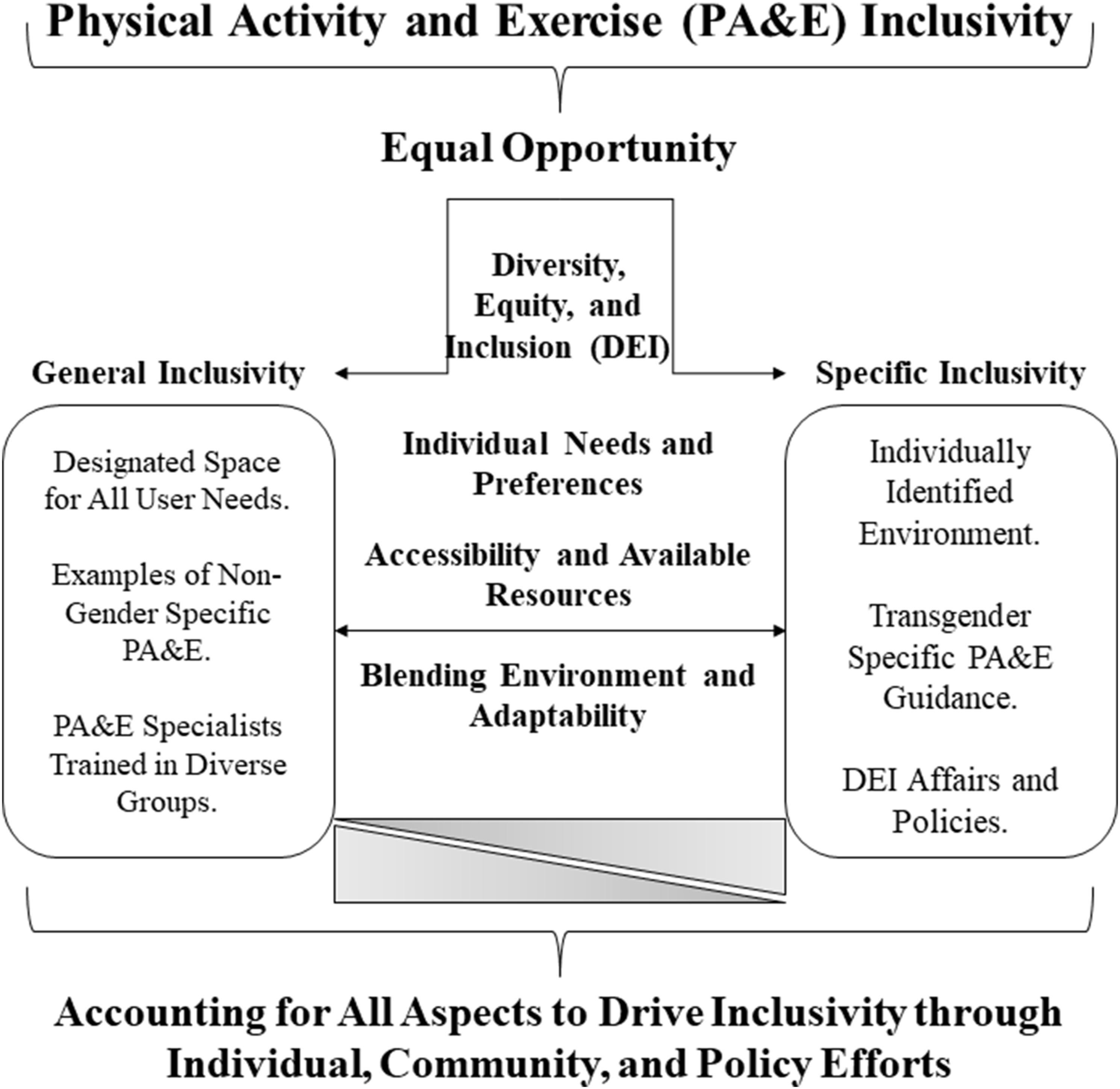
Offering information from physicians and other care providers for transgender individuals via continuing education courses and workshops focused on transgender inclusion in fitness settings, and providing guidelines, case studies, and best practices can help exercise professionals better understand and address the needs of transgender clients. This may also include adapting and implementing inclusive facility policies that explicitly prohibit discrimination based on gender identity or expression, create gender-inclusive spaces, and ensure that staff members are trained to enforce inclusive policies and respond appropriately to any incidents of discrimination or harassment. The hopes in creating a supportive environment may foster welcoming and affirming atmospheres for all, regardless of gender identity.
If PA&E professionals work closely with a transgender client’s healthcare team, they can ensure that PA&E prescriptions are tailored to the client’s individual needs. This includes the sharing of health information and risks that are unique to the transgender population, and the coordination of care to address any injuries or ailments a client experiences. 25 Additionally, improving community engagement to include locally identified transgender safe spaces that work to advocate for the needs and preferences of transgender individuals. PA&E professionals can collaborate with these safe spaces to organize events like step challenges, yoga classes, obstacle course races, and more that can promote PA&E and well-being within the transgender community. PA&E professionals should also seek feedback from their transgender clients to continuously improve services, and work to facilitate more inclusive and supportive environments. 26
Conclusion
Overall, promoting the general health of the transgender community requires addressing systemic barriers to healthcare access, providing culturally competent and inclusive healthcare services, and fostering social acceptance and support for transgender individuals. Transgender individuals are at a higher risk for health disparities. 3 Transgender individuals also tend to engage in less PA&E than cisgender people for many reasons, including fear of discrimination and facility members misgendering, facilities not providing safe or inclusive environments, and exclusion or social rejection from facility members and/or staff.11-13 As a result, the health of transgender individuals can suffer even further.
PA&E have been proven to improve the health of everyone, regardless of age, health status, sex, or, importantly, gender. It is important to strive for individual, community, and policy-level changes in fitness facilities and initiate training programs that not only provide safe opportunities for transgender people to be more active, but also allow for all facility members to feel equal and welcome.23-26 This helps to create an open environment for people and allows transgender people more opportunities to improve their health. It is not just about improving health, it is about saving lives, and in a marginalized group that is suffering from discrimination, it is important that action be taken immediately.
Limitations
The authors use terminology referring to the transgender community as a whole, but the information presented is targeted at transgender adults. While some of the information presented could apply to transgender youth and adolescents, this piece is focused on the importance of establishing inclusive and diverse education of PA&E professionals such as personal trainers, and those working in exercise facilities that are largely populated by adults. Authors also recognize the current political attacks against the transgender community, and while unable to fully unravel all the harm being done in this perspective, we recommend further action continue to be taken to share information to help protect the transgender community.
Footnotes
Acknowledgments
We would like to acknowledge those who make an appreciable and positive impact on the transgender community, specifically the working groups organizing efforts to improve health and well-being through equitable physical activity and exercise engagement.
Author Contributions
EDS and JRS were responsible for conceptualization, drafting and revising of this Perspective, and preparation of this Perspective for submission to the American Journal of Lifestyle Medicine. EDS and JRS both approved the final submitted version.
Declaration of Conflicting Interests
The author(s) declared no potential conflicts of interest with respect to the research, authorship, and/or publication of this article.
Funding
The author(s) received no financial support for the research, authorship, and/or publication of this article.
