



Abstract
Guided imagery is a mind-body technique that involves the controlled visualization of goals, behaviors, and desired outcomes. This secondary analysis aimed to identify themes in guided imagery scripts for the self-regulation of diet and stress management by overweight and obese women who were trying to lose weight. The guided imagery scripts were developed with the participants using prompts to elicit evocative emotional and sensory terms and phrases. Directed content analysis from 40 participants (21 to 51 years of age) was performed by 2 independent coders to develop a coding scheme, reach consensus, and identify major themes. Results showed 4 second-order themes for both stress reduction and food cravings. Major qualitative themes for stress reduction were imagined “special” places, body sensations and sensory descriptors, cognitive processes, and emotions. The four food cravings themes were foods and food types, body sensations/sensory descriptors, cognitive processes, and emotions. These results provide a framework for health care practitioners to develop simple to use guided imagery scripts to help women regulate stress and dietary behavior. Recommendations are made about how guided imagery techniques can be delivered in-person or digitally by nutritionists, psychologists, or health educators.
“The use of guided imagery in fMRI studies has great potential to advance a mechanistic understanding of overweight and obesity.”
Introduction
Guided imagery is a mind-body practice that involves visualizing events, experiences, and behaviors using emotions and all 5 senses. 1 It is often used by practitioners for healing, the treatment of specific conditions, coping with pain, and is often combined with breathing exercises for stress reduction. 2 Guided imagery is used widely in sport settings as a way to prepare for competition, learn new skills, and to cope with pre-competition anxiety. 3 This technique is used in rehabilitation settings to help patients imagine desired movements that were lost due to injury or illness. 4 National surveys in the United States have shown that about 2% of adults, or approximately 6 million people use guided imagery. 2
Randomized controlled trials (RCT) have shown that guided imagery positively impacts 4 of the 6 pillars of lifestyle medicine: 5 nutrition, exercise, sleep, and stress management. 6 Guided imagery has been shown to increase motivation towards physical activity, 7 modify diet and food cravings, 8 and help individuals cope with stress. 9 Like mindfulness, guided imagery has been shown to increase awareness of health behaviors and to help individuals understand how and why they eat certain foods.10,11
Our team reported results of an RCT that used guided imagery for the self-regulation of stress and food cravings with women trying to lose weight. 12 The guided imagery scripts were created with each participant in person after pre-testing and were individually tailored. This secondary analysis aimed to identify themes for the self-regulation of diet and stress management by overweight and obese women who were trying to lose weight.
Method
The printed scripts were included in a workbook to be used by the participants during the intervention. The guided imagery scripts were 150 to 400 words. Participants were instructed to read each script at least once daily for 35 days.
Participants
Forty-eight women were enrolled in the study but complete guided imagery scripts from 40 women (21 to 51 years) were analyzed. The sample was predominantly (90%) Caucasian.
Procedure
Two personalized guided imagery scripts were created that focused on stress reduction and food cravings, respectively. Although a standardized physical activity script based on previous research was also used, it was not personalized.
12
Hence, only the stress reduction and food cravings scripts were analyzed for this sub-study. Examples of prompts used to develop the stress reduction and food cravings script are as follows: Please describe your thoughts, feelings, and images of a time that you were very relaxed. Provide as much detail as you would like. Feel free to use or edit any sentence or section below. This is a mental imagery experience of you being calm, in control of your thoughts and feelings, and relaxed.
Similarly, the food craving script began with the following prompt: Please describe your thoughts, feelings, and images of a particular food or foods that you frequently crave. Provide as much detail as you would like. Feel free to use or edit any sentence or section below. This is a mental imagery experience of you craving and/or consuming a particular food(s).
Participants were encouraged to describe body sensations, sensory and emotional terms, and self-regulatory cues.
Data Analysis
The qualitative approach used in this investigation was based on a pragmatic research philosophy.13,14 Pragmatic researchers typically use multiple or mixed methods of inquiry as was the case in our previously reported RCT and this qualitative secondary analysis. Two data coders independently conducted a directed content analysis of the guided imagery scripts.
15
The decision to use directed content analysis was based on previous theory and research on the emotional and sensory aspects of mental imagery.
1
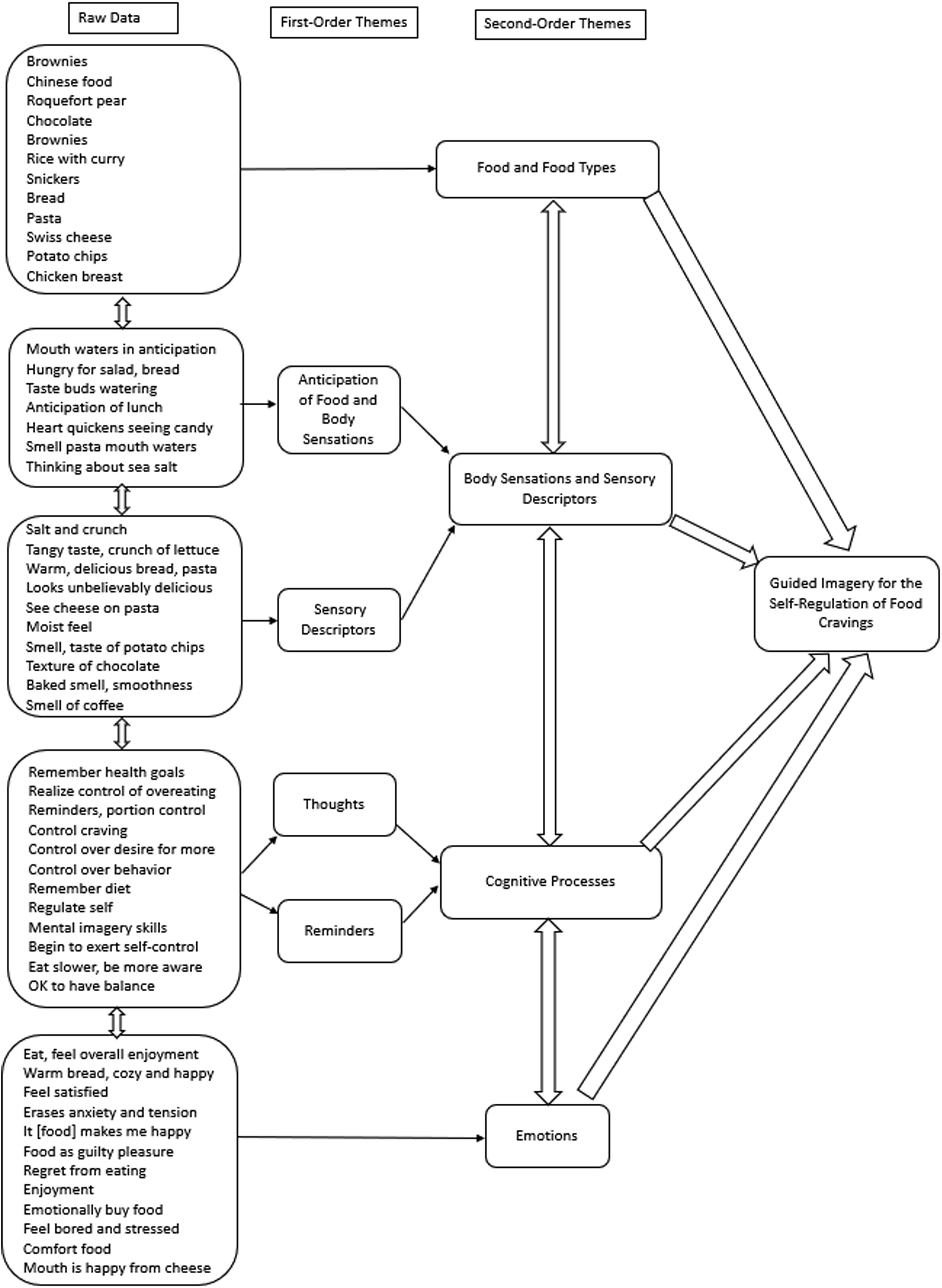
After independent coding, the coders met with the first author to discuss emergent themes, compared patterns across the scripts, and discussed discrepancies. The codes are shown as second-order themes in Figures 1 and 2. Standards for Reporting Qualitative Research (SRQR) guided this study.
16
Thematic analysis of stress reduction scripts. Thematic analysis of food cravings scripts.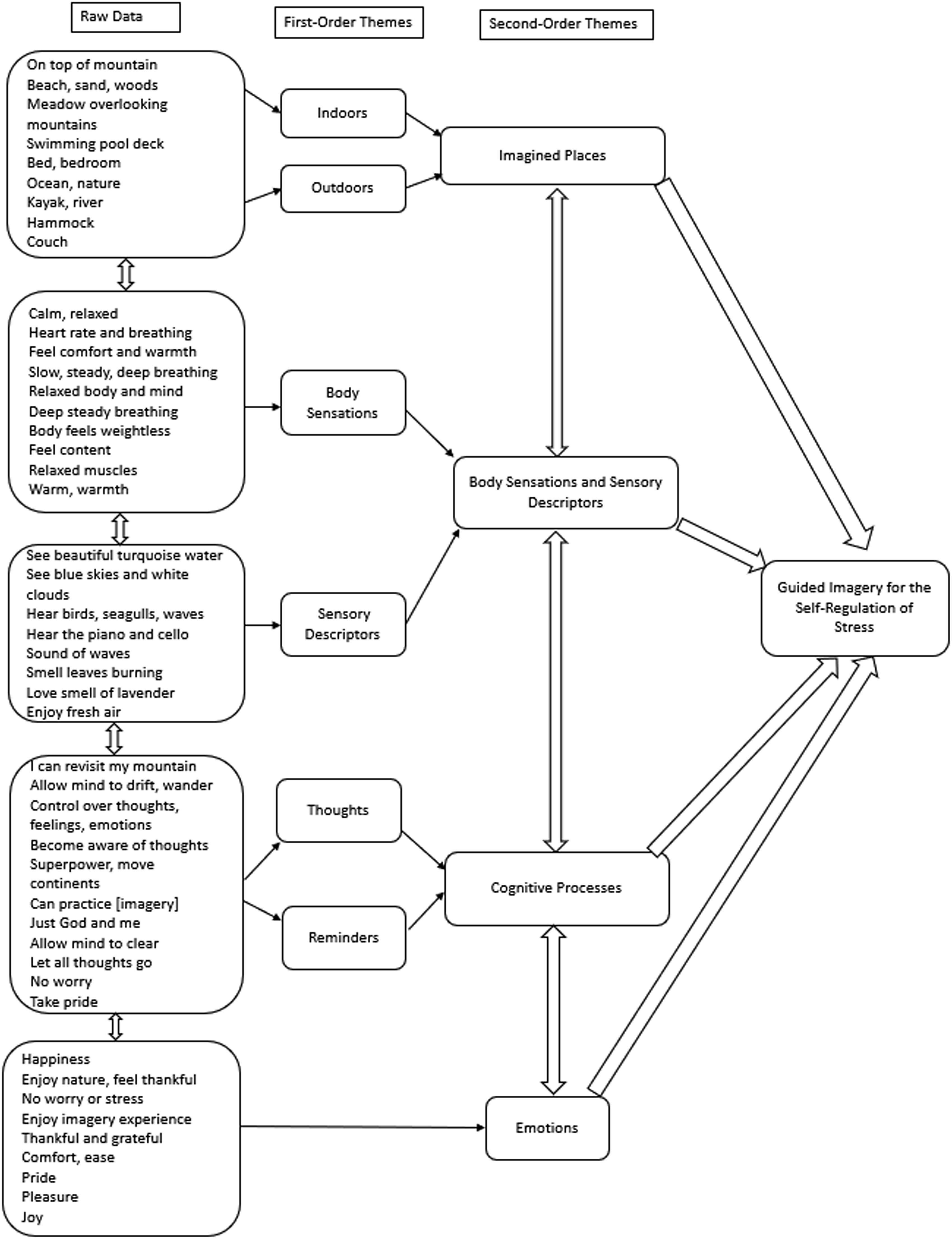
Results
Figure 1 shows results of the analysis of the stress reduction scripts. The double arrows between each of these second-order themes show interrelationships between the themes. For instance, body sensations, sensory descriptors, and emotions were elicited when participants described imagined places.
Imagined Places
Participants described “special” places, natural surroundings, or home spaces that they found comforting. They described scenes on the beach or other natural outdoor settings while some described places in their homes. One participant stated “I am sitting on top of a mountain,” while another stated “I am praying in the morning sitting on my couch in my living room with nobody around and it is quiet and peaceful.”
Body Sensations and Sensory Descriptors
This theme included a focus on breathing, heart rate, and sense of sound, smell, vision, and olfactory senses along with textures and temperature. Some described feelings of being “soft” and “relaxed.” Links between the second-order themes were observed. In the following quote, the participant described her body sensations: (e.g., “I feel calm and relaxed and take pride in knowing that I can revisit these images anytime that I choose”). Another participant’s script included the following: “I notice the warm surroundings, the color of the water, sand, and my soft skin.” The following quote highlights how descriptions of places were linked to stress reduction, and enjoyment: I vividly see the breaking of the ocean waves onto the surf and this brings about a sense of calmness and tranquility. With each breath I take, the tension in my body releases and I let go of all stress and worries. I feel as if I could drift off into a deep sleep. I am enjoying this moment and feel zoned out from life's daily stress.
The following quote highlights a general sense of “peace,” hearing and smell: I am feeling at peace…I can hear insects and birds and I am just finishing a good conversation with my good friends and taking a moment to rest and take it in. I can smell the smell of rain and freshness.
Cognitive Processes
This theme included thoughts (e.g., “I allow my mind to slow down”) and reminders (e.g., “I can revisit my mountain anytime that I choose”). The use of guided imagery for the self-regulation of stress was apparent as one participant stated “I am in control of my thoughts and emotions and my mind is at peace. I feel assured that I can revisit this state of calmness anytime that I choose” while another stated “I give myself permission to take this time to be peaceful in this state.”
Emotions
Positive emotional states and thankfulness emerged in the stress reduction scripts. These included “My heart is peaceful. It makes me happy” while another stated “I am enjoying the moment and I allow my mind to relax and be quiet.” Another participant referred to herself in the second person: “As you become more and more relaxed, you realize how happy you feel and how relaxed your muscles have become.” The quote below demonstrates how close guided imagery experiences are to mindfulness.
17
I’ve never felt so content and thankful and grateful to be in this beautiful place. This special place is stress and worry free and I greatly appreciate being in the moment…in the here and now with absolutely no worries or stress. My body feels weightless and soft and perfect. The muscles throughout my body are releasing all tension. I fully accept all the feelings in my body.
Figure 2 shows themes from the food cravings scripts. Food types were considered easily understood so they are only presented to describe links between foods and the other remaining second-order themes.
Body Sensations and Sensory Descriptors
Body sensations and sensory descriptors were elicited in anticipation of, or eating, specific foods (e.g., “When I smell pasta cooking my mouth waters as I think about the buttery taste).” Two other participants offered the following “My taste buds are watering in anticipation of the first bite” and “My mouth begins to water as I begin to remember how satisfying ice cream, cookies, and chocolate are…My heart starts to race.” Olfactory and the physical sensation of food crunching were also observed (e.g., “I feel like I can smell when I eat Snickers…I like the colors. I like the crunch”). Links between the second-order themes were also observed (e.g., “My mouth waters when I think about Snickers. My heart quickens when I see the candy in the vending machine sitting there waiting for me and smiling”). The struggles with food cravings were apparent in the following: “I just want it [cake] with every part of my being even if I am watching TV or reading it’s still in my mind and I need to eat it.”
Cognitive Processes
This theme included thoughts related to control over-eating and reminders about one’s health goals (e.g., “I remember my diet, exercise, and health related goals…and realize that I can control how much I eat. Stop when full and exert control”) and also reflected links with emotions (e.g., “I take pride in knowing that I can control my appetite and portion sizes anytime that I choose”). The struggles with food and guilty feelings was apparent in this quote: After the first brownie, I realize that I have eaten enough and I can control my desire for more in order to minimize that guilty feeling…I realize that I am not good at moderation when eating sweets…The urge of going to get another one is the dilemma and failure.
The participants use of guided imagery for the self-regulation of food cravings was observed (e.g., “As I imagine myself eating these foods, I realize my health goals and that I can control how much that I eat with my mental imagery skills”). The following quote highlighted a reminder about guided imagery practice: I can control what I do in this present moment and that’s enjoying the company of my friends instead of going up for another serving…I also realize that I can use mental imagery to manage my food craving and diet anytime I want.
Emotions
This theme reflected the enjoyment of food, how food could be comforting (e.g., “Brownies…are fulfilling and comforting…the smooth silk sensation erases all anxiety and tension”). The challenges of food were also apparent (e.g., “After eating the chips I quickly think why I did this…they make me feel warm and comforted”). The guilt associated with food was clear in one participant’s script (e.g., “After consuming the food, I felt guilty…I also felt guilty because the boys had also eating the unhealthier foods”). Another participant’s script included her craving for multiple sweets and a range of emotions: When I am in an emotional state I think about eating sugary foods…These emotions could be excitement, happiness, sadness, stress, or anxiety…When I take a bite of the food things slow down: my emotions regulate. Instead of being excited, sad, or anxious my emotions are dulled and things become more balanced…After I eat these foods I can relax.
Discussion
The clinical use of guided imagery is limited but this health behavior technique can be useful for weight loss and stress management by health care practitioners. 18 This study revealed an understanding of evocative emotional terms and demonstrated how specific places in the stress script and craved foods were linked to body sensations, thoughts, and emotions. The participants’ narratives provided a framework for clinicians who wish to maximize the use of guided imagery with personalized scripts that make the experience more vivid.
Imagery vividness and heightened awareness of one’s senses, emotions, and body sensations are considered key determinants of the impact of guided imagery on behavior. 19 That said, the present sample was predominantly Caucasian and the results here may not generalize to other racial or ethnic groups or men. It is also important to point out that there are differences in food sensitivity between those who are overweight or obese as compared to normal weight individuals in neural responses to food cues as shown in fMRI studies. 20 The use of guided imagery in fMRI studies has great potential to advance a mechanistic understanding of overweight and obesity.
There is great flexibility in the application of guided imagery in health education and clinical settings. This technique can be delivered in-person, by phone, digitally using audio recordings, and on social media thus offering tremendous potential reach in future interventions. Dieticians, psychologists, and those who treat obesity related conditions could use our findings to create standardized scripts or individually personalize scripts for each patient to self-regulate stress and food cravings.
Footnotes
Declaration of Conflicting Interests
The author(s) declared no potential conflicts of interest with respect to the research, authorship, and/or publication of this article.
Funding
The author(s) received no financial support for the research, authorship, and/or publication of this article.
