



Abstract
This study examined self-reported exercise time of day and psychosocial/behavioral correlates in a cohort of young adults previously enrolled in a randomized controlled weight management trial. An online survey was distributed to participants of the trial 2 years after conclusion. Questions assessed physical activity (PA), PA self-efficacy, sleep parameters, and BMI. One item assessed exercise timing: “During the last 7 days, I tended to exercise in the…” Response options included: Early morning (04:00-08:59
“Evening exercise was associated with greater MVPA and PA self-efficacy in a small, convenience sample of young adults previously enrolled in a weight management trial.”
Background
Scientific interest in the timing of physical activity (PA) and its potential relationship with health outcomes continues to grow. To date, evidence supports links between PA time of day and several behavioral and health outcomes, including weight,1-5 cardiometabolic risk factors,2,6-11 sleep parameters,12-15 and total PA volume.16,17 However, evidence is mixed as to whether morning physical activity, vs other times of day, is most beneficial for health. 18 For example, some cross-sectional 1 and intervention studies3,4 have reported morning activity as being optimal for weight loss, while other observational studies suggest evening activity may be better. 2 Furthermore, one large cross-sectional study reported morning PA was associated with cardiovascular risk in men only, 6 indicating the potential for differential effects of PA timing by outcome, as well as by sex.
Despite mixed evidence to-date, researchers maintain that morning exercise is likely to provide substantial benefits, particularly in the context of weight loss. Per a model put forth by Schumacher et al. 19 consistent morning exercise may be beneficial for weight loss among those with obesity. Specifically, consistent morning exercise leads to unconscious processes such as greater self-regulation, habit formation, and reduced complexity of planning for exercise sessions, leading to greater engagement in PA, and ultimately weight loss. 19 We propose that self-efficacy, a conscious reflective process, may also mediate the relationship between activity timing and total PA via similar mechanisms. Self-efficacy is promoted most effectively through mastery experience. 20 The mechanisms posited by Schumacher (i.e., self-regulation, habit, planning) lead to greater follow-through with planned engagement in PA, which in turn promotes opportunities for mastery experience. 21
While Schumacher et al. 19 describe mechanisms that are general to all adults with obesity, we propose that young adults (i.e., ages 18-35) with overweight/obesity are a particularly important and understudied population in the context of PA timing. First, obesity is increasing in prevalence among young adults, 22 indicating the importance of this period for behavioral intervention. Second, young adults are experiencing shifts to earlier chronotypes beginning at about age 20,23,24 which may promote circadian dysregulation when combined with psychosocial factors common to adolescents and young adults (e.g., evening social opportunities, academic pressures). 25 Morning PA in young adults has been shown to entrain circadian rhythms to earlier sleep-wake cycles, likely through morning light exposure, and earlier sleep-wake cycles are protective against circadian misalignment. 26 Third, young adults are also experiencing socio-cultural shifts in responsibility and autonomy.27,28 For example, almost 20 million young adults in the US are enrolled in higher education. 29 Young adults attending college/university may be particularly likely to benefit from consistent timing of PA, as many are experiencing novel autonomy (i.e., greater control over their lives/schedules than ever before). Novel autonomy may lead to difficulties planning and/or managing a weekly schedule, ego-depletion, and negative affective states, three issues regular timing of PA is posited to mitigate. 19 Finally, self-efficacy is a key component of developing and maintaining an exercise routine in young adulthood. 30 Thus, if a link between PA timing and improved PA self-efficacy were to be identified, the timing of PA would become a promising behavioral target for improving total PA volume, weight management, and overall health among young adults, with health benefits that continue into later life.
Thus, we designed an observational study to examine self-reported exercise time of day and the relationship between exercise timing and PA self-efficacy in a convenience sample of young adults who previously took part in a weight management trial. Additionally, we examined relationships between exercise timing and other self-reported outcomes previously associated with exercise timing, such as sleep parameters, total weekly moderate-to-vigorous physical activity (MVPA), and BMI. We hypothesized that morning activity, compared with other times of day, would be associated with greater PA self-efficacy and beneficial health outcomes (e.g., greater sleep quality, greater MVPA, lower BMI). To our knowledge, this is the first study to assess the relationship between exercise time of day and PA self-efficacy, and one of few studies to test hypotheses regarding exercise timing and health outcomes among young adults.
Methods
Healthy Body Healthy U
The Healthy Body Healthy U (HBHU) study was a two-site technology-delivered 18-month randomized controlled weight management trial designed for young adults. The trial tested the influence of Tailored health messaging, vs Targeted (i.e., generic) health messaging or Contact Control, on weight outcomes. Results of the trial are published elsewhere. 31 An online survey was distributed 2 years after trial conclusion to a convenience sample of participants that had indicated willingness to be contacted for future studies (N = 107). The survey was approved by the University’s Institutional Review Board and developed and distributed via REDCap software. Of the 107 HBHU participants contacted for follow-up, 38 responded (36% response rate), and 32 provided data on exercise timing. After excluding 1 individual who reported no exercise, the final analytic sample comprised 31 participants.
Study Variables
Sociodemographic data were collected at HBHU baseline (3-6 years prior to the follow-up survey) and included sex, age, academic year, study group, and race/ethnicity.
Exercise Time of day was assessed using a single item, adapted from Schumacher et al.:
15
“During the LAST 7 DAYS, I tended to exercise in the…” Response options were: 1) Early morning (4:00-8:59
PA Self-Efficacy was assessed at follow-up via the validated 5-item self-efficacy for PA scale. 32 Participants were asked: “How confident are you that you could exercise in each of the following situations?” from not confident at all (1) to extremely confident (5) under five conditions (i.e., tired, poor mood, no time, on vacation, bad weather). The PA self-efficacy score had a possible range of 5-25.
MVPA was self-reported at follow-up using the International Physical Activity Questionnaire (IPAQ). 33
Sleep Parameters: Chronotype (i.e., midpoint of sleep) and sleep duration were measured at follow-up via the Ultra Short Munich Chronotype Questionnaire. 34 Sleep onset latency and sleep quality were measured at follow-up using the Medical Outcomes Study (MOS) Sleep Scale. 35 The sleep quality score had a possible range of 10-60.
BMI was calculated from self-reported height and weight.
Statistical Analysis
The sample size was determined using one-way ANOVA power analysis and indicated that 70 participants (five groups) or 54 participants (three groups) were needed to detect a large effect (Cohen’s f = .44) at α = .05 and a power of 80%. 36 The a priori hypotheses were that weekly MVPA, PA self-efficacy, and sleep quality would be highest among morning exercisers, and BMI would be lowest among morning exercisers. Differences in demographic variables (baseline) and follow-up characteristics/behaviors were examined across self-reported exercise time categories using nonparametric tests (i.e., Fisher’s Exact and Kruskal–Wallis tests). Sensitivity analyses were performed combining early morning, mid-morning, and afternoon into one “daytime” category to test differences across an evenly distributed sample with three groups (Supplementary Table 1). Analyses were conducted using RStudio version 2022.07.1. 37 An a priori α-level of P < .05 was used to establish statistical significance. Due to the underpowered final sample, statistical tests should be interpreted with extreme caution.
Results
Characteristics of the analytic sample.
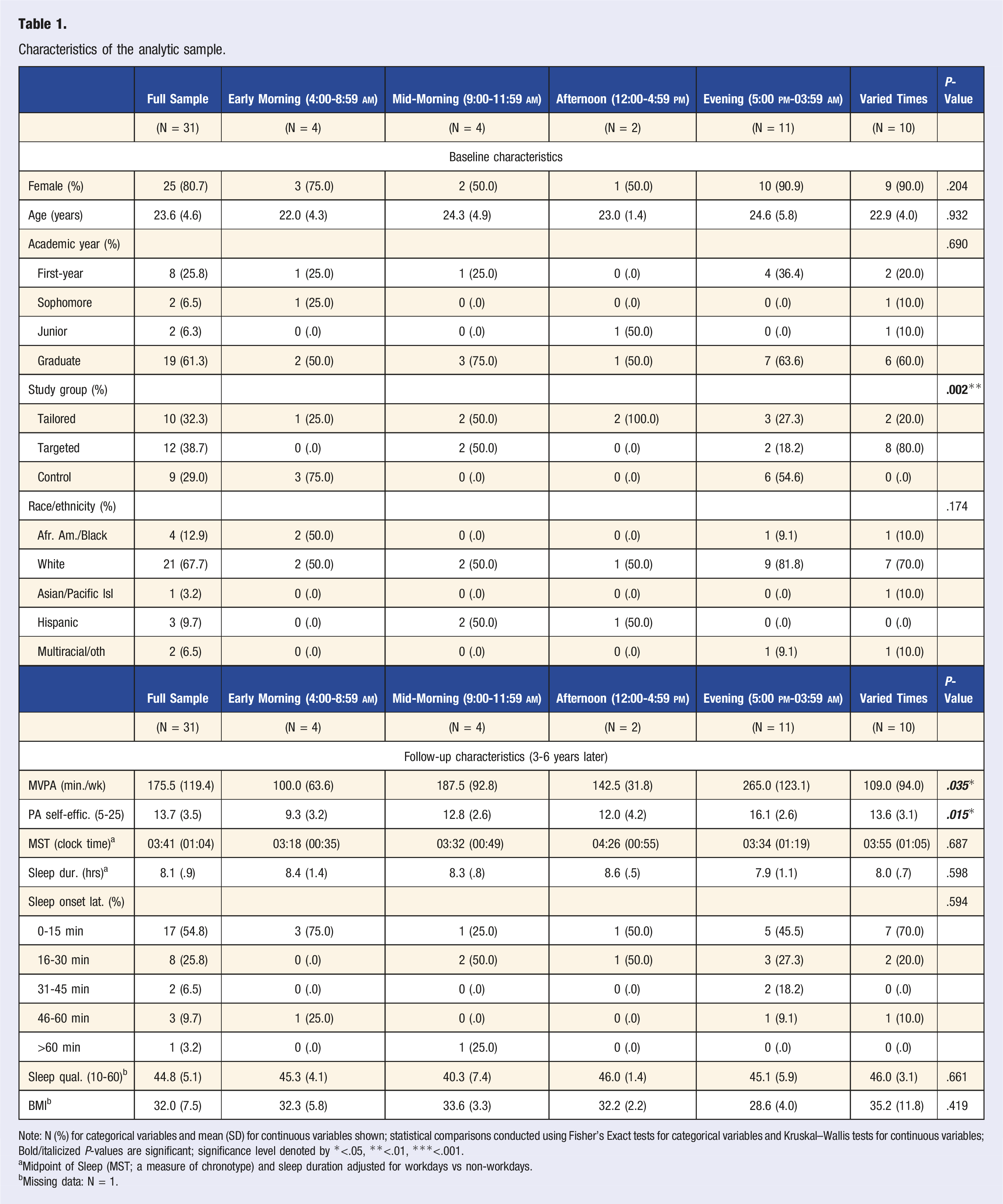
Note: N (%) for categorical variables and mean (SD) for continuous variables shown; statistical comparisons conducted using Fisher’s Exact tests for categorical variables and Kruskal–Wallis tests for continuous variables; Bold/italicized P-values are significant; significance level denoted by *<.05, **<.01, ***<.001.
aMidpoint of Sleep (MST; a measure of chronotype) and sleep duration adjusted for workdays vs non-workdays.
bMissing data: N = 1.
Evening exercise was most frequently reported (N = 11), followed by exercise at varied times of the day (N = 10), early morning and mid-morning exercise (both N = 4), and afternoon exercise (N = 2). MVPA was highest in evening exercisers (265.0 ± 123.1 min/week) compared with early morning (100.0 ± 63.6 min/week), mid-morning (187.5 ± 92.8 min/week), afternoon (142.5 ± 31.8 min/week), or varied times (109.0 ± 94.0 min/week; P = .035). PA self-efficacy was also highest in evening exercisers (16.1 ± 2.6) compared with early morning (9.3 ± 3.2), mid-morning (12.8 ± 2.6), afternoon (12.0 ± 4.2), or varied times (13.6 ± 3.1; P = .015). Further, Control group participants (55%), vs the Tailored (27%) or Targeted (18%) participants, represented the greatest proportion of respondents exercising in the evening (P = .002). There were no observed differences in baseline demographic factors (age, sex, race), sleep parameters, or BMI at follow-up across exercise timing categories (Table 1).
Sensitivity analyses conducted combining early morning, mid-morning, and afternoon into one “daytime” category revealed similar results (Supplementary Table 1). Namely, weekly MVPA and PA self-efficacy remained highest in the evening exercise group (ps ≤ .009). The distribution of study group allocation also remained significantly different across the exercise timing groups (P = .011). Additionally, there was a trend noted where BMI was lowest in the evening exercise group (28.6 ± 4.0 kg/m2), compared with day time (32.8 ± 4.0 kg/m2) or varied times (35.2 ± 11.8 kg/m2, P = .091).
Discussion
The results of our observational study suggest that evening (5:00
Contrary to the findings of others, we did not identify significant differences in body weight1-5 or sleep parameters12-15 across exercise time categories. It is possible that the null findings are due to a lack of statistical power. Several previous studies have reported significant benefits from both morning and evening exercise in terms of weight
38
and total PA volume.
16
For example, a study by Schumacher and colleagues reported that temporal consistency of exercise, regardless of time of day, was associated with greater weekly MVPA. Our study similarly found that individuals who reported exercising at varied times (the second most popular exercise pattern behind evening exercise) reported lower weekly MVPA, supporting the theory that temporal consistency of exercise is associated with greater weekly MVPA. In the study by Schumacher et al., which was conducted among successful weight loss maintainers in the National Weight Control Registry, the majority (48%) of participants that reported consistent exercise times were early morning exercisers (4:00-8:59
To our knowledge, our study is the first to test the relationship between exercise timing and PA self-efficacy in young adults. Due to the small sample size, we were unable to test more complex models, such as PA self-efficacy as a mediator of the relationship between exercise timing and MVPA volume. We suggest that future studies test these more complex models both in young adult samples and other age groups.
While this study is novel, in that it is the first to examine PA self-efficacy in relation to exercise timing in an at-risk young adult sample, several limitations exist. First, our hypotheses were tested in a small convenience sample. Due to the limited sample size and power, statistical tests should be interpreted with extreme caution, and emphasis is placed on the descriptive nature of the findings. Furthermore, in comparison to the full HBHU sample, more follow-up respondents identified as White and graduate student (at baseline). Given the large proportion of White and graduate student respondents, our results may not be generalizable. Despite these limitations, this study provides a framework for others to continue this work in larger, more diverse samples. Second, this study was a cross-sectional design, as all measures were collected at follow-up aside from demographic characteristics, which were collected at baseline. Thus, we cannot exclude the possibility of reverse causality. Future studies can contribute to the literature by testing the proposed temporal relationships using longitudinal data. Third, all follow-up measures were collected via survey and thus are self-report measures, introducing risk of recall and social desirability biases to the data. Additionally, the item used to assess exercise time of day category was based upon one item from a previous study, and future work could focus on further developing and strengthening this item (e.g., adding a second item to indicate how representative the past 7 days were of typical activity behaviors). Finally, we were unable to calculate weight change from baseline to post intervention follow-up, as all weight measurements during the intervention were collected using digital scales, while follow-up weight data was self-reported.
Conclusion
Pending evidence from larger observational studies, evening may be a popular time for exercise among young adults. Evening exercise was associated with greater MVPA and PA self-efficacy in a small, convenience sample of young adults previously enrolled in a weight management trial. These observational results are promising indicators of the potential benefits associated with evening exercise for young adults, and further suggest that morning activity may not be preferred or optimal in this population. Identifying benefits associated with specific activity times, and for specific age groups, can inform future PA guidelines and behavioral interventions designed to prevent chronic disease and maximize health in at-risk young adults.
Supplemental Material
Supplemental Material - Timing of Exercise Among Young Adults Previously Enrolled in a Randomized Controlled Weight Management Trial: An Observational Study
Supplemental Material for Timing of Exercise Among Young Adults Previously Enrolled in a Randomized Controlled Weight Management Trial: An Observational Study by Caitlin P. Bailey, Jingyi Qian, Loretta DiPietro, Melissa A. Napolitano in American Journal of Lifestyle Medicine.
Footnotes
Declaration of Conflicting Interests
The author(s) declared no potential conflicts of interest with respect to the research, authorship, and/or publication of this article.
Funding
The parent trial from which this research was derived was supported by funding from the National Institute of Diabetes and Digestive and Kidney Diseases of the National Institutes of Health under award number R01DK100916 to MAN. Other funding for individual investigators includes K99-HL148500 to JQ. The content is solely the responsibility of the authors and does not necessarily represent the official views of the National Institutes of Health.

Supplemental Material
Supplemental material for this article is available online.
References
Supplementary Material
Please find the following supplemental material available below.
For Open Access articles published under a Creative Commons License, all supplemental material carries the same license as the article it is associated with.
For non-Open Access articles published, all supplemental material carries a non-exclusive license, and permission requests for re-use of supplemental material or any part of supplemental material shall be sent directly to the copyright owner as specified in the copyright notice associated with the article.
