



Abstract
“The review of music on the heart rate emphasizes urgent need for high quality research on effects of music on the heart.”
Introduction
Humans have made music since prehistoric times, when it played a vital role in social life, from healing and ritual to hunting and warfare.1-4 Traces of prehistorical musical practice survive in folk and traditional music in many parts of the world. Neuroimaging and electrophysiological studies in normal individuals as well as in patients with focal neurological lesions, reveal that music can change the state of large-scale neural systems of the human brain. The changes are not confined to brain sectors related to auditory and motor processing; they also occur in regions related to the regulation of life processes (homeostasis), including those related to emotions and feelings, most prominently in the insula and cingulate cortices, in the ventral striatum, in the amygdala, and in certain upper brainstem nuclei. The ease with which music leads to feelings, the predictability with which it does so, the fact that human beings of many cultures actively seek and consume music, and the evidence that early humans engaged in music practices lead us to hypothesize that music had a consistent relation to the neural devices of human life regulation. 5 Hypertension remains the big threat to human lives worldwide and having it under better control with simple, enjoyable, and affordable intervention would be very beneficial to everyone who has elevated blood pressure.
Genetic and behavioral factors do not fully explain the development of hypertension, and there is increasing evidence suggesting that psychosocial factors may also play an important role. Exposure to chronic stress has been hypothesized as a risk factor for hypertension, and occupational stress, stressful aspects of the social environment, and low socioeconomic status have each been studied extensively. 6
At least four in ten U.S. adults (41%) have experienced high levels of psychological distress at least once since the early stages of the coronavirus outbreak according to a new Pew Research Center analysis that examines survey responses from the same Americans over time. 7 The goal of this study was to evaluate the effects of listening to music during blood pressure check in busy primary care settings. To our knowledge it is the first study evaluating the effects of music in a real practice environment. We are hoping that finding of this study will be able to shed some light on the effects of music and promote it as the way to reduce stress and reduce blood pressure, which is a known risk factor for premature death worldwide due to stroke and heart attack.
Methods
Study Design
The study was designed as observational study assessing effects of music listening on blood pressure in the same primary care settings for study subjects and controls. The study was conducted at Kaiser Primary care clinic in Clovis, California, USA and reflected a typical population sample of the local community. Study started on October 4, 2022, and concluded December 14, 2022.
Patients
Patients were ambulatory, community-dwelling men and women, who presented to primary care clinic for clinic visit or medical assistant blood pressure check and met criteria set for the study (the initial blood pressure measurement by medical assistant revealed systolic blood pressure above 139 millimeters of mercury (mmHg) and diastolic blood pressure above 89 mmHg). There were no patients excluded from this study and study was concluded when desired study sample was reached.
Interventions
All patients in the study have had blood pressure measurement repeated within 10-20 min after the initial measurement based on clinic set protocol.
The study group patients were verbally consented if blood pressure could be repeated while the music was playing, and they were encouraged to listen to the music. None of the consecutive patients refused to listen to the music and was excluded from the study.
The Concerto in E flat major solo for alto saxophone and string orchestra, written by Alexander Glazunov in 1934 was used. The piece lasts about fourteen minutes and is played without pause. It is deeply rooted in Romanticism, and has entered the standard saxophone repertoire and had been played worldwide for almost 100 years. For our study, we used up to first 50 seconds of the recording done by saxophone alto player Robert Volkov and recorded on the iPhone. Average duration for listening to the music was 30 seconds and varied depending on the blood pressure measuring cuff size and the time needed to proceed with measurement. Music was turned on exactly at the start of blood pressure measurement.
Results
The data was collected for both groups and summarized below in the tables with separation of groups of female and male patients.
Study subjects.
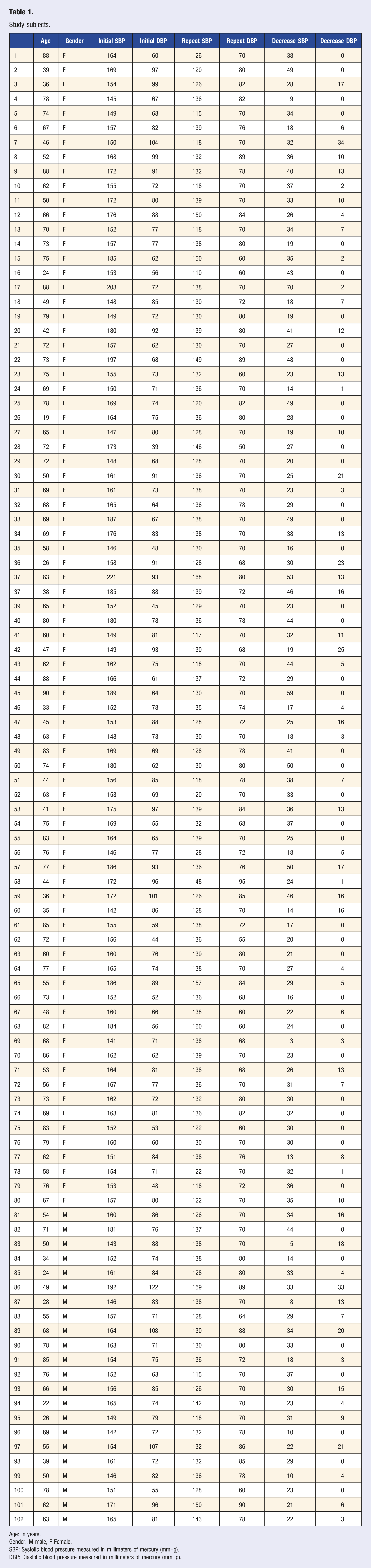
Age: in years.
Gender: M-male, F-Female.
SBP: Systolic blood pressure measured in millimeters of mercury (mmHg).
DBP: Diastolic blood pressure measured in millimeters of mercury (mmHg).
The study patients’ group had 80 females and 54 males. Average age for women was 63 years old with range from 19 years to 90 years. Average age for men was 54 years old and ranging from 22 years to 85 years.
Control subjects.
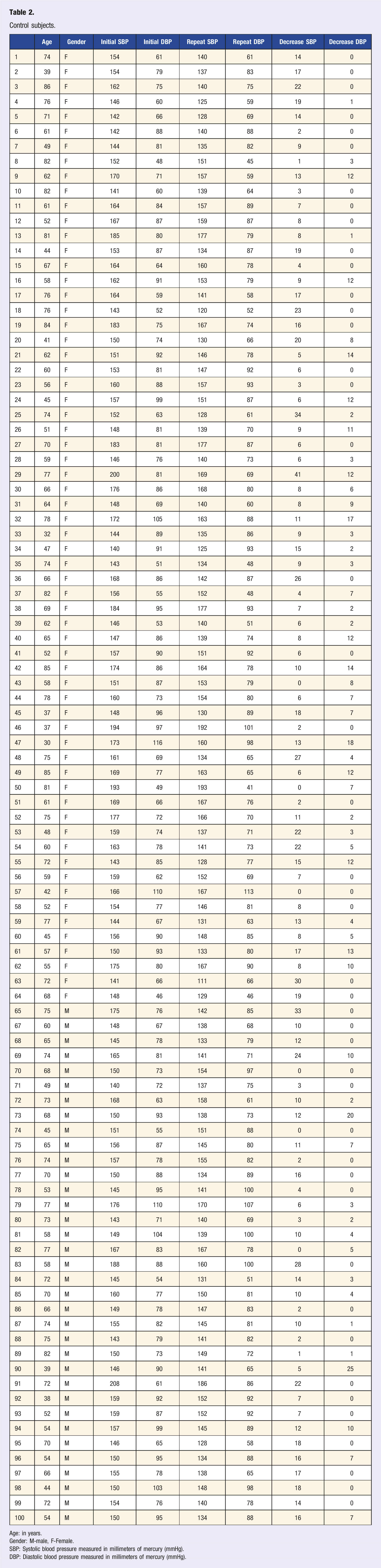
Age: in years.
Gender: M-male, F-Female.
SBP: Systolic blood pressure measured in millimeters of mercury (mmHg).
DBP: Diastolic blood pressure measured in millimeters of mercury (mmHg).
Results analysis.
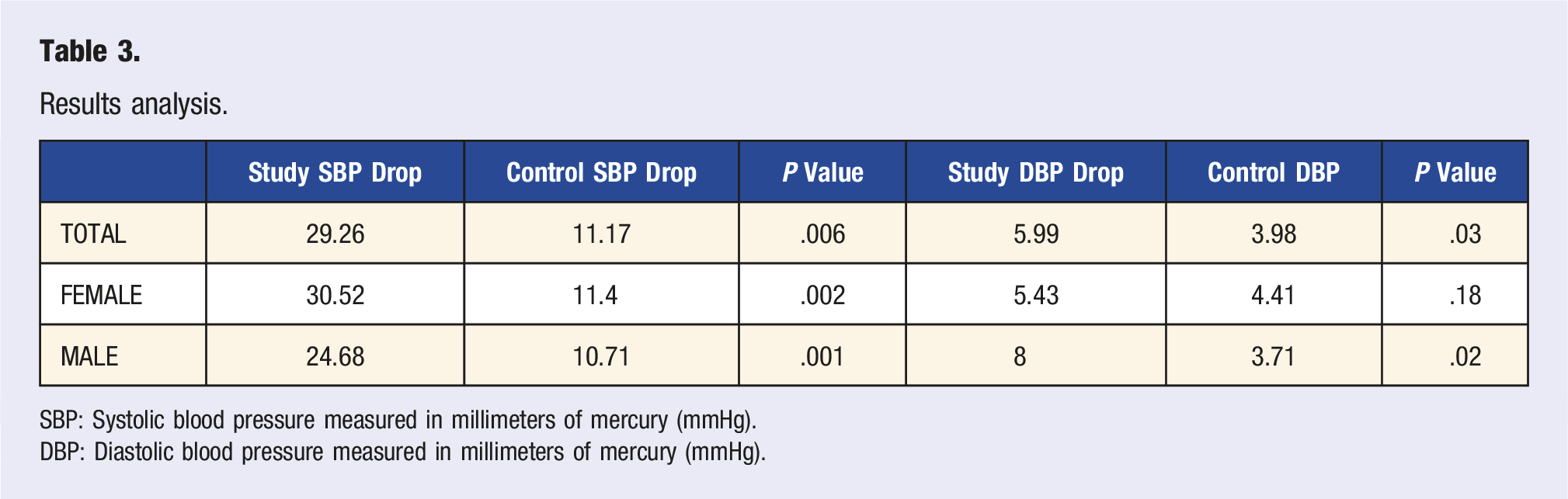
SBP: Systolic blood pressure measured in millimeters of mercury (mmHg).
DBP: Diastolic blood pressure measured in millimeters of mercury (mmHg).
To calculate statistical significance we used google sheets T.Test compare range 1 to range 2 and used two-tailed t-test and type 2 two sample t-test with equal variance. When separated by gender in female group systolic blood pressure drop was 11.4 mmHg (range 0-41 mmHg) and diastolic drop was 4.41 mmHg (range 0-18 mmHg) and male drop in systolic was 10.71 (range 0-33 mmHg) and diastolic was 3.71 mmHg (range 0-25 mmHg).
We noted statistical significance of the drop in systolic and diastolic blood pressure when music was used as an intervention in total group not separated by gender and male patients separately. Female diastolic blood pressure did not have statistically significant drop while systolic blood pressure still dropped significantly.
Female patient has higher than male systolic and diastolic blood pressure drop which can be because female patients are more sensitive to music sound stimuli.
Discussion
It is very intriguing that despite music being used since the beginning of civilization for medicinal purposes we still do not understand how it affects our brain, heart and how it affects blood pressure. The study on hypertensive rats found that classical Mozart’s music improved dopaminergic transmission in the rats’ brain but is not clearly applicable to humans.8,9
Intuitively, music is supposed relax, decrease the anxiety and stress and though those effects low blood pressure. The study on 24 human subjects found the positive for happiness emotional effect of pictures was not as pronounced as emotional effect of music and pictures combined. 10 Systolic blood pressure was reduced significantly in pre-hypertensive young adults in a small, randomized control trial with music therapy. 3 Systolic blood pressure was reduced in older adults with music therapy combined with muscle relaxation with significant effect for systolic but not diastolic blood pressure after 11 sessions of 6 days music therapy trial compared to controlled group. 11
Participants with hypertension with weekly music therapy for 12 weeks were found to have improvement in blood pressure in study patients. 12
When 75 study subjects were listening to classical, jazz and pop music after mental arithmetic task only classical music group had statistically significantly lower post-task blood pressure level. 13
We did use classical orchestra music for our study. It is possible that just sounds of musical instrument relaxing our minds more than sounds of songs which we must process. Another 2 reviews we found were confirming antianxiety effects of music. Group of students were presented with stress and effects of music were noted to decrease anxiety, blood pressure and heart rate during the stress. 14 Cochrane library meta-analysis found that music listening may have beneficial effect on preoperative anxiety. 15
The review of music on the heart rate emphasizes urgent need for high quality research on effects of music on the heart. 16 Music was also found to improve athletic performance and widely used during exercise and sports training. 17 Olympic swimming team USA gold-medal champion Caeleb Dressel attributed his win to drum music beat he plays on his drums and uses it to swim faster.
Lifestyle modifications are well-known to improve blood pressure control and routinely recommended in general practice since dietary approach to stop hypertension study was published more than 30 years ago.18,19 When listening to music scale was added to the lifestyle changers in randomized controlled trial it led to adjunct benefit of reduction of blood pressure in pre-hypertensive adults. 20
Our study is the first study done in not academic busy primary care clinical practice found statistically significant effect on less than one minute listening to solo classic alto saxophone music on reduction in blood pressure. Most likely effects are related to relaxation and decrease in anxiety. Due to Covid19 pandemic and severe increase in stress in general population this inexpensive and not time-consuming intervention in every clinic can provide tremendous benefit not only in reducing blood pressure but also in improving experience while visiting clinic. We suggest that classical music (e.g., music by W.A. Mozart) should be played in the waiting rooms even before patient’s blood pressure check. Easily found online professional recording of the A. Glazounov’s Concerto alto saxophone music can be also used and no more than one minute needed to play it for blood pressure check.
Limitations
This study has several limitations. First, we did not randomize our patients and the study and control sample were selected consequently. Second, we did not include race in our study. Third, our study did not evaluate the effects of music on age subgroups. Fourth, this study was limited to one clinic and represented only the sample of one local community population.
Conclusion
This is the first study in busy primary care clinic which demonstrated statistically significant decrease in blood pressure when it was measured while solo saxophone music piece A. Glazounov’s Concerto was played for less than one minute during blood pressure repeat measurement and compared to control group which had blood pressure measured in the same clinic during the same time frame without music. We hope that this study will help to implement classical music listening to clinic waiting rooms and blood pressure check areas and will help to reduce blood pressure burden and its well-known negative sequels. We also believe that more studies need to be done to research if music listening at home will help with blood pressure reduction in hypertensive patients in addition to lifestyle changers and stress reductions.
Footnotes
Author’s Note
Certified diplomate of American Board of Internal medicine, Certified diplomate of American College of Lifestyle Medicine.
For requests of the free file A. Glazunov’s Concerto recording by Robert Volkov used in this study we can be contacted by mail or email
We dedicate this study to a wonderful musician and music teacher, Mr. Steve Daily who brought music to our lives and continues to teach music to school children.
Declaration of Conflicting Interests
The author(s) declared no potential conflicts of interest with respect to the research, authorship, and/or publication of this article.
Funding
The author(s) received no financial support for the research, authorship, and/or publication of this article.
