




Abstract
Certification in lifestyle medicine demonstrates that a physician has achieved a high level of knowledge, abilities, and skills in this area of specialization. Since the American Board of Lifestyle Medicine (ABLM) began certifying physicians in 2017 through January 2022, about 1850 U.S. diplomates have emerged, with an additional 1375 physicians certified in 72 countries in partnership with the International Board of Lifestyle Medicine. Certification by the ABLM is not only a source of personal pride and accomplishment, but facilitates practice growth, employment opportunities, leadership roles, career satisfaction, and credibility among consumers, the public, payors, and within health systems. In this commentary, we make the case for certification as an integral, and logical, corollary to the explosive growth of the lifestyle medicine as an increasingly relevant, and essential, part of mainstream medical practice.
Keywords
Patients and families are empowered to adopt and sustain optimal lifestyle behaviors to address current disease, as well as reduce the incidence and severity of future disease.
A misconception may occur when physicians and others who are unfamiliar with the field hear the phrase “lifestyle medicine.” Is it a new medical fad? Is it a corporate wellness program? Or is it just a catchy phrase for promoting wellbeing, stress reduction, and avoiding burnout?
Lifestyle medicine is an evidence-based field that leverages health behavior change as the foundation for treating the underlying cause of lifestyle-related chronic disease, 1 in contrast to a first approach of managing signs and symptoms with high-cost medications and procedures.
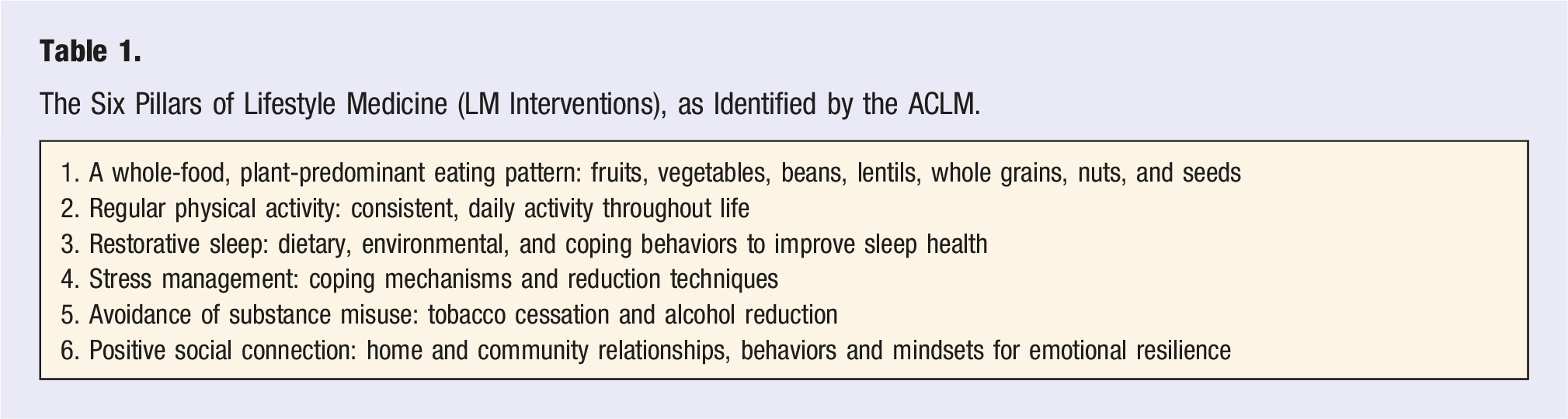
The American College of Lifestyle Medicine (ACLM), founded in 2004, provides education and certification to physicians and other clinicians who advocate for lifestyle medicine as a transformative and sustainable foundation for health care. According to ACLM, “Lifestyle medicine is the use of evidence-based lifestyle therapeutic intervention—including a whole-food, plant-predominant eating pattern, regular physical activity, restorative sleep, stress management, avoidance of risky substances and positive social connection—as a primary modality, delivered by clinicians trained and certified in this specialty, to prevent, treat and often reverse chronic disease.”
The Six Pillars of Lifestyle Medicine (LM Interventions), as Identified by the ACLM.
Top Ten Leading Causes of Death in the US—Conditions That Can Be Treated or Prevented by LM Interventions (annual deaths in US 2020) a .
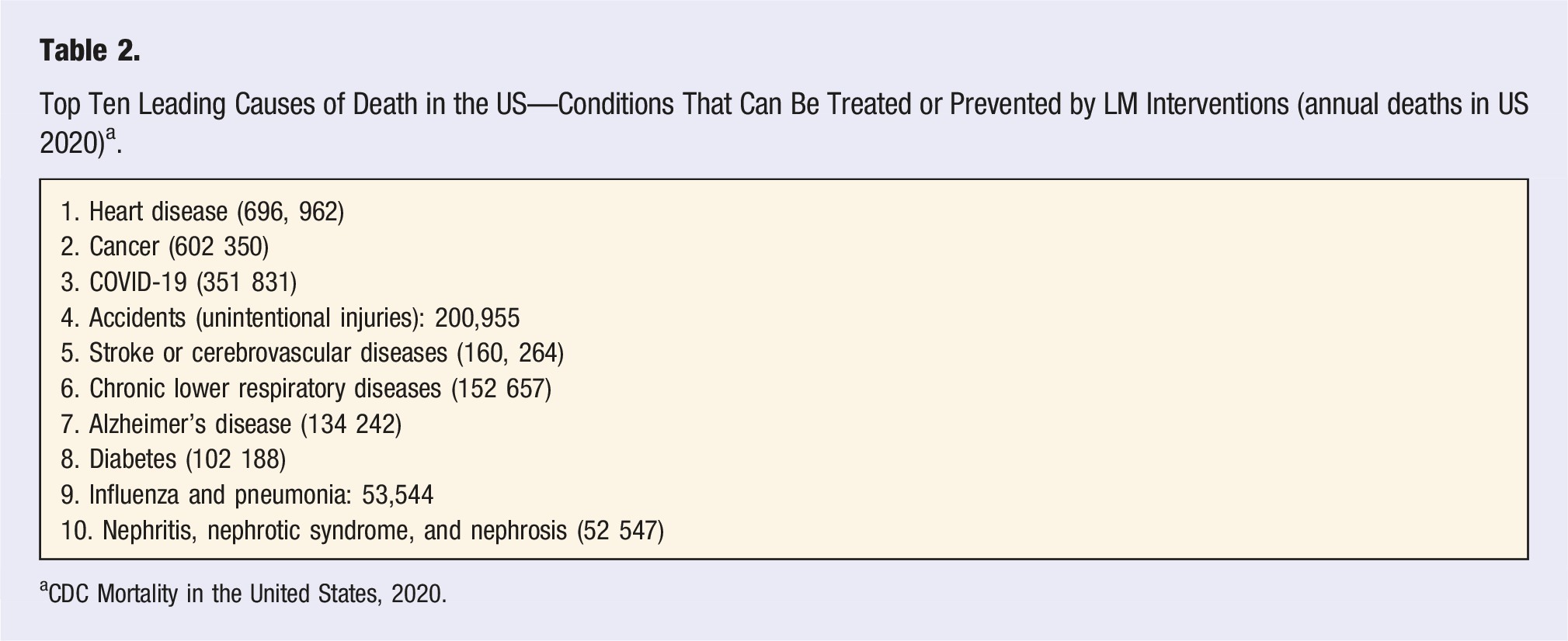
aCDC Mortality in the United States, 2020.
Medical leaders across a variety of health settings, including major systems, 9 have increasingly expressed interest in the critical role of lifestyle medicine in health care. Many clinical guidelines for treating and managing chronic disease identify lifestyle changes as a first-line intervention, or as an adjunctive intervention to medicine or surgery.10-12 However, because physicians receive little or no training on subjects like nutrition and physical activity, and because restrictions in traditional health care delivery models limit appointment time and reimbursement for lifestyle behavior interventions, these guideline recommendations are often not effectively implemented.
Moreover, even if the importance of lifestyle is recognized, and knowledge is gained in critical lifestyle medicine domains such as nutrition and physical activity, clinicians often have little to no experience or training in how to facilitate sustainable behavior change with fundamental techniques that include readiness to change assessments, motivational interviewing, cognitive behavior therapy, and positive psychology.
Lifestyle Medicine vs Preventive Medicine
One frequent question is how lifestyle medicine differs from preventive medicine. While there is some overlap, preventive medicine focuses on the health of individuals, communities, and defined populations, with a goal of protecting, promoting, and maintaining health and wellbeing to prevent disease, disability, and death. Similarly, the pillars of healthy behavior (Table 1) can prevent disease, but they go beyond prevention by emphasizing evidence-based interventions to treat and
The appeal and relevance of lifestyle medicine as a field of specialization is apparent from the growing interest in gaining certification through the American Board of Lifestyle Medicine (ABLM). Since the ABLM launched the first certification exams in 2017, the U.S. has 2004 physician diplomates. Some 1375 international physicians from 72 countries have been certified in partnership with the International Board of Lifestyle Medicine (January 2022).
Sometimes branded an emerging field, lifestyle medicine actually recalls the wisdom and knowledge of the healing power of lifestyle changes, such as diet and physical activity, dating back 2500 years to the age of Hippocrates, the Father of Medicine. These ancient truths are now substantiated by high-quality research evidence, such as the relationship between time spent sittings and type 2 diabetes and cardiovascular disease.17,18
Today, against the backdrop of a global pandemic, soaring health care spending and a rapidly-shifting health care landscape that is trending towards an emphasis on high-value care effectively achieving and sustaining improved outcomes, the case has never been stronger for physicians to be trained in lifestyle medicine and to validate this training with board-certification.
High Level of Competence
Physician Core Competency Domains in LM (original) a .
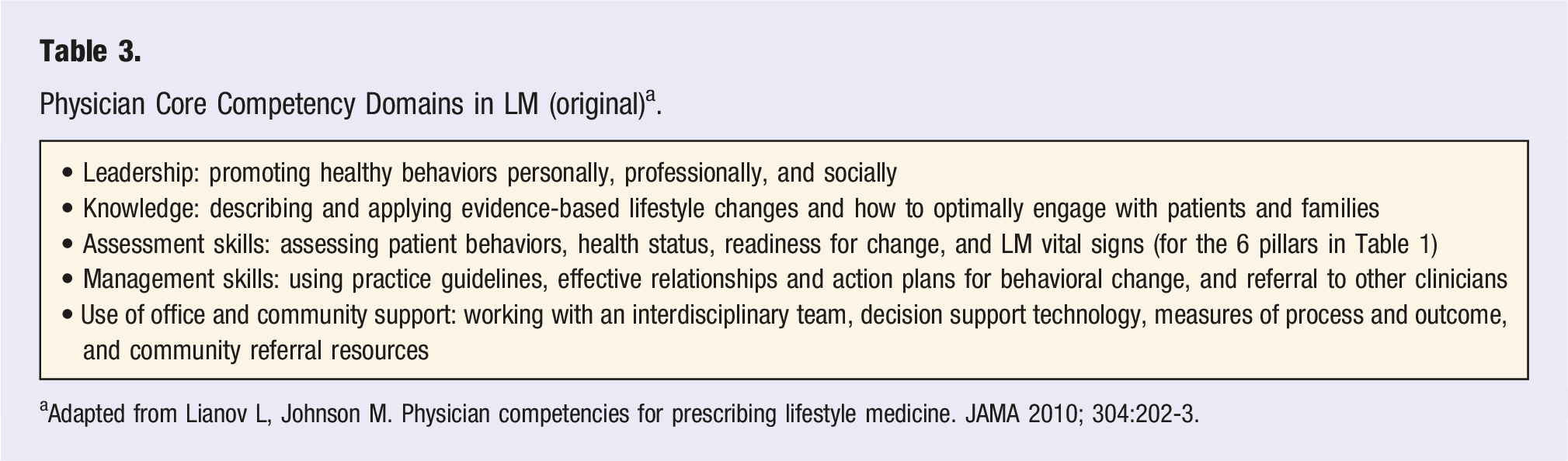
aAdapted from Lianov L, Johnson M. Physician competencies for prescribing lifestyle medicine. JAMA 2010; 304:202-3.
Patients want to feel confident that their physician is among the most knowledgeable and prepared in their field. Lifestyle medicine certification as an ABLM diplomate conveys that a physician knows what they are doing in prescribing and implementing evidence-based interventions to help patients achieve their goals and sustain the benefits.
Physicians certified in lifestyle medicine must not only be board-certified in their primary discipline by the American Board of Medical Specialties (ABMS), but must complete a case study, fulfill online and in-person continuing medical education (CME) requirements, and pass a comprehensive examination. Alternatively, physicians in training may participate in a lifestyle medicine residency curriculum, now integrated into 200 residency programs, and achieve diplomate status after obtaining board-certification by ABMS in their primary specialty. Once becoming an ABLM diplomate, they can maintain their status through the ABLM with ongoing critical assessment of high-impact publications and by acquiring necessary CME maintenance of certification credits through online or in-person courses and events.
More medical schools and residency programs are now incorporating lifestyle medicine into their curricula. Yet, most medical students and practicing physicians still do not receive adequate training in the basics of lifestyle medicine, such as nutrition, despite the World Health Organization recognizing that cardiovascular diseases, cancers, respiratory diseases, and diabetes account for over 80% of all premature deaths. 20 These diseases could be prevented or treated, primarily with improvements to diet and lifestyle. 21
Certification in lifestyle medicine as a diplomate of the ABLM can help physicians showcase their training, needed to move beyond disease management to health restoration, stand out among competitors, and achieve satisfaction in effectively engaging with patients and the health care team to address chronic disease in a sustainable, cost-effective fashion.
Employment Opportunities
Certification in lifestyle medicine could facilitate future employment opportunities as interest in the field grows among health care consumers and systems. This surge in interest makes diplomate status above and beyond ABMS certification in a primary specialty a particularly attractive skill set.
In 2021, ACLM launched the Health System Council (HSC) to support the growing implementation of lifestyle medicine into some of the largest and most innovative U.S. health organizations. The original founding group of 19 health systems has rapidly grown to 70 members (September 2022), employing more than 1 million employees and serving over 30 million covered lives across the nation. Some HSC members are explicitly seeking physicians certified in lifestyle medicine and some are providing additional compensation in recognition of the value of this achievement. As more large systems embrace the value of lifestyle medicine, they are incorporating a preference or requirement for lifestyle medicine certification into job descriptions for desired candidates or even offering additional salary to attract certified clinicians.
Payment Models
Momentum remains steady for a transition from a fee-for-service model of health care to one based on quality and value. With this shift, physicians who are diplomates of the ABLM will be well-positioned to meet new measures that are developed, because they can provide patient outcomes that help reduce the need for high-cost procedures and prescription medications.
As reimbursement models evolve from providing payment for each clinical encounter or procedure to rewarding quality patient outcomes, it is critical that physicians are equipped to make successful, lasting evidence-based interventions. Certification in lifestyle medicine provides the expertise to do exactly that.
Leadership and Career Satisfaction
Since ACLM was founded, it has grown to over 9000 members. There are now 49 sites implementing lifestyle medicine curricula across 82 ACGME-accredited medical residency training programs and more than 95 student-led lifestyle medicine interest groups at 52 medical schools.
The field is rife with opportunity for physicians certified in lifestyle medicine to establish themselves as subject matter experts and leaders integrating lifestyle medicine into their practices, health systems, academic institutions, and communities.
Finally, certification benefits the field of lifestyle medicine by improving quality and standardization. Certification holds us accountable to a higher standard of care and gives our patients the confidence that the lifestyle behavior changes we prescribe and facilitate can have a transformative, lasting effect on their health.
The increasing levels of physician dissatisfaction with their careers and rising burnout rates in the current health care environment demand urgent attention and action. 22 The field of lifestyle medicine, which emphasizes whole-person care, productive physician-patient relationships, and success in treating the root cause of disease, provides a potential route to greater career satisfaction and pride.
Footnotes
Declaration of Conflicting Interests
The author(s) declared no potential conflicts of interest with respect to the research, authorship, and/or publication of this article.
Funding
The author(s) received no financial support for the research, authorship, and/or publication of this article.
