



Abstract
Introduction: This systematic review addresses the effects of n-3 long-chain polyunsaturated fatty acids consumption on human neurodevelopment. It evaluates articles published between 2000 and 2022 investigating the cognitive outcomes during the period of neurodevelopment: from fetal development to adolescence. For the purpose of this review the terms LC PUFA and omega-3 fatty acid will be used interchangeably. Method: Data were sourced from several major databases including PubMed (MEDLINE), Web of Science, and ProQuest Central. Randomized controlled trials (RCTs), nonrandomized controlled trials, prospective or retrospective cohort studies, and observational studies investigating the effects of omega-3 fatty acid consumption from dietary supplements, multiple-nutrient supplement, or food questionnaire on neurodevelopment were considered. Study population was separated in three developmental phases: (1) in-utero, (2) lactation/infancy, and (3) childhood/adolescence. Each article was evaluated for several key factors such as study type, type/dosage of PUFAs, number of subjects, length of intervention, participant age range, population characteristics, outcome measure (both primary/cognitive and secondary/other), results, conclusion, and confounding variables/limitations. Results: A total of 88 articles were included in the review, 69 RCTs and 19 longitudinal or observational studies. The results indicate equivocal effect of intervention, with some short-term benefits observed in the areas of visual attention, working memory, executive function, and communication. Omega-3 supplement might have a short-term positive impact on neurodevelopment in all three phases. Supplementation is recommended throughout life, rather than only during the earliest developmental stage.
Although LC PUFAs supplied during infancy and in-utero seldom have shown significant cognitive effects, it appears that they do not persist at long-term follow-up assessments.
Introduction
As the most lipid-dense organ of the body, after adipose tissue, the brain requires fatty acids for purposes of fluidity, function, and structure. 1 Importantly, neither omega-3 (n-3) nor omega-6 (n-6) long-chain polyunsaturated fatty acids (LC PUFAs) can be synthesized de novo in human cells, meaning that dietary sources are important throughout life, particularly during several key, sensitive periods. Fatty acids affect white matter tracts in terms of myelination and fiber integrity, thereby influencing neural signaling. 2 Among LC PUFAs, docosahexaenoic acid, (DHA; 22:6, n-3) has received the most extensive attention throughout extant research, since it has the highest concentration in the brain; however, studies have also addressed eicosapentaenoic acid (EPA), alpha-linolenic acid (ALA), arachidonic acid (AA/ARA), and the importance of LC PUFA ratios. The frontal lobe, where complex cognitive processes occur, has a high concentration of DHA, which has a significant role in membrane fluidity and signal transmission.3-5
Westernization and the move toward diets with higher percentages of processed foods and lower consumption levels of dietary n-3 sources have led to concerns about population LC PUFA levels. Indeed, estimates of this shift suggest that traditional diets with 1:1 ratios of n-6 to n-3 PUFAs have been replaced by ratios closer to 20:1. 6
Omega-3 Fatty Acid and In-Utero Cognitive Development
The prenatal period is the most frequently cited sensitive period during which n-3 LC-PUFAs are important to cognitive development. Based on epidemiological studies conducted in regions with high levels of fish intake, researchers identified a potential correlation between the maternal consumption of EPA and DHA and factors including gestational length and birth weight. 1
During the third trimester an upsurge of PUFA accretion, primary DHA, in fetal brain matter occurs at a rate of 70 mg per day due to an increased cellular synthesis.1,7 The accumulation of LC PUFAs is particularly important in the frontal lobe and hippocampus, areas associated with higher-order cognitive functioning. 8
DHA supplementation has been previously related to extended gestational length, increased birth weight, and neurodevelopment. 9 Given that the third trimester is a significant period during which PUFAs are deposited in the fetal brain, many studies have attempted to identify deficiencies in or the effects of supplementation on preterm infants. Recently, the attention on the role of DHA in fetal development has been increased, and, in connection with concerns about consuming mercury-containing fish during pregnancy, the consumption of prenatal fish-oil and other n-3 supplements have increased.
Omega-3 Fatty Acid and Cognitive Development During Infancy
Supplementation with n-3 LC PUFAs during the infancy phase of development has its foundation in the longstanding research on the advantages of breastfeeding for cognitive development, and questions regarding whether this is due to the composition of human milk (including DHA), or other demographic factors associated with the decision to breastfeed.10,11 Studies conducted during infancy have highlighted a positive correlation between PUFA supplementation and both cognitive and visual functions due to the PUFA accretion in fetal brain and retinal tissue, Supplementation studies during infancy have largely been focused on DHA, often in combination with EPA and AA, given their role in various neural processes including synapse maturation, processing speed, and the structure of the neuronal membrane.3,11
Omega-3 Fatty Acid and Cognitive Development During Childhood and Adolescence
While the third trimester of pregnancy and first 18 months of life are particularly significant phases of n-3 accretion in brain and retinal tissue, it is important to consider the continued process of cognitive development in early childhood and adolescence, and clarify the neurodevelopmental effects of LC PUFAs in this later phase. Researchers focusing on this age group are particularly driving attention to pathologies that affect cognitive development, including attention-deficit/hyperactivity disorder (ADHD), phenylketonuria, and autism spectrum disorder (ASD).
Review Objective
Omega-3 LC-PUFAs function as cell membrane components, tissue formation and neuroprotection has been largely proved. 12 However, omega-3 supplement effect on neurodevelopment addressed in a large number of studies and reviews have reported controversial conclusions. Therefore, the need of a comprehensive review to extrapolate and evaluate data from studies published in the last 2 decade.
In this review we summaries the finding on the effect of omega-3 supplementation on cognitive development across three neurodevelopmental periods: (1) in-utero, (2) lactation/infancy, and (3) childhood and adolescence. The objective is to evaluate the efficacy of omega-3 supplementation on neurodevelopment in different brain developmental phases from in-utero to adolescence.
Methodology
For the purposes of this comprehensive review, we searched PubMed (MEDLINE), Web of Science, and ProQuest Central, using filters for peer-reviewed articles published between 2000 and 2022. Search terms included: omega-3s; docosahexaenoic acid (DHA); cognitive function; macronutrients; healthy fats; polyunsaturated fatty acids; brain health; developmental outcomes; n-3 polyunsaturated fats; LC PUFAs; dietary fats; and brain function.
Study Selection
Both the authors (DS and AS) were involved in the literature search, screening for eligible studies, and review. After articles were identified, the authors thoroughly reviewed titles, abstracts, and full texts, and selected the included ones according to the inclusion/exclusion criteria. Duplicate were eliminated. To confirm the comprehensiveness of the literature included, the Authors also consulted the reference lists of all articles published in the last 5 years, as well as previous literature review and meta-analysis articles, and used the “cited by” function in a university library database-wide search; additional abstracts were reviewed, and appropriated articles were included.
Inclusion and Exclusion Criteria
The authors defined inclusion and exclusion criteria a priori and included the following study designs: randomized controlled trials (RCTs), nonrandomized controlled trials, prospective or retrospective cohort studies, case-control studies, and observational studies. Only articles written in English published between 2000 and 2022 were included. Studies investigating the effects of omega-3 fatty acid intake from dietary supplements or multiple-nutrient supplement on cognition, or studies analyzing dietary omega-3 intake through a food questionnaire were considered. The populations included were: (i) in-utero, (ii) lactation/infancy, and (iii) childhood and adolescence. Case studies and studies in which PUFAs supplementation was not a primary (or differentiable) independent variable were not considered in this review.
Data Extraction
Included articles were analyzed and data were extracted using a custom data extraction form developed by DS and AS. The outcome of interests for the in-utero population were: communication and language, attention tasks, and visual development. For the lactation/infancy were: communication, intelligence, working memory, attention, and problem solving. For the childhood and adolescence population were: attention and executive functioning, information processing, speeds and impulsivity, memory, and cognitive pathologies.
After publication analysis, we extracted the following categories: study type, LC PUFA dosage and composition, sample number, length of intervention, subjects age, and population characteristics. Study characteristics and outcomes were also extrapolated. We reported: primary and secondary outcome (eg cognitive tests result, memory function, learning test), summary of result and conclusion, study limitation and funding sources.
Results
The literature search resulted in a total of 501 articles. Articles initially excluded were duplicates (n = 120), animal studies (n = 68), studies not focusing on omega-3 (88), studies with non-cognitive outcomes measure (n = 33). We reviewed the abstract of the remaining 181 articles and selected 81 pertaining to neurodevelopment to read in full. We narrowed these to a final set of 71 articles that met the inclusion criteria. To have a more comprehensive review, we expanded the search to the reference list of the included articles and reviewed an additional 34 abstracts of which 17 were included.
Of the 82 included articles, 26 investigated omega-3 prenatal supplementation (8 RCTs, 12 revision of RCTs, and 6 observational studies), 26 investigated omega-3 supplementation during infancy (19 RCT, 4 previous RCTs, and 3 observational studies), and 36 articles investigated omega-3 supplementation during childhood and adolescence (25 RCTs, 7 observational studies, and 4 secondary analyses of previous RCTs).
In-Utero Supplementation
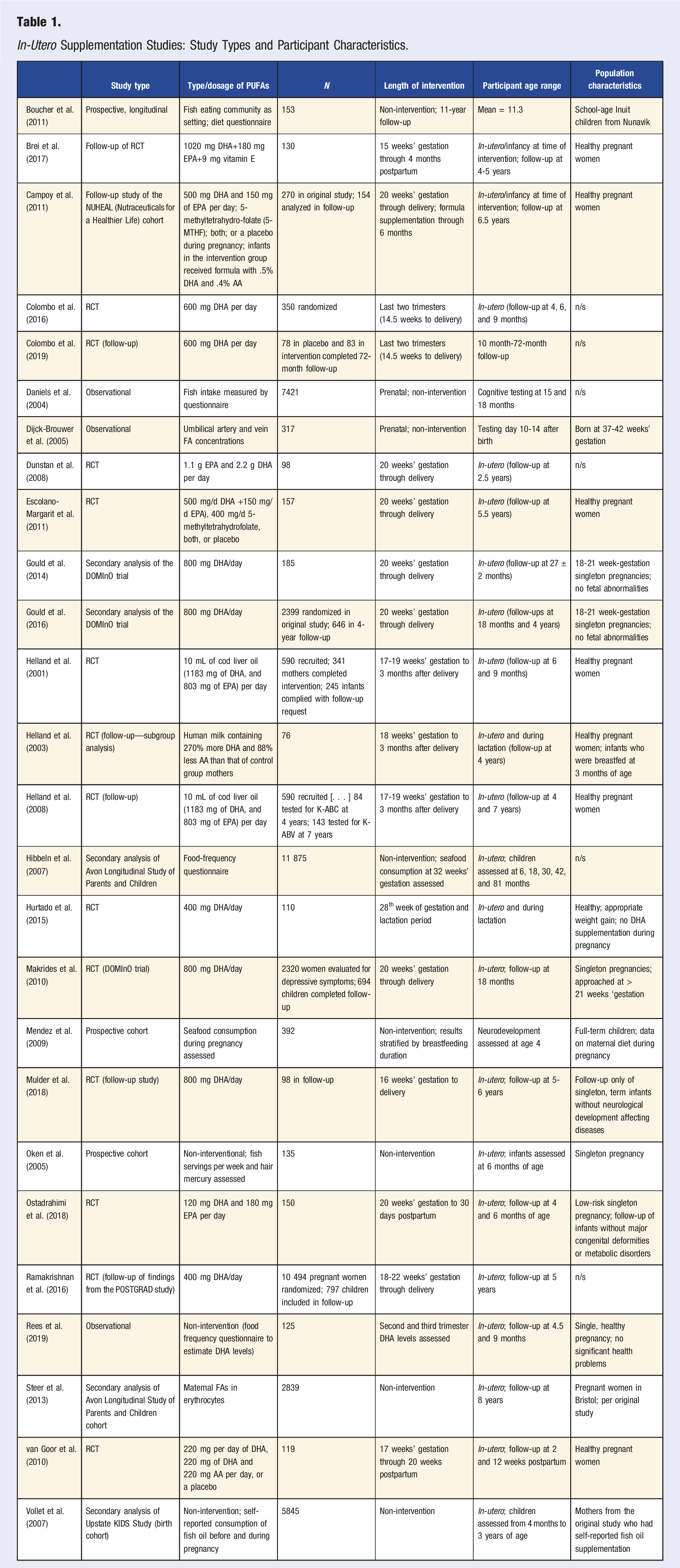
To our knowledge, only two large scale (N > 500) studies have been conducted on humans to assess the cognitive outcomes of n-3 LC PUFA supplementation in-utero: the DOMInO trial, 13 and the POSTGRAD cohort study. 14 Study sample sizes for the remaining included publications ranged from 76 to 350.
The studies included in this review primarily assessed the effect of omega-3 DHA supplementation (n = 9). In the included studies DHA dosage levels ranged from 220 mg to 800 mg per day. Rees et al. also assessed for DHA levels, but via a food frequency questionnaire rather than a supplementation intervention. 15 In the remaining studies DHA was combined with EPA,16-19 and AA. 20 In terms of intervention lengths, the studies reviewed here featured gestational supplementation ranging from week 12 to week 22 of gestation. The studies used a broad range of cognitive outcome measures, with the Kaufman Assessment Battery for Children (K-ABC) appearing most frequently.
In-Utero Supplementation Studies: Study Types and Participant Characteristics.
In-Utero Supplementation Studies: Instrumentation, Results, and Limitations.

Overall, the extant RCTs and RCT follow-up studies that feature in-utero n-3 LC PUFA supplementation have yielded mixed results. The largest study to date, the DOMInO trial (N = 2399; follow-up with 726 children), found that DHA supplementation during pregnancy had no significant effect on either maternal depression levels 6 months postpartum or the children’s mean cognitive composite or mean language composite scores on the Bayley Scales of Infant and Toddler Development, Third Edition (BSID-III). Importantly, these null results are at odds with those of previous epidemiological studies, which the authors noted may have overestimated effect sizes, and those of some smaller studies that have reported positive outcomes.
The studies included in this review that did yield positive outcomes of supplementation focused on communication and language, attentional tasks, and visual development. However, results in those areas are also mixed. Further, most studies that included a long-term follow-up largely reported that, even when positive outcomes were identified at a short-term follow-up, these outcomes often failed to persist at longer-term assessments.
Communication and Language
Several studies that assessed cognitive measures identified positive outcomes of n-3 LC PUFA supplementation and communication and language. The results of an RCT conducted in Iran found prenatal fish oil supplementation to be beneficial for neurodevelopment, but only in the communication domain, among infants at 4 months. 33 Similarly, although Mulder et al. did not report childhood neurodevelopment benefits of supplementation in-utero, the Authors did find higher maternal DHA level to be correlated to higher language scores on the K-ABC at 5-6 years of age. 34 While Colombo et al. found maternal blood DHA to correlate with higher verbal IQ at 5-6 years, this was not the case after controlling for the socioeconomic status. 35
Attentional Tasks
One of the key findings for this cognitive developmental phase is the indication that prenatal supplementation with n-3 LC PUFAs has positive effects on infantile attention. Notably, the results of a large RCT (the Kansas University DHA Outcomes Study [KUDOS]) that assessed visual habituation among 4-, 6-, and 9-month-old infants whose mothers had been prenatally supplemented with DHA, indicate that maternal DHA supplementation correlated with improved performance on sustained attention and behavioral state tests during the first year of life. 36 In a secondary analysis of the DOMINO trial assessing the prenatal effects of DHA on working memory and inhibitory control (WMIC), no difference between the control and the treatment group were observed. 9
While the results of the study by Ramakrishnan et al. did not indicate an effect of supplementation on general cognitive scores or MSCA subscales, children in the intervention group did make fewer omissions on the Conners’ Kiddie Continuous Performance Test (K-CPT), which is used to measure attention. 14 The results of that study also indicate that n-3 LC PUFA supplementation attenuated the effect of home environment on cognition, suggesting the importance of DHA supplementation for children with less stimulating home environments.
Visual Development
In addition to its role in fetal brain tissue development, n-3 LC PUFAs play a significant role in retinal development; therefore, several studies have addressed prenatal n-3 supplementation in relation to visual acuity and cognitive-associated visual and attention tasks. Dunstan et al. found hand-eye coordination scores on the Griffiths Mental Development Scales (GMDS) to be correlated with cord blood n-3 LC PUFA levels. 17 In Hurtado et al. study there was not a correlation between supplementation with n-3 LC PUFAs during pregnancy or during lactation on neurodevelopment outcomes, or on visual acuity for the sample as a whole. 37 However, when stratification was done by gender, supplementation did cause visual acuity to improve for boys, but not for girls. Rees et al 15 conducted a visual acuity test and found that children whose mothers were in the moderate DHA intake group performed the best on this measure at 9 months, and that this finding was only significant in relation to third-trimester DHA levels. 15 However, the results did not indicate any significant difference in habituation and visual attention levels in relation to DHA levels.
Long-Term Effects
Although several studies found n-3 LC PUFA supplementation having beneficial effects during follow-up assessment conducted on younger children, reported controversial outcome with more negligible results. A follow-up to the Nutraceuticals for a Healthier Life (NUHEAL) cohort found that, at 6.5 years of age, prenatal DHA supplementation (500 mg DHA daily) did not correlate with K-ABC scores. 16 Similarly, a long-term follow-up to the KUDOS study revealed that, while prenatal DHA supplementation produced positive attention development outcomes during the first year of life, positive effects tended to dissipate at older ages. 35 For example, a significant correlation between supplementation and rule learning and flexibility was seen at 36 months, but not at older ages. Correlations between supplementation and attention and spatial memory that were observed at 24 and 36 months did not persist at older ages, and the significance of these findings decreased when the researchers controlled for sex and task variables. Also, while maternal blood DHA level during pregnancy correlated with higher IQ at 5-6 years of age, this finding disappeared entirely when the researchers controlled for SES. 35 The lack of long-term effects may have been due to the fact that both placebo and intervention groups obtained sufficient levels of LC PUFAs for cognitive development postnatally.
Similarly, although Mulder et al. found DHA insufficiency during gestation to be associated with risk of failing to achieve high neurodevelopmental test scores at 18 months of age, by 5.75 years of age, these results had dissipated. 34 However, maternal DHA status was related to child scores on some language and short-term memory scales of the K-ABC.
Helland at al. found that, while higher umbilical plasma DHA level did correlate with longer length of gestation, the groups did not show any cognitive differences at 6- or 9-month follow-ups. 18 While the original study by Helland et al. did not report a correlation between cod liver oil supplementation during pregnancy and lactation and scores on the Fagan test for novelty preference at 6 or 9 months of age, a follow-up study on the original cohort reveled that, at 4 years of age, the children in the cod liver oil group scored an average of 4.1 points higher on the mental processing composite of the K-ABC. 21 While this result suggests that n-3 LC PUFA supplementation improves the intelligence of children at the age of 4, the researchers were unable to discern whether this result should be attributed to supplementation during pregnancy, lactation, or both. In a second follow-up study, however, Helland et al. did not find a difference in intelligence scores for children at 7 years of age, excepting insignificantly higher sequential processing scores among members of the intervention group. 19 However, by this time, the effects of supplementation may have been diluted by other diet and lifestyle factors; parental education level was also identified as a significant confounding variable.
Confounding Variables
In some cases, demographic variables were found to potentially skewing study results. For example, a secondary analysis of the DOMInO trial was conducted to assess whether maternal smoking status, maternal education, and socioeconomic status mediated the results. The adverse effects of smoking tended to negate the positive effects of DHA supplementation during pregnancy, and 18-month Bayley-III cognitive composite scores were higher for children in the DHA supplementation group, but only when their mothers had not completed further education. 9
Supplementation During Infancy
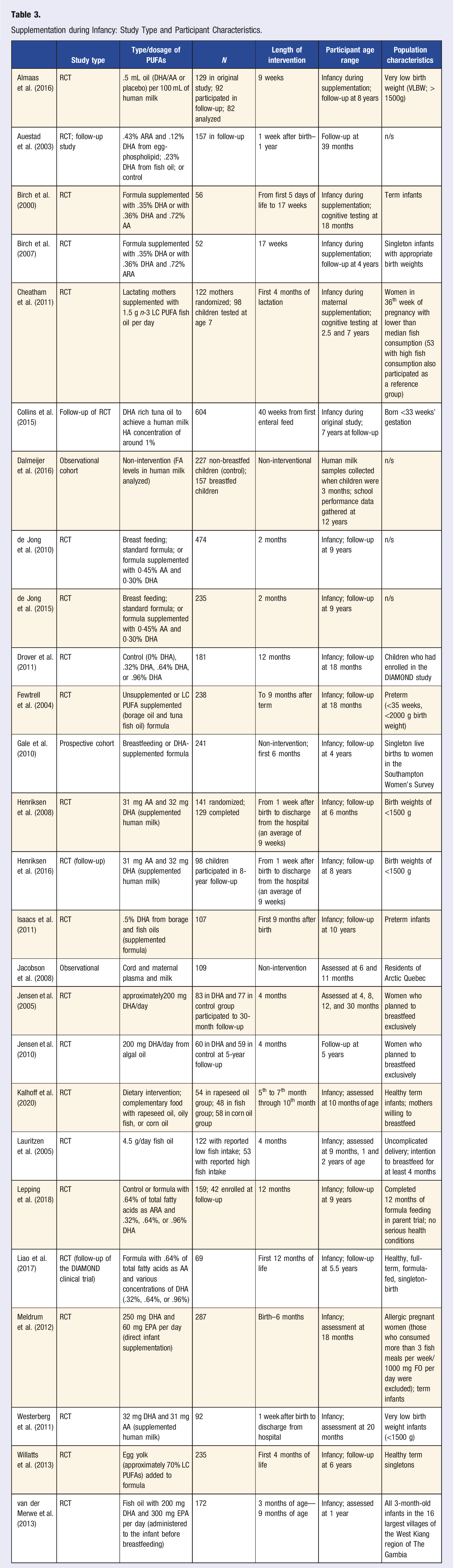
Supplementation during Infancy: Study Type and Participant Characteristics.
Supplementation during Infancy: Instrumentation and Results.

Supplementation During Childhood and Adolescence: Study Type and Participant Characteristics.

Dalmeijer et al. assessed the potential role of PUFAs benefits during breastfeeding, comparing with a control non-breastfed cohort (at the time of the study, formulas did not include PUFAs in the Netherlands). In 3 months old infants the results indicated some correlation between DHA level in human milk and higher scores on the Cito school standardized test; however, this was only true of girls, which indicates that sex-specific differences in ability to metabolize n-3 LC PUFAs require further investigation. 53
Supplements in Very Low Birth Weight Infants
FA insufficiency during the third-trimester has been correlated to fetal brain development, premature birth, and very low birth weight (VLBW). Considering that VLBW children have increased risk of behavioral problems, Almaas et al. suggested that DHA supplement to VLBW infants would influence cerebral white matter and improve behavioral outcome. Results did not indicate significant differences between control and intervention groups for both the outcomes. 2
Henriksen et al. tested the effect of DHA and AA supplementation in 129 VLBW infants fed human milk. The follow-up lasted 8 years, and whereas no differences in growth or intelligence quotient (IQ) were found, blood DHA at 8 years was positively associated with IQ. 54
Specific Outcomes of Interest
Supplementation During Childhood and Adolescence: Instrumentation and Results.

Communication
As addressed in the in-utero supplementation section, Ostadrahimi et al. conducted a study with a supplementation range including both in-utero and lactation periods, and found that—of five neurodevelopment domains assessed at each age—only the communication domain had a positive correlation with fish oil supplementation, and only at 4 months of age. 33 However, negative language results have also been reported. Cheatham et al. found language and prosocial scores to be lower, only among boys, in the fish oil supplementation group than in the control group. 3
While they did not find a significant effect of DHA supplementation during the first 9 months of life on overall cognitive function at 10 years of age, Isaacs et al. did find that girls in the supplemented group performed better on the reading and spelling measures of the Weschler Individual Achievement test. 55 However, both groups that received human milk scored higher on the Weschler subscales, again prompting the question of whether DHA or another factor associated with breastfeeding accounted for this correlation. While Meldrum et al. found that infants supplemented with FO exhibited higher gestural scores—important in relation to gesture as a precursor to language—the overall results of the study were inconclusive due to methodological issues including discrepant sample sizes across outcome measures and a high rate of correctly guessed group allocation, which may have introduced bias. 54
Intelligence
In an early study on DHA supplementation during infancy, Birch et al. found that supplementation with DHA and AA during infancy correlated with an increase of 7 points on the BSID-II mental development index (MDI). 7 The cognitive and motor subscales of the MDI were significantly higher among both the DHA and DHA + AA groups, and the language scores were higher, but not significantly so. Isaacs et al. found that, while there were no overall differences in cognitive outcomes between the groups, 10-year-old girls in the supplemented group demonstrated improved performance in reading and spelling measures of the Weschler Individual Achievement test. 55
While an 8-year follow-up study did not indicate any effect of supplementation during infancy on IQ, Henriksen et al. did find DHA level assessed at the time of the follow-up to correlate with higher IQ scores after correcting for maternal education and birth weight. 56 Willatts et al. did not find any difference in IQ scores among control or intervention (formula supplemented with egg yolk) group children at 6 years of age, but noted that the global testing measure may not be sufficiently sensitive to detect group differences. 11
Working Memory
Henriksen et al. reported a significant benefit of DHA and AA supplementation during infancy on working memory, tested using event related potentials. 56 They also reported that the test required infants to be relatively calm, and that agitated infants were excluded from the analyzed sample.
Programming During Brain Development
Liao et al. found that participants in the intervention groups exhibited activation of a larger, synchronized neuronal network than the control group, suggesting that early LC PUFA supplementation can have an important programming effect on the brain during development. 57
Attention
Westerberg et al. found that intervention group infants demonstrated more time sequences with a high level of attention during free play sessions than the control group, as well as higher levels of sustained attention among members of the intervention group. 58 Higher DHA levels at hospital discharge did correlate with better sustained attention levels and MDI scores, but due to loss to follow-up, the study’s ability to detect small between-group differences was limited, and the results may be attributable to chance. Willatts et al. did not find LC PUFA supplementation during infancy to affect scores on an attention control test. 11 However, the results did indicate an effect of supplementation on the speed of information processing, with shorter response latencies on the Matching Familiar Figures Test among members of the intervention group. Jensen et al. found that children whose mothers received modest DHA supplementation during breastfeeding for the first 4 months after delivery performed better on a test of sustained attention at 5 years of age. 59
Problem Solving
In a study supplementing infant with formula containing DHA and AA, Willatts et al. noted that supplementation with LC PUFAs did not improve problem solving ability, but did improve its efficiency. 11 In addition, Henriksen et al. found that supplementation significantly improved performance on the problem solving subset of the Ages and Stages Questionnaire. 56
Childhood and Adolescence
In the 36 studies60-95 described in tables 5 and 6 that met the inclusion criteria for this systematic review intervention lengths ranged from 3 weeks to 4.5 years. The main source of n-3 LC PUFA was primarily fish or algal oil. Subjects in the reviewed studies divided between healthy developing populations (n = 13) and those with clinical characteristics: history of asthma (n = 1), ADHD (n = 10), potential DHA deficiency (either as a result of preterm birth or low n-3 index; n = 2), ASD (n = 1), mood disorders (n = 1), or phenylketonuria (n = 1), iron deficiency (n = 1), malnutrition (n = 1); or below average reading level (n = 2) Figure 1. Literature search flow chart.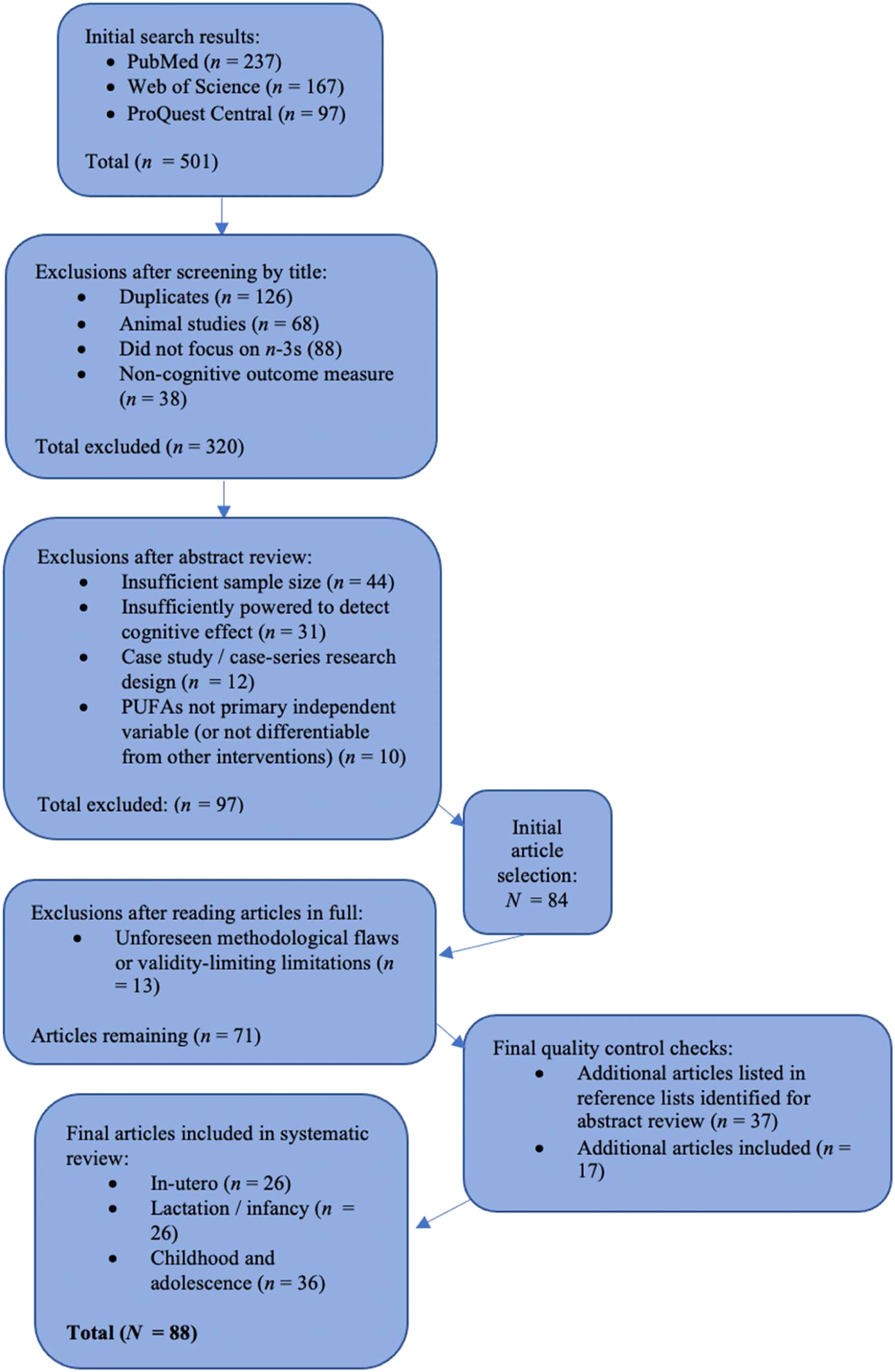
While significant attention has been given to the importance of LC PUFA level during gestation and the first year of life, less is known about its role in subsequent development. Specifically, the period from 12 months to 24 months remains a significant developmental period, which is also marked by dietary changes that can lead to deficiencies. Devlin et al. investigated the cognitive effect of DHA and ARA supplementation in toddler. The author reported no effects on cognitive and language composite, but did find red blood cell ARA level to correlate with improved language scores. 60 Another study conducted with toddlers did not indicate positive outcomes of DHA and AA supplementation, and found some negative effects of supplementation on language development among all but the lowest birth weight and lowest SES groups. 61
In a long-term study, Brew et al. attempted to discern whether FO supplementation from 6 months to 5 years of age correlated with children’s scores on the NAPLAN. 62 Similar to studies assessing in-utero supplementation’s effects on long-term cognitive outcomes, the results did not indicate that supplementation had any effect on scores. However, LC PUFA level at 8 years of age did correlate with test scores after correcting for birth weight, maternal age and education level. Similarly, in an adolescent population, Åberg et al. found that those who had consumed more than one fish meal per week at the age of 15 (assessed via questionnaire, had significantly higher cognitive performance levels in terms of composite, verbal, and visuospatial intelligence than those who had less, even after accounting for education level. 63
In one study investigating the effects of omega-3 supplementation on children’s learning and behavior, the authors reported equivocal results with a significant increase in DHA and EPA levels in both the placebo as well as the treatment group. Authors suggested that this may have been due to dietary changes based on increased awareness via information provided to participants’ parents on the purpose of the study. 64
Two important childhood and adolescence intervention studies—FINS-KIDS and FINS-TEENS—addressed the effect of dietarily supplied n-3 LC PUFAs from herring or mackerel meals three times per week, as opposed to meat meals three times per week. In the FINS-KIDS study, the meals included a mean concentration of .21 mg/g EPA + DHA in the meat group and 15.2 in the fish group, and caregivers filled out a food frequency questionnaire to provide information on non-intervention n-3 consumption. 65 After adjusting for dietary compliance, Øyen et al. found that the fish group demonstrated more WPPSI-III raw score improvement, as well as three subtests and the non-dominant hand 9-HPT test, but the overall results did not indicate improved general cognitive performance after intervention. Sheppard and Cheatham also addressed food-derived n-3s (specifically in relation to n-6: n-3 ratios) in terms of effect on cognitive function through an observational study using diet recalls and histories rather than a supplement intervention, and found that participants with balanced ratio scores scored higher on overall measures of executive function. 66 Importantly, the results indicate that when intake for both n-3 and n-6 was high (low ratio) cognitive abilities declined. In comparison to other studies, these results are important due to the focus on balance rather than high levels of supplementation, and may interact with/help explain the threshold findings offered in other studies.
Particularly among adolescents, compliance issues may introduce biases in studies that address these populations. Handeland et al. also found that, while dietary intake is preferable to supplementation, taste preferences may be a factor. 67 The results of the study by van der Wurff et al. did not indicate an effect of 1 year of krill oil supplementation on participants, or between n-3 index and neurocognitive test scores. 68 However, the authors noted a high level of non-compliance, and suggested that adherence difficulties may have contributed to the lack of a demonstrated correlation between krill oil supplementation and neurocognitive benefits.
Specific Outcomes of Interest
Given the prefrontal cortex development that occurs in childhood and adolescence, and the increasing ability to test for higher-order cognitive functions among older children, studies conducted during the later childhood and adolescence period in particular assessed for higher-order cognitive function, including: attention and executive functioning, information processing speeds and impulsivity, and memory.
Attention and Executive Functioning
Several studies found that DHA supplementation can have positive effects on attention and executive functioning during the childhood and adolescence periods, in both clinical and cognitive healthy populations. For instance, Vesco et al. studied a group of 7-14-year-olds with disorders that affect executive functioning, and found that n-3 supplementation may aid in executive functioning treatment for mood disorders. 69 In particular, executive functioning in the areas of inhibition control, adaptability to emotions, and cognitive flexibility improved more than in the areas of task initiation, planning, and organization. In the FINS-TEENS study, Handeland et al. found that total performance and processing speed improved in the fish meal group compared to meat and supplement groups; the authors noted that dietary intake appears preferable to supplementation. 67
Information Processing Speeds and Impulsivity
Van der Wurff et al. found that, on a letter digit substitution test, a higher omega-3 index was associated with better information processing speeds: each 1% higher the omega-3 index, the LDST score improved by 1.23 digits. 70 On the D2 test of attention, participants with higher omega-3 levels had fewer errors of omission, which indicates less impulsivity. While the overall results did not indicate an impact of fatty fish intake on general cognitive function, Øyen et al. did report a small beneficial effect on three subtests: processing speed subscale, coding and symbol search, and non-dominant hand 9-HPT, with 78% power to detect an effect size of .37. 65 Due to DHA’s role in neural communication, the dietary increases to n-3 intake in this study may indicate an interaction with processing speed, though the results are inconclusive and further studies using processing speed measures are indicated. Other studies have also reported an interaction between LC PUFAs and measures of impulsivity, primarily among the adolescent population. One study with a younger population (8-10 years of age) included the Matching Familiar Figures Test (MFFT) to measure visual attention and impulsivity, and found that the number of first correct responses increased with supplementation, although the study overall did not yield positive results. 64
Memory
Ryan and Nelson found that, while their results did not indicate significant treatment effects on the primary outcome measures, regression analysis did indicate a significant positive correlation between DHA level and higher PPVT scores (which tests for listening comprehension in English, and is associated with memory and cognitive function). 71 Sheppard and Cheatham similarly found a balanced n-3: n: 6 ratio correlated with better working memory scores. 66 Widenhorn-Müller et al. found DHA/EPA supplementation to improve working memory among a population with ADHD. 72
Cognitively Clinical Populations Studies
During the childhood and adolescence supplementation period, an increasing number of studies have addressed clinical rather than typically developing populations, assessing for the effect of LC PUFAs on pathologies including ADHD and ASD.
ADHD
Given the high concentration of DHA in the frontal areas of the brain associated with executive function, the correlation between n-3s and ADHD symptomatology have been of interest to various researchers. Crippa et al. tested the effect of DHA as an ADHD monotherapy. 73 The results showed no difference between treatment and intervention group on the primary outcome measure: ADHD rating scale IV. However, DHA supplementation did appear to produce small benefits to focused attention, parent-rated improvements to psychosocial functioning, and parent-identified reductions in emotional problems. Raz et al. did not find supplementation with EFA to produce any amelioration of ADHD symptoms beyond that of the placebo effect. 74
Kean et al. reported improved Conners’ Parent Rating Scale, behavior at home, and learning abilities scores as a result of supplementation with green-lipped mussel extract. 75 Further, participants in the intervention groups demonstrated improved memory in cognitive tasks, indicating the potential benefit of n-3 supplementation on delayed working memory in particular. Similarly, Milte et al. supplemented children with EPA,DHA, or linoleic acid for 4 months, and although outcome measures showed no significant differences between the three treatments, the Authors found that increased erythrocyte levels of EPA, DHA, and n-3 FAs overall (resulting in lower n-6 to n-3 ratios) correlated with improved overall literacy, attention, and parent-rated behavior measures.76,77
ASD
Due to insufficiencies of pharmacological treatments, there has been increasing interest in complementary and supplement-based treatments for ASD, including n-3 LC PUFAs, DHA and EPA. 78 1 study evaluating the efficacy of vitamin D, LC PUFA, or both, on core symptoms of ASD reported that improved social awareness and social communicative functioning was significantly correlated with both n-3 and n-3 + Vitamin D interventions. Authors suggested that either alone or in combination with Vitamin D, n-3s can have a positive effect on the core symptoms of ASD. 79
Discussion
This review evaluated the effect of omega-3 fatty acid supplementation on neurodevelopment in 3 different cognitive developmental phases: in-utero; lactation/infancy; and childhood and adolescence. Overall, the clinical studies reviewed reported equivocal results regarding cognitive function among the 3 populations.
Generally, researchers have reported beneficial effects on several specific cognitive domains, and at times with small effect sizes. The most consistent positive results include those pertaining to language/communication, executive functioning, attention, and memory.
Further, most research is conducted among populations that do not exhibit deficiencies in n-3 LC PUFA status, and numerous studies indicate the presence of a threshold or even a U-shaped curve in relation to n-3 consumption. It could appear that in populations that are not deficient in DHA or other n-3 LC PUFAs, supplementation has a negligible or at times detrimental effect. Few studies have addressed populations that are deficient in n-3s; 1 study conducted on a population of children with mild to moderate malnourishment resulted in improvements in an extensive number of domains on a neuropsychological test battery. 80
Although LC PUFAs supplied during infancy and in-utero seldom have shown significant cognitive effects, it appears that they do not persist at long-term follow-up assessments. This may indicate that other confounding variables such as nutritional and lifestyle factors can influence the outcomes in the intervening years. In dietary-based studies in particular, authors noted that higher levels of fish intake tend to correlate with higher parental education and socioeconomic status levels, which may confer their own benefits. However, while most studies have alluded to the superiority of dietarily-derived omega-3 sources, a recent study found no effect of supplementation with fatty fish or rapeseed oil from 5-10 months post-delivery on infants’ latencies of FVEP, Bayley’s MDI, or in PDI index. 48
Several studies across intervention periods yielded gender-dependent results, but further research on differences in how n-3 LC PUFAs are metabolized and synthesized according to sex is required to draw clear conclusions.
Overall, the authors of the majority of the studies with short interventions noted that it is important for n-3s to be supplied throughout life, rather than only during the earliest developmental stages.
The main strength of this systematic review is the fairly large number of papers analyzed and searched through multiple databases. Including reference lists in the search assured a comprehensive overview of the published studies. Also, To avoid bias, manuscripts were reviewed by two reviewers.
This review has also several limitations. Inconsistencies in LC PUFA source and type persist across the included studies, and contribute to the equivocality of the overall results. Studies have tested DHA in isolation, or in combination with EPA, ARA, and AA, derived from different sources and administered in a broad range of dosages. Further, some researchers have addressed an advantage of dietarily derived over supplement based n-3s, which may be due to bioavailability. For instance, LC PUFAs in fatty fish are bound to both phospholipids and triacylglycerol, whereas those in supplements are only bound to triacylglycerol. 67 Another source of bias could be that nearly all studies, even those funded by purely academic or governmental sources, reported that the intervention capsules/supplements were provided by a supplement or vitamin industry stakeholder.
Conclusion
Studies addressing n-3 LC PUFA supplementation at three key neurodevelopmental periods—in-utero, during the first year of life, and throughout childhood and adolescence—have reported some benefits in the areas of visual attention, working memory, executive function, and communication. However, effects are more often reported for specific cognitive domains rather than cognitive composite scores and do not tend to persist to long-term follow-up assessment. This may be due in part to the presence of confounding variables like other demographic and lifestyle characteristics and methodological difficulties (like lack of compliance, loss to follow-up, and a very broad range of outcome measures, dosages, and intervention types). Findings remain equivocal, and further research that is powered to detect small, subgroup effect sizes remains necessary.
Footnotes
Declaration of Conflicting Interests
The author(s) declared no potential conflicts of interest with respect to the research, authorship, and/or publication of this article.
Funding
The author(s) received no financial support for the research, authorship, and/or publication of this article.
