



Abstract
Attitudinal considerations are so important in the practice of meeting the patient as whole person, and in our literature, these are underexamined. Where does love sit in the transactionality of medical practice? Is this an uncomfortable question? In times which challenge intention and resolve, could the reflection be in some way nourishing?
“Love is receiving heart. Love flows from me, and is nourishing in return: in the noticing and the receiving of that return.”
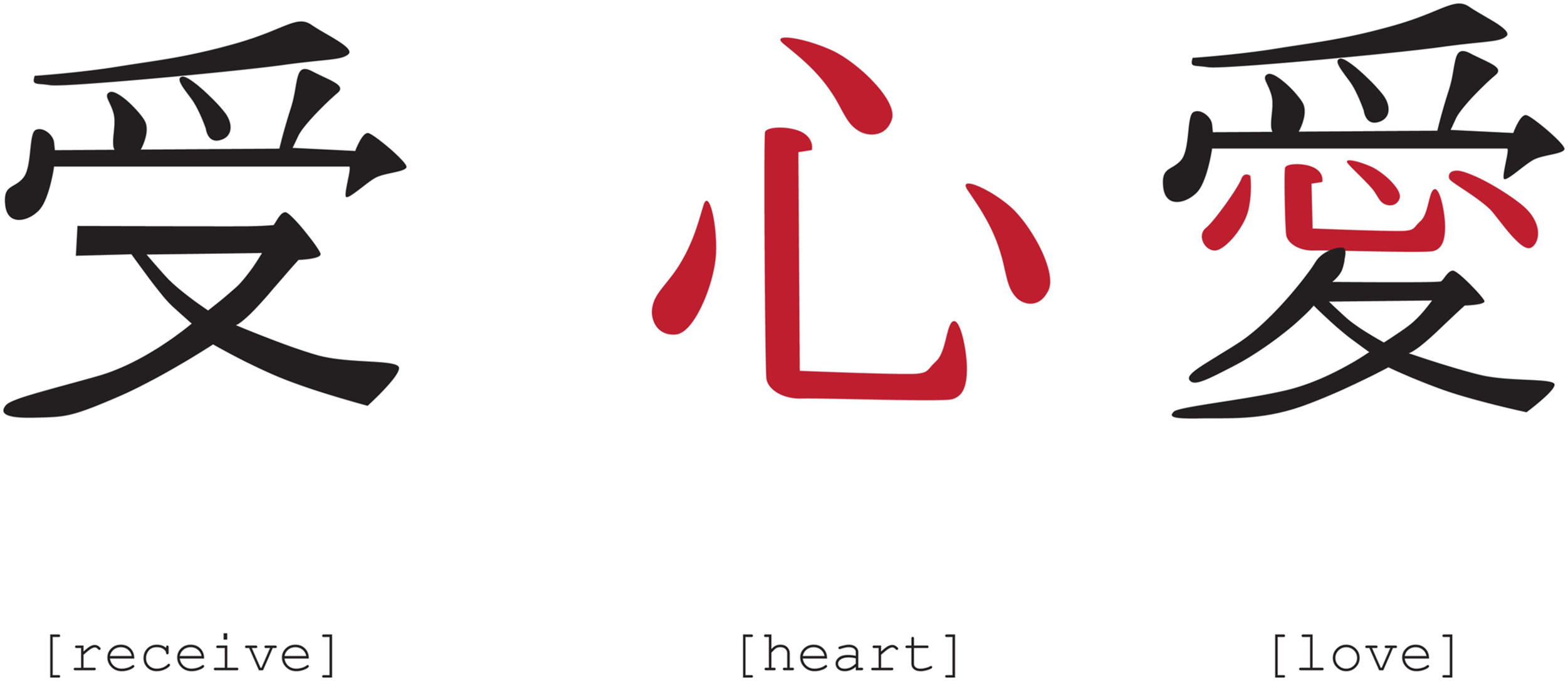
The Japanese character for love – ‘ai’ – is made up of two characters: ‘receive’ and ‘heart’.
Love = receive heart.
Really? This perspective turns my world upside-down! In medicine and in life, I have always conceived ‘love’ as a giving of heart.
I give myself to my loved ones, I give to my patients, I look for opportunities to be of service. It seems sometimes that I give and give and give.
And I don’t think I am on my own in this. As doctors, we are ‘caregivers’. We have made a decision to be in a caring profession. We dispense our love.
And yet, a whole culture thinks differently! To love is to receive heart.
Is there something I have been missing? Like, really missing. Could I hold this in a different way, with fresh eyes? Could there be something in this that is affirming and sustaining? If I really open to it, in my meeting with patients, where do I receive heart?
Nobody wants to be sick. Given preference, nobody would choose to be in a hospital. In Aesop’s fable, the lion approaches Androcles in awful pain, with the thorn in its paw, claws retracted, plaintive and beseeching. Androcles – understandably – is wary that he may be lunch. With Androcles’ realisation and removal of the thorn, the lion is forever grateful, in love and respect.
While much is spoken of the compassionate quivering of the heart of the caregiver in response to suffering, not a lot is said of the love in the approach of the patient, respectful and honouring of the learning and effort of the carer in their gift of healing.
How do I receive this love?
There is something in registering patient thanks. Noticing thanks is perhaps a first step, rather than just brushing off as ‘it’s my job’. And then the step beyond, not just a noticing, a truly-receiving: allowing thanks to percolate down into a connection of heart.
An acknowledgement of my gift in the giving is for me a receiving of heart.
And perhaps to take this recognition of thanks back a step further. There is love and thanks expressed by the patient even in their approach to another being who they think may be able to help them, claws retracted.
There is a love and honouring of learning and intent at the societal level even in the granting of the ‘honorific’: Doctor. Hello Doctor. Thankyou Doctor. Receiving love.
I can recall I was so proud when I first graduated to be called ‘Doctor’. What does that mean to me now? Can I feel into that again?
So where have things gone astray? When did my caring become unidirectional giving? I think perhaps for me sometimes to not receive the love is the armour I have grown to avoid being with suffering that cannot be fixed: sometimes in my neurology patients, being with is all that I can offer. I am fix-less, and feel something more was expected. The thorn is still in the paw. For me to give love in meted doses – rather than receiving when I have seemingly so little to offer in return – is much more controllable.
There is something here, however, that is not honouring of the intention of the patient in approach. When someone gives a gift, it is respectful to receive the gift graciously, whether it is felt deserved or not: this honours the generosity in the giving, and nourishes the giver. It is perhaps this expectation that explains our disappointment when as patients, we approach a system in respect and trust and hope, then to be treated as a number, or a set of numbers, and turned away to make way for the next.
Can I as doctor meet the love in the approach receptively? If so, how?
How else can I receive heart in my work, my vocation? From whence is love flowing to me?
A few things come up for me:
I can feel into my place in lineage. I can honour the love of my parents, my grandparents and beyond and what they wanted for me: that is easy for me to receive.
I can receive the love of my teenage children, who are happy to give their love to me and to receive my love, so long as it doesn’t cramp their style.
I can receive the love in the intention of my younger self, who decided to launch me on this path of ‘helping people’, with even then a wisdom around knowing it would not all be easy, and that the rewards could still be great.
I can receive the love of all around me in acknowledgement of my strengths: knowing that in essence, these strengths are not mine, but nurtured by all who allowed these gifts time and energy to develop. It is their love that flowers as my strengths, and somehow it is right for me to offer these back, including in my role as ‘Doctor’.
McCown in the book ‘Teaching Mindfulness’, speaks of stewardship of a group as enabling ‘freedom, resonance and belonging’. 2 These qualities seem generalisable and foundational to developing a sense of flourishing of an individual in any group. In recognising and assimilating my societal role as ‘doctor’ – in belonging in this space – can I find the freedom and resonance to receive the offered heart of my patients?
Love is sometimes a difficult concept. In many ways in our society, we are conditioned to feel that love is something to be wary of: potentially manipulable, tawdry, pernicious, grooming, toadying: these things are not love, but speak of some element of transactionality.
Even within Buddhist teachings, sometimes the message around love is not clear. I spoke with a Buddhist practitioner recently and mentioned my confusion that – within the richness of offerings of teachings on all manner of emotion – compassion, generosity, sympathetic joy, envy and on and on – love was not mentioned. Her answer: ‘lovingkindness’ is love. Perhaps this had been nuanced in some service of monastic consideration, but: lovingkindness is love. Can I feel the pervasiveness of that love in our systems, in every interaction – approach and reception, giving and receiving – with patients and with colleagues?
Sometimes it is the big picture that is lost.
Love is receiving heart. Love flows from me, and is nourishing in return: in the noticing and the receiving of that return.
Where do you receive heart?
Admit something:
Everyone you see, you say to them,
“Love me.”
Of course you do not do this out loud;
otherwise, someone would call the cops.
Still though, think about this,
this great pull in us
to connect.
Why not become the one
who lives with a full moon in each eye
that is always saying,
with that sweet moon language,
what every other eye in this world
is dying to hear?
Footnotes
Acknowledgment
“With That Moon Language,” is reprinted from the Penguin publication Love Poems from God: Twelve Sacred Voices from the East and West by Daniel Ladinsky, copyright 2002, and used with the author's permission.
Declaration of Conflicting Interests
The author(s) declared no potential conflicts of interest with respect to the research, authorship, and/or publication of this article.
Funding
The author(s) received no financial support for the research, authorship, and/or publication of this article.
