




Abstract
Mindful eating is the enjoyment of food utilizing all of the senses without judgment. The basic principles of mindful eating involve listening to internal cues of the body (ie, hunger and satiety) to avoid overconsumption and utilizing external cues (reducing portion sizes and distractions while eating, and eating slowly) to assist in achieving awareness. Some practical ways of incorporating mindful eating include chewing food thoroughly before swallowing, drinking water between bites of food, savoring the aroma and taste of food, using smaller plates and bowls, turning off the television and computer while eating, and creating a pleasurable experience around food and eating.
Keywords
‘Mindful eating . . . has been gaining popularity among clinicians and their patients.’ Imagine sitting at a table with a beautiful place setting, you feel your mouth start to water at the thought of consuming some of your favorite foods. All of your senses are heightened. The plate of warm, delicious food is placed in front of you and you take a moment to smell the aroma. It brings back fond memories of the first time you ate this food. You place a small amount of the food on a fork and delicately place it into your mouth. You put the fork down and close your eyes to savor every morsel. You chew the bite for awhile making sure you don’t miss any moment of enjoyment. You repeat the process until you are at a point of satisfaction. Even if there is food left on the plate, you feel content.
Mindful eating, the “nonjudgmental awareness of physical and emotional sensations while eating or in a food-related environment,” 1 has been gaining popularity among clinicians and their patients. This has occurred despite the fast-paced American lifestyle, which promotes eating on the run rather than sitting to slowly and thoroughly enjoy a meal. 2
Mindful eating can be assessed by the Mindful Eating Questionnaire (MEQ): the higher the MEQ score, the higher the practice of mindful eating. 2 The MEQ measures disinhibition with items such as “I stop eating when I’m full even when eating something I love,” awareness with items such as “Before I eat, I take a moment to appreciate the colors and smells of my food,” external cues with items such as “I recognize when food advertisements make me want to eat,” emotional response with items such as “When I’m sad I eat to feel better,” and distraction with items such as “I think about things I need to do while I am eating.” 1 Higher body mass index scores were associated with a lower MEQ score, suggesting that mindful eating could be used as a weight maintenance method. 1 Indeed, mindful eating has been utilized to treat behaviors associated with overweight and obesity such as binge eating, problematic eating behaviors, and food cravings, and has also been shown to increase positive attitudes and behaviors toward eating.3-5
There are multiple principles that constitute mindful eating but the following 5 principles will be discussed in this article: reduce eating rate, assess hunger and satiety cues, reduce portion sizes, reduce distractions while eating, and savor food. 2
Eating Rate
The first basic principle of mindful eating is reducing eating rate. Reducing eating rate has been hypothesized to reduce energy intake because the slower eating rate allows time for satiety signals to register within the brain (estimated to take about 20 minutes).6,7 Satiation is the result of a complex mechanism of physiological, chemical, and mechanical factors associated with pre- and postabsorption of food and nutrients. 8 A meta-analysis study analyzed 22 peer-reviewed studies of experimental manipulation of eating rate in participants of all ages excluding those with clinically diagnosed eating disorders. 9 Regardless of studies utilizing varying experimental conditions and manipulations, the meta-analysis concluded that slower eating rates result in significant reductions of food intake. 9
Andrade et al 10 investigated the outcomes of experimental manipulation of eating rate in healthy premenopausal females using a randomized crossover design. Participants visited the laboratory on 2 different occasions to consume a pasta test meal either quickly or slowly. During the quick eating session, participants were instructed to eat quickly without pausing using a large spoon, while during the slow eating session, participants were instructed to take small bites using a small spoon, chew the bite 20 to 30 times, and to put the spoon down between bites. The study concluded that a slower eating rate (21 minutes longer on average compared to fast eating rate) led to significantly reduced energy intake (~646 kcal during the quick session vs ~579 kcal during the slow session). Potential reasons for the reduced energy intake caused by the slower eating rate are: the longer duration of eating allows for the brain to register satiation before the meal is finished and pausing between bites allowed for water consumption during the meal. 10
Hunger and Satiety Awareness
The next basic mindful eating principle is hunger and satiety awareness, and relates to eating rate. Meal termination is determined through stomach distention and various gut hormones.7,11 It is hypothesized that, due to the time difference between the mechanism of swallowing and the digestion and absorption of food and nutrients, 8 the feeling of satiation is delayed,6,7 supporting the notion to reduce eating rate. In addition to eating rate, having emotional intelligence and assessing hunger and fullness cues are important to achieving this mindful eating principle. Stress-induced or emotional eating, that is, eating in response to positive or negative emotional cues,12-14 has been cited as contributing to excess energy intake15-17 and weight gain. 18 Research has shown that obesity is correlated with emotional reactivity and obese individuals are more likely to engage in emotional eating compared with normal-weight individuals. 15 Research has also shown that people engage in emotional eating when self-esteem is low or to substitute for a lack of fulfilled basic needs. 16 In a survey of English adults by Blair et al, 18 in which they investigated the relationship between emotional eating and weight maintenance over a 1-year period, body mass index was significantly positively correlated with emotional eating. Furthermore, respondents with initially high levels of emotional eating that managed to reduce that level of emotional eating were able to lose more weight compared with respondents that continued to report high levels. 18 The ability to control emotions and not use eating as a response to those emotions is important in not only weight maintenance but mindful eating as well.
Portion Sizes
Reducing portion sizes is the third basic principle of mindful eating. Portions have increased since the 1970s and have been cited as a contributing factor to the increase in overweight and obesity prevalence.19,20 One study found that using self-refilling soup bowls, participants consumed 73% more soup but did not report eating more compared with participants eating from normal soup bowls. 21 The researchers determined that people rely on external cues (ie, the amount of food left on a plate) to determine fullness but need to use the internal cues of hunger and fullness. 21
Distractions
The fourth basic principle of mindful eating involves reducing distractions during eating. Research has demonstrated that watching television while eating increases consumption of high-fat foods, frequency of meals, and overall daily intake of calories.22-24 Researchers investigated whether undergraduates would increase the amount of high-density foods (pizza or macaroni and cheese) consumed during television viewing versus listening to symphony music using a within-subject design. 22 Students increased pizza consumption by 36% and macaroni and cheese by 71% during television viewing compared with listening to symphony music. 22 Being distracted while eating reduces the ability to assess internal sensory cues such as taste perception and satiation,25,26 which can lead to overeating.
Savoring Food
Simply enjoying food is the fifth and final basic mindful eating principle. Using all of one’s senses (sight, smell, taste, and feel) is key to choosing foods that are pleasing. 2 Research has shown that one’s environment and surroundings can influence the acceptance and intake of food. 27 The same meal was served during 3 different table settings—plastic tray, home-style, or gourmet—and locations—classroom, home-style dining room, and restaurant. Participants favored the appearance and taste of the food during the gourmet style setting and restaurant above all other settings. 27
How to Practice Mindful Eating
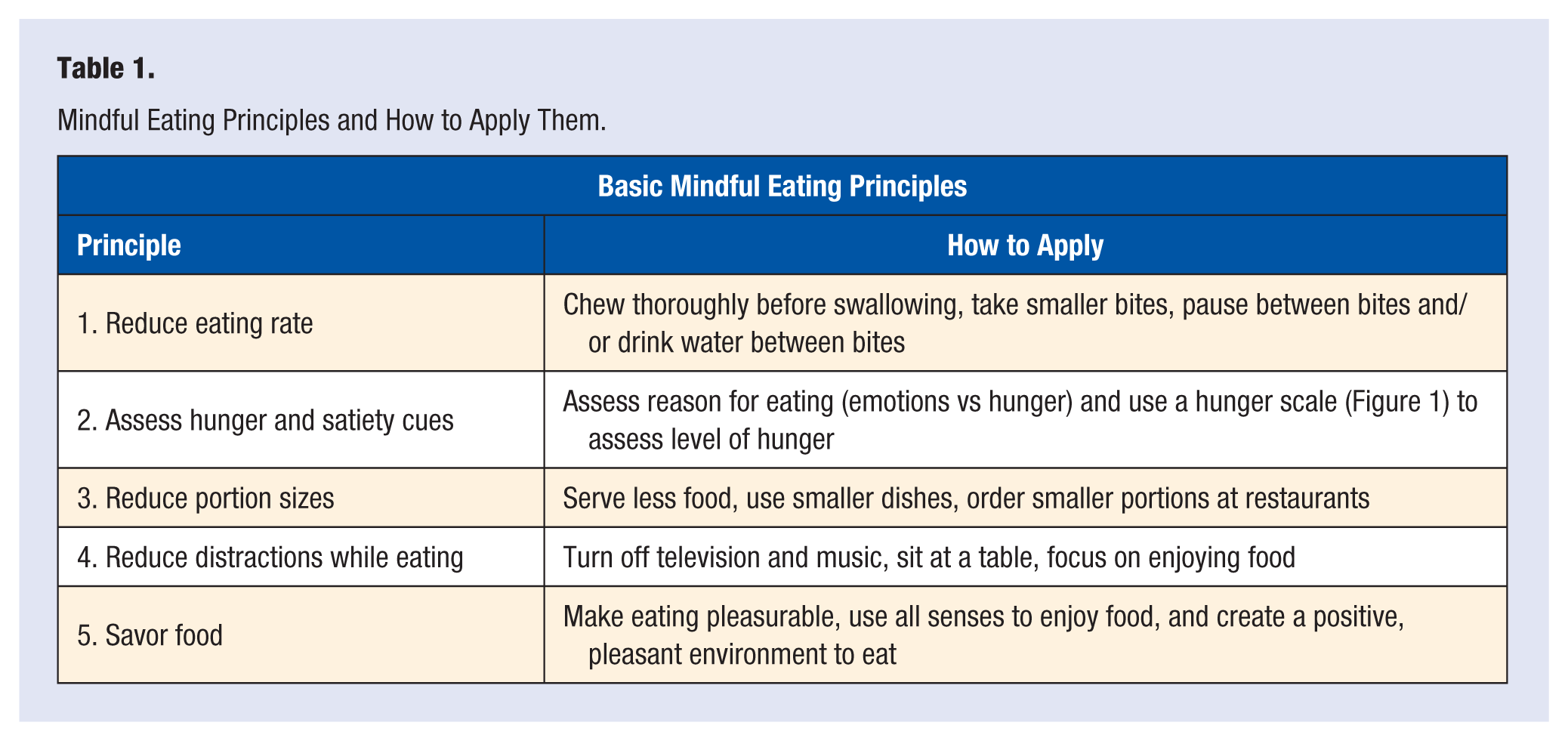
There are some straightforward, simple changes one can make to start practicing mindful eating (see Table 1). Strategies to reduce eating rate include increasing the number of chews or chewing thoroughly before swallowing, 28 taking smaller bite sizes, pausing between bites, and/or consuming water between bites. Prior to eating, one should determine if he or she is eating due to emotions such as stress, sadness, happiness or the internal cue of hunger. One should eat when hungry, but not starving, and stop eating when one starts to feel full. Using a hunger scale, 29 as shown in Figure 1, can assist in identifying one’s level of hunger. Reducing portion sizes by serving oneself less food, using smaller dish sizes, or ordering smaller portions at restaurants have been cited as methods of preventing excess weight gain due to overconsumption of calories.30-32 To reduce distractions during eating, turn off the television and music, sit at a table with friends or family, and focus on enjoying the food. Strategies to make eating a pleasurable experience include sitting at a table with a nice place setting, even if alone, and creating a positive, pleasant environment to savor and embrace the food. 33
Mindful Eating Principles and How to Apply Them.
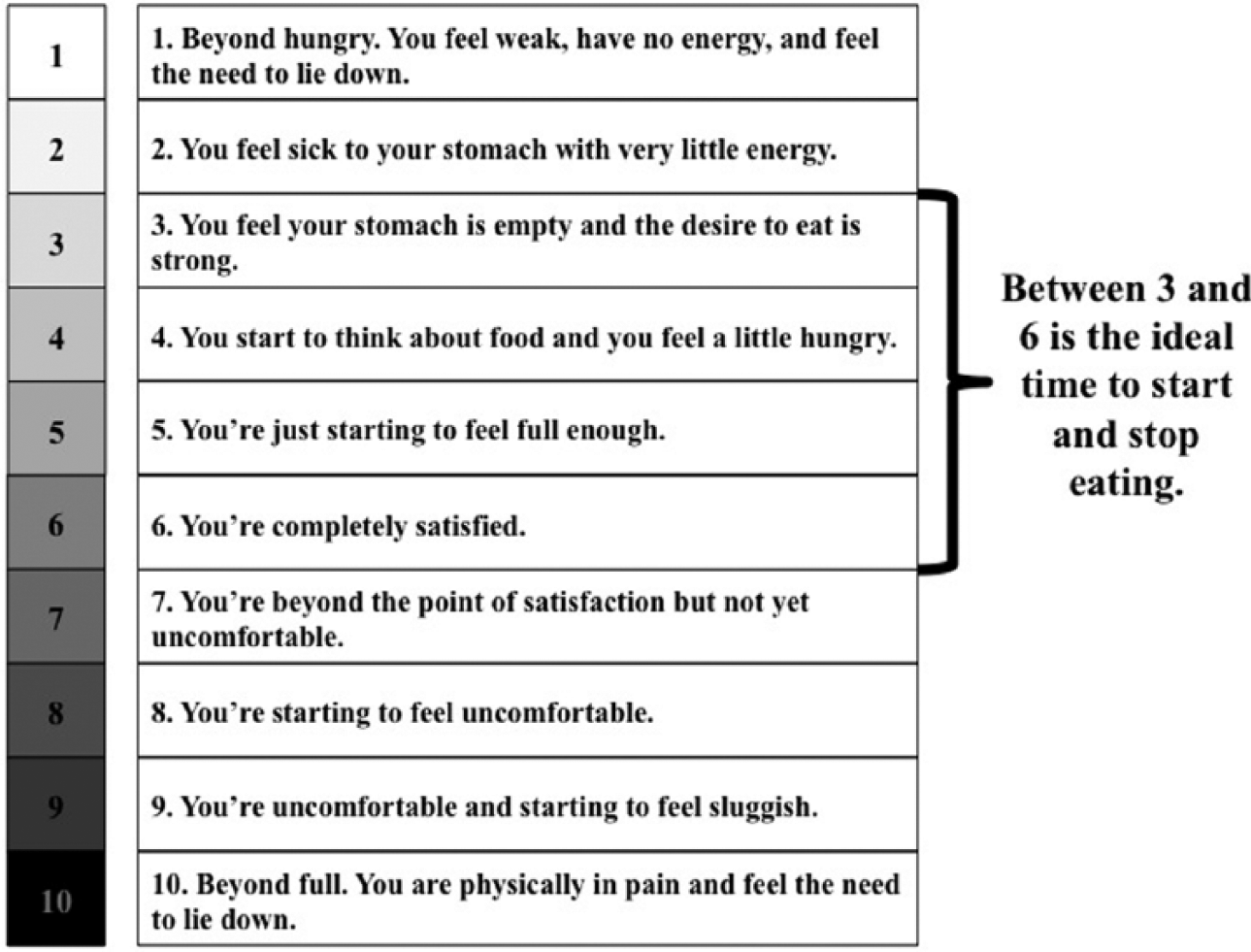
A Scale to Assess Hunger Level.
Conclusion
Mindful eating has been utilized to reduce negative behaviors associated with overweight and obesity. Eating slowly and when hungry, stopping when full, reducing portion sizes, reducing distractions during meals, and savoring food are all principles of mindful eating. Each principle can be attempted individually or collectively with small, simple changes.