



Abstract
Economic stability is a well-documented social determinant of health, and financial stress is an important driver for the health disparities observed in the poor. Persons under financial stress are more likely to engage in smoking, alcohol consumption, overspending, poor diet, and reduced exercise. Financial education and coaching is one strategy that can be used to reduce financial stress and potentially improve engagement in healthy lifestyle behaviors, quality of life, and objective health outcomes. A conceptual model describing the link between financial education/coaching and health is described along with preliminary data from a randomized controlled trial evaluating this intervention.
‘Because of less money, food, and time, people of low income must overcome more urges and make more difficult decisions more often than individuals with higher incomes.’
A primary objective of lifestyle medicine (LM) is to prevent, treat, or reverse chronic diseases that have, or may have, a lifestyle and/or environmental determinant.1-3 Economic stability is a well-documented social determinant of health, and financial stress is an important driver for the health disparities observed in the poor.4-8 Persons under financial stress are more likely to engage in smoking, alcohol consumption, overspending, poor diet, and reduced exercise. 9 The limited-resource model of self-control can be used, in part, to explain this finding. 10 The model suggests that self-control is a limited resource, and depletion of self-control leads to greater difficulty regulating behavior and resisting urges. Because of less money, food, and time, people of low income must overcome more urges and make more difficult decisions more often than individuals with higher incomes. This increased regulation of behavior depletes mental function, exhausts self-control, and leads to behaviors that are harmful to health. Such “bandwidth tax” is also why interventions to promote healthy behaviors in low-income individuals are often unsuccessful.10,11
It is, therefore, worthwhile to explore interventions aimed at addressing financial stress. Utilizing evidence-based models of financial education and coaching is one such strategy. A 1-year randomized controlled trial evaluating the health effects of financial education and coaching (the Finances First Study) is currently underway. Preliminary data from the Finances First Study demonstrate a statistically significant reduction in financial strain in women receiving the financial education and coaching intervention. Preliminary study data will be presented below along with a description of the conceptual framework that supports the central hypothesis of the project: financial education and coaching can improve health in women of low income experiencing financial stress.
Financial Education Intervention
More than half of US adults (54%) report living paycheck to paycheck, and finances have been identified as the most common cause of stress in the United States. 4 This is especially problematic for low-income, single mother families. Women consistently report higher levels of financial stress than men, and single parenting is the single most significant predictor of social immobility in the United States.12,13 According to the 2017 US Census Bureau, 80% of the 12 million single-parent families were headed by single mothers. 14 The Financial Success Program (FSP) is a novel financial education program for single mothers of low-income.
Founded in 2009, the FSP was originally funded by a grant from the FINRA Investor Education Foundation to identify which financial education components were most effective in facilitating behavior change for single mothers of low income. The FSP focuses on 3 core components: an outstanding trainer, a year of financial coaching, and an easy-to-use money management system. The initial 9-week curriculum addresses the immediate financial issues of working women who are struggling financially and has been described in detail elsewhere. 15
Importantly, the FSP has a consistent track record of improved financial outcomes.16,17 Women who participate in the FSP experience significant improvements in financial behaviors, such as a reduction in overdrawn bank accounts, receipt of shut-off notices, use of payday lenders, late paid bills, and community agency use. Graduates also report reductions in subjective financial stress, including lost sleep over money and allowing finances to affect their health, relationships, and ability to work. A 2-year evaluation of program outcomes demonstrated a greater than average increase in mean annual income for women who completed the FSP intervention. 17 These findings set the FSP apart from other financial education interventions, most of which are only weakly linked to changes in behavior. 18
Conceptual Model
The ongoing Finances First Study is evaluating the health effects of financial education and coaching in single mothers of low income. The investigators hypothesize that participating in the FSP will improve economic stability, decrease cardiovascular risk, and improve quality of life. The process by which this occurs begins with reducing financial stress and diminishing the exhaustion of self-control low-income imposes. As described earlier, interventions to promote healthy behaviors in low-income individuals are thought to be less effective, in part, because of the “bandwidth tax” imposed on those under financial stress. Increased reserves of self-control would allow women to successfully adopt healthy behaviors, including improved diet, increased exercise, and decreased smoking and alcohol use. This would lead to improvements in objective health outcomes, including weight, blood pressure, and cholesterol. Decreased stress and improvements in perceived hope and quality of life would decrease the release of stress hormones, including cortisol, norepinephrine, and epinephrine. This too, contributes to improvements in health outcomes and overall well-being. Figure 1 depicts the conceptual framework describing the relationship between financial education and health.
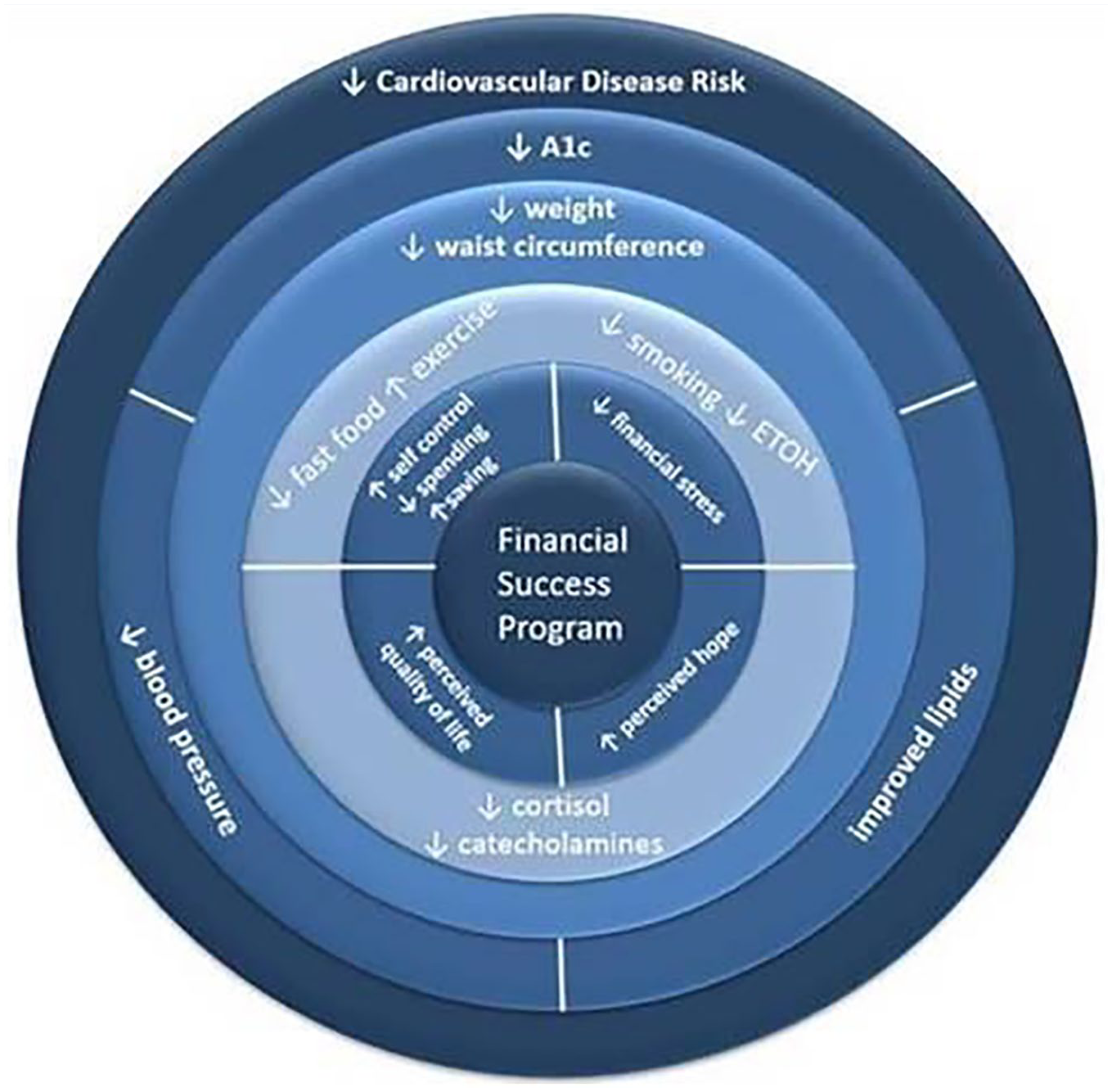
Conceptual relationship between the financial success program and health.
Preliminary Data
The Finances First Study is an ongoing, 1-year randomized controlled trial evaluating the health effects of financial education and coaching in single mothers of low income (<200% poverty level). At the time of interim analysis, 181 single mothers aged 19 to 55 years were randomized 1:1 to the FSP or usual care. Financial stress was measured using the Family Economic Strain Scale (FESS). 19 The FESS is a validated 13-item Likert type questionnaire designed to evaluate financial strain in families. Scores range from 13 to 65, with higher scores being better. The questionnaire was administered at baseline and 12 months postenrollment. A t test was used to compare mean changes in score between groups. Women randomized to intervention who completed the FSP (per protocol analysis) experienced a significantly greater increase in FESS scores compared with women in the control group (+10.3 ± 9.9 vs +5.7 ± 9.1, P = .003), indicating a reduction in financial stress. The health outcomes related to this reduction are being investigated in the ongoing study.
Conclusions
Financial stress is an important determinant of health and has been implicated as a barrier to engaging in healthy lifestyle behaviors. Evidence-based health interventions aimed at addressing financial stress are lacking. Effective models of financial education and coaching are one strategy that could be used to reduce financial stress as demonstrated with the FSP. Further study is needed to determine if this reduction is associated with improvements in healthy lifestyle behaviors, quality of life, and objective health outcomes.
Footnotes
Declaration of Conflicting Interests
The author(s) declared no potential conflicts of interest with respect to the research, authorship, and/or publication of this article.
Funding
The author(s) disclosed receipt of the following financial support for the research, authorship, and/or publication of this article: The Finances First study is funded through a Pioneering Ideas grant from the Robert Wood Johnson Foundation and co-funded by Creighton University and Omaha area foundations.
Ethical Approval
The Finances First study received approval from the Creighton University IRB. All procedures performed in the Finances First study were in accordance with the ethical standards of the institutional and/or national research committee and with the 1964 Helsinki declaration and its later amendments or comparable ethical standards.
Informed Consent
All human subjects in the Finances First study provided informed consent to participate.
