




Abstract
Canada’s population is increasing, and aging. These demographic patterns are accompanied by a growing awareness and evidence base of the benefits to society of leading a healthy and active life. The Canadian Academy of Lifestyle Medicine (CALM) was created to fill a knowledge gap in the Canadian public: how to lead a healthier and more active life. CALM aimed to address these challenges by confronting the lack of assistance modern medicine provides. As a diverse collaborative network using a lifestyle medicine philosophy, CALM’s objective was to generate discussions and examine lifestyle medicine approaches to improving overall health and well-being for Canadians. CALM aimed to engage patients whose access to health care is through a physician and provide an innovative platform to support care and healthy decision making. Despite perceived widespread support, intense planning, and extensive development, CALM was slow to gain traction and realize its full potential. This article describes the experiences and lessons learned in creating CALM from the perspective of the leadership team. Although most CALM activities have ceased, virtual space and social media remain active so too does the work of the leadership team, striving to enable Canadians to develop behaviors that will improve their lifestyle, and their overall well-being.
‘As a medical approach supported by evidence-based practice, lifestyle medicine assists individuals and families in sustaining health behaviors . . . to prevent and reverse the progression of chronic diseases . . .’
There is a limited supply of resources in the health care system, demanding a need for new, more efficient, and holistic ways of providing effective care. The field of lifestyle medicine evolved to address this challenge and the treatment and prevention gaps in chronic diseases. Many chronic diseases fit a classification of disease whose development can be attributed to individual choices and behaviors around nutrition, physical activity, stress, rest, smoking, and alcohol. 1 While some aspects of lifestyle medicine overlap with other related medical disciplines, such as preventative or integrated medicine, lifestyle medicine maintains a unique philosophy and scope of practice that focuses on a holistic and evidence-based practice. 2 As a medical approach supported by evidence-based practice, lifestyle medicine assists individuals and families in sustaining health behaviors (including nutrition, physical activity, stress management, social support, and environmental exposures) to prevent and reverse the progression of chronic diseases by addressing some of the underlying causes. 3 Other social, cultural, and environmental factors can largely affect an individual’s ability to enact and acquire health behaviors, including a strong relationship with a physician, family support, access to interdisciplinary teams, and involvement in the community. 4 While Canada is a healthy nation, experiencing low mortality and high life-expectancy rates, preventing chronic disease remains a high priority. 5 In Canada there has been a focus on improving healthy behaviors such as reducing smoking and heavy drinking and increasing physical activity and produce consumption. 6 Despite declining smoking percentages and increasing fruit and vegetable consumption, there remains room for improvement across multiple healthy lifestyle behaviours. 6 For example, despite known health benefits for physical activity (such as reducing the risk of chronic diseases), less than half of the male and female population aged 12 and older report being active during leisure time. 6 This trend is not unique to Canadians; in Australia, less than half of the population reported getting sufficient physical activity in 2015, contributing to 5% of the chronic disease burden. 7 Although there is increasing evidence to support the benefits of improved lifestyle behaviors to help patients achieve better health and well-being, physicians and other health care providers are often challenged with how best to educate and support patients. 8 Often this is a result of a need for multiple permanent behavior changes and adaptive coping strategies. Lifestyle medicine aims to address this need by identifying potential areas for lifestyle improvement and directly supporting those areas combined with teaching and reinforcing coping mechanisms. 9
Lifestyle medicine is gaining momentum around the world through coordinated national efforts. Twenty countries around the world support lifestyle medicine practices through national and global associations. Some health systems, such as Australia’s Enhanced Primary Care, introduced benefits to general practitioners for adopting a lifestyle medicine approach to managing patients’ chronic diseases. 10 Umbrella groups (such as in America and Europe) also exist to bring countries together under a shared lifestyle medicine model and philosophy. The Lifestyle Medicine Global Alliance, an organization started by the American College of Lifestyle Medicine in 2015, was developed in response to a desire for and anticipated growth of lifestyle solutions in low and middle-income countries. The Lifestyle Medicine Global Alliance has 6 strategic partners (for-profit donors) and 14 members, and was founded by leading medical societies, universities, governmental organization, and nongovernmental organizations to address the global epidemic of lifestyle-related diseases.
Currently, in Canada, lifestyle medicine programs or approaches are implemented piecemeal with no overarching coordinating body. A group of Canadians in the province of Ontario attempted to fill this gap by creating the Canadian Academy of Lifestyle Medicine. The aim of this article is to describe the experience of developing a lifestyle medicine association in Canada and discuss lessons learned during its creation.
Story of CALM
The Canadian Academy of Lifestyle Medicine (CALM) is a nonprofit organization that was founded in Ontario in 2013. Its founders were Canadians who understood the current health care system’s inherent challenges and barriers and were concerned about the epidemic of chronic disease coupled with the lack of holistic options for care. The growing lifestyle medicine movement in the United States gave motivation and inspiration for the creation of CALM, which was the first organized attempt to build lifestyle medicine in Canada. The purpose was to develop a network that would bring together health professionals to coordinate efforts in educating the community about chronic diseases, lifestyle choices, and the relationship between them.
Developing CALM: Setting the Stage
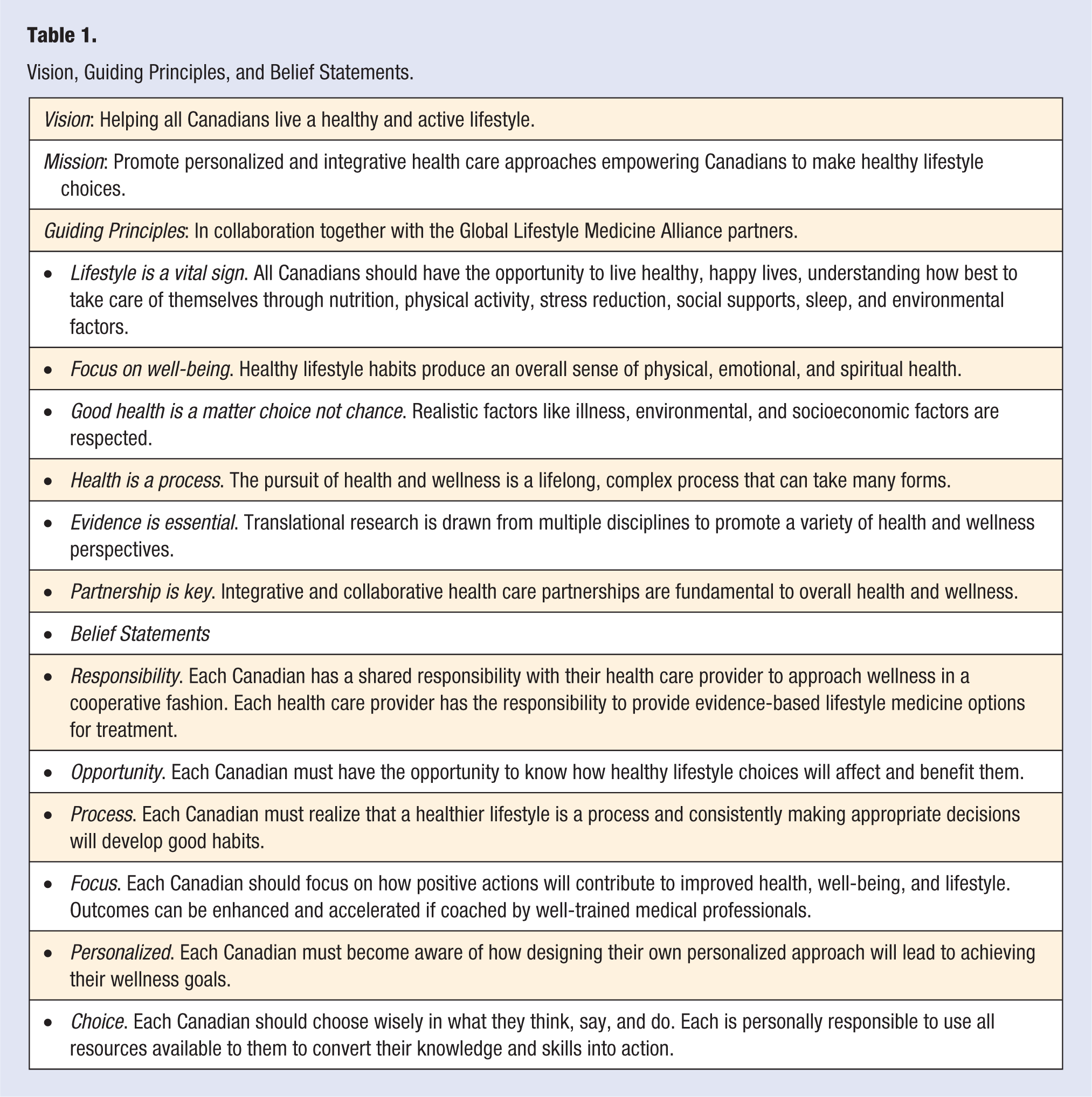
CALM meetings began as a community-based group of interdisciplinary professionals, all of whom were working in, or connected to, health care disciplines. A core steering committee of 12 people (including 4 doctors, 1 researcher, 2 students, 3 allied health professionals, and 2 community members) met monthly from late 2013 to 2016. From 2013 to 2014 CALM worked to create a logo and website, along with vision and mission statements, list of guiding principles, and belief statements (Table 1). Special care was given to ensure that CALM’s organizational mission was built on values shared by all members of CALM and its global lifestyle medicine partners. Early CALM meetings worked to craft the objectives of forming a network, identify areas for collaboration, and develop a plan to reach these goals. Each meeting also had an evaluation period to reflect on progress and determine the next steps for CALM. Working groups were formed to develop and implement specific activities to achieve the collective goals. From the early stages, CALM created a formal collaborative membership and governance structure to guide continued growth. The steering committee was well aware of the importance of integrating within existing structures to endorse buy-in and increase the likelihood of network success; there was a deliberate effort to liaise with the local university and medical students from the department of family medicine.
Vision, Guiding Principles, and Belief Statements.
In 2015, CALM formalized an advisory committee consisting of medical professionals (physicians and allied health professionals) and professional business leaders. CALM set a goal to connect with national and international societies, organizations, and businesses to promote health as part of a larger global movement that strived to educate and inspire healthy, active lives. CALM was officially launched in 2015 at the annual conference for the Institute of Lifestyle Medicine in Boston. An open call for membership in CALM followed shortly after in late 2015 with the goal of identifying new members who shared the enthusiasm for the well-being of the nation. The steering committee’s goal was to be broad and inclusive in membership, which made CALM accessible to anyone with passion for maintaining health and wellness in the community.
CALM Activities
Website
CALM aimed to support innovation in health care through technology to connect with the general population. Virtual advocacy and promotion of lifestyle medicine has provided a unique opportunity for organizations to engage their audience through online forms of health activism; however, it has also ignited an overabundance of information being made available to the public. 11 The first initiative of CALM was to create a streamlined and easy to use website to initiate an online presence. 12 CALM’s first step was to share information compiled by the steering committee with an aim to expand the range of information as membership and website engagement grew—the end goal being a site built by and for users. 13 When presented in this manner, information in turn can support or improve relationships, encourage health care reform, support disease prevention, and address health disparities in populations. 14 An initial call was put out to steering committee members to provide information (articles, blogs, factsheets, etc), which was given to a web-designer to populate the site. CALM started with areas where there was expertise in the steering committee, including nutrition and healthy diet, physical activity and exercise, hypertension, sleeping disorders, and weight loss and weight gain. Disease-specific information such as signs and symptoms of the condition as well as risk factors and recommendations for protective actions (ie, physical activity and healthy diet) for diabetes, high blood pressure, and back pain was also made available through the website.
A call to develop the website occurred in 2015. A contract was signed with a firm, but unfortunately the firm was not able to develop the site CALM had envisioned and the contract was terminated. A second web design firm was contracted to redesign the site, which resulted in an entirely new product. Together, both contracts cost more than $20 000. The process of developing the CALM website took approximately 10 months, which was much longer than originally anticipated. The primary focus remained gaining a strong online presence to ensure CALM would achieve significant reach within the Canadian population.
Walk-With-a-Doc
A second initiative implemented by CALM was the “Walk-with-a-Doc” program. This program brought together practitioners and community members in a safe setting while participating in an active lifestyle activity—walking. The original program was developed in 2005 in Columbus, Ohio, by Dr David Sabgir as an attempt to affect behavioral change in a nonclinical setting. 15 This grassroots project has expanded throughout Canada and the United States and continues to advance and improve its reach by encouraging doctors from around the world to bring the program to their local community. Doctors and other allied health professionals within the community can connect with the public using “Walk-with-a-Doc” as a means to increase exercise, education, and feelings of empowerment in a nontraditional setting. CALM’s first “Walk-with-a-Doc” event occurred in the spring of 2016 in London, Ontario. Subsequent walks were held on the first Saturday of the month for a year (12 walks in total). An average of 10 community members were present at each walk and were accompanied by at least 2 CALM members. While only one inaugural group was active, the anecdotal success of “Walk-with-a-Doc” in London, Ontario, is an indication that similar interventions that educate and empower could be implemented elsewhere in Canada. The “Walk-with-a-Doc” program requires commitment and participation from several local physicians to ensure feasibility and sustainability. In London, while community interest remains strong, the initiative is no longer running due to a lack of support from community doctors.
Conference
The third activity initiated by CALM was a national conference. Planning for the conference began in the winter of 2016 with an aim to host the conference in the following autumn. While planning was well underway, financial setbacks and exhaustion of CALM members led to the cancellation of the conference in the early summer of 2016. However, in April of 2017, an event was organized by university medical students with support and guidance from CALM leadership. The event had a strong interest and sold-out attendance. Delegates and speaker positions were filled by a keen cross-section of students and faculty from kinesiology, nursing, and health sciences. While not formally under the CALM umbrella, students continue to organize regular workshops using the goals and philosophy of CALM to guide their planning.
CALM Today
After the cancellation of the conference in the summer of 2016, the CALM steering committee also postponed convening. Momentum has slowed, despite strides achieved in the online community. The founding members were tired and frustrated by roadblocks. Although no longer formally meeting, many of steering committee members have continued working in the field, sharing their passion and dedication toward lifestyle medicine. CALM continues to be active on Twitter (@CALMedicine), and its website is still operational (www.calmlifestylemedicine.ca). Despite a decrease in formal activities and meetings, there are potential plans for smaller, local events to be run using the CALM infrastructure, but not necessarily the CALM branding. CALM leadership continues to be engaged in the lifestyle medicine movement.
Discussion
A recent call for improvements to health systems noted the following: “Many of the drivers of our future health lie upstream from individual interventions for lifestyle change.” 16 To do this effectively, multiple stakeholders need to work together to shift the current thinking around what a “health system” looks like and the most effective ways to work within it. CALM emerged as a unique national collaborative to meet this challenge. CALM’s grassroots development is similar to the development of the Institute of Lifestyle Medicine; both groups were founded by the effort of a few dedicated founders. This may be unique in comparison to other large national lifestyle medicine organizations such as the American College of Lifestyle Medicine, which was developed with the support of a national professional organization (the American College of Preventative Medicine). While explicit institutional support may not be necessary, it would have been helpful to ensure adequate support and buy-in.
CALM aimed to provide an avenue for passionate Canadians to not only examine lifestyle habits and behaviors but to also foster discussion around a novel approach to medicine. CALM is currently a member of the Global Lifestyle Medicine Alliance. Its creation was inspired by other lifestyle medicine organizations around the world and was developed with the intention to emphasize research, prevention, and treatment of lifestyle-related diseases—to be a Canadian counterpart to a growing international movement. The aims and objectives of CALM were noteworthy and ambitious. Increasing awareness of the need to change current thinking toward a lifestyle-based approach to health is only one part of the equation. Dealing with existing structures and lack of engagement are more aggressive barriers to instituting change. 17 However, the challenges faced by CALM can provide important lessons that should be shared broadly to garner more support and to build momentum for a lifestyle medicine movement.
Key Lessons
Four key lessons emerged from the process of building CALM.
First, a working website was fundamental for the establishment of the group and providing a tangible output for the steering committee. Without a base to share information, it was difficult to spread awareness and determine feasible priorities. Despite the potential for virtual methods of communication to alter an inaccurately conveyed message, the CALM website was extremely advantageous because of its efficiency in disseminating customized knowledge quickly and on a broad scale. 18 The quality of the information on the website had to be concise and agreed upon by all members, which was time intensive and resource consuming, making the process longer than anticipated. It is important to ensure adequate time, resources, and skills are available to meet information technology (IT) needs. It is recommended to involve or formally hire a team member with IT expertise to ensure the efficient development of an effective means of information sharing.
Second, support and buy-in from physicians and other health care providers within the community is essential. There are many disease management programs in health care, fostering an environment where a lack of proven outcomes can cause a distrust among clinicians. This typically results in healthy skepticism of whether support should be given to a program or initiative. 19 There is also a potential barrier in clinicians’ beliefs (especially physicians) that such programs could be a threat to professional autonomy or an unreasonable demand on their already limited time with patients. 20 CALM members believed that physician support was critical to ensure the success of CALM. However, after many attempts, meaningful engagement with physicians remained a huge challenge. This finding is not unique to CALM’s experience; others have reported physician agreement as a major factor in the broader acceptance of lifestyle medicine as a discipline. It is therefore essential to make physician engagement and buy-in a top priority from the start and to strategize for and anticipate potential resistance of physicians. We recommend hosting small, local educational events to teach the philosophy of lifestyle medicine to physicians and other health care professionals. Focus on emphasizing leadership, knowledge, assessment skills, management skills, and community support to increase their confidence in applying lifestyle medicine approaches.
During our planning, CALM founders had the opportunity to meet with like-minded individuals working with lifestyle medicine societies. Lifestyle medicine networks, such as the Institute of Lifestyle Medicine and the Global Alliance of Lifestyle Medicine, have embraced CALM and provided incredible support, resources, and mentoring to help launch and promote lifestyle medicine in Canada. Other societies have faced similar struggles in generating buy-in within their own countries. There is a feeling that the root of these struggles is found in both physician frustration and lack of medical training for approaches outside the traditional prescriptive care.21,22 Doctors are under increasing pressure to do more and to broaden their practice by considering patient satisfaction and values. The lifestyle medicine movement is, by nature, a collaborative approach; however, this is challenged within the “silo-ized” and specialized health care system within which many physicians work. “Healthy Israel 2020” is a national initiative aimed to enhance the health and well-being of Israel’s citizens; they also offer a certificate program in lifestyle medicine through the Israel Society of Lifestyle Medicine for family physicians. 23 This intervention has been shown to have a positive impact on physician’s attitude, prescription confidence, and self-behaviour. 23 In Canada, the lifestyle medicine movement continues to evolve as interest in lifestyle medicine grows among various medical associations. 24
Third, it is important to have multiple champions throughout the development process. These champions should be respected individuals in the health care field, who are willing to share their beliefs in lifestyle medicine and support for an organization such as CALM, but also the next generation of clinicians. The importance of having champions within multiple disciplines of health care, including alternative and complementary medicine, was seen to be fundamental to upholding the core philosophy of CALM. To work effectively, champions need to be intrinsically motivated to defend the behaviors and practices they are promoting. CALM had the support of multiple physicians and various other care providers, in addition to support from its American counterpart. CALM lacked the necessary support in the initial, intensive building phase that required significant resources and time. CALM also found support and energy from medical students. While CALM’s national conference did not run as planned, the energy and commitment of local youth and university student body allowed for the success of small student-oriented events. After one very successful (sold-out) workshop, students are now working toward hosting another event and creating their own network as a platform for communicating shared interests in lifestyle medicine. The next generation of health care professionals seem to embrace the CALM philosophy and vision and should be supported as they move forward.
Fourth, the need for financial resources is essential, ongoing, and should be built in from the outset. Whereas other lifestyle medicine organizations have obtained corporate sponsorship with lifestyle medicine–type companies, CALM started small with local businesses which was insufficient for the resources need. Corporate sponsorship would support the sustainability of CALM’s mission, website, and, ultimately, allow for planning of events. Another mechanism to increase financial input is to involve insurance companies promoting preventative health incentives.
Conclusion
The Canadian Academy of Lifestyle Medicine was incorporated as a not-for profit in April 2014; the official launch of CALM was at the Institute of Lifestyle Medicine Annual Conference held in Boston in June of 2015. The steering committee has not met since 2016, and the network is largely inactive today. Individuals from the group remain committed to the cause, driven by their passion and commitment to improving the health system for Canadians. The founders of CALM remain dedicated to the mission of CALM and remain leaders in the community and professional colleges. Interest is growing among young physicians and public health champions taking up the charge of system reform, while CALM planned for this, it did not come to fruition.
The structure of the current health care system and the challenges in shifting the attitudes of professionals were significant barriers to success of CALM. The lessons we have shared in this article echo the experiences of other networks trying to build and form.25,26 To the best of our knowledge, stories in the literature on how other lifestyle medicine societies began are not available. It would be helpful to better understand the journeys of other lifestyle medicine networks to enable knowledge sharing in regard to overcoming barriers, especially those associated with the initial phases of formation. Furthermore, a shift in philosophy of care depends on leaders and champions to motivate not only their patients and/or clients but also their students and colleagues. By assembling a diverse group of individuals with key roles in the health care field, CALM aimed to create an informal interprofessional network to engage in critical discussions around how to make this shift a reality. CALM’s vision is an attempt to spread the ideas of lifestyle medicine across Canada by connecting health professionals and individuals with the same goals and commitments, to facilitate collaborative learning and work experiences. While most CALM activities have ceased, efforts continue to keep the virtual space and social media account active and CALM leadership remain dedicated to the lifestyle medicine philosophy. We hope that our efforts and telling our story are a small step toward a continued goal of enabling Canadians to develop health behaviors and improve their lifestyle and overall well-being.
Footnotes
Acknowledgements
We would like to acknowledge the hard work and dedication of CALM’s original advisory committee: Andrew Campbell, Dr Owen Garrett, Shirley Garrett, Katherine Gigante-Burnett, Meaghan Jansen, Roberty Kayser, Françoise Matieu, Meredith McQuade, Dr Rob Petrella, Yoah Sui, Dr Jane Thornton, Sarah Westaway, Dr Dale Ziter, and Gord and Kathy Rayner, as well as our fellow board of directors: Dr Garth Mann, Dr Sonja Reichert, Dr Victoria Coleman, and Maryann Kovljenic.
Declaration of Conflicting Interests
The author(s) declared no potential conflicts of interest with respect to the research, authorship, and/or publication of this article.
Funding
The author(s) received no financial support for the research, authorship, and/or publication of this article.
Ethical Approval
Not applicable, because this article does not contain any studies with human or animal subjects.
Informed Consent
Not applicable, because this article does not contain any studies with human or animal subjects.
Trial Registration
Not applicable, because this article does not contain any clinical trials.
