



Abstract
Lifestyle medicine is a relatively new discipline, designed to improve the management of lifestyle and environmentally induced chronic diseases. As such it is evolving new skills, tools, and procedures. But these are often not assessed for their potential before being adopted in practice. Proof of concept (PoC) is an initial stage of testing characteristic of new product or process development in the commercial world. It can be equally applied to new processes and practices in lifestyle medicine.
‘Proof of concept (PoC) testing could validate a new idea before it is proposed for widespread use.’
Introduction: The Structure of Lifestyle Medicine
We have previously proposed a structure and methodology for lifestyle medicine (LM) in this journal that encompasses the epidemiology (the science) of modern chronic disease, as well as the evolving skills (the art), tools (the materials), and procedures (the actions) that are appropriate for clinical practice. 1 The latter (processes or procedures) are fundamental to LM in that they can vary from, and add to, conventional clinical procedures, for example, medication, surgery, physical therapies, and so on. On occasion, however, they are introduced without verification of their potential benefit in chronic disease management (eg, self-help websites, targeted programs for weight loss and other conditions, shared care, etc). Proof of concept (PoC) testing could validate a new idea before it is proposed for widespread use.
Proof of Concept Testing
Used as a standard procedure in the commercial world for new products or processes, PoC is defined as:
. . . realisation of a certain method or idea to demonstrate its feasibility, or a demonstration in principle, whose purpose is to verify that some concept or theory has practical potential. (http://searchcio.techtarget.com/definition/proof-of-concept-POC)
The intention of PoC testing is to provide documented evidence that a potential product or service can be successful, with minimal risk and a determined scope and effort. PoC testing is not to be confused with pilot testing, which is a test of a final process, albeit on a smaller scale, before full commitment to a scale-up and roll-out to a target audience.
In the medical sphere, PoC is a standard practice in the development of new drugs and medical devices. It is often absent in the development of lifestyle prescriptions, however, that are required to keep up with new patterns of disease in rapidly evolving societies. 2 This is topical at the moment since LM is emerging as a discipline in chronic disease management.3,4 Although there are efforts to define a structure for LM, 1 which has a basis in logic, and a foundation in epidemiology, it is currently lagging in novel skills, tools, and procedures that would differentiate it from standard modern clinical practice.
Potential Examples for PoC Testing
As well as lifestyle prescriptions, there are novel clinical processes being regularly proposed (eg, “de-prescription,” online training, self-help groups, telephone counseling and triaging, group therapy, psychogenetically determined behavioral scripts, etc), which are already initiated into practice with little proof of feasibility or verification of concept within the target environment. This also applies to larger contextual changes in the medical system, such as some components of new health care initiatives.
We have faced this challenge in Australia with the introduction of Shared Medical Appointments (SMAs)5,6 and Programmed Shared Medical Appointments (PSMAs) in a specific topic (eg. weight control) as an adjunct process to standard 1:1 medical consultation for chronic disease management. We have experienced barriers in funding to test the process because of a lack of local evidence to support its use, something that will only come from testing the process—the classical “Catch 22” situation!
It is ironic that there is no evidence in the literature proving the benefits or otherwise of 1:1 consulting, even though this has been the standard form of provider-patient interaction for centuries. This ignores the fact that health provision is dynamic and that modern chronic diseases may require a different provider-patient interaction process than the injury and infectious disease interactions that were more prominent in the past. A belated “PoC” test of such a consulting interaction would undoubtedly show up its deficiencies for dealing with the ~60% of current clinical presentations that now involve chronic diseases.
To overcome this hiatus, we have developed a check list of items relating to the process in question to determine PoC for lifestyle-related prescriptions. We propose that all, or most of the questions shown in Table 1 need to be answered in the affirmative before any new process proceeds to a pilot phase, or is adopted in clinical practice.
Proof of Concept (PoC) Check List.
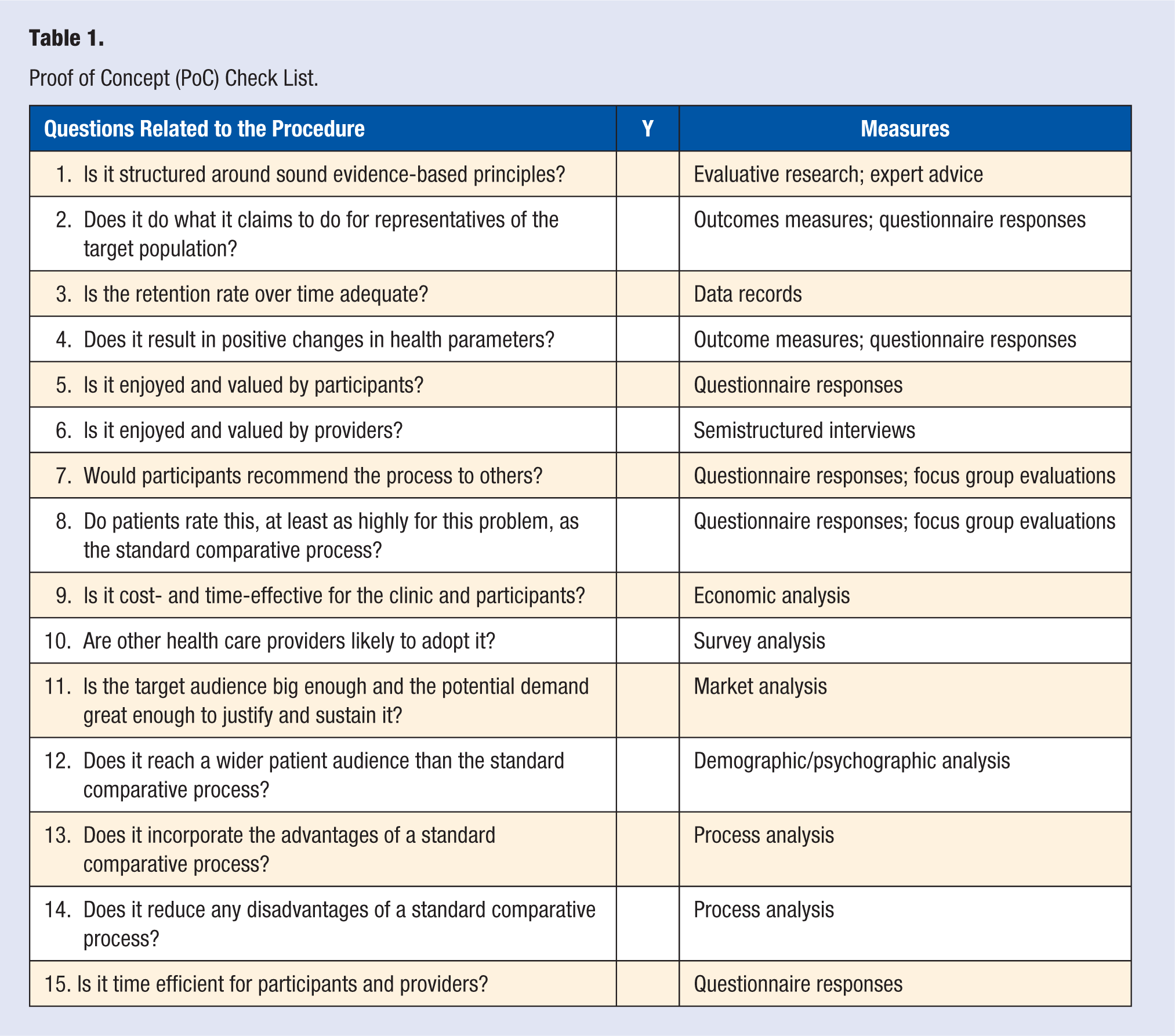
Other examples of skills, tools, and actions for LM include telephone triaging, psychogenetically determined behavioral scripts, de-prescription, lifestyle “nudging,” health coaching, and many more.
Summary
The practice of LM is a work in progress. With new skills, tools, and procedures being adapted or developed for the discipline, there is a need for techniques for measuring their feasibility before these are adopted. PoC testing allows LM to lead the way in the introduction of new procedures in a transformed era of clinical practice. It also offers opportunities to ensure the discipline is not distracted by processes such as 1:1 consulting that had historical precedent but lacks background support.
Footnotes
Declaration of Conflicting Interests
The author(s) declared no potential conflicts of interest with respect to the research, authorship, and/or publication of this article.
Funding
The author(s) received no financial support for the research, authorship, and/or publication of this article.
Ethical Approval
Not applicable, because this article does not contain any studies with human or animal subjects.
Informed Consent
Not applicable, because this article does not contain any studies with human or animal subjects.
Trial Registration
Not applicable, because this article does not contain any clinical trials.