Abstract
Research has connected sedentary lifestyles with numerous negative health outcomes, including a significant increased risk for mortality. Many health care professionals seek ways to help clients meet physical activity guidelines recommended by the Office of Disease Prevention and Health Promotion, the World Health Organization, and the American College of Sports Medicine in order to promote active lifestyles and improve overall wellness. Hiking is a cost-effective intervention that encourages people to be physically active while spending time in nature. Time in nature can lead to health benefits through contact with the natural elements, participation in physical activity, restoration of mental and emotional health, and time with social contacts. Benefits may be immediate, such as decreased blood pressure, decreased stress levels, enhanced immune system functioning, and restored attention, or transpire over time, such as weight loss, decreased depression, and overall wellness. Health care providers are ideally positioned to recommend and prescribe hiking to clients. Federal, state, and local natural resource agencies are beginning to partner with health care professionals to promote outdoor nature-related activities. Examples of successful doctor and other health care practitioner partnership programs are described, along with tips for getting started.
Keywords
‘Hiking can be considered accessible in terms of the limited skills and equipment needed, . . .’
Hiking is the act of walking for a substantive distance in the outdoors, often over natural terrain with obstacles such as rocks and tree roots to navigate around. 1 In this article, the authors demonstrate that as an outdoor physical activity, hiking has potent health benefits and is economical and convenient for most people. The absence of whole-body movement, primarily through sitting, has led to increasing sedentary lifestyles of much of the US population. Encouraging physical activity, such as hiking, is a way that health care professionals can promote patient wellness and health in both a preventive and curative manner. Hiking is unique in that it can help patients meet guidelines for regular physical activity and concurrently tap the significant health benefits that may be attained by spending time in natural settings. Hiking can be considered accessible in terms of the limited skills and equipment needed, as well as the ability for individuals to pick the terrain difficulty and the speed at which they walk.
In the United States, 43.3% of the total population qualifies as sedentary, the largest percentage of any country’s population worldwide. 2 Inactive and insufficiently active adults engage in less than 150 minutes of walking or moderate-intensity physical activity per week, whereas for children and adolescents this means engaging in less than 60 minutes of moderate to vigorous physical activity a day. 3 Inactivity increases with age, and women and older adults are more likely to live sedentary lives. 2 A lack of physical activity contributes to numerous health issues that can result in illness and premature death, such as cardiovascular disease and some cancers. An estimated 5.3 million premature deaths per year worldwide are attributed to physically inactive lifestyles. 2 In addition to the detrimental health impacts, physical inactivity and sedentary lifestyles increase health care costs for individuals as well as the overall health care system. 4 Hiking is one way to address inactivity and resulting illnesses. An Outdoor Participation Report showed hiking as an increasingly popular form of physical activity in the United States. 5 For select patients who can access hiking trails, hiking may be an enjoyable way to engage in enough physical activity to meet and exceed various recommended physical activity guidelines.
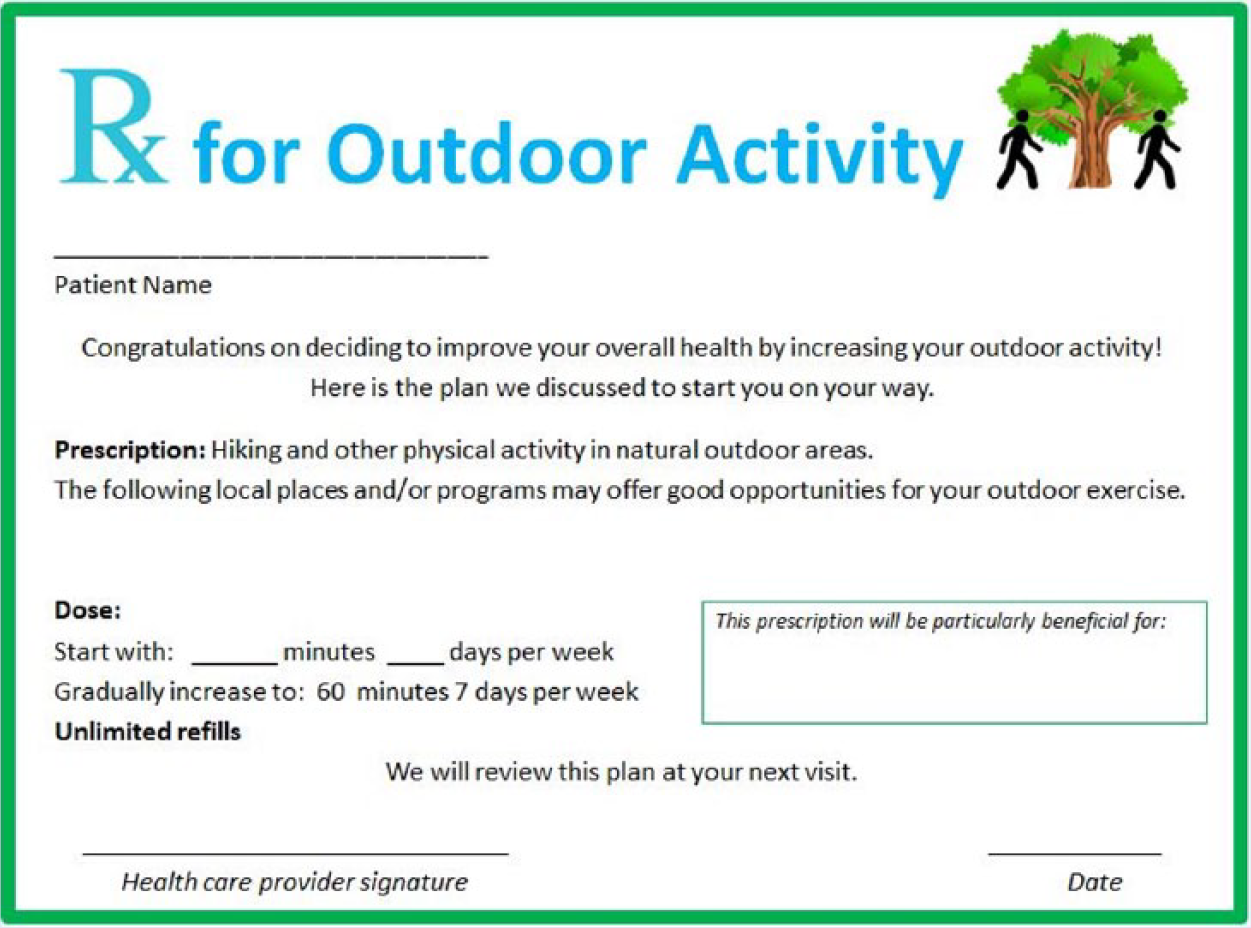
The aim of this article is to provide health care practitioners with the information and tools they need to feel confident when advising patients to incorporate hiking into their comprehensive health care strategy. After reviewing the need and recommendations for physical activity, we briefly present the wide array of important health benefits gained from being active in natural environments. We then specifically explore how hiking can promote health and wellness. Suggestions on how to start hiking are provided for practitioners to use for themselves and share with their patients. A template Prescription for Outdoor Activity is provided with practitioner instructions.
The Relationship Between Inactivity and Morbidity and Mortality
Early humans may have walked up to 12 miles a day finding food, exploring, and securing shelter. This activity provided our muscles and bones with abundant physical activity and our brains with enough oxygen for continued neuronal development. Present-day humans, especially in the United States and many other developed countries, are more sedentary across their life span. This lack of activity accounts for an estimated 6% to 10% of all deaths from major noncommunicable diseases 6 and 9% of premature deaths worldwide. 7 Irrespective of bodyweight, sedentary behaviors, such as sitting at a desk and watching television, are adversely associated with health outcomes such as obesity, cardiovascular disease, hypertension, and type 2 diabetes, as well as emotional and cognitive problems including anxiety, depression, mental fatigue, and stress.6,8-10 Additionally, poor skeletal health and some cancers, particularly breast and colon cancer, are linked to sedentary lifestyles. 6
Engaging in moderate-intensity physical activity has few negative side effects and is a low-cost alternative to prescription drugs. 11 As an example, regular hiking can lead to weight loss and Dietz et al 12 reported that even a 5% reduction in weight has substantial health benefits.
An early study published in The Lancet by Jerry Morris et al 13 confirmed the relationship between heart disease and level of physical activity at the workplace, and began the current movement to inform the medical community about the health benefits of being physically active. Since that time, research has continued to demonstrate that “being physically active is a major contributor to one’s overall physical and mental wellbeing” 14 and that those who are active in their professional and/or personal lives may avoid the health risks that come with a sedentary lifestyle. 15 For example, a recent study of 10 043 individuals with dyslipidemia (high cholesterol) showed an inverse association between fitness and all-cause mortality. 16
A number of systematic reviews by the US Centers for Disease Control and Prevention, US Department of Health and Human Services “Physical Activity Guidelines for Americans” project, and others have linked physical activity to health benefits and concluded that interventions should be developed that aim to both reduce sedentary behavior and promote physical activity.17-21
The studies and reviews informed the following recommendations for physical activity, 22 which are supported and promoted by the Office of Disease Prevention and Health Promotion, 23 the WHO’s Physical Activity Guidelines, 3 and the American College of Sports Medicine. 24 While each guideline is slightly different, the following captures the essence of the recommendations:
Children and adolescents from ages 6 to 17 years should engage in 60 minutes or more of moderate to vigorous physical activity each day.
Adults, including healthy older adults aged 65 years and older, are encouraged to engage in 150 minutes or more of moderate-intensity, or 75 minutes of vigorous-intensity, physical activity each week.
Both the WHO’s Physical Activity Guidelines and the 2008 Physical Activity Guidelines for Americans emphasize substantial health benefits from engaging in moderate-intensity physical activity, and they encourage muscle strengthening activities 2 or more times per week for all adults.3,23 The guidelines recommend that people unable to exercise for the proposed time frames strive to be as physically active as they can based on their present condition and abilities.
Health care providers are increasingly recognized as playing a pivotal role in encouraging people to become more physically active.25,26 When these recommendations come from a physician it was found that patient compliance was higher. Objective PA-11 of Healthy People 2020 encourages physicians to include physical activity counseling and education during office visits. 27 Valuing the role of physical activity in a clinical practice helps improve health indicators and save health care costs.28,29
Health care providers searching for cost-effective interventions should consider hiking. Hiking helps people meet physical activity guidelines and carries the added benefit of exposure to the natural environment. Hiking is not an ideal activity for everyone and is not necessarily accessible for all patients. Because of transportation constraints, some people may find hiking inaccessible. At the same time, programs like Rails to Trails are creating a network of flat trails out of former rail lines throughout US neighborhoods and cities, claiming to be accessible for people of all ages and abilities. Rails to Trails also lists wheelchair-friendly trails by state. 30 A recent call to action by the Surgeon General recognizes the health-promoting benefits of walking and the necessity for safe, walkable spaces as well as a culture that embraces the act of walking for fitness, transportation, socialization, and more. 31 As a form of walking, hiking encompasses the additional health benefits of time spent in nature.
The Natural Environment and Health Benefits
Researchers from more than 30 disciplines as varied as public health to outdoor education have studied the effects of exposure to nature on human well-being. 32 This research has examined multiple populations (eg, children, adults, patients, inmates, students), types of exposure to nature (eg, view of nature, domestic proximity to nature, being passive or active outdoors), and outcomes (eg, positive psychological and physiological changes, decreased morbidity and mortality, and positive subjective measures), and has suggested that the benefits of exposure to nature are both pervasive and generalizable.33-36 Possible pathways through which exposure to nature increases human health and well-being include the following: contact with natural elements (eg, daylight, fresh air); participation in physical activity; restoration of mental and emotional health; and time with social contacts. These pathways are often intertwined and may work synergistically across the life span.
While the benefits obtained from time spent in nature are frequently linked with the increased physical activity associated with time spent outdoors,37-40 the literature demonstrates that simply being exposed to nature, even in passive ways, has clear benefits. For example, an early landmark study demonstrated that viewing nature through a hospital window decreased recovery time and pain medication requests, and increased general well-being of patients recovering from gallbladder surgery. 41 More recently, the increasingly popular activity in Japan and some other Asian countries of forest bathing or Shinrin Yoku has been the subject of much study. Researchers have found the benefits of simply spending time in forests, or forest bathing, to include (a) decreased systolic blood pressure, 42 (b) decreased stress levels (measured through prefontal cortex activity and salivary cortisol), 43 (c) deactivated sympathetic nervous system (measured via urinary adrenaline and noradrenaline levels), 44 and (d) strengthened immune system (measured via enhanced natural killer cell activity and intercellular anticancer proteins).45-47 Each of these studies compared forest and urban environments, finding significant differences in health-related effects between the 2 environments throughout the study period. A theory is that inhaling the volatile antimicrobial organic compounds, or phytoncides, from particular trees may contribute to the health benefits. The studies indicated that health benefits begin accruing immediately on exposure to natural environments, then increase continually with sustained mild to moderate physical activity in nature. These effects persisted over time, lasting as long as 1 week after a forest bathing session.
Participating in hiking can simultaneously harness the health benefits of simply being in nature and of partaking in physical activity. Furthermore, unlike other forms of exercise such as going to the gym, many hikers report that hiking does not feel like exercise or working out. 48 In one study, hikers burned more calories than runners or walkers because they tended to spend longer periods of time outside enjoying nature than they would have if exercising in a different environment. 49 This is partly because physical exercise is often incidental to other goals of hiking, which include sightseeing, socializing, or experiencing nature. This means individuals may be more likely to persist in the activity over time, and to spend more time in a given session. 49 In addition, studies have found that exercise conducted outdoors has greater health benefits than comparable exercise conducted indoors. A study by Jelalian et al 50 randomly assigned 76 overweight adolescents to either a 16-week outdoor wilderness program or an indoor exercise program having comparable amounts of caloric expenditure and caloric intake. At the end of treatment, the older adolescents in the outdoor wilderness group lost 4 times as much weight as the indoor exercise group. A systematic review of 11 trials by Thompson Coon et al 48 used 13 measures to evaluate the effects of exercise on mental well-being and found that participant self-reports for outdoor exercises included positive effects such as greater feelings of revitalization and positive engagement, decreases in tension, confusion, anger, and depression, and increased energy. The same exercises conducted indoors did not elicit reports of these positive effects.
Many researchers have studied restoration of mental and emotional health, including stress reduction related to time in nature.51-53 In the 1980s, Rachel and Stephen Kaplan developed a theory of attention restoration (ART), which strove to explain how exposure to restorative environments—such as natural environments—can help people improve focus and mental health by resting directed attention.54,55 Building on this concept, empirical studies have found that when people are feeling stressed or depressed they tend to choose outdoor places such as wooded urban parks, places offering scenic views of natural landscape, and locations at the edge of water such as lakes or the ocean. 56 Olds 57 concluded that being in places with natural features can heal some cases of emotional depression. Sturm and colleagues 58 confirmed emotional benefits of time in nature, including reduced hopelessness, depression, and suicide ideation. People with greater connectivity to nature have been shown to demonstrate greater trait mindfulness and overall psychological well-being. 59
Time with social contacts in nature promotes positive psychosocial outcomes and research shows that people engage in physical activity more consistently when they do so with others.
60
Hiking is an activity to share in families, friendship groups, and with pets.61,62 For example, increased family bonding results from social connections created with others during time in nature. Natural environments stimulate social interaction between children
63
and an evaluation of a program in which students participate in a range of projects outdoors, such as constructing footpaths, found that children’s psychosocial health improved significantly as a result of participation.
64
Recent research on family nature clubs, community-based organizations that regularly bring families together to enjoy the benefits of time spent in nature, found that participation has significant positive overall effects on parental family life satisfaction, particularly in the areas of spending time together, sharing positive experiences, and a sense of parental efficacy; participation was also beneficial to the external relationships of these families, especially with regards to developing friendships with other families and a sense of connection with community.
62
A participant in this research study stated, We have hiking club traditions and the hikes give us the chance to talk about things the kids like. We are also able to share stories about the things we experience on our hikes together. I think that all provides another added benefit on a family level.
62
Time spent outdoors engaged in activities such as hiking can help individuals complete the developmental challenges faced in each life stage. Research provides convincing evidence that the benefits of time in nature are particularly profound for young children due to children’s greater levels of plasticity. 65 For example, children who regularly play in natural environments show more advanced motor fitness, including coordination, balance and agility, and are sick less often. 66 According to Ewert and colleagues, 33 teens are concerned with body image, sexuality, identity, and their future and encouraging participation in hiking provides teens an opportunity to relax, expend energy, and reflect on their needs and desires. 67 Among middle-aged women in Iran, a “green walking program” demonstrated increased personal growth, positive relations with others, self-acceptance, and sense of purpose in life. 68 Similarly, among older adults in Canada, hiking was linked to active aging in a way that promoted resistance to essentialism (providing a sense of control over the aging body and lessening dependence on medication), increased physical activity, and camaraderie. 69 Programs that promote hiking, either through individual education or through the formation of activity groups, offer alternative or adjunct health care to populations of all ages.
Success Stories: Health Care Practitioners Encouraging Patients to Hike
In April 2008, several US federal and nonprofit agencies organized an online meeting titled “Reconnecting Kids With Nature for Health Benefits.” The meeting was convened by the Society for Public Health Education for health care professionals, public health educators, environmental educators, and land conservationists to raise awareness of national efforts to promote children’s involvement in outdoor nature-related activities. Examples included school and youth organization partnerships to provide recreational activities on public lands for families; cost-share programs for local projects to connect children to forests; ambassadors on national wildlife refuges and fish hatcheries to encourage conservation values in children; programs to encourage children and families to visit national wildlife refuges and national parks; volunteer programs to restore habitat and build trails; and environmental health tools and resources to integrate into health education and practice. 70
The following programs, initiatives, and partnership specifically support health care professionals to help their patients engage in nature-based physical activities such as hiking and are representative of the many such efforts now occurring in the United States at national, regional, and local levels. Few of the programs have been able to effectively evaluate all elements of a program that has medical experts prescribing outdoor activity for health. Some specific outcomes that have been measured are the number of prescriptions written, the number of participants in special events, time spent participating, and participant attitudes toward exercising in nature.
Children and Nature Initiative: Rx for Outdoor Activity
The National Environmental Education Foundation’s (NEEF) ‘Children and Nature Initiative: Rx for Outdoor Activity’ program educates pediatric health care providers to integrate the value of being active in nature into patient care while promoting good health, enjoyment, and environmental stewardship. The program also connects health care providers with local nature sites, so that they can refer families to easily accessible outdoor areas such as parks and nature preserves. NEEF’s nature site partners include the US Bureau of Land Management, the National Park Service, the US Forest Service, the US Fish & Wildlife Service, the National Audubon Society, and local parks and recreation agencies.70,71 Tools such as nature prescription pads and a patient brochure give health care providers resources for patient education. 72
Nature Prescription Program
National Trails Day celebrations held in Henderson, Nevada in 2011 and 2012 helped more than 3,000 participants learn about the Nature Prescription Program. The Nature Prescription Program (which emerged from the NEEF Children and Nature Initiative) is administered through a partnership comprised of professionals from the Bureau of Land Management, National Park Service, US Fish & Wildlife Service, US Forest Service, and a variety of health care professionals and organizations. 73 Southern Nevada partners include the Children’s Heart Center, the Outside Las Vegas Foundation, the Clark County School District, and approximately 100 health care providers. Some of the people on the 1-mile Let’s Get Healthy! Family Fun Walk at the National Trail Days celebrations were following doctor’s orders according to a nature prescription, while others received prescriptions there. 74
Tiger on the Trail
In Harpers Ferry, West Virginia, Dr Mark Cucuzella began Tiger on the Trail as a voluntary collaborative to promote outdoor physical activity at a local middle school (the school’s mascot is a tiger). It resulted in a partnership with the National Park Service, a novel health/physical education program, and a change in school policy. Tiger on the Trail promotes noncompetitive physical activity using nature as the gym. Students learn about health, fitness, nature, and local history while hiking to and through local parks during school hours. Two hundred Tiger on the Trail participants indicated positive attitudes regarding physical activity, their happiness and ability to pay attention in school, and their intent to engage in outdoor physical activity postintervention. 75
Local Green Space Mapping
In Washington, DC, Unity Health Care pediatrician Robert Zarr mapped and rated the green spaces in the city for accessibility, cleanliness, safety, amenities, and services, producing a database that can be linked directly to patients’ electronic medical records. As of 2015, 180 doctors at 26 Unity Health Care locations across the city have signed on to the database, representing a potential reach of more than 100 000 patients. Dr Zarr recently studied 212 patients, and found a statistically significant increase in time spent outdoors following a nature prescription. 76
Healthy Parks, Healthy People
The National Park Service’s ‘Healthy Parks, Healthy People’ program is catalyzing similar efforts nationally. For example, ‘Getting Doctors Onboard Healthy Parks Healthy People Bay Area’, launched in 2012, involves numerous partners in all nine counties of the 7.1 million–resident San Francisco metro area. The city of San Francisco has adopted park prescriptions within its Department of Public Health, with weekly health-oriented programs at parks throughout the city. Plans to further the program include establishing a framework for regional park–health partnerships nationwide and an April 2016 conference on park prescriptions, designed to provide practical information for implementing and carrying out local programs.77,78 Health care providers and nature care providers continue to find mutual benefits in collaborating to encourage people to get out and hike.
Next Steps: Recommending Hiking to Your Patients
The following are specific suggestions for health care practitioners interested in encouraging their clients to include hiking as a part of their plan for a healthy lifestyle:
Learn about local nature programs and natural places by searching the Internet or consulting local environmental educators or natural area managers. Likely places and sources might be city, county, state, or federally managed natural areas within ~10-mile radius; programs such as Rails to Trails, Parks and People, or National Scenic Trails that may offer trail maps and guided hikes; hiking and outdoor adventure clubs, which often have announcements on Meetup, Facebook pages, and other social media sites; family nature clubs such as those listed with the Children & Nature Network; and webpages with search functions to identify nearby natural areas such as Nature Rocks, Nature Find, and Find Your Park.
Visit nearby natural areas to be able to personally recommend specific areas appropriate for clients. Groups of medical professionals can meet near local trails and hike together and with patients such as Docs in the Parks programs do. Promote local areas and events as some doctors’ offices and clinics do by posting photographs and maps of trails on their office walls. Provide information about outdoor events, such as National Trails Day, to clients. Every Kid in a Park is the theme for the National Park Service’s centennial anniversary in 2016 and the National Park Service is working with many partners to encourage children to visit parks, especially fourth graders.
Familiarize yourself with tips for successful hiking experiences so you can confidently advise patients that may be new to hiking. Hiking safety—People should choose hiking routes that are appropriate to their fitness and experience level. Before going to a new location, learn about the trail’s difficulty, length, location, and type of environment (eg, open sun, a wet marsh, rocky). Once a trail has been chosen, it is a good habit to make sure a close friend or relative knows of your plans, including the trail name, location, length, the expected hike duration, and the estimated return time. Hike with at least one companion whenever possible. Local hiking groups are a way to learn about locations to enjoy and to find hiking companions. Hiking gear—Hiking requires minimal equipment. A pair of sturdy shoes, a small daypack, and a water bottle are enough to get started. When hiking on level terrain, a basic pair of tennis shoes or trail running shoes may suffice. A pair of hiking boots can be beneficial for hiking on uneven or steep terrain. Trekking poles reduce strain on joints, improve efficiency, and are useful on uneven and steep terrain or for clients with balance, hip, knee, or ankle concerns. A daypack holds essentials needed during the hike. Depending on the length and type of hike, consider packing: (a) 3 to 4 liters of water, (b) snacks, (c) a map of the hiking area, (d) sun protection, (e) extra layers such as a rain jacket, and (f) a headlamp or flashlight. Printed hiking guides are excellent supplements to maps, since they often provide a detailed description of the area or the hiking trail that can aid in planning.
Write prescriptions for outdoor activity for clients who recommend specific programs and local areas to go hiking. Consider using a nature prescription to indicate the type and time period of outdoor activity recommended and the health issue the activity will address. During the next visit, the length of time or distance hiked can be adjusted and new sites suggested, if appropriate. A sample outdoor activity prescription form is included below. Offer guidance for getting into shape for hiking if needed. When starting any new form of physical activity, people should start slowly.79,80 For those who are new to hiking and not currently physically fit, for the first month a sample plan might include three 25- to 30-minute hikes a week on level terrain; the goal being to achieve a 20- to 30-minute mile. The second month, 15 minutes of hike time on hills can be incorporated into the 3 weekly hikes, increasing hiking time to 40 to 50 minutes until it is comfortable to hike at least 150 minutes per week. Mitten
80
emphasizes the importance of conducting both warm up and cool down stretches when hiking. Physical activity apps can be used to tracks steps, elevation, miles hiked, and calories burned during hiking excursions.
Conclusions
In The Lancet Series on Physical Activity, Das and Horton 14 challenged health care professionals to be on the forefront of creating a lifestyle inclusive of activity. They advocated for assembling “the best experts in the field and the best evidence to understand what we know about the relationship between human health and physical activity and creating a social revolution toward an active lifestyle and away from a passive one.” 14 Health care practitioners are in a pivotal position where they can serve as trusted advisors to counsel their clients to pursue new opportunities and to develop a holistic health care plan inclusive of physical activity in nature, such as hiking. As health care practitioners enhance their knowledge of the important health benefits of hiking they can help change client behavior to create a culture of wellness that includes activity in natural environments. In the United States, hiking is positioned well to become part of a comprehensive health care strategy to counter many sedentary lifestyle–related health conditions that currently lead to high morbidity and mortality rates. The synergistic effect of physical activity and time spent in nature make hiking an ideal activity to increase overall health and wellness. Multiple benefits for health and general well-being accrue from a lifestyle enriched by regular time in nature, among them breathing air rich in beneficial organic compounds, physical activity, restoration, and social bonding. 33 Benefits may be immediate, such as restoration, or transpire over time, such as decreased depression and overall physical health improvement. In short, hiking is a cost-effective intervention that helps people to meet physical activity guidelines, and carries the added benefit of exposure to the natural environment.
Prescription for Outdoor Activity Form
Health Care Practitioner Directions:
Do an Internet search of local nature programs and natural places. City, County, and State parks within ~10-mile radius. Programs such as Rails to Trails, Parks and People, National Scenic Trails. Hiking and outdoor adventure clubs on Meetup, Facebook, and so on. Family Nature Clubs such as those listed with the Children & Nature Network.
Visit several natural areas close to your office so you can make personal recommendations. What are the top 5 local places/programs you can suggest?
Make copies of the Prescription for Outdoor Activity for use during your appointments.
Fill out the prescription form with each patient’s name, recommended local places/programs, the initial dose of outdoor activity, particular issue you are recommending hiking for, and your signature and date.
Make note of this prescription in the patient’s file and follow up on it at the next visit.