




Abstract
Gastric banding (GB) is considered an option to support weight loss for individuals who are unable to lose weight through diet and exercise alone. Exercise is an important element of maintaining gradual weight loss following GB. Dog walking may be one method to encourage exercise and contribute to continued weight loss. Over a 5-year period, 24 individuals aged between 31 and 58 years (21 female; 12 dog-owners) were weighed at 7 time points. Intention to treat MANOVA analysis showed both groups lost a significant amount of weight, F(6, 17) = 15.7, P = .001, ηp2 = .85, but no difference was observed between dog owners and non–dog owners, F(6, 17) = 0.66, P = .68, ηp2 = .19, although from 24 months postbanding, data indicated dog owners appear to weigh less than non–dog owners. Further longitudinal research is warranted beyond 5 year post-GB; and encouraging exercise through dog walking may be a useful adjunct to increasing activity and promoting weight loss following GB.
‘A body of evidence is emerging suggesting dog walking may be an important factor in addressing the epidemic of obesity.’
Data indicate that worldwide 600 million adults are obese. 1 Complications of obesity include type 2 diabetes, cardiovascular disease, cancer, and functional impairment, for example, the inability to climb stairs without resting. 2 In addition, obesity may lead to social isolation due to mobility problems and social stigmatization owing to negativity of strangers toward appearance.3,4 To reduce weight, a combination of dietary changes and increased activity is most effective for weight loss and subsequent maintenance. 5 However, some individuals require surgical intervention to assist with weight loss, such as the placement of a gastric band (GB) to help an individual feel fuller after eating. 6
Evidence indicates that individuals who undergo bariatric surgery are more successful if they exercise postsurgery. 7 Walking is a particularly accessible form of exercise as it does not require any specialist equipment, has multiple health benefits, and may be a social activity.8,9 A body of evidence is emerging suggesting dog walking may be an important factor in addressing the epidemic of obesity.10,11 Research suggests dog owners are more likely to walk, even in poor weather. 12 There currently appears to be a lack of research on the implications of dog walking as it relates to either the short- or long-term outcomes of GB.
Between January 1, 2007, and December 31, 2009, individuals undergoing GB in a hospital in the South West region of the United Kingdom were invited by letter to participate in a longitudinal investigation into the impact of GB. In order to be eligible to participate in the study, patients had to fulfil the National Institute for Health and Clinical Excellence criteria for gastric banding (body mass index [BMI] ≥ 35.0 kg/m2 with type 2 diabetes mellitus or other weight-related comorbidity, or a BMI ≥ 40.0 kg/m2). 13 Biometric, psychometric, and qualitative data were collected. During analysis of the semistructured interview data, it was noted that a number of participants spoke of owning dogs. This prompted the formulation of the following question: “Do dog owners lose more weight following gastric banding than non–dog owners?” Findings presented are the secondary data analysis undertaken to quantitatively explore whether dog ownership has a long-term impact on weight loss following GB.14,15
Methods
Design
This longitudinal study had 7 data collection points: pre, 6, 12, 24, 36, 48, and 60 months post-GB.
Participants
Potential participants had to have been referred for obesity management and assessment for surgery to the Weight Loss Surgery Service in North Bristol via primary care or from other hospital units. Individuals were excluded if they had a major psychiatric illness or learning difficulties that might preclude them from being able to adjust their lifestyle after surgery.
The dog owners’ (n = 12) mean age at banding was 44.3 ± 7.6 years. Of this group, 11 were female, 11 were white, and 1 was Indian. The non–dog owners’ (n = 12) mean age at banding was 46.2 ± 6.5 years, 10 were female, and all described themselves as white. Ethnic classification was obtained by participants stating the ethnic category they felt they belonged to, a common practice in research. 16
Procedure
Ethical approval for this study was given by National Health COREC (REC Ref: 06/Q2002/38). Those who chose to participate gave written informed consent prior to data collection. Individuals were invited for interview at each data collection point. Prior to being interviewed, individuals were weighed.
Data Analysis
Individuals were grouped according to whether they were a dog owner or not. Mean and standard deviation of weight were calculated for each data collection point. A 7 (weight at each time point) × 2 (no dog vs dog owner) repeated-measures MANOVA was undertaken, with the last observation carried forward method applied for any missing weight data. 17
Results
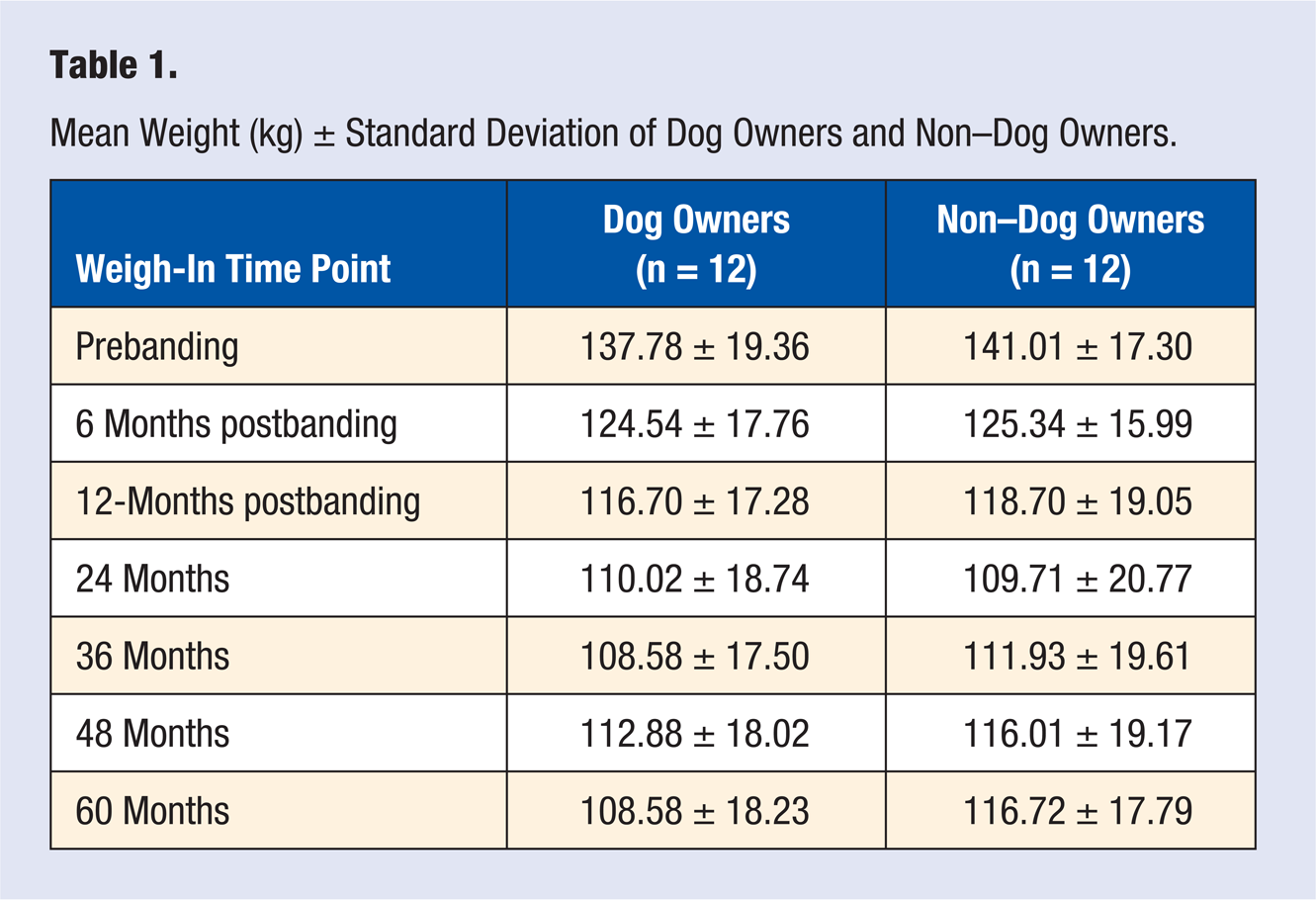
Table 1 shows the mean weight (kg) of dog owners and nonowners from prebanding to 5-year postbanding. A representativeness check to determine whether the groups differed in weight at baseline was performed, and no differences were found, t(22) = −.43, P = .67. Figure 1 suggests that the sample of dog owners have similar weight loss until 24 months postbanding. After this point, data suggested while non–dog owners’ weight begins to rise steadily, dog owners’ weight fluctuates but appears to be less than non–dog owners. The repeated-measures MANOVA showed over the 5-year period, both groups lost a significant amount of weight, F(6, 17) = 15.7, P = .001, ηp2 = .85, but no difference was observed between dog owners and non–dog owners, F(6, 17) = 0.66, P = .68, ηp2 = .19. Calculation of the effect size of the mean difference between the 2 groups at 60 months postbanding revealed a medium effect size (d = .45), 18 with dog owners weighing 8.14 kg less than non–dog owners.
Mean Weight (kg) ± Standard Deviation of Dog Owners and Non–Dog Owners.
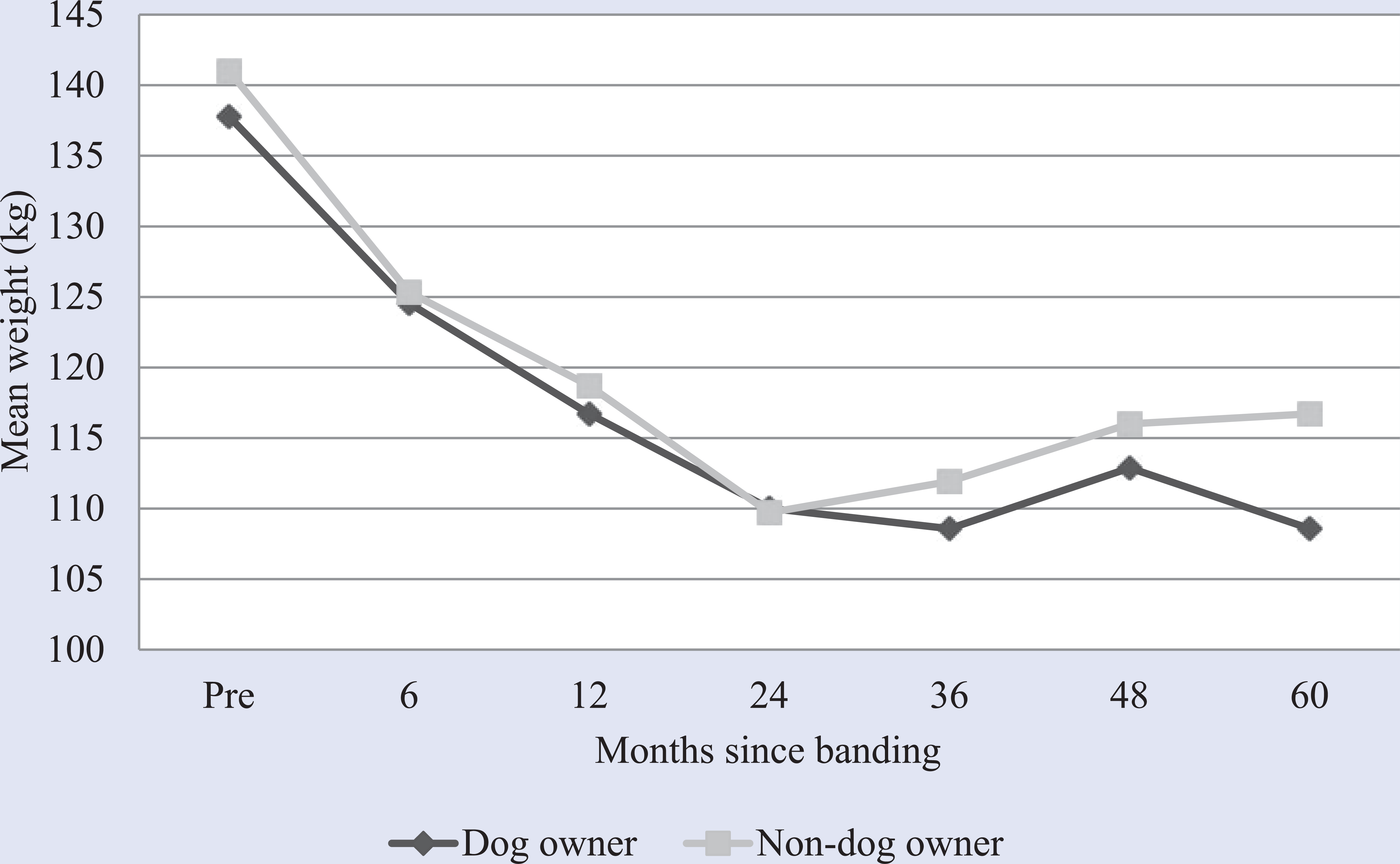
Mean weight (kg) of dog owners (n = 12) and non–dog owners (n = 12) over 5 years postbanding.
Discussion
As far as the authors are aware, this is the first exploration of the effect of dog ownership on weight loss following GB. Although results were not significant, there was a medium effect size at 60 months postbanding between the 2 groups. Furthermore, Figure 1 suggests that further longitudinal research is warranted beyond 5 years post-GB. While there is a fluctuating course of weight loss after 24 months, dog ownership may be a factor contributing to greater weight loss postbanding. It is postulated this might be due to increased mobility over time due to weight loss, 19 resulting in dog owners being able to walk with their dogs more. Mobility was not formally measured in this study; however, during interviews participants spoke of being more mobile and flexible as a result of losing weight.
Tailored exercise programs have been shown to enhance weight loss as they are linked to enjoyable activities for the individual, 20 but these may not significantly enhance weight loss long term. 6 One of the difficulties with GB is typically a plateau in weight loss that occurs around 24 months postbanding. 21 Based on evidence that dog ownership encourages walking regardless of weather conditions, 12 this would be a useful adjunct to postbanding interventions to help maintain weight loss. It must be stated that dog ownership is not the same as dog walking, that is, owning a dog does not necessarily mean an individual walks with his or her dog more. However, a recent meta-analysis indicates a direct relationship between dog ownership and dog walking, with dog owners walking more than non–dog owners as a result of owning a dog. 22 The authors would like to highlight that not owning a dog is not necessarily a barrier to dog walking. Charities exist that require individuals to walk dogs for owners with illness. 23 Promoting this link with specialist charities may help overcome some of the social isolation that has been linked with obesity. 24
Limitations
These data have been extracted from a longitudinal study that did not measure exercise levels pre- and post-GB. Therefore, data presented is limited and no conclusions can be drawn as to exactly how much dog walking behavior changed as a result of weight loss. Further research would benefit from incorporating a measure of walking behavior pre- and post-GB. 25 In addition, the analysis is likely to be underpowered due to the small sample. 26 Post hoc sample size calculations using G*Power advised a sample size of 62 to detect a medium effect size (d = .5) of a between-within repeated measures interaction, with 0.80 power, and α = .05, using MANOVA based on 7 measures of weight and 2 groups. 27
Conclusions
Dog ownership and/or dog walking could be an appealing means of encouraging individuals to increase activity levels following GB, and could be sustainable long term. More research is required to determine whether these proposed effects of dog walking as a method of continued weight loss after 24-month postbanding can be substantiated.
Footnotes
Acknowledgements
The authors would like to thank the 2 anonymous reviewers for helpful comments on an earlier draft of this article, and the participants who gave their time freely to participate in this research over 5 years. Financial support for the research came from money generated through commercial research studies and a charitable fund.