Abstract
Adolescents participating in sport have high demands for nutritional adequacy to meet their needs for growth, development, wellness and athletics. Nutritional risk can be quite high in this population due to their unique needs, low access to credible information and nutrition professionals, and misinformation in the media and marketplace specifically targeting athletes. Physicians and other health professionals have an opportunity to communicate nutrition facts and make evidence-based recommendations about healthy eating in the setting of their ongoing interactions with adolescent athletes and their families. The purpose of this review is to describe the nutritional needs of adolescents participating in sport and highlight the potential for nutritional risk. Endorsed by professional organizations, our recommendations emphasize a balanced eating pattern that includes a wide variety of fresh, minimally processed whole foods. Our approach is to empower and teach adolescents to take responsibility for planning, preparing, and providing themselves consistent access to foods and fluids that deliver nutrients needed for proper fueling and recovery. Specific talking points that health professionals can use in brief interactions with patients and families are provided to endorse key behavioral strategies that young athletes can adopt to achieve peak athletic performance and optimal nutritional status.
“Before bringing sport-specific advice into the conversation, the building blocks of healthy eating and nutritional adequacy must be in place.”
Sports Nutrition for Adolescents
Nutrition advice for adolescent athletes has, at its foundation, the principles of sound nutrition focused on adequacy to support the adolescent’s needs for growth and development in addition to increased needs for training and performance in sport. This advice is built on the US Dietary Guidelines, 1 which promote a nutritionally balanced eating pattern containing a daily variety of nutrient-dense foods. Before bringing sport-specific advice into the conversation, the building blocks of healthy eating and nutritional adequacy must be in place. Although athletes certainly have enhanced and often unique nutritional needs that are specific to their sport and their training regimens, proper nutrition to support adolescent growth is necessary at the core of any strategy to improve sports performance. Because of their distinct needs and transitional life stage, adolescent athletes are vulnerable to nutritional risk, fad diets, disordered eating, and marketing scams for nutritional products that promise fast results or improved performance despite the lack of an evidence base behind most claims.
For athletes, there are no shortcuts or substitutes for proper nutrition for optimal performance in sport. Supplements and functional foods will never overcome the deficits of poor nutrition for an athlete. The needs of adolescent athletes are different from the needs of adults and professional athletes, and the needs of competitive athletes are different from those of recreational athletes. Athletes in power sports have needs that are different from those in endurance sports and from those of sprinters. Even within a sport, field players have different needs from goalies, and swimmers have different needs from divers.2,3 Delving into these sport-specific nuances is beyond the scope of this review, but there are several books written by registered dietitians (RDs) to guide athletes and practitioners more specifically.4-8 Nonetheless, the common goal for every athlete is to achieve healthy eating behaviors centered on nutrient-dense and varied food choices, adequate hydration, dietary patterns that feature balanced meals and snacks to properly fuel training and competition and to enhance recovery, and intuitive eating behaviors that connect mind, body, and performance for the most successful outcomes.
Whereas functional foods or nutritional supplements may be indicated for certain individuals under certain circumstances and under the supervision of a RD and/or physician, they do not form the basis of sports nutrition, and they are not generally recommended for adolescent athletes.9-13 A diet based on fresh and minimally processed whole foods is what is advocated by professional organizations, including the Academy of Nutrition and Dietetics and the American College of Sports Medicine.10-12 For athletes whose goals include weight management or altering body composition to either build muscle mass or lose body fat or for athletes who have developed disordered eating or clinical eating disorders, referral to an RD is recommended. In all cases, we specifically recommend a nondiet approach to sports nutrition 14 that is weight neutral and centered on respecting body shape and size diversity, 15 promoting a holistic approach to achieve wellness and athletic goals, and that is grounded in eating competence 16 and intuitive, mindful eating.17,18
Healthy Eating Advice for Adolescent Athletes
The nutritional well-being of athletes depends on knowledgeable food choices. In fact, because of their special needs for proper fueling and hydration, athletes are faced with several opportunities demanding well-informed food choices every day, at every meal. Yet many adolescent athletes pay little attention to nutrition and largely underappreciate their protein and calorie needs, whereas others are influenced by dieting advice, functional foods/supplements marketed to athletes, and the desire to achieve either a competitive edge or an idealized athletic body type. With the help of a qualified sports nutritionist, athletes can learn to meet their nutritional needs with a flexible eating style that balances favorite foods with nutrient-rich foods to satisfy hunger, fuel workouts, maximize performance, and promote both physical health and emotional wellness.
Athletes need a varied and balanced eating plan that is adequate in energy, macronutrients, essential fatty acids, fiber, vitamins, and minerals. Although there are professional recommendations that guide the appropriate selection of foods and fluids for athletes, the timing of nutrient and fluid intake relative to exercise and competition, and supplement choices for optimal health and sports performance,10-12 the underlying principles of sound nutrition for health promotion in the general adolescent population form the foundation of dietary advice for those who participate in sports. The eating pattern that is recommended is one that allows growth, development, and maturation of youths and adolescents19,20 and maintenance of a healthy body weight.10-12 These nutritional goals can be met by including a predominance of plant foods in the daily diet, specifically fruits, vegetables, whole grains, legumes, nuts, seeds and unsaturated vegetable oils; inclusion of lean animal proteins, specifically low-fat dairy foods that provide vitamin D and calcium, fish, poultry, and iron-rich lean meats; and moderation of foods high in saturated or trans fats, sodium, and added sugars. In general, no vitamin and mineral supplements are required if an athlete is meeting energy needs by eating a balanced diet containing a variety of whole foods and is maintaining body weight.9-13
To meet such high nutritional needs, athletes need to fuel their bodies frequently throughout the day. This involves a daily commitment to 3 meals and frequent snacks strategically placed before and after workouts, practice, and competition. This level of commitment requires adolescent athletes to prioritize nutrition and feeding themselves, taking personal responsibility for ensuring ready access to nutritious foods, snacks, and fluids. Selection of foods that are nutrient dense, easily digested, and well tolerated are equally high priorities.
Nutritional Risk in Adolescent Athletes
Athletes participating in different sports have unique nutritional needs because of differences in energy expenditure, hydration, and the demands of the sport. Challenges and obstacles to good nutrition are also distinct within subgroups of athletes. Eating behavior is highly personal, yet heavily influenced by environment and important others, including peers, teammates, professional athletes, coaches, celebrities, and the media. As such, unhealthy behaviors and nutrition misinformation can set an athlete on a path that could undermine athletic performance, contribute to sports injuries, and have serious health consequences. These circumstances introduce vulnerability to nutritional risk that spans a spectrum and can include dieting, restrictive eating, disordered eating (anorexia nervosa, bulimia nervosa, binge eating disorder, anorexia athletica, and orthorexia nervosa), misuse of nutritional supplements, “uninformed” vegetarianism, and a variety of unhealthy weight-cutting practices that can sabotage athletic performance.
Adolescent athletes are quite vulnerable to the ill effects of suboptimal nutrition. Not only is their performance in sport threatened, but their growth, development, and maturation can be impaired by poor nutrition. Among the special issues that physicians caring for adolescent athletes are urged to address are nutritional needs and supplement use. While focusing on achieving healthy body weights and avoiding use of supplements and ergogenic aids, a 2008 consensus statement for team physicians made a clear recommendation to emphasize health and performance over weight goals and to understand the impact of pathological weight behaviors on adolescent growth and development. 13
Three major concerns are iron deficiency anemia, compromised bone health, and disordered eating/eating disorders. A well-described combination of risk factors known as the female athlete triad consists of inadequate food intake, amenorrhea, and reduced bone mineral density.21,22 This triad poses a specific threat to athletes in both the short and long term because the opportunity to reach peak bone mass can be negatively affected by poor nutrition during adolescence. In an updated definition acknowledging that male athletes are similarly affected, the triad was described as one piece of a more comprehensive syndrome called RED-S (Relative Energy Deficiency in Sport). RED-S consists of “impaired physiological function including, but not limited to, metabolic rate, menstrual function (in females), bone health, immunity, protein synthesis, and cardiovascular health caused by relative energy deficiency” (p. 491) where an imbalance occurs between dietary energy intake and energy expenditure required to sustain homeostasis, health and activities of daily living, growth, and supporting activities. 23 The resulting package of low energy availability, disordered eating behavior, and pathological weight control measures that may include starvation, excessive exercising, purging, or laxative abuse, often driven by body image dysmorphia, results in hormonal and metabolic imbalances, serious medical complications, sports injuries, and impaired athletic performance. 24
Adolescent athletes are vulnerable to the pressures of competitive sports and the demands of physical training on their still-developing bodies as well as the influence of coaches, teammates, peers, parents, society, culture, and the media. There is tremendous pressure, for example, exerted by society and the media that idolizes thinness and an ideal body image—one that is far different from the average adolescent athlete’s body size or shape. This is not only an issue for female athletes who perceive the need to diet, but also for male athletes who are faced with the challenge of developing “abs of steel.” Adolescents do not necessarily have the nutrition knowledge to practice sports nutrition, nor do coaches who most typically coach at the middle school or high school level. Taken together, there is tremendous potential for misinformation and pressure for dieting behavior or supplement use. The risk for disordered eating and eating disorders is high in the adolescent athlete population.25,26
Role of Physicians and Other Health Professionals
For nutrition advice to be adopted and sustained by adolescents, it must be food based, practical, achievable, and personally relevant. Yet sports nutrition guidelines are oftentimes nutrient based, framed in technical terms involving mathematical equations, and highly sport specific, leaving athletes confused and misinformed, unable to translate the advice to their own personal needs and vulnerable to adverse outcomes. The role of the nutrition professional in sport is to successfully translate these guidelines from nutrients to foods, and from science to practice.
Recognizing nutritional risk and making referrals to RDs is essential for those in need of nutrition assessment and counseling. This task is a priority for physicians and other health professionals who work with adolescent athletes. In addition, having proactive conversations with youths and families to share evidence-based advice about healthy eating is a strategy that can promote wellness, prevent injury, and help athletes achieve their goals in sport. Appropriate messages that physicians and other health professionals can convey in brief interactions to endorse healthy habits for adolescent athletes are summarized below. In general, strategies that promote positive and empowering messages that encourage adolescents to take responsibility for feeding themselves and to focus on foods to include to maximize nutrition, rather than focusing on foods to restrict or avoid, are recommended.
Fill your plate with fresh food: Reflect on your food choices and consider how many of the things you eat come from packages that you simply tear open and eat, or heat and eat. For good health and sports performance, it is time to shift the balance to include real foods like fresh fruits, fresh vegetables, nuts, beans, dairy, lean meats, chicken and fish, and minimally processed whole grain foods in your daily diet. Fuel your body with food, not with supplements and energy drinks or other sports products that masquerade as food.
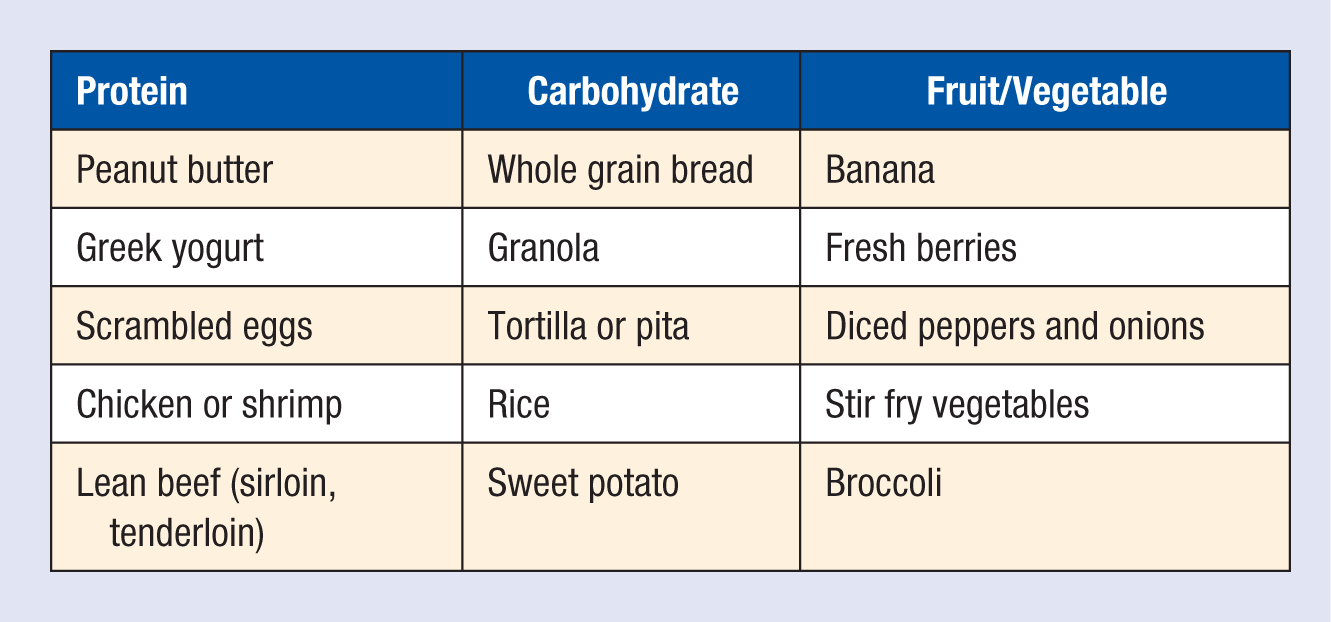
Eat to compete: Athletes need to eat breakfast, lunch, and dinner with snacks in between to be properly fueled for performance. Skipping meals is not a strategy for success. Break your overnight fast (“breakfast”) with a balanced meal. Follow this simple meal-building strategy to create balanced meals including these key components:
Reload for rapid recovery: Exercise creates muscle breakdown, so it is important to refuel your body within 30 minutes after practice or a competition to promote muscle repair. Best choices for recovery nutrition are those that provide a combination of fluid, electrolytes, carbohydrates, and protein. Try chocolate milk or yogurt, a mini bagel with peanut butter and an apple, or homemade trail mix of nuts, dried fruit, and whole grain cereal along with recovery fluids.
Hydrate: Under most circumstances, water is the only sports hydration you need, especially if you are fueling yourself by eating a variety of healthy foods throughout the day.
Color your plate: Different-colored foods have different nutrients. Getting several colors onto your plate at every meal or snack delivers more nutrition to your body. Do not just “eat white” by loading your plate with white rice, chicken, and cheese. Add color by adding tomato salsa, black or brown beans, and grilled vegetables like peppers and onions.
Plan ahead: Good nutrition does not just happen. It involves some work and advance planning. It requires access to healthy choices and hydration. Just like you pack up your sports gear, pack snacks like fruit, string cheese, whole grain crackers, nuts, or granola bars into your bag for long bus rides so you do not miss the recovery nutrition window needed to fuel your body after the game.
Change it up: Peak performance requires athletes to be well nourished, uninjured, fit, focused, and ready to compete. Sports nutrition is not just about calories to achieve weight or body composition goals; nor is it all about protein for muscles or carbohydrates for fuel. It is also about micronutrients like iron to avoid anemia, calcium and vitamin D for bone health, and other vitamins, minerals, and antioxidants for wellness, immunity, and recovery from injury or surgery. Eating an adequate variety of nutritious whole foods is your best strategy to achieve these goals.
Ask for help: Disordered eating and eating disorders are more common than you might think. Furthermore, amenorrhea in female athletes is not normal and is one of several clues, along with weight loss or underweight status, that food intake is insufficient compared to the energy demands of training for sport on top of adolescent growth needs. It is important to address these warning signs of nutritional risk, and help is available to get you back on track. If you are having difficulty feeding yourself or maintaining weight in a healthy range, seek help from a physician, qualified health professional, and/or registered dietitian.