




Abstract
Prevalence of overweight and obesity in youth has steadily increased over the last decade, although it appears to have currently stabilized. Physical inactivity is a major contributor to this obesity epidemic, and more than half of American youth do not meet physical activity recommendations. Rock climbing and bouldering require both aerobic and anaerobic fitness, with the metabolic cost comparable to moderate to vigorous physical activity in adults. Minimal data on youth climbers exist, yet climbing is extremely popular with youth, and thus the sport may be a viable option for decreasing the prevalence of obesity. Available data show that rock climbing can provide youth with muscular strength and endurance building exercise, and possibly improve flexibility. In addition, rock climbing has the potential to provide youth with moderate levels of physical activity according to recommended guidelines. Nine peer reviewed articles are included in this review, as these are the articles specifically associated with youth climbing and health-related fitness. Due to limited research in this area, no articles were excluded if they were related to health-related fitness and youth and rock climbing/bouldering. This review aims to systematically address the impact of rock climbing and bouldering on health-related fitness in youth.
‘Of late, alternative types of activities such as rock climbing and bouldering have become increasingly popular.’
Introduction
Overview of Fitness and Obesity and Activity in Youth
In the United States and the United Kingdom, the combined prevalence of children and youth 2 to 19 years of age with a body mass index greater than or equal to the 85th percentile is approximately 32% 1 and 29%,2,3 respectively. The prevalence of not meeting physical activity guidelines is approximately 60% in American youth,4-7 and physical inactivity is a major contributor toward the obesity epidemic. Additionally, a low level of physical fitness has been shown to be an independent risk factor of premature morbidity and mortality. 8 Consequently, this trend toward inactivity impacts not only the health of the individual, but also that of the society in general. Clearly, sustainable activities to increase physical activity and, thus, the well-being among youth are necessary. Of late, alternative types of activities such as rock climbing and bouldering have become increasingly popular.9-11 This popularity may be due to the fact that rock climbing has been shown to be an enjoyable vigorous activity, and as such can be used as an alternate and potentially more sustainable proxy for fulfilling recommended amounts of exercise. Articles in the popular press, such the UK National Health Service and the US National Parks and Recreation programs, have been advocating the advantages of these activities for adults and youth.12,13 Therefore, this review will address the health-related benefits that may be obtained when children and adolescents take part in rock climbing.
Overview of Rock Climbing
Rock climbing encompasses numerous different disciplines, including, but not limited to, top rope climbing, sport climbing, traditional climbing, and bouldering. 14 Top rope climbing involves a person ascending a route with a safety rope attached from above, ensuring minimal falling when the climber releases his/her grip on the rock. Sport climbing involves ascending a route with a safety rope attached; the climber clips preplaced bolts on the route every few meters to prevent a large fall when the climber lets go of the holds/rock. Traditional climbing works on the same principle as sport climbing except there are no preset bolts, and as such, the climber must place his/her own protection into cracks in the rock to prevent large falls. Bouldering encompasses a small number of moves that are generally powerful in nature, and low to the ground; most climbers use a crash pad to protect from injury in case of a fall. All disciplines of rock climbing are distinctly different activities when compared to standard sports (soccer, baseball, basketball, etc) or other physical activities in which youth traditionally participate.
In the 1990s, many US elementary schools had traversing/bouldering walls in which individuals worked their way across a section of wall horizontally. In addition, teachers and professionals in the field knew that traversing/bouldering had potential benefits in the motor, cognitive, affective, and social domains. 15 Unfortunately, concerns about liability and funding problems in physical education programs led to many of these walls being underutilized, covered up, or removed. 15
Participation Rates
Perhaps due to the unique nature and constant variation during climbing and bouldering, youth are taking to these activities in large numbers; approximately 5 million youth younger than 18 years of age climb in rock gyms in the United States.11,16 Furthermore, in the United Kingdom, participation rates have consistently increased. 9 According to the British Mountaineering Council, in 2015, over 350 public access climbing gyms are in use; France has in excess of 2200 climbing gyms, and Australasia has also seen exponential growth.9,17-19 As participation rates continue to increase, youth are actively pursuing the sports of indoor rock climbing and bouldering. 20 Thus, climbing and bouldering are likely to be viable options for reducing physical inactivity and improving overall health-related fitness in youth. Although access and cost can be prominent barriers to sport participation in youth populations, as the sport increases in popularity, the associated cost has reduced, making it easier to partake. 16 Furthermore, 14% of British schools now offer climbing and bouldering as school-sponsored activities. 20 In addition, various elementary schools in the United States have again added climbing and/or traverse walls to their school gyms, and some universities in the United States, the United Kingdom, Australia, and other countries have begun climbing/outdoor recreation programs that not only use rock climbing as a means of increasing physical activity but also as a way of increasing cultural awareness and improving both mental health and well-being.15,21,22 However, despite the growing popularity of climbing, much important information remains unknown, such as (a) the types of children who engage in the sport on a regular basis and (b) if rock climbing and bouldering provide physical activity opportunity at intensities that could be considered health-enhancing for youth.
With the geographical availability of rock gyms, the affordable price, as well as the interest shown by youth in this activity, training youth to rock climb safely will allow them more opportunity to be active, and thus decrease their risk of sedentary behavior, overweight/obesity, and their sequelae, metabolic and/or cardiovascular disease. Once they have acquired the skill set for climbing, youth then have the prerequisite skills and knowledge to climb/boulder outdoors. A myriad of outdoor opportunities for these activities are available, and outdoor activities have been associated with improvement in overall well-being in adults. 23 The fact that rock climbing and bouldering are more accessible, popular, and recurrent activities suggest salient reasons for considering them as viable options to increase physical activity in today’s youth. In addition, some data show that rock climbing can provide youth with much-needed muscle and bone strengthening activity, in addition to providing them with moderate levels of physical activity.24-32
Overview of Current Rock Climbing Benefits in Adults
The physiological demands of rock climbing require both aerobic and anaerobic fitness.33-35 However, much recent evidence suggests that whole body aerobic capacity may not be limiting for elite-level performance.36,37 As research speculating on the relative energy system contributions remain discordant, it is well known that rock climbing can increase both muscular strength and endurance as well as have the potential to improve flexibility.38,39 Furthermore, the metabolic cost of climbing can be comparable to moderate-to-vigorous physical activity as exercise intensity in recreational adult climbers (
Overview of Rock Climbing Benefits in Youth
As researchers, teachers, and parents strive to find activities that children and adolescents will perform on a regular basis, with enough duration and intensity to improve health-related fitness, nontraditional activities are becoming more popular and may provide additional benefits. Engaging in nontraditional physical activities may address important psychosocial correlates of physical activity. 15 Self-efficacy (situation-specific self-confidence) and enjoyment of physical education and physical activity are key components linked with physical activity in youth. 44 For example, rock climbing has been shown to improve self-efficacy in 6- to 12-year-old youth with disabilities. 45 In addition, although outside the scope of this review, some anecdotal evidence does suggest that rock climbing in youth may increase self-esteem, self-efficacy, and improve confidence in youth.
Although the number of youth who are rock climbing/bouldering is rapidly increasing, very little research exists for the recreational-level participant.30,32 Some evidence on the physiological demands of competitive elite youth climbing exists,39,46,47 as well as on the anthropometric requirements. 24 Of late, more articles are addressing the impact of rock climbing on the overall health-related fitness of youth.25-32
Selection Criteria
The purpose of this review was to determine from the available literature whether rock climbing can be used to promote healthy lifestyles in youth. Nine articles that addressed youth rock climbing and at least one component of health-related fitness were selected.24-32 Although many articles exist on various aspects of rock climbing and bouldering in adults, few exist on youth. Eleven articles on youth rock climbing were found in the literature (2 articles were removed for not meeting the specific criteria stated above). In order to obtain as many articles addressing youth climbing and health-related fitness as possible, all reference lists from articles on youth rock climbers were assessed, multiple databases were mined, rock-climbing and mountaineering websites were reviewed, and authors who have published in this field were questioned for further research articles. (One study addressing just the physiology of climbing, 39 and a further study reporting information on cortical bone changes and injury risk in elite German youth climbers compared to recreational controls 48 did not fit the parameters of this review, as the 2 articles did not specifically address components of health-related fitness.) One of the articles included in this review is under review 28 (published abstract used here), and the remaining articles were published between 2003 and 2015.24-27,29-32
The studies and associated data included in this review are presented in Table 1. In the following sections, the information from the gathered literature addressing health-related fitness components in youth rock climbers is presented and assessed.
Studies Reporting Impact of Rock Climbing on Physical Activity in Youth.
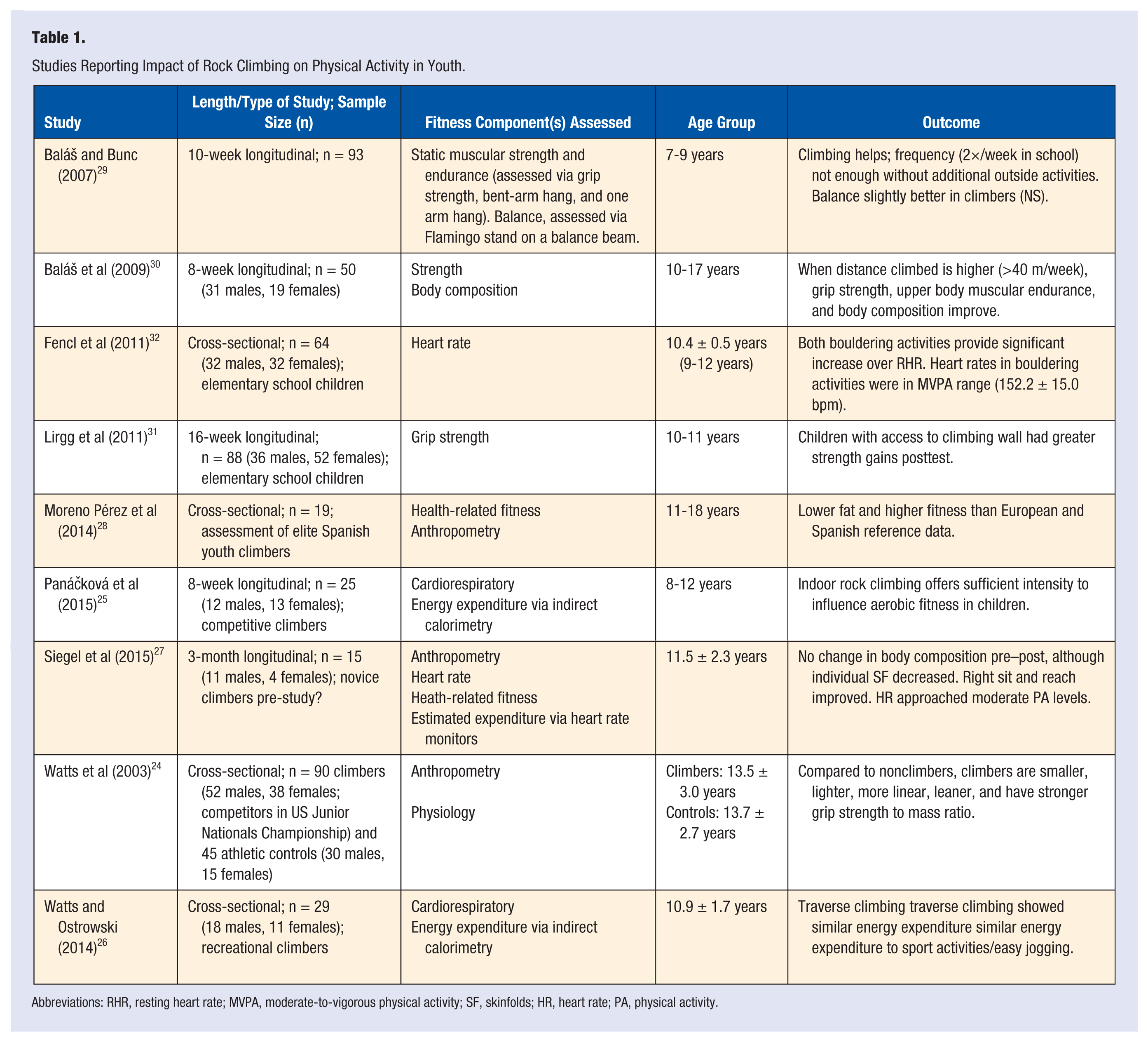
Abbreviations: RHR, resting heart rate; MVPA, moderate-to-vigorous physical activity; SF, skinfolds; HR, heart rate; PA, physical activity.
Recommendations for Physical Activity in Youth
The US Department of Health and Human Services (US DHHS) guidelines for physical activity in youth have recommended moderate and vigorous aerobic, muscle-strengthening, and bone-strengthening activities. 4 The current definition of moderate and vigorous physical activity used in the US DHHS guidelines 4 follows the recommendations of Armstrong and Bray. 6 The authors suggested a heart rate of >139 beats per minute and >159 beats per minute represent moderate and vigorous physical activity, respectively. Furthermore, the US DHHS guidelines 4 suggest 60 or more minutes of aerobic activity a day at a moderate to vigorous intensity, with at least 3 of these days including vigorous-intensity physical activity. As part of these weekly activities, youth should also include muscle-strengthening and bone-strengthening exercises for at least 3 of the days. 4
Health-Related Fitness
At least 1 of the 5 components of health-related fitness (muscular strength, endurance and flexibility, cardiorespiratory fitness, or body composition) was assessed in the youth climbing studies compiled for this review (n = 9). However, many of the standard assessments for health-related fitness lack ecological validity. That is, they do not closely mimic the real-world application of these components in rock climbing. Thus, many of the common health-related fitness assessments may not be sensitive enough to detect physiological/biological changes. Consequently, rock climbing studies have often adapted traditional health-related fitness tests to assess sport specific changes where possible.35,37,39 In addition, many of the reviewed studies are cross-sectional in nature, and thus cannot necessarily give adequate information on the long-term physiological benefits. Nonetheless, they do show trends from the activity and, as such, stimulate further discussion and promote future investigations into the use of rock climbing as a tool for increasing physical activity and reducing the obesity epidemic.
In rock climbing, muscular strength has previously been assessed using handgrip dynamometry.24,27,29-31 Pushups, sit-ups, flexed (bent)-arm hang, and repeat bouts of climbing have been used to assess muscular endurance in youth climbers.25-27,29,30 The cardiorespiratory fitness of youth rock climbers has only recently been assessed using portable metabolic carts during repeat bouts of climbing.25,26 Previously, data on the aerobic fitness of youth climbers have been absent from the literature, thus only allowing practitioners to speculate on the relative aerobic benefits of the sport. In the reviewed climbing studies, body composition was estimated via the body mass index, skinfold measures, and/or bioelectrical impedance analysis.24,29,30 While all of these methods can help describe the sample, some give more information than others. For example, body mass index is a good descriptor—it can help differentiate between diverse groups but it is not very sensitive. Skinfold measures can be a very good way to estimate body composition, but they can be variable, depending on the skill and consistency of the operator, and which predication equations are used. Bioelectrical impedance analysis is probably one of the easiest methods for assessment. However, the equipment needs to be research grade, and hydration levels need to be taken into account to ensure validity. Climber-specific tests would be beneficial for all of the components of health-related fitness. But as they have not been designed for all of the components as of yet, this review will address what has been assessed in youth climbers to date.
Muscular Strength and Endurance
Muscular strength is the ability of a muscle to exert a maximal or near maximal force against an object, while muscular endurance is the ability of a muscle or group of muscles to sustain repeated contractions against a resistance for an extended period of time.49,50 As mentioned previously, 5 of the studies included in this review used handgrip dynamometry to assess muscular strength.24,27,29-31 Although it is a standard way to assess strength, the way in which grip strength is measured does not really represent how rock climbers use their hands for grip strength. Nevertheless, population norms exist for comparison with standard handgrip dynamometry assessment. As might be expected, youth rock climbers perform well relative to age- and sex-matched norms.24,27,29-31 Two longitudinal studies showed an increase in muscular strength and endurance in youth climbers over time, as assessed by handgrip dynamometry.30,31 However, climbing alone did not improve muscular strength during a 10-week program when the children (7-9 years) climbed twice a week for 45 minutes. 29 Baláš and Bunc suggest that more time climbing was necessary to see improvement, as out of school activities (nonclimbing) did show an increase in static strength. 29 Watts et al showed that as climbing ability increased, so did strength (as assessed with handgrip dynamometry). 24
As well as improvements in handgrip dynamometry with climbing ability, 2 studies showed improvements in muscular endurance.29,30 In both boys and girls, climbing distance (m) was related to an increased flexed-arm hang time during an 8-week training study. 30 This highlights the specificity of training to show improvements in muscular strength and endurance in sports. Further emphasizing the point, no significant differences were found in sit-ups or pushups following a 12-week study. 27
Flexibility
Flexibility is defined as the range of motion around a joint or joints.49,50 In youth climbing studies, the sit and reach has been used in only one study to assess low back, hamstring, and gluteal flexibility. 27 However, the sit and reach test lacks specificity for rock climbing, although it is a quick and easy test to use in the field, and normative data exist for comparison. In climbers 8 to 16 years, Siegel et al 27 used the Fitnessgram protocol pre and post a 12-week study; the youth climbers showed some improvement in flexibility over time in the right side, but not the left. 27 However, relative to Fitnessgram norms, the youth climbers were in the healthy fitness zone for flexibility.27,49 Due to the multiple joints involved in the sit and reach motion, it is hard to obtain ecologically valid data, and so drawing valid conclusions remains difficult. In addition, unless the youth climbers were specifically working on their flexibility over the course of the study, it was not likely to improve as a direct consequence of merely partaking in the sport.
Cardiorespiratory Fitness
Cardiorespiratory fitness is the body’s ability to consume, deliver, and extract oxygen for physical work.
49
Two studies25,26 have assessed cardiorespiratory fitness and energy expenditure via use of a portable metabolic cart (indirect calorimetry). Watts and Ostrowski
26
had youth climbers perform 5 minutes of sustained traversing (with a 5-minute rest after), and a set of 5 interval climbs (1 minute traverse, 1 minute rest). The average
Panácˇková et al
25
assessed a group of youth climbers on a 10-m route, climbed twice in rapid succession, in order to provide a climbing bout of at least 3 minutes. The climbers could climb a vertical route and/or a slightly over-hung route. No differences between males and females were found in peak
Body Composition
The 2-compartment model of fat mass and fat-free mass was used in all studies included in this review. Skinfold assessment was used in 3 of the studies,24,27,28 while 2 others25,30 included bioelectrical impedance analysis to estimate body composition. In general, active rock climbing youth have lower body fat than nonclimbing controls.24,28 Neither of the longitudinal studies (8-12 weeks in length) showed significant decreases in overall fat mass.27,30 However, Baláš et al showed that those who climbed more (higher climbing volume) had lower percentages of fat than those who climbed less. 30 In addition, skinfold assessments showed that the biceps and supraspinale decreased between pre and post testing in novice youth climbers, 27 but overall fatness did not. The lack of significant change in body composition over time can be related to the small sample sizes, 27 or the length of the studies.27,30 Although the studies ranged from 8 to 12 weeks, which is often enough time to see changes in body composition, neither study changed nutrition nor assessed eating habits of the climbers; the studies were not specifically designed to alter body composition. Nevertheless, given the decrease in some of the skinfold measures in the study by Siegel et al, 27 it does appear that rock climbing has the potential to improve body composition in novice youth climbers. Further longitudinal research specifically addressing this component of health-related fitness in sedentary or overweight youth would allow researchers to quantify the positive effects of rock climbing on body composition with greater accuracy.
Balance
Although not used in the United States as a standard assessment of health-related fitness, balance is part of the Eurofit protocol. 50 For the Eurofit requirements, a person has to stand on one leg (flamingo or stork stand), with the other leg flexed, while standing on a raised beam. 50 Baláš and Bunc found that balance was not significantly enhanced during a 10-week climbing program. 29 Due to the multifaceted nature of climbing, it may be that other solutions to balance-type problems while rock climbing may have been utilized. The use of the flamingo stand lacks ecological validity in a rock climbing scenario, and thus may have not shown any differences. For the most part, climbing is a matter of keeping 2 or 3 points of contact with the wall. 14 Therefore, a one-footed balancing act with no other support may not be associated with improved climbing performance. However, the use of the proprioceptive enhancements may help improve overall body awareness and stability.
Energy Expenditure
In assessing youth climbers (11.5 ± 2.3 years) partaking in three 2-hour climbing sessions per week, Siegel et al 27 estimated calories used as 5.7 ± 1.7 kcal/min per climbing session, which could include climbing, belaying, and bouldering. In the same study, youth often reached the 139 beats per minute in heart rate required for moderate physical activity, although they were rarely in that range for extended periods of time. 27 Similarly, Panácˇková et al 25 found that youth climbers burned between 5.7 and 6.3 kcal/min in climbing specifically, depending on sex/gender and difficulty of climb. As such, Panácˇková et al concluded that indoor rock climbing has the potential to improve aerobic fitness in youth. 25 Fencl et al 32 showed sufficiently high heart rate for moderate physical activity (152.2 ± 15.0 beats per minute) in their assessment of grade school children in traditional bouldering and bouldering games, and importantly, Watts and Ostrowski 26 found that energy expenditure in youth climbers were similar to some mainstream sporting activities such as light jogging and some team sport activities. Thus, while youth may achieve the moderate level of physical activity with respect to their heart rate data, the duration of the activity is often not enough to meet current aerobic exercise guidelines. 4 This situation seems especially applicable to the recreational and/or school-based type of youth climber. Nevertheless, recent evidence supports the idea that high-intensity interval training (to which rock climbing seems most similar) does provide long-term aerobic benefit. 52
Future Research
Although emerging evidence suggests that rock climbing is a potential health-enhancing activity for youth, there is still a need to understand many of the physiological and psychological benefits posed by the sport in order to provide a more enhanced application with specific populations. Future research should consider areas such as, but not limited to, (a) determining the effects of rock climbing on cardiorespiratory fitness, (b) describing the physical and mental health benefits of rock climbing in overweight and obese youth, and (c) investigating the sustainable potential of using rock climbing as a tool for improving body composition and physical fitness. Further research should also consider the notable potential that rock climbing may have on improving the mental health and well-being of different youth populations.
Conclusion
Taken collectively, data indicate that climbing and bouldering have many potential benefits, although until recently, many of these benefits were anecdotal in nature. Nonetheless, current peer-reviewed research has shown some positive benefits of rock climbing for health-related fitness in youth.24-32
Elite- or competitive-level rock climbing provides youth with adequate frequency, intensity, and time of activity to fulfil recommended guidelines.24,39,43 However, at the recreational level, the research does not currently support rock climbing as an activity that promotes adequate aerobic fitness in youth. Clearly, the paucity of literature on this topic is undeniably a contributing factor for the lack of support for rock climbing/bouldering in schools. Likewise, the small sample sizes have an impact on statistical power. Additionally, the very nature of rock climbing at the recreational level involves a lot of standing around, unless specific effort is made to lap climb or perform repeat consecutive climbs, and as such, duration of activity is an issue. Nonetheless, much of the youth climbing research in this review suggests that many of the youth recreational climbers achieved moderate intensity of physical activity on most of their climbing bouts. The duration or time of the activity, however, at the moderate level (heart rate > 139 bpm 6 ) was not usually adequate to meet US DHHS standards. 4
Although research suggests that climbing is aerobically beneficial to youth, it has been shown to be more beneficial for muscular strength and endurance, as well as good for providing bone-strengthening exercises.24,25,27-29 In addition, the aerobic fitness of climbing can be improved in youth via having them climb in “laps” or repeats of a route.25,26 Climbing may also lend itself to youth participating in other physical activities, although currently only anecdotal evidence exists to support this. Thus, from a clinical perspective, encouraging youth to go climb is a beneficial and health-enhancing activity. More important, rock climbing and bouldering appear to be activities that youth will return to repeatedly, thereby increasing overall energy expenditure, activity levels, and improving overall fitness.
Footnotes
Declaration of Conflicting Interests
The author(s) declared no potential conflicts of interest with respect to the research, authorship, and/or publication of this article.