




Abstract
As a person acculturates into a new culture, dietary changes may occur. This is termed dietary acculturation and is a complex process that has been observed in the Hispanic population in the United States. As acculturation occurs, traditional dietary behaviors are shed, and behaviors representative of the US diet are adopted. Many diet-related psychological and environmental factors may influence this diet change in the Hispanic population. It is important for health professionals to identify factors that may be causing unhealthy dietary behaviors and determine the most appropriate forms to address them. By identifying and addressing negative dietary change and behaviors, certain diet-related health issues commonly seen in this population, such as obesity and diabetes, may be prevented or managed.
‘Immigrants from each of these Hispanic countries arrive with their respective dietary customs and norms, but if and when acculturation occurs after their arrival, some or all of these native habits and preferences may be shed for the adoption of those prevalent in the United States.’
Minority and immigrant populations are increasing in the United States, and many people who make up these populations bring with them dietary behaviors reflective of their native cultures. The Hispanic population, for example, is the fastest growing and second largest minority population in the United States, but it is a population consisting of immigrants from a variety of countries; most of the Hispanics residing in the United States are from Mexico (65%), but others are from Central America (9%), South America (6%), the Caribbean (16%), and Spain (4%). 1 Immigrants from each of these Hispanic countries arrive with their respective dietary customs and norms, but if and when acculturation occurs after their arrival, some or all of these native habits and preferences may be shed for the adoption of those prevalent in the United States. In fact, diet is likely to be one of the first behaviors to be influenced by this process. 2 According to Perez-Escamilla, this dietary acculturation is a “complex dynamic process that is shaped by the cumulative experience of the interaction of individuals with their environments across the life cycle.” (p. 1163S) 3 The purpose of this article is to examine dietary acculturation and its effects within the US Hispanic population as well as to provide practical implications for health practitioners.
Social and Health Indicators
Compared to the overall US population, Hispanics have the lowest educational attainment rate among ethnic groups in the United States. Moreover, Hispanics are second to the black population for lowest income. 4 Disparities also exist in the health of the US Hispanic population, many of which may be linked to diet. For example, Hispanics have the highest rate of childhood obesity and are second behind African Americans for adult obesity, with 42% of the Hispanic population falling in this category. 5 Often obesity is positively correlated with acculturation and nativity.6-10 About 12% of Hispanics residing in the United State have been diagnosed with diabetes. Hispanics are approximately 1.7 times more likely to have been diagnosed with diabetes compared with non-Hispanic whites. Mexicans and Puerto Ricans have the highest rates of diabetes among Hispanic subgroups. Acculturation may have a positive association to diabetes; however, other factors such as generation, Hispanic race, and socioeconomic status (SES) may determine diabetes risk.11-14
Dietary Behavior in the Hispanic Population
The traditional Hispanic diet in Latin America consists of chili, lard, cactus, coffee, rice, poultry, fish, meat, legumes, cocoa, tomatoes, corn, peas, and squash, and it is a diet typically high in fiber, fruits, and vegetables.15-18 However, each society throughout Latin America has variable food practices, and so understanding dietary nuances for each is important. 15 In contrast, US food behavior commonly follows what has been termed the Western diet, consisting mainly of refined foods, fatty meats, salt, and dairy products. Research consistently indicates that lower-acculturated Hispanics retain more of their traditional food habits and have higher intakes of fruits, vegetables, whole-fat dairy, solid fat, and fiber compared with higher-acculturated Hispanics, who consume more snacks, desserts, and fried foods.3,19-21 Research also indicates that, in terms of nutrients, those with lower acculturation are more likely to meet the national dietary guidelines than are their counterparts with higher intakes of fat and a more energy-dense diet.21-23 Mazur and colleagues showed that acculturation, as measured by language spoken in the home, mediated the relationship between SES and dietary intake (2003). 24 Youth from low-income, low-educational, and low-acculturated households had better dietary outcomes than youth who had similar socioeconomic determinants but were from higher acculturated homes.
Other factors, such as subgroup and level of food security, need to be considered when examining dietary behavior in this population. Food-insecure Hispanics have been shown to have higher energy-dense diets compared with food-secure Hispanics. 25 Moreover, current research suggests that Hispanics of Mexican descent have significant differences in food group and nutrient intakes compared with Hispanics of various subgroups, implying that it is important to understand an individual’s ethnic orientation when assessing diet. 26
Dietary-Influencing Factors
Psychosocial Factors
Dietary-related psychosocial and environmental factors clearly influence diet behaviors in Hispanics. Values, attitudes, preferences, beliefs, and knowledge are the salient psychosocial factors. These factors function differently depending on the acculturation level of the individual.27,28 For example, research suggests that an individual who is assimilated into the US culture is more likely to possess diet-related psychosocial factors commonly seen in American society than are individuals less acculturated or who have maintained their traditional norms. 27 In the traditional Hispanic culture, family time and social time around meals are valued, as is retaining traditional foods. 29 And Hispanics place much importance on consuming fresh food and foods produced without chemicals.27,28,30 Moreover, traditional Hispanics value social status, and food can be used as an indicator of this status. For instance, consuming meat and consuming fast food are viewed as luxuries and thus are associated with having more money, providing a sense of pride in the individual.27,28,31 In the Hispanic culture, however, there is usually a preference for traditional, home-prepared foods during certain meal times. Snacking and having small meals such as sandwiches are not preferred.32,33
Hispanics, particularly Mexican men, have lower levels of knowledge about nutrition compared with other ethnic groups. 34 A recent study indicated that language barriers exacerbate this lack of nutritional knowledge. 35 Educational materials and nutrition interventions available for Hispanics may lack cultural appropriateness or simply not be available.33,36 Moreover, traditional Hispanic beliefs relating to food may influence intake and need to be taken into consideration. One common belief in this culture is the idea that foods are eaten either hot or cold. The intermixing of foods, herbs, or medications that are expressly classified as hot with foods, herbs, or medications expressly classified as cold is believed to influence health adversely. Other similar considerations are certain common Hispanic fatalistic beliefs and beliefs about gender roles relating to food.
Environmental Factors
Certain environmental factors also influence Hispanics’ dietary intake, including food access and availability, cooking skills, social interaction, living structure, schedules, and available time. Food access and availability in the United States are different when compared with that in other countries and have a definite effect on dietary behavior. For example, the Hispanic population in the United States may have more difficulty obtaining traditional ingredients and foods, or these foods may taste different or cost more. In particular, Hispanics born and raised in rural areas in their countries of origin frequently say it is difficult to find traditional ingredients, especially fresh ingredients. They indicate that the United States offers more processed foods, such as canned and frozen foods. Other food access and availability factors that negatively influence Hispanic immigrants’ diet include the higher cost of fruits and vegetables in the United States, the availability and preponderance of processed foods, the lack of convenient or affordable transportation to and from supermarkets, and the lack of markets selling fresh, affordable food.28,29,37 Because of the nutrition transition, migrants from more urban areas have usually had more exposure to Western foods. Furthermore, the areas in the United States where Hispanic immigrants tend to reside may dictate availability of traditional ethnic foods. 38 The majority of Hispanics live in the southwestern United States, and they also show a notable presence in bigger cities such as Miami, Chicago, and New York. 4 These areas may make it easier for immigrants to buy and consume their traditional foods purely because of greater availability of these foods—a result of supply and demand.
Still other environmental factors influencing diet include cooking skills, social interaction, living structure, and schedule/time.27,30,31 Social interaction is particularly important during mealtime for this population. However, because of different work, school, restaurant, and retail schedules and times in the United States, the traditional Hispanic meal patterns (3 meals during the day and minimal snacking) may be altered. In fact, research indicates an increase in snacking and in eating on the run in the Hispanic US population, with a resulting decrease in social interaction during meals.30,31,37,39
The relationships that people develop and maintain when residing together in a home are termed the living structure. Many immigrants come to the United States without their spouses, for example, and therefore depend on a living structure in which they live alone or with other roommates. 40 This new living structure may obviously have an influence on the food available in the home. 27 Also, many Hispanic children have spent most of their lives in the United States and are more accustomed to the United States, in contrast to their parents. Research has indicated that children in a traditional Hispanic household may still prefer nontraditional foods because they have been exposed to them in US schools and other places. 27 There may also be a psychosocial aspect, in that a child wants to identify more with the host culture. Finally, a child’s food preferences can clearly influence dietary behavior of the household.27,32,41,42
Many of the factors influencing dietary intake in the Hispanic population are not independent of one another. For example, Hispanic men who have migrated to the United States without their spouses may lack skills for cooking traditional foods; they may lack knowledge relating to food procurement and food preparation; and they may lack time to devote to meals because of frequently strenuous work schedules.27,43 Such factors also intertwine with the traditionally female gender role associated with food procurement and preparation. 27 Furthermore, Hispanic women may work in the United States, spending less time in the household, which decreases the time spent on food procurement and preparation—a situation leading to an increased reliance on more processed foods and more eating outside of the home.44,45
Practical Implications and Considerations
Dietary interventions that are culturally appropriate and that target multiple influencing factors may decrease disease and health disparities in the Hispanic population. Considering an individual’s or group’s nativity, acculturation progression, sociodemographics, and factors influencing behavior can help guide intervention development and implementation.
Dietary Acculturation Indicators for Assessment
The following provides a guide to better understand dietary behavior in a Hispanic individual (see Figure 1).
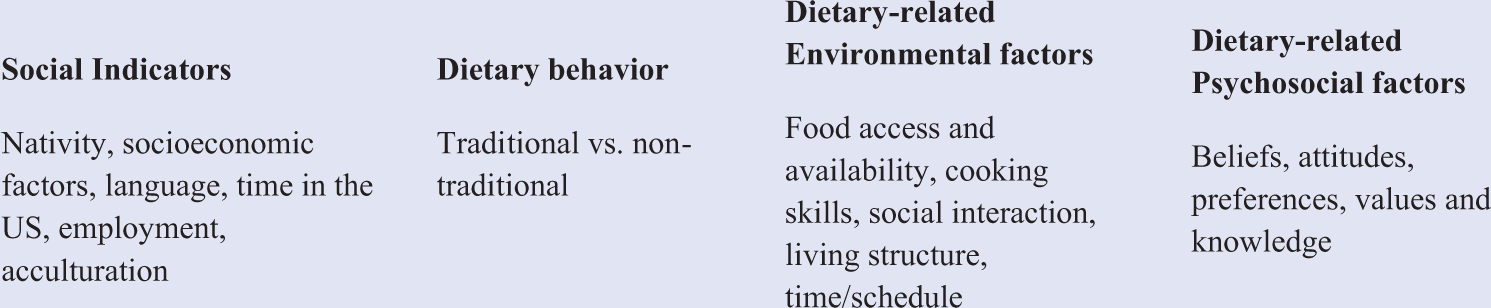
Factors to Assess in Dietary Acculturation.
Social indicators: Assess nativity, SES, primary language, and employment status. If an immigrant is foreign born, inquire regarding the type of area—urban or rural—in which that person resided in the country of origin and time spent in the United States. Determine their interaction with the host culture and maintenance of traditional Hispanic norms and behaviors.
Dietary behavior: Determine what natural protection has accrued from traditional dietary behaviors that have been retained, and then, encourage the continuation of these behaviors. Such protective behaviors include consumption of fresh fruits and vegetables, beans, and homemade foods. Identify negative dietary behaviors such as consumption of high-fat dairy products or cooking with lard. Next, find out what dietary behaviors are occurring, such as high consumption of refined sugars and processed foods, meat, fast food, and sugar-sweetened beverages.
Dietary-related factors: Identify different psychosocial and environmental factors that may be related to positive or negative dietary acculturation behaviors. In the psychosocial arena, discover the person’s food beliefs, attitudes, preferences, values, and knowledge. For the environmental factors, determine the individual’s living and social structure, food access and availability, time/schedule, and abilities in food procurement and preparation.
An assessment tool such as the Psychosocial and Environmental Dietary Questionnaire can help determine relevant factors. 45 Once the practitioner has a complete view of influencing factors and their relationships to one another, he or she can better understand the connection between diet and health outcomes and determine the best route to address dietary-related factors that may be detrimental to one’s health. Some routes may be linking the individual with a nutrition course or intervention offered in the community that addresses an identified influencing factor, referring the individual to a registered dietitian for nutrition counseling, or contacting a social worker to help provide and identify resources.
A Case Study
Juan is a 23-year-old Mexican male. He has lived in the United States for 3 years. He arrives at the community clinic for his yearly work physical.
Social indicators: Juan speaks very little English, has a sixth-grade level of education, resides with 4 Hispanic male roommates, and indicates that he has little contact with people who are not Hispanic because of the language barrier. He makes about $18 000 per year and does not have health insurance. Juan indicates that he has gained about 10 pounds since moving to the United States and often feels fatigued.
Dietary behavior: When asked about his diet now compared to before moving to the United States, Juan indicates that he eats out more often and tries to eat his traditional food but that he consumes fewer fruits and vegetables and more meat and packaged food items. He also indicates that he often skips breakfast and eats a light lunch. This is not how he traditionally ate in his country of origin.
Dietary-influencing factors: Juan believes that nutrition is important to his health but does not know how it directly affects his health (beliefs and knowledge). He does not like the foods often found in the United States and feels that there are too many chemicals put on fresh produce (preference and attitude). He would rather eat his traditional foods but because of other factors, he feels it is not an option (preference). He does not know how to cook, and cost and time are a big factor in what he consumes (cooking skill and food access). He says he does not have time to think much about food because of a strenuous work schedule, so he eats out often or picks up snacks at a convenience store. Juan feels that fresh produce is expensive, but meat is inexpensive and more filling (time and cost). He also feels fortunate that he now has the means to buy meat, whereas in Mexico it was too expensive (cost). Juan wants to lose the 10 pounds he has gained but does not know how. He is worried about becoming diabetic, like his father. The health practitioner wants to connect Juan with further assistance to help address his weight and dietary behaviors that may place him at a higher risk for diabetes. The practitioner helps Juan sign up for a basic nutrition and cooking course targeted to Hispanics at a local community health center. She also arranges an appointment with a dietitian who speaks Spanish at the community clinic; the clinic charges on a sliding scale basis.
Summary
As the Hispanic population grows, addressing important factors related to diet can contribute to rectifying health disparities. Admittedly, a group’s dietary habits are complex, and equally complex are the many factors that influence dietary behavior. Moreover, dietary behavior may be different in Hispanics depending on subgroups, levels of acculturation levels, or nativity. Therefore, stereotyping dietary behavior in an individual or group may result in incorrect assumptions and conclusions. To address dietary behavioral concerns in this population, a practitioner should thus carefully examine the multiple factors that influence behavior and determine resources available to address them.