




Abstract
Today, children are at risk for disease stemming from the prevalence of sedentary behaviors. Schools are largely obesogenic environments but have the potential to promote and provide opportunities to meet the recommended daily minutes of physical activity. Yet educators must be prepared to do so. The objective of this review was to examine the strength of evidence from studies on professional development effectiveness in order to make recommendations on how to structure such experiences to prepare teachers to promote and provide physical activity in schools. Effective strategies for professional development that were confirmed in the literature focused on knowledge of subject matter, collective and collaborative participation, continual and long in duration, coherence with student learning, active learning, and the building of a community of practice. Further, research to examine the effectiveness of professional development on student physical activity participation within the school environment is warranted.
. . . it is recommended that a quality physical education curriculum be the foundation of comprehensive opportunities for students to be physically active throughout the school day . . .
Schools are an ideal place for children to be physically active as a means of disease prevention and treatment.1,2 Previously identified in multiple publications, such as the National Physical Activity Plan, 3 the importance of physical activity in schools is unequivocal. The Accelerating Progress in Obesity Prevention: Solving the Weight of Nation 4 proposed that all children engage in 60 minutes of moderate to vigorous physical activity per day, with most happening during school. There is sufficient evidence that a multicomponent approach, interventions that implement 2 or more strategies at the same time, has the greatest potential to increase physical activity engagement among students in schools, as suggested by the Physical Activity Guidelines for Americans Mid-course Report: Strategies to Increase Physical Activity among Youth. 5 Specifically, it is recommended that a quality physical education curriculum be the foundation of comprehensive opportunities for students to be physically active throughout the school day and that federal, state, and local policies require schools to provide these comprehensive programs. Yet although schools can provide the maximal access to children and effective strategies for increasing physical activity, they remain largely sedentary environments.
Despite evidence of the positive benefits of physical activity, reductions in physical activity opportunities such as recess, 6 physical education, 6 after-school opportunities, 7 intramurals, 7 and active transportation to school,8,9 have transpired over the past 2 decades. One reason for the reductions can be attributed to mandates centered on academic achievement and the unintended outcomes stemming from federal legislation such as the No Child Left Behind Act of 2001, which prioritized math, science, and literacy over other subject matters. Because of the expectation that all students achieve the national standards in math and science, the expectations for teacher quality have increased, given the era of accountability. It is inevitable that teachers need enhanced knowledge and refined pedagogical strategies to prepare students to be competitive in a global market. 10 However, some have argued that student achievement is not simply associated with increased teacher quality but also associated with health status, 11 physical fitness,12-14 physical activity,15-17 and healthy body weight. 18 A robust body of literature has causally linked these behaviors and traits to cognitive health in older adults, while emerging evidence suggests a similar relationship among children. 19
Given the combination of increased pressure to achieve on standardized tests and the convenience of a sedentary lifestyle, children weigh more and have a greater body mass index today than their peers a generation earlier. 20 The combination of these issues has made sedentary behaviors the norm, especially in the school setting. Changing the school environment to be more active and health promoting is possible, when educational personnel recognize the need, make it a priority, and receive the necessary training to do so (E. E. Centeio, PhD and D. M. Castelli, PhD, unpublished data, 2013). Given the paucity of research directly related to educators as promoters and providers of physical activity, the purpose of this review is to examine the strength of evidence from studies on effective professional development (PD). PD, also referred to as continuing education, encompasses formal training opportunities for practicing teachers to enhance or expand their knowledge and skills. Recommendations on how to structure PD in a manner that will persuade teachers to integrate physical activity opportunities into the school day will be made. In addition to the key elements of effective PD for educators, this article will discuss the strength of evidence from studies on teacher learning and growth, strategies for planning and implementing PD, and recommendations for future research in relation to the creation of healthy schools.
Professional Development for Educators
Although the term PD is often associated with career advancement, for educators it is more about refinement of skills and knowledge that will lead to implementation of cutting-edge instructional strategies and curriculum. From a physical activity promotion perspective, this would mean the implementation of multiple strategies to educate students about the benefits of physical activity, provision of opportunities to regularly participate in physical activity, and the involvement of teachers, family, and community members as part of the support system. PD in education includes a vast range of activities and interactions that teachers engage in to improve their teaching practice, and contribute to their personal, social, and emotional growth. 21
When designing PD opportunities for teachers, one must begin by considering the central, interactive components of (a) teachers, (b) facilitators, (c) the PD program, and (d) school context (Figure 1). These components collectively form a PD system of delivery based on the bidirectional interdependence within a given context. First, we must consider what the teachers already know and what they need to learn. Teachers, like their students, have specific knowledge, skills, and abilities. Furthermore, teachers bring familiarity of their contexts, inhibitors, local politics, and budgetary constraints to the PD and because all influence each other, these items should be taken into account when planning and implementing PD opportunities. Second, the facilitator, who is commonly a university faculty or credentialed expert, must be carefully selected so their approach aligns with the needs of the teachers. Broadly, facilitators largely have an awareness of the trends and status of specific research paradigms and conceptual models. When facilitators are prioritizing PD strategies, they should consider the impact of both the empirical evidence and posited theories that explain the relationships between teacher abilities and the desired student learning outcomes. A PD program, the third components to be considered, should be associated with the facilitator’s expertise, relevant for the teachers, and authentic within the context. Additional detail on the specific elements of a PD program will be detailed in a later section. Finally, the context or the environment in which a teacher is employed must be considered. PD may need to differ based on a contextual variables such as urban/rural regions, school size, educational level of elementary versus secondary, state educational mandates, and school type (eg, public, private, charter, faith-based). In general, the interaction between the components of a PD system has evolved over the last decade, with a broader perspective on PD emerging. Today it is common to treat teacher learning as an interactive and social process based on discourse and community practice. 22 Many studies have tried to create lists of what successful PD includes, while other researchers have compiled data from success stories to create what they believe is an appropriate and beneficial form of PD.23,24
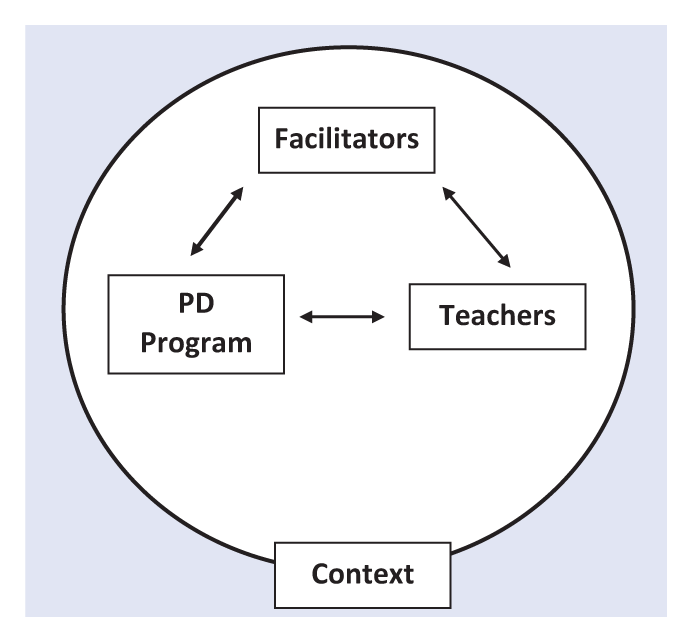
Elements of a professional development (PD) system.
The authors began their review about effective PD with the underlying assumption that there are main features of effective PD: (a) knowledge of subject matter, (b) collective and collaborative participation, (c) continual and long duration, (d) coherence with student performance, (e) active learning, and (f) builds a community of practice24,26 (see the elements in Table 1). In accordance with these recommendations, PD should be directly related to subject matter content, focus on teacher content knowledge, model pedagogies that can help students learn specified content, engage all staff members in meaningful ways, and be extended across multiple sessions.
Educator Professional Development: Elements, Strategies, and Future Research. a
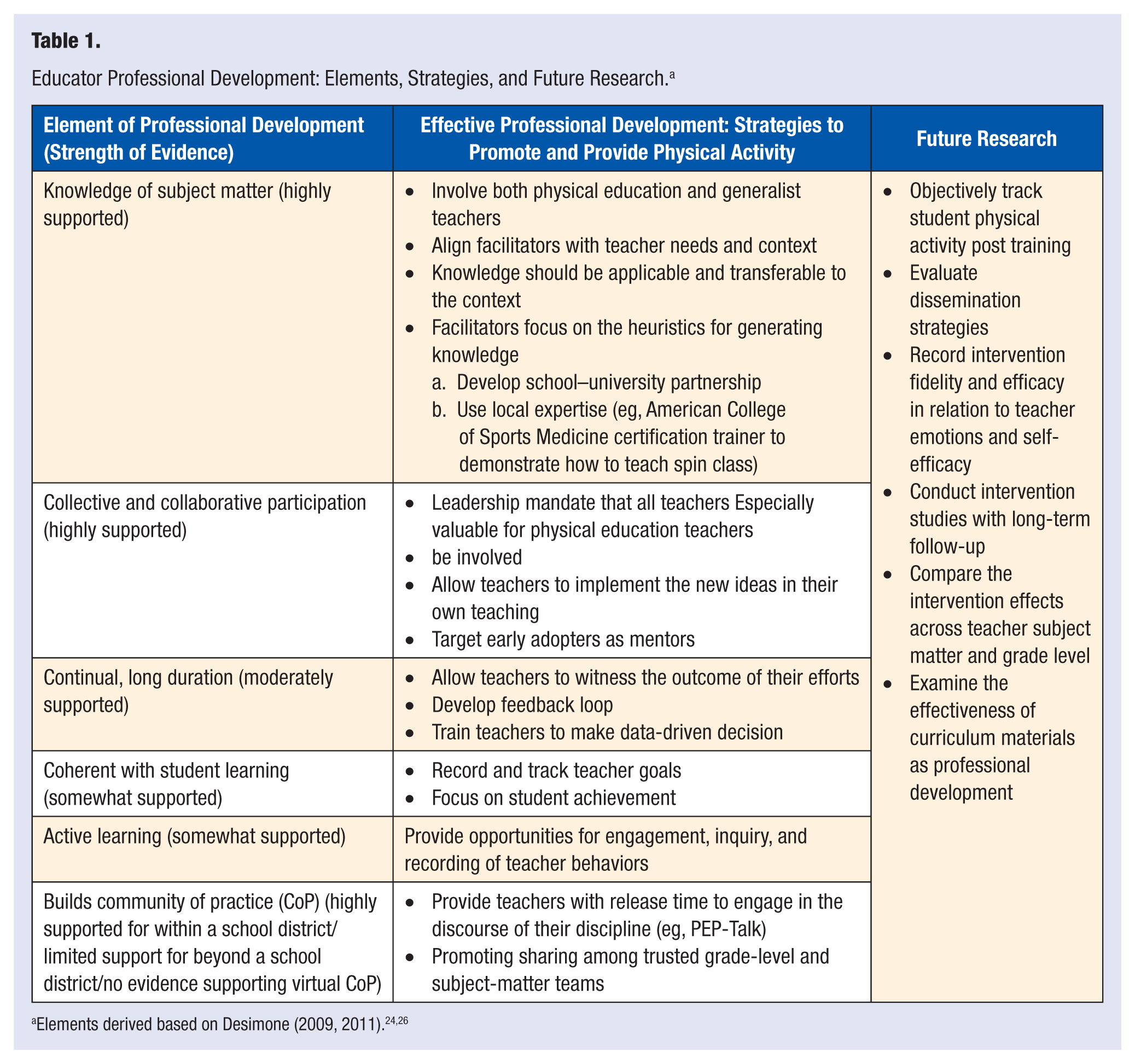
Knowledge of Subject Matter: Selecting Professional Development Content
For any learning to be effective, it must be meaningfully related to the learner. In the case of PD, training should be targeted to the student population of the teacher participants so that teachers can directly apply the ideas and concepts introduced in the PD sessions. If teachers believe learning experiences within PD opportunities are unrelated to the needs of their student population, they will dismiss what is being said and conform to what they “know” works (E. E. Centeio, PhD and D. M. Castelli, PhD, unpublished data, 2013). In addition, there is extensive support for increasing teacher knowledge during PD. 27 Educators should know the facts and concepts within their discipline and facilitate the heuristics for generating new knowledge. 25 As such, planners of PD should attempt to ensure that teachers leave PD with advanced expertise and new competencies. Finally, effective PD must model teaching strategies that are applicable to the subject and transferrable to the developmental level of their students (eg, classroom physical activity breaks for third graders, how to safely and adequately supervise recess for elementary students, how the principles of training influence adolescent anatomy). As teaching professionals take on the role of student during PD it is just as important for them to have a well-aligned learning experience during training as it is for school-aged children in the classroom. PD about physical activity has the opportunity to excite teachers about implementing physical activity opportunities for their students, enhance understanding of the acute and chronic benefits of physical activity, equip teachers with the resources to sustain the implementation, and provide ideas and activities that teachers can apply to their own teaching.
Collective and Collaborative Participation
Professional development is effective when it requires both collective (all teachers) and collaborative (teachers working together) participation, enables teachers to discuss concepts and problems, and provides an opportunity to integrate ideas into instructional practice, often leading to the sharing of instructional materials. By participating in PD together, teachers develop a support group and a sense of camaraderie. This sense of community needs to be fostered by leadership at the school level, such as administrators, in order for it to permeate the infrastructure. Thinking of teachers as members of a learning community is a belief that, if fostered, can change the school culture. An example of a healthy school climate, developed through teacher collaboration, can be found at Namaste Charter School, which is located in Chicago, Illinois (for more details see www.namastecharterschool.org/academics.html). PD specifically focuses on physical activity and health was provided during the initial period of design and continues today to address the school’s main focus of health and wellness. As a learning community, school personnel developed a daily schedule that included numerous forms of health and wellness such as physical education, classroom physical activity breaks, recess, healthy lunches for teachers and students, high parent involvement, and physically active after-school programming. In the instance of Namaste, having an entire faculty that experienced prolonged, collective PD, resulted in the creation of a comprehensive healthy school environment.
This collaboration can also occur with students as teachers reflect on students’ reaction of the new activities, connect feedback to strategies learned in training, and adapt lessons to increase effectiveness. Conducting monthly meetings, where students have late start to school or are released from school early, is one way to create such opportunities. Such a session could begin with the teachers participating in physical activity, as means of addressing his or her own wellness and as a model of opportunities that could be offered to the students. Although attitudes and beliefs can change in many ways, PD is most successful when teachers connect personal and professional knowledge with the knowledge they gain from their students, that will only come about if teachers are given time to interact with one another on a regular basis. 28
Continual and Long Duration
When planning PD, Garet et al 29 determined that PD should be spread out and contain over 20 hours of contact time. PD that extends beyond a single day has potential to allow educators time for sequential training sessions where they are able to witness the results of implementation. 30 In addition, a longer span of PD allows time for teachers to make connections and to build relationships among colleagues, supporting the collaborative participation component of effective PD. In some schools, teachers mentoring or peer coaching, which teachers teach each other, is a strategy that is both collaborative and extensive. For instance, a teacher may be provided with release time to observe another teacher who regularly integrates physical activity breaks into the classroom. This social learning and mentoring can help increase teacher self-efficacy toward providing physical activity opportunities and also increase the likelihood that they themselves will introduce physical activity into the classroom. 31
As part of the PD system, facilitators need to anticipate and be receptive to emotional responses that teachers may experience in regards to change over time. 32 Furthermore, facilitators need to have an awareness of the barriers that may arise and provide teachers with strategies to overcome such barriers (eg, loss of playground facilities because of school construction). As such, continual PD gives the facilitator a chance to provide teachers with the resources and support they need during the implementation of new strategies.
Coherence With Student Learning
Making connections to personal experiences is important to the learning process and a similar experience occurs as teachers connect PD to their teaching. In addition, many believe that these personal connections are stronger when confirmed by multiple sources. Coherence refers to the teachers’ perceptions of how well a series of PD activities are aligned to their own goals surrounding student learning. If there is a lack of coherence, or an inconsistent message from one PD to the next, teachers may become confused and disengage from the process. 29 Accordingly, PD should not only be aligned with teaching goals but also experiences should be purposefully sequenced to build on previous learning (eg, begin a follow-up PD session by presenting a physically active review session where teachers need to stand, clap, snap, or jump as the correct response). Additionally, coherent PD explicitly links new ideas to a desirable student learning outcome. For example, having the math teacher use student heart rate data, collected during a session of physical activity, to calculate the slope of the line and thereby facilitating a discussion about the odds of gaining health benefits based on the value. Identification of where in the curriculum new pedagogical strategies can be employed and cross-referencing the frequency of these learning experiences is called curriculum mapping, which is an approach designed to enrich PD coherence. Curriculum mapping, which can be an outcome of curriculum focused PD, would permit specific health-related issues to be introduced and frequently revisited across academic subject matter.
Active Learning and Engagement
In all successful PD, but especially PD intended to promote physical activity, active learning is important. Being involved in hands-on activities (eg, teachers participate in physically active brain breaks during the PD; educators walk and talk about their practice; or teachers participate in a highly kinetic lesson about the specified content) allows teachers to try new activities (demonstrating strategies they could use in their own classrooms), reflect on the new ideas through peer debriefing, and discuss innovative teaching and learning pedagogies. Although, experiential learning does not guarantee that an educator will implement these strategies, this is a logical way to introduce such an opportunity.
Active learning should occur not just during sessions delivered by PD facilitator but extend beyond. One way that teachers can be engaged in PD is to reflect on and record their own practice prior to, during, and after the PD experience. Throughout the learning process, goal setting should play an important role, in order to help facilitate learning among teachers. Teachers should be encouraged to prepare for PD by determining their desired outcome at the forefront and working toward those goals throughout the entire PD experience. Setting goals also provides motivation for completion 33 (E. E. Centeio, PhD and D. M. Castelli, PhD, unpublished data, 2013), which will aid in the implementation of PD content. Since context has been shown to be a fundamental part of how teachers learn, it is important that teachers have a part in determining what they learn and an awareness of how they perform.
Being cognizant of the struggles and successes personally experienced during the PD activities and reflecting on these experiences with colleagues will also enhance teachers’ understanding. As one example of active learning, McCaughtry et al 31 studied the heuristics of how mentoring influenced adoption of the Exemplary Physical Education Curriculum (EPEC). Findings suggest that, with training, teachers were capable of serving as effective mentors and that the mentor–mentee relationship fostered a reflective practice among the 30 teachers, thus confirming the importance of active learning. As such, the role of colleagues throughout the PD experience is a key element for comprehensive change.
Building a Community of Practice
A community of practice (CoP) is “a group of people who share a concern, a set of problems, or a passion about a topic, and who deepen their knowledge and expertise in this area by interacting on an ongoing basis.”34(p4) Establishing a CoP is different from a traditional work group or team who works together to accomplish a specific or given task, as a CoP focuses on developing participants’ capacities and the building and exchanging of knowledge. These elements allow those who participate in a CoP to enrich comprehension while sharing information and building relationships with people who have similar interests. Although CoP has been used in the field of education for numerous years as an effective form of PD for teachers,35,36 developing a CoP within the domain of physical activity is less documented. 37
To develop an effective CoP that will lead to continual PD, teachers need to create a community among their colleagues where they interchangeably discuss hardships and encourage innovative thinking. Establishing an effective CoP among teachers also needs to have the support of administrators; without support and resources, teachers might be unable to establish an effective CoP. It is suggested that a CoP be built with teachers who have similar experiences within the school setting, which could include teachers from the same building, district, or county. If teachers feel comfortable with others who are in the community and sense that they share similar experiences and have students with common characteristics and backgrounds, they are more likely to find benefit in the CoP (E. E. Centeio, PhD and D. M. Castelli, PhD, unpublished data, 2013). In one instance, teachers who elected to form a CoP in their school faculty were collectively able to develop new curricula content and materials by building relationships with their colleagues that they would not have been able to experience otherwise.29,38 In summary, within a given context a PD system contains essential elements that transcend PD effectiveness for all educators. However, there is evidence that physical education teachers may need to place greater emphasis on some specific elements.
Professional Development for Physical Education Teachers
The underlying assumption of this review is that all teachers, regardless of subject matter expertise, can provide physical activity opportunities for children in a school setting.1,4,5,16,17,39 PD for physical education teachers, however, requires a slightly different focus than general education PD because physical education teachers participate in teacher education programs targeting physical activity during the school day. Physical education teachers are educators with health-related content specialization and regular access to all children within a given school. Physical education is part of the whole school curriculum, with teacher instruction guided by national standards. 40 However, because curricular decisions are made at the local level, physical education is delivered in many forms and varies from district to district. Similar to all educators, PD for physical education teachers must focus on subject matter knowledge, collective and collaborative participation, continual opportunities, coherence with student learning, active learning, and the building of a community of practice. However, because physical education teachers often work in isolation and are subjected to marginalization,41,42 there needs to be a greater emphasis on the elements collective and collaborative participation and the building of a community of practice. Specifically, as pressure mounts to increase student achievement in the school setting, availability and resources for physical education teachers to participate in content specific PD and to apply PD to their classrooms are diminishing. 32 A summative discussion of a series of PD studies focused on improving physical education programming verified that physical education teachers were confident about their content knowledge, but felt helpless with regard to overcoming barriers such as marginalization and lack of resources. Specifically, “physical education teachers simultaneously express their sense of power as content specialists and their sense of powerlessness to do anything about diminishing resources for physical education in the public school curriculum.”43(p451) Accordingly, PD experiences for physical education teachers should look different from typical classroom-focused PD, as they must be planned explicitly for the physical education teacher.
Within the field of physical education, there are limited opportunities for teachers to participate in continuing PD.44-46 In a study that analyzed career-long professional development for 85 physical education teachers, Armour and Yelling 47 conducted interviews to examine teacher perceptions of previous PD experiences in order to garner recommendations for change. The results yielded 3 suggestions for PD specifically focusing on experienced physical education teachers. First, Armour and Yelling recommend that PD opportunities for physical education teachers should be school-based and applicable to the daily routine of the teacher while addressing how to overcome barriers; this relates to the overall PD program component, content specific. Second, PD should maximize teacher interaction and collaboration with others, because many physical education teachers work in isolation and have few opportunities to interact with each other as well as other subject matter teachers, supporting collective and collaborative participation. Last, PD for physical education teachers should be based on overall student outcomes and carried out as such (eg, helping students to embody a physically active lifestyle; comparing and contrasting the effects of different motivational strategies; using heart rate data from class to inform the development of their next lesson). This incorporates the idea of coherence, as it aligns with teacher goals for student performance.
Conceptualization of teacher knowledge is difficult when seemingly effective PD does not lead to implementation, which has been evidenced in some PD targeted for physical education teachers. 43 Furthermore, misunderstanding arises when PD advances teacher competency, but fails to address teacher attitude, as in a case of improved technology skills with sustained negative attitudes toward technology use. 48 Although these findings were predicated on reduced access to technology for physical education teachers, they elucidate a disconnect between PD and practice. In a study of teachers who had received Physical Education for Progress (PEP) grant monies to reform curriculum, a forum was created entitled PEP-Talk, which is a teacher-centered gathering that allowed teachers to meet for 90-minute sessions at least 6 times. Physical education teachers reported wanting to talk about “assessment, liability issues, equipment needs within the physical education programs, management strategies, classroom lessons when no gym was available, and strategies for dealing with difficult students.”44(p418) Despite the attendance of university faculty as facilitators, PEP-Talk meetings were predominantly led by the teachers who mostly discussed craft knowledge and how to maximize student performance. Given the unique contextual variables, teacher perceptions of helplessness and teacher emotion associated with change, physical education teachers appear to require not only the common elements of effective PD but also additional targeted strategies in order for change to occur.
Effective Professional Development Leading to Increased Physical Activity Promotion and Participation
Given the lack of documented, content-specific, effective PD opportunities pertaining to the implementation of multicomponent physical activity initiatives, the authors relied on applying related research to teacher learning and organizational change. The limitation of such a tactic is that few studies have objectively measured student physical activity as an outcome of PD. One study did examine the effects of PD on the implementation of mandated fitness testing. As a measure of implementation of a coordinated school health model, PD increased the likelihood of teachers accurately implementing fitness testing and providing meaningful student experiences. 49 However, other studies noted that some teachers need continual PD to be able to give meaning to fitness testing data and to apply the principles of health-related fitness in their lessons.50,51 Specifically, teachers should know how to create personal relevance for students. 52 Conversely, using a comprehensive physical activity implementation framework, which examines intervention efficacy, researchers discovered that despite experiencing a high-quality PD workshop intended to develop content knowledge and engage participants in active learning, teachers’ learning was superficial. 43 Initially, implementation planning lacked detail and once enacted the teacher displayed a “rapid retreat.”43(p411) to their original practice. Therefore, teachers need to be given planning time as well as continued feedback and support during the implementation phase, as change is a process, not a single event.
Given the push to increase the use of a multicomponent approach in creating physical activity opportunities within the school environment, coupled with the lack of PD that has effectively increased physical activity minutes during the school day, the National Association for Sport and Physical Education (NASPE) developed a PD program to train physical education teachers to provide and promote such opportunities. Specifically, this yearlong training was designed to add value to a physical education teacher’s credentials by earning the title of Certified Director of Physical Activity (C-DPA; see Carson 53 for a detailed overview). Findings from the first 2 years of training suggest that the 1-day workshop and 12-month online support program have been effective for increasing teacher self-efficacy and had led to a significant increase in the number of physical activity opportunities provided in Texas. 54 Data collection, which includes a direct examination of student physical activity engagement, is presently ongoing in Kansas, Louisiana, Kentucky, and Massachusetts.
Classroom teachers have also experienced various forms of PD related to implementing a multicomponent approach in the classroom setting. For classroom teachers, PD resulted in increased opportunities for physical activity engagement.16,39 Teacher and student led physical activity breaks in the classroom produced health-enhancing energy expenditure, but not changes in body mass index. 16 These findings, however, should be interpreted with caution as research from Project SPARK documented that physical education teachers produce better student knowledge and health-related physical fitness than their classroom counterparts. 55 Evaluation of the current physical activity interventions (eg, FIT Kids, NASPE Directors of Physical Activity; Let’s Move! Active Schools Physical Activity Leaders [PALs], Physical Activity Across the Curriculum, Take 10!) that include educator PD as part of their initiative should further shed light on the specific outcome of PD on physical activity within the schools.
Scalability and Sustainability of Effective Professional Development
Because the PD element of collective and collaborative engagement has the highest empirical support, planners must consider the scalability (how all teachers, regardless of subject matter, can be involved in a multicomponent approach) and sustainability (the conditions that are most likely to maintain the culture of physical activity across the curriculum). If new initiatives like the multicomponent approach or comprehensive school health are implemented to create a school climate that is focused on health and the provision of opportunities to be physically activity, educators must engaged in quality PD. Given the diverse needs of today’s student and the complexity of interventions, quality PD must be a central component of systemic reform. 56 The PD system and its corresponding elements was most effective when carried in the following stages: (a) PD to affect instructional practices, (b) focus on student learning outcomes, and (c) changes in teacher beliefs and attitudes. 56 Two possible ways to make change both scalable and sustainable are through a greater emphasis on the development of CoP, as an additional piece of the collective, collaborate component of PD, and through formal school–university partnerships, with the goal of increasing content focus and coherence.
Cautions About the Building of a Community of Practice
Despite the positive findings from this work, we still need to proceed with caution regarding community membership and the type of forum, because many teachers, particularly physical education teachers, lack the financial resources for their own PD. The NASPE DPA program experience tried to combat the inhibitors of time and funding by including access to a virtual CoP. The intent was to form a CoP to provide occasions to think together and share ideas with other teachers via the Internet as a means of strengthening the implementation of the multicomponent approach. Although teachers expressed the desire for a CoP and supported the idea of the communication with other teachers, in reality, initial attempts to create the virtual CoP, through Facebook and Moodle online courseware, fell short because of a lack of trust among the teachers and unanticipated technological barriers (E. E. Centeio, PhD and D. M. Castelli, PhD, unpublished data, 2013). Developing a CoP should be grounded in a mutual sharing and trust among the participants. An effective CoP cannot be mandated.
In addition to creating a local CoP, PD should include school–university partnerships. By establishing this relationship between a school and a university, the teachers and administrators are exposed to new and innovative ideas. This relationship is beneficial not only for the school but also for higher education faculty who are presented with an opportunity to understand the perspectives of and barriers faced by practicing teachers. When establishing a school–university partnership, it is important to understand common elements of effectiveness including shared leadership between the teachers and the facilitators, extensive collaboration, trust, mutually beneficial relationships, knowledge dissemination, and commitment from both parties.57,58 Although the complexity of the work relationship may require additional effort, if schools and their university counterparts can strive to create an alliance based on these foundations they will benefit greatly from the joint PD opportunities that are created. As both parties consider the long-term sustainability of their relationship, the CoP that is formed through the PD experiences should be centered on financial support, acknowledge of success, and empowerment. In general, we know that individuals with specialized training are the most effective at offering physical activity opportunities and accordingly providing additional professional development for teachers is prudent.
Implications
In summary, if PD is to change school culture to one that fosters physical activity and makes health a priority, continuing education must be pervasive, and begin immediately. Short-term, one-time PD is largely ineffective and unsustainable, whereas content-specific, engaging, cooperative, meaningful, and continuous PD has the greatest potential to incite cultural change. Because physical education teachers have requisite knowledge within the discipline of kinesiology, they should be acknowledged as health experts within a school environment and accordingly should be put in leadership positions when whole school, multicomponent health initiatives are implemented. Since collective and collaborative involvement is highly supported in the literature, all educators should be offered regular PD focused specifically on children’s health. It is important to note that this article presented a targeted discussion on the promotion and provision of physical activity in the school environment. The authors acknowledge the importance of nutrition in increasing health and the value of including these experiences as part of teacher education programs; however, because of space limitations, did not include this content.
Few research studies have directly examined the effectiveness of PD on physical activity implementation. Largely the evaluation of PD effectiveness is reduced to a teacher self-report, lacking accountability for implementation of the new ideas and strategies. Study of PD should objectively measure student physical activity before and after the PD. The greatest success of physical activity engagement should be a change in student performance, but many PD opportunities end before educators are granted an opportunity to confirm that the initiative worked. Furthermore, study should record intervention fidelity and efficacy in relation to teacher emotions and self-efficacy, given the predictive value of providing physical activity opportunities for children. Experimentally designed study should compare PD effectiveness across teacher expertise and student developmental level. If such research were enacted, these data would further decompose the complexity of teacher learning and learning communities, providing valuable information on how to provide and promote physical activity in schools.
Footnotes
Acknowledgements
We would like to thank the American Alliance for Health, Physical Education, Recreation, and Dance (AAHPERD) for funding the Research Consortium Graduate Student Award, which supported the proposal titled, Director of Physical Activity Professional Development Outcomes. Erin E. Centeio was the principal investigator and Darla M. Castelli was the co-principal investigator on this project.