



Abstract
The effectiveness of carotenoids in helping protect the skin from damage caused by environmental exposure has been a subject of research for more than 3 decades. It has only been within the last decade that lutein and zeaxanthin, 2 unique carotenoid molecules, have been evaluated for skin health benefits. This article summarizes the most recent research on the efficacy of lutein and zeaxanthin in skin health.
Keywords
The skin is an important organ of the human body. It not only provides a protective barrier for the internal organs against pollutants, microorganisms, and light-induced damage, but it also plays an important role in water retention and temperature regulation. The appearance and texture of the skin change as people age. Generally, as age increases, the skin becomes thinner and drier, retaining even less moisture, and losing at least some of its more youthful elasticity. This combination of effects results in the formation of fine lines and wrinkles.1,2 These changes can be accelerated by exposure to sunlight, particularly the ultraviolet (UV) wavelengths, because of the damage that sunlight causes. Skin areas such as hands, face, and neck are particularly prone to such UV-induced damage since they tend to be more chronically exposed to sunlight than other portions of the skin. This process, which is commonly called photoaging or even premature skin aging, is generally noticeable before similar chronological aging changes become noticeable. 2
Oral supplementation with lutein and zeaxanthin helps diminish the effects of UVB radiation exposure, as measured by its potential to induce inflammation, epidermal hyperproliferation, and sunburn cell formation.
UV light (280-400 nm) is capable of inducing damage because it can penetrate into the skin, where it induces the formation of reactive oxygen species (ROS) and free radicals. The shorter wavelengths of UV light, commonly termed the UVB wavelengths (280-320 nm), are able to penetrate the outermost layers of the skin (the epidermis). These wavelengths are primarily responsible for sunburns and inflammation. The longer wavelengths, commonly termed the UVA wavelengths (320-400 nm), penetrate much deeper into the skin, reaching the dermis. The damage associated with longer wavelengths is primarily associated with a significant decrease in the elastic nature of the skin that produces the wrinkling that is the hallmark of premature skin aging. Although the damage associated with either of these sets of wavelengths is a result of the formation of free radicals or ROS, these wavelengths can also damage cellular genetic code (DNA and RNA), membranes via lipid peroxidation, and proteins via denaturation. 2
In addition to UV light, the shortest wavelengths of visible light, namely, the blue wavelengths (400-500 nm), are able penetrate the skin. In fact, these wavelengths are able to penetrate to greater depths than any of the UV wavelengths. Visible light can penetrate the entire depth of the skin. Additionally, because these wavelengths are also capable of inducing the formation of free radicals, they are capable of causing damage throughout the entire depth of the skin. 3
The skin has a natural antioxidant capacity to protect against damage caused by light exposure. This capacity results from the presence of a combination of enzymes, vitamins, and other antioxidant molecules such as carotenoids. However, overexposure to light, particularly UV light, can overwhelm the skin’s natural antioxidant capacity, thereby leaving the skin vulnerable to damage.4,5 This combination of overexposure to light and a compromised antioxidant defense capacity can result in damage that is manifested in premature skin aging.
Lutein and zeaxanthin, carotenoids found in the human diet and in numerous dietary supplements, especially in products for eye health, may have the capacity to bolster the antioxidant capacity of the skin. This article summarizes the results of studies conducted in animals and humans that have examined the effectiveness of lutein in promoting skin health and provides results from recent research that indicates that lutein may have an effect on the processes associated with the loss of skin elasticity—one of the hallmarks of sunlight-induced premature aging.
Lutein and Zeaxanthin
Carotenoids are yellow to red natural pigments found primarily in fruits and vegetables. Of the more than 600 known carotenoids found in nature, only 40 to 50 are found in the human diet, but only about 14 of these carotenoids are found in the human bloodstream. Of those found in the bloodstream, lutein and zeaxanthin are unique since they are the only carotenoids found in significant quantities in the macula of the human eye. In the macula of the eye, lutein and zeaxanthin function as filters of the damaging blue wavelengths of light and act as antioxidants to prevent free radical damage. 6 These carotenoids are also found in significant quantities in human skin.7,8
In cells, lutein and zeaxanthin are primarily found in membranes. Because of their molecular dimensions and the presence of the hydroxyl groups at the ends of these molecules, lutein and zeaxanthin have the ability to interact with the structure of these membranes such that they are capable of bridging the membrane structure from the inner membrane surface to the outer membrane surface as shown in Figure 1. Additionally, because of the placement of the double bond in the structure of lutein, it can be oriented parallel to the membrane surface. 9 Such orientations in membranes may help provide significant antioxidant protection to cellular membranes as well as intracellular and intercellular lipid bilayers and the lipid content of these structures300% increase above controls from oxidative damage caused by light exposure.
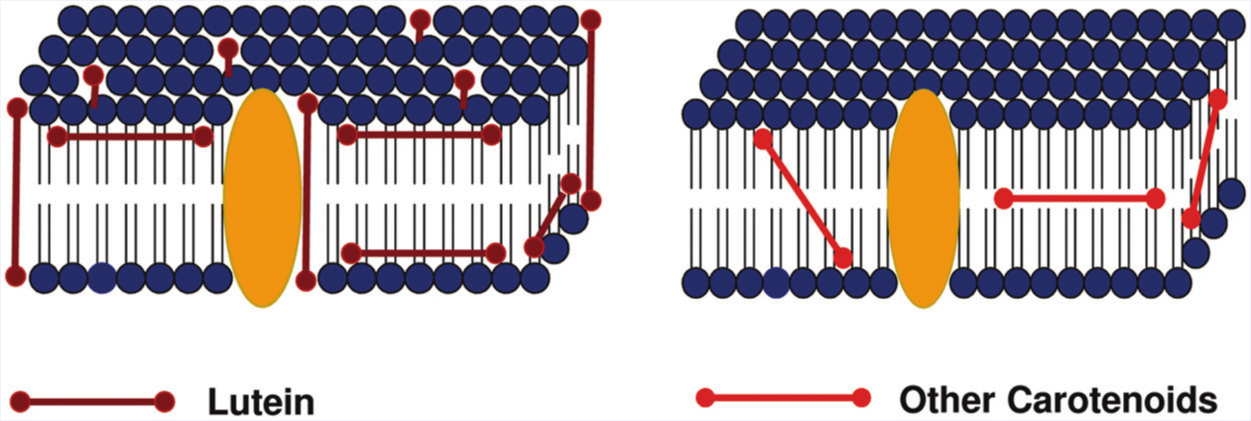
Parallel and Perpendicular Orientation of Lutein in Membranes (Left) and Random Orientation of Other Carotenoids in Membranes (Right).
Lutein and Zeaxanthin in the Murine Skin Model
Hairless mouse skin has long been used as a model for studying the effects of UV light on skin. Using this model, the skin of the mouse can be irradiated with UV light, excised, and the effects of the light exposure can be studied. In a study using this model, mice were fed a diet containing 0% lutein/0% zeaxanthin, 0.04% lutein/~0.003% zeaxanthin, or 0.4% lutein/~0.03% zeaxanthin for a period of 2 weeks prior to the start of experimentation. They were then irradiated with an acute dosage (40-160 mJ/cm2)* of UVB light to evaluate the effects of this exposure on (a) the degree of ear swelling (a potential measure of light-induced inflammation), (b) epidermal hyperproliferation, and (c) inhibition of sunburn cell formation. 10 The study had 3 significant findings. First, at both 24 and 48 hours after irradiation, ear swelling was reduced in a dose-dependent manner with a significant ~50% reduction in swelling observed in animals receiving the highest dosage of lutein and zeaxanthin evaluated. Second, as measured by 2 separate histochemical techniques, the oral ingestion of lutein and zeaxanthin resulted in significant, up to 40% reduction, in epidermal hyperproliferation regardless of the dosage of UVB radiation or the technique used to measure hyperproliferation. Third, the number of sunburn cells found in the skin was significantly reduced by 47% to 50% at both lutein/zeaxanthin dosages evaluated 48 hours after irradiation but only the highest dosage of lutein/zeaxanthin resulted in a significant ~50% reduction in sunburn cells when evaluated 24 hours after irradiation. These findings indicate that oral supplementation with lutein and zeaxanthin helps diminish the effects of UVB radiation exposure, as measured by its potential to induce inflammation, epidermal hyperproliferation, and sunburn cell formation.
A separate study using the hairless mouse model evaluated the effects of lutein and zeaxanthin supplementation on ear swelling and UV-induced immune suppression. 11 The immune function, which helps protect the body against invasion of microorganisms when skin structure is compromised, is suppressed as a result of UV exposure. This study employed the same levels of supplementation fed to the mice for up to 35 days: control (0% lutein/0% zeaxanthin), low dose (0.04% lutein/~0.003% zeaxanthin), and high dose (0.4% lutein/~0.03% zeaxanthin). This study also evaluated the amount of lutein in the skin and the relative amounts of ROS present in the skin following irradiation with UV light. Compared with control mice, the skin of mice fed with the high-dose diet contained a significant amount of lutein (200% increase above controls) after only 14 days, whereas mice fed with the low-dose diet contained a significant amount lutein (100% increase above controls) in the skin after 35 days. Experiments evaluating the antioxidant efficacy against ROS formation were conducted on the skin of animals fed lutein/zeaxanthin for a period of 28 days and then irradiated with UV light using a dye that fluoresces in the presence of ROS following exposure to a subsequent UV light source. A dose-dependent reduction in ROS (a nonsignificant 26% for the low dose, and significant 49% for the high dose, compared with controls) was observed. This study also showed that 24 hours after exposure to a 350 mJ/cm2 dose of full-spectrum UV light, † there was a significant dose-dependent reduction in ear swelling, a measure of inflammation (nonsignificant 27% for the low dose and significant 33% for the high dose) compared with controls. Finally, the contact hypersensitivity of the skin to dinitrofluorobenzene was evaluated in the low-dose UV radiation model for photoimmunosuppression following UV irradiation at 170 mJ/cm2 per day for 4 days. ‡ The results obtained showed that both lutein/zeaxanthin dosages administered resulted in a significant reduction of UV-induced suppression of the skin’s immune function (no immunosuppression at either lutein/zeaxanthin dosage compared with a 46% suppression in controls). These results indicate that lutein and zeaxanthin accumulate in the skin following oral administration, where it may help decrease the formation of ROS while simultaneously helping to inhibit the inflammation and immunosuppression associated with UV light exposure.
A third study in the murine skin model assessed the effect of dietary supplementation with lutein (0.4%) and zeaxanthin (~0.03%) for up to 22 weeks of irradiation with UVB light (at 0.5 mW/cm2) on photoaging or photocarcinogenic parameters compared with unsupplemented control mice. 12 In the photoaging experiments, supplemented mice had a 58% reduction in dermal mast cell density, 22% reduction in epidermal thickness, and 10% reduction in dermal desmosine content compared with controls. In the photocarcinogenicity experiments, supplemented mice exhibited a lower number of skin tumors, smaller total tumor surface area, smaller tumor volume, and longer tumor-free survival time compared with control mice. These results indicate that supplementation with lutein and zeaxanthin may help provide skin protection against the detrimental cutaneous effects of UVB exposure as it relates to both photoaging- and photocarcinogenicity-related changes.
Lutein and Zeaxanthin in Cell Culture
In addition to these animal model studies, the effect of lutein and zeaxanthin supplementation has been evaluated in human dermal fibroblasts as a way of evaluating how lutein and zeaxanthin may help in reducing UV-induced photoaging of the skin. 13 As the skin ages, a natural degeneration of the extracellular matrix (ECM) of the skin occurs. This natural degeneration is commonly referred to as normal skin aging. However, in chronically sun exposed areas of the skin this degradation of the ECM is accelerated. In such cases, this degeneration is referred to as photoaging or even premature aging of the skin. ECM degradation is also observed to be associated with skin cancers. The inherent evidence for ECM degradation are wrinkles, diminished structural integrity, and impaired wound healing. Cancer metastases are also associated with ECM degradation. The ECM, which is composed of collagen and elastin, is degraded by matrix metalloproteinases (MMPs), primarily MMP-1, which cleaves interstitial collagen, and MMP-2, which degrades the basement membrane and damaged interstitial collagen. MMP-1 and MMP-2 are inhibited by tissue inhibitors of metalloproteinases (TIMPS), especially TIMP-1 and TIMP-2, respectively. It is not known whether EMC degradation is favored by increased MMP expression/activity or lowered TIMP activity.
In a well-designed, well-controlled study, dermal fibroblasts or melanoma cells were treated with lutein along with zeaxanthin (up to 10 µM in lutein) for 24 hours. In a separate set of cell cultures, dermal fibroblasts were treated with a single dose of UVA or UVB radiation exposures prior to treating with 0, 0.5, 1.5, 5, and 15 µM lutein also containing smaller quantities of zeaxanthin for 24 hours and compared with fibroblasts similarly treated with lutein/zeaxanthin but not irradiated controls. Several parameters associated with skin health were evaluated in these experiments, including cell viability, membrane integrity, protein levels of MMPs, TIMPS, and elastin.
Relative to control cells, the administration of lutein and zeaxanthin significant inhibited the amount and activity of MMP-1 and MMP-2 in dermal fibroblasts in a dose-dependent manner (22% to 39% for MMP-1 and 8% to 65% for MMP-2). The levels of TIMP-1 and -2 present in the cell cultures were not significantly altered by lutein except for a 14% decrease in TIMP-2 at 10 µM. In UV-treated fibroblasts, lutein at 15 µM significantly improved cell viability (158% of control following UVA exposure and 168% of control following UVB exposure). Lutein treatment significantly inhibited membrane damage (~35% regardless of lutein/zeaxanthin dosage administered) and elastin deposition (6% to 34%) in UVB-irradiated cells at all concentrations tested compared with controls. These findings confirm that lutein and zeaxanthin help protect against membrane damage and indicate that lutein and zeaxanthin may improve cell viability, reduce elastin deposition, and inhibit MMPs. The latter finding suggests a mechanism by which these carotenoids may maintain healthy skin.
Lutein and Zeaxanthin in Human Skin Health
As interesting as the above studies may be from a research and/or mechanistic point of view, they only provide supporting evidence that lutein and zeaxanthin may have an effect in human skin. Without some form of confirmation that the above cell culture and animal studies are applicable to the skin of humans, it is difficult to conclude that a similar effect takes place in living human skin tissues. Despite the fact that several human studies have been conducted where the effects of carotenoid administration on skin were evaluated, most of these studies involved the administration of several materials in addition to lutein and zeaxanthin. However, one study has been conducted that evaluated only the effects that lutein and zeaxanthin have on skin health parameters. 14 In this 12-week, double-blind, placebo-controlled study, a group of 40 females between the ages of 25 and 50 years, all exhibiting signs of premature skin aging, were given either (a) an oral placebo capsule administered twice daily or (b) an orally administered capsule containing 5 mg of lutein and 0.3 mg of zeaxanthin administered twice daily.
Skin hydration, elasticity, lipid peroxidation, lipid content, and photoprotective activity were evaluated at regular intervals throughout the study period. After 12 weeks, the oral administration of lutein/zeaxanthin significantly suppressed lipid peroxidation by 56%, improved skin hydration by more than 2-fold, improved skin lipid content by 4-fold, improved skin elasticity by 17%, and improved photoprotective activity 3-fold compared with the placebo-treated subjects. These results confirm the results seen in animal and cell culture studies, demonstrating that oral lutein/zeaxanthin improves skin health and may help in reducing the detrimental effects of sunlight exposure on the skin of females with premature skin aging. Further research to confirm cell culture and human skin health findings is warranted.
Conclusions
Results from cell culture and animal studies showing that lutein and zeaxanthin exhibit positive skin health benefits have considerable merit and suggest an avenue by which these carotenoids may function. The results from one human study demonstrate that orally administered lutein and zeaxanthin can inhibit lipid peroxidation on the surface of the skin and help bolster the skin’s photoprotective activity, potentially protecting the skin from exposure to light, particularly UV light. Since the typical diet of people in the United States is about 2 mg of lutein per day, due to the ingestion of foods such as green leafy vegetables that contain the highest levels of diet-derived lutein and zeaxanthin, 15 it may be considered advisable to increase the daily intake of lutein and zeaxanthin for optimal skin health and photoprotection.
Footnotes
*
Using this light source, it is estimated that the lowest dose of UVB administered to these animals would yield minimum sunburn in humans.
†
Using this light source, it is estimated that the lowest dose of UVB administered to these animals would yield minimum sunburn in humans.
‡
Using this light source, this amounts to approximately half the energy needed to produce minimum sunburn in humans when given in a single exposure.