




Abstract
This article summarizes the scientific literature on the health risks and benefits of having a gun in the home for the gun owner and his/her family. For most contemporary Americans, scientific studies indicate that the health risk of a gun in the home is greater than the benefit. The evidence is overwhelming for the fact that a gun in the home is a risk factor for completed suicide and that gun accidents are most likely to occur in homes with guns. There is compelling evidence that a gun in the home is a risk factor for intimidation and for killing women in their homes. On the benefit side, there are fewer studies, and there is no credible evidence of a deterrent effect of firearms or that a gun in the home reduces the likelihood or severity of injury during an altercation or break-in. Thus, groups such as the American Academy of Pediatrics urge parents not to have guns in the home.
For example, your gun may be stolen and used to commit crimes, your child may shoot a friend accidentally, or you may scare a burglar away from your neighbor’s house.
Introduction
Americans have more private guns per capita, and particularly more handguns, than citizens of other developed countries. Currently, more than one third of households in the United States contain a working firearm; slightly fewer than half of American men and 10% of women are firearm owners. Although most firearms in the United States are rifles or shotguns, handguns sales have recently been higher than long gun sales.
Compared with other Americans, gun owners are disproportionately male, married, older than 40 years, and are more likely to live in nonurban areas. Their long guns (rifles, shotguns) are owned mainly for sport (hunting and target shooting). Major predictors of sporting gun ownership include having parents who owned guns and currently having friends and neighbors with guns. Individuals surrounded by gun owners tend to want guns themselves. People who own only handguns typically own the guns for protection against crime. As a group, gun owners tend to be Conservatives, and they are less likely than nonowners to believe that public officials care about them or that police can protect them and are somewhat more likely to believe in private retribution for offenses against them.1,2
Gun issues are among the most contentious in America. This article summarizes the scientific evidence on the health risks and benefits of having a gun in the home for the gun owner and his/her family. The article does not examine some of the possible benefits (eg, the fun of target practice) or costs (eg, loss of hearing) of gun use nor does it directly address the literature on the effects of gun laws on public health. It focuses instead on the risks of firearm intimidation, injuries, and death and on the benefits of protection
There are also risks and benefits to carrying a gun outside the home. And, of course, your having a gun imposes risks and provides benefits to others, just as others having guns imposes risks and provides benefits to you. For example, your gun may be stolen and used to commit crimes, your child may shoot a friend accidentally, or you may scare a burglar away from your neighbor’s house. This article does not focus on such issues.
Finally, it is important to recognize that the scientific literature typically deals with averages, whereas each individual family and each individual situation is unique.
Risks
The main risks of having a gun in the home stem from the fact that someone inappropriate can be shot or intimidated with the gun. There can be (a) accidents, (b) suicides, (c) assaults and homicides, and (d) intimidation.
Accidents
According to death certificate data, from 2003 to 2007, more than 680 Americans per year were killed unintentionally with firearms. Data from the National Violent Death Reporting System (which has more comprehensive data on each shooting but currently is operating only in 18 states) show that two thirds of the accidental shooting deaths occurred in someone’s home, about half of the victims were younger than 25 years, and half of all deaths were other inflicted—the victim was typically shot accidentally by a friend or family member (eg, brother.) 3 It appears that the large majority of accidental shooting deaths in the home are from guns that were kept in the home.
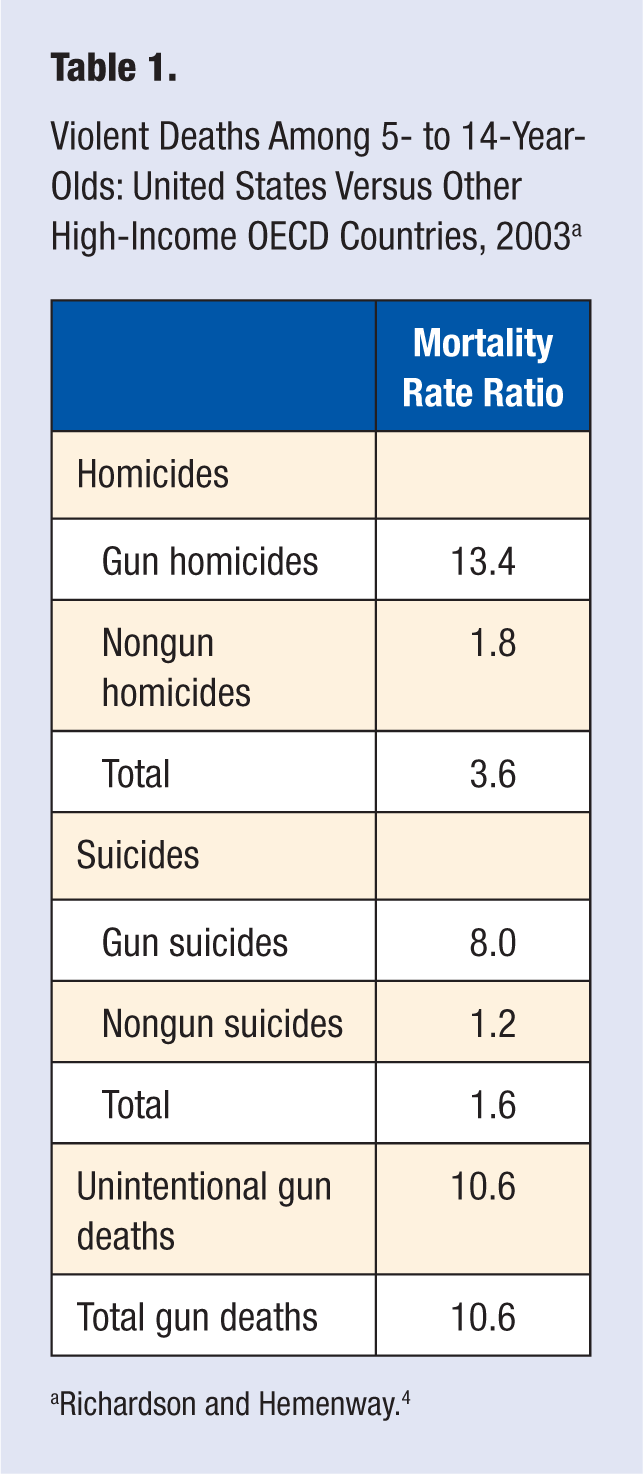
Children aged 5 to 14 years in the United States have 11 times the likelihood of being killed accidentally with a gun compared with similarly aged children in other developed countries (Table 1). 4 The United States has been in this unenviable position for at least the past decade. 5 From 2003 to 2007, the yearly averages of unintentional firearm fatalities were as follows: 62 children aged 0 to 14, 89 youth aged 15 to 19, and 95 young adults aged 20 to 24 years. 6
Violent Deaths Among 5- to 14-Year-Olds: United States Versus Other High-Income OECD Countries, 2003 a
Richardson and Hemenway. 4
Not surprisingly, there are more accidental gun deaths in areas with more guns.7-9 The differences are substantial. To illustrate, we compare accidental firearm deaths among the states most extreme in terms of firearm ownership levels. States are grouped so that the populations of the high and low gun states are equal. According to the Centers for Disease Control (CDC) data, between 2003 and 2007, the typical resident from the 15 states with the most guns (WY, MT, AK, SD, AR, WV, AL, ID, MS, ND, KY, TN, LA, MO, and VT) was 6 times more likely to die in a gun accident than a typical resident from the 6 states with the fewest guns (HI, NJ, MA, RI, CT, and NY). For example, although there were virtually the same number of children aged 5 to 14 years in both groups of states, 82 had died from accidental gunshot wounds in these high gun states, compared with 8 in the low gun states (Table 2).
Violent Deaths Among US Children Aged 5 to 14 Years in High- and Low-Gun States, 2003-2007 a
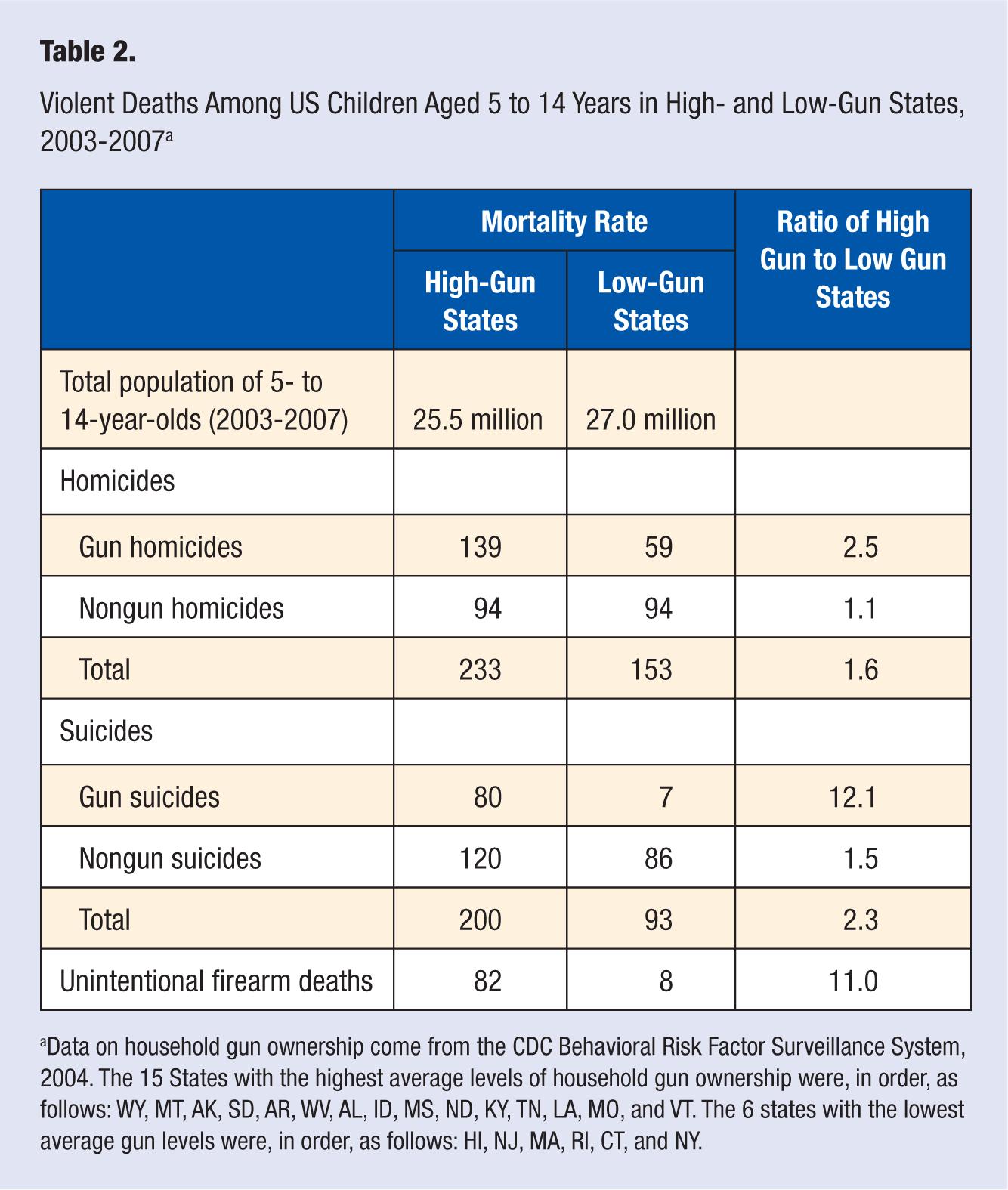
Data on household gun ownership come from the CDC Behavioral Risk Factor Surveillance System, 2004. The 15 States with the highest average levels of household gun ownership were, in order, as follows: WY, MT, AK, SD, AR, WV, AL, ID, MS, ND, KY, TN, LA, MO, and VT. The 6 states with the lowest average gun levels were, in order, as follows: HI, NJ, MA, RI, CT, and NY.
Fatal injuries are only the tip of the iceberg. For every fatality from an accidental shooting, there are more than 10 people injured seriously enough in gun accidents to be treated in hospital emergency departments. 10 In other words, almost 20 people a day are shot unintentionally but do not die. This number does not include any of the more than 45 people per day who are treated in emergency rooms for BB/pellet gun wounds (2003-2007) or the many others injured by firearms in other ways (eg, powder burns, struck with a firearm, injured by the recoil of a firearm), many unintentionally.
One study of nonfatal accidental shootings found that the majority were self-inflicted, most involved handguns, and more than one third of the injuries required hospitalization. Injuries often occurred during fairly routine gun handling—cleaning a gun, loading and unloading, target shooting, and so on. 11 It is important to recognize that although some people are at higher risk for unintentional shootings than others, accidents can happen to anyone. No one is completely immune, as shown anecdotally by scores of stories of police, firearms safety instructors, firearms advocates, and other experts who have accidentally shot themselves or others. 12
Overall, the evidence indicates that a gun in the home is a risk factor for serious accidental injury. When 34 injury prevention experts were asked to prioritize home injury hazards for young children, based on frequency, severity, and preventability of the injury, the experts rated access to firearms in the home as the most significant hazard. 13
Self-Harm: Suicides
From 2003 to 2007, an average of 46 Americans committed suicide with guns each day. This includes 2 teenagers (aged 15-19) and 3.5 young adults (aged 20-24) per day. Even though suicide attempts with guns are infrequent, more Americans kill themselves with guns than with all other methods combined. That is because among methods commonly used in suicide attempts, firearms are the most lethal.
Many suicides appear to be impulsive acts. Individuals who take their own lives often do so when confronting a severe but temporary crisis. In a study of self-inflicted gunshot wounds, which would have been fatal without emergency treatment, none of the 30 attempters had written a suicide note, and more than half reported having suicidal thoughts for less than 24 hours. In 2 years of follow-up, none of the 30 attempted suicide again. 14 Other studies that have followed survivors of serious suicide attempts find that fewer than 10% typically go on to kill themselves.15,16
Suicidal individuals are often ambivalent about killing themselves. One expert estimates that no more than 10% to 15% of these individuals display an unbreakable determination to kill themselves. 17 For the rest, the risk period is transient. Reducing the availability of commonly used and lethal instruments during this period can prevent suicide. Psychiatric and penal institutions have long recognized the importance of restricting access to lethal means of suicide for newly admitted and potentially suicidal inmates.
Scientific studies show that a gun in the home is a risk factor for suicide.12,18 More than a dozen case-control studies have examined the relationship between gun ownership and suicide in the United States, and all find that firearms in the home are associated with substantially and significantly higher rates of suicide.19-33
These and other studies34,35 indicate that individuals have especially high risks of suicide if they live in homes with loaded guns and unlocked guns. Having any gun in the home is a risk factor for suicide for everyone in the home—the gun owner, the gun owner’s spouse, and the gun owner’s children. Although most suicide decedents have some history of mental illness or substance abuse, a gun in the home increases the risk of suicide even for household members without these problems. Guns increase the risk for everyone but especially for adolescents and young adults. Although a small minority of suicidal individuals purchase firearms with the immediate intention of killing themselves, 36 excluding such cases does not change these findings.
Ecological studies try to explain varying rates of suicide across different geographical areas. Within the United States, researchers have looked across US regions,37-39 states,40-44 and urban areas.42,45 The studies using validated measures of firearm ownership levels typically find a strong significant positive association between levels of gun ownership and rates of suicide because of higher rates of firearm suicide.
For example, a cross-sectional study using firearm ownership data from the large Behavioral Risk Factor Surveillance System found that in states with more guns, there were more suicides (because there were more firearm suicides), even after controlling for the percentage of the state’s population with serious mental illness, alcohol dependence or abuse, illicit substance dependence or abuse, and the percentage unemployed, living below the poverty level, and in urban areas. There was no association between gun prevalence and a state’s nonfirearm suicide rate. The findings held for both sexes and all age groups. 43
A national time series study (1981-2002) also found a strong association between gun prevalence and suicide rates for men, women, youth, and the entire population, even accounting for unemployment, alcohol consumption, poverty, and region. Household gun ownership levels were largely constant in the 1980s and fell in the 1990s. Firearm suicide rates and overall suicide rates followed suit. There were no significant changes in nonfirearm suicide rates. 46 During the period when firearm and overall suicides were decreasing, the percentage of Americans thinking about suicide, planning suicide, or attempting suicide did not change. 47
Is it possible that gun owners are simply more suicidal—could that explain the association between guns and suicides? Recent evidence provides no support for that idea. 48 A study of older individuals in Pennsylvania found that “patients with suicidal ideation or high levels of depression or psychological distress were not significantly more or less likely to have a gun in the home than those without these emotional stressors.” 49 Other studies using data from the National Co-Morbidity Surveys, the gold standard for evidence about the prevalence of mental illness in the United States, find that gun owners are not more or less likely to have depression or other mental health problems.50,51
The evidence linking suicide to gun availability is compelling. The American Association of Suicidology consensus statement on youth suicide concludes:
There is a positive association between the accessibility and availability of firearms in the home and the risk of youth suicide; guns in the home, particularly loaded guns, are associated with increased risk for suicide by youth, both with and without identifiable mental health problems or suicidal risk factors.
52
A total of 23 suicide experts from 15 countries reviewed the evidence concerning specific suicide prevention interventions. They concluded that the empirical evidence showed that “physician education in depression recognition and treatment, and restricting access to lethal methods reduce suicide rates. Other interventions need more evidence of efficacy.” 53
Homicides
From 2003 to 2007, 33 Americans per day were murdered with guns. This includes almost 1 child (aged 0-14 years), 5 teenagers (aged 15-19 years), and more than 7 young adults (aged 20-24 years) per day. More than two thirds of all homicides in the United States during this period were firearm homicides.
The US rate of firearm homicide for children aged 5 to 14 years is 13 times higher than the firearms homicide rate of other developed nations (Table 1), and our firearms homicide rate for 15- to 24-year-olds is 43 times higher. The overall homicide rate of our youth aged 15 to 24 years is 14 times higher than the overall homicide rate for youth in other countries such as Australia, Canada, France, Germany, Italy, Japan, Spain, and the United Kingdom. 4 In US states with more guns, many more children, adolescents, young adults, older adults, and women are murdered per capita than in states with fewer guns.54,55
The presence of a gun makes quarrels, disputes, assaults, and robberies more deadly. Many murders are committed in a moment of rage. For example, a large percentage of homicides—and especially homicides in the home—occur during altercations over matters such as love, money, and domestic problems, involving acquaintances, neighbors, lovers, and family members; often the assailant or victim has been drinking. Only a small minority of homicides appear to be the carefully planned acts of individuals with a single-minded intention to kill. Most gun killings are indistinguishable from nonfatal gun shootings; it is just a question of the caliber of the gun, whether a vital organ is hit, and how much time passes before medical treatment arrives.12,56
Many ecological studies link gun prevalence with overall homicide rates because gun prevalence is associated with high gun homicide rates; there is typically no association of gun prevalence with nongun homicide.12,57 Articles include international studies of high-income countries 58 as well as US studies of regions,38,54 states,55,59-62 and counties.63,64 The studies take into account a variety of potential confounders. For example, because urban areas typically have more gangs and crime than rural areas, studies at the state level usually control for the percentage of the state’s population that lives in urban areas in order to compare urban areas with urban areas and rural areas with rural areas.
Whereas most firearm suicides shoot themselves at home with the family gun, most homicide victims—except for children and older adults—are not shot at home. And those shot outside the home are almost always shot with someone else’s gun. So although the existing ecological studies provide evidence about whether more guns in the community are associated with more homicides in the community, the results have limited relevance concerning whether a gun in your own home increases or reduces your own risk of homicide. Case-control studies provide somewhat more pertinent information, but there have only been a handful of such studies, and all are far from ideal.
The case-control studies typically compare homes with homicides to homes without homicides. The problem is that the people in these 2 types of homes are often quite different—for example, the ones that have firearms may be more likely to be criminal or more likely to have reasons to fear criminals, and researchers have to try to take these factors into account.
One of the most cited studies involved approximately 400 homicide victims from 3 metropolitan areas who were killed in their homes. Half died from gunshot wounds. In 83% of the homicide cases, the perpetrator was discovered; among these cases, 95% of the time, the perpetrator was not a stranger. In only 14% of all the cases was there evidence of forced entry. 65
Controls were matched to cases by gender, race, age range, and neighborhood of residence. Handguns were kept in 36% of case households compared with 23% of control households. After controlling for illicit drug use, fights, arrests, living alone, and whether or not the home was rented, the presence of a gun in the home remained strongly associated with an increased risk for homicide in the home.
One limitation was that the study did not provide evidence about whether a gun from the home was used in any of the homicides. Nonetheless, the findings from stratified analyses were consistent with the notion that a gun in the home increased the risk of death. First, the link between gun ownership and homicide was due entirely to a strong association between gun ownership and homicide by firearm; homicide by other means was not significantly linked to the presence or absence of a gun in the home. Second, gun ownership was most strongly associated with homicide at the hands of a family member or intimate acquaintance; guns were not significantly linked to an increased risk of homicide by other friends, unidentified persons, or strangers. Finally, there was no evidence of a protective effect of keeping a gun in the home—even in the small subgroup of cases that involved forced entry.
Other case-control studies have also found that a gun in the home is a risk for homicide in the home.30,27,31 And results from 2 offender-based case-control homicide studies find that gun ownership is a risk for homicide perpetration.66,67
Whereas most men are murdered away from home, most children, older adults, and women are murdered at home. A gun in the home is a particularly strong risk factor for female homicide victimization. Women in the United States are at far greater risk of homicide victimization than women in other developed countries,4,68 and the greatest danger for women in homicides that occur in the home comes from their intimate partners—especially partners with guns.
A subgroup analysis of female homicide victimization from a large case-control study of homicide in the home in 3 metropolitan counties found that having a gun in the home was a large and significant risk factor for homicide. 69 Most of the women were murdered by a spouse, a lover, or a close relative, and the increased risk for homicide from having a gun in the home was attributable to these homicides.
Another case-control study of women murdered by intimate partners, compared with a control group of battered women, found that a gun in the home was an important risk factor for femicide. There was easy access to a firearm (eg, a gun in the house) for 65% of case perpetrators versus 24% of perpetrators of nonfatal abuse. Access to a firearm by the battered woman had no protective effect. 70
Overall, domestic disputes are likely to be affected by the presence of a firearm. 71 Although many spousal homicides occur following a long history of violence in the home, spousal abusers are often impulsive and volatile. 72 The availability of a firearm increases the likelihood that an attack will prove fatal.
A review of intimate partner homicides in Chicago over a 29-year period concluded that “an effective prevention strategy for intimate homicide of women . . . would be to reduce the availability of firearms in the home.” 73
Intimidation
Guns can be used not only to wound and kill but also to intimidate and coerce. Data on intimidation with firearms are relatively scarce. The National Crime Victimization Surveys (NCVSs) provide information about crime but miss much intimate partner violence and thus much of the intimidation with guns in the home. Fortunately, some information about such intimidation has been picked up by other surveys.74-77
A study of battered women in emergency shelters in California (a state in which more than 600 000 women each year experience intimate partner violence) found that if there were a gun in the home, nearly two thirds of the male partners involved had used the gun to scare, threaten, or harm the women. In contrast, women rarely used the gun in self-defense; fewer than 7% of these women had used a gun in self-defense and only against batterers who had used a gun against them. 76
Batterers use guns in a variety of ways to control their victims. Not only do they threaten to kill the women, but they also sometimes threaten to kill themselves or the children. 76 Other methods of gun intimidation include, during an argument, cleaning, holding, or loading a gun; going outside and shooting the gun; or threatening to shoot a pet. 77 A national random survey found more hostile gun displays against women in the home—primarily by intimate partners—than self-defense gun uses in the home by women or anyone else. 75
Benefits
The main reason people give for having a handgun in the home is protection, typically against stranger violence. However, it is important to recognize that the home is a relatively safe place, especially from strangers. For example, fewer than 30% of burglaries in the United States (2003-2007) occur when someone is at home. In the 7% of burglaries when violence does occur, the burglar is more likely to be an intimate (current or former) and also more likely to be a relative or known acquaintance than a stranger. 78 Although people typically spend most of their time at home, only 5% of all the crimes of violence perpetrated by strangers occur at home. 79
The main health benefits of guns in the home are that they may be used to (a) deter crime and (b) thwart crimes in progress.
Deterrence
Theoretically, knowledge that potential victims have access to firearms could increase the perceived cost of committing a crime to a potential perpetrator and thus prevent the crime from occurring. However, there does not seem to be credible evidence that higher levels of gun ownership and availability actually deter crime. A criminologist once claimed that publicized police programs to train citizens in gun use in Orlando (to prevent rape) and in Kansas City (to prevent robbery) led to reductions in crime. 80 However, a careful analysis of the data found no evidence that crime rates changed in either location after the training. 81 The deterrent effects of civilian gun ownership on burglary rates were supposedly shown by the experiences of Morton Grove, Illinois—after it banned handguns—and Kennesaw, Georgia—after it required that firearms be kept in all homes. 80 Again, a careful analysis of the data did not show that guns reduced crime. 82 Instead, in Morton Grove, the banning of handguns was actually followed by a large and statistically significant decrease in burglary reports. 81
One study found an association between lower crime rates in states with higher levels of household gun ownership. 83 But the gun ownership data for the analysis were not valid. The source of the data (Voter News Service) stated that the data could not justifiably be used to determine state-level gun ownership levels or changes in gun ownership rates.
Some have argued that when gun prevalence is high, there are fewer burglaries 84 and fewer “hot” burglaries (when someone is at home) because burglars will seek out unoccupied dwellings to avoid being shot.80,85 But the evidence does not show this. An international compilation of victimization surveys in 11 developed countries found that the United States (with the most guns) was average in terms of attempted and completed burglary rates, 86 and there was no relationship between gun prevalence and burglary rates. 12 Studies in the United States across states and counties found that in areas with higher levels of household gun ownership, there were actually more burglaries, and there were more burglaries when someone was at home, not less.63,87 One reason may be that guns, like cash and jewelry, are attractive loot for burglars, and burglars may target houses with many guns.
Thwarting Crimes
Unfortunately, data on self-defense gun use are not reliable. Unlike deaths or woundings, where the definitions are clear and one needs to only count the bodies, what constitutes a self-defense gun use and whether it was successful may depend on who is telling the story. For example, criminals who use a gun commonly claim that they were acting in self-defense. 88 The National Research Council, which examined the scientific literature on self-defense gun use concluded that “self-defense is an ambiguous term,” that whether one is a defender or a perpetrator may depend on perspective, and that “we do not know accurately how often armed self-defense occurs or even how precisely to define self-defense.” 89
Data on self-defense use come from (a) police reports (eg, after the victim calls police to report a crime), (b) surveys that ask directly about self-defense gun use, and (c) surveys that ask about self-defense gun use only after respondents report that someone attempted to commit a crime against them.
Police reports: One study examined Atlanta police department reports of home invasions during a 4-month period. Researchers identified 198 cases of unwanted entry into a single-family dwelling when someone was at home. 90 In 32 instances, at least 1 of the offenders was known to have carried a gun. In 6 of the 198 cases, an invader obtained the victim’s gun. In only 3 cases (1.5%) was a victim able to use a firearm in self-defense.
Many private surveys have asked questions directly about self-defense gun use. Some general conclusions from these surveys are the following: (a) more people report a self-defense gun use against an animal (eg, snakes, dogs) than against a human; (b) police report more total self-defense gun uses than all civilians combined; (c) there are far more illegal gun uses against people than self-reported self-defense uses by them; (d) most reported self-defense gun uses do not occur at home, and relatively few protect children; (e) most of the self-reported self-defense uses are either ambiguous or socially undesirable.12,91 These surveys belie the notion that most reported self-defense gun uses are legal or socially beneficial.92,93 For example, criminology students read all the stories of self-defense gun use in a national firearm survey and rated only 25% as being socially desirable. 94 Criminal court judges from across the United States read the 35 descriptions of the reported self-defense firearm uses from 2 national surveys and found that, even if description of the event was accurate, in most of the cases, the self-defense gun use was probably illegal. 95 Many were arguments that escalated into gun use.
The National Crime Victimization Surveys (NCVS) obtain information about self-defense gun use only from those respondents who first report that a crime against them was threatened, attempted, or completed. This feature of the NCVS substantially reduces the problem of reporting incidents that were not true self-defense gun uses. Although the NCVS data are not ideal, 85 they suggest that legitimate self-defense use is very rare. For example, from 1992 to 2001, NCVS respondents reported 1119 incidents when they were assaulted sexually. 96 In only 1 of these sexual assaults did the victims report using a gun; in 15 incidents, the victim used a nongun weapon in self-defense; 38 called the police or a guard; 120 attacked the assailant without a weapon; 161 ran away; 219 yelled; and 343 struggled. In all confrontational crimes, only 0.9% of victims reported using a gun. 96 Again, although not ideal (eg, it does not include instances of victim death), the NCVS currently provides the best data on the effectiveness of self-defense gun use. Since the early 1990s, the NCVS has asked victims not only whether they were injured but when they were injured—before or after they resisted. One study examined 27 000 personal contact crimes reported on the NCVS from 1992 to 2001. Results suggest that self-defense gun use may be the best method for preventing property loss; if borne out in other studies this is a significant, although nonhealth, benefit. However, it does not appear that self-defense gun use is more effective at preventing injury than many other methods of resistance. In terms of the likelihood of receiving an injury after adopting a particular mode of resistance, in simple comparisons, nothing was better than calling the police—only 0.9% of the time was calling the police followed by injury. Threatening with a gun was followed by an injury 2.5% of the time; yelling, 2.7%; and the highest, stalling, 4.5%. In multivariate analysis, only 1 mode of resistance—“ran away, hid” (and not self-defense gun use)—was significantly better than calling the police in terms of not receiving an injury. 96
Overall, the limited data on self-defense gun use suggest that (a) genuine self-defense gun use is rare, (b) there are many ways that people defend themselves without a gun, and (c) many of these other methods may be as effective as self-defense gun use in preventing injury. Perhaps surprisingly, the evidence does not indicate that having a gun reduces the risk of being a victim of a crime or that having a gun reduces the risk of injury during the commission of a crime.
What the data do indicate is that much of the self-defense gun use reported on private surveys is inappropriate and socially undesirable. The possibility of using a gun in a socially useful manner—for example, against a criminal during the commission of a crime—will occur, for the average person, 0 times, or perhaps once in a lifetime. At other times, the use of a gun against another human is socially undesirable. Regular citizens with guns, who are sometimes tired, angry, drunk, or afraid, and who are not trained in dispute resolution, have lots of opportunities for inappropriate gun use. People engage in innumerable annoying and somewhat hostile interactions with each other in the course of a lifetime.
In the rare instance of a real-world shooting situation, confusion, stress, and fear can become overwhelming. Heart rates skyrocket, and it is difficult to think clearly and act deliberately. This creates 2 major problems for civilians with guns, particularly those who are not well trained. The first is that they may act inappropriately. Indeed, police officers, who receive large amounts of training, are still often inadequately prepared to handle ambiguous but potentially dangerous situations, and they often make serious mistakes. Individuals without practical training do much worse.
The second problem is that the pounding heart, muscle tension, trembling, dizziness, and nausea that may accompany a real-world shooting situation will degrade the owner’s ability not only to use the gun wisely but to use it effectively. Although adrenaline may enhance animal fighting skills and be useful for either flight or fighting, it creates a severe loss in the fine motor coordination needed for the accurate shooting of a handgun as well as the ability to think rationally, reflectively, or creatively. 97
Thus, many gun experts believe that a handgun is far from an ideal tool for home self-defense, except for a small minority of especially well-trained individuals who maintain their skills through intensive, regular practice. 97 Currently, few homeowners are sufficiently trained for that tiny chance when they may have to use their handgun to ward off an intruder.
Shootings in the Home
Various studies have examined who typically gets shot by a gun in the home. A study in King County, Washington (which includes Seattle) examined gun deaths occurring at home from 1978 to 1983 (N = 398). There were 9 total self-protection homicides (only 2 of intruders). For every self-defense homicide involving a firearm kept in the home, there were 1.3 accidental deaths, 4.6 criminal homicides, and 37 firearm suicides. 98
A more complete study examined all gunshot injuries (nonfatal as well as fatal) in the home occurring in Memphis, Tennessee; Seattle, Washington; and Galveston, Texas (1992-1994) in which the gun involved was known to be kept in the home. Home guns were 4 times more likely to be involved in an accident, 7 times more likely to be used in a criminal assault or homicide, and 11 times more likely to be used in an attempted or completed suicide than to be used to injure or kill in self-defense. 99
A study of all gunshot injuries in Galveston, Texas, over a 3-year period found only 2 that were related to residential burglary or robbery. In one, the homeowner was shot and killed by a burglar; in the other, the homeowner shot the burglar. During the same interval, guns in the home were involved in the death and injury of more than 100 residents, family members, friends, or acquaintances. 100
These studies provide useful information about who is likely to be shot with a home gun but, of course, deal with only a portion of the potential risks and benefits of having a gun in the home. For example, a drawback of these studies is that they do not measure instances in which a gun is used to intimidate a family member or to thwart an intruder.
Conclusion
There are real and imaginary situations when it might be beneficial to have a gun in the home. For example, in the Australian film Mad Max, where survivors of the apocalypse seem to have been predominantly psychopathic male bikers, having a loaded gun would seem to be very helpful for survival, and public health experts would probably advise people in that world to obtain guns.
However, for most contemporary Americans, the scientific studies suggest that the health risk of a gun in the home is greater than the benefit. There are no credible studies that indicate otherwise. The evidence is overwhelming that a gun in the home is a risk factor for completed suicide and that gun accidents are most likely to occur in homes with guns. There is compelling evidence that a gun in the home is a risk factor for intimidation and for killing women in their homes, and it appears that a gun in the home may more likely be used to threaten intimates than to protect against intruders. On the potential benefit side, there is no good evidence of a deterrent effect of firearms or that a gun in the home reduces the likelihood or severity of injury during an altercation or break-in.
That said, for the large majority of households, having a gun in the home will not provide either health benefits or costs this year. However, for those households where having a gun or not will matter this year, the evidence indicates that the costs will widely outweigh the benefits. The benefit–cost ratio is especially adverse for women and children in the household. Indeed, after weighing the scientific evidence, the American Academy of Pediatrics (AAP) decided that guns do not belong in households with children:
The AAP recommends that pediatricians incorporate questions about guns into their patient history taking and urge parents who possess guns to remove them, especially handguns, from the home.
101