




Abstract
Background
The therapeutic potential of Haloxylon griffithii found in northern region of Balochistan, so far has been neglected.
Purpose
The current study was aimed to assess the phytochemicals and pharmacological potential of fractions isolated from H griffithii.
Research Design
During phytochemicals analysis of H griffithii using GC/MS showed various bioactive compounds like alkaloids, flavonoids, terpenoids, tannins, saponins, and carboxylic acids. In vitro antioxidant activity of H griffithii was determined by 2, 2’- diphenyl-1-picrylhydrazyl (DPPH)
Results
The quantitative analysis of ethyl acetate showed highest total flavonoid contents (1.19 ± .05) while ethanol with lowest value (.52 ± .01). The total phenolic contents in ethyle acetate was 1.50 ± .42, whereas ethanol showed lowest value (.77 ± .02). Ethanol exhibited excellent (88.68 ± 3.0) free radical scavenging potential measured by 1,1-diphenyl-2-picryl-hydrazyl radical scavenging assay. For antimicrobial activity, different bacterial and fungal strains like B subtilis, S aureus, E coli, S typhi, C albicans, and A. niger were selected. The essential oil showed maximum % inhibition diameter (9 mm) against B. Subtillus and (5 mm) against C albicans, respectively. The ethyl acetate presented % inhibition diameter (9 mm) against S aureus and (6 mm) against A niger. Anti-urease activity also showed positive response.
Conclusions
The presence of high (%) bioactive compounds with great therapeutic potential suggest that H griffithii can be used as natural alternative of synthetic drugs without side effects.
Introduction
Pakistan is a rich source of medicinal plants due to its splendid climate. Out of 6000 species, nearly 400–600 medicinal species are found in Pakistan. Medicinal plants are serving as natural protector against several diseases and reflected as the gift of nature. 1 These medicinal plants contain several naturally occurring phytochemicals bioactive compounds like alkaloids, flavonoids, glycosides, phenols, steroids, terpenoids, and tannins have been reported with good therapeutic effects for many centuries.2,3 The basic purpose for their wide therapeutic practice is safe in nature and low cost as compared to synthetic compounds. These phytochemicals implicate several pharmacological and biological effects like antimicrobial, anti-oxidant and anti-inflammatory.
According to WHO, above 80% of the world’s population use natural remedies for primary health care. Only a small fraction of medicinal plants has been evaluated for biological and pharmacological screening.4,5 The people relies on local customary healers might be due to inaccessibility of medical facilities and inadequate approach to medical centers. The healers adopt different approaches for cure of illness but with plants is very successful practice since ancient times. 6 Previously, majority of rural community relied on medicinal plants for treatment. Currently, urban population also moving towards green revolution due to absurd side effects and cost issues of modern medicines.6-8
Globally, herbal medicines have huge impact on the health system. Recently, the commercially isolated bioactive compounds from the herbs are used worldwide as an anti-oxidant, antibacterial, anti-inflammatory, and anti-urease agent. 9 The last 50 years were remarkable research period in sense of isolation and characterization of bioactive compounds from medicinal plants and development of natural products against different diseases. Infectious diseases mainly caused by bacteria, fungi, and virus are still very alarming hazard for human health even remarkable development in medicine field. Plants contain several secondary metabolites used against different infectious agents. Plants are the rich natural source of all kind of medicines. But unfortunately only small fraction of plants has been studied for their phytochemically and biological screening (Vijayakumar et al., 2012).
The primary source of health issues in living organisms is reactive oxygen species and free radicles which cause oxidative damage but the nature also produces various substances which counteract these free radicles and protect cells from injuries. H griffithii is also well-known for their antioxidant property by scavenging free radicals which diminish oxidative injury consequently empower immune system and stop tissue impairment.1,10 H griffithii consisting of 1200 species of which 100 belongs to chenopodiaceae family dispersed locally in the southern regions of Pakistan. H griffithii has been reported as a multipurpose medicinal plant used in different eye-disorders, diabetes, anti-inflammatory agent, and antiseptic agent. A huge research has been carried out on member of chenopodiaceae family including genus Haloxyloni. But detail description of phytochemicals constituents and medicinal effects of H griffithii are still under observation.2,11 Therefore, the main objectives of this study were to evaluate phytochemical screening of H griffithii and their therapeutic effects especially anti-oxidant, antimicrobial, and anti-urease activities. It would be helpful in future to develop natural drugs against certain diseases.
Materials and Methods
The plant was collected from Quetta and identified by Prof. Dr. Rasool Baksh Tareen under herbarium number (BOT-487), Department of Botany, University of Balochistan, Quetta Pakistan.
Extraction of H Griffithii Plant
The air dried whole plant powder material (500 g) was extracted successively with each of n-hexane, chloroform, ethyl acetate, and ethanol by cold maceration technique. The solvent was evaporated to dryness under pressure using rotary flash evaporator (Buchi R-210) to obtain solid extracts. Weight of the obtain extract was measured and the yield of each extract was also calculated. The solid extracts were preserved at 4°C for further use. 12
Extraction of Essential Oils and Fixed Oils
Essential oil and fixed oil were extracted through Clevenger apparatus and Soxhlet extractor, respectively. 13 While qualitative and quantitative analysis were done by using Gas chromatography and Mass spectroscopy (5977A Series GC/MSD System, Agilent Technologies, Inc., USA). 14
Phytochemical Screening of H griffithii
The phytochemical analysis of plant fractions was carried out both qualitatively and quantitatively.
Qualitative Phytochemical Analysis
Various standard analytical techniques were used for qualitative analysis of different phytochemicals such as alkaloids, flavonoids, tannins, phenolics, saponins, terpenoids, glycosides, carboxylic acids, and volatile oils. 12
Quantitative Phytochemical Analysis
Different standard methods were used for quantitative analysis to evaluate the amounts of various secondary metabolites like total phenolic content and total flavonoid content.
Determination of Total Phenolic Content (TPC)
The total phenolic content of H griffithii fractions was analyzed using slightly modified Folin-Ciocalteu regent assay with the help of optimize standard methods. A volume of .2 mL of the plant fraction (500 µg/ml) was mixed with 2.5 mL of Folin–Ciocalteu regent and neutralize with 1 mL of Na2CO3 (7.5%, w/v) reagent ml of distilled water. The reaction mixture was incubated at room temperature for 30 min. The absorbance of the mixture was measured spectrophotometrically (Systronic UV-VIS) at wavelength 765 nm using UV/VIS spectrophotometer. Measurements were taken in triplicates. Total phenolic contents were identified by standard curve of Gallic acid. The total phenol contents were expressed as mg/g Gallic acid equivalents of the extract.15,16
Determination of Total Flavonoids Content (TFC)
The total flavonoid content of H griffithii fractions was determined with the help of aluminum chloride assay.16-18 .5 mL of each fraction was taken in test tube and then added 5 mL of distilled water followed by .3 mL of (.5% w/v) sodium nitrite (NaNO3). After incubation at room temperature for 10 minutes, .3 mL of (10% w/v) aluminum chloride (AlCl3) and 2 mL of 1M sodium hydroxide NaOH was added in such a way that total volume become up to 10 mL. The absorbance was measured at 510 nm using spectrophotometer. The distilled water was used as a blank. The total flavonoid content was expressed in mg of rutin equivalents per gram of extract.16,18
GC/MS Analysis
The bioactive compounds identification of H griffithii was evaluated using GC/MS (model 7890B with 5977A mass detector) technique. Species were separated on Column CD-50 CNW, with the column length 30.00 m. 1 µ/L sample was injected in the split less mode with the split ratio of 1:50 with the split less time of 1 minute. The carrier helium gas (He) was used in this analysis, with the constant pressure with the average flow rate of 30 cm/s at 40°C. Initial temperature program was 40°C for 1 minute and then increased 10°C/min. when it reached at 280°C maintain constant for 5 minutes. For the purpose of mass spectra identification, electron ionization method was employed where the ionization energy was in the range of 70 eV, the scanning mass range used was 40–500 m/z. The ion source temperature program that was 230°C and that of MS quadropole was 150°C. The determination of various species was built on comparison of their mass spectra with the help of mass spectral library.
Pharmacological Potential
In Vitro Antioxidant Activity
The free radical scavenging activity of H griffithii was determined by 2, 2’- diphenyl-1-picrylhydrazyl (DPPH) assay. The results were compared with ascorbic acid as standard. The % free radical scavenging activity was measured using equation.
19

Antimicrobial assay
Disc diffusion method was used for analysis of antibacterial and antifungal activity of plant extract. Bacterial cultures of gram positive bacteria (B. subtilis and S aurenus) and Gram-negative bacteria (E. coli and S typhi) were cultured in petri-plates containing Mueller Hinton Agar and incubated at 37°C for 24 hours. Fungal cultures (C. albicans and A. niger) were cultured on PDA plates and incubated at 25°C ± 2°C for 24 hours.
Anti-Urease Activity
Urease solution (25 µL) was mixed with sample (5 µL) and incubated at 30°C for 15 min. Aliquots were taken and immediately transferred to assay mixtures containing urea (100 mM) in buffer (40 μL) and again incubated for 30 minutes in micro well plate. In each well of micro well plate 50 μL phenol reagent (1% w/v), 50 μL sodium nitroprusside (.005% w/v), 70 μL of alkali reagent (.5% w/v) NaOH, and .1% NaOCl were added. Final volume of reaction at pH 8.2 is 200 μL.20,21 Absorbance was measured after 50 mint at 630 nm in Spectramax Plus 384 molecular Device, USA. Thiourea used as a positive control. The percentage inhibition (%) was determined by the formula; Urease Inhibition (%) = 100 - OD sample/OD control.
Results
Percentage Yield of Extracts and Fractions
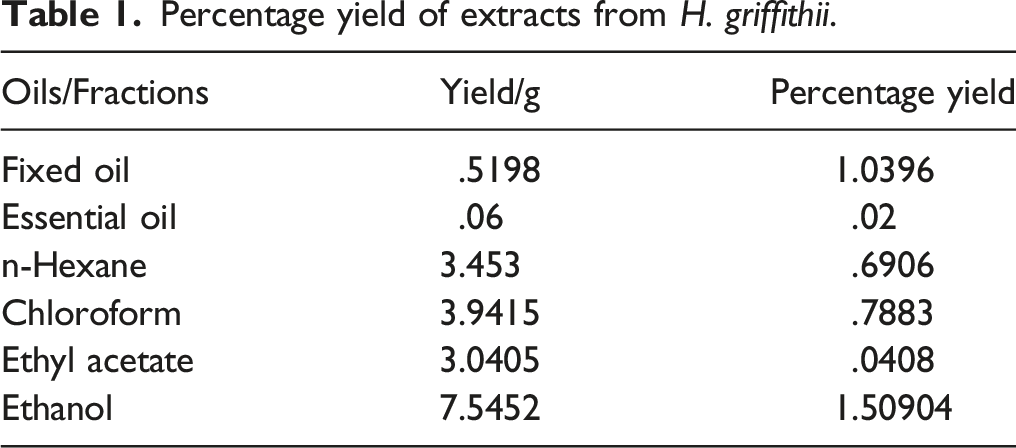
Percentage yield of extracts from H. griffithii.
Phytochemical Analysis
Qualitative Phytochemical Analysis
The phytochemical analysis of H griffithii showed that the screening of phytochemicals extracted from this plant showed the presence of alkaloids, flavonoids, tannins, phenolics, saponins, carbohydrates, glycosides, quinones, and carboxylic acids.
Quantitative Phytochemical Analysis
The quantitative estimation of the examined plants revealed that phytochemicals are present in different amounts in each plant extract.
Total Phenolic Content Analysis
Percentage of TPC and TFC of H. griffithii.

Total Flavonoids Content Analysis
According to the results the H griffithii showed, the assortment of TFC value where the ethanol fraction showed the lowest values of TFC while fixed oil showed highest content of flavonoids. The overall summary is expressed in the Table 2.
GCMS Analysis
Evaluated constitutes of Essential oil by GC-MS.

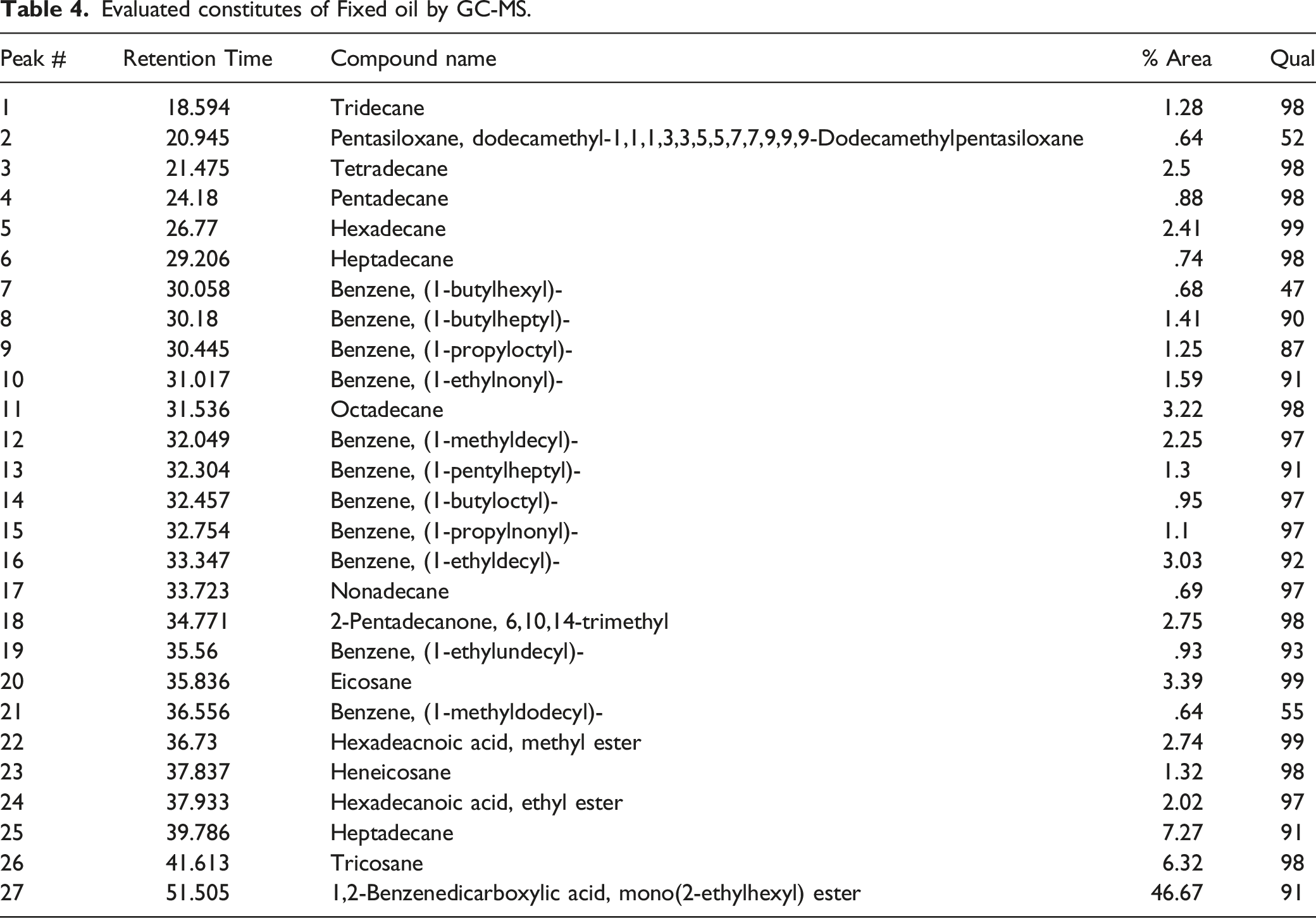
Evaluated constitutes of Fixed oil by GC-MS.

GC-MS spectra for essential oil of H. griffithii.

Gas chromatography spectra for fixed oil of H. griffithii.
Pharmacological Potential
Antioxidant Assay
The antioxidant results showed that ethanol revealed maximum % free radical scavenging activity (88.68 ± 3.0) which was close to the standard, ascorbic acid. The descending order of antioxidant activity was found HG4 > HG1 > HGF > HG2 while essential oil (HGE) and ethyl acetate (HG3) did not show any activity among the fractions and isolated oils. Hence, the results revealed H griffithii is the rich source of antioxidants Figure 3. Antioxidant activity by DPPH assay of H. griffithii from extraction HGF (fixed oil), HG1 (extraction oil 1), HG2 (extraction oil 2), and HG4 (extraction oil 4). HGE (essential oil) and HG3 (extraction oil 3) did not shows any activity. Vitamin C used as standard.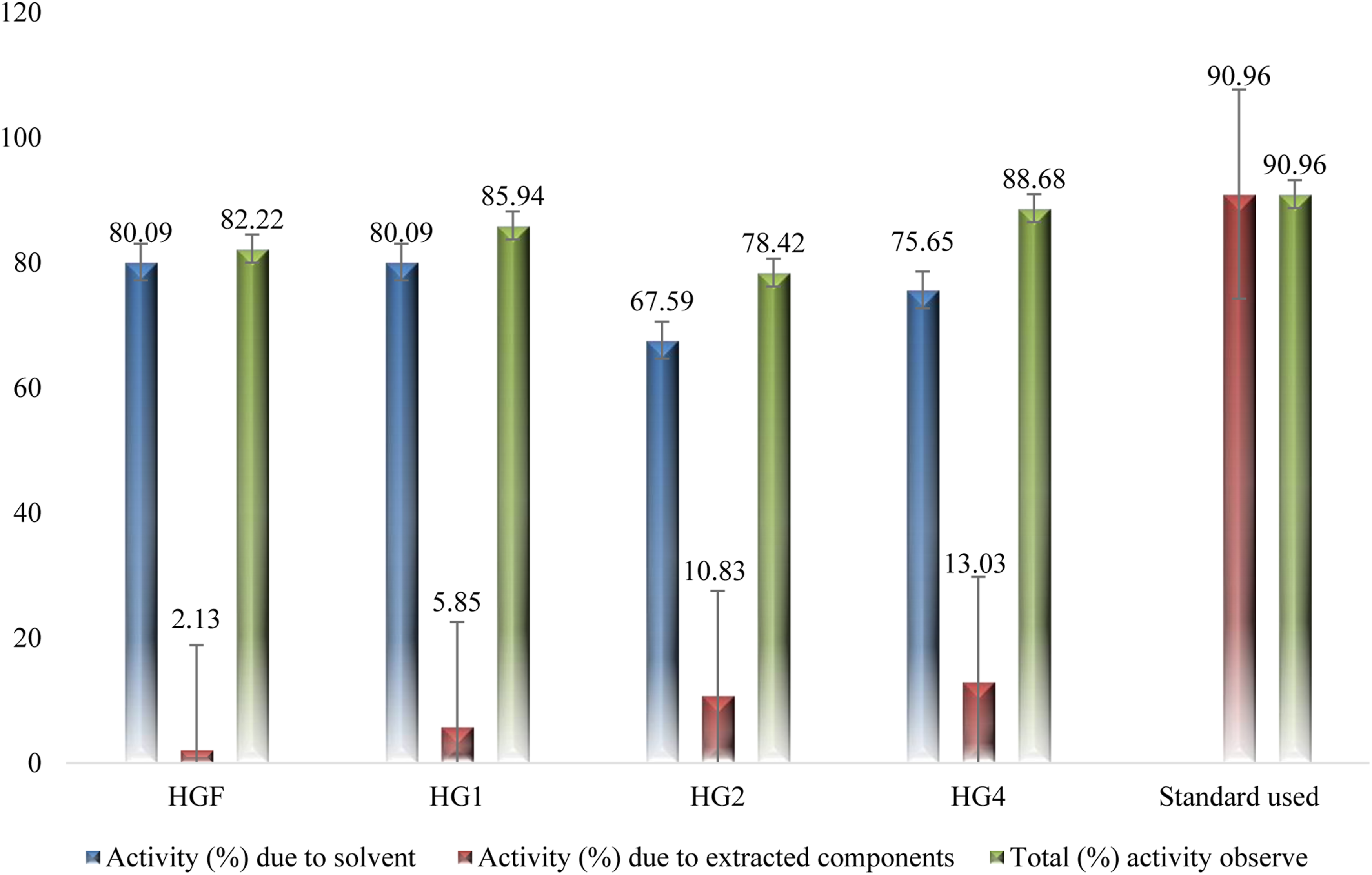
Total Flavonoids and Phenolic Contents
According to the results that were shown by H griffithii, the maximum percentages of total phenolic potential and of total flavonoid potential expressed by ethyl acetate fraction were 1.50 ± .42 and 1.19 ± .05, respectively, while lowest percentages of total phenolic (.74 ± .05) for essential oil and of total flavonoids (.52 ± .01) for ethanol, respectively, were obtained. The consequences are summarized in Figure 4. Percentage of TFC (Total flavonoid content; blue dots) and TPC (Total phenolic content; dark red spot).
Antimicrobial Activity by Disc Diffusion Method
The antimicrobial activity of the plant H griffithii was measured using disc diffusion. The genus Haloxylon was traditionally used as medicine and potential source of antimicrobial complexes. Disc diffusion method is used to estimate the antimicrobial potential of H griffithii. Positive results were presented by bacterial and fungal strains as shown in Figure 5. Antimicrobial activity of H. griffithii against microorganism. Inhibition was measured in diameter.
Minimal Inhibitory Concentration
The growth of microbes that could be hold back by minimum inhibitory concentration (MIC) showed that essential oil and ethyl acetate fraction respond well against bacterial strain, while fungal strains are inactive against fixed oils and ethyl acetate fractions. The antimicrobial results were exactly opposite to the MIC as shown in Figure 6. Minimum inhibitory concentration to check better response against bacteria or fungus.
Anti-Urease Activity
Anti-urease activity of H. griffithii.

Discussion
Medicinal plants are playing important role in public health and raising the life standards of human for many years. Medicinal plants contain natural bioactive compounds that lessen illness and increased health. The aim of the present study was to evaluate the bioactive analysis and therapeutic potential of essential oil and fixed oil isolated from H. griffithii from the family of chenopodiaceae. Bioactive compounds isolated from natural products are not only a good source of therapeutic potential but also an excellent alternative of synthetic medicines with cluster of side effects. 22 Phytochemical and pharmacological potential of H. griffithii essential oil, fixed oil, and fractions were evaluated. As per yield, ethanol fraction offered maximum yield (7.5452 g) while essential oil had minimum yield (.06 g). Our results showed the percentage of total phenolic contents was maximum presented by ethyl acetate fraction (1.50%) and minimum TPC obtained in the essential oil (.74%), this shows low concentration of phenolic contents by essential oil. The % of total flavonoids contents are minimum by the ethanol fraction (.52%) while it is maximum from ethyl acetate, it revealed the presence of maximum flavonoids from the ethyl acetate fraction and to be served in many ways at industrial and clinical level. The results from the quantitative analysis showed significant variations among the contents of alkaloids, flavonoids, and saponins. These variations are due to a number of environmental factors such as climate, altitude, and rainfall. Decadal variation in the heat and cold waves got over in India during 1971-2000. 23 From the literature survey it was found that alkaloids, flavonoids, and phenolic compounds show anti-diabetic properties, anti-inflammatory, anti-bacterial, anti-viral, anti-allergic, and antioxidant effects. Flavonoids are also used in the treatment of neurodegenerative diseases and have a vasodilator action. 24
Investigation of antioxidant potential revealed that this plant has good antioxidant capability. TFC, the antioxidant potential was directly the free radical scavenging or % inhibition. 25 Their potential of components and solvents tested separately and maximum results for the ethanol fraction was observed. Ethanol fraction having maximum potential of antioxidants 26 also clarified that the amount of phenolic compounds increase in the test sample as the scavenging rate is boosted. The redox reaction properties are a major cause of antioxidant activity of phenolic compounds. TFC and TPC have antioxidant capability because of their e-donating ability of H2 and stable radical intermediates. 27 The absorption and neutralization of free radicals, the decomposition of peroxide and reduction (singlet and triplet) is mainly due to these phenolic compounds. Phenolic components constitute (ascorbic acid, nitrogen compounds, and carotenoids obtained from herbs and fruits. 28
The antimicrobial potential was also investigated against 4 bacteria (two gram positive and two gram negative) and it showed that CHCl3 fraction was high potency against gram positive bacteria. But ethanol was active against gram negative ethanol and fungus. The genus Haloxylon was traditionally used as medicines and potential sources of antimicrobial agents. The potential against urease test is presented by extracts and fraction of the plant H. griffithii was good. The maximum potential was shown by ethyl acetate fraction and minimum was by its fixed oil. Maximum activity was observed by the ethanol fraction and minimum activity was shown by the ethyl acetate fraction that is (.92). While the essential oil and n-hexane fraction present no potential for the anti-urease test. The results presented show complete information of the anti-urease activity of the plant. The potential of H. griffithii against microorganisms like bacteria and fungi was also evaluated and comparable results were obtained in disc diffusion method and mic. 2
The GC/MS analysis of H. griffithii isolated essential oil and fixed oil recognized about 23 and 27 potential bioactive compounds, respectively. Best antioxidant activity of fixed oil is due to the presence of hexadeacanoic acid, methyl ester analyzed by GCMS. As literature reported hexadeacnoic acid, methyl ester as effective anti-inflammatory, antioxidant, and antimicrobial agent. 29 These findings provide molecular insight of the mechanisms by which heptadecane exerts its anti-inflammatory effect in aged kidney tissues, heptadecane suppresses age-related increases in pro-inflammatory gene expressions then travel upstream set by step by reducing NF-kB activity by down regulating the NIK/IKK and MAPKs pathways induced by RS. 30 A high concentration of 1,2-benzene dicarboxylic acid mono (2-ethylhexyl) ester contributed to the antifungal activity of the endophytic fungi, Aspergillus flavipes strain. 31 The antifungal activity in fixed essential oil is due to the presence of 1,2-benzene dicarboxylic acid mono (2-ethylhexyl) ester.
The aim of this study is to highlight the importance of H. griffithii as a medicinal plant and indicate its potential utilization in pharmaceuticals. As this plant is not well known reported therefore our group will start working by evaluating plants for antimicrobial, anti-urease, and antifungal analysis which showed their potential.
Conclusion
Medicinal plants are globally getting attention towards various alarming disorders due to their extensive therapeutic effects and safety concerns. Current study was performed for evaluation of phytochemical analysis as well as therapeutic potential like antimicrobial, antioxidants, and anti-urease activity of H. griffithii. H. griffithii contains many important bioactive compounds which are well studied for their therapeutic effects. GC/MS analysis of fixed oil and essential oil revealed the presence of variety of useful bioactive compounds in the plant which has been reported in the literature with strong pharmacological potential. At the end, H. griffithii proved a suitable alternate of synthetic drugs for cure of various illness without side effects.
Footnotes
Declaration of conflicting interests
The author(s) declared no potential conflicts of interest with respect to the research, authorship, and/or publication of this article.
Funding
The author(s) received no financial support for the research, authorship, and/or publication of this article.
